
A Guide to the Modern Commercial Banker Lead Gen Tool
Brian's Banking Blog
In commercial banking, a modern lead gen tool is no longer a discretionary upgrade; it is a core component of any credible growth strategy. These platforms move banks beyond outdated lead lists, using data intelligence to identify, qualify, and prioritize the most valuable commercial prospects. The objective is to transform an expensive, time-consuming process into an efficient engine for portfolio growth.
Why Traditional Lead Generation Is Failing Commercial Banks
The cost of acquiring a new commercial banking relationship has become a significant strategic liability. For decades, the playbook has remained static: reliance on personal networks, high-volume cold calling, and broad marketing campaigns with low conversion rates. This approach is fundamentally misaligned with a market where decision-makers are more sophisticated and insulated than ever.
The core issue is inefficiency. Bankers are expending their most valuable resource—time—pursuing leads with a low probability of conversion, while high-value opportunities remain unidentified. This is not a failure of effort but a failure of tools. Without actionable, data-driven insights, prospecting is a speculative exercise that erodes margins and jeopardizes growth targets.
The Escalating Costs of Outdated Methods
The financial impact of this inefficiency is substantial. Within the broader market, financial services consistently report among the highest lead generation costs. The average cost per lead (CPL) is $653, a figure that significantly outpaces the all-industry average of $198.44.
The return on this investment is equally concerning. Traditional outbound methods like cold calling yield a mere 1.7% close rate. In contrast, data-informed inbound strategies achieve a 14.6% close rate. The data is unequivocal. For a deeper analysis, these lead generation performance benchmarks illustrate the stark disparity.
This economic pressure demands a strategic pivot. Banks cannot sustain the practice of allocating significant capital to activities with such demonstrably poor returns. The focus must shift from volume to value and from brute force to precision.
The real liability isn't just the cost per lead; it's the opportunity cost of every high-value relationship your bankers miss while pursuing unqualified prospects. An effective lead generation tool directly addresses this by reallocating your most valuable asset—your bankers' time—to the opportunities that matter.
A modern lead gen tool inverts the traditional model. Instead of casting a wide, expensive net, it uses data intelligence to pinpoint businesses that not only fit a bank's ideal client profile but are also exhibiting clear indicators of an immediate need for banking services.
This is accomplished by identifying signals such as:
- Trigger Events: A company secures a new round of funding, announces a major expansion, or files a UCC indicating a significant equipment purchase.
- Relationship Mapping: Uncovering pre-existing connections between a bank's board members or employees and high-potential prospects.
- Predictive Analytics: Scoring potential leads based on financial health, industry growth trends, and other key indicators of conversion probability.
Arming your team with these data-driven signals transforms the nature of their outreach. Conversations become relevant and informed. The objective is no longer simply to find leads but to initiate strategic discussions that mature into profitable, long-term banking relationships. To compete effectively, banks must benchmark current acquisition costs against the measurable returns of a data-driven strategy.
Anatomy of a Modern Commercial Banker Lead Gen Tool
The era of static lead lists and rudimentary databases is over. A modern lead gen tool is not a digital directory; it is an active intelligence system engineered to identify real-time opportunities with precision.
For bank executives, understanding the components of these tools is critical to distinguishing between a genuine growth engine and a recurring software expense. The platform's value is not in providing company names and phone numbers. Its power lies in synthesizing multiple, disparate data streams into a single, actionable view. This capability fundamentally changes the prospecting equation—moving from who to call to when and why that call will be impactful.
Core Component 1: Market and Financial Data Integration
The foundation of any effective lead gen tool is its data architecture. This is not basic firmographic data but a dynamic synthesis of public records and proprietary sources that provides a comprehensive market narrative.
- Financial & Regulatory Data: This includes foundational sources such as FDIC call reports, NCUA 5300 filings, and SEC disclosures, offering a clear view of a prospect's financial stability, existing banking relationships, and credit facilities.
- Trigger Event Data: These are real-time indicators of opportunity, including UCC filings, SBA loan data, or M&A announcements. For example, a $2,500,000 UCC-1 filing for new machinery is not just a public record; it is a clear signal of expansion and an immediate financing need.
- Macroeconomic & Industry Data: Integrating broader indicators from sources like the Bureau of Labor Statistics provides essential context, enabling the identification of growth trends in specific sectors and a deeper understanding of a prospect's operating environment.
By integrating these sources, the tool provides bankers with a 360-degree view of a prospect before the first contact is made, ensuring that the initial conversation is immediately relevant.
Core Component 2: Relationship Intelligence
Beyond financial metrics, commercial relationships are built on human connections. A modern tool quantifies these connections by mapping the network of individuals behind the businesses, uncovering pathways to key decision-makers.
For instance, a banker might discover that a member of their own board also serves on the board of a top manufacturing prospect. This insight transforms a cold call into a warm introduction, dramatically increasing the probability of securing a meeting. This systematically solves the perennial challenge of gaining access to the right people.
This is where the traditional model fails completely.
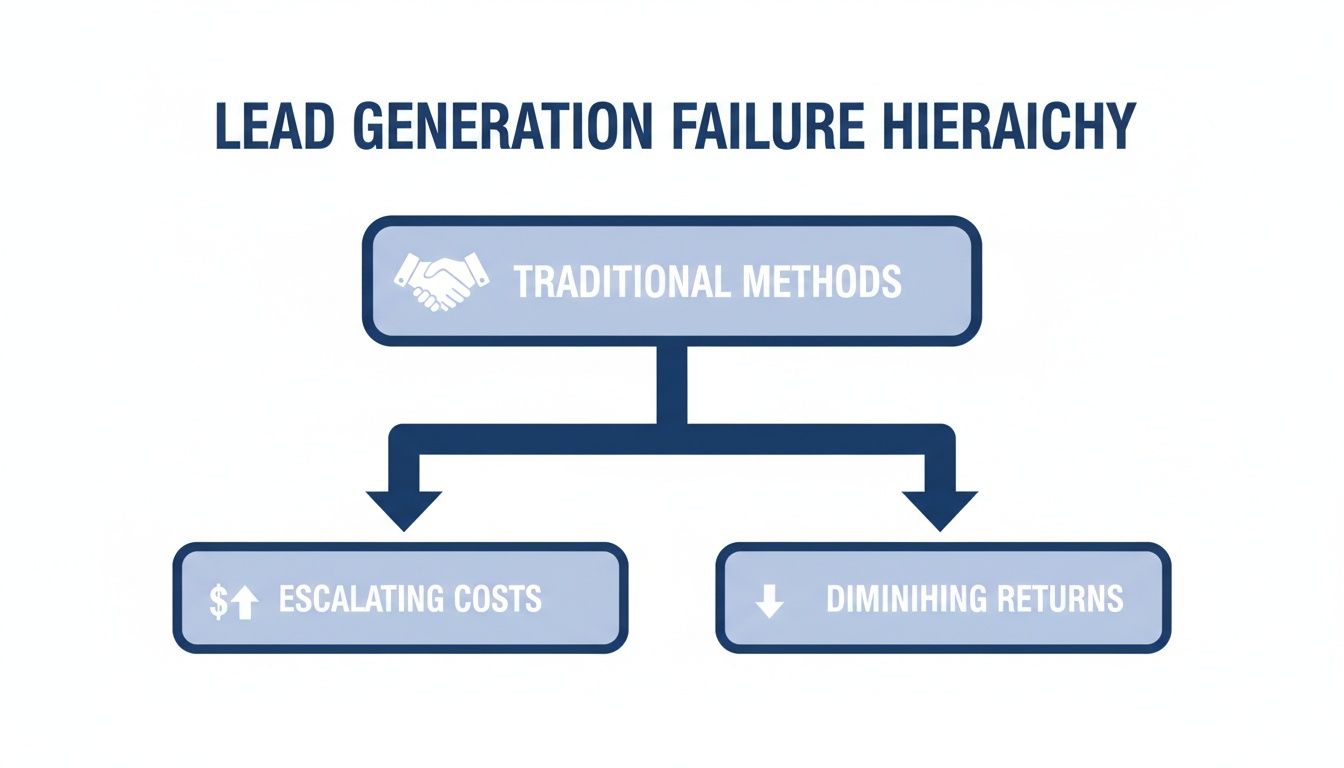
As illustrated, adherence to outdated, non-data-driven methods leads directly to escalating costs and diminishing returns, an unsustainable trajectory for any financial institution.
Core Component 3: CRM Synchronization and Workflow Automation
A powerful tool cannot operate in a silo. Seamless integration with a bank’s CRM (e.g., Salesforce, nCino) is a mandatory requirement. Intelligence must flow directly into the platforms bankers use daily, eliminating manual data entry and enriching existing client profiles with new insights.
A lead gen tool shouldn't be another password for your team to remember. It should be the intelligence layer that makes their current workflow smarter by automatically pushing prioritized leads and conversation starters right into their pipeline.
This is what converts raw data into action. When the system identifies a significant opportunity—such as a local technology company closing a $10,000,000 funding round—it should automatically generate a new lead in the CRM and assign it to the appropriate banker, ensuring no opportunity is missed. Modern bank prospecting software is purpose-built for this function.
The evolution from traditional methods to a modern, data-driven approach is not merely an upgrade; it is a complete re-architecture of the commercial banking growth model.
Evolution of Commercial Banking Lead Generation
This table outlines the practical differences between legacy and modern approaches and the corresponding impact on executive-level objectives.
| Capability | Traditional Approach | Modern Data-Driven Tool | Executive Impact |
|---|---|---|---|
| Lead Sourcing | Buying static lists, cold calling, manual research | Dynamic identification based on real-time trigger events (e.g., M&A, financing) | Shifts focus from quantity to quality, dramatically increasing conversion rates. |
| Prospect Intel | Basic firmographics (size, industry, location) | Deep financial health, existing banking relationships, credit needs | Empowers bankers to lead with value and insight, not a generic sales pitch. |
| Relationship Path | Guesswork, "who do you know" in meetings | AI-driven mapping of connections between your bank and the prospect | Shortens sales cycles by turning cold calls into warm, high-impact introductions. |
| Workflow | Manual data entry, disconnected systems, missed opportunities | Automated CRM integration, prioritized lead delivery, real-time alerts | Boosts banker productivity, ensures accountability, and guarantees follow-up. |
This shift translates directly to a more strategic, efficient, and profitable commercial banking operation.
Ultimately, a superior tool is distinguished by its ability to connect disparate data points, uncover latent relationships, and automate the delivery of intelligence. The result is a prospecting process that is not just more efficient, but fundamentally smarter—enabling your bankers to operate with the confidence and precision required to win deals.
Building Your Inbound Engine with Content and SEO
In many executive suites, "content marketing" is still dismissed as a marketing function with ambiguous ROI. This perspective represents a significant strategic oversight.
An inbound marketing engine, driven by strategic content and rigorous search engine optimization (SEO), is one of the most powerful and cost-effective methods for attracting high-value commercial clients. It reverses the traditional dynamic: instead of the bank pursuing prospects, businesses with an active financial need seek out the bank.
This is not about producing generic blog posts. It is about creating strategic assets: detailed white papers on industry-specific financing for regional manufacturers, or data-backed analyses of local economic trends. This is content that captures the attention of decision-makers and establishes the bank as a definitive expert in its market. It directly answers the complex questions that CFOs and business owners are already asking search engines.
From Cold Calls to Qualified Inquiries
The transition from an outbound to an inbound model fundamentally alters the economics of client acquisition.
Consider this scenario: Your bank publishes a comprehensive guide on equipment financing for the logistics sector, optimized for relevant search terms. A CFO at a regional distribution company discovers the guide, recognizes its value, and submits an inquiry to speak with a banker.
This lead is orders of magnitude more valuable than one generated via a cold call. The prospect is already educated on the subject, has a self-identified need, and perceives the bank as a credible authority.
This completely changes the first conversation. Instead of your banker having to build trust from scratch, they walk into a discussion where the prospect already views them as a trusted advisor. That’s how you shorten sales cycles and boost your close rates.
The data corroborates this. In commercial banking, content marketing is the leading channel for lead generation, responsible for over 51.5% of leads, far surpassing paid social (14.9%) and paid search (11.9%). Furthermore, 35% of high-scoring leads originate from SEO and convert at an impressive 14.6% rate. These powerful B2B lead generation statistics confirm the effectiveness of this approach. An inbound engine is a durable asset that generates continuous returns.
Using Data to Drive Content Strategy
An inbound strategy is effective only when its content is precisely targeted. Producing articles without a data-backed plan is as inefficient as traditional mass-marketing tactics. Market intelligence platforms are essential for informing this strategy.
A modern commercial banker lead gen tool provides the necessary intelligence to move beyond guesswork. These platforms enable your team to identify:
- Key prospect challenges: Analysis of UCC filings, SBA loan data, and industry reports reveals the specific financing and operational challenges businesses in your target sectors are currently facing.
- Competitive gaps: Data can illuminate topics and service areas your competitors are neglecting, creating a clear opportunity to establish thought leadership.
- Prospect language: Understanding the specific terminology and questions CFOs use in their search for financial solutions allows you to create content that resonates and attracts organic traffic.
For example, data from a platform like Visbanking might reveal a surge in UCC filings for renewable energy equipment in your market. This is a direct signal to develop a definitive guide on financing green energy projects. Your content is no longer just well-written; it is strategically timed to meet a measurable market demand. This is the core principle of effective digital marketing for banks—aligning your message with data-verified market needs.
By building this inbound engine, you create a durable, long-term asset. Each strategic piece of content works 24/7 to attract, educate, and convert high-value clients, reducing your reliance on expensive and inefficient outbound tactics.
Using Digital Channels for High-Value Prospecting
For elite commercial bankers, social media platforms are not for personal networking; they are critical sources of market intelligence. Leading banks now utilize digital channels, particularly LinkedIn, as a central component of their intelligence-driven prospecting operations. This is not passive profile viewing but an active, systematic monitoring process.
A modern commercial banker lead gen tool integrates with these channels, maintaining an automated watch on target companies and their key executives. This is where data becomes action. The system is not flagging arbitrary updates; it is specifically calibrated to identify trigger events—real-world business developments that signal an immediate need for banking services.

From Signal to Engagement
This approach transforms prospecting from a high-volume, low-return numbers game into a precise, targeted operation. Instead of speculating on who might be receptive to a call, bankers receive specific, data-backed alerts about current business activities.
Consider a relationship manager responsible for a portfolio of 100 high-potential manufacturing companies. Manually tracking each for significant developments is an impossible task. With the right lead gen tool, this process becomes automated and highly precise.
The goal is to give your bankers a reason to call that is so relevant and timely, the conversation feels less like a sales pitch and more like a strategic consultation. This is how you go from interrupting a prospect's day to becoming a valuable part of it.
The system could, for example, generate an instant alert when the CFO of a target company announces on LinkedIn the closing of a new private equity funding round. This alert represents a pre-qualified opportunity, providing the banker with a specific, compelling reason to engage and fundamentally changing the dynamic of the initial conversation.
Leveraging Trigger Events for Pipeline Growth
The true power of this methodology lies in directly connecting digital signals to measurable pipeline growth. An effective tool will be tuned to detect a range of high-value trigger events, including:
- Executive Hires: The appointment of a new CFO or Head of Operations presents a prime opportunity to establish a relationship while existing financial partnerships are under review.
- Expansion Announcements: Plans to open a new facility or enter a new market almost invariably signal a need for commercial real estate financing or expanded treasury services.
- Funding and M&A Activity: A merger, acquisition, or significant capital raise indicates a company in transition, actively seeking banking solutions to support its new structure.
The data strongly supports this focus. In the B2B context, LinkedIn is the dominant platform, with research indicating that 80% of social media leads originate there. A full 62% of marketers state it generates more than double the leads of any other social network. In commercial banking, where a single high-value relationship can define a fiscal quarter, these metrics are paramount. Further details on how digital platforms drive lead generation underscore this point. The objective is not to collect contacts but to identify opportunities with clear intent.
Quantifying the Return on Intelligence
The ROI from this intelligence-led approach is clear and quantifiable. Revisit the relationship manager monitoring 100 prospects. Over a single quarter, the tool identifies 15 high-quality trigger events.
If just 20% of the subsequent targeted outreach efforts convert to qualified meetings (three meetings), and one of those meetings results in a new $5,000,000 commercial relationship, the system has delivered a substantial return on investment. Equally important, it has saved the banker hundreds of hours that would have been wasted on low-probability cold calls, freeing them to focus on high-value relationship management.
This methodical, data-first approach to digital prospecting is no longer a niche tactic. For any bank serious about growth, it is the new operational standard.
Executing a Data-First Lead Generation Strategy
Acquiring a powerful commercial banker lead gen tool is a critical first step, but the platform alone does not generate returns. Value is unlocked through the implementation of a disciplined strategy that integrates the tool into the bank's operational fabric.
For bank executives, this requires leading a cultural shift from traditional, relationship-based prospecting to a modern, intelligence-driven growth model.
Success is not achieved by merely providing bankers with new software. It requires a complete re-engineering of the client acquisition process, demanding clear protocols, shared metrics, and a top-down commitment to data integrity. Without this framework, even the most sophisticated tool becomes an underutilized asset.
Tearing Down the Wall Between Sales and Marketing
The traditional separation between sales and marketing must be eliminated. In a data-first model, both teams are accountable for the same performance metrics, tracking a prospect's journey from initial contact to closed deal. This alignment is non-negotiable for achieving a meaningful ROI.
Key shared metrics should include:
- Lead-to-Opportunity Conversion Rate: This KPI measures the quality of leads generated by the tool. A low rate—for instance, below 5%—indicates a misalignment between your ideal client profile and your targeting criteria, necessitating recalibration.
- Pipeline Velocity: This tracks the speed at which opportunities move through the sales cycle. A measurable increase in velocity demonstrates that data-driven insights are shortening the path to revenue.
- Average Deal Size: Comparing the size of deals sourced through the platform against those from traditional methods provides quantitative justification for the technology investment.
When both teams are focused on these outcomes, marketing delivers actionable intelligence and sales executes with precision. This synergy is the foundation of any successful lead generation for banks program, elevating it from a marketing function to a core business process.
Mandating CRM Discipline and Clean Data
Your CRM is the central nervous system of your growth strategy. Inaccurate or incomplete data will compromise the effectiveness of any integrated lead generation tool. Maintaining data hygiene is not an administrative task; it is a strategic imperative.
A lead generation platform is an amplifier. It will amplify good data practices into exceptional results, or it will amplify poor data practices into costly inefficiencies and missed opportunities. There is no middle ground.
The rollout of a new tool must be accompanied by strict protocols for CRM usage. This includes non-negotiable standards for data entry, regular updates on client interactions, and consistent tracking of lead status. This discipline ensures that the intelligence from your tool feeds a reliable system, creating a virtuous cycle of sharper targeting and enhanced insights.
Prove the Value with a Pilot Program
Attempting a bank-wide, "big bang" implementation of new technology often invites resistance and failure. A more prudent approach is to conduct a controlled pilot program with a small, selected team of motivated, tech-savvy commercial bankers. This creates an ideal environment to demonstrate the tool's value and cultivate internal advocates.
For example, select a team of five bankers and assign them a specific mandate: target mid-market manufacturing firms with revenues between $20,000,000 and $100,000,000. Track their performance rigorously for 90 days.
When that team demonstrates a 25% increase in qualified meetings and secures two new significant relationships, you have a powerful internal case study. This hard evidence neutralizes skepticism. Adoption shifts from a top-down mandate to a pull-based demand from other bankers who see the results and desire the same competitive advantage. You have proven why the tool is valuable—not just how it functions, but how it enables them to win more business with less wasted effort.
Measuring Success and Demanding Results from Your Tools
The acquisition of a lead generation tool is not an IT expenditure; it is a capital investment. As such, it must be subjected to the same rigorous performance scrutiny as any other asset in your portfolio.
For bank executives, the discussion must move beyond anecdotal success stories to a dashboard of quantitative metrics that prove the tool is generating a positive financial return.
Accountability is paramount. The number of leads generated is a vanity metric; it is irrelevant to bottom-line performance. True performance is measured by tangible impacts on profitability and market position.
A Framework for Executive Oversight
Leadership must review a concise performance dashboard on a quarterly basis. This is not optional. The report must track the metrics that matter, providing an objective assessment of whether the technology is delivering on its promise.
Your dashboard should answer three fundamental questions:
- Are we acquiring clients more efficiently? The primary KPI is Cost Per Acquired Client (CPAC). If the CPAC for relationships sourced through the tool is not 20-30% lower than via traditional methods within the first year, a strategic review is warranted.
- Are we closing deals faster? Track Sales Pipeline Velocity. A successful tool will shorten the time from initial contact to a closed deal, demonstrating that data-driven insights are accelerating revenue recognition.
- Are we landing better deals? Analyze the Average Deal Size from tool-sourced leads versus other channels. A core objective of such a platform is to identify larger, more complex, and ultimately more profitable relationships aligned with the bank's strategic goals.
The ultimate test for any lead generation platform is simple: does it deliver sustained, profitable growth to the portfolio? If the data doesn't clearly show a positive impact on your efficiency, velocity, and deal quality, the investment has failed.
This level of scrutiny requires more than a software purchase; it demands a cultural commitment to making growth decisions based on objective, verifiable data.
To truly understand performance, you must look beyond your own institution. How do your client acquisition costs or pipeline velocity compare to your peers? Market intelligence platforms like Visbanking are essential for providing the competitive benchmarks required to gauge your true market performance.
Examine our data to see how your results compare and to identify your next significant growth opportunity.
Got Questions? We've Got Answers.
Adopting a data-first growth model invariably raises important questions from bank leadership. Here are the most common inquiries we address when executives evaluate a modern commercial banker lead gen tool.
How Will This Tool Talk to Our Existing CRM?
The connection is best described as a strategic partnership. Modern lead generation platforms are architected for seamless integration with major CRMs like Salesforce and nCino, typically via APIs.
This creates a two-way data flow. The tool injects fresh, qualified leads and market intelligence into your CRM. In turn, your CRM data refines the tool's scoring and prioritization models to better align with your bank's ideal client profile. The result is a unified system that eliminates manual data entry and ensures bankers are operating with the most current intelligence within their primary workspace.
This integration transforms your CRM from a passive repository into an active, intelligent growth engine, ensuring no high-value opportunity is overlooked.
What Kind of ROI Should We Actually Expect?
While results vary by institution, leading banks are achieving significant returns. Key performance indicators to monitor include a 20-30% reduction in Cost Per Lead, driven by a sharpened focus on high-probability prospects, and a 15-25% increase in lead-to-opportunity conversion rates. Superior targeting yields superior outcomes.
A well-implemented tool should generate a positive return on investment within 12 to 18 months, often by securing just a few key commercial relationships that would have otherwise been missed. The most significant ROI, however, is the establishment of a sustainable, profitable growth model and a durable competitive advantage.
The payback isn't just about saving money. It's about giving your bankers back their most valuable asset—time—so they can stop chasing dead ends and start building the high-value relationships that drive revenue for years to come.
How Do We Get Our Bankers to Actually Use This Thing?
User adoption hinges on a single principle: proving to bankers that the tool makes their work easier and helps them exceed their goals. It must be positioned not as another required software, but as a competitive weapon.
A successful adoption strategy includes these elements:
- Start with a pilot. Launch with a team of champions. Their early successes will create internal case studies and generate demand from other teams.
- Provide practical training. Focus training on how the tool solves real-world prospecting challenges and integrates into their existing workflow, not just on software features.
- Align with incentives. Integrate tool-related metrics into performance reviews and compensation structures. This creates accountability and rewards data-driven prospecting.
Once your team sees the platform delivering pre-qualified leads enriched with actionable insights—saving them hours of unproductive effort—adoption will cease to be a concern. They will view it as an indispensable part of their toolkit.
The best way to know where you can go is to see where you stand. Visbanking is the data intelligence platform that not only helps you find your next best commercial client but also shows you how you stack up against the competition. See our data for yourself at https://www.visbanking.com.
Related Articles

Visbanking Blog
Fastest Growing Banks by Loan Volume

Visbanking Blog
Revolutionize Your Banking Operations with Data-Driven Insights from BIAS

Visbanking Blog
Banking Data Analytics: Turning Information Into Profit

Visbanking Blog
In our rapidly evolving digital age, traditional banking models are being overturned

Visbanking Blog
In the world of banking, digital transformation is no longer a 'nice-to-have'. It's a necessity

Visbanking Blog