
Top Challenges in the Banking Sector Today
Brian's Banking Blog
Navigating the modern banking landscape requires a clear-eyed strategy grounded in unified intelligence. Executives and board members are contending with compressed margins, relentless fintech competition, significant portfolio risks, and a complex regulatory environment. Addressing these challenges in silos is no longer a viable option; an integrated, data-driven approach is essential for stability and growth.
The New Reality For Banking Leadership
For executives and board members, this is not just another business cycle. It is a defining moment where access to precise, actionable data separates market leaders from the laggards. Generic industry reports are insufficient. What is required is a real-time, granular understanding of the critical pressures shaping your institution and a clear strategy to address them. Banks that effectively translate raw data into decisive action will convert these challenges into competitive advantages.
It is time to move beyond historical assumptions and embrace a framework grounded in forward-looking intelligence. Proactive decisions, based on a clear view of the market, are paramount to protecting your bank's stability and driving sustainable growth.
It’s All Connected
Viewing these challenges as discrete issues is a critical error. An institution’s inability to innovate digitally, for example, directly impairs its capacity to attract top-tier talent and defend its margins against agile fintech competitors. Similarly, new regulatory mandates often necessitate significant technology investments, placing immense pressure on operating budgets.
This chart illustrates the interconnected nature of these forces and underscores why data-driven leadership is central to a successful strategy.
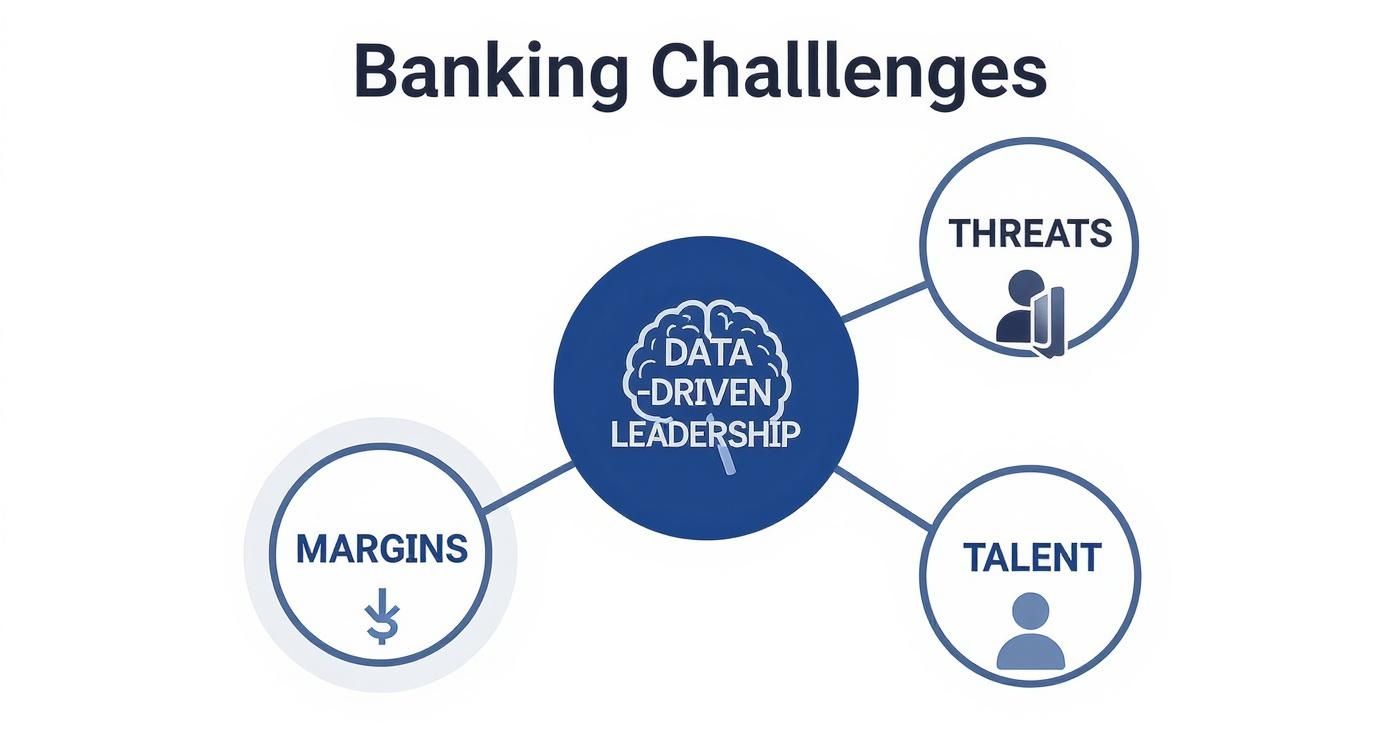
The primary takeaway for any executive is this: the only effective method for managing this complex web of risks and opportunities is a centralized strategy built on robust, clean data. Such a strategy connects the dots between margin pressure, competitive threats, and your talent pipeline.
Stop Reacting and Start Strategizing
Historically, banks could afford to address problems reactively. The current pace of change renders that approach obsolete.
Consider a community bank with $2,500,000,000 in assets. A sudden 25-basis-point drop in its Net Interest Margin (NIM) could eliminate millions in net income. Concurrently, a new online lender could be eroding its local small business loan market share. The cost of being the last to know is unacceptably high.
Leadership’s primary function has evolved. It is no longer sufficient to manage risk; the mandate is to anticipate it. This requires a shift from analyzing historical reports to acting on forward-looking intelligence. Otherwise, you are perpetually managing yesterday's outcomes.
The first step is a comprehensive, objective assessment of your institution’s position. This extends beyond internal metrics; it requires benchmarking against your true peer group in real-time. For a deeper examination of this principle, our guide on financial digital transformation details how banks can build a decisive competitive edge.
To visualize how these challenges translate into actionable strategies, here is a concise breakdown:
Key Banking Challenges and Data-Driven Responses
This table summarizes the core pressures banks face and how a data-first methodology provides a clear path forward.
| Challenge Area | Primary Impact on the Bank | Data-Driven Strategic Response |
|---|---|---|
| Margin Compression | Squeezed profitability and reduced Net Interest Margin (NIM). | Benchmark deposit and loan rates against true peers to identify pricing opportunities and protect margins. |
| Digital Competition | Loss of market share to agile fintechs and neobanks. | Analyze competitive product offerings and customer acquisition trends to inform digital strategy and innovation. |
| Regulatory Burden | Increased compliance costs and operational strain. | Use performance data to justify strategic investments and model the impact of regulatory changes on capital and liquidity. |
| Cybersecurity Threats | Reputational damage and significant financial loss from breaches. | Monitor industry-wide security investment trends and benchmark IT spending to ensure adequate defense posture. |
| Talent Gap | Difficulty attracting and retaining skilled professionals, especially in tech and data roles. | Analyze compensation and productivity metrics against peer banks to create competitive hiring and retention packages. |
By leveraging the right analytics, bank leaders can model the impact of market shifts before they occur, benchmark operational costs with surgical precision, and identify growth opportunities that competitors overlook.
This is what it means to turn a challenge into an advantage. It begins with a commitment to mastering your data.
Protecting Profitability in a Low-Margin Era
Protecting bank profitability is a formidable challenge. Macroeconomic forces, from fluctuating interest rates to decelerating economic growth, are exerting relentless pressure on net interest margins (NIMs)—the core engine of a bank's earnings.

This is not an abstract boardroom discussion. For a community bank with a $2,500,000,000 asset portfolio, a mere 25-basis-point decline in NIM can erase millions in annual net income. In an environment where every basis point is contested, intuition and historical precedent are no longer sufficient guides.
Compounding these external pressures are internal operational inefficiencies. The banking industry faces a paradox: despite massive technology expenditures, corresponding productivity gains have often failed to materialize. This disconnect is a significant part of the profitability challenge.
Banks are spending an estimated $600,000,000,000 annually on technology, yet industry-wide productivity growth remains muted. This signals a reversion to mean performance after a few peak years, indicating that digitization efforts are not consistently delivering their intended impact.
In this environment, broad-stroke strategies are ineffective. Surgical precision is required. Bank executives must move beyond high-level dashboards and legacy assumptions to understand the true drivers of profitability. The only way to achieve this is with actionable, granular intelligence.
From Data Overload to Decisive Action
The solution is not simply more data; it is the capability to convert vast datasets into clear, decisive actions that protect the bottom line. A data-driven approach is no longer a luxury—it is the most critical asset for modern leadership.
Imagine moving beyond reacting to last quarter's performance report to modeling market shifts in real-time. What is the precise impact of a Federal Reserve rate hike on your funding costs compared to your closest competitors? How would a 10% decline in commercial real estate values in your primary lending area affect your capital ratios?
Answering these questions is impossible without a unified view of your performance, benchmarked against the correct peer group.
A Practical Framework for Margin Protection
This is where a data intelligence platform like Visbanking provides the tools to move from analysis to action. It empowers your teams to:
- Benchmark Operational Costs: Pinpoint exactly where non-interest expenses exceed those of peer banks with a similar size, asset mix, and geographic footprint. A 5% reduction in operating costs, for instance, could be equivalent to adding 10 basis points to your NIM.
- Identify Underperforming Assets: Isolate specific loan segments or products that are diluting profitability. This enables targeted actions, from repricing to reallocating capital toward higher-yield opportunities.
- Model Pricing Adjustments: Run simulations to forecast the balance sheet impact of changes in deposit rates or loan pricing before implementation. This foresight allows you to remain competitive without sacrificing margin.
This level of detail gives leadership the confidence to make proactive decisions with direct bottom-line impact. It is also the key to mastering one of your most important metrics. To delve deeper, review our guide on how to manage your bank's net interest income in this environment.
Ultimately, navigating a low-margin era is an exercise in control. By leveraging granular data, bank leaders can gain a precise understanding of their institution's financial DNA. This clarity enables a shift from reacting to the market to actively managing profitability, transforming a formidable industry challenge into a distinct competitive advantage.
Winning Against Digital Transformation and Fintech Competition
Many bank executives invest heavily in technology yet struggle to realize a tangible competitive edge. It is a common frustration: attempting to modernize legacy systems internally while nimble fintechs systematically capture market share from the outside.
Simply increasing technology budgets is not the solution.

These new entrants are surgically unbundling banking services, targeting high-margin niches and fundamentally resetting customer expectations for digital experiences. Their success serves as a critical wake-up call for the entire industry.
Consider small business lending. A fintech can leverage alternative data to approve and fund a loan in hours. A traditional bank, by contrast, may remain encumbered by a weeks-long, paper-intensive process. This is not an incremental improvement; it is a fundamental disruption of the competitive landscape.
Shifting from Digital Spending to Strategic Wins
The solution is not to outspend every fintech on every new technology. The strategic victory lies in shifting the objective from "going digital" to leveraging technology to win specific market battles. This requires a different class of intelligence—one that extends beyond the institution's own walls.
Effective leadership demands answers to critical questions:
- Which specific fintechs are gaining traction in our core lending segments?
- What product features are they deploying to attract our most profitable customers?
- Which customer niches are we failing to serve with our current digital offerings?
Answering these questions confidently requires precise, external data. Imagine a $5,000,000,000 bank observes a 10% quarterly dip in mortgage applications. The easy explanation is a slowing economy. But what if the data reveals that a new digital mortgage broker has captured 15% of the local market with a superior online closing process? Without that intelligence, you are operating blind.
The objective is not digital transformation for its own sake. It is targeted innovation that protects market share and unlocks new revenue streams. Success is measured not by IT budgets, but by market impact.
This data-first approach enables a shift from a defensive posture to an offensive strategy. It allows you to proactively identify and neutralize threats before they manifest as negative variances on your balance sheet.
Using Intelligence to Pinpoint Opportunities
A modern bank intelligence platform becomes an essential strategic asset in this context. It provides the ability to dissect the competitive landscape with surgical precision, transforming vague threats into concrete growth opportunities.
By analyzing real-time market data, leadership can:
- Track Fintech Penetration: Identify precisely where nonbank lenders are gaining ground, down to specific product lines and geographic areas.
- Analyze Competitive Offerings: Conduct a head-to-head comparison of your digital products against the competition. How do your features, pricing, and user experience truly measure up?
- Identify Underserved Segments: Use data to uncover pockets of opportunity—such as gig economy workers or specialized small businesses—that both legacy banks and large fintechs are overlooking.
This is how sophisticated institutions are responding. They are not merely building another application; they are engineering targeted solutions for clearly defined market needs. Many are even launching their own digital assets to compete directly. This list of bank-issued stablecoins demonstrates the rapid evolution of this strategy.
Arming your team with the right intelligence transforms the fintech challenge from a threat into a catalyst for focused, effective innovation. It all begins with seeing the market as it truly is.
Managing a Minefield of Risk
For bank executives and directors, today's risk landscape resembles a minefield more than a spreadsheet. The challenge extends beyond standard compliance to a complex interplay of macroeconomic shifts, geopolitical uncertainty, and highly concentrated portfolio risks. This new reality demands a new playbook.
Currently, one of the most significant areas of concern is Commercial Real Estate (CRE).
Economic headwinds and the seismic shift in property utilization—driven by trends like remote work—are creating substantial asset quality pressures. Regulators are scrutinizing this sector with extreme prejudice.
The data is unambiguous. The FDIC’s latest Risk Review reports that banks hold a record $3,200,000,000,000 in CRE loans. Office properties are particularly concerning, accounting for nearly a quarter of all CRE loan maturities this year. With vacancy rates rising and rent growth stagnating, the value of underlying collateral is under significant pressure. The FDIC's detailed risk analysis provides a comprehensive overview.
This reality forces difficult but essential questions in the boardroom.
How Big is the Hole in the Boat?
Let's ground this in a practical example. Assume your bank holds a $500,000,000 CRE loan portfolio. If 25% of that—a significant $125,000,000—is concentrated in the increasingly volatile office sector, your risk profile has fundamentally changed.
Relying on historical performance data is no longer adequate. Your board and chief risk officer must be conducting stress tests now. What is the impact on your loan-to-value ratios if collateral values in that specific segment decline by 20%? Or 30%?
These are not academic exercises. They are rehearsals for a plausible market reality.
The role of a modern bank leader is not to report on risks after they have materialized. It is to build proactive risk intelligence. Identifying an existing problem is a failure of foresight. The objective is to model and mitigate threats long before they impact the balance sheet.
This requires a granular, data-first approach. The institutions that emerge stronger from this cycle will be those that can precisely identify, measure, and manage their concentrations against the backdrop of the broader market.
Moving from a Rear-View Mirror to a GPS
The solution is to replace static, internal reports—which only show where you have been—with a dynamic, market-aware GPS that illuminates the road ahead.
To satisfy regulators and ensure institutional stability, you need tools that answer the hard questions with clarity:
- How do we stack up? How does our office or retail CRE concentration compare to our peers, segmented by asset size and geography?
- Where are we most vulnerable? Are our loans concentrated in metropolitan areas with the highest office vacancy rates?
- What's the real impact? If collateral values fall by 15%, what is the effect on our Tier 1 capital ratio in real-dollar terms?
Answering these questions confidently requires a platform that integrates regulatory data with real-time market intelligence. This is precisely why Visbanking was developed. It empowers risk officers and executives to conduct this level of deep-dive analysis, transforming raw data into a clear strategic advantage.
This is about seeing around corners. By exploring our guide on regulatory compliance and risk management, you can learn how this forward-looking, intelligence-led approach transforms one of banking's greatest challenges into a masterclass in sound, strategic governance.
The New Competitors on the Block: Nonbank Financial Institutions
The competitive landscape has fundamentally changed. For generations, a bank’s primary competitor was another bank. That era is over. The ascent of nonbank financial institutions (NBFIs)—private credit funds, fintech lenders, and global investment firms—is not a passing trend. It is a structural realignment of the financial ecosystem.
These entities operate under a different regulatory framework and with a greater risk appetite, allowing them to capture significant market share while traditional banks navigate complex compliance requirements.

This is not a niche segment. The IMF estimates that nonbanks now control roughly half of the world's financial assets. This explosive growth has created a complex web of interconnectedness, leaving many banks with substantial, often unmonitored, exposures to these less-regulated entities—exposures that can quietly grow to exceed a bank’s total Tier 1 capital.
If your competitive analysis remains focused solely on other depository institutions, you are operating with a dangerously outdated worldview, blind to your most significant threats.
The Hidden Domino Effect of Interconnectedness
The most immediate danger is not the loss of a single loan to a fintech; it is the counterparty risk hidden in plain sight.
Consider a regional bank with $1,500,000,000 in Tier 1 capital. It extends credit lines to several private equity funds and asset managers, with a total commitment of $1,750,000,000. Individually, each line appears well within the bank's risk tolerance.
But what happens during a market shock? Suddenly, all of those nonbank funds draw down their credit lines simultaneously. This can trigger a massive, unforeseen liquidity crisis that could overwhelm the bank in days. This is the new reality. Your bank's stability is now directly linked to the financial health of counterparties whose operations are opaque and unregulated.
Your greatest vulnerability is likely not the competitor you see daily, but the nonbank counterparty whose systemic importance becomes apparent only when a crisis is already underway. Mapping these relationships is no longer just good practice; it is a fundamental fiduciary duty.
Navigating these modern challenges in the banking sector requires a new level of intelligence. You must see the entire chessboard, not just a few pieces. Understanding specific dynamics, such as the competitive landscape between mortgage brokers and traditional bank lenders, is just one component of this much larger puzzle.
Building a Defense with Better Intel
To effectively compete and mitigate risk, you must discard old assumptions and arm your institution with comprehensive market data. The objective is to achieve clarity in an increasingly opaque world. With the right intelligence, you can take specific, defensive actions.
- Map the Web: Identify and quantify your bank’s total exposure to the nonbank ecosystem. Analyze which NBFIs your top commercial clients are utilizing. This process will almost certainly uncover hidden risks.
- Redefine Your Peer Group: Your true competitors now include these nonbank lenders. Benchmark your loan pricing, product features, and market share against them, not just other banks, to assess your true competitive standing.
- Find the Gaps: Determine where NBFIs are winning, but more importantly, identify where they are not competing. This analysis will reveal underserved markets where your bank’s reputation and stability provide a powerful competitive advantage.
This proactive, data-first strategy is the only path forward. It transforms debilitating uncertainty into a clear-eyed view of both risks and opportunities.
Turning Headwinds into a Tailwind
In today's banking environment, data fluency is not optional; it is essential for survival and success. The formidable challenges we face—compressed margins, digital disruption, and complex portfolio risks—are not isolated storms to be weathered. They are the new climate. Legacy decision-making models, reliant on intuition and past performance, are inadequate for steering a multi-billion-dollar institution through this landscape.
Modern bank executives must lead with intelligence. This means viewing the greatest challenges in the banking sector not as threats, but as market signals. Every pressure point, from a fintech capturing market share to a regulator scrutinizing your CRE concentration, indicates where decisive action is required. However, the effectiveness of that action depends entirely on the quality of the underlying data.
From Vague Worries to Decisive Action
The initial step is to gain an objective, unvarnished assessment of your institution’s position. Vague concerns about "market dynamics" are unproductive. What is needed are concrete, data-backed insights that are immediately actionable.
For example, instead of merely worrying about margin compression, an effective leader asks: “How does our rate on a $100,000 Certificate of Deposit compare to the five banks we compete with most directly in our core market?” Answering that question provides a specific, actionable lever. It converts an amorphous problem into a solvable one.
Success is no longer defined by navigating the next business cycle. It is defined by the speed and precision with which you can convert market data into strategic decisions. This is the new competitive frontier.
This shift in mindset is what distinguishes market leaders from the rest. Leaders view these challenges as an impetus to become more intelligent and agile, leveraging superior data as a competitive weapon.
The New Mandate: Intelligence-Led Banking
Cultivating a data-first culture begins with one critical action: achieving absolute clarity on your bank's true market position. The era of relying solely on internal reports is over. You must evaluate your performance, risks, and opportunities through the lens of a carefully selected peer group and the broader market.
This is not an academic exercise; it is a matter of survival and growth. It is time to move from discussion to action. Benchmark your bank against your true peers using a platform designed for that specific purpose.
Achieving that clarity provides the actionable intelligence required to navigate the challenges in the banking sector and build a stronger, more profitable institution. See how Visbanking’s unified data can deliver the insights your team needs to transform today's pressures into tomorrow's strategic victories.
Burning Questions From the C-Suite
In today's banking environment, sharp, data-driven answers are required to maintain a competitive edge. Here are key questions we regularly address for bank executives prepared to convert challenges into opportunities.
How Do We Protect Our Margins Without Pushing Customers Away?
This is the essential balancing act. The solution is not a broad, across-the-board rate adjustment, but rather a surgical approach.
Consider this: what if you could precisely benchmark your deposit and loan rates against your direct competitors in your primary markets? A $3,000,000,000 bank we worked with did exactly that. They discovered their 12-month CD rates were 15 basis points higher than their top five local rivals. This presented a clear opportunity for a targeted adjustment with minimal customer impact. Granular data enables these precise, confident actions.
Where Do We Even Start When Competing with Fintechs?
Before allocating capital to new technology, you must identify where you are losing market share. The first step is to quantify the threat.
Get granular. Use market data to pinpoint which nonbank lenders are eroding your portfolio in specific products, such as small business loans under $250,000, within your core service areas. Discovering that a single fintech has captured 10% of that market in 18 months provides a clear target. Your digital strategy shifts from a broad, unfocused initiative to a targeted campaign designed to neutralize a specific competitor.
How Can We Use Data to Get Ahead of Portfolio Risk?
Analyzing last quarter's delinquency rates is like driving while looking in the rearview mirror. Proactive risk management requires looking forward to model what is coming.
Assume your bank has significant CRE exposure. Instead of merely tracking it, use data to pinpoint your exact concentration in office properties within high-vacancy metropolitan areas. From there, you can model the direct impact on your Tier 1 capital if those property values were to decline by 20%. This foresight transforms risk management from a compliance function into a powerful strategic tool.
Ready to stop reacting and start leading? The Visbanking platform provides your team with the unified intelligence needed to make these smart, data-backed decisions faster than the competition.
Let's move beyond data collection to data utilization. Benchmark your performance, uncover hidden growth opportunities, and manage risk with a new level of clarity. See how at https://www.visbanking.com.
Related Articles

Visbanking Blog
Banking Data Analytics: Turning Information Into Profit

Visbanking Blog
BIAS: Your Competitive Edge in Banking Data Driven Strategy

Visbanking Blog
Revolutionize Your Banking Operations with Data-Driven Insights from BIAS

Visbanking Blog
Capital Banking in the USA: An Overview of Investment Services, Financial Instruments, and Regulations

Visbanking Blog
Revolutionize Your Bank's Performance with BIAS: Unlocking the Future of Visual Banking Data

Visbanking Blog