
A Leadership Guide to Financial Digital Transformation
Brian's Banking Blog
For banking executives and directors, financial digital transformation is not an IT project; it is the strategic imperative for survival and market leadership. The objective is to intelligently integrate technology, data, and operations to create measurable, bottom-line value. Success is defined not by technology acquired, but by tangible gains in market share, operational efficiency, and customer loyalty.
Redefining Financial Digital Transformation For Banking Leaders
Financial digital transformation is a fundamental re-engineering of how a bank operates, competes, and creates value. It is not a cosmetic update to legacy systems.
Too many institutions mistake launching a new mobile app or modernizing a core platform for "transformation." The substantive shift occurs when data intelligence is embedded into every critical decision, from loan origination to client service. This requires a fundamental change in executive mindset: from viewing technology as a cost center to wielding it as a primary driver of revenue and competitive advantage.
This is not about adopting technological trends. It is about achieving specific, material business outcomes.
Consider two banks of equivalent size, each investing $10 million. Bank A executes a core system upgrade, achieving a modest 2.5% improvement in processing times. Bank B invests in a data analytics platform. This platform identifies an underserved small business lending niche, resulting in $35 million in new, high-margin loans within 18 months. Bank B understood that technology without a data-driven strategy is a high-cost, low-return endeavor.

From Modernization to True Transformation
The differentiating factor is the strategic application of data. Without a robust intelligence foundation, even the most expensive technology projects yield a poor return on investment. The architecture of a successful transformation includes:
- Operational Intelligence: Automating manual processes not merely to reduce costs, but to redeploy high-value personnel toward strategic initiatives and relationship management.
- Customer-Centricity: Leveraging data to deliver personalized products and services that anticipate client needs, thereby building durable loyalty. While our focus is banking, executives must monitor broader trends in digital transformation in customer experience to meet evolving expectations.
- Competitive Agility: Utilizing real-time market data to respond decisively to competitor actions, whether adjusting deposit rates or launching a counter-product.
The purpose of financial digital transformation is to build an institution that can learn and adapt faster than its competitors. This requires a foundation of clean, accessible, and actionable data—the fuel for strategic growth.
This is the central thesis of the future of banking technology. The ability to interpret data and act decisively is what separates market leaders from the rest.
The path forward demands a new mode of thinking, not just new software. Before authorizing significant capital expenditure, the initial step must be to benchmark your current position and identify precisely where data-driven strategies will generate the greatest impact.
The Unseen Forces Driving Transformation
The imperative for digital transformation in banking is a direct response to fundamental shifts in the competitive and regulatory landscape. While evolving customer expectations are a factor, the primary drivers are disruptive forces that legacy banking models were not designed to withstand.
These are not distant threats; they are actively eroding market share and profitability today.

Market spending reflects this urgency. The global digital transformation market is projected to reach $2.8 trillion by 2025, a significant increase from just under $1 trillion in 2020. However, capital allocation alone does not guarantee success. A startling 65% of companies fail to realize the expected value from these substantial investments, highlighting a critical gap between spending and strategic execution. Deloitte has some great insights into why translating investment into tangible results is so challenging.
The Rise of Embedded Finance and Agile Competitors
The most significant strategic threat originates from agile, non-bank entities. Fintechs and large technology firms are embedding financial products directly into their platforms, disintermediating traditional banks from their own customer relationships. This is the new competitive arena.
Consider a regional bank with a long-standing $15 million commercial lending relationship. At renewal, the client is lost. The reason: a fintech competitor utilized alternative data and automated underwriting to approve a new line of credit in 48 hours. The bank’s loan application was still pending committee review after two weeks. The fintech won not on price, but on speed and superior data intelligence.
This is the new competitive benchmark. It is no longer about branch aesthetics; it is about who possesses the most intelligent and rapid data pipelines to make immediate, accurate decisions. The inability to match this velocity is a direct path to client attrition.
Data Demands From Regulatory and Market Pressures
Simultaneously, regulatory scrutiny is intensifying. Compliance is no longer a quarterly reporting exercise; it demands dynamic, data-centric systems capable of real-time risk monitoring and analysis. Regulators expect a live, granular view of risk exposure—an impossibility when data remains siloed in legacy systems.
Aggressive competition and stringent regulation are two facets of the same challenge, both requiring a deep, institutional command of data intelligence. Banks operating without the ability to monitor market shifts and benchmark performance against new threats are operating with a critical strategic blind spot.
This is where a dedicated intelligence platform like Visbanking becomes a necessity. For bank leadership, access to curated, market-wide data is the only effective way to identify emerging threats before they escalate into crises. The first step in any successful digital transformation is to establish a clear, data-informed view of the competitive landscape. Explore how Visbanking’s data enables you to benchmark your institution against these unseen forces and convert market intelligence into decisive action.
Using AI and Analytics for a Competitive Edge
If digital transformation is the strategic framework, then artificial intelligence (AI) and advanced analytics are the engine driving execution. For banking executives, the discussion around AI must transcend technical jargon and focus on business outcomes. This is not about acquiring novel technology; it is about deploying intelligent systems to enhance decision-making, manage risk, and outperform competitors.
The banks that effectively integrate AI are creating significant competitive separation.
Consider a mid-sized commercial bank that implemented predictive analytics to analyze its loan portfolio. The system identified subtle patterns preceding defaults. By proactively engaging these at-risk clients, the bank reduced its loan default rate by 15%, adding $25 million to its bottom line in a single year. This is the level of direct, measurable impact that defines success.
In another instance, an institution used AI to automate thousands of routine compliance checks. The system flagged potential issues with near-perfect accuracy, saving an estimated 20,000 person-hours annually. The compliance team was freed from rote tasks to focus on complex investigations, transforming a cost center into a strategic risk management function.
The Non-Negotiable Prerequisite: Clean Data
These results are not a function of magic. They are the product of a disciplined approach contingent on one absolute prerequisite: clean, accessible, and comprehensive data. The efficacy of an AI model is directly proportional to the quality of the data it is trained on. Utilizing inconsistent or incomplete internal data is analogous to asking a top analyst to build a forecast from a corrupted spreadsheet; the resulting insights will be flawed, and the decisions based on them will be unsound.
This is the primary point of failure for many AI initiatives.
A competitive pricing model cannot be built on market data that is three months old. Underserved customer segments cannot be identified without clear visibility into the economic and demographic trends shaping your market.
The core challenge for most banks is not a lack of ambition but a deficit of high-quality, market-wide data to fuel that ambition. Internal data provides a historical view; external market intelligence is the forward-looking guidance system required for navigation.
This is where a data intelligence partner like Visbanking becomes critical. We deliver the curated, reliable, and comprehensive market data essential for training effective AI models. By aggregating vast datasets—from regulatory filings to macroeconomic indicators—we provide the raw material necessary to build a sustainable competitive advantage. This enables your bank to move beyond simple reporting into the realm of powerful predictive insights, the very foundation of modern business intelligence and analytics in banking.
Turning Intelligence into Action
The industry is adopting AI at an accelerated pace. A recent survey indicates 72% of financial firms are making moderate to large investments in generative AI—nearly double the rate of the previous year. Yet, 62% of data leaders cite data governance as their most significant impediment. Institutions that solve the data problem deploy AI three times faster and achieve 60% higher success rates, as detailed in the Broadridge 2025 Digital Transformation Study.
With a solid data foundation, the avenues for competitive advantage become clear:
- Dynamic Pricing Models: Monitor competitor rate changes in real-time, allowing for immediate adjustments to deposit and loan products to protect net interest margin without sacrificing market share.
- Proactive Risk Management: Identify early warning signs of credit and operational risk across the entire market, not just within your own institution.
- Targeted Market Expansion: Use hard economic and competitive data to pinpoint geographic areas or customer segments with the highest growth potential.
Ultimately, success in this new banking era depends on building a culture of decision-making powered by superior data. Before launching any AI project, the first critical step is an honest assessment of your data capabilities and securing the market intelligence required to win.
Building a Data-Driven Decision Framework
A successful **financial digital transformation** is not an IT initiative; it is a boardroom mandate.The entire endeavor is underpinned by a framework that integrates intelligence directly into executive decision-making processes. Too often, such initiatives stall because valuable data remains siloed with analysts or appears as a historical footnote in presentations. The objective is to move beyond rearview-mirror reporting and establish a live, forward-looking command center.
This is a cultural shift that must be championed from the highest level, resting on three pillars: access, literacy, and action. Without these, even the most sophisticated technology becomes an underperforming asset.
Moving Beyond Intuition
For generations, banking leaders have relied on experience and intuition—valuable assets, but insufficient for today's market velocity. A data-driven framework does not replace executive judgment; it sharpens it with objective, real-time evidence.
Imagine a quarterly board meeting. The CEO presents a new product strategy, and a director questions the likely competitive response. In the traditional model, this initiates a discussion based on speculation.
In a data-driven bank, the CEO accesses a live competitive intelligence dashboard, powered by a platform like Visbanking.
In real-time, they demonstrate that a key competitor just increased its 12-month CD rates by 15 basis points. The data also reveals this competitor historically follows rate hikes with an aggressive marketing campaign targeting high-net-worth individuals. The conversation immediately shifts from opinion to a precise, tactical discussion based on live market signals. This is the new standard for strategic agility.
Building a framework that provides a competitive edge requires the right tools. It is worth exploring how platforms like Power BI can significantly enhance existing financial processes. You can learn more about Enhancing Excel with Power BI for Finance Pros.
This diagram illustrates how AI becomes the central nervous system for the entire operation, connecting core functions like analytics, automation, and data management.
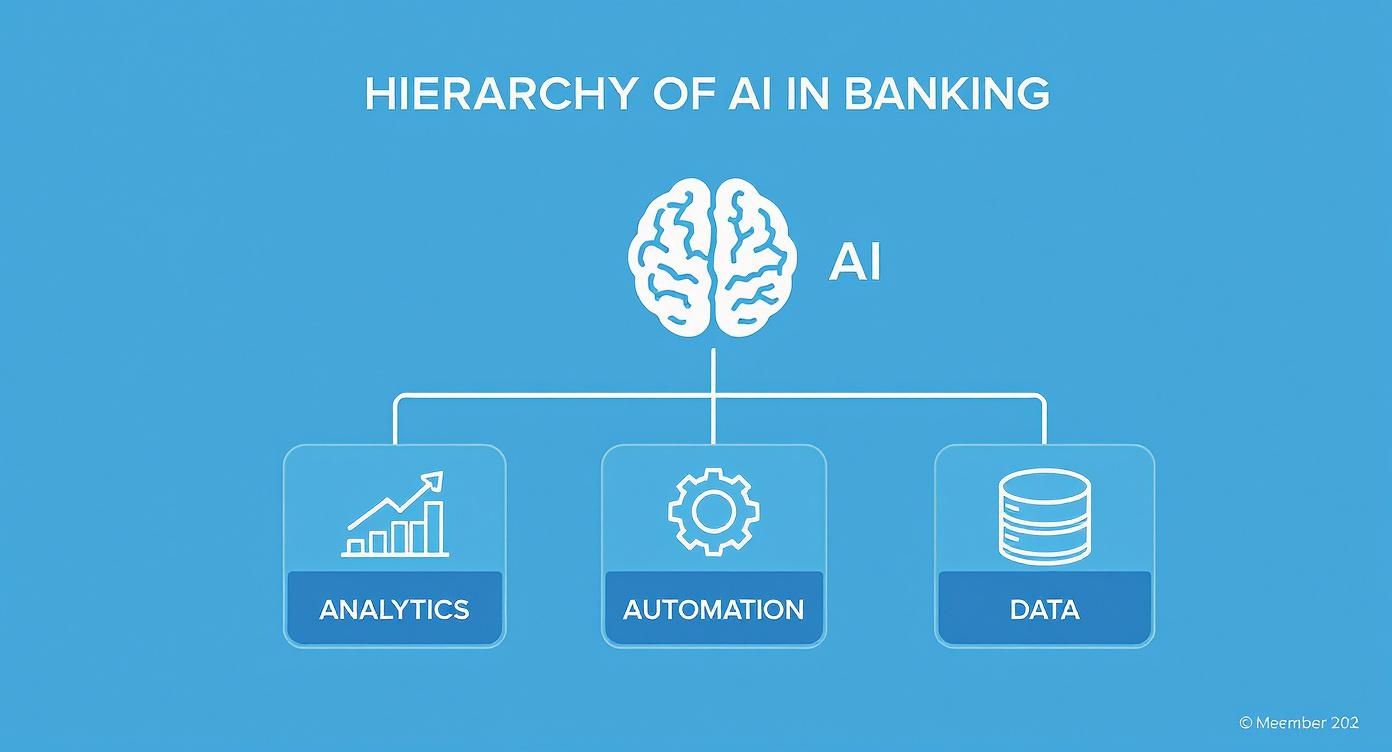
Each component reinforces the others, creating a virtuous cycle where better data fuels smarter automation, which in turn delivers deeper analytical insights.
The New Decision-Making Paradigm
The distinction between the legacy and modern approaches is stark. One is reactive and high-risk; the other is proactive and precise. Executives leading a transformation must internalize this fundamental shift.
The table below contrasts the two models, illustrating two fundamentally different competitive postures.
Decision-Making Models Traditional vs Data-Driven
| Attribute | Traditional Model (Intuition-Based) | Data-Driven Model (Intelligence-Enabled) |
|---|---|---|
| Decision Speed | Weeks or months, reliant on manual reports and committees. | Hours or minutes, based on real-time dashboards and alerts. |
| Data Source | Lagging internal reports, anecdotal evidence. | Unified internal, competitor, and macroeconomic data. |
| Accuracy | High margin for error, subject to cognitive biases. | Verifiable, evidence-based, with predictive modeling. |
| Risk Profile | High. Decisions are often based on outdated assumptions. | Mitigated. Risks are identified and quantified early. |
| Strategic Outcome | Incremental adjustments, often reactive to market events. | Proactive pivots, identifying opportunities before they are obvious. |
An institution operating on the right side of this chart can identify market gaps and neutralize threats before its peers are even aware of them.
The ultimate measure of a data-driven framework is not the sophistication of its dashboards, but the speed and confidence with which leadership can act on the intelligence provided. It transforms data from a passive asset into an active strategic weapon.
Achieving this requires more than software. It demands a top-down mandate to democratize data access and foster a culture where "What does the data say?" is the first question in every strategic discussion. The initial step is to benchmark your bank's current decision-making velocity against market leaders. This analysis will illuminate your most significant gaps and provide a clear roadmap for building a true intelligence-driven institution.
Navigating The Primary Risks and Strategic Missteps
While a financial digital transformation holds immense promise, the path is fraught with costly failures. For any executive steering such an initiative, understanding the common causes of underperformance is the first step toward ensuring success.
The most significant risks are rarely technological. They are strategic, operational, and cultural.
Failed transformations typically stem from a few classic errors: entanglement with legacy systems, internal resistance to change, and poor vendor selection. However, the most critical mistake is pursuing technology without a clear, quantifiable business case.
These are not minor obstacles; they are fundamental flaws that can derail even the most well-funded projects.
The Anatomy of Underperformance
Consider this common scenario: a mid-sized regional bank invests $50 million in a new core banking system, promised modernized operations and an enhanced customer experience.
Eighteen months later, the results are deeply disappointing. The bank has achieved a mere 2% gain in operational efficiency, and customer satisfaction scores have not improved.
The error? The bank implemented new technology atop archaic, inefficient processes. Loan approvals followed the same manual workflow, and account opening remained as cumbersome as before. They installed a Ferrari engine in the chassis of a Ford Pinto.
This is a failure of strategic thinking, not technology.
The primary risk in any transformation is not that the technology will fail, but that the organization will resist the necessary operational changes. Investing millions in new software without re-engineering the workflows it is intended to improve is the fastest path to a negative ROI.
Making Smarter, Data-Backed Decisions
The only way to avoid these pitfalls is to replace conjecture with evidence-based decision-making. Rigorous due diligence and performance tracking are indispensable. This begins by asking difficult questions and demanding answers supported by hard data.
- What Does Success Actually Look Like? A vague goal like "improve efficiency" is insufficient. You must know what top-performers in your asset class are achieving. Without objective benchmarks, targets are merely aspirations.
- How Do You Hold Vendors Accountable? Focus on results, not features. Structure vendor contracts around specific, measurable business outcomes—such as reducing customer onboarding time by 10% or increasing digital product adoption by 15%.
- Where Are the Real Bottlenecks? Before investing in new technology, you must precisely map the processes it is intended to improve. A clear "before" state is required to measure the "after."
This is where external market intelligence becomes a strategic necessity. A platform like Visbanking eliminates guesswork by providing a clear, unbiased view of peer performance. Benchmarking your key metrics against the competition allows you to set goals that are both ambitious and achievable.
This data empowers executives to hold all stakeholders—from internal teams to external vendors—accountable for delivering tangible value. It converts a high-stakes gamble into a calculated strategic investment.
The pressure to execute correctly is intense. Digital banking is a high-growth fintech segment, with some entities reporting 59% profit growth. Concurrently, 89% of financial firms are increasing cybersecurity spending to counter rising digital threats.
As recent global fintech reports indicate, the directive is clear: adapt and build a resilient, technology-forward operation, or be left behind. You can read more about these fintech and security trends here.
Before signing the next multi-million-dollar technology contract, pause. The most prudent initial investment is in intelligence. Benchmark your performance, identify your true operational weaknesses, and build a transformation strategy grounded in data, not hope.
Your First 100 Days: A Transformation Action Plan
Strategy without execution is theory. For bank executives committed to digital transformation, the initial 100 days are critical. This period sets the tone, establishes credibility, and builds essential momentum. This is a time for decisive action, not prolonged debate.
This plan is not a high-level theoretical exercise. It is a tangible, executive-level checklist designed to transition from meetings to data-driven execution, ensuring every dollar invested is tied to a specific business outcome.

Days 1-30: Set the Target and Pick Your Leader
The first month is dedicated to defining success in concrete terms. An ambiguous goal like "be more innovative" is a recipe for failure. The entire initiative must be anchored to a core business KPI.
Your action items:
Define One, Measurable Goal: This must be a business objective, not a technological one. Examples: "Increase non-interest income by 8% in 18 months through new digital products," or "Reduce commercial loan underwriting time by 40% to capture an additional $50 million in market share."
Appoint a Cross-Functional Lead: Designate a senior leader with P&L responsibility and genuine authority to own the initiative. This individual must have the influence to dismantle silos between IT, marketing, operations, and finance.
Secure Board and C-Suite Alignment: The leadership team must publicly and consistently endorse the mission. Any perceived hesitation at the top will cascade into resistance and inaction throughout the organization.
Days 31-60: Take a Hard Look in the Mirror
A successful journey requires knowing your starting point. This phase is about replacing assumptions with objective data. It demands a brutally honest assessment of your bank's capabilities relative to the market.
The single greatest error in any transformation is the failure to benchmark against the market. Without external context, you are grading your own homework, which leads to flawed strategies and unattainable goals.
This is where data intelligence platforms like Visbanking become indispensable. You must:
- Benchmark Your Ratios: How does your efficiency ratio, net interest margin, and loan growth compare to your top five competitors and industry high-performers?
- Find Your Data Blind Spots: Where do you lack critical visibility? Is it competitive deposit rates, commercial client concentrations, or talent trends?
- Map Tech to Value: Analyze your current technology stack. Which systems are generating revenue, and which are creating operational drag?
Understanding your position is paramount. For a more detailed guide, see our article on building a digital transformation strategy framework.
Days 61-100: Launch a Pilot and Score a Quick Win
With a clear objective and a data-backed baseline, the final step in the first 100 days is to secure a rapid, visible success. Select one high-impact pilot project that directly supports your primary goal. This builds momentum and demonstrates to the organization that this initiative is substantive.
For example, if the goal is to increase non-interest income, the pilot could be the launch of a new digital treasury management service for a specific commercial client segment identified during your data analysis. Then, rigorously track its adoption and revenue generation.
This 100-day sprint will not complete the transformation, but it will establish the foundation for success. It instills discipline, makes data the final arbiter, and proves that change is not only possible but profitable. The time for observation is over. Benchmark your performance, identify your greatest opportunities, and execute.
A Few Lingering Questions
How Do We Actually Measure the ROI of This Stuff?
The true return on investment is not measured in cost savings from automating minor tasks. For the C-suite and board, the critical metrics are those that directly impact financial performance: improvements in Customer Lifetime Value (CLV), a reduction in the cost of customer acquisition (CAC), and tangible gains in Net Interest Margin (NIM) driven by more intelligent pricing.
Growth in market share within strategic segments is another non-negotiable metric.
Every dollar invested in technology must be tied to a core business KPI. A $2 million investment in a new analytics platform must be justified by a specific expected return, such as a 1.5% increase in cross-selling within 12 months.
A platform like Visbanking provides the necessary external context. It allows you to benchmark your KPIs against direct competitors, enabling you to set targets that are both ambitious and grounded in market reality, thereby proving the financial impact of your decisions.
Should We Build Our Own Tech or Just Partner with a Fintech?
The "build vs. buy" decision must be strategic, not emotional.
For capabilities that are core to your institution's unique competitive advantage—such as a proprietary underwriting model for a niche market—building in-house may be justified. This is how a defensible moat is created.
For all other functions that have become commoditized—such as fraud detection or regulatory reporting—partnering with a best-in-class fintech is nearly always the more rapid and capital-efficient approach. Do not allocate your top talent to reinventing established solutions.
The key is to design your architecture to integrate seamlessly with these external solutions while maintaining strict control over your customer data and strategic direction.
What's the Board's Role in All This?
The board's role is governance and strategic oversight, not project management. Its primary responsibility is to ensure the transformation initiative remains aligned with the bank's long-term business objectives and shareholder value creation.
Directors must ask the difficult questions.
They should challenge the executive team with pointed inquiries like: "How does this $10 million investment defend our market share against non-bank lenders?" or "Show me the data that proves this initiative will improve our efficiency ratio relative to our peers."
Their role is to approve the capital allocation, hold leadership accountable for measurable results, and insist on the use of external market data to maintain an objective perspective on performance and risk. This ensures the initiative remains a business-led strategy, not an open-ended IT project.
Ultimately, real financial digital transformation is fueled by having better intelligence than the competition.
At Visbanking, we build the data and analytics platform that banking leaders use to benchmark performance, spot opportunities, and execute their strategy with total confidence. See how our BIAS platform can help you make faster, smarter decisions.
Related Articles

Visbanking Blog
Banking Data Analytics: Turning Information Into Profit

Visbanking Blog
Transitioning from a Traditional Bank to a Digital Bank: What Does it Take?

Visbanking Blog
Fastest Growing Banks by Loan Volume

Visbanking Blog
Bank Branch Networks: Are Physical Locations Still Relevant?

Visbanking Blog
In our rapidly evolving digital age, traditional banking models are being overturned

Visbanking Blog