
A Guide to Modern Bank Operation Management
Brian's Banking Blog
For too long, bank operation management has been treated as a back-office cost center. That mindset is not just outdated—it’s a direct threat to your institution's survival. Today, your operations are the strategic engine that powers profitability, customer trust, and resilience in the face of relentless regulatory and economic pressures.
Rethinking Bank Operation management for a New Era
As a bank executive, operational excellence is a core strategic weapon. The game has shifted from simply maintaining the status quo to building a hyper-efficient, resilient, and intelligent organization that dictates market competitiveness. The objective is to stop reacting to problems and start leading with data-driven strategy.
Modern bank operation management rests on three pillars:
- Radical Efficiency: This is the disciplined pursuit of eliminating waste. It means automating manual processes and optimizing every workflow to drive down the cost-to-income ratio.
- Unwavering Resilience: Your systems must be bulletproof. They need to withstand economic shocks, sophisticated cyber threats, and new regulations without failure.
- Predictive Intelligence: This is the decisive advantage. It means leveraging your own data to anticipate market shifts, identify growth opportunities, and execute critical decisions with confidence.
Operational data is noise until given context. Imagine your team reports that the average new commercial account onboarding time has crept up to 10 business days. Is that acceptable? On its own, it’s just a number. But when a bank intelligence platform reveals your direct peers consistently complete the process in 5 days, that number transforms into a critical competitive disadvantage requiring immediate action.
The challenge for bank leaders today isn’t managing operations—it’s turning operational data into a strategic asset. The goal is to convert complex metrics, from transaction processing costs to AML alert resolution times, into decisive actions that protect and enhance the bottom line.
This is where a bank intelligence platform becomes indispensable. It provides an unvarnished, objective view of where you stand versus the competition, where you need to be, and the most direct path to get there. It is the tool for turning operational insight into market leadership.
To build an operations framework that performs, you must begin with an honest, data-backed baseline. It is time to see how your key performance indicators truly stack up against the competition and turn your operational data into a roadmap for superior performance.
Mapping the Core Domains of Bank Operations
A bank’s performance is the direct result of its operational execution. For any executive, having a clear, unfiltered view of this complex machinery is essential for making sound strategic decisions.
Effective bank operation management requires understanding how each component functions in relation to the others. It demands a systems-level perspective, not a siloed one.
Let's dissect the seven critical domains that form your bank's operational backbone. Each presents distinct challenges and significant opportunities for data-driven improvement.
The Transactional and Foundational Layers
These are the core infrastructure of the bank. Flaws here compromise the entire institution.
Payments and Settlements: This is the bank’s circulatory system, processing everything from ACH and wire transfers to card transactions. Friction—such as settlement delays or high processing fees—directly impacts profitability and erodes customer trust.
Core Ledger Management: This is the absolute source of truth. The ledger must be flawless. This function ensures every transaction is posted correctly and all accounts balance precisely. A single error can trigger significant financial restatements and regulatory scrutiny.
Reconciliation: This is the daily verification process. The reconciliation team acts as an internal auditor, matching the bank’s books against statements from correspondent banks and payment networks. A high volume of exceptions—for example, 2,000 exceptions per day requiring manual review—is a clear indicator of process breakdowns and escalating operational risk.
This diagram illustrates how efficiency, resilience, and intelligence are the three pillars supporting a modern bank's operations.
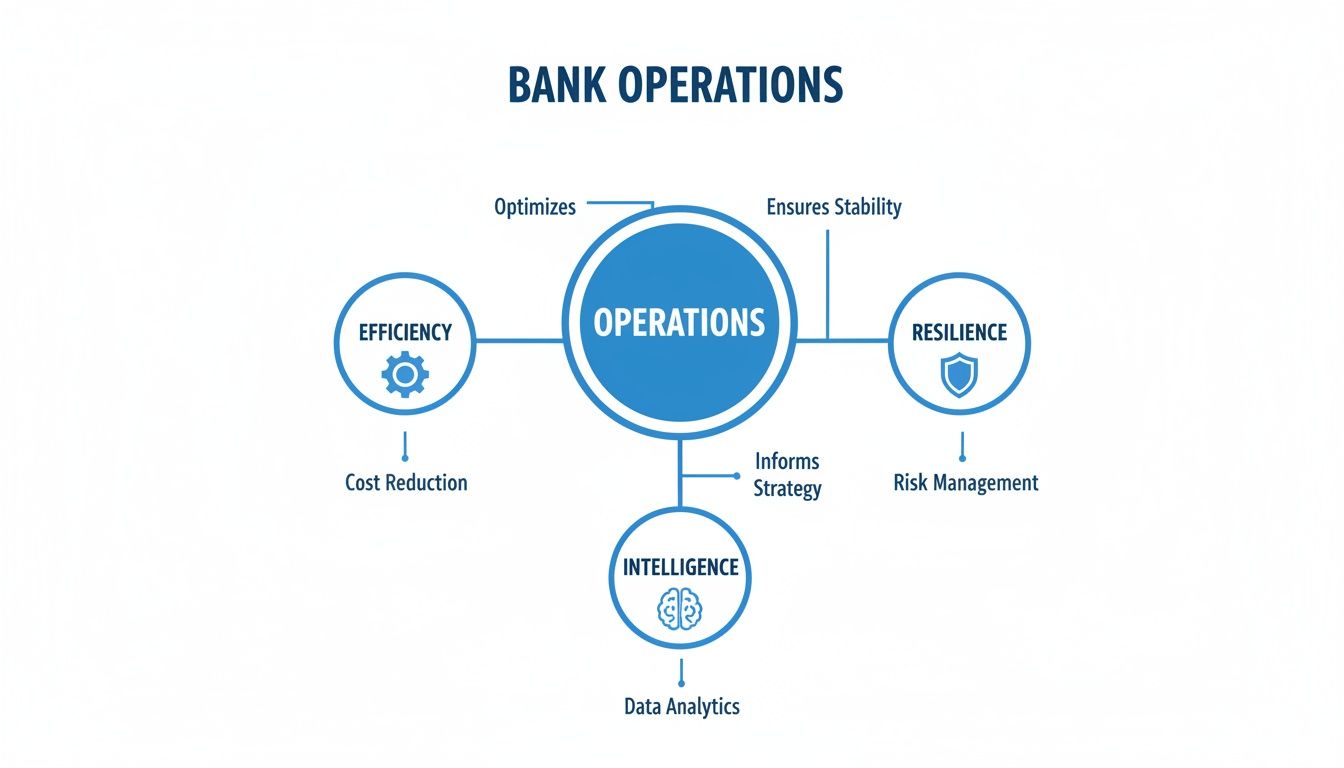
The concept is powerful in its simplicity: balance cost control with a rock-solid, risk-proof foundation, all while using data intelligence to guide every strategic move.
The Risk Management and Growth Engines
With a solid foundation, these domains protect the bank and drive it forward.
Treasury Operations: This function extends far beyond managing daily cash. A strategic treasury team actively manages liquidity, funding, and interest rate risk. Mismanagement here can cause Net Interest Margin (NIM) compression or, in a volatile market, a severe liquidity crisis.
Customer Onboarding: This is the first client interaction and sets the tone for the entire relationship. A cumbersome, paper-intensive process taking 7–10 business days when competitors execute in two is a direct threat to growth targets.
AML/KYC Operations: These teams are the gatekeepers, protecting the bank’s reputation and ensuring regulatory adherence. They manage transaction monitoring, sanctions screening, and customer due diligence. However, if their systems generate excessive false positives, analysts may waste 90% of their time on non-productive investigations, inflating costs without mitigating risk.
Customer Service Operations: From the call center to the branch, this is where the brand promise is delivered. Key metrics like Average Handling Time (AHT) and First Contact Resolution (FCR) are not just dashboard numbers; they are direct measures of customer satisfaction and operational efficiency.
Each of these domains produces a torrent of data. The challenge for executives is not a lack of information, but a lack of actionable intelligence. Without clear performance comparisons, how do you know if the $1,500,000 invested in a new AML system is providing a competitive edge or merely maintaining compliance?
Understanding how these functions interrelate provides a powerful lens for identifying weaknesses and allocating capital. For a more detailed analysis, review our guide to mastering key operations in the banking industry.
Ultimately, superior performance requires moving beyond isolated reports and siloed metrics. The first step is to benchmark your performance in each domain against your peers. That is where the most significant opportunities are found.
Measuring What Matters With KPIs and Benchmarks
In banking, what is not measured cannot be effectively managed. The challenge for most executives is not a scarcity of data, but a famine of insight.
The solution is to stop chasing every metric and concentrate on the Key Performance Indicators (KPIs) that directly impact your bank's operational health and bottom line.

Collecting internal data is merely table stakes, not a strategy. The transformative power lies in benchmarking—comparing your performance against the competition. Raw numbers are observations; benchmarked data is a call to action.
From Data Points to Strategic Decisions
Effective operations management requires a balanced scorecard of metrics covering efficiency, risk, and customer experience. A singular focus on one area, such as cost reduction, will inevitably degrade another, such as service quality or compliance. A holistic view is the only defense against such strategic blind spots.
To illustrate, consider a few essential KPIs every leadership team must monitor:
Efficiency: The Cost-to-Income Ratio (CIR) remains a fundamental measure of profitability. It quantifies how much is spent for every dollar of revenue. A lower ratio is superior, but the number is useless in isolation.
Risk Management: Your AML False Positive Rate is a critical indicator. A high rate, often exceeding 95%, signifies that you are paying analysts to investigate non-threats—a significant drain on resources that inflates costs without effectively mitigating risk.
Customer Experience: Average Handling Time (AHT) in your call center is a direct proxy for both customer satisfaction and operational cost. High AHT often indicates undertrained staff or inefficient systems—both of which erode margins and drive customers away.
These are just foundational metrics. A robust dashboard requires a suite of specific KPIs for each business unit. For a more comprehensive framework, exploring a wider array of banking performance metrics is a logical next step toward gaining a clearer picture of your bank's health.
The following table outlines several essential KPIs across core operational domains. Use this as a starting point for building a dashboard that delivers true, actionable intelligence.
Essential Bank Operations KPIs by Domain
| Operational Domain | Key Performance Indicator (KPI) | What It Measures | Example Target |
|---|---|---|---|
| Payments & Treasury | Straight-Through Processing (STP) Rate | Percentage of transactions processed without manual intervention. | 98%+ |
| Customer Onboarding | Time to Fulfill (Commercial Accounts) | Average time from application start to account being fully operational. | < 4 business days |
| Ledger Operations | General Ledger Close Time | Number of days required to close the books at month-end. | < 3 business days |
| Customer Service | First Contact Resolution (FCR) Rate | Percentage of customer issues resolved during the first interaction. | > 80% |
| Reconciliation | Automated Match Rate | Percentage of transactions matched automatically by the system. | > 95% |
| AML/Compliance | AML False Positive Rate | Percentage of alerts that are closed as non-suspicious. | < 90% |
Possessing these numbers is one thing; knowing how to act on them is where strategic advantage is created.
The Power of Peer Benchmarking
Internal KPIs tell only half the story. True strategic leverage comes from benchmarking against a curated group of peers. This is where data transforms into actionable intelligence.
Consider this scenario: Your internal report shows a Cost-to-Income Ratio of 58%. In isolation, it is just a number. Your team may compare it to last year's figure and conclude that performance is stable. No action is taken.
Now, let's introduce context from a bank intelligence platform. The data shows that the median CIR for banks of your asset size and business model is 52%.
This is no longer just a number. For a bank with $100,000,000 in annual revenue, it is a $6,000,000 performance gap. The conversation immediately shifts from, "How are we doing?" to a far more urgent, "Why are we falling behind, and which specific operational levers must we pull—now—to close this gap?"
That is the power of benchmarking. It removes internal biases and forces an objective confrontation with market reality. It initiates the necessary, difficult conversations about resource allocation and operational priorities.
Using Benchmarks to Drive Accountability
Objective benchmarks provide an external, impartial yardstick for performance. They remove emotion and subjectivity from management reviews and enable the setting of clear, data-backed goals for your leadership team.
Suppose your Head of Onboarding reports an 8-day cycle for new commercial accounts. In a vacuum, this may seem adequate. But what if benchmarking data reveals that the top 25% of your peers complete the process in just 4 days?
The goal is no longer a vague "continuous improvement." It becomes a strategic imperative: cut the onboarding cycle in half, or cede market share.
Without this external data, you are operating on intuition. With it, you know precisely where you lead, where you are average, and—most importantly—where you are critically behind. That clarity is the foundation of world-class bank operations.
Navigating Economic Pressures and Regulatory Headwinds
Bank operations do not exist in a vacuum. They are subject to constant external forces, from macroeconomic shifts to an ever-expanding list of regulatory requirements. For any bank executive, mastering bank operation management means navigating these forces effectively. A single misstep can severely impact the bottom line.
Currently, the balance between capital adequacy, liquidity, and profitability is more precarious than ever. With interest rate volatility, maintaining sharp operational efficiency is not just prudent—it is a matter of survival.
The Profitability Squeeze
Shrinking Net Interest Margins (NIMs) are a primary concern for bank leaders. Every basis point of margin compression puts immense pressure on operations to eliminate inefficiencies.
This reality forces difficult questions. If your bank's efficiency ratio is 62% while your peers operate at 55%, that 7% gap is not an abstract figure. It represents millions in potential profit consumed by operational friction and a direct threat to shareholder value.
A dynamic operational strategy, informed by real-time data intelligence, is the only effective way to navigate this environment. Without a clear, comparative view of your costs and processes, you are making critical decisions with incomplete information.
This pressure is not transient. Rating agencies forecast stable capital and liquidity but warn that narrowing NIMs could significantly impact profitability. As Moody’s noted in its 2025 global outlook, this will compel banks to manage their balance sheets and daily operations with far greater precision.
The Regulatory Burden as an Operational Driver
Simultaneously, regulation has evolved from a compliance checklist into a primary driver of operational strategy and expense. The cost of compliance—from AML systems to model risk management—now constitutes a major portion of a bank's non-interest expenses.
This creates a fundamental tension for executives: capital must be allocated to mandatory resilience projects while also funding strategic initiatives that drive growth. To manage this conflict, resources like a practical guide to regulatory compliance risk management become essential.
Consider the ripple effect of a new liquidity reporting rule. A bank might spend $500,000 on system upgrades and allocate 2,000 staff hours annually just to meet the new standard. This is a purely defensive investment yielding zero revenue. The objective must be to execute such mandatory spending with maximum efficiency, thereby preserving capital for value-generating projects.
Connecting External Forces to Internal Action
The most effective leadership teams excel at translating macroeconomic trends and regulatory shifts into specific, actionable operational adjustments.
- Interest Rate Sensitivity: If rates are projected to decline, treasury operations must proactively adjust funding and hedging strategies to protect NIMs. This requires precise, up-to-the-minute data on the bank’s asset-liability position.
- Capital Adequacy: When regulators signal higher capital requirements, the operations team must identify ways to improve risk-weighted asset (RWA) density. This could involve refining loan workflows or enhancing credit risk models to optimize capital buffers.
- Liquidity Stress: When new liquidity coverage ratio (LCR) rules are introduced, operations must ensure that high-quality liquid assets (HQLA) are not just available but can be mobilized instantly. This demands robust collateral management systems.
Each of these pressures requires a precise, data-backed operational response. Without clear, comparative data, banks are forced to guess, often over-investing in some areas while leaving critical vulnerabilities in others.
This is where a bank intelligence platform like Visbanking provides a decisive edge. By benchmarking your treasury efficiency, compliance spending, and key capital ratios against true peers, you can identify exactly where external pressures are creating the most internal strain. It allows you to allocate resources with surgical precision, transforming a reactive compliance burden into a strategic advantage.
Building the Right Technology and Data Architecture
At the heart of modern bank operations is technology. The question for executives is no longer if to invest, but how to deploy capital to generate measurable returns. The core challenge is balancing mandatory spending with investments that drive business growth.
A sharper approach to IT budgeting is to bifurcate it into "run-the-bank" versus "change-the-business." "Run-the-bank" encompasses essential maintenance, compliance, and system upkeep. "Change-the-business" is the capital allocated for innovation, automation, and digital enhancements that create a competitive advantage.
The Squeeze on Innovation Spending
While overall tech spending is rising, a closer analysis reveals a concerning trend: a significant portion of new investment is consumed by non-discretionary projects.
A recent global banking outlook report highlights this pressure. Global banks are projected to increase IT spending to approximately US$176,000,000,000 in 2025, yet only about 39% is earmarked for ‘change-the-business’ initiatives. The remainder is allocated to running the bank, meeting regulatory requirements, and making essential resiliency upgrades.
This reality severely constrains innovation. The solution is not merely to increase spending, but to invest with surgical precision, ensuring every technology dollar delivers a quantifiable return.
From Spending More to Spending Smarter
To break this cycle, investment decisions must be grounded in solid, comparative data. Without a clear benchmark of your operational performance against peers, you are investing blindly. A bank intelligence platform provides the necessary context to identify where capital will have the greatest impact.
A well-architected data strategy does more than support operations; it transforms them. It shifts the conversation from "How do we justify this IT cost?" to "Look at the value we're driving," turning a traditional cost center into a strategic asset for growth.
Consider a practical example. A mid-sized bank's reconciliation team manually processes 5,000 exceptions per month, requiring three full-time employees and significant management oversight. The leadership team hesitates at the $250,000 cost of a new automation platform.
Now, what if the COO uses a platform like Visbanking to benchmark their "Automated Match Rate" against a peer group of similar-sized banks? The data reveals their rate is 82%, while top performers are achieving 96%. The business case is instantly reframed.
This is no longer about incremental efficiency; it's about competitive necessity. The investment shifts from a discretionary "nice-to-have" to a critical initiative to close a major performance gap. Armed with this hard data, the COO can demonstrate that the new platform will automate 80% of the remaining manual work, freeing up over 4,500 staff hours annually. This not only achieves payback in 18 months but also allows the reallocation of skilled employees to value-generating activities.
This data-driven approach removes subjectivity from technology investment, converting it into a clear, ROI-backed decision. It pinpoints exactly where capital can unlock significant resources, freeing up money and talent to focus on changing the business. To start making these strategic moves, the first step is to benchmark your bank's performance and identify your greatest opportunities.
Unlocking True Efficiency with Automation and AI
Bank executives are investing heavily in technology, yet many question why significant productivity gains remain elusive. The primary culprit is the persistent friction of manual tasks that consume resources and impede progress. Targeted automation and Artificial Intelligence (AI) are the keys to closing this gap, enabling not just incremental improvements but major leaps in bank operation management.

This is not a futuristic concept; it is the practical application of available technology to solve today's most significant operational challenges. The banking industry invests approximately US$600,000,000,000 in technology annually, yet operational inefficiencies persist. Intelligent use of AI and automation could boost operational productivity by 20–35%—a massive opportunity. McKinsey’s global banking review explores this challenge in depth.
From Manual Grind to Intelligent Operations
The potential is immense, but success requires a surgical approach. Forget vague "AI strategies." The banks that are winning are those pinpointing specific, high-volume processes where automation delivers the largest and fastest return on investment.
Consider a mid-sized bank that automates 75% of its manual reconciliation work. This single initiative could free up more than 10,000 FTE hours annually—a direct and measurable impact on the bottom line. Talented employees can then be redeployed from repetitive data entry to high-value work like resolving complex exceptions or engaging with clients.
AI is no longer a "what if" technology; it is a tool for today that delivers tangible cost savings and operational scalability. The goal is not to replace people but to augment them. Let machines handle repetitive tasks so your best talent can focus on critical thinking and strategic decision-making.
Here are two high-impact examples of this technology in action today:
- Intelligent Document Processing (IDP): This AI-powered technology can read, interpret, and extract key data from unstructured documents like loan applications and trade finance paperwork. We have seen it reduce new account onboarding times by 50% or more, enabling faster revenue generation and an improved client experience.
- Predictive Analytics for Fraud Detection: Legacy, rule-based systems are notorious for generating a high volume of false positives. Modern AI models, in contrast, can analyze transaction patterns in real-time to identify genuinely suspicious activity with far greater accuracy. This reduces the workload on investigation teams and strengthens the bank's defenses against financial crime.
High-Impact Automation Opportunities in Banking
To identify where automation can deliver the greatest value, it is useful to map specific operational pain points to concrete AI solutions. The table below provides a comparative analysis of key banking operations, highlighting where you can achieve the most significant efficiency gains and risk reduction.
| Operational Area | Manual Process Pain Point | Automation/AI Solution | Projected Productivity Gain |
|---|---|---|---|
| Customer Onboarding | Slow, error-prone manual data entry from ID and financial docs. | Intelligent Document Processing (IDP) to auto-extract and validate customer data. | 40-60% |
| Payments Processing | High volume of exceptions and manual repairs for failed payments. | AI-driven routing and predictive analytics to pre-empt and resolve errors. | 25-40% |
| Reconciliation | Time-consuming, tedious matching of millions of transactions. | Automated matching algorithms that handle high volumes and flag only true exceptions. | 60-80% |
| AML/KYC Compliance | Overwhelming number of false positive alerts from legacy systems. | Machine Learning models to analyze behavior and reduce false alerts dramatically. | 30-50% |
| Customer Service | Repetitive inquiries tying up agents (e.g., balance checks). | AI-powered chatbots and IVR to handle common queries 24/7. | 20-35% |
By focusing on these areas, banks can move beyond incremental improvements and achieve significant, measurable results that directly impact both the bottom line and the customer experience.
Building the Business Case with Data
The decision to invest in this technology must not be a leap of faith. It must be a firm, data-driven business case. This is where benchmarking becomes an executive's most powerful tool.
Imagine discovering that your peers are achieving a 95% straight-through processing rate in payments, while your bank is at 85%. That is not just an interesting statistic; it is the justification needed to secure project approval. It changes the conversation from a vague "we need to be more efficient" to a concrete, actionable plan: "Closing this 10% performance gap will reduce our cost-per-transaction by $0.15, saving $1,200,000 annually." For leaders looking to build this kind of powerful case, our guide on automation in banks offers further detail.
Ultimately, unlocking true efficiency is about making smarter, more targeted technology investments. By using peer data to identify your most significant operational weaknesses, you can deploy automation and AI with confidence, knowing that every dollar invested will deliver a clear return in cost savings, risk reduction, and competitive advantage. The first step is to get an objective assessment of where you stand relative to your competition.
Your Roadmap to Operational Excellence
We have covered the core principles of superior bank operation management. But theory is insufficient. Lasting competitive advantage is created when data-driven decisions separate market leaders from the rest of the pack. It is time for action.
Transforming operations from a cost center into a competitive weapon is a disciplined process. For executives ready to lead this change, the path is direct. It requires moving from ambiguous goals to a concrete, data-backed plan of attack.
A Four-Step Framework for Transformation
Building a modern, resilient, and hyper-efficient operations model can be distilled into four key steps. Each builds upon the last, creating a powerful cycle of continuous improvement that not only insulates the bank from market shocks but also positions it for sustained growth.
Establish a Definitive Baseline: First, you must know exactly where you stand. This is non-negotiable. It means benchmarking your most critical KPIs—from cost-to-income ratio to AML false positive rates—against your true peers. Without this objective starting point, any strategic plan is based on guesswork.
Identify High-ROI Bottlenecks: With comparative data, you can pinpoint the top three operational deficiencies that are costing you the most in terms of money, time, and risk. Is it commercial onboarding that takes twice as long as competitors? Is it a reconciliation exception rate that is bleeding cash? Focus your resources where they will have the greatest impact.
Develop Targeted Initiatives: With clear targets identified, you can now create specific, measurable initiatives to address them. This could mean implementing an automation platform to reduce manual reconciliation by 80%, or redesigning a workflow to cut customer service handle times by 25%.
Implement and Monitor Continuously: Finally, you execute. But this is not a one-time fix. The objective is to embed a culture that relentlessly identifies and eliminates operational friction. This requires a rigorous cycle of monitoring, measuring, and refining.
The first step—benchmarking—is the absolute linchpin of this entire framework. It transforms subjective opinion into a measurable, actionable strategy. The time for internal debates and assumptions is over. It is time to let the data lead.
Begin by seeing exactly where you stand. With Visbanking, you can benchmark your performance against thousands of peers, turning raw data into a clear roadmap for operational excellence. Explore our platform at https://www.visbanking.com.
Related Articles

Visbanking Blog
How Bank Efficiency Ratios Reveal Hidden Operational Costs

Visbanking Blog
Revolutionize Your Bank with BIAS, the Bank Intelligence and Action System

Visbanking Blog
Get a Competitive Advantage with BIAS, the Proactive Banking Solution

Visbanking Blog
Bank Regulatory Compliance: Navigating the Complex Maze

Visbanking Blog
If you want your bank to be the most profitable in the long run - make the most of your CRM.

Visbanking Blog