
Automation in Banks: A Strategic Growth Imperative
Brian's Banking Blog
Automation in banking is no longer a futuristic concept. It is the price of admission for competitive relevance and sustainable growth. The imperative for leadership is to shift the perspective on automation from a simple cost-cutting tool to a strategic enabler of superior decision-making.
This is not another IT project; it is a fundamental redesign of banking operations, centered on data intelligence.
The Strategic Shift to Data-Driven Banking

For decades, banking operations ran on manual processes. While functional, they were inherently slow, created significant operational drag, and left dangerous strategic blind spots. Today’s market demands a velocity and foresight that legacy workflows cannot deliver.
Automation bridges this gap. However, its effectiveness is entirely contingent on the quality of the data that fuels it.
The industry has recognized this reality. As of early 2025, 92% of global banks were leveraging artificial intelligence in at least one key operational area. This is backed by significant capital allocation, with a projected spend exceeding $73 billion on AI technologies by year-end 2025. This is not a trend; it is a systemic commitment to data-driven operations.
From Reactive Reporting to Proactive Decisions
Effective automation transcends mere task execution. It fundamentally alters how an institution acts on information, shifting the operating model from a reactive, historical review to a proactive, predictive strategy.
Consider the contrast: a manual process produces a quarterly report on loan portfolio risk after the period closes. An automated, intelligent system flags a commercial client’s deteriorating debt-service coverage ratio in real-time, enabling immediate intervention. This is where competitive advantage is won.
Achieving this state requires more than software; it demands a robust data intelligence layer capable of:
- Unifying Data Sources: Consolidating disparate information from call reports, market data feeds, and internal systems into a single, coherent analytical framework.
- Providing Contextual Analytics: Translating raw numbers into actionable insights for specific decisions, from credit analysis to regulatory compliance.
- Building Predictive Capabilities: Leveraging historical data and current trend analysis to anticipate risks and opportunities before they materialize.
The objective is not merely to automate existing processes. It is to re-engineer those processes around live data intelligence. This empowers your team to anticipate market shifts, identify high-value opportunities, and mitigate risk with unprecedented speed.
Platforms like Visbanking's Bank Intelligence and Action System (BIAS) are purpose-built for this function. By aggregating complex data and delivering decision-ready analytics, they enable banks to build automation that directly impacts net interest margins and reduces operational risk.
Understanding the strategic implications of new banking technology is the first step toward building a more resilient and profitable institution.
To thrive, bank executives must champion a strategy where every automated workflow is fueled by clean, contextual, and predictive data. It is time to benchmark your performance and define where intelligent automation can drive your institution forward.
Closing the Gap Between Automation Goals and Reality
Bank executives recognize the strategic imperative of automation. Yet, a significant gap persists between this understanding and day-to-day operational reality.
The promise of agile, intelligent operations is often impeded by the inertia of legacy systems and entrenched manual habits. This is not a failure of vision but a symptom of structural deficiencies that create profound operational drag.
The core issue is that meaningful automation is not a software patch. It is an operational overhaul that requires a clean, unified data foundation—a foundation most institutions are still struggling to build. Without it, even sophisticated tools will underperform, leading to disappointing results and a reversion to inefficient legacy processes.
Why Are We Still Drowning in Manual Work?
A startling number of finance departments continue to operate in a manual environment. A 2025 survey revealed that 49% of finance teams have zero automation. They rely on manual data entry and disconnected spreadsheets for mission-critical functions.
This disconnect is not accidental. It stems from several addressable root causes.
- Fragmented Data Silos: Critical data is often trapped in disparate systems—core banking, loan origination, compliance software—that do not communicate. This fragmentation makes a single, trustworthy view of a customer, risk profile, or performance metric nearly impossible to achieve, yet this unified view is the bedrock of effective automation.
- Cultural Resistance: Change is difficult. Teams accustomed to established processes may view automation as a threat rather than an enabler. Without strong executive leadership articulating the strategic benefits, institutional inertia will prevail.
- Perceived Complexity: The prospect of integrating new technology with aging infrastructure can be daunting. Executives often become paralyzed by the perceived implementation hurdles while underestimating the significant and ongoing cost of inaction.
These roadblocks do more than impede progress; they create tangible vulnerabilities. Manual work is a primary source of costly errors, exposes the bank to compliance failures, and consumes employee time that should be dedicated to revenue-generating activities. The first step to improving operational efficiency in banking is dismantling these barriers.
A Practical Path Forward With Data Intelligence
Consider the monthly board reporting process at a typical community bank. It is an intensive, manual effort requiring analysts to extract data from multiple spreadsheets and systems. A single analyst might spend 20 to 30 hours each month compiling, formatting, and verifying numbers for loan growth, deposit trends, and risk metrics. The final report is a static, backward-looking snapshot that is often obsolete upon delivery.
Now, reimagine that process powered by a central data intelligence platform.
Instead of a manual data chase, the system automatically aggregates real-time data from all relevant sources. The board report is transformed from a static PDF into a dynamic, interactive dashboard. Directors can drill down into the numbers, benchmark performance against peer banks, and model future scenarios in real-time.
This is precisely the function of a tool like Visbanking's BIAS. It bridges the gap between raw, messy data and the clean, contextualized intelligence required for automation to succeed.
The bank in our example not only reclaims 30 hours of an analyst's time monthly but also gains the ability to make strategic decisions based on current reality. The board's conversation shifts from, "What happened last month?" to "What do these trends indicate for the next quarter, and what is our strategic response?"
By establishing the data foundation first, banks can move from discussing automation to executing it effectively. The process begins with a clear-eyed assessment of your own performance, benchmarked against your peers. This is how you identify the opportunities where automation will deliver the most significant and immediate impact.
Strategic Automation Use Cases That Drive Real ROI
Theory is insufficient; boards and shareholders require tangible results. True automation in banking is not about adopting the latest technology. It is about the strategic deployment of intelligent systems in high-impact areas to deliver measurable gains in profitability, efficiency, and risk management.
The key is to focus on use cases where data-driven precision can decisively outperform legacy processes.
However, success does not depend on the automation tool itself. It depends entirely on the quality and accessibility of the underlying data. Without a unified intelligence layer, such as that provided by Visbanking, even the most advanced algorithms operate with incomplete information, yielding unreliable outcomes.
With the right data foundation, the returns are both substantial and immediate.
High-Impact Automation Areas and Their Financial Outcomes
To make this concrete, let's examine where strategic automation delivers a significant return on investment. The following table outlines key areas, quantifying the financial impact for a hypothetical bank and highlighting how a robust data intelligence platform is the critical enabler.
| Automation Use Case | Key Challenge Addressed | Potential Annual ROI (Example: $5B Bank) | Data Intelligence Enabler (Visbanking) |
|---|---|---|---|
| Automated Credit Risk Analysis | Slow, inconsistent manual underwriting processes leading to missed opportunities and higher default rates. | $2,500,000 increase in loan portfolio profitability from reduced defaults and faster origination. | Unifies applicant data, market trends, and peer benchmarks for instant, accurate risk assessment. |
| Proactive Compliance Monitoring | Reactive, manual reviews that catch violations late and create high rates of false positives, wasting analyst time. | 50%+ reduction in false positives, freeing up compliance teams and lowering regulatory penalty risk. | Provides real-time, comprehensive view of all transactions, customer data, and watchlists for the AML engine. |
| Intelligent CRM | Untapped customer data sitting in silos, leading to generic marketing and missed cross-sell/upsell opportunities. | Identifies high-potential clients and triggers proactive, personalized offers, driving new revenue. | Connects disparate customer data points to reveal timely opportunities for relationship managers. |
As illustrated, the right automation, fueled by the right data, is not a cost-saver—it is a powerful engine for growth. Now, let's examine how these use cases function in practice.
Automated Credit Risk Analysis
Lending has been fundamentally transformed by automation. AI-powered systems are now central to managing risk and making real-time credit decisions, a shift driven by clear financial incentives. 76% of financial services companies have launched AI initiatives to reduce costs and identify new revenue streams.
Consider a mid-sized bank with a $5 billion commercial loan portfolio. Historically, its underwriters spent three to five days manually gathering data to render a decision. The process was slow and resulted in inconsistent risk assessments.
By implementing an automated credit risk model—fueled by clean, aggregated data—the entire workflow is transformed. The system instantly analyzes applicant data against historical performance, macroeconomic indicators, and peer benchmarks.
The Result: The decision time for a standard commercial loan decreases from days to under four hours. More importantly, the AI model's superior risk detection leads to a 15% reduction in the default rate on new loans. For our hypothetical bank, this translates to a direct $2,500,000 increase in annual loan profitability.
This outcome is only possible when the automation engine is fed a single, coherent picture of risk from a platform like Visbanking, which integrates everything from call reports to UCC filings.
Proactive Compliance Monitoring
Regulatory compliance is a major operational burden. The cost of failure—in both financial penalties and reputational damage—is immense. The traditional approach relies on periodic, manual spot-checks, which is an inherently defensive posture, catching violations only after they occur.
Intelligent automation enables proactive, 24/7 monitoring. An automated system can scan millions of transactions in real-time, identifying suspicious activity patterns that a human analyst would almost certainly miss. For example, an anti-money laundering (AML) system can detect a complex network of small, structured transactions that appear innocuous individually but indicate illicit activity when viewed in aggregate.
- Benefit 1: A dramatic reduction in false positives. A well-tuned system can reduce false alerts by over 50%, freeing compliance officers to investigate legitimate threats.
- Benefit 2: Unimpeachable accuracy and auditability. The system generates a complete, immutable log of every transaction and alert, providing regulators with a clear audit trail and substantially lowering the risk of penalties.
The data intelligence required for this is immense. The system must have a unified view of customer data, transaction histories, and external watchlists. This is where a centralized data engine becomes non-negotiable. To see the power of this in action, explore these impactful business process automation examples.
Intelligent Customer Relationship Management
The final frontier for automation is not merely back-office efficiency; it is driving revenue through more intelligent customer engagement. Banks possess a wealth of customer data, but most of it remains locked in disconnected systems, completely unutilized.
An automated CRM, powered by a unified data platform, can analyze a customer's entire relationship with the bank—deposits, loans, transaction patterns, and service interactions. This enables the system to identify opportunities with exceptional precision.
For instance, the system might flag a business client whose payroll deposits have increased 20% year-over-year and who recently researched commercial real estate rates on the bank's website. Instantly, an automated alert is sent to the relationship manager with a pre-packaged recommendation for a new property loan, complete with suggested terms based on that client's specific risk profile.
This is a world apart from generic marketing campaigns.
This level of precision is only achievable when your systems can see the complete customer picture. For executives seeking to organize and present this data effectively, understanding the power of financial reporting automation is a critical first step.
These examples make it clear: bank automation is not a cost center. It is a powerful engine for ROI. Unlocking it requires an investment in the data intelligence layer that makes it all possible.
Building the Data Foundation Your Strategy Depends On
You have invested in a new automation tool, expecting it to revolutionize credit analysis or compliance. Instead, it is underperforming. What went wrong?
The issue is rarely the technology itself. The true culprit is the inadequate data foundation upon which it is built. A sophisticated automation system is like a high-performance engine; it requires high-octane fuel to operate. For a bank, that fuel is clean, unified, and context-rich data.
Feeding low-grade, contaminated fuel into a precision machine causes it to choke and seize. The same occurs when you feed fragmented data from legacy silos into your automation engine. The result is always poor performance and a failure to realize a return on your investment.
As a bank executive, your role is not to be a data scientist. It is to champion a data-first culture and recognize that data is not an IT byproduct; it is the central asset that powers every strategic decision.
What Does "Automation-Ready" Data Actually Look Like?
Vast quantities of raw data are not the solution. Data pulled from disparate sources is often chaotic—contradictory, outdated, or lacking the context required for utility. For automation to function effectively, your data must possess three non-negotiable characteristics:
- Absolute Accuracy: The data must reflect reality. An automated underwriting model operating on a flawed credit history or an outdated property valuation is a liability. It will approve bad loans and reject good ones, silently eroding portfolio quality.
- Timeliness and Accessibility: Data has a short shelf life. An anti-money laundering system receiving transaction data on a 24-hour delay is ineffective. Automation-ready data must be available in real-time, at the moment the system requires it.
- Contextual Relevance: This is the most critical and often overlooked element. Data points in isolation are meaningless. Knowing a customer's account balance is useful. Knowing that balance in the context of their transaction history, other credit relationships, and recent service inquiries—that is intelligence.
This concept map illustrates how a solid data foundation drives ROI across the entire institution—from risk and compliance to customer relationship management.
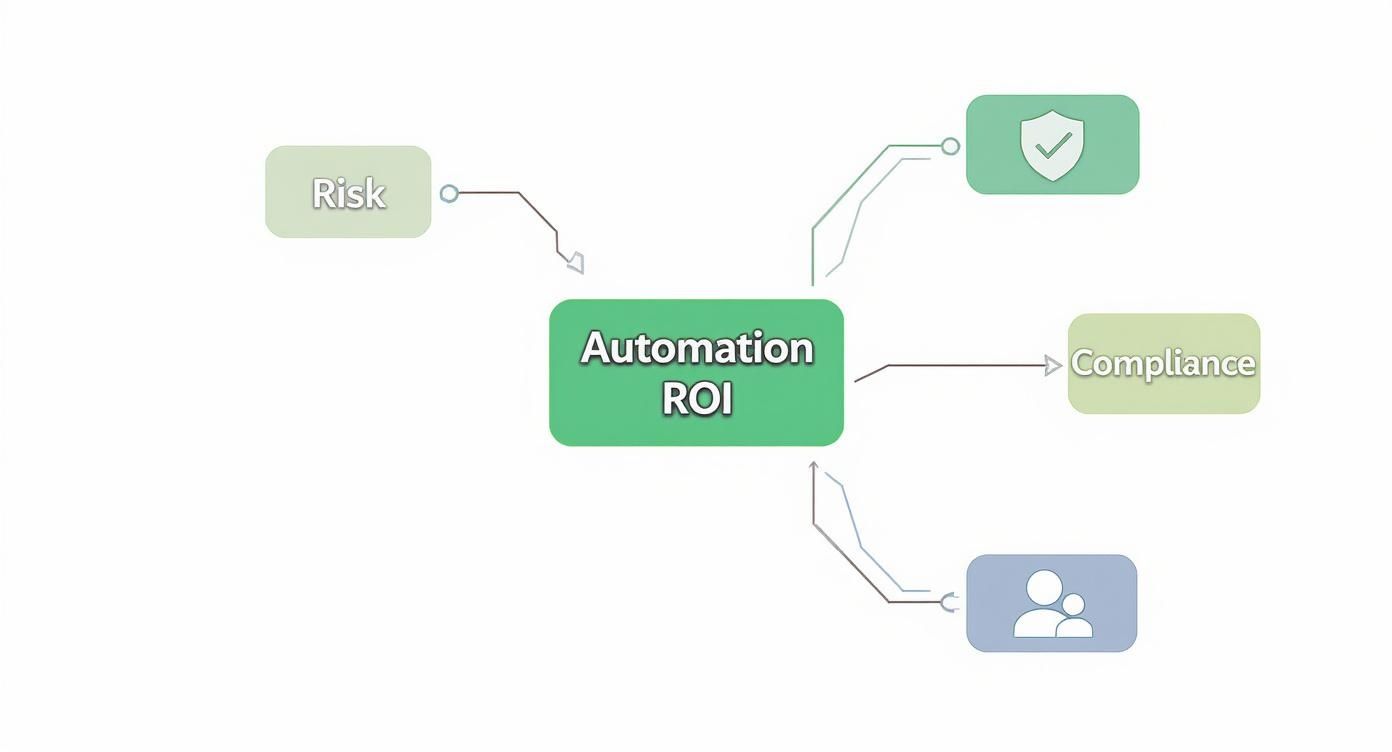
The conclusion is clear: generating a positive return from automation is not a technology problem. It is a data intelligence problem that affects every function of the bank.
From Raw Data to Refined Intelligence
Transforming fragmented, raw data into automation-grade fuel requires a dedicated intelligence layer—a refinery for your bank's most valuable asset. This is the function of a platform like Visbanking's Bank Intelligence and Action System (BIAS). It ingests chaotic data from numerous sources—FDIC call reports, your core system, market feeds—and systematically cleans, unifies, and enriches it.
This is not a one-time project; it is an ongoing operational discipline. By creating a single source of truth, you establish the stable foundation upon which all effective automation depends, converting your data from a liability into a strategic advantage.
Let's make this tangible. A community bank aims to automate its commercial loan pricing model. The model requires data from multiple domains: the client's current relationship depth, payment history, industry-specific risk factors, and competitor pricing.
Without a unified platform, an analyst would spend 20 to 30 hours per loan attempting to locate and consolidate this information. The process is slow, error-prone, and inconsistent. With a platform like Visbanking, the automation engine has direct access to a clean, contextualized dataset. The model can generate a precise, risk-adjusted price in seconds, not days, with a complete audit trail.
This is the real-world difference between an automation strategy that creates immense value and one that creates immense frustration. Before allocating another dollar to automation software, ask the critical question: have we built the data foundation our strategy requires? The first step is to assess where you stand today. A dedicated bank intelligence platform can provide the fuel your institution needs to outperform the competition.
A Phased Roadmap for Data-Driven Automation
Attempting a bank-wide automation initiative without a clear plan is a formula for wasted capital and strategic confusion. Successful implementation is not about a single, large-scale project; it is a deliberate, phased process built on a foundation of hard data.
For bank executives, the goal is to build momentum through small, measurable victories. This approach de-risks the investment and secures organizational buy-in for the long-term vision.
This roadmap is a strategic guide for leadership, not a technical manual for IT. It is designed to transform "automation" from a buzzword into a value-generating reality. The principle is simple: intelligent execution always trumps technological complexity.

Phase 1: Benchmark and Identify
The first move is not to procure software. It is to identify the precise points of operational friction where automation will yield the greatest impact. This requires an objective, data-backed analysis of your bank's performance against its peers. Assumptions are insufficient.
This is where a bank intelligence platform like Visbanking is indispensable. It allows you to move beyond internal anecdotes and benchmark critical KPIs—efficiency ratios, loan origination cycle times, compliance costs—against a curated peer group. This analysis immediately reveals where you are lagging and quantifies the size of the opportunity.
For example, you might discover your commercial loan underwriting process takes 40% longer than the peer average. The conversation immediately shifts from a vague "we should automate lending" to a laser-focused, high-value strategic target.
With this clarity, you can pinpoint one or two high-priority candidates for an initial automation initiative. Select processes that are both a significant operational burden and strategically important, such as regulatory reporting or customer onboarding.
Phase 2: Pilot and Validate
With a high-impact target identified, the next step is a tightly scoped pilot project. Resist the temptation of a large, bank-wide rollout. A pilot is critical for two reasons: it proves the business case with empirical data and builds support from stakeholders who may be skeptical of change.
The mission is to validate the ROI on a small scale before committing significant resources. Establish clear success metrics from the outset. If automating compliance monitoring, the goal might be to reduce false positives by 50% and decrease manual review time by 75% within 90 days.
- Select the Right Team: Assemble a cross-functional team from operations, IT, and the business lines directly impacted by the process. Their involvement is crucial for navigating internal hurdles.
- Isolate Variables: Conduct the pilot in a controlled environment to accurately measure its impact against the existing manual process.
- Communicate the Results: Upon completion, present a clear, quantitative analysis of the outcomes to the executive team and the board. Demonstrate the tangible ROI in hours saved, risk mitigated, or revenue generated.
A successful pilot does more than prove a concept; it creates internal champions. When a loan officer experiences a new tool that reduces their workload by hours, they become the most effective advocate for broader implementation.
Phase 3: Scale and Optimize
With a proven ROI and support from key stakeholders, you can scale the solution across the organization. At this stage, governance and change management are paramount. Scaling automation is less a technical challenge and more about embedding new, data-driven behaviors into the bank's operational DNA.
This requires a clear framework for managing the rollout and monitoring performance. It also demands a robust change management plan. You must articulate the "why" behind the new process, provide effective training, and demonstrate how automation frees employees for higher-value work, rather than replacing them.
Finally, automation is not a "set it and forget it" initiative. Markets change, regulations evolve, and strategic priorities shift. The final step is to establish a cycle of continuous improvement. Use the data generated by your new automated processes to constantly refine and optimize them, ensuring your bank not only keeps pace but sets the standard.
Successful automation is a journey of deliberate, data-informed steps. It begins with knowing exactly where you stand. To see how your institution measures up and identify your greatest opportunities, it is time to benchmark your performance against your peers.
Seizing Competitive Advantage with Proactive Automation
The true strategic value of automation is not merely executing today's tasks more efficiently. The most forward-thinking banks are looking beyond simple efficiency gains toward a proactive, predictive future. This is the new competitive frontier: using automation not just to react to market changes, but to anticipate and capitalize on them.
This represents a fundamental shift in mindset from a defensive to an offensive posture. It means treating automation not as a series of disparate projects, but as the central nervous system of the institution, powered by a continuous flow of intelligent data.
From Reactive Measures to Predictive Strategy
The banks that will dominate the next decade are those using integrated data and AI to build models that answer mission-critical questions before they are even asked. A powerful data intelligence engine is the foundation, enabling you to forecast future outcomes with a high degree of confidence.
Consider portfolio management. The traditional method involves a quarterly review of loan concentrations, reacting to data that is already obsolete. A proactive, automated approach is a different paradigm.
An intelligent system can continuously model how macroeconomic shifts—such as a projected 0.25% interest rate increase or a 5% decline in local commercial real estate values—will impact your specific loan portfolio. It can identify borrowers most likely to face distress six months in the future, allowing your team to intervene with solutions long before a payment is missed.
This transforms risk management from a necessary cost center into a strategic tool that actively preserves and enhances portfolio value.
Anticipating Client Needs and Market Opportunities
This predictive capability is equally powerful for uncovering growth opportunities that competitors, mired in reactive cycles, will completely miss. By analyzing transaction data, product usage, and market signals, automation can pinpoint emerging customer needs with precision.
Imagine your system automatically flagging a cohort of business clients who have recently increased their international wire transfers by over $50,000 per month. Before a competitor even registers the trend, your commercial team receives an alert to offer treasury management or foreign exchange services.
This is what a data-driven offense looks like. It is about:
- Identifying Micro-Trends: Detecting subtle shifts in customer behavior that signal a new need or a change in their business.
- Automating Opportunity Alerts: Delivering actionable insights directly to your front-line teams, complete with the context needed for immediate action.
- Personalizing Outreach at Scale: Empowering your team to engage clients with timely, relevant offers that strengthen relationships and drive revenue.
This level of foresight is impossible when your data is fragmented in silos. It requires a unified intelligence layer, like Visbanking's BIAS, to connect disparate data points and surface these predictive signals. The goal is to make your bank the first to act, converting market intelligence into market share.
For too long, the banking industry has treated technology as a tool to perform legacy tasks more quickly. The true opportunity lies in using data-driven automation to perform entirely new functions—to see around corners, act with certainty, and build an institution that is always one step ahead.
Stop reacting and start anticipating. Visbanking provides the unified intelligence layer your bank needs to build a proactive, predictive future. Discover how you stack up against your peers and identify your greatest opportunities for growth by exploring our platform at https://www.visbanking.com.
Related Articles

Visbanking Blog
Are you ready to transform your bank information services?

Visbanking Blog
The commoditization of core banking functions is NOT causing layoffs.

Visbanking Blog
The Future of Financial Services Recruitment – Why Visbanking Talent Is a Game-Changer

Visbanking Blog
BIAS: The Future of Banking is Revoluzationizing

Visbanking Blog
Revolutionize Your Bank with BIAS, the Bank Intelligence and Action System

Visbanking Blog