
10 Customer Onboarding Best Practices for Banks in 2025
Brian's Banking Blog
The modern depositor relationship is won or lost in the first 90 days. An effective onboarding process is no longer a procedural formality; it is a strategic imperative that directly impacts lifetime value, reduces early-stage churn, and solidifies market position. For bank executives, optimizing this initial experience is the single most effective lever for sustainable growth.
However, guesswork and legacy processes are insufficient. Winning in today's competitive landscape requires a rigorous, data-driven approach to customer acquisition and retention. This article outlines ten essential customer onboarding best practices, grounded in quantitative analysis and designed to provide a decisive competitive advantage. We will explore how leading institutions are leveraging intelligence to not just welcome new customers, but to systematically convert them into profitable, long-term partners.
Each practice is supported by concrete examples and demonstrates how unified data, like that provided by Visbanking's BIAS platform, transforms onboarding strategy into measurable action. You will learn specific, actionable tactics to enhance the new customer journey, from initial sign-up to full product adoption, ensuring every interaction reinforces your bank's value and builds a foundation for lasting loyalty.
1. Digitize and Streamline Account Opening
The first interaction a new customer has with your bank is often the account opening process. A slow, paper-heavy experience sets a poor precedent, suggesting inefficiency and a disregard for the customer's time. This initial friction is a primary driver of abandonment and a significant competitive disadvantage in a market where digital-first challengers are gaining ground.
One of the most critical customer onboarding best practices is to replace manual processes with a frictionless, mobile-first workflow. The goal is to reduce the application-to-funding timeline from days or hours to mere minutes. A streamlined process directly impacts completion rates, with data showing that every additional minute spent on an application increases the likelihood of abandonment. This is not just an operational improvement; it's a strategic imperative for capturing and retaining market share.
Key Insight: A digital account opening process that takes under five minutes is no longer an outlier; it is rapidly becoming the industry benchmark for retail banking. Institutions still requiring in-person visits or lengthy manual reviews are at a severe competitive disadvantage.
Visbanking’s BIAS platform provides the market intelligence necessary to quantify this gap. For example, if our data shows that top-quartile banks complete consumer checking onboarding in an average of 4.5 minutes, and your institution’s average is 22 minutes, you have a clear, data-backed mandate for change. By benchmarking your performance, you can identify specific bottlenecks, whether in identity verification, document submission, or initial funding, and prioritize technology investments that deliver the highest ROI.
2. Interactive Product Tours and Walkthroughs
Once an account is open, the next critical moment is the customer's first interaction with your digital banking platform. Simply providing access is not enough; true adoption happens when customers understand how to use the tools available to them. An unintuitive interface or hidden features can lead to frustration, low engagement, and a quick return to old banking habits, defeating the purpose of your digital investment.
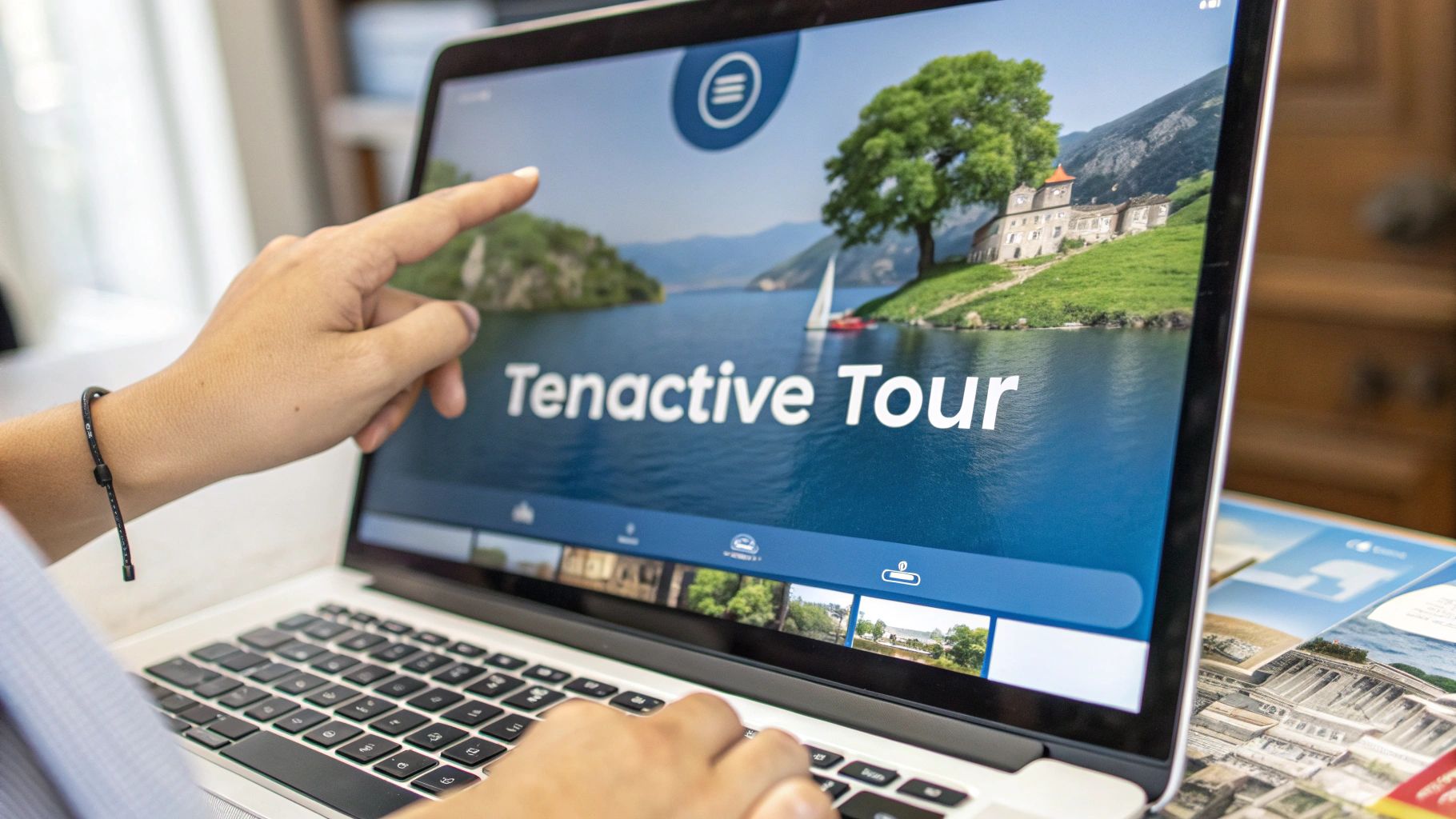
Implementing interactive product tours is one of the most effective customer onboarding best practices for accelerating proficiency. Instead of static FAQs or lengthy video tutorials, these guided walkthroughs teach by doing, using in-app tooltips and overlays to direct users through key workflows like setting up bill pay or initiating a mobile deposit. This hands-on approach demystifies the platform and demonstrates its value immediately, directly boosting feature adoption rates and long-term customer engagement.
Key Insight: The first 48 hours post-account opening are the most critical for digital engagement. A customer who successfully completes a key action (e.g., mobile deposit, P2P transfer) during this window is over 75% more likely to become a high-value, digitally active user.
Visbanking’s BIAS platform can help identify which features are most correlated with high lifetime value. For instance, if data reveals that customers who set up recurring transfers within their first week have a 30% higher retention rate, you can prioritize building an interactive tour for that specific workflow. By benchmarking your feature adoption rates against top-performing peers, you can pinpoint underutilized services and develop targeted, data-driven walkthroughs to drive engagement, turning a new account holder into an active, profitable relationship. To learn more about how these tours fit into a winning strategy, explore our guide to developing a modern bank digital strategy.
3. Clear Value Proposition Communication
From the moment a customer opens their new account, the clock is ticking. You must immediately and clearly articulate the value they will receive, reinforcing their decision and setting the stage for long-term engagement. Failing to communicate the "why" behind your products leaves customers directionless, increasing the likelihood they will become disengaged or revert to their old banking habits. This is a critical failure in the customer onboarding journey.
One of the most vital customer onboarding best practices is to lead with the outcome, not just the features. A customer did not sign up for a "high-yield savings account"; they signed up for a tool to "grow their money faster for a down payment." This outcome-oriented messaging should permeate your welcome emails, in-app tours, and initial banker conversations. The first 60 seconds of interaction are paramount for establishing this value and preventing the account from becoming dormant.
Key Insight: Top-performing banks frame product value in terms of the customer's financial goals, not the bank's product catalog. They answer the question "How does this make my financial life better?" within the first two interactions, significantly boosting product adoption and cross-sell potential.
Visbanking’s BIAS platform can help quantify the impact of effective value communication. By analyzing product usage patterns, you can correlate initial messaging with activation rates. If data shows customers who receive a "reach your savings goal 20% faster" message have a 40% higher direct deposit setup rate than those who get a generic "welcome" email, you have a clear business case for refining your communication strategy across all new accounts.
4. Progressive Feature Disclosure
Overwhelming new customers with every feature of your digital banking platform at once is a recipe for confusion and disengagement. A cluttered interface filled with advanced options that are irrelevant to a first-time user can obscure the core value proposition. This cognitive overload leads to frustration, making it less likely that customers will explore and adopt the very tools designed to deepen their engagement.
One of the most effective customer onboarding best practices is to implement progressive feature disclosure. This approach involves introducing features and capabilities gradually, revealing more advanced functionality only after a user has mastered the basics or when it becomes contextually relevant to their actions. The objective is to create a guided journey that builds confidence and demonstrates value at each step, transforming a potentially intimidating experience into an intuitive and empowering one.
Key Insight: The goal is not to hide functionality but to reveal it at the perfect moment. Successful digital onboarding guides users from essential tasks like checking balances and making transfers to more advanced features like setting savings goals or using P2P payments, all at a natural pace.
Visbanking’s BIAS platform can pinpoint where this strategy is most needed. For instance, if our data shows that 95% of new users on your platform only perform balance inquiries in their first 30 days while competitor platforms see 40% adoption of bill pay services, it signals a clear onboarding failure. By benchmarking feature adoption rates, you can identify which advanced tools are being overlooked and design a progressive disclosure path that systematically introduces them based on user behavior triggers, such as after their first direct deposit or third login.
5. Implement Hands-On Onboarding Assignments
Simply showing new customers how to use your services is insufficient; you must guide them to experience value firsthand. Passive tours and tooltips are easily ignored, but structured assignments create early, tangible wins that build momentum. By tasking customers with completing small, meaningful actions, you actively demonstrate your platform's utility and solidify their engagement from the very first session. This is a critical component of customer onboarding best practices that transforms initial curiosity into long-term loyalty.
Instead of a generic welcome, challenge customers to complete a high-value action, such as setting up a savings goal or scheduling their first recurring transfer. This approach shifts onboarding from a passive overview to an active, results-oriented experience. Completing these tasks creates a sense of accomplishment and provides immediate, tangible proof of the product's value, significantly boosting the likelihood that the customer will become a frequent, engaged user.
Key Insight: Data consistently shows that customers who complete a key "first value" action within their initial sessions are 50% more likely to be retained after 90 days. For banks, this could be the difference between a dormant account and a primary, profitable relationship.
Visbanking’s BIAS platform helps you identify which onboarding actions correlate most strongly with long-term customer value. For instance, if our data reveals that customers who set up a direct deposit within the first week have a 3x higher lifetime value, you have a clear mandate to build an onboarding challenge around that specific task. This intelligence allows you to move beyond generic onboarding and architect a data-driven journey that demonstrably improves retention and profitability.
6. Proactive In-App Messaging and Education
An engaged customer is a profitable one. Leaving users to discover critical features on their own is a gamble that often results in low product adoption and early churn. The most effective onboarding programs guide users proactively, offering assistance and highlighting value at the precise moment it’s most relevant. This is where contextual in-app messaging becomes an indispensable tool.
This approach moves beyond generic welcome emails to deliver timely, behavior-driven guidance directly within your digital banking platform. For example, if a user adds an external account but doesn’t set up a transfer, a contextual prompt can appear, guiding them through the process. Another one of the most impactful customer onboarding best practices is to use these messages to educate users on features like mobile check deposit or Zelle transfers immediately after they’ve completed a related action, significantly boosting adoption rates.
Key Insight: Proactive guidance transforms the user experience from a self-service puzzle into a guided tour. Banks that successfully implement contextual messaging see a 15-20% higher activation rate for key revenue-driving features in the first 90 days.
Visbanking’s BIAS platform helps institutions identify the most critical drop-off points in the user journey. By analyzing user behavior data, you can pinpoint exactly where customers hesitate or abandon a task. For instance, if data shows a 40% drop-off rate when users first navigate to the bill pay setup screen, you know precisely where to implement a targeted in-app tutorial. This data-driven approach ensures your educational efforts are focused on the highest-impact opportunities, maximizing engagement and feature utilization.
7. Comprehensive Documentation and Self-Service Resources
Empowering customers with the tools to find answers on their own is a cornerstone of modern, scalable service delivery. A reliance on call centers or in-branch support for every minor query creates operational drag and frustrates customers accustomed to instant digital solutions. Building a robust library of self-service resources is not about deflecting support tickets; it's about providing immediate value and fostering user independence.
This critical component of customer onboarding best practices involves creating an easily accessible, well-organized knowledge base with FAQs, video tutorials, and step-by-step guides. For banking, this could include clear instructions on setting up direct deposit, using the mobile check deposit feature, or understanding account fees. These resources reduce the burden on support staff for common, repetitive questions, allowing them to focus on more complex, high-value customer interactions. The result is a more efficient operation and a more confident, capable customer base.

Key Insight: Self-service is not a secondary support channel; it is the preferred first stop for a majority of customers. Institutions that fail to provide comprehensive, easy-to-navigate digital resources are perceived as outdated and create unnecessary friction in the customer journey.
The BIAS platform from Visbanking can directly inform your documentation strategy. By analyzing customer interaction data, call center logs, and chatbot queries, we help you identify the top 10 or 20 most frequent questions new customers ask. For example, if our data reveals that 35% of all onboarding-related support calls concern activating a debit card, you have a clear mandate to create a prominent video tutorial and step-by-step guide for that exact process. This data-driven approach ensures your self-service resources address actual customer pain points, maximizing their impact and delivering a measurable return on investment.
8. Dedicated Onboarding Support and Success Teams
Automating the initial stages of onboarding is critical, but high-value relationships, particularly in commercial or wealth management banking, demand a human touch. A seamless digital experience can be undermined if a new, high-value client feels unsupported when navigating complex products or treasury services for the first time. This is where dedicated support becomes a competitive differentiator, preventing early-stage churn and cementing long-term loyalty.
One of the most impactful customer onboarding best practices for these key segments is to assign dedicated onboarding specialists or success managers. These teams act as a concierge, proactively guiding clients through their first 30-90 days, answering complex questions, and ensuring they achieve their primary financial objectives. This high-touch model transforms onboarding from a transactional process into a strategic, relationship-building engagement, significantly increasing product adoption and share of wallet. It directly addresses the risk of losing valuable clients who might otherwise struggle and quietly switch to a competitor.
Key Insight: For high-value commercial clients, the cost of a dedicated onboarding specialist is minimal compared to the potential lifetime value at risk. Banks that fail to provide this concierge-level service see lower product cross-sell rates and higher churn within the first year.
Visbanking’s BIAS platform can help identify which client segments justify this investment. By analyzing customer profitability data against onboarding costs, you can determine the precise revenue threshold where a dedicated success team delivers a positive ROI. For instance, if data shows clients with over $250,000 in initial deposits have a 40% higher attrition rate without personalized support, you have a clear business case for creating a dedicated onboarding program targeted specifically at this high-value cohort.
9. Data Import and Pre-population of Initial Content
One of the most significant barriers during customer onboarding is the "empty state" problem. When a new business or wealth management client logs into a platform for the first time, they face a blank screen requiring extensive manual data entry. This creates immediate friction and delays their ability to see value, increasing the risk of disengagement. Instead of forcing them to build their financial profile from scratch, best-in-class onboarding facilitates a running start.
A key customer onboarding best practice is to pre-populate their environment with relevant data or provide simple import tools. For a new business banking client, this could mean integrating with their accounting software to import existing payees and transaction histories. For a wealth client, it could involve providing templates for common portfolio structures or a guided flow to migrate assets from a competitor. This approach transforms a daunting setup task into a simple validation exercise, drastically shortening the time to first value.
Key Insight: The initial user experience should focus on validation, not creation. When a client can immediately see and interact with their own data or a relevant template, their engagement and perception of the platform's utility skyrocket. This shifts the onboarding narrative from "work I have to do" to "value I'm already getting."
Visbanking’s BIAS platform can help identify which onboarding features drive the highest adoption rates for specific customer segments. For example, our data might reveal that business clients who use an accounting software import tool have a 40% higher product cross-sell rate within the first 90 days. This intelligence allows your institution to prioritize integrations and template development that deliver the most significant impact on customer lifetime value and retention, ensuring your technology investments are directly tied to measurable business outcomes.
10. Measurable Onboarding Metrics and Continuous Optimization
An onboarding process without clear metrics is a ship without a rudder. Simply launching a new digital flow is insufficient; to achieve sustainable growth and profitability, institutions must treat onboarding not as a one-time project but as a dynamic process that requires constant measurement and refinement. This involves establishing clear key performance indicators (KPIs) to monitor performance, identify friction points, and make data-driven decisions.
Tracking metrics like application completion rates, time-to-first-transaction, and early feature adoption provides an objective view of the customer experience. A high drop-off rate between identity verification and account funding, for instance, signals a clear process bottleneck. Implementing one of the most crucial customer onboarding best practices, continuous optimization, allows a bank to methodically test solutions, such as simplifying the funding step or offering more payment options, to improve outcomes.
Key Insight: Top-performing institutions don't just measure onboarding completion; they track "time to value," specifically how long it takes a new customer to engage with a core, revenue-generating product like bill pay or mobile deposit. Reducing this timeline is directly correlated with higher long-term customer retention and profitability.
This is where granular performance data becomes a competitive weapon. The Visbanking BIAS platform enables you to benchmark your onboarding funnel against anonymized peer data, moving beyond internal assumptions. For example, if our data reveals that your mobile check deposit adoption rate in the first 30 days is 15% while the top quartile achieves 35%, you have a clear, quantifiable target for improvement. This level of insight transforms strategic discussions and provides a clear mandate for targeted enhancements. You can learn more about our banking analytics and how to apply them.
Customer Onboarding: Top 10 Practices Comparison
| Approach | Implementation Complexity 🔄 | Resource Requirements ⚡ | Expected Outcomes 📊⭐ | Ideal Use Cases 💡 | Key Advantages ⭐ |
|---|---|---|---|---|---|
| Personalized Onboarding Flows | 🔄 High — segmentation logic & dynamic paths | ⚡ Moderate–High — dev, analytics, content | 📊 30–50% faster time-to-value; higher adoption & satisfaction | 💡 Multi-role B2B / industry-specific products | ⭐ Highly relevant experiences; reduced cognitive load |
| Interactive Product Tours and Walkthroughs | 🔄 Medium–High — UX flows & integration | ⚡ Medium — design, tooling (Pendo/Appcues) | 📊 ↑40–60% feature discovery; fewer basic support tickets | 💡 Feature-rich apps where learning-by-doing helps | ⭐ Hands-on learning; memorable & guided |
| Clear Value Proposition Communication | 🔄 Low–Medium — strategy & messaging | ⚡ Low — PM/marketing copy, little dev | 📊 Lower early churn; improved conversions | 💡 All products, especially trials/freemium | ⭐ Fast clarity on benefits; aligns expectations |
| Progressive Feature Disclosure | 🔄 Medium — sequencing & flags | ⚡ Medium — product design, feature-flag infra | 📊 Reduced overwhelm; improved staged adoption | 💡 Complex apps with novice→power-user paths | ⭐ Gradual learning; better long-term adoption |
| Hands-On Onboarding Assignments & Challenges | 🔄 Medium — task design & tracking | ⚡ Medium — content, UX, reward system | 📊 Higher mastery & retention; real user data | 💡 Learning platforms, setup-heavy products | ⭐ Early wins; builds confidence & habit |
| Proactive In-App Messaging & Education | 🔄 Medium — triggers & timing rules | ⚡ Medium — messaging tooling & segmentation | 📊 Timely education; increased adoption (if not overused) | 💡 Contextual workflows and support-heavy areas | ⭐ Just-in-time help; reduces friction when timed well |
| Comprehensive Documentation & Self-Service Resources | 🔄 Low–Medium — structure & upkeep | ⚡ Medium — docs team, video/SEO effort | 📊 −30–40% support tickets; scalable self-service | 💡 Developer tools, complex workflows, high-scale SaaS | ⭐ Empowers users; reduces support load; SEO benefits |
| Dedicated Onboarding Support & Success Teams | 🔄 High — playbooks & human workflow | ⚡ High — hiring, training, time investment | 📊 Dramatic increase in completion & retention | 💡 Enterprise & high-value customers | ⭐ Personal guidance; strong retention & upsell |
| Data Import & Pre-population of Initial Content | 🔄 High — mapping, validation, migration | ⚡ High — engineering, migration support, compliance | 📊 Much faster TTV (days vs weeks); higher activation | 💡 Data-driven products; migrations from competitors | ⭐ Immediate usable state; reduces setup friction |
| Measurable Onboarding Metrics & Continuous Optimization | 🔄 Medium — instrumentation & analysis | ⚡ Medium — analytics tools + analysts | 📊 Identifies friction; enables iterative improvement & ROI | 💡 Growth-focused products with adequate volume | ⭐ Data-driven decisions; measurable impact on metrics |
From Onboarding to Outperforming: The Data-Driven Mandate
The era of one-size-fits-all customer onboarding in banking is over. As we've detailed, executing superior onboarding is no longer just a matter of enhanced customer service; it is a direct result of superior data intelligence. The customer onboarding best practices explored in this article, from personalized onboarding flows to proactive in-app messaging, all hinge on a single, non-negotiable capability: the ability to access, interpret, and act on data with both speed and precision. This is the new competitive mandate for financial institutions aiming for market leadership.
A procedural, check-the-box approach to welcoming new customers is a recipe for mediocrity and, ultimately, churn. The most successful banks view onboarding not as a cost center but as the first and most critical stage of the customer lifecycle. It is the prime opportunity to demonstrate value, build trust, and lay the foundation for a long-term, profitable relationship. This requires a fundamental shift from intuition-based adjustments to data-driven optimization.
Turning Onboarding Insights into Action
The difference between market leaders and the rest is their ability to move from static dashboards to dynamic decisions. It is not enough to simply collect data; you must translate it into strategic action. Consider these key takeaways:
- Personalization Drives Profitability: Understanding a customer's specific financial profile and likely needs allows you to present the most relevant products first. For example, a bank that identifies a new customer as a high-net-worth individual with a complex investment portfolio can tailor the onboarding to immediately highlight private banking services, potentially increasing asset management revenue by 15-20% from that segment within the first year.
- Efficiency Reduces Risk: A streamlined, data-informed process minimizes friction and abandonment. By analyzing peer performance data, a regional bank might discover its 12-step digital onboarding process is 50% longer than the industry average, contributing to a 40% drop-off rate. Simplifying this to six steps based on best practices could slash abandonment and increase new account funding. To truly embrace this data-driven mandate and achieve superior performance, banks are increasingly leveraging AI in business automation for enhanced personalization, efficiency, and predictive insights throughout the onboarding process.
- Continuous Measurement is Non-Negotiable: The most effective customer onboarding best practices are those that are constantly measured and refined. Tracking metrics like "time-to-first-value" or product adoption rates within the first 90 days provides the clear, quantitative feedback needed to iterate and improve.
Executing on this mandate means moving beyond internal metrics alone. Understanding your performance against peers, identifying high-value customer segments that are underserved by competitors, and measuring the real-world impact of your process changes are not optional activities for growth-focused banks. They are the essential functions of a modern, resilient financial institution. If you are ready to transform your onboarding process from a procedural necessity into a competitive weapon, the first step is to establish a clear, unbiased view of your performance and market position.
Ready to stop guessing and start leading? Visbanking provides the definitive peer and market intelligence platform that empowers banks to benchmark performance, identify strategic opportunities, and execute data-driven decisions with confidence. See precisely how your onboarding metrics stack up against the competition and turn insight into outperformance.
Related Articles

Visbanking Blog
Revolutionize Your Banking Operations with Data-Driven Insights from BIAS

Visbanking Blog
Make More Informed Decisions with BIAS, the Data-Driven Banking Solution

Visbanking Blog
AI Banking Revolution: How Machine Learning Transforms Finance

Visbanking Blog
BIAS: The Smart Choice for Banking Intelligence and Action

Visbanking Blog
BIAS: The Smart Choice for Banking Intelligence and Action

Visbanking Blog