
What Is Strategic Risk Management for Banks?
Brian's Banking Blog
When bank executives hear "risk management," their minds often jump to compliance checklists and internal controls. While essential, that's only half the picture.
Strategic risk management is the discipline of identifying, assessing, and acting on the macro-level threats and opportunities that can derail—or define—a bank’s core business plan. It’s not about day-to-day operational hiccups; it’s about the high-stakes decisions—a major acquisition, a new market entry, or a bet on emerging technology—that determine long-term viability and shareholder value.
Understanding Strategic Risk Beyond Compliance
A flawless compliance record is non-negotiable, but it won’t save an institution from a flawed strategy. Traditional risk management protects the bank you have today. Strategic risk management ensures your institution remains relevant and profitable tomorrow.
The focus shifts from preventing a processing error to avoiding a merger that dilutes earnings for a decade. It’s about anticipating market shifts that could render your current business model obsolete, not just perfecting internal processes while a competitor quietly captures your most profitable customer segment.

Consider the distinction: traditional risk ensures loan documents are executed correctly. Strategic risk determines whether you should be in that lending category at all. One is about process; the other is about purpose and positioning.
The Critical Distinction for Bank Leaders
Traditional risk focuses inward on controllable elements: systems, people, and processes. Strategic risk management, by contrast, is almost entirely about navigating external forces: competitors, technological disruption, economic cycles, and evolving customer demands.
Imagine a bank with perfect internal audits that suddenly experiences a 15% drop in new checking accounts from customers under 40. The cause? A five-year plan that completely ignored the rise of user-friendly neobanks. This is a strategic failure. The internal controls were sound, but the market awareness was not. Data intelligence platforms like Visbanking are designed to close this gap by providing the external, competitive benchmarks needed to see these shifts as they happen.
Strategic risk is the exposure a bank creates when it chooses a path. Every decision to act—or not to act—carries inherent risk that must be quantified and managed with the same rigor as credit or operational risk.
Traditional vs. Strategic Risk Management: A Core Comparison
The table below clarifies the fundamental shift in mindset from loss prevention to active value creation. This isn't semantics; it's about elevating risk management from a cost center to a core driver of competitive advantage. This philosophy complements, rather than replaces, foundational duties like regulatory compliance in banking.
| Aspect | Traditional Risk Management | Strategic Risk Management |
|---|---|---|
| Primary Focus | Internal processes, systems, and controls | External forces, market shifts, and competitive threats |
| Timeline | Short-term prevention and immediate controls | Long-term alignment with strategic goals and opportunities |
| Objective | Minimize operational losses and ensure compliance | Maximize risk-adjusted returns and create sustainable value |
| Data Used | Historical, internal performance data | Predictive, external market, and peer benchmark data |
Ultimately, managing strategic risk effectively is impossible when looking only at your own history. It demands sharp, forward-looking data. Intelligence platforms provide that external visibility, turning abstract threats into quantifiable scenarios that enable leadership to make decisions with confidence.
Navigating the Evolving Financial Risk Landscape
The ground is shifting. For banking leaders, the environment is more volatile and interconnected than ever. The siloed categories of credit, operational, and market risk no longer capture the full picture.
We now face a complex web of threats where a single event can cascade across the institution. A sophisticated cyberattack is not merely a data security issue; it can ignite a reputational crisis that shatters depositor confidence overnight. A sudden geopolitical flare-up can disrupt capital markets, sending funding costs soaring. A reactive, siloed approach to risk management is a recipe for failure.
The Interplay of Modern Threats
We are seeing a tangled interplay of technology, geopolitics, and economic turbulence. According to the Executive Perspectives on Top Risks report, economic conditions, cyber threats, and talent management are among the top near-term risks through 2027. This aligns with other analyses of risk management strategies to help tackle 2025's biggest challenges.
For banks, this means juggling more than traditional financial exposures. We must account for external factors like climate impact and operational threats from supply chain disruptions.
Let's ground this with an example. A regional bank considers acquiring a smaller competitor to expand its mortgage lending business. A traditional risk assessment would focus on credit quality and integration costs. A strategic risk assessment asks tougher, data-driven questions:
- Technology Risk: Is the target’s antiquated core banking system a cybersecurity liability that will cost $5,000,000 to remediate, delaying integration by a full year?
- Economic Risk: How will sustained inflation and interest rate volatility impact mortgage demand in their primary market? Could this slash projected revenue by 10%–15%?
- Competitive Risk: Are agile fintech lenders already capturing 30% of high-value refinancings in that market—a trend invisible in standard financial statements?
This analysis uncovers threats a simple pro forma would completely miss. Data intelligence from Visbanking provides the peer and market data to answer these questions decisively.
In this environment, failing to connect the dots between global events and your strategic plan is a critical blind spot. The greatest risks emerge at the intersection of seemingly unrelated domains.
From Reactive Defense to Proactive Offense
This new reality demands a change in mindset. It’s no longer about building a fortress against known threats; it's about developing the agility to navigate an unpredictable world. Data intelligence is your most powerful weapon, turning external forces from threats into strategic advantages.
Good data allows your board to move beyond instinct. Instead of guessing how a competitor’s new deposit product will perform, you can benchmark its actual performance in similar markets. Instead of reacting to a downturn, you can model its potential impact on your loan portfolio with rigorous stress testing for banks. By putting a number on these interconnected risks, the conversation shifts from "what if?" to "what is the probable impact, and what is our data-driven plan?"
Putting a Practical Risk Management Framework into Action
Theory is useless without a disciplined, repeatable process. For bank executives and directors, a robust strategic risk management framework is a core discipline that protects and grows shareholder value. It embeds risk awareness into every major decision.
The process boils down to four distinct, data-driven stages designed to convert abstract "what-if" threats into hard numbers that leadership can act on with confidence.
Step 1: Identification
First, you must scan the horizon for both emerging threats and latent opportunities. This requires looking beyond internal performance reports and tapping into real-time market and competitor data.
For example, you notice a local competitor is aggressively marketing a new small business loan product. With a platform like Visbanking’s BIAS, you can instantly quantify this. You discover this competitor increased its C&I loan originations by 22% last quarter in your core market, targeting industries that account for 30% of your most profitable deposit relationships. A vague concern becomes a specific, measurable threat to your balance sheet.
Step 2: Assessment
Once a risk is identified, you must assess its potential impact and likelihood. Many banks falter here, using subjective labels like "high, medium, or low." A superior approach uses data to model the potential impact on the bottom line.
Consider a planned digital banking upgrade. The risk is a botched rollout that drives depositors away. Instead of guessing, you model the financial exposure. What if you discover a peer bank of your size experienced a 2% drop in non-interest-bearing deposits and a 5% spike in customer service calls after a similar migration? You can now project a potential outflow of $15,000,000 in core deposits. That number quantifies the risk and informs your budget and testing plan.
Step 3: Response
With a clear-eyed assessment, the board and management can make a decisive call. There are four primary strategic responses, chosen based on the bank's risk appetite.
- Accept: For low-impact risks or when the cost of mitigation exceeds the potential loss.
- Mitigate: The most common response. Implement controls to reduce the likelihood or impact, such as enhancing cybersecurity.
- Transfer: Shift the financial consequence to a third party, typically through insurance or contractual clauses.
- Avoid: If a risk is too significant, exit the activity. This could mean shelving a product launch or divesting from a volatile lending category.
This is the core of a functional banking risk management framework, connecting actions directly to strategic goals.
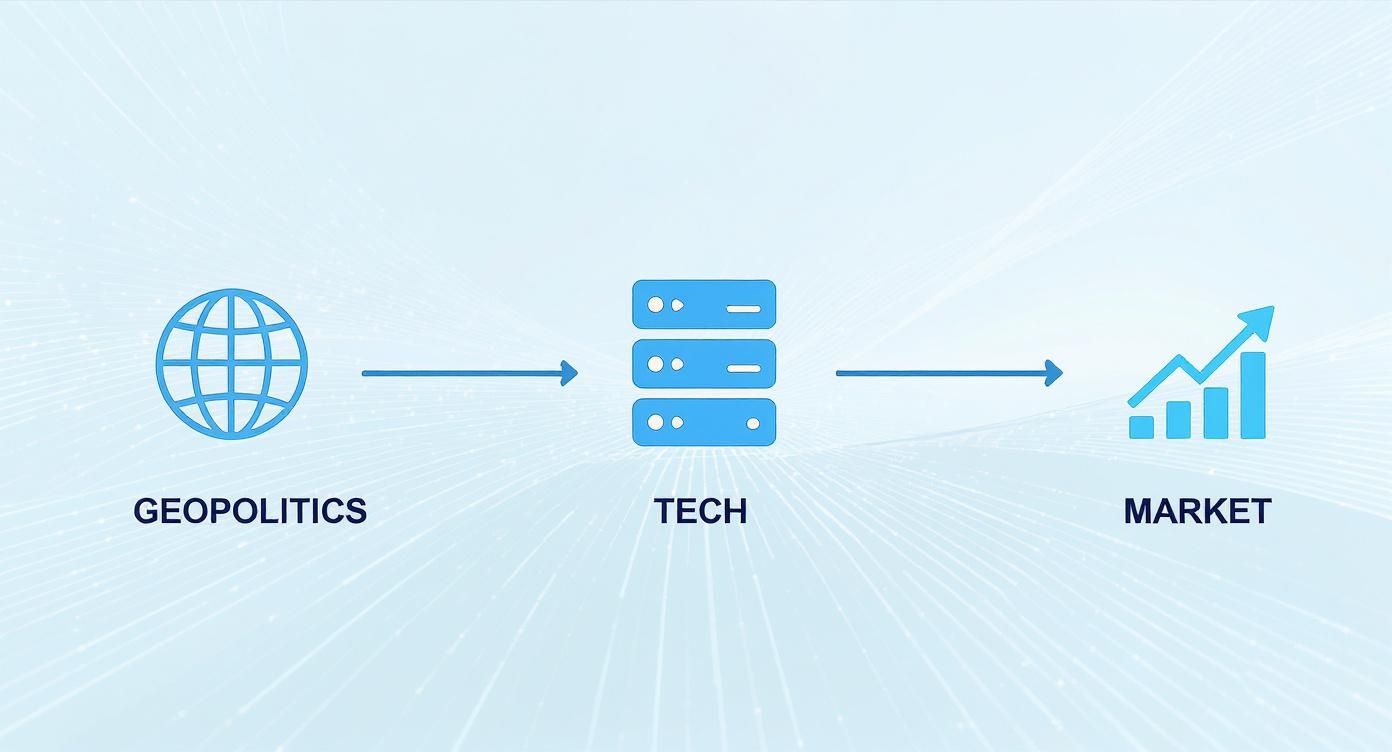
The infographic above illustrates how a single external event can trigger a cascade of risks, demanding a structured response.
Step 4: Monitoring
Strategic risk management is a continuous loop, not a one-time project. The final step involves setting up Key Risk Indicators (KRIs) and using real-time data to monitor risk exposure and the effectiveness of your response strategies.
Monitoring transforms risk management from an annual report into a dynamic capability. It provides the board with an early-warning system, enabling adjustments before a risk materializes into a loss.
Returning to the aggressive competitor example, you would track their loan growth, your customer attrition rates, and market share shifts monthly. If your counter-offer fails to slow their momentum after two quarters, the data will clearly indicate that a more aggressive strategy is required. This closes the loop, turning data into decisive, ongoing action.
Turning Data Into Decisive Strategic Action
A strategic risk framework is a skeleton. Data—the right data—provides the muscle. Without robust, forward-looking intelligence, risk management is merely educated guesswork driven by executive intuition, which is often riddled with outdated biases.
Quality data changes the conversation from "we think" to "we know." In today's market, the quality of your decisions is a direct reflection of the quality of your data. Real-time intelligence is required to move with conviction.
From Ambiguity to Action: A Practical Scenario
Imagine your board is considering an expansion into an adjacent county. The traditional approach might involve dated census data and senior team intuition, leaving dangerous blind spots.
Now, picture that meeting powered by a platform like Visbanking’s BIAS. The board can ask—and immediately answer—surgically precise questions:
- Who are we really up against? Peer analysis reveals three local banks control 75% of the small business lending market. Deeper analysis shows their pricing is so aggressive it would compress your margins.
- How stable is the deposit base? You discover the market is dominated by a few large commercial accounts, making it a hotbed for rate shoppers. The average cost of funds for peers is 35 basis points higher than your own, signaling a fierce fight for every dollar.
- What's hiding in their loan books? You uncover that commercial real estate—specifically office space—constitutes over 40% of the loan portfolios for the top five banks there. In a hybrid-work economy, that is a significant concentration risk.
- Where is the real opportunity? Sifting through demographic and business formation data, you spot a booming medical services sector that local competitors are overlooking. Now you have a viable entry point.
This isn't about eliminating risk; it's about understanding it with precision. The decision shifts from a high-stakes gamble to a calculated strategic move.
Visualizing the Competitive Landscape
A dashboard that benchmarks your bank against competitors in the target market can instantly reveal where you would win and where you would struggle.

This side-by-side comparison brings key metrics like loan growth, efficiency ratio, and asset quality to life. It provides the board with an unvarnished snapshot of the competitive terrain, showing exactly where the bank must outperform to gain market share.
Superior data doesn't just help you see risks; it empowers you to seize strategic opportunities with confidence. It is the definitive line between reactive management and proactive leadership.
By embedding deep market and peer intelligence into your decision-making, you are not just defending against threats—you are actively identifying opportunities others cannot see. See how Visbanking’s BIAS platform can help you find those hidden insights.
Strategic Risk Management: A Tale of Two Banks
The true test of strategic risk management is its impact on the income statement. The difference between a proactive, data-first approach and a traditional, reactive one is not academic—it's financial.
Consider two hypothetical community banks that spot the same market opportunity. Their actions, and results, diverge dramatically.
Bank A: The Reactive Gamble
Bank A’s leadership team, excited by a year-old industry report on small business lending, approves a $50,000,000 allocation for a new loan program. The decision is based on broad economic forecasts and the senior lender’s intuition.
Six months in, the cracks appear:
- Blindsided by Competition: The dated report missed the influx of fintech lenders whose digital-first approach squeezed Bank A's margins by 15% more than projected.
- Dangerous Concentration: A significant portion of new loans went to local retail and restaurants. When a downtown revitalization project stalls, foot traffic plummets, and delinquencies rise.
- Economic Whiplash: A sudden interest rate hike makes it harder for these businesses to service their new debt.
Eighteen months post-launch, non-performing loans in the new portfolio have climbed by 15%. The required increase in the loan loss provision erases any hope of profitability. The strategy, built on stale data, has become a liability.
Bank B: The Proactive Pivot
Bank B sees the same opportunity but insists on a data-driven analysis before committing capital. Using a peer analytics platform, they immediately spot what Bank A missed: the market is saturated, and peer banks are over-exposed to retail CRE. The "golden opportunity" is a trap.
Effective strategic risk management isn’t about running from risk. It's about picking the right risks—the ones you actually understand, can measure, and have a unique advantage in winning.
Instead of abandoning growth, they pivot. Internal data reveals a quiet trend: rising deposits from regional healthcare and specialized manufacturing firms. Cross-referencing this with external market data reveals an underserved niche: specialized equipment financing for these sectors.
They launch a focused $30,000,000 program. The results are starkly different from Bank A's. Bank B grows its total loan book by a healthy 12% over 18 months. By sidestepping the crowded mainstream market, they keep their risk profile 20% lower than their direct peers.
This tale illustrates what real strategic risk management delivers. Bank A made a bet; Bank B made a calculated, data-backed decision. To see where your own institution might have unseen risks or missed opportunities, the first step is to benchmark your performance against your peers.
Building a Proactive Risk-Aware Culture
Frameworks and data are tools. Their power is unleashed by the culture that wields them. Effective strategic risk management is not a static report; it is a dynamic, ongoing conversation across the entire leadership team and boardroom.
This begins by changing how leadership discusses risk. Strategic risk cannot be an afterthought; it requires dedicated, agenda-driven time where management presents not just ideas, but also the data-backed threats and assumptions behind them. The board's role is to challenge those assumptions with sharp, evidence-based questions.
Empowering Management and Aligning Incentives
For robust discussion to occur, management needs two things: the autonomy to raise a red flag and the data to justify it.
When leaders have direct access to peer benchmarks, the conversation shifts from "I feel this is a bad idea" to "Here is an objective analysis showing a competitor’s similar product led to a 10% jump in delinquencies in an adjacent market."
Furthermore, compensation structures must reward long-term, risk-aware thinking. When bonuses are tied solely to short-term volume, you incentivize ignoring strategic risks. Leading banks now link a portion of executive compensation to multi-year, risk-adjusted performance, rewarding sustainable growth, not fleeting wins.
From Checklist to Continuous Dialogue
This investment in a risk-aware culture is accelerating. The global risk management market is projected to grow from US$10.5 billion to US$23.7 billion by 2028, with 36% of organizations planning to increase investment in risk capabilities. You can explore these expanding risk management statistics for more detail. Proactive risk management is becoming a significant competitive advantage.
Strategic risk management is the fundamental responsibility of leadership. It is not an annual checklist item but a continuous conversation that shapes every significant decision the institution makes. An institution's culture is its ultimate risk control.
This disciplined approach transforms risk management from a passive, defensive function into an active, strategic weapon. The banks that thrive will be those that master this dynamic, turning risk awareness into an engine for resilient, long-term value.
The time to move beyond passive oversight is now. Benchmark your institution's performance and begin uncovering the strategic risks and opportunities hidden in your data.
Got Questions? We've Got Answers.
So, How Is Strategic Risk Different from Operational Risk?
Operational risk arises from internal failures—broken processes, people, or systems. A server outage, a mishandled wire transfer, or internal fraud are examples. These events are costly but typically contained.
Strategic risk, conversely, stems from the high-level decisions shaping the bank’s future, such as launching a new digital brand or acquiring a competitor. An operational failure might impact quarterly earnings; a strategic blind spot can jeopardize the institution's future. One is a process failure; the other is a vision failure.
Is Strategic Risk Management Just Something the CEO Handles?
No. While the CEO is ultimately accountable, effective strategic risk management requires the active participation of the entire board and senior leadership team. The board’s duty is to challenge management's assumptions, question the data supporting the strategic plan, and ensure the risk framework is actively used.
Relying on a single perspective creates a massive blind spot. True foresight comes from diverse viewpoints across the C-suite, enabling the identification of threats and opportunities before capital is committed.
How Can We Actually Measure Something as Vague as Strategic Risk?
While strategic risk lacks the precision of credit risk modeling, it is far from immeasurable. The key is to move beyond subjective "high/medium/low" labels to tracking forward-looking Key Risk Indicators (KRIs)—metrics like market share concentration, shifts in deposit mix, or a competitor’s product launch velocity.
The real advantage comes from quantifying abstract threats through rigorous scenario analysis. Tools like Visbanking’s BIAS platform are critical here. Instead of just worrying about a rival's new high-yield product, you can model its precise financial impact. A vague concern becomes a tangible $25,000,000 potential deposit runoff—a problem demanding a clear, data-driven response.
At Visbanking, we believe better data leads to better decisions. It’s time to move from just looking at dashboards to taking decisive action. Benchmark your bank’s performance and see the risks and opportunities hiding in plain sight.
Related Articles

Visbanking Blog
Capital Banking in the USA: An Overview of Investment Services, Financial Instruments, and Regulations

Visbanking Blog
Banking Data Analytics: Turning Information Into Profit

Visbanking Blog
What is a “Risk Continuum” and why on earth should you even care??

Visbanking Blog
Bank Risk Management: Protecting Assets in Uncertain Times

Visbanking Blog
BIAS: Your Competitive Edge in Banking Data Driven Strategy

Visbanking Blog