
Effective Banking Risk Management Framework Strategies
Brian's Banking Blog
Mastering the Essentials of Banking Risk Management
A robust banking risk management framework is essential in today's interconnected financial world. It's the foundation for navigating complex challenges, from traditional credit risks to emerging threats like cyberattacks and geopolitical instability. But what makes a framework effective, and how can institutions prepare for the unexpected?
Core Components of an Effective Framework
A successful banking risk management framework isn't built on isolated processes. It's a connected system of elements working together. Think of it as a well-oiled machine, with each part crucial for smooth operation.
To help illustrate this, let's look at the core components:
- Risk Identification: This involves systematically finding all potential risks that could affect the institution. Think internal operational risks and external market fluctuations.
- Risk Assessment: Once identified, risks are analyzed and measured to understand their potential impact. This often means assigning probabilities and potential losses to each risk.
- Risk Mitigation: This stage focuses on creating strategies and controls to lessen the likelihood or impact of risks. This might involve implementing stricter security or diversifying investments.
- Risk Monitoring: This is the ongoing process of tracking identified risks and how well mitigation strategies are working. This allows for adjustments and improvements to the framework.
To further clarify these components and their implementation, consider the following table:
Core Components of a Banking Risk Management Framework
This table outlines the essential elements that make up a comprehensive banking risk management framework and their primary functions.
| Component | Primary Function | Implementation Considerations |
|---|---|---|
| Risk Identification | Pinpointing potential threats to the institution | Regular internal audits, external expert reviews, scenario planning |
| Risk Assessment | Analyzing and quantifying the potential impact of identified risks | Statistical modeling, stress testing, expert judgment |
| Risk Mitigation | Developing strategies and controls to reduce the likelihood or impact of risks | Implementing new policies and procedures, staff training, investing in new technologies |
| Risk Monitoring | Tracking identified risks and the effectiveness of mitigation strategies | Key risk indicators (KRIs), regular reporting, independent validation |
This table provides a clear overview of the key components and how they function within the larger framework. Implementing these components effectively is crucial for a successful risk management strategy.
Addressing Emerging Challenges in Risk Management
One key trend in banking risk management is the growing focus on geopolitical risks. Central Banking's Risk Management Benchmarks 2025 shows these risks are a rising concern, with cyber risks remaining the biggest current worry. This highlights the complexities of managing risk in a global financial system. Central banks are adapting, with 82.5% of respondents in the 2025 report reviewing their risk management frameworks. This emphasis on geopolitical risks reflects the changing global economic and political landscape.
Rapid technological advancement presents both opportunities and challenges. Technology can improve risk assessment and mitigation, but it also introduces new risks, especially in cybersecurity. Balancing technology's benefits with robust security is key for modern banks. For more on technology's impact, read about the ROI of AI in customer service.
Building a Future-Proof Framework
Building an effective banking risk management framework requires a proactive and adaptable approach. It’s not enough to just react to risks; institutions must anticipate and prepare for them. This means investing in strong risk assessment methods, building a strong risk culture, and constantly monitoring the framework's effectiveness. By embracing a dynamic and forward-looking approach, banks can navigate today's financial complexities and ensure long-term stability and success.
Mapping Your Institution's Risk Landscape
Effective banking risk management isn't about checking off regulatory requirements. It's about deeply understanding your institution's unique risk profile. This means going beyond standard templates and creating a risk taxonomy that truly reflects your specific business model and its challenges.
Identifying and Categorizing Risks
A crucial first step is thoroughly identifying all potential risks, including both established and emerging threats. This involves familiar categories like credit risk, market risk, and operational risk. It also includes newer challenges, such as cyberattacks, geopolitical instability, and climate-related financial risks.
For example, a bank heavily invested in a specific geographic region could face higher geopolitical risk than a more diversified institution. This process requires separating theoretical risks from actual risks, focusing resources on the threats with the biggest potential impact.
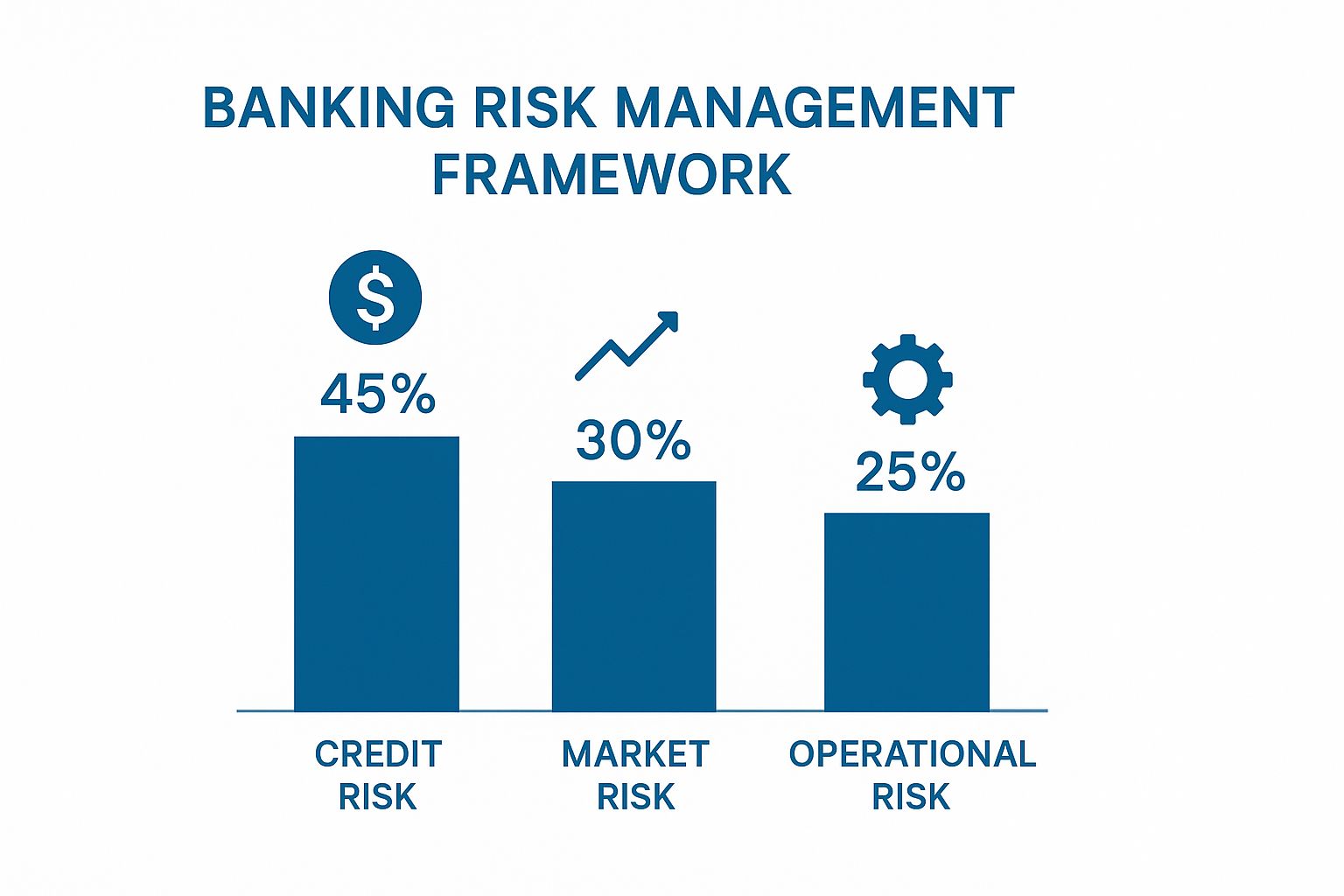
This infographic provides a visual breakdown of the relative impact of three core components of a banking risk management framework.
As the infographic shows, credit risk represents the largest portion (45%) of potential impact, followed by market risk (30%) and operational risk (25%). This highlights the importance of prioritizing resources to manage credit risk effectively. It's also important to maintain robust strategies for addressing market and operational vulnerabilities. Understanding these proportions helps institutions tailor their frameworks for maximum effectiveness.
Quantifying and Capturing Emerging Threats
One of the toughest parts of risk management is quantifying exposures that are inherently difficult to measure. Consider reputational risk. While the damage can be significant, assigning a precise numerical value is complex. This requires developing new approaches, perhaps using qualitative assessments alongside quantitative data.
The dynamic nature of finance requires continuous monitoring and adaptation. Your risk identification processes should be designed to capture emerging threats before they impact your bottom line. For instance, banks must now consider the financial implications of climate change, a risk largely absent from previous frameworks.
To help visualize the various risks and their potential impact, let's look at the following table:
Banking Risk Categories and Their Potential Impacts
This comparison table provides an overview of major banking risk categories, their defining characteristics, potential impacts, and key management considerations.
| Risk Category | Definition | Potential Impact | Management Approach |
|---|---|---|---|
| Credit Risk | The risk of borrowers defaulting on their loans. | Loan losses, reduced profitability, financial instability. | Diversification of loan portfolio, robust credit assessment procedures, stress testing. |
| Market Risk | The risk of losses due to changes in market conditions (interest rates, exchange rates, etc.). | Reduced trading income, decreased portfolio value. | Hedging strategies, market monitoring, limit setting. |
| Operational Risk | The risk of losses due to internal process failures, human error, or external events. | Financial losses, reputational damage, regulatory penalties. | Strong internal controls, disaster recovery planning, business continuity management. |
| Reputational Risk | The risk of damage to an institution's reputation due to negative publicity or public perception. | Loss of customers, decreased investor confidence, difficulty accessing funding. | Public relations management, proactive stakeholder engagement, ethical business practices. |
| Climate-Related Financial Risk | The risk of financial losses associated with the physical and transition impacts of climate change. | Stranded assets, increased insurance costs, supply chain disruptions. | Integrating climate risk into investment decisions, developing climate-resilient business models. |
This table summarizes the key aspects of each risk category, highlighting the potential impacts and management strategies. The interconnectedness of these risks underscores the need for a holistic approach to risk management.
Building a Dynamic Risk Taxonomy
Leading institutions are developing dynamic risk taxonomies that evolve with the changing threat landscape. These aren't static documents. They're living frameworks that are regularly reviewed and updated. This might involve adding new risk categories, refining existing definitions, or adjusting risk appetite statements to reflect changing business strategies.
This iterative process is essential for ensuring the banking risk management framework stays relevant and effective in today's volatile environment. This ongoing adaptation is what differentiates a truly successful framework from one that simply meets regulatory requirements.
Navigating the Regulatory Maze With Confidence

Regulatory requirements are essential for a strong banking risk management framework. Instead of seeing compliance as a burden, successful banks use regulations to create strategic advantages. This means understanding how regulations affect business goals and building frameworks that are both compliant and profitable.
Interpreting Key Regulations and Standards
Navigating the regulatory landscape means understanding guidance from groups like the Basel Committee, local authorities, and international standards organizations. This isn't about memorizing every single rule. It's about grasping the core principles and applying them to your bank's specific situation.
For example, the Basel Committee's principles for effective risk data aggregation and risk reporting (RDARR) offer a general framework. Each bank then adapts these principles to its own systems and operations. Learn more about regulatory compliance.
Monitoring Regulatory Changes and Building Relationships
Top banks use effective monitoring systems to stay ahead. They actively track regulatory changes, analyze their potential impact, and adapt their frameworks proactively. This minimizes disruptions and allows them to anticipate changes, not just react.
Building good relationships with supervisors is also key. Open communication with regulators can provide helpful information and make compliance smoother. This turns a potentially difficult relationship into something that benefits everyone.
Adapting to Shifting Requirements and Creating Business Value
The regulatory landscape is always evolving. In 2025, banking risk management is predicted to face greater regulatory scrutiny, especially in data governance and cybersecurity. Regulators want to ensure banks are prepared for these growing risks.
For example, the Basel Committee continues to update its guidance on managing interest rate risk in the banking book (IRRBB) and the Internal Capital Adequacy Assessment Process (ICAAP). This regulatory landscape is complicated, with higher expectations in some areas and possible easing in others. Find more detailed statistics here. Banks need to strengthen their controls and risk management, including more rigorous testing and addressing supervisory feedback.
This changing environment demands a proactive approach, using technology to transform data into usable insights for risk mitigation. Frameworks must be adaptable, using modular structures that can be adjusted as regulations change. This lets banks respond quickly to new rules without rebuilding their whole risk management system. This flexibility can be a major competitive advantage.
Going beyond basic compliance can also create real business value. By integrating regulatory considerations into strategic planning, banks can find ways to optimize processes, improve efficiency, and stand out in the market. This changes compliance from a cost into a source of innovation and growth.
Building a Risk Governance Structure That Actually Works
Even the most sophisticated risk models are ineffective without a robust governance structure. This section explores how successful financial institutions build governance structures that effectively balance clear accountability and efficient decision-making.
The Three Lines of Defense: Collaboration, Not Conflict
The three lines of defense model is fundamental to banking risk management frameworks. However, implementing it successfully requires more than simply assigning roles. It requires nurturing a collaborative environment.
- First Line (Operational Management): This line owns and manages risk daily. They are the front line, implementing controls and identifying potential issues.
- Second Line (Risk Management and Compliance): This line oversees, develops frameworks, and monitors the first line's effectiveness. They are the strategists, providing guidance and support.
- Third Line (Internal Audit): This line provides independent assurance, evaluating the effectiveness of both the first and second lines. They are the inspectors, ensuring everything functions as designed.
For example, consider a loan approval process. The first line approves loans based on set criteria. The second line monitors these approvals, looking for patterns or anomalies. The third line audits the entire process, checking if the first and second lines are operating correctly. This layered approach provides checks and balances, ensuring risks are identified and addressed at every level.
Building Effective Risk Committees
Risk committees are vital for governance. But they shouldn't be just another bureaucratic hurdle. Effective committees offer genuine value by providing expert guidance, challenging assumptions, and guaranteeing risk considerations are integrated into strategic choices. This demands clear mandates, diverse membership, and direct access to senior management.
Cultivating a Positive Risk Culture
A strong risk culture is crucial for effective governance. This means integrating risk awareness into all levels of the organization, from front-line staff to the board of directors. This involves training, communication, and incentivizing responsible risk-taking. For example, banks can create reward systems that recognize employees who proactively identify and mitigate risks.
Ensuring Meaningful Board Engagement
Board oversight should be more than a cursory review. The board needs a deep understanding of the institution's risk profile, the ability to challenge management's assumptions, and the authority to hold them accountable for effective risk management. You might be interested in: How to master bank liquidity management. This requires transparent reporting, regular briefings, and access to independent risk information.
Avoiding Common Governance Pitfalls
Common pitfalls include unclear roles and responsibilities, inadequate communication, and a lack of accountability. Successful banks avoid these traps by maintaining segregation of duties while ensuring risk information efficiently reaches decision-makers. This careful balance is vital for a robust governance structure. It prevents conflicts of interest while ensuring everyone has the necessary information for informed decisions. This proactive approach to governance sets leading institutions apart, enabling them to navigate the complex banking risk landscape with confidence and foresight.
Transforming Risk Assessment From Theory to Practice

This section explores how leading banks move beyond theoretical discussions of risk assessment to practical, real-world applications within a banking risk management framework. We'll look at how these institutions generate actionable insights that contribute to their success. This means understanding your institution's specific needs and customizing your approach.
Selecting and Customizing Assessment Tools
Picking the right risk assessment tools is critical. There’s no universal solution. The optimal approach depends on factors like your institution's size, complexity, and specific risk profile. A small community bank has different needs than a large, multinational institution.
For example, a retail lending-focused bank might prioritize credit risk assessment tools, while an investment bank might focus on market risk tools. This focused approach helps ensure resources are used effectively, addressing the most significant threats. Learn more about software options at How to master banking risk management software.
Developing Key Risk Indicators (KRIs)
Key Risk Indicators (KRIs) act as crucial early warning signals. They differ from traditional, backward-looking metrics by focusing on predictive indicators. Rather than simply analyzing past losses, KRIs identify potential future issues.
This proactive approach allows intervention before vulnerabilities become significant problems. For instance, a KRI for credit risk might be the debt-to-income ratio of loan applicants, which can help predict future defaults. A sudden rise in phishing emails could signal increasing cybersecurity risks, prompting enhanced security protocols.
Conducting Stress Tests That Reveal Vulnerabilities
Stress tests are vital for assessing an institution's resilience. However, these tests need to go beyond hypothetical situations. They should realistically simulate vulnerabilities and potential crises that could pose genuine threats.
This involves considering interconnected risks. A stress test might model the combined impact of a market crash and a significant cyberattack, pushing the institution to its limits. This comprehensive approach reveals hidden weaknesses that might be missed in isolated scenarios.
Establishing a Risk Appetite Framework
A risk appetite framework defines the acceptable level of risk an institution is willing to take to achieve its objectives. It’s not a static document; it should actively guide decisions across the organization.
This involves clearly defined risk tolerance limits for various activities and ensuring these limits are understood and followed. A bank might set its risk appetite for loan defaults by defining a maximum acceptable loss percentage. This framework acts as a guiding principle for balanced, informed decision-making.
Overcoming Implementation Challenges and Leveraging Limited Resources
Building a robust banking risk management framework comes with challenges. Many institutions, particularly smaller ones, have limited resources. This requires creative solutions, like prioritizing high-impact risks and using cost-effective technologies.
Maintaining a dynamic assessment approach is also crucial. The financial landscape is constantly changing, with new risks emerging and existing risks evolving. This requires ongoing monitoring, regular review, and adapting assessment methods to stay relevant and effective. According to the European Central Bank, banks operate in a world of escalating geopolitical tensions and rapid technological change, demanding constant adaptation. This might involve adjusting KRIs, stress test scenarios, and risk appetite statements, keeping the framework aligned with the current threat environment. This proactive stance ensures your institution is prepared for the ever-changing landscape of banking risks.
Harnessing Technology to Revolutionize Risk Management

Technology is reshaping the banking industry. It’s transforming risk management from a mere compliance activity into a strategic advantage. This section explores how banks of all sizes can leverage technology to bolster their risk management capabilities efficiently.
Data Analytics, AI, and Automation: A Powerful Trio
Leading banks are incorporating data analytics, artificial intelligence (AI), and automation to identify risks faster and more accurately. AI algorithms, for example, can sift through massive datasets to pinpoint patterns suggesting fraudulent activities. Automation, meanwhile, can improve the efficiency of compliance processes.
This proactive approach allows financial institutions to identify and address risks before they escalate into significant issues. Data analytics also provides valuable insights into developing trends, enabling banks to adapt their strategies and stay ahead of the competition.
Overcoming Technology Implementation Challenges
Implementing new technology has its challenges. Integrating new systems with existing infrastructure can be a significant hurdle for many institutions. Selecting solutions that offer smooth integration with existing platforms can minimize these difficulties.
Ensuring data quality across various systems is another common challenge. This necessitates the development of robust data governance procedures. These procedures should include validation and cleansing processes.
Building the Right Talent Mix
Technology is only effective when utilized by skilled individuals. Maximizing technology investments requires assembling a team with the right skills. This means a combination of technical expertise and a deep understanding of banking risk management.
This blend ensures practical application of technological capabilities within the banking context. Data scientists can build complex risk models, but risk managers are crucial for interpreting and applying those models effectively.
Emerging Technologies and a Realistic Roadmap
Emerging technologies like machine learning and blockchain hold great potential for improving risk management. Machine learning can refine risk prediction models, while blockchain can increase transparency and security. Implementing these technologies, however, requires a well-defined roadmap.
This roadmap should prioritize integration with the existing banking risk management framework and align with the institution’s overall strategic objectives. Thorough testing and validation are crucial before full implementation. This phased approach ensures that these technologies enhance risk management capabilities, maximizing their impact and minimizing disruptions. This forward-thinking approach will be vital for maintaining a strong and effective risk management framework for years to come.
Demonstrating the Value of Your Risk Management Efforts
Risk management within a banking risk management framework isn't just about avoiding problems. It's about showcasing the real, tangible benefits of your program. This means showing how risk management contributes to the institution's overall goals and resonates with everyone involved, from the board of directors to individual business unit leaders. This requires a proactive approach to measuring, analyzing, and communicating the impact of your risk strategies.
Developing Meaningful Performance Metrics
The first step in demonstrating value is creating Key Risk Indicators (KRIs) that accurately reflect the effectiveness of your risk management program. These metrics should go beyond simply counting identified risks or completed audits. Instead, they should measure the impact on important business objectives.
For example, instead of tracking the number of cybersecurity incidents, track the reduction in financial losses from successful mitigation.
Different stakeholders will also be interested in different metrics. Board members might focus on overall capital adequacy and regulatory compliance, while business unit leaders might be more interested in the effects on operational efficiency and profitability. Tailoring reports to these specific needs ensures the message is relevant and encourages action.
Creating Insightful Risk Reports That Drive Action
Risk reports shouldn't be ignored. They should be dynamic tools that drive decision-making and continuous improvement. This means presenting data clearly, concisely, and actionably. Technology plays a critical role in modernizing risk management. For further information, read this article about the impact of technology. Visualizations, dashboards, and interactive reports can make complex data easier to understand, highlighting key trends and insights.
Risk reports shouldn’t just focus on the past. They should also include forward-looking analyses like scenario planning and stress testing. This helps stakeholders understand and prepare for potential future risks.
Quantifying Both Risk Prevention and Value Creation
Demonstrating value involves quantifying both risks prevented and value created. This means showing not only how your efforts have reduced losses, but also how they have allowed the institution to take calculated risks and pursue growth.
For instance, a strong risk management framework can enable a bank to expand into new markets or offer new products confidently, knowing that potential risks are being managed effectively. This proactive approach demonstrates how risk management is not a cost center, but a strategic advantage.
Continuous Improvement Based on Performance Data
A successful risk management framework is always evolving. Use performance data to identify areas for improvement and adjust your strategies. This could involve changing KRIs, improving risk assessment methods, or updating the risk appetite statement. Regular reviews and updates ensure your framework stays aligned with the institution’s changing risk profile and strategic objectives. According to the European Central Bank, banks are operating in a rapidly changing environment and need to adapt constantly. This iterative process demonstrates a commitment to continuous improvement and reinforces the credibility of your risk management program. By consistently seeking improvement, you not only enhance risk management capabilities but also reinforce its strategic value.
Ready to improve your bank's risk management? Explore how Visbanking can provide the intelligence and action system you need to succeed in today's complex financial world.
Latest Articles

Brian's Banking Blog
Customer Service Survey: A Guide for Bank Executives

Brian's Banking Blog
Dun Number Registration: Banking Executive's 2026 Guide

Brian's Banking Blog
Equity and Debt Financing: A Banker's Decision Guide

Brian's Banking Blog
Download Sales Strategy Template: Boost Bank & CU OKRs

Brian's Banking Blog
Contacts Management Software for Banks & Credit Unions

Brian's Banking Blog