
What Is Market Intelligence? A Guide for Bank Executives
Brian's Banking Blog
In banking, executives are inundated with data yet often starved for actionable insight. Market intelligence is the discipline that converts that raw data into a decisive competitive advantage. It provides clear, evidence-based answers to the board's most pressing questions: Where are we truly gaining or losing market share? What is the real impact of a competitor's recent rate change? Which untapped growth opportunities exist in our adjacent markets?
For bank leadership, market intelligence moves the institution beyond historical reporting into a forward-looking posture that drives both profitable growth and proactive risk management. It is the framework for making high-stakes decisions with confidence.
Defining Market Intelligence for Financial Institutions
At its core, market intelligence (MI) is the systematic gathering, analysis, and application of external information to inform strategic decisions. It is not a single report or a dashboard, but an ongoing discipline for understanding the competitive landscape, market dynamics, and customer behavior.
For a bank's executive team, this discipline weaves disparate data points—competitor rate filings, local demographic shifts, FDIC call reports—into a cohesive narrative that guides strategy. It is the difference between noting a competitor’s deposit growth and understanding precisely which customer segments they are capturing and why their new certificate of deposit special is outperforming yours. This level of granular insight is essential for effective decisions on branch strategy, product development, and capital allocation.
The financial sector recognizes this necessity. The market research industry, a key component of MI, has grown from $71.5 billion in 2016 to over $130 billion in 2023. This growth underscores a critical reality: validated, external insights are no longer a discretionary expense but a prerequisite for competing effectively.
From Data Points to Strategic Direction
Effective market intelligence establishes a clear hierarchy of information, refining raw, unstructured inputs into high-level strategic guidance. This process separates actionable intelligence from a mere data dump.
The journey looks something like this:
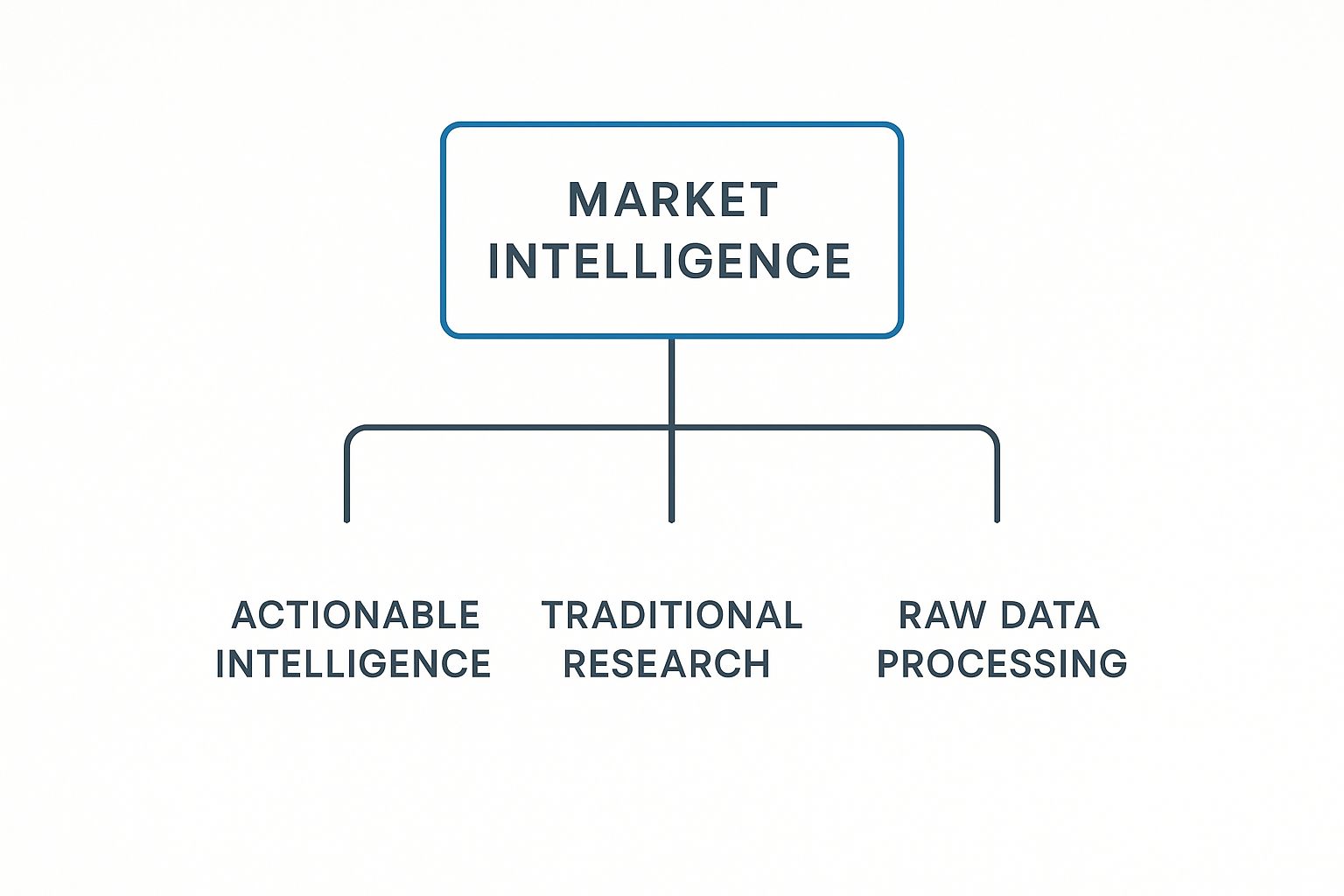
This structure ensures that board-level decisions are based on distilled, relevant intelligence, not raw data. It is a critical distinction for navigating today’s financial landscape. The following table contrasts this modern approach with outdated methods.
Market Intelligence: The Executive Overview
| Component | Traditional Market Research | Modern Market Intelligence (MI) |
|---|---|---|
| Focus | Answers specific, pre-defined questions ("What is our market share?") | Discovers emerging opportunities and threats ("Where could we gain market share?") |
| Cadence | Project-based, conducted quarterly or annually. | Continuous and near real-time, functioning as an ongoing process. |
| Output | A static report or presentation deck; a historical view. | Interactive dashboards, automated alerts, and forward-looking strategic insights. |
| Goal | To inform and validate a specific, isolated decision. | To drive proactive, ongoing strategic adjustments across the institution. |
| Scope | Often siloed, focusing on a single area like customer surveys or competitor ads. | Holistic, integrating competitive, market, economic, and customer data. |
The key takeaway for leadership is clear: traditional research explains what happened, while modern market intelligence informs what to do next.
The Visbanking Approach to Intelligence
At Visbanking, we view market intelligence as a proactive tool for shaping outcomes, not a reactive one for explaining the past. Our platform is engineered to make this process seamless by consolidating regulatory, financial, and market data into a single, cohesive system.
The objective is to equip executive teams with the foresight to act decisively. A foundational element of this is understanding the landscape, as detailed in our guide on how to conduct market research for your bank.
A data-driven bank doesn't just react to market shifts; it anticipates them. Market intelligence provides the critical foresight needed to identify opportunities and mitigate risks before they fully materialize, turning potential threats into a competitive edge.
This mindset transforms intelligence from a cost center into a core driver of profitability and shareholder value.
The Three Pillars of Modern Banking Intelligence
Effective market intelligence is not an abstract concept. It is a practical framework built on three distinct pillars that, when combined, provide a 360-degree view of the strategic landscape. Mastering these pillars is the difference between reacting to market forces and shaping your institution's position within them.

These pillars provide a structure for organizing chaotic external data into a clean, strategic dashboard—precisely how platforms like Visbanking are designed.
1. Competitive Intelligence
Competitive intelligence moves beyond simply identifying competitors to systematically tracking their actions, performance, and strategy. The goal is to anticipate their moves and neutralize threats before they impact your P&L.
Effective competitive intelligence answers urgent questions with hard data:
- Which specific competitor just launched a high-yield savings product that is now capturing an estimated $10 million per month in deposits from our primary service area?
- Why did the rival branch two blocks away see a 15% increase in foot traffic last quarter? What operational or marketing changes did they implement?
- What marketing message is a regional credit union using that has allowed them to capture 30% of the first-time homebuyer mortgage market?
Answering these questions allows your team to replace speculation with precise, data-backed countermeasures. For a deeper examination, we have outlined what is competitive intelligence in banking and its role in strategic formulation.
2. Product Intelligence
While competitive intelligence looks outward, product intelligence assesses your own loan and deposit products against the market backdrop. It provides an objective analysis of where you are winning, where you are vulnerable, and where clear opportunities for growth exist.
Product intelligence isn't about having the most products; it's about having the right products for your specific market, priced to win.
Imagine a Visbanking analysis reveals that your institution is underperforming peers by 25% in money market account balances within a key growth county, despite having a strong overall deposit base. This is not just a statistic; it is an immediate, quantifiable product gap. Closing it could yield millions in low-cost core deposits.
3. Customer Intelligence
Finally, customer intelligence is the discipline of understanding the people and businesses you currently serve and those you aim to serve. It involves analyzing demographic shifts, depositor behavior, and local economic trends to anticipate customer needs.
This pillar is foundational to long-term, sustainable growth. It enables a bank to answer crucial strategic questions:
- With median household income in our primary market projected to grow 5% over the next two years, should we allocate more resources to our wealth management division?
- Are new business formations in the healthcare sector outpacing others in our footprint? Is it time to develop a specialized commercial lending product for medical practices?
Integrating these three pillars, powered by a platform like Visbanking, creates a unified, actionable view of your operating environment. This is how raw data is transformed into a decisive strategic advantage, allowing leadership to benchmark performance and chart a clear course for profitable growth.
Turning Raw Numbers into Your Next Move
Raw data in a database is a liability, not an asset. The value of market intelligence is realized through the systematic conversion of raw material—dense FDIC call reports, local demographic data, competitor rate filings—into a clear strategic action plan.
This is a disciplined process, applying analytics to connect disparate data points and understand not just what happened, but why it happened and what to do about it.

Consider this: an FDIC report shows a competitor’s deposits increased by $25 million last quarter. Standing alone, this number is just noise. A market intelligence platform like Visbanking contextualizes it, layering on demographic data and your own branch performance metrics. The real story emerges: the competitor is successfully capturing high-net-worth households in a specific zip code you previously dominated. The single data point is now a clear strategic directive.
Clean Data In, Smart Decisions Out
In a highly regulated industry like banking, data integrity is paramount. The quality of strategic decisions is directly proportional to the quality of the data underpinning them. The race is no longer to collect the most data, but to ensure the data you use is clean, reliable, and well-governed.
For five consecutive years, establishing a data-driven culture has been a top-five priority for business leaders globally. The message is clear: embedding trusted data into the decision-making fabric of an organization is now a baseline requirement for success.
A flawed data input will always produce a flawed strategic output. For bank executives, ensuring data integrity isn't an IT function; it's a core tenet of risk management and strategic leadership.
Platforms like Visbanking are built on this principle. Every data point ingested—from regulatory filings to economic indicators—is validated and structured for analysis. This foundation of trust provides leaders the confidence to act decisively.
From Complex Data to Clear Direction
The final step is translating complex analysis into clear, unambiguous direction for the leadership team. This requires moving beyond static spreadsheets to dynamic, visual dashboards that tell a story. For a closer look at the tools involved, our guide on the differences between business intelligence and analytics offers further detail.
Ultimately, the process must answer three fundamental questions:
- Where are we exposed? Identify markets and product lines where competitors are gaining ground.
- Where is the opportunity? Pinpoint underserved customer segments or gaps in the competitive landscape.
- How should we respond? Provide the hard evidence required to justify a strategic pivot, new product launch, or targeted marketing campaign.
This structured approach transforms data from a rearview mirror into a forward-looking compass, making market intelligence your most reliable asset for navigating a competitive market.
Putting Market Intelligence To Work: A Banking Scenario
Strategic decisions require objective data, not intuition. To illustrate market intelligence in practice, consider a regional bank’s board debating expansion into a neighboring county—a multimillion-dollar capital decision.
Without a robust market intelligence process, this decision rests on outdated reports and anecdotal evidence, representing a significant gamble. With a modern MI platform, the executive team can convert this high-risk bet into a calculated, evidence-backed strategy.

The first question is whether the market opportunity justifies the investment. An MI platform like Visbanking provides this top-level view instantly.
Analyzing The Market Opportunity
The initial data on the target, "Madison County," reveals a growing, attractive market.
- Total Market Deposits: The county holds $2.5 billion in deposits, a market of sufficient scale.
- Annual Deposit Growth: The market is growing at 4.0% annually, outpacing the national average and indicating a healthy local economy.
- Demographic Trends: Population is projected to grow 2.5% over the next three years, driven by an influx of young professionals and new business formation.
The market is viable. The next question is the competitive landscape.
Evaluating The Competitive Landscape
Here, market intelligence moves beyond a simple list of competitors. An effective MI system dissects their performance, product offerings, and strategic vulnerabilities.
A competitor’s weakness is your strategic opportunity. Market intelligence is the tool that finds and validates those openings, turning observation into a direct plan of attack.
Analysis of Madison County reveals a concentrated market with exploitable weaknesses:
- Market Share Concentration: Three institutions control 75% of deposits, suggesting potential complacency.
- Competitor A (40% Share): A national bank with strong brand recognition but declining branch traffic, down 8% year-over-year.
- Competitor B (20% Share): A regional bank with a dated product set. Its certificate of deposit and small business loan rates are uncompetitive.
- Competitor C (15% Share): A local credit union with a loyal retail base but virtually no commercial banking services.
The data reveals that while a few large players dominate, none are invulnerable. Competitor B’s outdated product offerings present a clear point of attack.
The following table summarizes the data points that form this strategic conclusion.
Scenario Data Points: Expansion into Madison County
| Metric | Data Point | Strategic Implication |
|---|---|---|
| Total County Deposits | $2.5 Billion | The market is large enough to justify the investment. |
| Annual Deposit Growth | +4.0% | The market is healthy and expanding, not stagnant. |
| Key Competitor Weakness | Competitor B offers non-competitive business loan rates. | A clear vulnerability to exploit with a superior product. |
| New Business Registrations | 500 in the last year | Strong, unmet demand for commercial banking services. |
| Competitor Branch Traffic | Competitor A is down -8.0% YOY | Opportunity for a high-touch, community-focused approach. |
This is not a collection of numbers; it is a battle plan.
Identifying The Strategic Entry Point
The intelligence has defined not just if the bank should expand, but how.
The platform identifies a significant gap in the market: small business lending. With 500 new businesses registered last year and the dominant incumbents offering weak or overpriced commercial products, a clear entry point emerges.
Armed with this validated intelligence, the board's decision is no longer a guess. It is a data-driven strategy to enter a $2.5 billion market by surgically targeting an underserved, high-growth segment. This is the power of market intelligence: turning vast amounts of data into a clear, actionable plan.
To see how your institution stacks up against peers, explore how Visbanking can benchmark performance and reveal your next strategic move.
Calculating the ROI of Proactive Decisions
Market intelligence is not an expense; it is a strategic investment with a measurable return. Every decision fueled by proactive insight instead of reactive necessity impacts the bottom line through increased market share, protected net interest margin, and mitigated risks. The value is measured in both revenue gained and losses averted.
This is why investment in market intelligence continues to grow. The U.S. market research industry has expanded at a 3.8% compound annual rate over the last five years, reaching an estimated $36.4 billion in revenue this year. This growth is driven by leadership teams who invest capital in data-driven strategy. Further insights on U.S. market research industry growth confirm this trajectory.
Quantifying Strategic Wins
A board of directors requires tangible financial outcomes, not abstract benefits. A robust MI framework enables leadership to draw a straight line from strategic initiatives to hard performance metrics, demonstrating clear ROI.
Consider these realistic scenarios:
- Loan Portfolio Growth: An MI analysis identifies an underserved commercial real estate niche. Acting on this insight before competitors, the bank launches a targeted lending product, resulting in a $15 million increase to the commercial loan portfolio within 12 months.
- Deposit Protection: Real-time rate monitoring flags a competitor's plan to launch an aggressive high-yield savings campaign. With this advance notice, the bank deploys a proactive retention program, successfully protecting an estimated $50 million in core deposits that were at risk.
Moving from Defense to Offense
These examples illustrate a critical shift in posture. Reactive banks operate defensively, a costly strategy focused on protecting existing turf. Proactive institutions, guided by continuous market intelligence, operate offensively, seizing opportunities before the competition is even aware of them. This is the ultimate competitive advantage.
Intelligence platforms like Visbanking are engineered to facilitate this shift. They transform raw market data into a forward-looking P&L, allowing you to model the financial impact of strategic decisions before committing capital.
The calculation is straightforward: the investment in an intelligence platform versus the multimillion-dollar gains from new loans secured or deposits protected. The ROI of market intelligence is the difference between leading the market and being led by it. By integrating a system that continuously benchmarks performance, you ensure your strategy remains one step ahead. A crucial first step is to benchmark your performance against key competitors.
Weaving Intelligence Into Your Strategic DNA
Market intelligence delivers maximum value when it transitions from a periodic report to a living component of your bank’s strategic rhythm. The goal is to embed a forward-looking, data-driven mindset into the institutional culture, making it foundational to every major decision.
This cultural shift requires a deliberate plan where intelligence is woven into the annual strategic cycle. It establishes a repeatable process that converts market signals into institutional wisdom and, ultimately, confident action. It begins with leadership defining the critical strategic questions for the year and assigning ownership of key market indicators to specific teams, building accountability into the process.
From Annual Guesswork to Continuous Insight
The traditional model of annual strategic planning, based on reviewing historical data, is obsolete. The market moves too fast. The modern approach utilizes a central intelligence hub like Visbanking to ensure the entire leadership team operates from a single, up-to-the-minute source of truth.
This creates a continuous feedback loop, where strategy is informed by real-time market dynamics. Instead of debating a new product based on a six-month-old analysis, the board can access live data showing competitor rate changes from the previous week and new business formation data from the last 30 days.
The objective is to evolve strategic planning from a static annual event into a dynamic, continuous process. When the entire leadership team has direct access to validated market intelligence, strategy becomes smarter, faster, and more resilient.
This is how an institution gets ahead of the market. When a competitor launches a new CD promotion, your team already understands the target demographic and has a data-backed countermove prepared.
Building a Culture That Craves Data
Ultimately, embedding market intelligence is about building a culture where the question "What does the data say?" is the default starting point for every important conversation.
This relies on three pillars:
- A Single Source of Truth: A unified platform like Visbanking eliminates data silos and conflicting spreadsheets.
- Dashboards That Tell a Story: Replace dense reports with visual, intuitive dashboards that instantly flag risks and highlight opportunities for executives.
- Proactive "Heads-Up" Alerts: Configure automated triggers for key competitor moves or market shifts, turning your intelligence system into an early-warning radar.
When these components are in place, market intelligence ceases to be a niche analytical function. It becomes a shared capability that empowers every leader to make better, faster decisions. This is how you navigate the competitive landscape with confidence, turning uncertainty into your most significant strategic advantage.
Your bank's next strategic move is waiting in the data. Visbanking provides the Bank Intelligence and Action System to uncover it. Benchmark your performance and explore opportunities today.
Related Articles

Visbanking Blog
Banking Data Analytics: Turning Information Into Profit

Visbanking Blog
BIAS: The All-in-One Solution for Banking Intelligence and Action

Visbanking Blog
Make More Informed Decisions with BIAS, the Data-Driven Banking Solution

Visbanking Blog
BIAS: The Smart Choice for Banking Intelligence and Action

Visbanking Blog
BIAS: The Smart Choice for Banking Intelligence and Action

Visbanking Blog