
What Is Competitive Intelligence in Banking?
Brian's Banking Blog
Competitive intelligence, or CI, is not corporate espionage or a passive watch on the competition. It is a disciplined, ethical framework for converting market data into decisive strategic action.
For bank executives and directors, CI is a critical function. It separates institutions that merely react to market shifts from those that proactively shape them.
A New Framework For Strategic Decisions
Reviewing last quarter’s performance reports is like driving while looking only in the rearview mirror. You see where you’ve been, but you have no foresight into what is coming.
Competitive intelligence is the forward-looking guidance system. It anticipates market turns, reveals efficient routes to growth, and identifies opportunities your competitors have missed. CI is the formal process of turning raw information—regulatory call reports, competitor product announcements, local market share data—into actionable foresight.
This process enables executives to anticipate competitor moves, pinpoint underserved markets, and steer their bank's future with confidence. It is the systematic collection, analysis, and application of intelligence about products, customers, and competitors to support high-stakes decisions.
From Tactical Support To Strategic Imperative
Historically, CI was often a siloed, tactical task focused on basic competitor tracking. Today, it is an essential, bank-wide capability integrated into executive planning.
Market trends reflect this shift. The global competitive intelligence market, valued at approximately USD 50.87 billion, is projected to reach nearly USD 122.77 billion by 2033, a compound annual growth rate (CAGR) of 9.1%. You can read the full research on CI market growth for a detailed analysis.
This growth is fueled by a clear return on investment. For example, instead of merely noting a rival’s deposits grew by $50 million, a robust CI function investigates why. Analysis might reveal the launch of a high-yield money market account attracting funds from a demographic your bank also serves.
This level of insight transforms the executive conversation from "What happened?" to "What is our countermove?" It provides the context needed to act decisively—for example, by launching a targeted digital campaign for a superior product or adjusting rates to protect your deposit base.
The following table illustrates how this process translates simple data points into executive action.
From Raw Data to Executive Action
| Traditional Data Point | Competitive Intelligence Insight | Executive Action Enabled |
|---|---|---|
| Competitor X opened a new branch in Zip Code 90210. | Competitor X is targeting high-net-worth individuals; the branch location correlates with a 30% increase in their private banking advertisements. | Launch a digital wealth management campaign targeting the same zip code with a superior, lower-fee service offering. |
| Our auto loan applications are down 5% this quarter. | Two local credit unions launched a "90 days no payment" promotion, capturing 70% of new auto loans in our primary market. | Develop a competitive "rate match plus" offer and empower loan officers to approve it on the spot for qualified applicants. |
| A neobank announced a new high-yield savings account. | Social media sentiment analysis shows the neobank’s account is attracting younger depositors (ages 25-35) who value mobile-first features. | Accelerate the rollout of your new mobile banking app's savings goal feature and promote it heavily on digital channels. |
The pattern is clear: connecting disparate data points creates a strategic advantage.

Modern data intelligence platforms like Visbanking’s BIAS are designed for this purpose. They automate the collection and synthesis of millions of data points, freeing leadership to focus on strategy rather than spreadsheets.
With this level of clarity, your bank can shift from a defensive posture to an offensive one, actively seizing market share and driving profitability.
The Four Pillars of a Banking CI Framework
A robust competitive intelligence program is built on four distinct pillars. Neglecting any one of them creates a significant strategic blind spot. A bank could offer superior products but fail if it misreads economic shifts or is caught off guard by a new fintech competitor. True market leadership requires a comprehensive framework.
Market and Competitor Intelligence
The first two pillars provide an external view.
Market Intelligence is the wide-angle lens, offering a macroeconomic perspective. It addresses critical questions about economic forecasts, regulatory changes, and demographic trends that define the operating environment. For instance, are rising interest rates compressing margins industry-wide, or is your bank being disproportionately affected?
Competitor Intelligence is the zoom lens, providing a granular analysis of your rivals. It moves beyond surface-level metrics to understand their strategies, performance, and market position. A competitor's deposits might grow by $20 million, but effective CI can reveal that 75% of that growth originated from a new business money market account—one targeting a commercial segment you have overlooked. This insight transforms a simple data point into a direct strategic threat, or a significant opportunity.
This infographic outlines the core components of a banking CI framework.
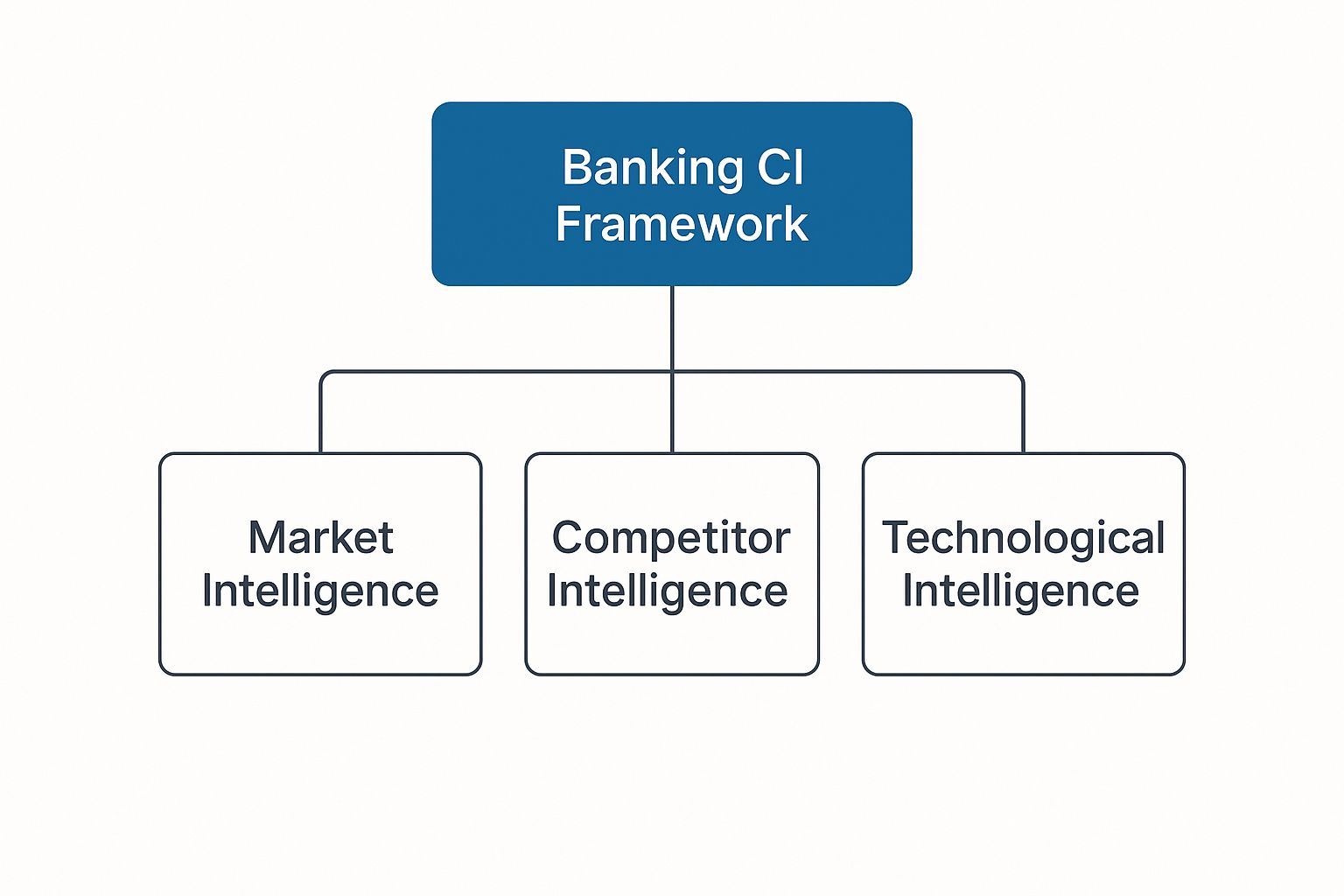
Market, Competitor, and Technological Intelligence are not isolated disciplines; they are interconnected inputs that inform a unified strategy.
Product and Technological Intelligence
The final two pillars focus on your offerings and potential market disruptions.
Product Intelligence involves a methodical breakdown of products offered in the marketplace. This requires benchmarking everything—from checking account fees and CD rates to the specific terms on commercial loan products. If a rival bank consistently wins business, is it because their rates are 0.25% lower, or is their approval process two weeks faster? This is a critical distinction.
Technological Intelligence is the early-warning system for disruption. This pillar tracks fintech innovations, digital banking trends, and new platforms that could challenge traditional models. Understanding which technologies are gaining traction allows you to make informed build, buy, or partner decisions to maintain a competitive edge.
By integrating these four pillars, a bank moves from isolated tactical reactions to a coordinated, strategic execution. Data from each pillar informs the others, creating a powerful feedback loop that sharpens every executive decision.
This is precisely what Visbanking’s BIAS platform is designed to do—unify these disparate information streams to provide a complete market picture. It enables you to benchmark performance not just against peers, but within the full context of market dynamics and technological shifts. Explore our data to see how your institution measures up.
How Winning Banks Use Actionable CI
A strategy remains a theory until it is put into action. In banking, the line between market leaders and the rest is often defined by the ability to convert intelligence into profitable decisions. This is not an academic exercise; it directly drives financial performance.
Top-performing institutions use granular data to anticipate market shifts and preempt competitor moves, generating tangible returns. They analyze specific, numbers-driven tactics that capture market share and attract deposits.

From Insight to Impact
Consider a community bank facing deposit pressure. Instead of a knee-jerk reaction—raising rates across all products—the leadership team used a data intelligence platform to analyze competitor rate sheets, term specials, and marketing messages within their specific market.
The analysis revealed a key opportunity. A rival was aggressively promoting a 12-month CD, but their 18-month product was priced below the market average. Armed with this single data point, the bank launched a promotional 18-month CD, priced slightly above the competition, and supported it with a targeted digital marketing campaign.
The result was immediate and substantial. The campaign attracted $15,000,000 in new deposits in a single quarter, strengthening the balance sheet without initiating a costly, margin-eroding rate war.
Reshaping Market Entry Strategy
Effective intelligence informs tactics and shapes high-level strategy, such as market expansion. A regional bank planned to open three new branches in a nearby metropolitan area—a capital-intensive move.
However, a deeper data analysis told a different story. Demographic data and competitive density mapping revealed an already saturated retail banking market. The real opportunity was an underserved small business sector. Commercial lending was the untapped potential.
With this insight, the bank changed course. It cancelled the costly three-branch plan and instead opened a single, focused commercial lending office. This targeted approach allowed them to capture 20% of the local small business lending market within 18 months, achieving superior profitability with a fraction of the originally planned investment.
These examples underscore a critical point: the most effective strategies are not based on gut feelings. They are forged from precise, actionable data that identifies a competitor's weakness or an unmet market need.
Outsmarting Instead of Outspending
A data-first approach is about outmaneuvering the competition, not simply outspending them. Suppose your primary rival launches a new "premium" checking account. The reactive move is to create a copycat product. The strategic move is to dissect their offering.
By analyzing the competitor’s fee structure, minimum balance requirements, and associated benefits, one bank identified a key vulnerability. The account's monthly fee was waived only with an exceptionally high combined balance, excluding a large segment of the market.
In response, the bank introduced a superior product with a simpler, more attainable fee waiver. This calculated countermove was a success, capturing 30% of all new account openings directly from its main competitor over the next six months.
Each of these victories was powered by a commitment to what is competitive intelligence at its core—turning raw data into strategic wins. To understand your institution's position, you need a clear, unbiased benchmark. Explore our data to uncover your most significant opportunities.
The Tools and Processes That Power Modern CI
Effective intelligence is not accidental. It is the output of a systematic process supported by appropriate technology.
For bank leadership, understanding this workflow is key to transforming competitive intelligence from a backward-looking reporting function into a real-time strategic advantage. While the traditional intelligence cycle—planning, collection, analysis, and dissemination—remains relevant, modern platforms have dramatically compressed the time required for each stage.
Instead of an analyst spending days manually scraping competitor websites or parsing dense quarterly call reports, today’s CI platforms automate this work. A system like Visbanking’s BIAS can aggregate and structure millions of data points—from regulatory filings to local market shifts—instantaneously.
A process that once took weeks now takes minutes. This is a fundamental shift that liberates your strategy team to focus on high-value activities: interpretation, strategic thinking, and decisive action, not data entry.
Automating the Intelligence Workflow
The purpose of a modern CI tool is to provide a single source of truth, eliminating the delays and inconsistencies of fragmented data. The process is both straightforward and powerful.
- Direction and Planning: The process begins by defining Key Intelligence Topics (KITs). Are you focused on protecting deposit market share, growing the commercial loan portfolio, or monitoring a new fintech threat? Clear objectives direct the entire intelligence effort.
- Collection and Processing: This is where technology provides the greatest leverage. Automated systems continuously gather and organize vast quantities of public data—FDIC reports, HMDA filings, competitor press releases—and structure it for immediate analysis.
- Analysis and Production: With organized data readily available, analysts can proceed directly to high-value work. They can benchmark performance against a curated peer group, model the impact of a competitor's rate change, or identify underserved customer segments with precision.
- Dissemination and Action: Insights are not buried in lengthy reports. They are delivered through intuitive dashboards and automated alerts to the relevant stakeholders. An alert about a rival's sudden increase in commercial real estate lending can trigger an immediate strategy session, not a stale review at month's end.
The Growing Demand for CI Platforms
The banking industry's shift toward data-driven strategy is fueling demand for these tools. The market for competitive intelligence platforms is projected to grow by USD 27.95 billion by 2029, driven by the need for superior data and industry benchmarking.
Currently, large enterprises account for over 63% of the market, indicating that data intelligence is no longer optional—it is a core operational requirement for any bank intending to compete effectively. You can review the full market analysis on competitive intelligence tools.
By integrating this technological capability into daily operations, a bank becomes more agile and responsive. Every decision, from the boardroom to the branch, is grounded in real-time market data, not outdated reports or intuition.
This systematic approach is the engine of modern competitive intelligence. It creates a continuous loop where market signals directly inform strategic action, providing a sustainable competitive advantage.
Curious how your bank stacks up? Start by benchmarking your performance with our data.
Building a CI Culture in Your Institution
The most sophisticated competitive intelligence platform provides no value if the organization's culture is not prepared to use it. A sustainable competitive advantage is not derived from a tool but from a data-driven mindset embedded within the bank's DNA.
When this occurs, CI ceases to be a department and becomes a core competency. This cultural shift creates a competitive moat that rivals cannot easily replicate. It must start with leadership consistently demonstrating an external market focus rather than an internal operational one.

From Buy-In to Action
Securing leadership commitment is the first and most critical step. This is achieved by framing CI initiatives in terms of financial impact.
When requesting investment in a data platform, do not focus on features. Connect the request to a tangible business outcome: "By benchmarking our commercial loan rates against our top three competitors in real-time, we can adjust our offerings to capture an additional $20,000,000 in loan volume this year." This language links intelligence directly to the bottom line.
Democratizing Data and Insights
Once executive support is secured, the objective is to disseminate intelligence throughout the organization. Data confined to a silo is worthless. The goal is to empower every team—from marketing and product development to commercial lending—with the insights needed for smarter, faster decisions.
This requires replacing static, outdated reports with live, interactive dashboards.
An effective CI culture ensures that critical insights are not just collected but are delivered to the right people at the right time. It creates clear pathways for intelligence to flow directly to decision-makers, converting passive analysis into proactive strategy.
A marketing manager should be able to see which competitor’s new advertising campaign is gaining traction now. A lending officer should be able to benchmark a proposed deal against current market conditions, not last quarter's.
Platforms like Visbanking’s BIAS are designed for this purpose—to create a single source of truth that aligns the entire organization.
Ultimately, building a CI culture is about changing behavior. It is about ensuring that before any significant decision is made, the first question is always, "What does the intelligence tell us?" When that question becomes institutional reflex, you have built a powerful competitive advantage.
To see how your institution currently stacks up, start by benchmarking your performance with our data.
Your Next Strategic Move Starts Here
In banking, the primary differentiator between leaders and followers is not size or legacy. It is the quality of their intelligence.
Guesswork and intuition are no longer sufficient. Relying on last quarter's reports or assumptions about competitors' actions is a formula for falling behind. True leadership requires knowing competitors' moves before they are made, identifying underserved customers, and neutralizing threats before they materialize.
This does not require a massive organizational overhaul. It begins with a commitment to better data. By benchmarking your bank against a hand-picked peer group on key metrics—loan growth, deposit costs, efficiency ratios—you immediately identify vulnerabilities and opportunities.
This is how strategy transitions from the boardroom to the marketplace. It is about ensuring your next major initiative is also your most informed one.
This discipline is not exclusive to large institutions. The competitive intelligence software market for small and medium businesses is projected to grow from USD 2.56 billion to USD 6.02 billion by 2030. More information is available in these key competitive intelligence findings.
Such clarity is essential for established banks and equally vital for new ventures, informing all critical strategic considerations for new ventures.
A platform like Visbanking’s BIAS delivers the clear, accurate intelligence needed to act with confidence. Explore our data to benchmark your performance today.
A Few Common Questions
As bank leaders consider the implications of competitive intelligence, several key questions typically arise.
Is This Even Legal?
Yes, unequivocally. Professional competitive intelligence is entirely distinct from corporate espionage. It does not involve illicit or unethical tactics.
CI is the systematic analysis of publicly available information, such as regulatory filings (e.g., call reports), news articles, corporate websites, and market data. A reputable CI program operates under a strict code of ethics. The objective is to out-think, not to spy on, the competition.
What's This Going to Cost Us?
While a fair question, the more pertinent one is, "What is it costing us not to have this intelligence?"
Consider the return on investment rather than the initial cost. A modern, platform-based approach is significantly more cost-effective than hiring an in-house team of data scientists and analysts.
To put it in perspective: what is the value of preventing a $50 million deposit outflow? What is the value of capturing an additional 1% of the local commercial lending market? The investment in high-quality intelligence is almost always negligible compared to the cost of a single poor strategic decision.
We Don't Have a Big Team. How Can We Possibly Start?
A comprehensive program is not necessary at the outset. A focused approach is more effective.
Instead of attempting to track everything, identify the two or three most pressing strategic questions your bank faces.
- "How can we profitably grow core deposits in the current rate environment?"
- "Which specific competitor is eroding our market share in the commercial loan portfolio?"
- "Where are the most significant gaps in our product lineup compared to our closest peers?"
A data intelligence platform can provide definitive answers to these questions. This is about achieving tangible wins. By demonstrating value on a small scale, you can build a compelling case for expanding CI efforts across the institution.
True competitive intelligence is not about looking in the rearview mirror. It is about moving your bank from reacting to the market to proactively shaping it. At Visbanking, we provide the data and analytics platform to make that happen. Benchmark your bank against your peers and uncover your next strategic opportunity.
Related Articles

Visbanking Blog
BIAS: Your Competitive Edge in Banking Data Driven Strategy

Visbanking Blog
BIAS: The Smart Choice for Banking Intelligence and Action

Visbanking Blog
BIAS: The Smart Choice for Banking Intelligence and Action

Visbanking Blog
BIAS: The Future of Banking Intelligence and Action System

Visbanking Blog
BIAS: The All-in-One Solution for Banking Intelligence and Action

Visbanking Blog