
A Bank Executive's Guide to C&I Loans: Strategy, Risk, and Data-Driven Growth
Brian's Banking Blog
Commercial and Industrial (C&I) loans are the core operating capital for businesses, financing everything from daily operations and inventory to major equipment acquisitions. Unlike commercial real estate loans tied to physical property, C&I loans are primarily underwritten against a company's cash flow and operating assets.
For bank leadership, these loans are more than a product line; they are the primary channel for embedding the bank within the commercial economy. A robust C&I portfolio is a direct indicator of a bank's market relevance and a critical driver of profitability.
The Strategic Core of the Loan Portfolio
Viewing C&I loans as mere transactions is a significant strategic misstep. These relationships are the most direct conduit to understanding the real-time health of the commercial sector. Proficient execution in this area is not about booking another loan; it is about forging deep, profitable client relationships that serve as a gateway to fee income, deposits, and treasury management services.
A high-performing C&I portfolio does more than bolster the balance sheet; it solidifies a bank's role as an indispensable partner to the business community. This segment is substantial. The global commercial banking industry generated $3.8624 trillion in revenue as of 2025, with U.S. C&I loan balances reaching $2.7096 trillion. For deeper market data, see the analysis from IBISWorld.
The true value of a C&I relationship extends far beyond the interest spread. It is an entry point into a client's entire financial ecosystem, where data on their operational health becomes your most valuable asset for cross-selling and risk management.
Effective commercial banking relationship management is paramount. A data-driven approach enables your team to identify creditworthy prospects, structure deals that align with both client needs and the bank's risk appetite, and maintain proactive portfolio oversight. By analyzing market trends and peer activities, banks can uncover underserved industries or sectors poised for growth—transforming raw data into a competitive advantage.
The directive is clear: a formidable C&I lending program, powered by sharp market intelligence, is the most direct path to sustainable growth. To achieve this, leadership must equip teams with the right tools. The imperative is to move beyond simple underwriting toward a holistic, data-informed approach to relationship banking. This is where Visbanking’s platform provides the necessary clarity, enabling you to benchmark C&I performance and identify your next strategic growth opportunity.
Breaking Down C&I Loan Structures and Applications
To build and manage a sound C&I portfolio, leadership must ensure that loan structures are precisely matched to borrower objectives. Proper structuring is non-negotiable—it is how the bank creates a solution that facilitates client success while protecting its capital.
C&I loans are a specialized discipline within a commercial bank's toolkit, distinct from consumer lending or other services.
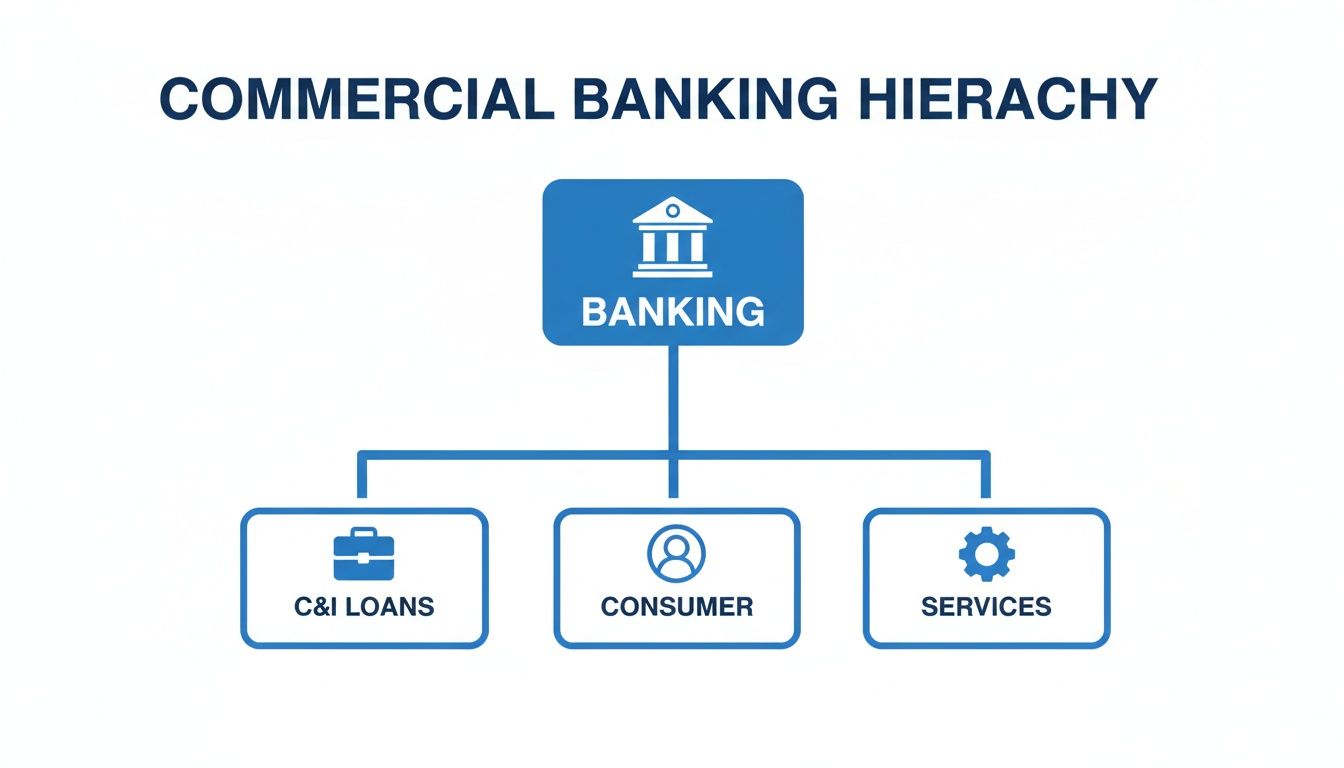
This distinction underscores that C&I lending is a core function demanding deep expertise in underwriting and active portfolio management.
The Workhorses: Term Loans and Revolvers
The majority of C&I facilities are structured as either term loans or revolving lines of credit. Each serves a distinct and critical business need.
- Term Loans: The classic lump-sum facility. The business receives the full loan amount upfront and repays it over a fixed schedule. This structure is ideal for significant, one-time capital expenditures. For example, a manufacturing firm seeking $5,000,000 for new robotic assembly lines would likely be financed with a seven-year term loan, with the equipment serving as collateral.
- Revolving Lines of Credit (Revolvers): Functioning like a corporate credit card, revolvers provide flexible access to capital up to a predetermined limit. A wholesale distributor, for instance, might secure a $2,000,000 revolver to manage seasonal inventory builds. Funds can be drawn as needed and repaid as inventory is sold.
The choice of structure should be dictated by data. A business with a singular, predictable capital need is a prime candidate for a term loan. A company with cyclical cash flow patterns, however, is a clear indicator that a revolver is the more appropriate tool.
Specialized Financing: Asset-Based Lending
For businesses with strong tangible assets but inconsistent cash flow, asset-based lending (ABL) is a powerful solution. ABL facilities are revolvers secured by a company's most liquid assets—typically accounts receivable and inventory.
An ABL facility is dynamic. The credit limit is not static; it fluctuates based on a borrowing base formula that applies advance rates to eligible collateral. This mechanism directly links credit availability to the business's real-time operational performance.
Consider a logistics company with $4,000,000 in eligible accounts receivable and $2,000,000 in inventory. An ABL structure might offer an 80% advance rate on receivables ($3,200,000) and a 50% advance rate on inventory ($1,000,000), creating a total borrowing capacity of $4,200,000. For the lender, this structure provides a robust risk mitigation framework.
The key is understanding and deploying the correct instrument from the C&I toolbox. The table below outlines common structures and their strategic applications.
Common C&I Loan Structures and Their Strategic Applications
| Loan Structure | Primary Business Use Case | Typical Term | Collateral Requirement |
|---|---|---|---|
| Term Loan | Major capital expenditures (equipment, facilities), acquisitions, business expansion. | 3-10 years | Typically secured by the asset being financed; may include a blanket lien. |
| Revolving Line of Credit | Managing working capital, financing seasonal needs, bridging cash flow gaps. | 1-3 years (renewable) | Often secured by accounts receivable, inventory, and other business assets. |
| Asset-Based Lending (ABL) | Working capital for asset-rich companies with fluctuating cash flow. | 1-3 years (renewable) | Secured by a borrowing base of accounts receivable and inventory. |
| Equipment Financing | Purchase of specific machinery, vehicles, or technology. | Matches asset's useful life | The equipment itself serves as the primary collateral. |
Each structure serves a specific purpose. The mandate is to analyze a company's operational needs and match them with the financing instrument that is optimal for both the client and the bank.
By leveraging UCC filing data and analyzing A/R aging reports, banks can develop an evidence-based view of a prospect's collateral quality before initiating substantive discussions. This is where a platform like Visbanking provides a decisive advantage, transforming public data into actionable intelligence for sourcing and underwriting ABL transactions.
The objective is to eliminate one-size-fits-all lending. A data-first methodology empowers relationship managers and credit teams to construct financing solutions that are both profitable for the bank and strategically sound for the client. To lead the market, your team must benchmark these loan structures against the competition. See how Visbanking’s data intelligence platform can deliver that competitive edge.
Modernizing C&I Underwriting with Data Intelligence
A profitable C&I loan portfolio is built on rigorous underwriting. The Five Cs of Credit—Character, Capacity, Capital, Collateral, and Conditions—remain the bedrock of any sound lending decision. However, market-leading institutions no longer evaluate these factors in isolation. They are layering sophisticated, real-time data intelligence to create a more dynamic and predictive framework.

This evolution transforms underwriting from a static review of historical performance into a dynamic, forward-looking risk assessment. It is no longer sufficient to analyze the numbers on a financial statement; it is critical to understand the market forces that will shape those numbers in the future.
A Data-Driven Approach to the Five Cs
Integrating market and peer data fundamentally enhances the analysis of each of the Five Cs. Assumptions are replaced with evidence, providing a sharper, more accurate picture of the risks and opportunities inherent in every C&I loan.
- Capacity: The debt-service coverage ratio (DSCR) is a standard measure of capacity. A data-driven approach asks, "How does this DSCR compare?" It benchmarks a borrower’s cash flow trends against industry peers to determine if their performance is leading, lagging, or merely tracking the market.
- Collateral: Collateral evaluation once centered on an appraisal review. Today, public records such as UCC filings provide a comprehensive view of a company’s entire lien structure, clarifying the bank's lien priority before a term sheet is even drafted.
- Conditions: A generic summary of economic conditions is no longer adequate. Modern underwriting demands a granular analysis of supply chain vulnerabilities, regional economic shifts, and competitive pressures specific to the borrower’s niche.
This is not about complicating the process. It is about building a smarter, more resilient portfolio. This approach empowers credit teams to ask more insightful questions and structure loans capable of withstanding identifiable market stressors.
The objective of modern underwriting is not simply to answer, "Can this business repay its C&I loan based on historical performance?" The critical question is, "How will this business perform relative to its competitors and prevailing market conditions over the life of the loan?" That forward-looking perspective is where data intelligence delivers its greatest value.
Underwriting Scenario: A $10 Million Credit Facility
Consider a mid-sized logistics company requesting a $10,000,000 working capital line of credit. The company presents strong historical financials showing a consistent DSCR of 1.45x. In a traditional underwriting process, this might be sufficient for approval.
A data-intelligent approach probes deeper. By analyzing industry-specific freight pricing data, the underwriting team discovers that sector-wide margins are contracting by an average of 15% due to rising fuel costs. Simultaneously, a review of UCC filings on the company’s largest customers reveals that two of them—representing 30% of accounts receivable—have recently pledged their own assets to other lenders, a significant indicator of potential financial distress.
This new information does not necessarily terminate the deal. Instead, it fundamentally reframes the structuring discussion.
The team can now engineer a more robust credit facility:
- Tighter Covenants: Establish a higher DSCR covenant of 1.50x to serve as an early warning signal.
- Concentration Limits: Implement specific limits on borrowing base exposure to the two at-risk customers.
- Quarterly Reviews: Mandate more frequent reviews of industry pricing trends and link them to covenant compliance.
This is the power of looking beyond the borrower's isolated financials. By integrating external market signals, the bank has structured a safer, more resilient C&I loan that protects its capital while still supporting the client. The decision moves beyond a simple "yes" or "no" to the construction of a credit facility engineered for real-world conditions.
Achieving this level of clarity requires the right tools. Platforms that synthesize financial, regulatory, and market data are indispensable for any modern C&I underwriting team. Exploring advanced analytics for banking can equip your institution to benchmark deals and monitor portfolio health with unprecedented precision.
The ultimate goal is to provide credit officers and relationship managers with the intelligence needed for confident decision-making. Benchmark your underwriting process, leverage available data, and build a C&I portfolio that is not just larger, but fundamentally stronger.
Managing C&I Portfolio Risk and Profitability
For bank executives, a growing C&I portfolio is a powerful engine for profitability. However, growth without disciplined risk management is a direct path to future write-offs. The strategic imperative is to strike a precise balance: deploying capital into relationships that deliver strong, risk-adjusted returns while maintaining rigorous surveillance for any signs of portfolio stress.
This requires moving beyond top-line loan volume and focusing on the key performance indicators (KPIs) that accurately measure the health of the C&I book. These metrics are the instruments on the dashboard, providing the real-time feedback necessary to steer the bank's strategy with confidence.
Core Metrics for C&I Portfolio Health
Effective portfolio management depends on a clear, unobstructed view of both risk and reward. Several KPIs are essential for this purpose, creating a framework for informed decisions on pricing, capital allocation, and risk appetite.
- Risk-Adjusted Return on Capital (RAROC): This is the definitive performance metric. RAROC measures the return a loan or relationship generates relative to the economic capital it requires. It enables a true apples-to-apples comparison of profitability across all C&I segments.
- Concentration Risk: Over-exposure to a single industry, geography, or borrower type is a common and avoidable risk. Establishing and adhering to strict concentration limits is fundamental to ensuring portfolio resilience against sector-specific downturns.
- Non-Accrual Loan Rates: This is the most direct indicator of deteriorating credit quality. A rising non-accrual rate is a clear warning that underlying stress is materializing. It demands immediate investigation and may require a reassessment of underwriting standards.
These are not passive metrics for a quarterly board report; they are active management tools. If the RAROC on new manufacturing loans consistently falls below the bank's cost of capital, it signals a need to re-evaluate pricing models for that sector. If construction C&I concentration approaches the 15% policy limit, it is time to moderate origination and seek diversification.
Navigating Market Dynamics with Data
The C&I lending environment is never static. Macroeconomic shifts directly influence loan demand and borrower health, making it critical to ground portfolio strategy in robust market intelligence. The interplay between interest rate spreads and credit quality provides a clear example.
As seen in Q3 2025, aggregate commercial loan spreads tightened to a weighted average of 2.31%, down from 2.63% the prior quarter, reflecting intense competition for quality credits. Concurrently, non-accrual rates for C&I loans held at approximately 0.95%. This margin compression, occurring alongside persistent credit risk, demands data-driven decisions to optimize the portfolio. Deeper insights into these commercial lending market trends are available for review.
When spreads tighten, the temptation to chase volume by relaxing credit standards is significant. This is a critical error. The superior strategy is to use data to identify market segments where target RAROC can still be achieved without assuming undue risk.
That 0.95% non-accrual rate, viewed in isolation, is just a number. When incorporated into portfolio stress tests, however, it provides a realistic baseline for modeling potential losses in a downturn. This directly informs the provisioning process and is a vital input for calculating the allowance for credit losses.
Benchmarking Your Way to Better Performance
How can you objectively assess whether your portfolio's yield, risk profile, and growth are competitive? Without a clear benchmark, you are operating without crucial context. This is where a bank intelligence platform like Visbanking becomes invaluable. It replaces conjecture with objective, external comparison.
Imagine discovering that your bank's C&I portfolio yield is 50 basis points below that of a curated peer group with a similar risk profile. This is not merely an interesting data point; it is a direct call to action. It empowers leadership to ask critical questions:
- Are our relationship managers pricing new loans too aggressively to win deals?
- Is our product mix overly weighted toward lower-margin facilities?
- Are we failing to capture additional yield by not cross-selling higher-margin treasury services?
By benchmarking against peers, you convert raw data into a strategic roadmap. It enables rapid, informed decisions to reprice relationships, de-risk over-exposed segments, or confidently pursue new markets where a competitive advantage has been identified. Stop guessing. Start knowing. See how Visbanking’s data can illuminate your C&I portfolio's true potential.
Reading the Economic Tea Leaves in Your C&I Portfolio
C&I lending does not exist in a vacuum. It is a direct reflection of the broader economy. For bank executives, this means the portfolio is continuously influenced by macroeconomic forces. Interest rate changes, inflation, and supply chain disruptions are not abstract headlines; they directly impact loan demand and credit quality.
Leading institutions do not simply react to these shifts; they anticipate them. The essential skill is to look beyond a single company’s financials to understand the entire economic landscape. This is the transition from reactive lender to strategic, forward-thinking capital partner—a transition necessary for navigating uncertainty and identifying opportunities ahead of the competition.
From Macro Signals to Smart Moves
Consider the impact of Federal Reserve policy. When the Fed raises rates, the cost of capital increases for every business.
A manufacturer that was planning a $5,000,000 equipment upgrade may postpone the investment, dampening loan demand. Conversely, a logistics company facing supply chain delays might require an increased line of credit to manage excess inventory, creating a short-term spike in demand.
This is not theoretical. The October 2025 Senior Loan Officer Survey indicated a slight tightening of C&I standards but also revealed stronger demand from large and mid-market firms, driven by real-world pressures like inventory investment and pricing adjustments. The data makes it clear how sensitive C&I lending is to the immediate economic environment. The full survey provides detailed macroeconomic C&I lending trends from the Federal Reserve.
The bottom line for bank leadership is this: Macroeconomic indicators are not just news; they are early warning signals for your C&I portfolio. Monitoring these forward-looking data points provides a significant advantage in identifying both risks and opportunities.
For instance, a sustained decline in the manufacturing Purchasing Managers' Index (PMI) is a clear leading indicator of a slowdown. For a bank with heavy exposure to manufacturers, this is a signal to stress test that segment of the portfolio, re-evaluate credit lines, and potentially tighten underwriting for new credits in that sector.
Putting Market Intelligence to Work
Staying ahead of the economic cycle requires synthesizing all available data. Internal portfolio performance must be combined with external market intelligence to gain a complete picture. A deep understanding of market dynamics is non-negotiable for proactive C&I portfolio management. For those new to this concept, this explainer on What Is Market Intelligence provides a solid foundation for building a data-first culture.
This is precisely where a Bank Intelligence and Action System provides a strategic advantage. Instead of relying on intuition or lagging data, your team can use real-time information to answer mission-critical questions:
- Which industries in our market are demonstrating growth despite economic headwinds?
- How are competitors adjusting their C&I loan pricing and terms in response to rate movements?
- Are our largest borrowers concentrated in sectors vulnerable to specific supply chain disruptions?
By integrating data from sources like the Bureau of Labor Statistics, industry reports, and peer bank performance, you can build a dynamic risk model for your C&I portfolio. This enables sharp, data-backed decisions—whether that means proactively engaging a struggling client to discuss restructuring or aggressively pursuing new business in a resilient sector.
This is not just about risk mitigation; it is about intelligent growth. By understanding where the economy is headed, you can position your bank as the first call for businesses navigating change. The goal is to transform economic data from a passive report into an active component of your C&I lending strategy. Benchmark your portfolio, understand your position, and let Visbanking show you how to prepare for the next economic shift.
Turning C&I Data Into Decisive Action
Understanding the mechanics of C&I loans—structures, underwriting, economic drivers—is foundational. In today’s competitive market, however, the banks that win are those that can convert that knowledge into faster, more intelligent decisions. This is where a true Bank Intelligence and Action System elevates C&I lending from a reactive, historical review process to a proactive engine for growth.

The imperative is to shift focus from analyzing what happened to acting on what is about to happen. Instead of simply reviewing last quarter’s financial statements, leading banks monitor real-time market signals to anticipate client needs and identify portfolio risks before they appear on a delinquency report. A robust strategy for collecting and analyzing data for business growth is no longer optional; it is the prerequisite for competitive success.
From Prospecting to Portfolio Management
Effective data intelligence transforms the entire C&I lifecycle, from sourcing high-quality relationships to safeguarding the health of the existing portfolio. It empowers your team to operate with speed and precision, replacing days of manual research and subjective judgment with hard, actionable facts.
Consider these real-world applications:
Identifying a Strategic Opportunity: A relationship manager targets a mid-sized distribution company. Instead of spending a week on preliminary research, they access the company’s UCC filings in minutes. They instantly see the prospect has a $5,000,000 line of credit with a competitor, secured three years ago by specific equipment. The data also reveals the competitor’s lien is limited to that equipment, leaving accounts receivable and inventory unencumbered—a clear entry point for a new asset-based lending proposal.
Detecting Early Warning Signs: An automated intelligence system continuously monitors your $250,000,000 C&I portfolio. It flags a $7,500,000 loan to a construction firm. The trigger: the firm’s Days Sales Outstanding (DSO) has increased by 15 days this quarter, a significant deviation from the 2-day average increase for its local industry peers. This alert immediately notifies the credit officer, enabling a proactive conversation with the borrower weeks before a covenant breach could occur.
The single most important shift a bank can make in C&I portfolio management is moving from lagging to leading indicators. It’s the difference between reacting to a problem and getting ahead of it.
The New Mandate: Actionable Intelligence
In both scenarios, data is not a passive report. It is a trigger for immediate, decisive action. The RM can approach a prospect with a well-informed, tailored solution, and the credit officer can address a weakening credit before it becomes a non-accrual problem. This capability is what separates market leaders from the rest of the pack.
Understanding what are C&I loans is step one. The true differentiator is how your institution leverages data to source, price, and manage them more effectively than anyone else. The path forward is clear: equip your teams with the intelligence they need to act with confidence.
Benchmark your C&I portfolio performance against the market and uncover your next growth engine. Explore Visbanking’s Bank Intelligence and Action System to see how data can drive your strategy forward.
Got Questions About C&I Loans? We've Got Answers.
We've covered the strategic dimensions of C&I lending. Here, we address some of the most common tactical questions faced by bank executives and relationship managers.
What's the Real Difference Between a C&I Loan and a CRE Loan?
The distinction lies in purpose and repayment source.
A C&I loan finances the business operations—working capital, equipment purchases, or general corporate needs. Repayment is generated from the company's operating cash flow.
A Commercial Real Estate (CRE) loan, conversely, finances a specific property. The loan is used to acquire or develop real estate, and repayment is sourced from the income that property generates, such as rental revenue.
How Do You Actually Value Collateral for C&I Loans?
This process blends art and science. C&I collateral consists of operating assets, not fixed property. Key assets include accounts receivable (A/R), inventory, and equipment.
Valuation requires deep analysis. For A/R, you must assess aging and customer concentration risk. For inventory, the critical questions are how quickly it can be liquidated and at what recovery value.
Lenders perfect their security interest in these assets by filing UCC liens. A crucial best practice is to use a data platform to analyze a prospect’s existing lien structure before engaging in deep negotiations. This proactive step can prevent significant complications later.
What Are the Real Warning Signs of a C&I Loan Going South?
Late payments are an obvious, lagging indicator. The true signs of distress often appear much earlier in more subtle operational metrics. The key is to identify patterns.
Key indicators to monitor include:
- Revenue or margin erosion relative to industry peers.
- A lengthening of the cash conversion cycle, indicating difficulty selling inventory or collecting receivables.
- Significant draws on a line of credit without a corresponding increase in sales activity.
- Delays in submitting financial reports or missing covenant deadlines.
This is precisely why proactive, data-driven monitoring is a game-changer. By benchmarking a borrower against real-time industry data, you can detect these early signs of stress weeks or months before a default, providing valuable time to mitigate the risk.
A winning C&I strategy is not about reacting to problems; it is about making intelligent, data-driven decisions that position you ahead of the market.
At Visbanking, our Bank Intelligence and Action System provides the tools to benchmark your portfolio, identify risks before they escalate, and uncover your next strategic growth opportunity.
See how you can gain a competitive edge. Visit us at https://www.visbanking.com.
Related Articles

Visbanking Blog
<strong>The Ultimate Guide to Bank Loans: How to Find the Best Deal and Avoid Getting Burned</strong>

Visbanking Blog
Capital Banking in the USA: An Overview of Investment Services, Financial Instruments, and Regulations

Visbanking Blog
VCs might give you money before you’re profitable

Visbanking Blog
How does a bank decide whether or not your business qualifies for a loan?

Visbanking Blog
Looking for a business loan?

Visbanking Blog