
Mastering Remote Deposit Capture: A Strategic Guide for Bank Executives
Brian's Banking Blog
At its core, Remote Deposit Capture (RDC) is a mechanism for converting paper checks into secure digital images. For banking leaders, however, it represents far more than operational convenience—it is a critical tool for driving efficiency, securing high-value commercial relationships, and generating actionable data.
RDC as a Strategic Imperative
In the current banking landscape, RDC is not a feature; it is a foundational component of any competitive commercial banking offering. The value proposition extends beyond reducing branch traffic. A well-executed RDC strategy directly enhances operational efficiency, reduces processing costs, and is essential for attracting and retaining profitable commercial clients.
The technology enables a client to transform a physical check into a legally binding electronic image at their place of business, unlocking significant operational gains. Consider a community bank processing 5,000 commercial checks in-branch monthly. Shifting this volume to RDC can reduce the per-item handling cost by up to 40%. These are material savings derived from reduced teller hours, courier expenses, and back-office processing.
Beyond Cost Savings to Client Retention
While efficiency gains are significant, RDC’s primary strategic value lies in securing and retaining commercial clients. Businesses view RDC not as a convenience but as an essential treasury management tool that optimizes cash flow and streamlines accounting. Offering a substandard or non-existent RDC platform is a competitive disadvantage when competing for valuable commercial deposits.
A well-implemented RDC service can increase commercial client stickiness by over 60%, as it becomes deeply integrated into their daily financial operations. When a business relies on your RDC system, the cost and inconvenience of switching to a competitor become prohibitively high.
This integration transforms RDC from a service into a strategic asset. By analyzing RDC usage data, executives can identify high-value clients, pinpoint cross-sell opportunities for other treasury services, and preemptively address relationship risks. Understanding these patterns is a cornerstone of a winning bank digital strategy.
This is precisely where data intelligence platforms like Visbanking provide a decisive advantage, offering the tools to benchmark adoption rates against peers and translate raw operational data into actionable growth strategies.
Decoding the Business Value of RDC Technology
Ostensibly, Remote Deposit Capture is straightforward: a client scans a check, the system validates the image, and the data is transmitted for clearing. The true business impact, however, lies beneath this surface—in its direct effects on operational efficiency, client relationships, and the bottom line.
A primary decision is the deployment model. An on-premise solution offers complete control over data and security, a model often preferred by larger institutions with the IT infrastructure to manage servers and compliance in-house. Conversely, a cloud-based (SaaS) model provides scalability and a lower initial capital outlay, outsourcing maintenance and security to a vendor. This allows community and regional banks to offer sophisticated RDC services without a prohibitive upfront investment.
The global RDC market is projected to reach USD 560.12 million by 2033, driven largely by its proven ability to reduce check processing costs by up to 40%. This is not merely a trend but an industry-wide validation of RDC's financial efficacy. A deeper analysis of these market trends and their strategic implications is available in recent industry reports.
Quantifying the Return on Investment
The business case for RDC becomes clear through quantitative analysis. Consider a mid-sized commercial client depositing 200 checks per month.
- Traditional Method (In-Branch): A single deposit run requires an employee 45 minutes for travel and teller interaction. At a loaded labor cost of $30 per hour, this equates to $22.50 per trip, excluding fuel and opportunity costs.
- RDC Method: The same task is completed in approximately five minutes at the client's office. The direct labor cost falls to roughly $2.50—a 90% reduction that commands the attention of any business owner.
This calculation demonstrates how RDC's efficiency gains translate directly into client cost reduction and, more importantly, fuel strategic growth.
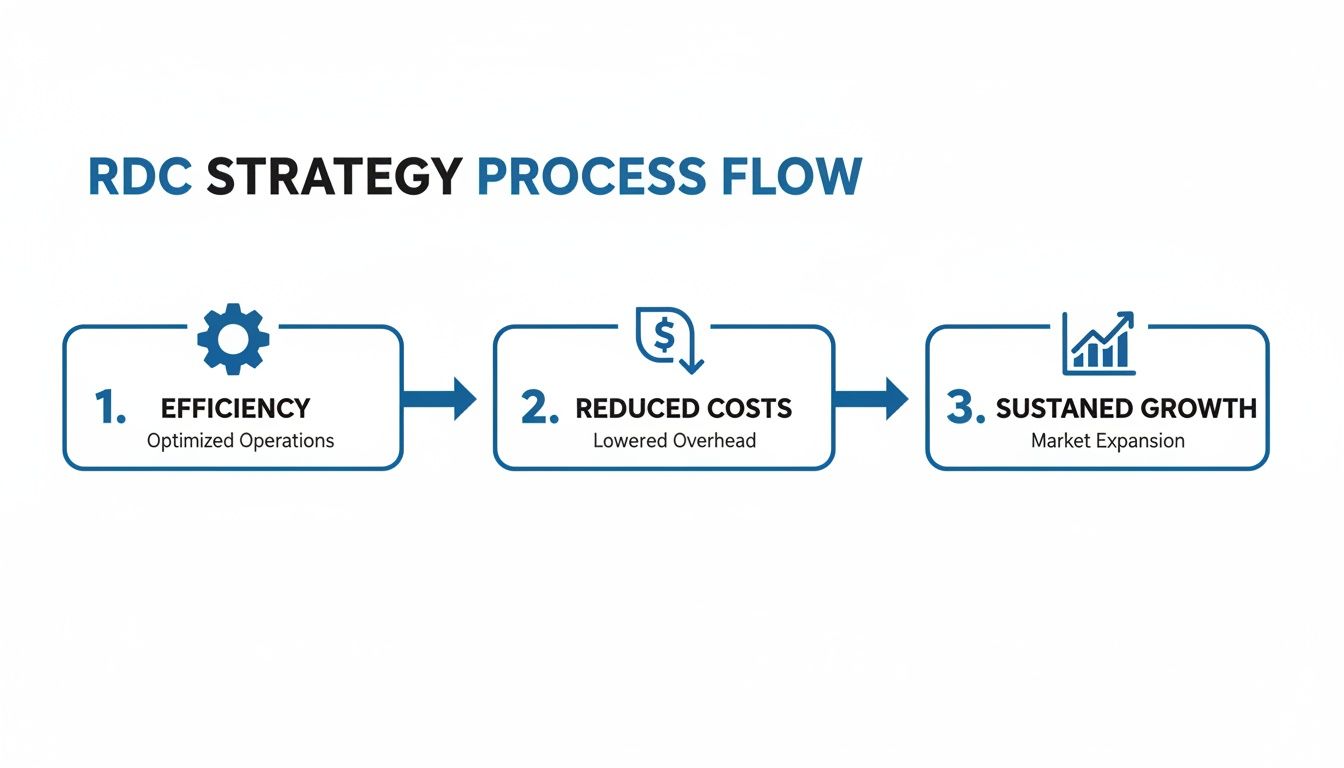
The pathway is clear: operational efficiency reduces costs, freeing capital and human resources to focus on business expansion.
Tying KPIs to Strategic Decisions
Effective management of an RDC program requires moving beyond anecdotal evidence to rigorous Key Performance Indicators (KPIs). These metrics serve as the vital signs of the RDC service, indicating its health and contribution to the bank's strategic objectives.
The true value of RDC isn't just in the cost savings. It's in the data it spins off. Analyzing deposit patterns, error rates, and client adoption gives you the intel to deepen relationships, price services smartly, and get ahead of risk.
Tracking these KPIs is an active exercise in turning data into decisions.
- Adoption Rate: If key commercial clients are not utilizing RDC, a review of the fee structure or targeted training may be warranted.
- Deposit Volume by Channel: A sudden shift in volume from RDC to the teller line could signal a technical issue or a competitor's strategic move.
- Image Error Rate: A high error rate indicates a need for improved client training on scanner usage or a review of the RDC software's image quality controls.
These data points provide the intelligence needed to make decisions that drive profitability. This is where a data intelligence platform like Visbanking becomes indispensable. We enable you to benchmark RDC adoption and fee income against a curated peer group, providing clear insight into your competitive standing. Explore our data to see how your program measures up.
RDC Business Value Metrics
The following are key metrics bank executives should monitor to measure the strategic impact and operational efficiency of their Remote Deposit Capture program.
| Metric | Description | Executive Action Signal |
|---|---|---|
| Adoption Rate | Percentage of eligible commercial clients actively using RDC. | A low rate may indicate poor marketing, complex onboarding, or non-competitive pricing. |
| Average Deposit Value | The average dollar amount per RDC transaction. | Tracking trends helps in forecasting and understanding client business cycles. |
| Image Error Rate | Percentage of deposited items rejected due to poor image quality. | High rates point to issues with client hardware/training or system sensitivity. |
| Cost Per Deposit | Total cost of the RDC program (tech, labor) divided by the number of deposits. | This number should be significantly lower than the cost of a teller-assisted deposit. |
| Client Support Tickets | Volume of RDC-related support inquiries. | A spike could signal a system outage, a difficult user interface, or a need for better FAQs. |
| Revenue Per Client | Fee income generated from RDC services for each client. | Helps identify high-value users and opportunities to cross-sell other treasury services. |
By closely monitoring these KPIs, leadership can transition from simply offering a service to strategically managing a core component of the commercial banking portfolio.
Navigating RDC Risk and Compliance
While remote deposit capture offers substantial efficiencies, it also introduces a new set of risks. For bank executives, managing these risks is not an operational task; it is a fundamental fiduciary responsibility.
A failure to adequately address RDC threats can result in direct financial losses, significant regulatory penalties, and reputational damage that can take years to repair.
Effective RDC risk management requires more than basic controls. It demands an understanding of sophisticated fraud schemes, a command of complex compliance regulations, and a strategy to close operational gaps created when deposits occur outside the branch. The objective is to protect the bank's assets and its reputation in a distributed banking environment.

Unpacking Advanced Fraud Schemes
Fraudsters continually evolve their methods, viewing RDC's speed and automation as an opportunity for exploitation.
- Duplicate Deposits: The quintessential RDC fraud involves depositing the same check at multiple institutions—one via RDC, another via a mobile app—to receive duplicate payment before the fraud is detected.
- Check Alteration and Washing: Modern image-editing software facilitates the alteration of payee or dollar amounts on scanned checks. Criminals also use chemicals to "wash" ink from a physical check, rewrite it for a larger amount, and deposit it via RDC.
- Synthetic Identity Fraud: In this sophisticated scheme, criminals create fictitious businesses, open commercial accounts, and then deposit a high volume of fraudulent checks through RDC, withdrawing the funds before the items are returned.
Consider a commercial client depositing 150 checks monthly with an average value of $2,500. A single altered check that bypasses controls could result in an immediate $25,000 loss. If fraudulent items constitute just 1% of that client’s activity, the annualized exposure exceeds $45,000 from a single relationship.
Mastering the Compliance Landscape
The regulatory framework governing RDC is stringent, and non-compliance carries severe consequences. Bank leadership must ensure the RDC program operates within these established guidelines.
The Check 21 Act of 2004 was the catalyst for RDC adoption in North America, granting digital check images the same legal standing as paper originals. This legislation accelerated clearing times and enabled the use of AI-powered verification, which is estimated to reduce fraud by 25%. Industry reports provide further detail on how regulatory support has shaped the RDC market.
Beyond Check 21, banks must also adhere to:
- Regulation CC: This governs funds availability and establishes the liability of the bank of first deposit for losses arising from duplicate deposits.
- FFIEC Guidance: Regulators have explicit expectations for risk assessments, vendor management, and internal controls related to RDC. Documented policies are subject to examiner review.
Compliance failures result not only in financial penalties but also signal a weak risk culture to regulators, potentially leading to broader supervisory actions.
A strong RDC program is built on proactive risk mitigation, not reactive fraud cleanup. The goal is to spot and neutralize threats before they cause a loss, using data as your first line of defense.
Building a Proactive Mitigation Strategy
An effective risk mitigation strategy combines intelligent technology, robust policies, and data-driven insights. Static rules and manual reviews are no longer sufficient; the approach must be dynamic and adaptive.
This includes a rigorous plan for managing technology vendors and partners. For a comprehensive guide, refer to our article on establishing a third-party risk management framework.
The core of a proactive strategy, however, is the analysis of transaction data to identify anomalous activity indicative of risk.
For example, a business account that typically deposits $150,000 per month suddenly deposits $500,000 in one week. An account that averages 10 deposits per day suddenly submits 50. These are not mere data points; they are critical risk signals that demand immediate investigation.
Data intelligence platforms like Visbanking are designed for this purpose. By establishing a baseline of normal behavior for each client, our system can automatically flag significant deviations in real time. This empowers your team to intervene before funds are released, transforming risk management from a manual, reactive process into a precise, automated defense. To assess your institution's risk profile against peers, explore Visbanking’s peer benchmarking data.
Your Roadmap for RDC Implementation and Integration
A successful remote deposit capture program is not an accident. It is the result of deliberate, strategic planning. For executives overseeing technology and operations, the path from vendor selection to full-scale deployment involves critical decisions that directly impact security, efficiency, and client satisfaction.
A correct implementation creates a powerful strategic asset. A flawed one results in a costly operational liability.
The process begins with selecting the right technology partner. Beyond features, the primary consideration must be compatibility with your core banking system. A disjointed integration creates data silos, necessitates manual workarounds, and introduces security vulnerabilities. Demand a clear and proven integration blueprint from any potential vendor.
Selecting the Right Technology Partner
Choosing an RDC vendor is less a procurement exercise and more the formation of a strategic partnership. Look beyond current features to assess the vendor's long-term product roadmap and financial stability.
- Core System Compatibility: The critical question is: "Do you have proven, documented integrations with our specific core processor?" Request case studies and speak to references using the same core system. Seamless data flow between the RDC platform and the core is non-negotiable.
- Security Architecture: Scrutinize the vendor's security protocols, including data encryption (in-transit and at-rest), multi-factor authentication, and their incident response plan. Your bank remains ultimately responsible for data security, regardless of the software vendor.
- Future-Proofing: Evaluate the vendor's R&D priorities. A partner investing in AI for fraud detection or developing seamless ERP integrations is better positioned for the future than one merely maintaining a legacy system.
A Phased Approach to Integration and Migration
Once a partner is selected, the implementation work begins. Consider a $2 billion community bank migrating from a legacy RDC system to a modern, cloud-based platform. A failed transition could disrupt service for hundreds of commercial clients and place millions in deposits at risk.
A great RDC implementation is about more than just flipping a switch. It’s defined by clear communication, solid client training, and a phased rollout that protects your most valuable commercial relationships from chaos.
A structured project plan for such a migration would span 90-120 days and include the following phases:
- Project Kickoff (Days 1-15): Assemble a cross-functional team of IT, operations, treasury management, and compliance stakeholders. Define roles and success metrics, such as migrating 95% of clients within 60 days of launch with no more than a 5% increase in support calls.
- Technical Integration (Days 16-60): The vendor and your IT team connect the new RDC platform to the core system. This integration must be tested exhaustively in a sandbox environment to ensure the integrity of transaction data, balances, and risk parameters.
- Pilot Program (Days 61-75): Select a small group of 10-15 trusted commercial clients to participate in a pilot. Their real-world feedback is invaluable for identifying issues and refining training materials before a full launch.
- Full Rollout and Training (Days 76-120): Migrate clients in managed waves, supported by proactive communication and training webinars. Ensure relationship managers are experts on the new system to serve as internal champions. This process should align with the bank's broader business automation and SaaS integration strategies to ensure technological coherence.
This disciplined approach transforms a complex project into a predictable process. Furthermore, data can refine this plan. Using a platform like Visbanking, you can benchmark your implementation timelines and resource allocation against peer institutions, ensuring your plan is not only organized but also competitive.
To see how your bank's operational metrics stack up, explore our platform.
Squeezing Every Drop of Value Out of Your RDC Data
Every remote deposit generates a data point. In most banks, this data remains dormant, accessed only for operational reporting or fraud investigations. This represents a significant missed opportunity.
Leading institutions recognize this data as the key to transforming RDC from a cost center into a profit driver. By analyzing this information, you shift from merely offering a service to strategically managing a high-performance asset. The objective is to make your data reveal where to find new revenue.

Turning Raw Numbers into Real Intelligence
The value is unlocked when you move from viewing RDC data as individual transactions to seeing it as a narrative about your clients' businesses. This narrative contains signals that can inform everything from a single sales call to overarching product strategy.
Consider a construction client who typically deposits $250,000 monthly via RDC from approximately 150 checks. For two consecutive months, their volume drops to $100,000. A standard report states the "what." True intelligence provides the "so what."
While it could be seasonal, it could also indicate they are piloting treasury services with a competitor. A data intelligence platform that identifies this anomaly can trigger an automated alert to the relationship manager. This transforms a potential client attrition event into an opportunity for proactive engagement and relationship strengthening.
Finding Hidden Pockets of Growth and Cross-Sell Gold
Your RDC data is a map of your clients' financial operations. Analyzing these patterns across the entire portfolio reveals opportunities invisible at the individual account level.
A client's RDC usage is one of the clearest indicators of their business health and how fast they're growing. By looking at deposit volumes and frequency, you can segment clients with almost surgical precision and figure out exactly what they need next.
A prime example is identifying untapped potential. Data analysis might reveal 25 high-volume RDC clients who are not using your ACH or wire transfer services. This is not just an observation; it is a qualified lead list.
It enables a targeted cross-sell campaign. Instead of a generic sales pitch, your team can state, "We see you are processing a high volume of checks. Our integrated ACH service could likely manage your payroll and vendor payments more efficiently." This consultative approach positions the bank as a strategic partner.
How Do You Stack Up? Benchmarking Against Your Peers
Internal data provides a limited perspective. Without peer benchmarking, you are operating without crucial context. Are your adoption rates competitive? Is your fee structure optimized? Is your fraud rate higher than that of similarly sized institutions?
Without this external comparison, you are flying blind.
Suppose your RDC fee income per commercial client is 15% below the median for your peer group. This single data point prompts critical questions. Is the service underpriced, leaving revenue on the table? Or is the sales team failing to transition clients to appropriate fee-based tiers?
This is where a dedicated platform becomes essential. A tool like Visbanking ingests and standardizes complex regulatory and market data, allowing you to create custom peer groups for precise comparison. This data-driven context eliminates guesswork. You can set realistic performance targets, refine your pricing strategy, and support strategic recommendations to the board with empirical evidence. To understand the foundational concepts, review our guide on business intelligence analytics.
To truly own your RDC program, you need to own your data. Here's a simple framework for how that looks in practice:
Data-Driven RDC Decision Framework
Translating RDC data signals into strategic executive actions to enhance profitability and manage risk.
| Data Signal | Potential Implication | Executive Action Using Data Intelligence |
|---|---|---|
| Consistently high deposit volume from a new client | High-growth business, potential for expanded treasury needs. | Proactively engage with a tailored treasury solutions package. |
| Sudden, unexplained drop in RDC activity | Client may be testing a competitor or facing financial distress. | Trigger an immediate relationship manager outreach to investigate. |
| High percentage of clients in low-tier RDC plans | Under-monetization of the service; potential pricing or sales issue. | Analyze peer pricing and launch a targeted upgrade campaign. |
| Increased rate of returned items from a specific client | Elevated credit or fraud risk. | Automatically flag the account for enhanced monitoring and review limits. |
| Multiple clients in the same industry show declining volume | Sector-wide economic downturn or systemic risk. | Adjust portfolio risk models and inform lending strategy for that industry. |
Ultimately, connecting your transactional data to your strategic goals is what separates the leaders from the laggards. It’s how you find new revenue, dodge risks, and build the kind of sticky relationships that last.
Answering the Tough RDC Questions from the Boardroom
Even with a solid RDC strategy, you’re still going to get tough questions from the top. Executives want to know about long-term value and where you stand against the competition. These aren't just operational questions—they get right to the heart of your bank's strategy. Here are some straight answers to help you lead those conversations.
How Do We Price This Thing to Be Competitive but Still Make Money?
There is no single correct price for RDC. A one-size-fits-all fee structure either leaves revenue on the table with larger clients or alienates smaller businesses. A segmented approach is required.
For small businesses, a tiered model based on item volume provides predictable costs and allows pricing to scale with their growth.
For larger commercial clients, RDC pricing should be integrated into the overall treasury relationship analysis. Consider total deposits, transaction volumes, and the cost to serve. The price should reflect the comprehensive value delivered.
The key is to use data. A platform like Visbanking allows you to benchmark your pricing against peer institutions. If your peers generate $40 per month for a scanner and $0.10 per item, and your pricing is significantly higher, you must justify it with superior value, such as seamless ERP integration or enhanced security features. Pricing is a strategic lever for winning and retaining target clients.
What's the Biggest Way Banks Screw Up an RDC Program?
The costliest mistake is treating RDC as an IT project instead of a core business strategy. Institutions invest heavily in technology—vendor selection, core integration, security—but then fail to drive adoption.
The result is a high-cost, underutilized asset. You can have the most advanced RDC platform available, but if your relationship managers cannot articulate its value proposition or assist with onboarding, adoption rates will stagnate.
A successful RDC program isn't measured by its features; it's measured by its adoption rate. That means you need a real go-to-market plan with solid internal training, client communication that hits the mark, and clear goals for getting customers on board.
Success involves setting a specific target, such as migrating 75% of the top 50 commercial clients to RDC within six months, and aligning relationship manager incentives with that goal. This transforms RDC from a technology project into a driver of commercial banking growth.
Are We Wasting Money on RDC When Real-Time Payments Are Taking Over?
This question misreads the B2B payments landscape. While electronic payments are growing, the paper check is not disappearing overnight. The decline is gradual, particularly for complex business transactions that require detailed remittance information.
Federal Reserve data confirms that businesses continue to issue billions of checks annually, representing trillions of dollars in value. Investing in RDC is not a bet on the future of paper; it is a strategy to capture the significant value flowing through that channel today. A superior RDC experience is a key differentiator for attracting and retaining commercial clients who still rely on checks.
Furthermore, the technology underlying RDC—image capture, OCR, data extraction, AI-based risk analysis—is foundational for future digital payment solutions. The capabilities and infrastructure developed for RDC can be repurposed to digitize other paper-based processes. This is not an either/or decision. Optimizing RDC secures current revenue while building the institutional capacity for tomorrow's payment systems.
Your RDC strategy needs to be powered by sharp, actionable intelligence. Visbanking is the Bank Intelligence and Action System that brings together financial, regulatory, and market data so you can benchmark performance, spot opportunities, and tackle risks head-on. It’s time to move from dashboards to decisions. See how at https://www.visbanking.com.
Related Articles

Visbanking Blog
Banking Data Analytics: Turning Information Into Profit

Visbanking Blog
Revolutionize Your Banking Operations with Data-Driven Insights from BIAS

Visbanking Blog
Revolutionize Your Bank's Performance with BIAS: Unlocking the Future of Visual Banking Data

Visbanking Blog
BIAS: Your Competitive Edge in Banking Data Driven Strategy

Visbanking Blog
From Data Overload to Actionable Insights: How BIAS Simplifies Banking Intelligence

Visbanking Blog