
A Banking Executive's Guide to Third Party Risk Management Frameworks
Brian's Banking Blog
A third party risk management framework is not a compliance exercise. It is a core business discipline, a strategic mandate for identifying, assessing, and neutralizing threats introduced by external partners. For bank leadership, this means abandoning the reactive audit cycle in favor of a proactive system that protects institutional assets, customer data, and reputation.
A modern framework is the mechanism that ensures every vendor relationship aligns with the bank’s strategic goals and risk appetite. It is how you grow confidently through partnerships, assured that risk is actively managed, not merely documented.
Building Your TPRM Framework for Strategic Advantage

As a banking leader, you recognize that third-party relationships are integral to operations. From core processing systems to the digital banking applications your customers demand, vendors are embedded in your value chain. Each partnership, however, introduces a new vector of risk. Unmanaged, this exposure leads to regulatory sanction, operational disruption, and reputational damage that can erode shareholder value for years.
A modern Third Party Risk Management (TPRM) framework transforms this defensive necessity into a competitive advantage. The stakes are too high to treat vendor management as a perfunctory, back-office task. A robust framework provides the board and executive team with the confidence that risks are being actively managed across the entire vendor lifecycle, not just cataloged.
The Business Case for a Robust Framework
The investment in a dynamic TPRM program is not an expense; it is a shield with a clear return on investment. Consider a community bank with $2 billion in assets relying on a third party for its mobile banking platform. A data breach at that vendor exposes the personal information of 50,000 customers.
The financial fallout includes direct remediation costs easily exceeding $1 million, plus significant regulatory fines. The erosion of customer trust, however, is an intangible loss with long-term consequences. A strong framework mitigates this risk through rigorous due diligence and continuous monitoring, making risk management a direct protector of the bottom line.
The market recognizes this urgency. Valued at US$8.3 billion, the global TPRM market is projected to more than double to US$18.7 billion by 2030, driven by escalating third-party breaches and a tightening regulatory environment.
A TPRM framework is the institution's primary defense against imported risk. It’s the structured process that prevents a vendor's vulnerability from becoming the bank's crisis.
A modern TPRM framework must be a dynamic system, not a static policy document. It must perform these core functions to actively safeguard the institution.
Core Functions of a Modern Banking TPRM Framework
| Function | Objective | Key Outcome for the Bank |
|---|---|---|
| Vendor Identification & Onboarding | To ensure all new third-party relationships are thoroughly vetted against predefined risk criteria before engagement. | Prevents high-risk vendors from entering the ecosystem and establishes a baseline for risk assessment. |
| Risk Assessment & Due Diligence | To systematically identify, measure, and evaluate the specific risks associated with each vendor. | Provides a clear, documented understanding of potential vulnerabilities (financial, operational, cyber, etc.). |
| Contract & SLA Management | To ensure contractual agreements include robust risk mitigation clauses, clear service levels, and right-to-audit provisions. | Creates legal and operational accountability, ensuring vendor performance aligns with bank expectations. |
| Continuous Monitoring & Reporting | To actively track vendor performance, financial health, and compliance status throughout the relationship lifecycle. | Enables early detection of emerging risks, allowing for proactive intervention before a crisis occurs. |
| Offboarding & Termination | To securely and completely terminate vendor relationships, ensuring all data is returned or destroyed and access is revoked. | Mitigates post-contract risks, such as data leakage or unauthorized system access. |
These functions work in concert to transform risk management from a compliance exercise into a strategic asset that enhances institutional resilience and protects long-term value.
From Compliance to Competitive Edge
Comprehensive due diligence, including conducting detailed background research, is a critical component of any framework. However, a truly strategic framework moves beyond initial checks.
It integrates data intelligence into the fabric of the process, providing a continuous, forward-looking view of the entire vendor network. This is where a data intelligence platform becomes invaluable. By benchmarking a critical vendor's financial health or operational performance against industry peers, you can identify subtle indicators of distress long before they escalate into service disruptions. This data-driven approach transforms your framework from a static policy into a dynamic engine for building institutional resilience.
The Anatomy of a Resilient Framework
A third-party risk management framework is not a document to be filed away. A resilient framework is a living process integrated throughout the bank. As an executive, you must demand this level of rigor from your teams. Moving beyond simple checklists is not an option; it is your primary line of defense.
The framework must govern the entire vendor lifecycle, from initial engagement to secure termination. Each stage presents unique risks that require a structured, data-backed methodology to manage. This ensures no vendor operates in a blind spot.
The Foundational Pillars of TPRM
A strong framework rests on several non-negotiable pillars:
- Vendor Due Diligence and Onboarding: This is your gatekeeper. Before a contract is signed, a deep analysis of the vendor’s financial health, cybersecurity posture, operational stability, and compliance track record is mandatory. For a critical vendor, this means scrutinizing a SOC 2 report, not just acknowledging its existence. It requires validating insurance coverage and investigating their own fourth-party risks.
- Risk-Tiered Assessment: Not all vendors pose the same level of risk. A resilient framework categorizes them—critical, high, medium, low—based on data access and operational essentiality. The marketing agency does not warrant the same exhaustive review as the new cloud provider for your loan origination system.
- Contractual Standards and Negotiation: The contract is your most powerful risk mitigation tool. It must grant the explicit right to audit, define strict service-level agreements (SLAs), and mandate breach notification within a narrow window, such as 24 or 48 hours. Explicit protocols for data handling, security, and termination are fundamental requirements.
- Continuous Monitoring: Risk assessment is not a point-in-time event. A financially stable vendor today can become a liability tomorrow. Continuous monitoring uses real-time data to track leading indicators of risk, such as adverse media, deteriorating cybersecurity ratings, or financial instability.
- Systematic Offboarding: A relationship's end does not eliminate risk. A formal offboarding process is critical to ensure all institutional data is securely returned or destroyed, system access is fully revoked, and auditable proof is documented. This prevents "ghost access" and residual data vulnerabilities.
This diagram illustrates the logical flow: you cannot manage risk you have not properly assessed.
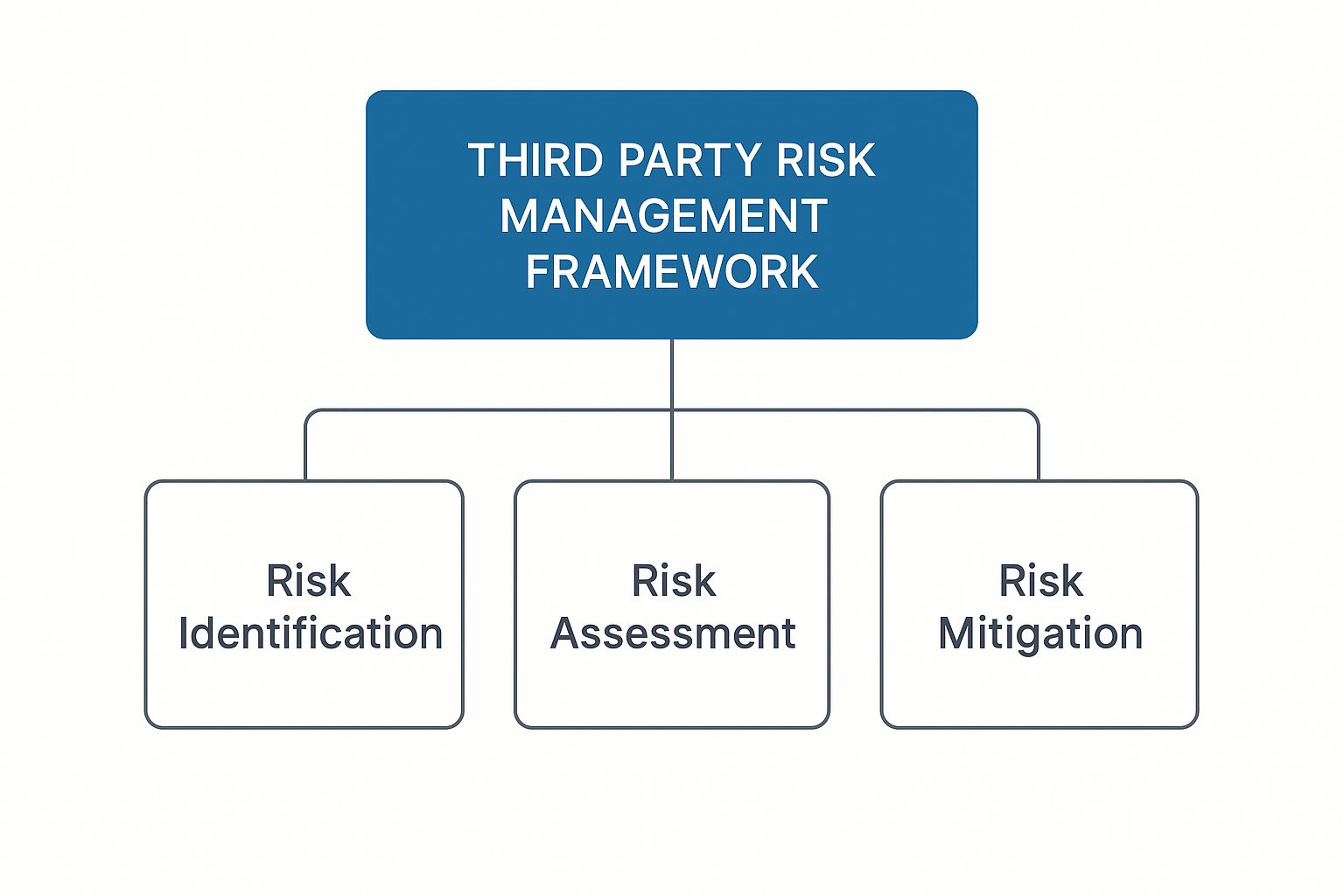
Effective mitigation is impossible without a solid assessment, which depends on identifying the right risks from the start.
From Theory to Action: A Scenario
Consider the onboarding of a new FinTech partner for payment processing. A weak framework might involve a cursory reference check. A resilient framework demands quantifiable answers.
Your risk team must ask: What is the vendor’s Mean Time to Respond (MTTR) to a security incident? What were the findings of their last five penetration tests, and how were they remediated? Is their disaster recovery plan tested, and can they meet a four-hour Recovery Time Objective (RTO)?
This level of scrutiny is essential for survival. With third-party breaches impacting over 60% of companies, your vendor’s weakness becomes your institutional liability.
This is precisely where a data intelligence platform like Visbanking provides a decisive edge. Instead of relying on vendor attestations, your team can independently benchmark their financial health against industry data or identify troubling trends in their operational performance. It supplies the objective, verifiable evidence required for a truly comprehensive third-party risk assessment.
Your framework is your institution's immune system. It requires constant vigilance, objective data, and the executive will to enforce it without exception. Is yours built to withstand the pressure?
Meeting Regulatory Scrutiny and Board Expectations
The landscape for bank directors has fundamentally changed. Third-party risk, once an operational concern, is now a focal point for regulators from the OCC, FDIC, and the Federal Reserve in every examination.
This reframes the conversation entirely. Your third-party risk management framework is no longer an operational task; it is a core governance responsibility of the board. A passive, check-the-box approach is a direct invitation for regulatory action. Examiners and your board expect a framework that is a living, integrated component of the bank's risk culture.
Translating Regulatory Mandates Into Action
When regulators arrive, their demand is simple: prove it. Demonstrate that your framework is an active, functioning system for managing risk.
This requires your framework to deliver:
- Documented Decision-Making: Every significant vendor decision requires an auditable trail. If the board accepts the risk of engaging a FinTech partner with a minor SOC 2 report exception, the rationale and compensating controls must be clearly documented in meeting minutes.
- Clear Escalation Paths: When a high-risk vendor breaches a critical SLA, your framework must define a pre-approved escalation path, from the relationship manager to the risk committee and, if necessary, the board. This plan must exist before a crisis occurs.
- Actionable Reporting: The board requires concise, executive-level summaries that clearly articulate the bank's overall third-party risk posture, highlighting the top 5-10 riskiest relationships and any emerging threats. Data dumps obscure insight; actionable intelligence is required.
This is not a uniquely American concern. To maintain global standards, your framework must account for evolving cybersecurity directives, such as the upcoming NIS2 regulations. This signals to regulators and the board that your institution is forward-looking.
Evidencing a Living Framework to the Board
Presenting TPRM information to the board is about facilitating a strategic dialogue and demonstrating diligence. Your team must answer not just "Are we compliant?" but "Are we resilient?"
An effective third party risk management framework provides the board with assurance, not just data. It tells a clear story of how risk is being identified, measured, and managed within the bank's established risk appetite.
Consider a vendor handling $500 million in monthly payments for your bank. Their public cybersecurity rating declines by 12%. A static framework might not detect this until the annual review—far too late. A living framework, powered by real-time data, flags this immediately.
The report to the board should be direct and data-driven:
- The Event: Vendor X's cybersecurity score dropped from 850 to 748.
- The Cause: Our analysis traced this to unpatched server software vulnerabilities.
- Our Action: We have contacted the vendor, invoking our contractual right to demand a remediation plan within 10 business days.
- Board Decision Point: If an adequate plan is not received, management recommends transitioning to our pre-vetted backup processor.
This is the level of detail that transforms a routine update into a substantive governance session. It is objective proof that your framework is operational. For additional detail on examiner expectations, review the latest on how U.S. regulators have issued new guidance for third-party risk management.
Data intelligence platforms like Visbanking are essential for this process. They automate the monitoring and provide the clear, benchmarked data needed to construct these high-impact reports. To truly understand your position, you must see how your framework and vendors compare to your peers. It is a critical step in exceeding board expectations.
Moving from a Rearview Mirror to a Crystal Ball with Data
A traditional third-party risk management framework is akin to driving while looking exclusively in the rearview mirror. It excels at identifying issues through audits and periodic reviews—long after they have begun to manifest. For today's bank executives and directors, this reactive posture is insufficient.
The future of risk management is predictive. It requires a fundamental shift from asking "what happened?" to "what is likely to happen?" This is not an incremental adjustment; it is a transformation powered by data intelligence, converting your TPRM framework from a static compliance document into a dynamic, forward-looking strategic asset.
This is not about replacing your experienced risk professionals. It is about equipping them with the tools to anticipate threats, enabling leadership to allocate capital and resources with previously unattainable foresight and precision.
The Real Power of Predictive Analytics in TPRM
Predictive analytics serves as the engine for your risk framework, processing diverse data sets—financial statements, SOC reports, real-time threat intelligence, and market sentiment—to identify patterns and forecast outcomes. It connects disparate signals before they escalate into a crisis.
Consider a community bank reliant on a core processor that appears stable on the surface. A traditional review finds SLAs are met and the last audit was clean. However, a data intelligence platform detects faint, leading indicators:
- Public financial filings reveal the vendor's free cash flow has declined 15% for two consecutive quarters.
- Sentiment analysis of employee reviews indicates rising internal instability.
- The vendor’s cybersecurity score has quietly degraded due to slow patch management for non-critical vulnerabilities.
Individually, these signals might be dismissed. Collectively, they paint a clear picture of a partner under operational stress. A predictive framework flags this combination, allowing intervention months before that stress materializes as a service outage affecting your customers.
The objective is to change the conversation from, "What just happened?" to "What does the data suggest is likely to happen, and what is our response plan?" This is the essence of data-driven governance.
Artificial intelligence is central to this evolution. AI is becoming a disruptive force in TPRM, generating insights that identify threats before they materialize. It is no surprise that an EY global survey found 57% of executives view business operation disruption as their top third-party risk. This is precisely the threat AI-driven analysis is designed to detect. You can read the full research on the future of third-party risk management to understand the trajectory.
Augmenting Your Gut Instinct with Hard Data
A data-first culture provides leadership with the empirical evidence needed to challenge assumptions and enforce accountability, both internally and with vendors. Instead of relying on vendor attestations, you can now benchmark their real-world performance against peers and the industry.
This table illustrates the strategic difference between the two approaches.
Traditional vs. Data-Driven TPRM Approaches
| Attribute | Traditional Framework (Reactive) | Data-Driven Framework (Predictive) |
|---|---|---|
| Focus | Compliance & audit findings. "Checking the box." | Proactive risk identification & strategic foresight. |
| Data Source | Vendor self-attestations, annual reports, periodic audits. | Continuous, multi-source data feeds (financial, cyber, operational). |
| Timing | Point-in-time snapshots (quarterly, annually). | Real-time, continuous monitoring. |
| Alerts | Flags historical issues after they occur. | Predicts future problems based on weak signals. |
| Outcome | Rearview mirror analysis; firefighting. | Forward-looking strategy; risk avoidance. |
The distinction is clear: one approach reacts to the past; the other shapes the future. A dedicated platform is essential to enable this shift.
By integrating modern banking data analytics, your team can automate the continuous monitoring that underpins a predictive framework. This liberates your key personnel from manual data collection, allowing them to focus on strategic analysis and decisive action.
Integrating data intelligence transforms your TPRM from a cost center into a value driver that actively protects the bank's reputation and bottom line. The first question for any board or executive team is this: Is our current framework merely telling us where we have been, or is it showing us where we are going?
Integrating Your Framework for Decisive Action
A third party risk management framework that exists in a silo is nothing more than expensive documentation. Its true value is realized only when it is integrated into the bank's enterprise-wide Governance, Risk, and Compliance (GRC) strategy.
The objective is to create a unified view of risk. Vendor risk cannot be an isolated data set; it must be a critical input for enterprise-level decisions, from strategic planning and capital allocation to operational resilience. When this integration is achieved, your framework evolves from a defensive shield into an instrument for smarter, more resilient banking.
Weaving TPRM into the GRC Fabric
Achieving this requires building defined pathways for risk data to flow from the TPRM program into other core bank functions.
Consider a high-risk FinTech partner processing $100 million in monthly transactions. Your TPRM team identifies a 15% decline in its key financial health ratios. This information cannot remain confined to a departmental report; it must trigger an institutional response.
- Strategic Planning: The C-suite must assess the impact on growth projections. Is it time to activate a pre-vetted backup vendor?
- Capital Allocation: The finance team must evaluate whether this partner's instability creates a new contingent liability, potentially impacting capital reserves and contingency funding plans.
- Operational Resilience: The operations team must immediately model the impact of a service disruption. What is the failover time? What is the direct impact on customers?
You know your integrated framework is working when a vendor risk signal from TPRM forces a review of capital models and operational continuity plans. That's when you've graduated from simple management to true governance.
From Data Points to Strategic Decisions
This level of integration is impossible without a central intelligence layer capable of aggregating vendor risk data and presenting it as actionable, enterprise-level insight.
Imagine your risk committee evaluating a major new technology investment. An integrated framework provides the complete picture. It moves beyond a list of product features to overlay the vendor’s cybersecurity posture, its financial stability benchmarked against peers, and any concentration risk it introduces to your ecosystem.
This data-driven context changes the nature of the evaluation. The question shifts from, "Does this vendor meet minimum requirements?" to "Does this partnership align with our institutional risk appetite and long-term strategic objectives?"
A modern third party risk management framework, when fully integrated, provides the connective tissue that ensures vendor risk is a central component of strategic decision-making. Building a resilient institution begins with connecting these dots. The first step is to understand your current vendor risk profile—not in a vacuum, but benchmarked against your peers.
We invite you to explore how Visbanking’s data intelligence can provide this crucial benchmark, turning your framework into a foundation for decisive, strategic action.
Got Questions? We've Got Answers.
As a bank executive or director, you hold ultimate accountability for all institutional risk, including that introduced by third-party relationships. A robust, data-driven third party risk management framework is not merely advisable—it is your primary shield.
We frequently address key questions from leaders navigating this complex environment. The answers consistently point toward a disciplined, data-first methodology for managing the entire vendor ecosystem.
How Do We Figure Out Which Vendors Need the Microscope?
The answer lies in risk-tiering, a methodology based on impact, not contract value. A $50,000 contract for a customer-facing mobile application carries infinitely more risk than a $500,000 contract for office furniture. Your framework must establish objective, non-negotiable criteria for segmentation.
Your highest tiers, typically Critical or High-Risk, should be reserved for vendors that meet specific triggers:
- Sensitive Data Access: Any partner handling non-public information (NPI) is automatically classified as high-risk. There are no exceptions.
- Operational Criticality: This includes your core processor, cloud provider, or payment gateway. If their failure would cause a material disruption to banking operations, they are critical.
- Reputational Impact: Certain vendors can inflict significant reputational damage without accessing sensitive data. Their actions reflect directly on the bank, warranting a high-risk designation.
The depth of due diligence and continuous monitoring must be commensurate with the risk tier. Your critical payments vendor requires comprehensive oversight: annual on-site audits, continuous cybersecurity scanning, and, at a minimum, quarterly performance reviews. In contrast, a low-risk marketing consultant may only require an initial background check and a simple annual compliance attestation.
What Exactly Is the Board's Role in All This?
The board's role is strategic oversight, not day-to-day management. Directors are responsible for ensuring a sound framework is established and that management executes against it. This is a core fiduciary duty.
Specifically, the board must:
- Approve the Framework and Policy: Directors provide formal approval of the TPRM policy, ensuring it aligns with the bank's established risk appetite.
- Ensure Adequate Resourcing: The board must challenge management to allocate the necessary budget, technology, and personnel for the TPRM program to be effective.
- Enforce Accountability: Through regular, data-driven reporting, the board monitors program performance and holds executive leadership accountable for managing third-party risk effectively.
Board reports must be strategic and concise, summarizing the bank's aggregate third-party risk, identifying the top 5-10 riskiest relationships, and flagging any material incidents or emerging threats. The board's role is to ask probing questions and ensure vendor risk remains a key component of the strategic agenda.
How Do We Prove to Regulators That Our Framework Actually Works?
Regulators operate on a simple principle: "If it isn't documented, it didn't happen." Demonstrating an effective framework requires meticulous record-keeping and a clear, auditable trail of all risk management activities.
Examiners will demand more than a policy document; they will scrutinize its real-world application.
- A Complete Audit Trail: For every high-risk vendor, you must maintain a complete file: the initial risk assessment, all due diligence documentation (including SOC 2 reports and financial analyses), and the specific contractual clauses granting right-to-audit.
- Proof of Active Governance: Regulators will review risk committee and board meeting minutes, searching for documented discussions of vendor risks, decisions made, and evidence of follow-up actions.
- Evidence of Active Monitoring: This is a common point of failure. You must provide documented proof of continuous oversight: performance reviews against SLAs, reports from monitoring tools, results from incident response tests, and periodically updated risk assessments.
A framework's true strength isn't in its design, but in its execution. Regulators are looking for a living, breathing program where you find a risk, you document it, and you take action. That shows a real culture of oversight.
This is precisely where data intelligence platforms become indispensable. A system that centralizes vendor documentation, tracks monitoring activities, and generates audit-ready reports provides the tangible proof regulators require. It transforms your framework from a static document into a dynamic, defensible component of your bank's governance structure.
The challenges of third-party risk are significant, but manageable with the right framework and intelligence. At Visbanking, we provide banking leaders with the tools to move beyond compliance and build a truly resilient institution. By delivering the data and analytics to benchmark performance and deeply understand your vendor ecosystem, we help you transform risk management into a competitive advantage.
See how Visbanking can strengthen your third party risk management framework today.
Latest Articles
Brian's Banking Blog
ISO 20022 Migration Strategy for Bank Leaders
Brian's Banking Blog
Lead Tracking Software for Banks: An Executive Guide
Brian's Banking Blog
What Are Key Metrics for Banks? a Decision Guide
Brian's Banking Blog
Customer Feedback Surveys: A Playbook for Banks
Brian's Banking Blog
How to Create a Dashboard That Banks Actually Use
Brian's Banking Blog