
The Positive Pay System: A Bank Executive's Guide to Mitigating Check Fraud Risk
Brian's Banking Blog
A positive pay system is a straightforward yet powerful automated fraud prevention service offered by banks. It functions as a digital gatekeeper for a commercial checking account. Before any check is paid, the system verifies its details—amount, check number, and payee—against a client-provided list of issued checks. Any discrepancy flags the item for review, effectively stopping fraud before funds are disbursed.
The Resurgence of a Foundational Threat
For bank executives, risk management is a core function. While digital threats command significant attention, a substantial vulnerability persists in a seemingly traditional area: the commercial checking account. Check fraud, far from obsolete, has staged a dramatic resurgence, posing an immediate and material threat to your institution and its clients.
The metrics are not merely concerning; they are definitive. In 2021, financial institutions filed over 350,000 Suspicious Activity Reports (SARs) related to check fraud. By 2022, that figure escalated to over 680,000.
The U.S. Department of the Treasury corroborates this trend, reporting a 385% increase in check fraud since the pandemic. Projections indicate that losses from check fraud could reach $24 billion this year, representing a potential 60% of all attempted payment fraud. In this environment, a positive pay system is not an ancillary feature; it is an essential control.
The Modernization of Check Fraud
Today’s check fraud schemes are executed with a level of sophistication that bypasses routine visual inspection. Perpetrators employ advanced techniques for check washing, precise alteration of payee details, and the creation of high-fidelity forgeries. For a bank, a single compromised commercial account can precipitate significant financial and reputational damage.
Consider a mid-sized commercial client issuing 100 checks monthly. A fraudster intercepts a single check for $15,000.00 and successfully alters it. The bank now confronts not only a direct financial loss but also a complex investigation, mandatory regulatory reporting, and a difficult conversation with a valuable client whose trust has been eroded. A clear understanding of the critical importance of addressing security breaches is fundamental when financial stability is compromised.
Shifting from a Reactive to a Proactive Posture
Historically, the banking industry has often operated reactively, addressing fraud after the fact. This model is no longer tenable. Each fraudulent check that clears erodes the bank’s capital base and, more critically, damages its reputation as a secure financial partner.
The operational imperative has shifted from remediation to prevention. A positive pay system is the linchpin of modern treasury management and a non-negotiable component of a robust risk framework.
For bank leadership, the directive is clear. This is not an operational expense; it is a strategic investment in asset protection and client retention. Data-driven tools like Visbanking’s Fraud & Risk Manager provide the intelligence to not only mitigate fraud but also to identify clients with the highest risk profiles. Benchmarking your security adoption rates against peers transforms a significant liability into a competitive differentiator, demonstrating your commitment to safeguarding client assets.
How a Positive Pay System Actually Works
At its core, a positive pay system operates on the principle of pre-authorization, shifting check clearing from a passive process to an active, controlled verification. The system's integrity relies on a single source of truth: a check-issue file provided by the commercial client.
This file, generated directly from the client's accounting software, serves as a digital manifest. It contains the critical data points for every check issued: the exact dollar amount, check number, issue date, and, for maximum security, the payee name.
When a check is presented for payment, the bank’s core system does not automatically process it. Instead, it executes an immediate comparison of the physical check's details against the client's pre-submitted file. This validation occurs in real-time, verifying each key field before any funds are transferred.
Managing Exceptions and Shifting Liability
The system’s primary value is realized in its exception handling protocol. If any detail on the presented check—amount, number, or payee—deviates from the issue file, the system flags it as an exception.
The flagged item is not paid. It is routed to a specialized queue, and an immediate notification is sent to the client. The client is then empowered to make the final disposition: "pay" or "return." This process is transformative. It shifts the liability for a fraudulent check away from the bank and its client and places it squarely on the party attempting to negotiate the illegitimate item.
The threat is not theoretical; it is growing at a significant rate. As illustrated below, both the volume of reported check fraud and the associated financial damages have increased dramatically.
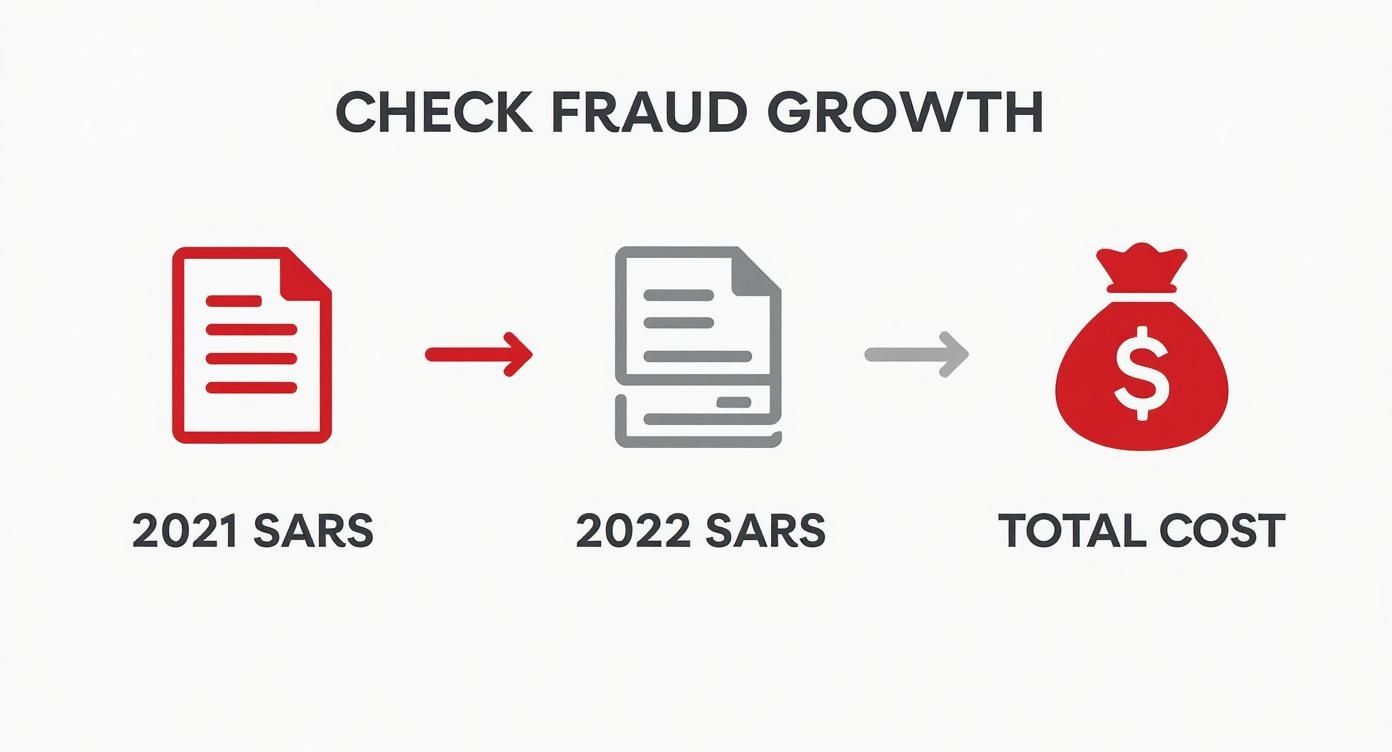
These figures underscore the inadequacy of a reactive, manual approach to check processing. An automated defense like positive pay is a strategic necessity.
A Practical Example of Loss Prevention
To illustrate, consider a client who issues a check for $1,500.00. A criminal intercepts it, "washes" the ink, and alters the amount to $15,000.00. Without positive pay, this altered check has a high probability of clearing, resulting in a $13,500.00 loss for the bank and a severely damaged client relationship.
With a positive pay system in place, the outcome is different. The moment the $15,000.00 check is presented, the system flags a mismatch against the $1,500.00 entry in the client's issue file. The check is immediately identified as an exception, the client is notified, and they instruct the bank to return the item. The fraud is neutralized.
This is not merely about preventing a single loss. It is about demonstrating a rigorous commitment to protecting client funds, which cultivates institutional trust. Each exception caught is a tangible proof point of the security you provide.
Understanding the mechanics is foundational, but the strategic application lies in identifying which clients require this protection most. A bank intelligence platform like Visbanking allows you to analyze your portfolio and pinpoint high-volume check issuers who remain unprotected. By benchmarking your treasury services against peers, you can uncover opportunities to expand client relationships and mitigate institutional risk.
Closing the Critical Positive Pay Adoption Gap
Despite its proven effectiveness, positive pay suffers from a persistent adoption deficit. A significant percentage of commercial clients do not utilize this critical fraud mitigation tool. For bank executives, this gap represents not just a missed revenue opportunity, but a substantial and quantifiable risk on the balance sheet.
Client reluctance typically stems from common misconceptions: a belief that their business is too small to be a target, a perception of implementation complexity, or a general lack of awareness. The assumption of being "too small to fail" is a dangerously obsolete mindset in the current fraud environment.
The Scope of the Problem
Industry data quantifies the challenge. A recent survey from Datos Insights revealed that 65% of financial institutions report that less than half of their treasury clients use positive pay. More alarmingly, 39% of these banks have an adoption rate below 25%. This is occurring while 65% of banks are actively defending against check fraud attacks.
The data exposes a profound disconnect between the known threat level and the deployment of the most effective defense.
| Metric | Statistic (Datos Insights) |
|---|---|
| Banks with < 50% Positive Pay adoption | 65% |
| Banks with < 25% Positive Pay adoption | 39% |
| Banks reporting check fraud attacks | 65% |
Table: Positive Pay Adoption vs. Perceived Fraud Threat
This protection gap is a systemic vulnerability. However, the same report indicates that over 75% of banks anticipate increased adoption over the next two years. The strategic question is not if clients will adopt these services, but which institutions will lead this transition and secure the client loyalty—and fee income—that follows.
The discrepancy between known risk and client action represents one of the most significant, addressable security flaws in commercial banking today. Closing this gap is not merely a sales initiative; it is a fundamental act of risk management.
This is the point where strategy must be driven by data, not intuition. Instead of executing broad-based marketing campaigns, a bank intelligence platform like Visbanking provides a clear, granular view of your entire commercial portfolio. You can precisely identify clients with high check volumes who are not enrolled in positive pay, creating a target list based on empirical risk.
This transforms a defensive necessity into a strategic growth opportunity. Armed with data on a client's specific exposure, your relationship managers can engage in a more substantive dialogue, presenting a solution that directly addresses their business's risk reality. To assess your institution's position, you must benchmark your performance against your peers and uncover your own hidden opportunities.
Quantifying the ROI of Your Positive Pay Program
Every executive decision must be supported by a clear business case. A positive pay system is not an operational cost center; it is a direct driver of financial performance. Its return on investment extends far beyond fraud prevention, creating tangible value that strengthens the bottom line and enhances competitive positioning.
The most direct return is the prevention of financial loss. When a single fraudulent check for $50,000.00 or $100,000.00 is stopped, the system has often generated a return sufficient to cover its entire annual cost. However, the total financial impact is far greater, encompassing significant indirect savings that are frequently overlooked.

Beyond Direct Loss Prevention
Manual fraud investigations are a significant drain on institutional resources. A single suspicious item can consume hours from back-office operations, fraud specialists, and relationship managers—diverting them from revenue-generating activities. A positive pay system automates this process, substantially reducing the operational drag associated with fraud management.
These indirect savings constitute the larger part of the value equation:
- Reduced Operational Costs: Minimizes time spent on manual check verification, client communications, and internal investigations.
- Lower Legal and Compliance Expenses: Avoids costly litigation and regulatory penalties that often follow significant fraud events.
- Reputation Shield: Protects client trust, an invaluable and difficult-to-quantify asset that is devastating to lose.
Modeling the Financial Impact
Consider a hypothetical model. A mid-sized regional bank invests $100,000.00 annually in the technology and personnel for its positive pay program. In that year, the system directly prevents $2.5 million in confirmed fraudulent checks from clearing. The direct ROI is a formidable 25-to-1.
This, however, is an incomplete analysis. The bank's business intelligence platform reveals that it saved an additional $2.5 million in associated costs, including reduced investigation hours, avoided legal fees, and the retention of several key commercial clients who were targeted by fraudsters.
In this realistic scenario, the total value created is $5 million. This represents a 50-to-1 return on investment. For every dollar the bank invested in its positive pay system, it protected $50.00 in assets and operational capacity.
This quantitative analysis reframes the entire discussion. Positive pay transitions from an expense to a core profit and loss strategy. By implementing robust performance measurement systems, bank leaders can track this value with precision and articulate it clearly to the board and shareholders.
To understand how your institution’s treasury services and fraud prevention efforts compare, you must benchmark your performance against your peers and pinpoint where your greatest opportunities for improvement and growth lie.
Using Data Intelligence to Drive Adoption
To increase commercial client enrollment in your positive pay system, generic marketing initiatives are insufficient. The key to driving adoption is not a more persuasive sales pitch, but superior intelligence.
Your bank possesses a wealth of data that can identify every high-risk commercial client who lacks this protection. The challenge lies in converting this raw data into an actionable strategic plan. This is where a dedicated bank intelligence platform provides decisive value.
Pinpointing High-Risk Clients
Instead of relying on anecdotal evidence from relationship managers, you can systematically segment your entire client base using your own core data to identify those most in need of this service.
A bank executive can execute a simple query to identify:
- All business clients issuing more than 50 checks per month.
- Any client with an average check value exceeding $2,500.00.
- Commercial accounts with a history of returned-item fraud within the past 24 months.
Cross-referencing these criteria and excluding already-enrolled clients produces a highly targeted prospect list. A client issuing 100 checks per month totaling $300,000.00 without fraud protection is not merely a sales prospect; they represent a significant liability for both their business and your institution.
Data-Driven Client Segmentation for Positive Pay Outreach
A structured, data-driven approach allows your team to prioritize its efforts effectively. The following framework provides a model for segmenting commercial clients to identify prime candidates for positive pay.
| Client Segment | Key Identifiers (Data Points) | Targeted Action |
|---|---|---|
| High-Volume/High-Value | Issues >100 checks/month Avg. check value >$5,000.00 |
Immediate, high-touch outreach from a senior relationship manager. This is a top-priority risk. |
| Moderate & Growing | Issues 25-100 checks/month Growing deposit/loan relationship |
Proactive educational campaign showing real-world fraud examples and the ROI of positive pay. |
| Past Fraud Victims | Any history of check fraud Currently not enrolled |
A direct, consultative conversation about how positive pay provides a concrete solution to prevent future incidents. |
| Industry-Specific Risk | Businesses in high-risk sectors (e.g., construction, real estate, nonprofits) |
Targeted marketing materials that speak directly to the fraud challenges common in their industry. |
By segmenting clients in this manner, you transition from a one-size-fits-all approach to a precise strategy that addresses specific risks, making the client conversation more relevant and impactful.
Benchmarking for a Competitive Edge
Your internal data identifies whom to contact. External peer data provides context on how you perform against the competition. This is critical for assessing your position in the treasury services market.
Are your treasury service fees aligned with market rates? Is your adoption rate among high-volume clients lagging behind your peers? Answering these questions with hard data reveals performance gaps and provides a clear roadmap for growth.
This is where true data intelligence delivers value. By using comprehensive analytics for banking, you can benchmark your fee income and service penetration against a curated peer group. Discovering that your peers generate 15% more in non-interest income from treasury services is a powerful data point, signaling a need to re-evaluate pricing, refine sales strategies, or enhance client education.
This strategic use of data transforms the push for positive pay system adoption from a defensive measure into a proactive engine for growth. It equips your team with the evidence needed to approach the right clients with a compelling, data-backed value proposition, protecting both their business and the bank's bottom line.
Overcoming Common Client Objections to Positive Pay
Securing client adoption for a positive pay system requires more than a discussion of features; it necessitates a shift in the client's risk perspective. Your team must be prepared to address and dismantle common objections with factual, data-driven responses.
Successfully navigating this conversation is what distinguishes a failed sales attempt from the acquisition of a new, protected, and more profitable client relationship.

When a client states, "We're too small to be a target," the response must be grounded in market reality. Fraudsters specifically target small and mid-sized businesses, predicated on the assumption of weaker internal controls.
A single fraudulent check for $10,000.00 may be a rounding error for a large corporation, but for a smaller enterprise, it can be a catastrophic event.
Reframing Complexity as Control
The most frequent objection is, "It sounds too complicated." This presents an opportunity to reframe the narrative. Modern positive pay systems are not the cumbersome, manual processes of the past.
The client's primary responsibility is the simple upload of a check-issue file, a task that most accounting software packages can automate. The value proposition is not an additional administrative burden; it is the empowerment of complete control over every disbursement from their account.
The dialogue must pivot from process to protection. Frame the decision thus: a few minutes to upload a file now eliminates days of administrative burden and financial loss in the aftermath of fraud. It is a strategic investment of time.
Articulating the Value Proposition
When the discussion turns to cost, the ROI must be made explicit. A nominal monthly fee is insignificant when compared to the financial and operational impact of a single fraudulent check. Practical strategies to educate clients include:
- Host targeted workshops: Demonstrate the system's ease of use and present anonymized, local examples of check fraud to make the threat tangible.
- Develop concise one-page guides: Visually contrast the minimal effort of using positive pay against the substantial risk of inaction.
- Leverage client-specific data: Use a platform like Visbanking to present a client's actual check volume and average check value, transforming a generic risk into a specific, quantifiable exposure.
Equipping your team with these data-backed talking points elevates their role from that of a vendor to a trusted risk management advisor.
To lead this conversation effectively, you must first understand your own position in the market. You need to benchmark your performance against peers and identify your most compelling growth opportunities.
A Few Questions We Hear All the Time
What is the bottom-line benefit for our institution?
The primary benefit is risk mitigation. An effective positive pay system is a hard control against check fraud. This not only prevents direct financial losses but also protects the bank's reputation and strengthens client relationships by demonstrating a commitment to their security. It is a powerful driver of institutional trust.
Isn't this service primarily for large corporate clients?
This is a common misconception. While historically true, fraudsters now frequently target small and mid-sized businesses, presuming they have less sophisticated security measures. A single fraudulent check for $15,000.00 can be a minor issue for a large corporation but a solvency-threatening event for a smaller company.
How do we drive client adoption without creating the perception of a burdensome process?
The focus must be on the simplicity of the client's role. Modern systems are highly automated. The client's main task is uploading a single issue file, a function that can typically be automated directly from their accounting software. Frame it as a strategic, two-minute task that prevents significant financial and operational disruption later.
Offering a robust positive pay system is no longer just a defensive necessity—it is a competitive differentiator, particularly when you can precisely identify which clients are most exposed. This is where a platform like Visbanking provides critical intelligence. It allows you to pinpoint at-risk clients and benchmark your treasury services against the competition, enabling you to convert a security feature into a tangible growth driver.
Related Articles

Visbanking Blog
AI Banking Revolution: How Machine Learning Transforms Finance

Visbanking Blog
Get a Competitive Advantage with BIAS, the Proactive Banking Solution

Visbanking Blog
Make More Informed Decisions with BIAS, the Data-Driven Banking Solution

Visbanking Blog
Unlocking Banking Excellence with BIAS: Your Roadmap to Success

Visbanking Blog
Innovate and Excel with BIAS, Your Banking Ally

Visbanking Blog