
Metro 2 Reporting Software: A Strategic Guide for Bank Executives
Brian's Banking Blog
Metro 2 reporting software is not merely a compliance tool; it is a strategic instrument with a direct impact on your bank's financial health, regulatory standing, and market perception. For the executive suite, accurate data furnishing is a cornerstone of robust governance and risk management. This guide reframes the requirement from a technical burden to a data-driven competitive advantage.
Why Metro 2 Reporting Demands Executive Attention
In banking, data is the asset that fuels every strategic decision, from credit underwriting to portfolio risk assessment. Metro 2 reporting—the standardized format for transmitting consumer credit data to bureaus like Experian and TransUnion—is a critical, and often underestimated, component of this data ecosystem.
This is not a back-office function to be set and forgotten. It is a direct reflection of your institution's operational integrity. Reporting failures are not minor hiccups; they create material liabilities that land squarely on the executive desk.
The Material Cost of Inaccuracy
Even a marginal error rate of 1-2% in reporting files can trigger a cascade of negative outcomes. For a bank managing 100,000 consumer accounts, this translates to 1,000 to 2,000 potential reporting errors per cycle. Each represents a tangible financial and reputational cost.
- Regulatory Penalties: The Consumer Financial Protection Bureau (CFPB) enforces the Fair Credit Reporting Act (FCRA) with significant financial penalties. For example, a systemic error in reporting payment statuses could lead to fines well into six figures, depending on the scope and duration of the violation.
- Operational Drag: Correcting errors and managing consumer disputes consumes significant resources. This diverts skilled personnel from revenue-generating activities to costly, defensive maneuvers. A single complex dispute can consume over 20 hours of senior compliance officer time.
- Reputational Damage: An error on a customer's credit file can directly prevent them from securing a mortgage or auto loan, creating lasting brand damage. That single error erodes trust and can lead to customer attrition.
At its core, rigorous Metro 2 reporting is about control. It provides assurance that the data representing your bank's largest asset—the loan portfolio—is accurate, compliant, and correctly communicated.
Mastering this process is a non-negotiable component of sound bank data governance. The right Metro 2 software provides the automation and validation required to mitigate these risks, ensuring your data serves as a reliable foundation for strategic action.
This allows leadership to shift focus from compliance fire-fighting to driving performance and growth. Data intelligence platforms like Visbanking enable you to benchmark operational efficiency against peers, transforming a regulatory necessity into a measurable competitive advantage.
Understanding the Metro 2 Reporting Standard
The Metro 2 format is the universal language for credit reporting in the United States. It is the standardized framework ensuring every piece of consumer credit data—from account status to payment history—is structured, coded, and interpreted identically across all financial institutions.
This is not merely a technical specification; it is the fundamental architecture of our national credit infrastructure.
Introduced in 1997 by the Consumer Data Industry Association (CDIA), Metro 2 replaced disparate, inconsistent reporting methods with a single, unified structure for submitting data to Experian, Equifax, and TransUnion. This standardization was a critical advancement for the industry.
Because of this standard, an auto loan originated by your institution is described using the exact same data lexicon as a personal loan from a competitor. For bank executives, the key takeaway is not memorizing field codes, but understanding that this framework is what preserves data integrity and contains risk.
The Foundational Segments of a Metro 2 File
A Metro 2 file is a structured report composed of distinct segments, each serving a specific function. While the technical details are complex, their strategic purpose is clear:
- Header and Trailer Segments: These act as the file's bookends. The header identifies your institution as the data furnisher, while the trailer confirms file completeness upon receipt by the credit bureau.
- Base Segment: This is the core of the report, containing fundamental consumer and account information: name, address, account number, origination date, and credit limit. It establishes the "who" and "what" of the credit relationship.
- J2 Segment (Associated Consumer): This specialized segment is essential for joint accounts. It provides a standardized method for linking multiple individuals to a single obligation, which is critical for an accurate credit profile.
Failure to govern this structure correctly introduces significant risk.
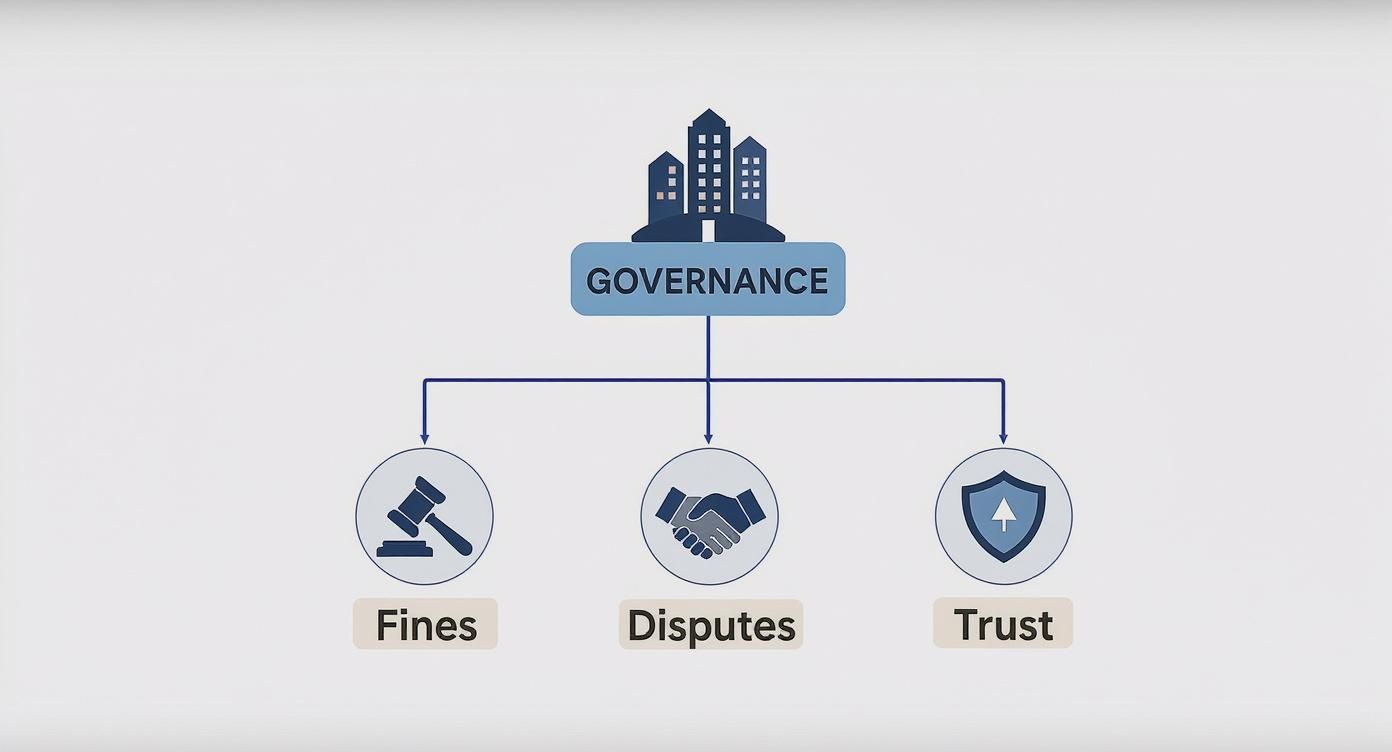
As illustrated, weak reporting governance directly exposes an institution to regulatory fines, costly disputes, and an erosion of customer trust.
Every segment works in concert to build a complete, accurate, and legally defensible credit history. An error or omission in any one segment can trigger a compliance violation or a customer dispute.
This is why mastering the standard is an essential governance function. Modern metro 2 reporting software manages this complexity by automating the assembly of these segments, transforming a technical challenge into a reliable, auditable process.
This frees your team from focusing on file construction and allows them to analyze the strategic insights within the portfolio data. When you can benchmark data accuracy against peers using a platform like Visbanking, this compliance function becomes a source of powerful competitive intelligence.
Essential Features of Executive-Grade Reporting Software
Creating a Metro 2 file is merely the baseline. An effective reporting platform is a strategic tool that must actively shield your bank from risk, drive operational efficiency, and provide clear executive oversight. It is time to move beyond manual processes, which are inherently prone to human error.
Consider an institution with 50,000 consumer accounts. A seemingly low 1% error rate translates to 500 potential FCRA violations or customer disputes each month. The primary function of modern Metro 2 software is to drive that number toward zero.
Core Functions for Executive Control
Any solution under consideration must automate and safeguard the entire reporting lifecycle. These are not optional features; they are foundational elements of sound risk management.
The non-negotiables include:
- A robust data validation engine: The system must automatically scrub data for logical inconsistencies, invalid codes, or missing information before file creation. This is the first and most critical line of defense against costly rejections and compliance actions.
- Direct core system integration: Data must flow seamlessly via API or secure automated transfer. This eliminates the risks associated with manual data extraction and manipulation. The data furnished to bureaus must be an exact reflection of your system of record.
- A comprehensive audit trail: From a governance perspective, an immutable record of all activities is mandatory. The software must track every file generation, submission, and manual modification, creating a defensible history for internal audits and regulatory examinations.
The objective is not simply to report data, but to do so with provable accuracy and complete transparency. A system lacking a clear audit trail presents an unacceptable risk.
These capabilities translate directly into measurable business outcomes.
Key Software Capabilities vs. Strategic Banking Outcomes
| Software Capability | Operational Impact | Strategic Outcome |
|---|---|---|
| Automated Data Validation | Reduces manual review hours from days to minutes; prevents flawed file submissions. | Minimizes risk of FCRA violations, associated fines, and reputational damage. |
| Direct Core Integration (API) | Eliminates error-prone manual data handling; ensures data consistency. | Guarantees data integrity and establishes a single source of truth for reporting. |
| Comprehensive Audit Trails | Provides a complete, immutable log of all reporting activities and changes. | Creates a defensible record for regulators and proves adherence to internal controls. |
| Performance Dashboards | Offers at-a-glance visibility into submission success, error rates, and key trends. | Enables proactive management and continuous process improvement based on hard data. |
This demonstrates how technology directly supports banking strategy by strengthening the control environment.
From Compliance to Intelligence
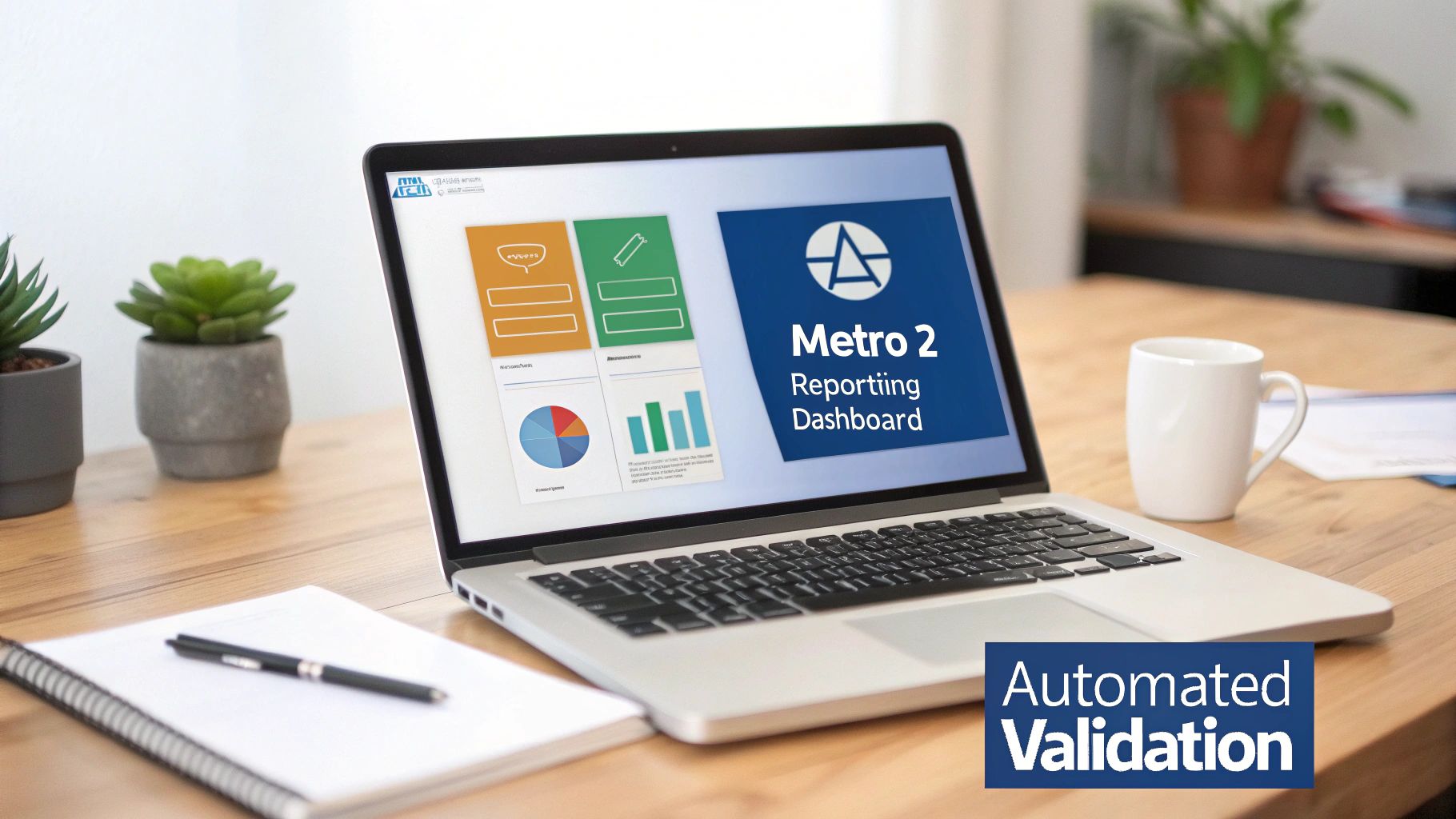
Leading platforms provide dashboards offering a high-level view of reporting performance. Executive leadership should have instant visibility into submission success rates, dispute trends, and data quality scores. This capability is a cornerstone of modern banking compliance software, enabling management by exception rather than constant crisis resolution.
By securing these essential capabilities, you ensure your Metro 2 reporting is compliant, efficient, and transparent. With that foundation of data integrity established, you can begin to ask the more strategic question: how does our data compare to our peers?
Calculating the ROI of Automated Reporting
Investing in high-quality Metro 2 reporting software is not an IT expense; it is a strategic decision with a measurable return. For the C-suite, this is about strengthening the balance sheet by improving operational efficiency, mitigating financial risk, and reallocating high-value talent to revenue-generating activities.
The business case is compelling.
Consider a mid-sized lender with 50,000 consumer accounts. Manual reporting processes are notorious for high error rates. Industry data shows that implementing automated software can reduce submission rejections from credit bureaus by over 90%. This is the direct impact of replacing manual work with systemic controls. You can explore how top lenders track these metrics to drive performance.

Quantifying the Financial Impact
The ROI becomes tangible when an institution reduces its reporting error rate from a manual-process average of 5% to a best-in-class automated rate of less than 0.5%. For our example bank, this shift directly avoids an estimated $150,000 annually in potential regulatory fines, dispute resolution costs, and corrective labor.
Operational efficiencies yield further gains. A skilled compliance officer who spends 40 hours per month on the reporting cycle can reduce that time to just four hours with automation. That is 36 hours of high-value expertise reclaimed monthly—time better invested in strategic risk analysis than tactical data validation.
The true ROI is realized when a bank transitions from a reactive, defensive compliance posture to a proactive, data-driven strategy. Automation provides the foundation for this shift, turning a cost center into a source of operational leverage.
Benchmarking for Competitive Advantage
Improving internal metrics is only part of the equation. True strategic advantage comes from understanding how your performance compares to the market. Data intelligence platforms provide this critical context.
For example, knowing your dispute rate is 0.2% is informative. Discovering it is 50% lower than the average for peer institutions of a similar size is a powerful strategic insight. It validates your investment and demonstrates superior operational control to regulators, directors, and stakeholders.
Visbanking’s platform is designed to provide this context, allowing executives to benchmark key metrics against a curated peer group. We help you move beyond asking, "Are we compliant?" to definitively answering, "Are we outperforming our competitors?" Explore our data and see how you measure up.
How to Select the Right Software Partner
Choosing a Metro 2 reporting solution is a strategic decision that extends far beyond a feature comparison. You are not acquiring a tool; you are entering a long-term partnership that directly impacts your institution's compliance framework and operational stability.
The right partner acts as an extension of your team, providing regulatory expertise and reliable support. A vendor's true value is revealed during periods of regulatory change. Their ability to manage complexity is a direct indicator of their competence. Rigorous due diligence is mandatory.

Core Evaluation Criteria
Your evaluation must focus on three critical areas: regulatory expertise, support infrastructure, and technical capability. Success in these domains ensures a partner can meet today's requirements and adapt to future challenges.
Key questions to guide your assessment include:
- Regulatory Agility: What is your process for monitoring and implementing updates from the CDIA and credit bureaus? How are clients notified and guided through these changes?
- Support Infrastructure: What are your service-level agreements (SLAs) for critical issues that delay a submission? Does a support request route to a qualified expert or a generic help desk?
- Scalability and Security: Can the platform accommodate 50% growth in our loan portfolio over the next five years without performance degradation? How does your solution integrate with our institution's security protocols and technology stack?
A practical litmus test for any potential vendor: "Describe your firm's process for managing the reporting changes required by the CARES Act forbearances." Their response will reveal more about their operational agility and expertise than any sales presentation.
With over 10,000 financial institutions in the U.S. reporting data, the demand for robust software is clear. The market for metro 2 reporting software is projected to grow by over 20% annually, underscoring its critical role in the industry. Further research on the growth of the credit reporting compliance market validates this trend.
The principles of vendor selection here are universal, mirroring the diligence required when choosing trusted partners for data-sensitive services.
Ultimately, selecting a partner is an exercise in risk mitigation. A thorough evaluation protects your investment and demonstrates a commitment to sound data governance. Once that trusted partner and reliable data are in place, the next step is to leverage that data for a competitive edge. Explore Visbanking's data to benchmark your reporting accuracy and efficiency against your peers.
Transforming Compliance Data Into a Strategic Asset
Implementing **metro 2 reporting software** is not the final objective; it is the foundation for developing a new strategic capability.Once optimized, the system evolves from a compliance tool into a source of valuable business intelligence. The data provides a real-time, unvarnished view of your loan portfolio's health and customer behavior. This insight is too valuable to remain siloed within the compliance function.
For instance, if your reports reveal a statistically significant increase in 30-day delinquencies in a specific loan category—say, a 15% month-over-month rise in a particular auto loan vintage—that is not a historical data point. It is a predictive indicator. This early warning enables proactive risk management, such as tightening underwriting standards for that product or adjusting collection strategies before delinquencies escalate into charge-offs.
The strategic shift is to stop viewing regulatory reporting as a defensive necessity and start treating it as an offensive tool. The data you generate for regulators is a direct reflection of market and portfolio dynamics—it must be used as such.
From Compliance to Competitive Intelligence
The strategic value multiplies when internal reporting data is benchmarked against the broader market. A deep understanding of bank regulatory reporting is essential for any institution aiming for market leadership.
Data intelligence platforms like Visbanking provide the necessary context, enabling you to measure your portfolio's performance against a relevant peer group.
Knowing your institution’s charge-off rate is 0.75% is a fact. Discovering it is 25 basis points below the average for your direct competitors is a strategic advantage. It validates your risk management framework and provides the confidence to expand profitable lending activities.
This is how a compliance function is transformed into a competitive advantage. You are not just adhering to regulations; you are using the resulting data to outperform the market.
Key Questions for Executive Leadership
What Are the Material Risks of Reporting Deficiencies?
Reporting failures expose an institution to a trifecta of risks.
First, regulatory risk is immediate, with the CFPB authorized to levy significant fines for FCRA violations. For a mid-sized institution, a systemic reporting error could easily result in penalties exceeding $100,000.00.
Second, operational risk manifests as a persistent drag on productivity. Each file rejection by a credit bureau requires manual intervention, diverting skilled personnel from core business functions.
Finally, reputational risk arises from customer impact. An error on a consumer's credit file erodes trust, a far more difficult asset to recover than any financial loss.
How Does This Software Integrate with Our Core System?
Leading Metro 2 reporting solutions do not depend on manual data transfer. They integrate directly with your bank’s core processing system via secure APIs or automated file transfers.
This direct integration is a critical control. It eliminates the human error inherent in manual processes and ensures the data furnished to bureaus is an exact mirror of your system of record. Verifying seamless integration with your specific core provider is a crucial step in the vendor due diligence process.
Is an In-House Solution a Viable Alternative to Specialized Software?
While technically possible, developing an in-house solution is, from a risk management perspective, highly inadvisable.
The Metro 2 format involves hundreds of fields and codes subject to continuous updates by the CDIA and credit bureaus. Building a system to manage this is a significant undertaking; maintaining its compliance year after year is a substantial and perpetual drain on resources.
The risk of a critical, systemic error is unacceptably high. Specialized metro 2 reporting software is the industry standard because it automates complexity, provides essential audit trails, and includes expert support that an in-house system cannot replicate.
At Visbanking, we believe compliance data should be a strategic asset, not a regulatory burden. Our platform helps you benchmark your performance against peers to turn accurate reporting into a competitive advantage.
Explore Visbanking's data intelligence platform to see how you measure up.
Related Articles

Visbanking Blog
Exploring Cutting-Edge Technologies Empowering US Banks: A Deep Dive into Visbanking Banking Report Portal

Visbanking Blog
FDIC Call Reports: The Banking Data Goldmine Explained

Visbanking Blog
Revolutionizing Banking Analysis: Introducing the Bank Comparisons Tool on Visbanking Banking Report Portal

Visbanking Blog
Bank Call Reports: The Financial Pulse of the Banking Industry

Visbanking Blog
Revolutionize Your Bank's Performance with BIAS: Unlocking the Future of Visual Banking Data

Visbanking Blog