
Top 8 Banking Compliance Software Solutions for 2025
Brian's Banking Blog
Navigating the Complexities of Banking Compliance in 2025
Staying compliant with evolving regulations is critical for any financial institution. This listicle provides eight leading banking compliance software solutions to streamline compliance processes, mitigate risk, and improve operational efficiency. Learn how tools like Continuity, MetricStream, and others can help your organization tackle challenges from AML and KYC to regulatory reporting. Explore these top eight solutions transforming banking compliance in 2025 and find the right banking compliance software for your institution.
1. Continuity
Continuity offers a robust and comprehensive regulatory compliance management platform explicitly tailored for the complexities of banking and credit union operations. This banking compliance software provides real-time updates on the ever-changing regulatory landscape, automated risk assessments, and streamlined compliance processes, all within a cloud-based environment. For financial institutions grappling with the burden of regulatory compliance, Continuity presents a compelling solution to reduce costs, eliminate redundancies, and maintain adherence to federal regulations. This focus on the specific needs of financial institutions is what earns Continuity a top spot on this list.
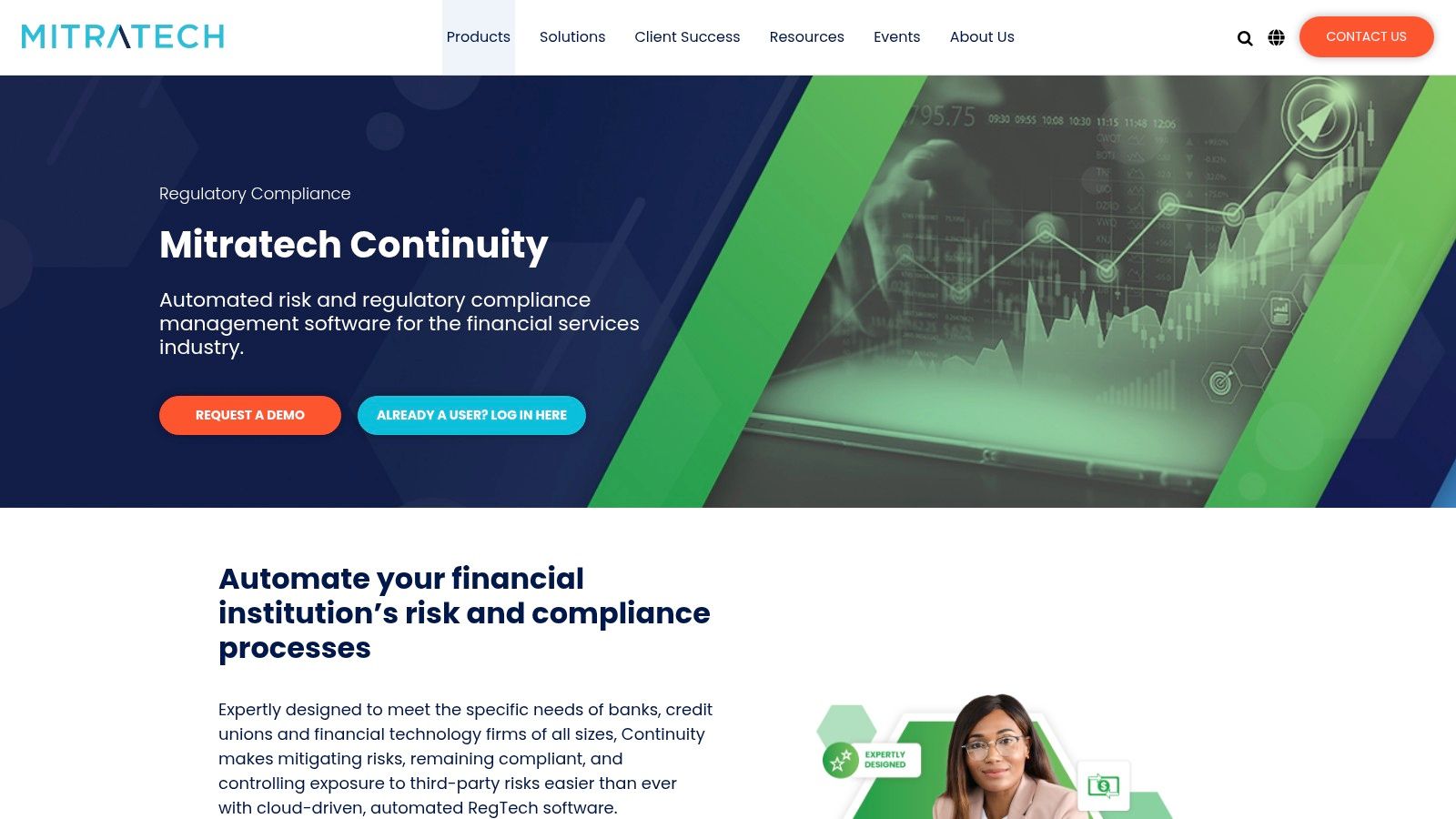
From a practical standpoint, Continuity allows compliance officers to automate key tasks, freeing up valuable time for strategic initiatives. Imagine automating the distribution and attestation of new policies, tracking regulatory changes impacting your institution, and generating comprehensive audit reports with just a few clicks. This is the power Continuity brings to banking compliance. Features like the automated regulatory change management system, with real-time updates, ensure that your institution is always ahead of the curve. Risk assessment tools, incorporating built-in frameworks for various regulatory requirements, simplify complex assessments and provide actionable insights. Pre-built compliance policies and procedures, aligned with federal regulations, offer a solid foundation for building a robust compliance program. The dashboard, featuring a compliance calendar and task management tools, provides a centralized hub for managing all compliance activities. Finally, the audit trail and documentation repository ensure complete transparency and readily available evidence for audits.
While pricing information isn't publicly available, it's generally understood that Continuity sits at a higher price point compared to some competitors. This premium is arguably justified by the depth of its features, the dedicated customer support provided by compliance experts, and the intuitive user interface requiring minimal training. Some users have reported occasional lags in system updates, although these instances appear to be infrequent. It's also worth noting that smaller institutions might find themselves with access to more features than they currently need, which could contribute to the perceived higher cost.
Compared to more generalized GRC (Governance, Risk, and Compliance) platforms, Continuity's dedicated focus on banking regulations allows for a more tailored and efficient experience. For instance, while a generic GRC platform may offer basic risk assessment tools, Continuity provides frameworks specifically designed for regulations like BSA/AML, KYC, and Reg Z.
For implementation, Continuity offers dedicated onboarding and training services to ensure a smooth transition. It’s recommended to engage with their compliance experts early in the process to tailor the system to your institution’s specific requirements. While the intuitive interface minimizes training time, dedicating resources to fully understanding the platform’s capabilities will maximize its effectiveness. Technical requirements are minimal, as the software is cloud-based and accessible through a web browser.
Key Benefits for Different Roles:
- Banking Executives: Gain confidence in regulatory compliance and reduce reputational risk.
- Financial Analysts: Leverage data-driven insights from risk assessments to inform strategic decisions.
- Risk and Compliance Professionals: Streamline compliance processes and free up time for strategic initiatives.
- Innovation and IT Leaders: Implement a secure, cloud-based solution with minimal IT overhead.
- Banking Regulators: Observe a clear commitment to compliance through robust documentation and audit trails.
For institutions seeking a comprehensive, purpose-built banking compliance software solution, Continuity deserves serious consideration. Visit their website (https://www.continuity.net/) for more information and to request a demo.
2. MetricStream: Comprehensive Banking Compliance Software for Enterprise-Level Institutions
MetricStream provides a robust, AI-powered Governance, Risk, and Compliance (GRC) platform specifically designed to address the complex regulatory landscape faced by banking institutions. This banking compliance software offers a comprehensive suite of solutions covering regulatory compliance, operational risk management, audit management, and third-party governance, making it a strong contender for larger institutions seeking a centralized compliance hub. Its scalability allows it to serve organizations of all sizes, though its features and pricing are geared towards enterprise-level clients.
For banking executives concerned with staying ahead of evolving regulations, MetricStream offers integrated regulatory intelligence and change management capabilities. This feature allows financial institutions to proactively monitor regulatory updates, assess their impact, and adapt internal policies and procedures accordingly, minimizing the risk of non-compliance. Financial analysts will appreciate the advanced analytics and reporting features, including configurable dashboards, offering actionable insights into risk exposures and compliance performance. These data-driven insights can inform strategic decision-making and optimize resource allocation for risk mitigation.
Risk and compliance professionals can leverage MetricStream's integrated risk assessment and control testing functionalities to streamline compliance processes. The platform allows for automated control testing, workflow automation, and issue management, facilitating efficient identification, assessment, and remediation of compliance gaps. Furthermore, its third-party risk management integration ensures that vendor risks are effectively monitored and managed, a crucial aspect of maintaining a secure and compliant ecosystem. Innovation and IT leaders involved in digital transformation initiatives within banks will find the platform’s cloud-based or on-premise deployment options beneficial, allowing for flexible integration with existing systems.
Key Features and Benefits:
- Regulatory Intelligence & Change Management: Proactive monitoring of regulatory changes and their impact on the organization.
- Integrated Risk Assessment & Control Testing: Streamlined processes for identifying, assessing, and remediating compliance risks.
- Compliance Monitoring & Issue Management: Automated tracking and management of compliance issues and remediation efforts.
- Advanced Analytics & Reporting: Configurable dashboards and reports providing actionable insights into compliance performance.
- Third-Party Risk Management Integration: Effective monitoring and management of vendor-related risks.
- Scalable Deployment: Available on-cloud or on-premise to suit organizational needs.
Pros:
- Highly Configurable: Adapts to specific organizational requirements and workflows.
- Comprehensive Solution: Covers multiple facets of banking compliance, offering a centralized GRC platform.
- Strong Analytics Capabilities: Provides data-driven insights for informed decision-making.
- Global Regulatory Coverage: Supports international financial institutions with multi-jurisdictional compliance needs.
Cons:
- Complex Implementation: Requires significant resources and expertise for successful deployment. Organizations should budget ample time and personnel for training and integration.
- Steep Learning Curve: New users may require extensive training to fully utilize the platform's functionalities.
- Premium Pricing: The comprehensive nature of the platform comes with a higher price tag, potentially making it less accessible for smaller banks. While specific pricing is not publicly available, it's generally understood to be a premium solution geared towards enterprise-level clients.
Implementation Tips:
- Phased Rollout: Implement the platform in stages, focusing on critical compliance areas first.
- Dedicated Project Team: Assemble a dedicated team with representation from relevant departments to oversee implementation.
- Thorough Training: Provide comprehensive training to all users to ensure effective adoption.
MetricStream deserves its place on this list because of its comprehensive approach to banking compliance, its advanced analytics capabilities, and its scalability. While the complexity and cost may pose challenges for smaller institutions, its robust functionality makes it a valuable tool for larger banks seeking an integrated GRC solution to manage their complex compliance obligations. For more information, visit their website: https://www.metricstream.com/industries/banking-financial-services
3. Wolters Kluwer OneSumX
Wolters Kluwer OneSumX stands out as a leading banking compliance software solution designed to address the multifaceted regulatory challenges faced by modern financial institutions. This integrated platform offers a comprehensive suite of modules covering compliance, finance, risk, and reporting, empowering banks to navigate the complex regulatory landscape while optimizing operational efficiency. OneSumX is particularly well-suited for large, international banks dealing with a high volume of regulatory requirements across various jurisdictions. Its modular design, however, allows institutions to select and implement only the components they need, making it adaptable to organizations of varying sizes and complexities.
OneSumX's strength lies in its deep regulatory expertise. The platform leverages content curated by seasoned compliance professionals, ensuring that banks stay ahead of evolving regulatory changes and avoid costly penalties. Its global coverage makes it a valuable asset for international financial institutions needing to comply with regulations across multiple jurisdictions. Features such as regulatory change management with expert legal analysis, financial crime control management (covering AML, KYC, and fraud detection), and integrated risk and finance platforms consolidate essential compliance functions into a single, unified system. Workflow automation capabilities allow banks to streamline processes and improve operational efficiency. For example, automated regulatory reporting can significantly reduce manual effort and ensure timely and accurate submissions.
While OneSumX offers significant advantages, potential users should be aware of its complexity and associated costs. Implementation typically requires dedicated IT support and may entail higher upfront costs compared to more basic banking compliance software solutions. Some users have also reported occasional performance issues when processing large datasets.
Key Features and Benefits:
- Comprehensive Regulatory Reporting: Streamlines regulatory reporting across multiple jurisdictions.
- Regulatory Change Management: Provides up-to-date information and analysis on regulatory changes.
- Financial Crime Control: Integrates AML, KYC, and fraud detection capabilities.
- Integrated Risk & Finance Platforms: Consolidates risk and finance functions for a holistic view.
- Customizable Workflow Automation: Automates key compliance processes for increased efficiency.
Pros:
- Deep Regulatory Expertise: Leverages expert knowledge for accurate and up-to-date compliance.
- Global Coverage: Supports compliance with international regulations.
- Modular Approach: Allows for flexible implementation based on specific needs.
- Strong Integration Capabilities: Integrates seamlessly with existing banking systems.
Cons:
- Higher Implementation Costs: Requires dedicated IT resources and may involve significant upfront investment.
- Complex System: Steeper learning curve and ongoing IT support needed.
- Occasional Performance Issues: Potential for performance bottlenecks with large datasets.
Pricing & Technical Requirements:
Pricing for OneSumX is tailored to each institution's specific needs and requirements, and is typically based on the modules selected and the size and complexity of the organization. Detailed technical requirements should be discussed directly with Wolters Kluwer.
Implementation Tips:
- Phased Rollout: Implement modules gradually to manage complexity and ensure smooth transitions.
- Dedicated Team: Assign a dedicated team to manage the implementation and ongoing maintenance.
- Training & Support: Invest in adequate training for staff to maximize the platform's effectiveness.
Comparison with Similar Tools:
While other banking compliance software solutions exist, such as MetricStream and IBM OpenPages, OneSumX differentiates itself through its deep regulatory content and focus on global coverage. It's particularly suitable for large international institutions or those with complex compliance needs.
Website: https://www.wolterskluwer.com/en/solutions/onesumx-for-finance-risk-and-regulatory-reporting
OneSumX earns its place on this list by offering a robust and comprehensive approach to banking compliance. It empowers financial institutions to confidently manage regulatory obligations, mitigate risks, and optimize business performance in an increasingly complex global environment. While the investment may be substantial, the potential benefits in terms of reduced risk, improved efficiency, and enhanced regulatory compliance make it a worthwhile consideration for organizations seeking a best-in-class solution.
4. AML360: Streamlined Anti-Money Laundering Solution for Banking Compliance
AML360 earns its place on this list as a focused and affordable anti-money laundering (AML) solution specifically designed for financial institutions seeking to bolster their banking compliance software capabilities. While not a comprehensive compliance platform, its strength lies in addressing the critical area of AML/CFT (Combating the Financing of Terrorism), offering a robust suite of tools to mitigate financial crime risks. This makes it particularly appealing to smaller institutions or those looking to enhance their existing compliance framework with a dedicated AML solution. AML360 empowers banks to meet their regulatory obligations under AML/CFT regulations while aiming to optimize operational efficiency. This targeted approach allows compliance teams to focus on core AML tasks without the overhead and complexity of larger, more generalized platforms.
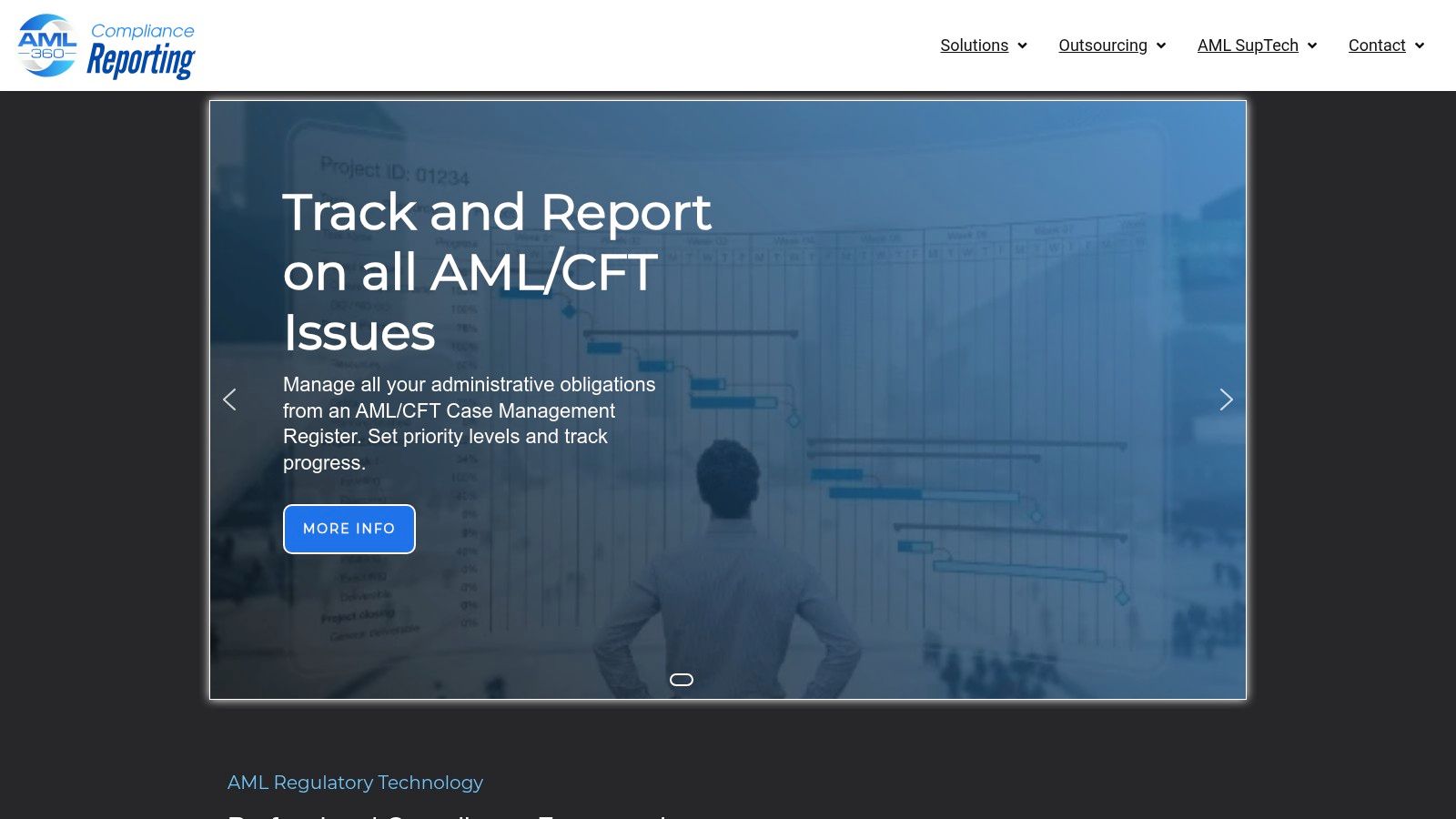
AML360 provides a comprehensive range of features tailored to AML compliance, including: automated AML/CFT risk assessment and management, allowing institutions to identify and mitigate potential vulnerabilities; customer due diligence (CDD) and ongoing monitoring capabilities, enabling thorough vetting and tracking of customer activity; suspicious transaction detection and reporting, facilitating timely identification and escalation of potentially illicit activities; sanctions screening and politically exposed persons (PEP) identification, ensuring compliance with global watchlists; and comprehensive compliance reporting and audit trail functionality, providing valuable insights and supporting regulatory audits.
For banking executives and risk and compliance professionals, AML360 offers a practical solution to navigate the complexities of AML compliance. Financial analysts can leverage the platform's transaction monitoring and reporting capabilities for deeper insights into financial activity. Innovation and IT leaders will appreciate the quick implementation time and minimal IT resource requirements. Banking regulators will find the platform's focus on AML compliance beneficial for supervised institutions.
Pros:
- Affordability: AML360 offers a cost-effective solution compared to enterprise-level platforms, making it accessible to a wider range of financial institutions.
- Rapid Implementation: The platform boasts quick implementation with minimal IT resources required, minimizing disruption to existing operations.
- Regulatory Updates: AML360 provides regular updates to keep pace with evolving AML regulations, ensuring ongoing compliance.
- User-Friendly Interface: The intuitive interface is designed specifically for compliance officers, simplifying complex tasks and workflows.
Cons:
- AML Focused: The platform's specialization in AML means it might not offer the breadth of features found in more comprehensive compliance suites.
- Limited Customization: Compared to larger platforms, AML360 may offer fewer customization options, potentially limiting flexibility for specific institutional needs.
- Legacy System Integration: Integrating with existing legacy systems could present challenges depending on the institution's infrastructure.
Implementation Tips:
- Conduct a thorough needs assessment to ensure AML360 aligns with your specific AML requirements.
- Leverage the vendor's expertise during implementation for a smooth onboarding process.
- Train your compliance team effectively to maximize the platform's capabilities.
Website: https://aml360.com/
While pricing and detailed technical requirements are not readily available, prospective users are encouraged to contact AML360 directly for a tailored consultation and demonstration. By focusing specifically on anti-money laundering, AML360 offers a streamlined and efficient solution for financial institutions seeking to strengthen their banking compliance software in this crucial area. Its affordability, rapid implementation, and regular updates make it a valuable tool for combatting financial crime and meeting regulatory obligations.
5. Temenos Compliance
Temenos Compliance is a comprehensive suite of banking compliance software solutions designed to help financial institutions mitigate financial crime, adhere to evolving regulatory requirements, and streamline reporting processes. As part of the larger Temenos banking software ecosystem, it offers deep integration with core banking functions, enabling a holistic approach to compliance management. This makes it particularly attractive to banks already utilizing Temenos core banking solutions, allowing for seamless data flow and enhanced operational efficiency. It aims to equip banks with the tools to address key regulatory areas, including Know Your Customer (KYC), sanctions screening, Anti-Money Laundering (AML), and fraud detection. This positions Temenos Compliance as a robust solution for institutions seeking a centralized and integrated compliance platform.

Temenos Compliance leverages real-time financial crime detection and prevention mechanisms, enabling banks to proactively identify and address suspicious activities. Its KYC and customer risk scoring capabilities facilitate robust customer due diligence, helping institutions understand and manage their customer risk profiles effectively. Automated regulatory reporting features streamline compliance processes, reducing manual effort and ensuring timely and accurate reporting. Further enhancing its capabilities are profile-based monitoring with behavioral analytics, as well as the incorporation of AI and machine learning for anomaly detection, increasing the precision and efficiency of identifying potential threats.
Features and Benefits:
- Real-time financial crime detection and prevention: Reduces exposure to fraud and money laundering by identifying suspicious transactions as they occur.
- KYC and customer risk scoring: Enables thorough customer due diligence and facilitates risk-based decision-making.
- Regulatory reporting automation: Streamlines compliance reporting, reducing manual effort and ensuring accuracy.
- Profile-based monitoring with behavioral analytics: Detects deviations from established customer behavior patterns, signaling potential fraudulent activity.
- AI and machine learning for anomaly detection: Enhances accuracy and efficiency in identifying suspicious transactions and reducing false positives.
- Seamless integration with Temenos core banking platform: Simplifies implementation and data management for existing Temenos users.
- Cloud-native architecture with high scalability: Allows the system to adapt to growing data volumes and evolving business needs.
- Regular updates to address evolving regulatory requirements: Ensures ongoing compliance with changing regulations and best practices.
Pros:
- Seamless integration with other Temenos products provides a unified banking platform.
- Cloud-native architecture ensures scalability and resilience.
- Advanced AI capabilities reduce false positives and improve detection accuracy.
- Regular updates maintain compliance with evolving regulatory landscapes.
Cons:
- Realizes greater value when integrated within the Temenos ecosystem, potentially limiting its appeal to non-Temenos users.
- Higher cost structure may be prohibitive for smaller institutions.
- Customization can be complex and may necessitate specialized consultants.
Pricing and Technical Requirements:
Pricing information for Temenos Compliance is not publicly available and is typically based on the specific modules implemented and the size of the institution. Technical requirements vary depending on the chosen deployment model (cloud or on-premise). Contacting Temenos directly is recommended for detailed pricing and technical specifications.
Implementation and Setup Tips:
Implementing Temenos Compliance involves a thorough assessment of existing systems and processes. Close collaboration with Temenos implementation specialists is crucial for successful deployment. Prioritizing key regulatory requirements and focusing on integrating with existing data sources can streamline the implementation process.
Comparison with Similar Tools:
Compared to other banking compliance software solutions, Temenos Compliance stands out with its deep integration capabilities within the Temenos ecosystem. While other platforms may offer similar features, the seamless data flow and operational efficiencies gained through integration give Temenos an edge for existing Temenos users. However, institutions not utilizing Temenos core banking solutions should carefully evaluate the integration costs and potential benefits compared to standalone compliance platforms.
Why Temenos Compliance Deserves its Place on this List:
Temenos Compliance earns its spot on this list due to its comprehensive feature set, advanced AI capabilities, and seamless integration within the Temenos banking software ecosystem. Its focus on real-time financial crime detection, robust KYC/AML functionality, and automated regulatory reporting makes it a valuable tool for mid-sized to large banking institutions seeking a powerful and integrated compliance solution. While the cost and Temenos-centric approach may not suit all organizations, its advanced features and scalability make it a strong contender in the banking compliance software landscape. For more information, visit https://www.temenos.com/products/financial-crime-mitigation/.
6. Nice Actimize
NICE Actimize stands out as a leading provider of comprehensive banking compliance software solutions, catering specifically to the complex needs of financial institutions. Their platform tackles the crucial areas of financial crime, risk management, and regulatory compliance, making it a strong contender for any bank seeking robust and sophisticated protection. This powerful suite leverages cutting-edge technologies like artificial intelligence (AI), machine learning, and advanced analytics to proactively identify suspicious activities, minimize risks, and ensure adherence to ever-evolving regulatory landscapes. This proactive approach not only safeguards financial institutions but also strengthens trust and stability within the broader financial system.
NICE Actimize offers a modular architecture covering a broad spectrum of compliance areas, from anti-money laundering (AML) and fraud prevention to market surveillance. This modularity allows banks to select and implement the specific functionalities they need, optimizing resource allocation and maximizing the return on investment. For instance, the end-to-end AML suite, complete with Know Your Customer (KYC) and Customer Due Diligence (CDD) capabilities, empowers banks to effectively combat money laundering activities and comply with stringent regulatory requirements. Similarly, the AI-powered fraud detection and prevention module can significantly reduce fraud losses by proactively identifying and stopping suspicious transactions in real-time. The trade surveillance and market abuse prevention functionalities help ensure market integrity and protect against insider trading and other manipulative practices. Case management and investigation tools streamline the entire investigation process, while regulatory reporting automation simplifies the complex and often time-consuming task of generating regulatory reports.
For banking executives, financial analysts, and risk and compliance professionals, NICE Actimize offers a comprehensive solution for navigating the increasingly complex regulatory landscape. Its advanced analytics can reduce false positives by up to 40%, freeing up valuable time and resources. Innovation and IT leaders will appreciate the platform's scalability and robust architecture, ensuring it can adapt to the evolving needs of the institution. Banking regulators can find confidence in the comprehensive compliance coverage offered by NICE Actimize, promoting stability and integrity within the financial system.
Features & Benefits:
- End-to-end AML suite with KYC/CDD capabilities: Streamlines AML compliance and reduces risk.
- AI-powered fraud detection and prevention: Proactively identifies and prevents fraud in real time.
- Trade surveillance and market abuse prevention: Ensures market integrity and detects manipulative practices.
- Case management and investigation tools: Streamlines investigations and improves efficiency.
- Regulatory reporting automation: Simplifies regulatory reporting and ensures accuracy.
Pros:
- Industry-leading AI and machine learning capabilities
- Comprehensive coverage across multiple compliance areas
- Scalable for financial institutions of all sizes
- Strong analytics reducing false positives
Cons:
- Premium pricing structure (contact NICE Actimize for specific pricing details)
- Complex implementation requiring significant resources
- May require professional services for optimal configuration
Implementation Tips:
- Begin with a thorough needs assessment to determine the specific modules required.
- Allocate adequate resources for implementation, including IT and compliance personnel.
- Consider leveraging NICE Actimize's professional services for optimal configuration and training.
- Develop a clear implementation roadmap and timeline.
While the pricing structure is premium and implementation can be complex, NICE Actimize's robust features and powerful analytics justify its place on this list. It offers a comprehensive and sophisticated suite of banking compliance software tools, enabling financial institutions to proactively manage risk, combat financial crime, and maintain regulatory compliance. For financial institutions seeking a top-tier solution, NICE Actimize is a worthy investment.
Website: https://www.niceactimize.com/
7. Fenergo: Streamlining Client Lifecycle Management for Global Banking Compliance
Fenergo stands out as a leading client lifecycle management (CLM) platform specifically designed to address the complex KYC, AML, and client onboarding challenges faced by financial institutions. Unlike some point solutions that only address specific aspects of compliance, Fenergo offers a comprehensive suite of tools to digitize and automate the entire regulatory onboarding process, ensuring adherence to evolving global regulations. This makes it a powerful tool for banking executives, risk and compliance professionals, and IT leaders seeking to streamline client journeys while mitigating ri
Latest Articles

Brian's Banking Blog
Alternative Investment Jobs: A Guide for Bank Executives

Brian's Banking Blog
Investor Relations Associate: A Strategic Banking Asset

Brian's Banking Blog
Customer Service Survey: A Guide for Bank Executives

Brian's Banking Blog
Dun Number Registration: Banking Executive's 2026 Guide

Brian's Banking Blog
Equity and Debt Financing: A Banker's Decision Guide

Brian's Banking Blog