
A Modern Playbook for De Novo Banking
Brian's Banking Blog
Launching a new bank—a process known as de novo banking—means building a financial institution from the ground up, rather than acquiring an existing one.
This is a formidable undertaking. It requires substantial capital, stringent regulatory approval, and the construction of a complete operational framework designed to serve a specific community or market niche. For skilled organizing groups, it represents a unique opportunity to create a bank with a modern infrastructure and a focused business model, unencumbered by the legacy systems and operational drag of established institutions.
Why De Novo Banking is Making a Comeback
For bank executives and directors, the decision to pursue a de novo banking charter is a significant strategic move. It requires a clear-eyed assessment of a challenging market landscape.
The hurdles are substantial: intense regulatory scrutiny and fierce competition for capital and deposits. However, for the right leadership team, the opportunities are equally significant. Success hinges on one critical factor: grounding every strategic decision in robust, verifiable data.
A successful de novo charter cannot be built on intuition. It requires a defensible, data-driven rationale for why the new institution is necessary and how it will achieve sustainable profitability. Market intelligence is not an accessory to the business plan; it is the foundation upon which the entire endeavor rests.
Finding Market Gaps with Data Intelligence
Organizing groups must move beyond anecdotal evidence to identify genuine market opportunities. This requires a granular analysis of the competitive landscape, demographic shifts, and local economic dynamics.
For instance, a rigorous market assessment might reveal an underserved segment of small businesses within a specific metropolitan area. Data could show that the top five incumbent banks have an average commercial and industrial (C&I) loan concentration of only 15.0% of their total portfolios, despite robust local economic growth.
This is an actionable insight. Supported by hard numbers, it forms a compelling narrative for both investors and regulators, elevating the business plan from a speculative proposal to a data-validated strategy. This process necessitates detailed project planning and feasibility studies to prove the market opportunity is viable and the operational model is sound.
The Modern De Novo Playbook
Despite its strategic appeal, the number of new bank charters has been historically low. In 2024, only six new banks opened, following eight in 2023 and sixteen in 2022. This trend underscores the difficulty of the process.
However, it also highlights the significant rewards for those who succeed. You can explore this trend further in our guide to https://visbanking.com/greenfield-banking-company.
For a modern de novo bank, the business plan must be an analytical document, not a marketing one. It should demonstrate a precise understanding of the target market’s financial needs, the competitive pressures, and a clear, metrics-driven path to achieving a 1.0% return on average assets (ROAA) within a reasonable timeframe.
Success today is contingent on using sophisticated data tools to model financial projections, identify profitable niches, and benchmark the plan against established competitors. To build a winning case for a new charter, an organizing group must analyze and present this data with complete confidence.
The following outlines the major milestones on the journey from concept to operational launch.
Key Stages of De Novo Bank Formation
| Phase | Primary Objective | Key Stakeholders |
|---|---|---|
| 1. Pre-Filing & Capital Raise | Form the organizing group, develop a strategic business plan, and raise initial seed capital. | Organizers, Founding Investors, Legal & Financial Advisors |
| 2. Regulatory Application | Submit detailed charter and deposit insurance applications to the OCC/FDIC and state authorities. | Regulators (OCC, FDIC, State), Organizing Board, Consultants |
| 3. Pre-Opening | Secure final approvals, raise remaining capital, hire key staff, and build out physical/IT infrastructure. | Board of Directors, Executive Team, Regulators, Vendors |
| 4. Operational Launch | Open for business, implement the strategic plan, and begin serving the target community. | Bank Staff, Customers, Community Leaders, Regulators |
Navigating these stages requires a blend of strategic vision, meticulous planning, and regulatory expertise. Each phase presents distinct challenges and demands unwavering focus from the leadership team.
Navigating the Modern Regulatory Gauntlet
Securing a new bank charter is the primary barrier to entry. This process is not a clerical exercise; it is a strategic gauntlet designed to test an organizing group’s viability, expertise, and foresight. Success requires moving beyond outdated application templates to build an undeniable, data-driven case for why the proposed bank must exist and how it will operate in a safe and sound manner.
Understanding this journey is critical. This infographic breaks down the core phases of planning, funding, and launching a new bank charter.
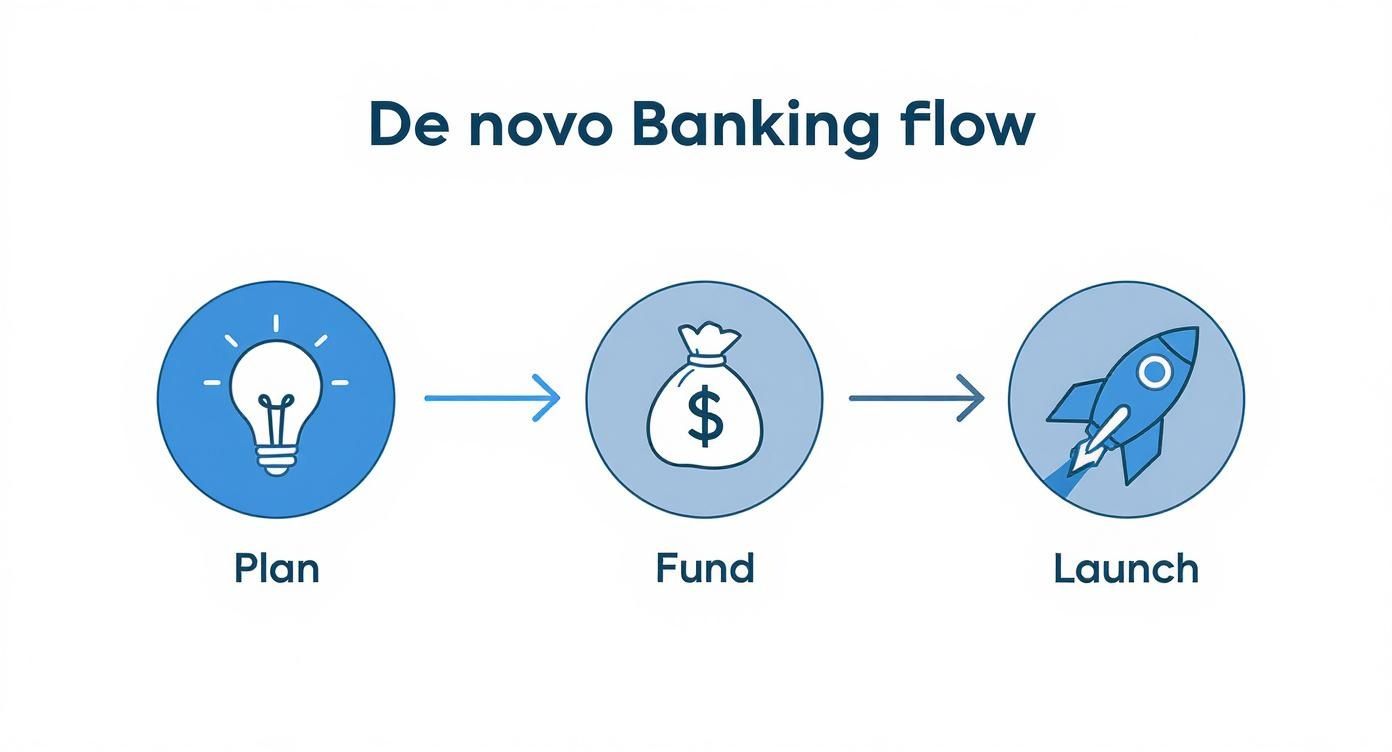
Each stage, from initial concept to opening day, is fraught with regulatory and financial hurdles. Meticulous, data-informed preparation is not merely recommended; it is required.
The Shifting Regulatory Climate
Following the 2008 financial crisis, the path to a new charter was nearly impassable due to regulatory risk aversion. That climate is thawing. Regulators now acknowledge that a lack of new entrants stifles competition and innovation.
Acting FDIC Chairman Travis Hill recently noted that de novo bank formation had "fallen off a cliff" and highlighted the agency's efforts to revisit capital standards and the deposit insurance application process, particularly for noncomplex community banks. You can read more about the FDIC’s evolving stance on their website.
This shift signals a more receptive environment for well-conceived plans, not an easier one. Regulators seek proposals that address specific market needs—whether through a niche focus, a compelling community-based model, or a secure technological advantage. The burden of proof remains squarely on the organizing group to deliver a business plan that is not just ambitious, but empirically sound.
Building an Undeniable Case with Data
A modern business plan submitted to the FDIC, OCC, or state authorities must be an analytical masterpiece. It demands granular, verifiable data to substantiate every projection and assumption. Vague assertions of "market opportunity" are insufficient.
Regulators expect a rigorous, data-backed narrative that answers several key questions:
- Market Viability: What specific demographic, economic, and competitive data prove a sustainable demand for another bank? For example, demonstrating a target market with 5.0% annual small business growth where the top three incumbents have only 12.0% C&I loan concentration provides a powerful rationale.
- Capital Adequacy: How was the initial capital target—for instance, $35,000,000—determined? Pro forma financials must model realistic scenarios for loan growth, operational expenses, and potential credit losses, proving this capital can sustain the bank for at least three years until it reaches profitability.
- Management Expertise: Does the proposed board and executive team possess direct, proven experience relevant to the bank's stated strategy? A bank targeting agricultural lending must have directors with deep, demonstrable expertise in that sector.
A charter application is fundamentally a risk management document. Organizers must use data to not only project success but to anticipate and mitigate potential failures. A plan that shows a path to a 1.05% ROAA by year five is compelling only if it’s supported by a realistic analysis of the competitive pressures and credit risks in the target market.
A robust bank intelligence platform is non-negotiable. Rather than manually collating disparate data, an integrated system provides instant access to market analysis, peer benchmarking, and demographic insights. This allows an organizing group to pressure-test its assumptions against real-world data, ensuring the business plan can withstand intense regulatory scrutiny. You can learn more about the roles of the various regulatory agencies for banks in our detailed guide.
Ultimately, navigating the regulatory gauntlet demands a proactive, evidence-based approach. By leveraging deep data intelligence, an organizing group transforms its application from a hopeful proposal into a compelling directive for approval.
Building a Bulletproof Capital Strategy
If the charter application is the blueprint, capital is the engine. For any organizing group, the capital strategy is paramount. It is not merely a regulatory requirement; it is the foundation that dictates the bank's resilience, growth potential, and ultimate viability.
The challenge is not simply raising funds, but raising sufficient capital to endure the initial loss-making years and drive through to profitability.
Regulators are laser-focused on this point. They require a capital plan that can absorb operational losses for a period of three to five years while simultaneously funding projected asset growth. This is not a back-of-the-napkin calculation. It demands rigorous, data-driven financial modeling that replaces guesswork with evidence.

From Minimums to Strategic Sufficiency
Meeting the minimum regulatory capital ratio is a tactical error and a recipe for failure. A bulletproof capital strategy presents a compelling narrative to investors and regulators, backed by rigorous analysis that connects initial funding to sustainable profitability while accounting for market realities.
Consider a proposed launch in a mid-sized city with a capital target of $30,000,000. Deeper analysis using a bank intelligence platform might reveal that peer banks in similar markets required an average of 4.5 years to break even. It might also show that intense deposit competition compressed their net interest margin (NIM) by 25 basis points more than anticipated.
This insight fundamentally changes the calculus. The $30,000,000 target now appears insufficient, and a revised goal of $40,000,000 becomes a strategic imperative. This is not just a larger number; it is a strategic buffer built on real-world market data. It demonstrates to regulators that the plan is grounded in reality, not best-case scenarios.
The question regulators and sophisticated investors ask isn't, "How much capital do you need to open?" It’s, "How have you quantified the capital required to execute your specific five-year strategy and withstand plausible market headwinds?"
Modeling the Path to Profitability
The capital plan must be directly linked to the operational blueprint and performance targets, illustrating how the initial investment will achieve key milestones, such as a 1.0% Return on Average Assets (ROAA).
If the business plan projects reaching $200,000,000 in assets by Year 3, the capital strategy must meticulously map the loan growth, operating expenses, and loan loss provisions required to support that scale. Executing this requires a deep understanding of how to read company financial statements; it is a non-negotiable skill.
This level of detailed projection is where many proposals falter. What is a realistic efficiency ratio for a new bank in its second year? What loan-to-deposit ratio is achievable in a hyper-competitive urban market? Answering these questions with confidence is impossible without historical data from de novo peers.
The following table provides a simplified look at what five-year projections might entail.
Hypothetical De Novo Capital and Performance Projections (Year 1-5)
| Year | Initial Capital | Projected Total Assets | Net Interest Margin (NIM) | Return on Average Assets (ROAA) |
|---|---|---|---|---|
| 1 | $40,000,000 | $50,000,000 | 2.80% | -2.50% |
| 2 | $40,000,000 | $125,000,000 | 3.10% | -1.10% |
| 3 | $40,000,000 | $200,000,000 | 3.35% | 0.25% |
| 4 | $40,000,000 | $275,000,000 | 3.50% | 0.85% |
| 5 | $40,000,000 | $350,000,000 | 3.60% | 1.05% |
This table demonstrates the long-term strategy: absorbing early losses (Years 1-2), reaching breakeven (Year 3), and achieving profitability targets (Years 4-5). Each metric is interconnected, showing how capital supports asset growth and the disciplined path to a healthy ROAA.
This is where advanced tools become critical. A platform like Visbanking provides the data necessary for essential bank capital planning, allowing organizers to build and stress-test pro forma financials against the actual performance of other new banks.
When a capital raise is grounded in a data-validated strategy, it is no longer a simple request for funds. It is an invitation to investors to participate in a strategic partnership with a clear, defensible path to long-term value creation.
Designing the Operational Blueprint for Day One
Securing capital and a charter are critical milestones, but the true test begins on opening day. A well-crafted business plan is merely theoretical without the technology, talent, and governance to execute it. For directors, designing the operational blueprint is a core strategic function.
Among the first and most consequential decisions is the selection of a core banking platform. This choice dictates everything from daily operational efficiency to future innovation capacity. It is a defining fork in the road.
One path leads to established core providers offering battle-tested systems well-understood by regulators. The tradeoff is often rigidity, high costs, and slow adaptation, potentially locking the new bank into the same technological constraints as its legacy competitors. The other path involves modern, cloud-native platforms that promise greater flexibility, seamless integrations, and a lower total cost of ownership, but may require a more difficult case with regulators and a more technologically adept internal team.
Assembling the Leadership Cadre
In parallel with technology decisions, assembling the right leadership is paramount. The board and executive team must be a curated blend of seasoned bankers, individuals with deep local market connections, and strategic visionaries. Regulators will scrutinize this team's collective experience to ensure it aligns with the bank's proposed strategy.
For a bank focused on small-to-medium-sized enterprises (SMEs) in a competitive urban market, the operational plan must reflect this specific mission:
- Technology: The tech stack must feature a best-in-class commercial loan origination system (LOS) and robust treasury management tools, with a core platform capable of integrating with these specialized fintech systems.
- Talent: The board requires directors with proven expertise in commercial credit risk and local business development. The Chief Lending Officer must be a known entity in the market, with a track record of building a high-quality loan portfolio from scratch.
This is where data supplants guesswork. Analyzing the real-world operational metrics of successful de novo banks provides an objective benchmark for these critical decisions.
A new bank cannot afford to improvise on operational efficiency. If peer data shows that similar de novo banks achieve an average efficiency ratio of 75.0% by their third year, that metric becomes a tangible target. The internal conversation shifts from "I think we should..." to "The data shows we must..."
Using Data to Engineer Efficiency
An intelligence platform like Visbanking allows directors to analyze the performance of other newly chartered banks. By examining efficiency ratios, non-interest expenses, and employee productivity metrics (such as assets per employee), an organizing group can construct a realistic and defensible budget.
For example, data might reveal that the most successful de novos achieve an assets-per-employee ratio of $4,500,000 by Year 4. This single metric is incredibly powerful. It provides a benchmark for the hiring plan and helps set ambitious yet attainable productivity goals. Staffing is no longer an intuitive exercise; it is a strategic calculation.
Ultimately, a superior operational blueprint is a competitive advantage. It ensures a smooth launch and establishes a foundation that is scalable, efficient, and resilient. For any director preparing to launch a new bank, the first step is to benchmark the market. See how Visbanking’s data can shape your operational and staffing models to build a bank engineered for success from day one.
The Long Road to Profitability
Once open for business, the real work begins. The initial excitement of launching a de novo bank quickly gives way to the daily discipline of executing the business plan. For the board, the first three years are characterized by intense, granular oversight—a shift from strategic planning to the hard reality of managing risk and driving toward profitability.
The early years are defined by risk management. Initial operating losses are an expected part of the plan; the danger lies in underestimating their depth and duration. Founders often face a challenging trifecta of headwinds: slower-than-projected loan growth, higher-than-budgeted operating expenses, and intense competition for low-cost core deposits. Any one of these can accelerate capital burn and delay the breakeven point.
Juggling the Three Big Risks
Risk management for a de novo is not an abstract boardroom concept. It is the active identification and neutralization of specific threats that could cripple the institution before it matures. The board must maintain vigilant oversight of three key areas, supported by real-time data.
- Credit Risk: With a clean-slate loan portfolio and no historical performance data, early underwriting discipline must be ironclad. A single poor-quality commercial loan can create a significant capital impairment.
- Operational Risk: New systems, new personnel, and new processes are inherently vulnerable. A failure in internal controls or a cybersecurity breach can inflict devastating reputational and financial damage at a critical stage.
- Compliance Risk: De novo banks are under intense regulatory surveillance. Any misstep regarding the Bank Secrecy Act (BSA), Community Reinvestment Act (CRA), or consumer protection regulations will attract immediate and forceful regulatory action.
These risks are interconnected. Pressure from slow loan growth may create a temptation to relax credit standards, creating future credit problems. An attempt to reduce costs by understaffing the compliance function can create significant regulatory exposure. The board's role is to ensure these trade-offs are always made with a focus on long-term safety and soundness.
Your Roadmap to Break-Even
Achieving profitability is a marathon. The most critical tool for this journey is a realistic, data-driven financial model that serves as a roadmap for tracking progress and making necessary course corrections.
Consider a common scenario for a new bank launched with $35,000,000 in capital.
Year one is defined by investment. The bank is hiring staff, implementing technology, and building its physical presence while the loan pipeline slowly materializes. A net loss of -$4,500,000 would not be unexpected.
The objective for a de novo board in Year 1 is not to achieve profitability. It is to ensure that losses are planned losses and that the engines of future profit—the loan pipeline, deposit gathering, and brand presence—are beginning to function effectively.
By the end of Year 2, the focus shifts to scaling operations. Assuming successful execution, assets might grow to $120,000,000, and the efficiency ratio could improve to 95.0%. The net loss may shrink to -$1,800,000. The bank remains unprofitable, but a clear path to breakeven is now visible.
Year 3 is often the inflection point. If total assets reach $200,000,000, the income from the loan portfolio should be sufficient to cover operating expenses. Achieving a positive net income, even a modest $500,000, is a major milestone. It signals to investors and regulators that the business model is viable and ready for scalable growth.
This entire journey, from significant initial losses to the first dollar of profit, depends on one thing: disciplined execution against objective metrics.
This is where access to the right data is indispensable. A board cannot evaluate its performance in a vacuum. It must ask critical questions: Is our loan growth consistent with the trajectory of other de novos launched in the last five years? How does our efficiency ratio compare to other banks of a similar size and strategy?
Without this external context, the board is operating blind. Answering these questions requires robust benchmarking tools. By using a platform like Visbanking, directors can instantly compare their bank's performance against a curated peer group of other de novos. This process transforms abstract goals into hard, defensible targets.
Explore how Visbanking’s data can help your board benchmark performance and keep your institution on a disciplined path to profitability.
Building a Future-Proof Bank with Data Intelligence
Laying the strategic groundwork for a successful de novo bank is no longer an exercise in intuition. In an industry where instinct once held sway, every core assumption—from market selection to capital adequacy—must be rigorously tested with verifiable data.
Data intelligence is not a supplementary tool; it is the central nervous system of a modern banking institution. It is essential for navigating a complex and competitive market.

This data-first mindset extends far beyond the charter application. It underpins the real-time strategic decisions made after opening. Success requires a commitment to continuous analysis, enabling the board to pivot intelligently based on hard performance metrics and evolving market dynamics.
From Static Plans to Dynamic Strategy
A business plan is not a static document to be filed and forgotten. It is a living strategy that requires constant monitoring and adjustment. Ongoing competitive benchmarking and performance monitoring are what enable agile, informed decision-making.
Consider a de novo bank whose leadership observes its loan-to-deposit ratio is lagging initial projections by 15.0% six months post-launch. By using a data platform to analyze peer performance, they can quickly determine if this is an institution-specific issue or a broader market trend affecting other new banks. That insight is the difference between a minor tactical adjustment and a major strategic miscalculation, allowing them to take precise, corrective action.
In today’s financial environment, experience is essential, but it’s not enough on its own without empirical validation. The most successful boards are the ones that demand data to either confirm their instincts or challenge their assumptions, making sure every major decision is grounded in solid evidence.
The opportunities in banking remain immense. Between 2019 and 2024, the global banking system expanded by $122 trillion in funds intermediated—nearly 40.0% growth in five years, far outpacing global GDP. You can dive into more insights about this massive growth from McKinsey.
For any organizing group or director serious about launching a successful de novo bank, the mandate is clear. The first step is to leverage robust data to validate the market opportunity, construct a charter application that regulators find undeniable, and engineer an institution built for sustained profitability from day one.
Explore how Visbanking’s data intelligence platform can help you benchmark your market and build a future-proof strategy.
Got Questions? We've Got Answers
Organizing groups and bank executives considering a de novo launch invariably have critical questions. The following provides direct answers to the most common inquiries.
How Long Does It Really Take to Open a New Bank?
A realistic timeline is 18 to 24 months, assuming a smooth process.
This can be broken into three primary phases:
- The Groundwork (6 to 9 months): This phase involves forming the leadership team, developing the business plan, and raising initial seed capital.
- The Regulatory Gauntlet (9 to 12 months): This is the formal application period with the FDIC, OCC, and state authorities. It is the longest phase and involves deep regulatory scrutiny.
- The Final Stretch (3 to 6 months): Following conditional approval, this period is a sprint to hire staff, implement technology, and prepare for the operational launch.
Any deficiency in the application or an unforeseen regulatory concern can extend this timeline. This is where data intelligence provides a crucial advantage, helping to anticipate and address questions about market viability and capital adequacy, thereby keeping the process on track.
How Much Cash Do We Need to Get Started?
While regulatory minimums exist, a practical capital range is between $25,000,000 and $50,000,000. The precise figure is dictated by the target market and the scope of the business plan.
Regulators aren't just checking a box to see if you can unlock the doors on day one. They need to see that you have enough capital to eat all your projected losses for at least three years while still funding your growth.
Comprehensive, data-backed financial projections are non-negotiable. For example, if pro forma financials demonstrate a clear path to a 1.0% ROAA within a challenging market, a $40,000,000 capital raise appears far more credible to regulators. It proves the plan is grounded in financial reality.
What are the Top Deal-Breakers for an Application?
Application denials almost always stem from one of three fundamental weaknesses.
- A Flawed Business Plan: The financial projections are not credible, the plan lacks a data-supported path to profitability, or it fundamentally misjudges the competitive landscape.
- An Inadequate Management Team: The board or executive team lacks the specific, relevant experience required to execute the proposed strategy.
- A Weak Capital Strategy: The plan is overly optimistic and fails to adequately account for startup losses, competitive pressures, and future growth requirements.
Ultimately, regulators' primary concern is that the proposed institution can operate in a safe and sound manner. A superior application uses hard data to eliminate all doubt on these critical points.
A successful de novo bank is not built on hope; it is built on a defensible, data-driven strategy. Visbanking provides the market intelligence and peer benchmarking tools to build an undeniable case for your charter. We help you model your capital needs and map a clear path to profitability. Let's turn your ambitious plan into an approved, operational bank.
Related Articles

Visbanking Blog
Capital Banking in the USA: An Overview of Investment Services, Financial Instruments, and Regulations

Visbanking Blog
Major Banks Focus on Digital Wallet to Counter Tech’s Advance Into Consumer Banking

Visbanking Blog
Bank Risk Management: Protecting Assets in Uncertain Times

Visbanking Blog
Revolutionize Your Bank with BIAS, the Bank Intelligence and Action System

Visbanking Blog
Get a Competitive Advantage with BIAS, the Proactive Banking Solution

Visbanking Blog