
Mastering Banking Analytics for Executive Strategy
Brian's Banking Blog
For bank executives and directors, banking analytics is no longer a technical specialty—it is the command center for institutional strategy. This represents a fundamental shift from reviewing last quarter's reports to actively steering the bank's future with validated, real-time data.
Ultimately, this is about making smarter, faster decisions that drive bottom-line results.
Why Banking Analytics Is Your New Competitive Edge

In an environment of compressed margins and heightened competition, executive intuition alone is insufficient. The institutions that win will be those that consistently weaponize their vast data assets. This is the function of banking analytics: the discipline of transforming raw financial, operational, and customer data into clear, actionable intelligence.
This is not about generating more complex spreadsheets. It is about obtaining definitive answers to the strategic questions that dictate bank performance.
Banking analytics transitions an institution from being merely data-rich to becoming insight-driven. It is the engine that converts what you know into what you must do.
The distinction between legacy and modern approaches is stark. It reflects a fundamental change in how we manage everything from client relationships to capital planning.
The Evolution of Banking Decision Making
| Area of Focus | Traditional Approach (Intuition-Based) | Modern Approach (Analytics-Driven) |
|---|---|---|
| Strategy | Relies on historical performance and gut feelings. | Uses predictive models to forecast market and portfolio outcomes. |
| Risk Management | Reacts to problems after they materialize in reports. | Proactively identifies leading indicators of credit and operational risk. |
| Customer Targeting | Deploys broad marketing campaigns based on generalities. | Pinpoints specific, high-value customer segments for targeted action. |
| Capital Allocation | Bases decisions on past successes and internal politics. | Justifies investments with data-backed ROI projections. |
This table illustrates a clear evolution—from reactive and assumption-based to proactive and evidence-based. It is a more rigorous and effective way to run a bank.
From Data Overload to Decisive Action
Effective analytics cuts through informational noise and empowers leadership to act with conviction. It provides the hard evidence needed to:
- Identify Undervalued Opportunities: Pinpoint customer segments or geographic markets where you hold a competitive advantage. For example, if data reveals a 30% year-over-year increase in small business loan applications within a specific zip code, that is a clear signal for targeted expansion.
- Neutralize Risks Preemptively: Detect the early warning signs of credit deterioration or operational gaps long before they become material financial events.
- Allocate Capital with Surgical Precision: Justify every strategic investment—from a new branch to a technology platform—with robust data forecasting the highest potential return.
This is not a theoretical shift; the market is voting with its capital. The global market for banking data analytics was valued at $9.67 billion in 2023 and is projected to reach $39.16 billion by 2032. This growth underscores how essential data-driven strategy has become for risk management, customer acquisition, and financial stability. You can explore more data about this rapid market expansion and its drivers.
The objective is to build a culture where decisions are grounded in verifiable insights, not assumptions. By benchmarking your performance against peers with a platform like Visbanking, you gain an immediate, objective view of your competitive standing. That clarity is the first step toward building a durable competitive advantage. Explore your bank’s performance against the market to identify your next strategic move.
The Four Tiers of Strategic Data Intelligence
Data collection is a prerequisite, but leveraging it for strategic advantage is a distinct discipline. To truly command your bank's data, you must understand its value across four levels of intelligence. This framework provides a roadmap from reviewing historical performance to making decisive actions that shape your future.
This is a disciplined methodology for building a more resilient and profitable institution. Each tier answers a progressively more critical question, delivering the insight required for your next move.
The infographic below illustrates the gains realized from mastering this framework.
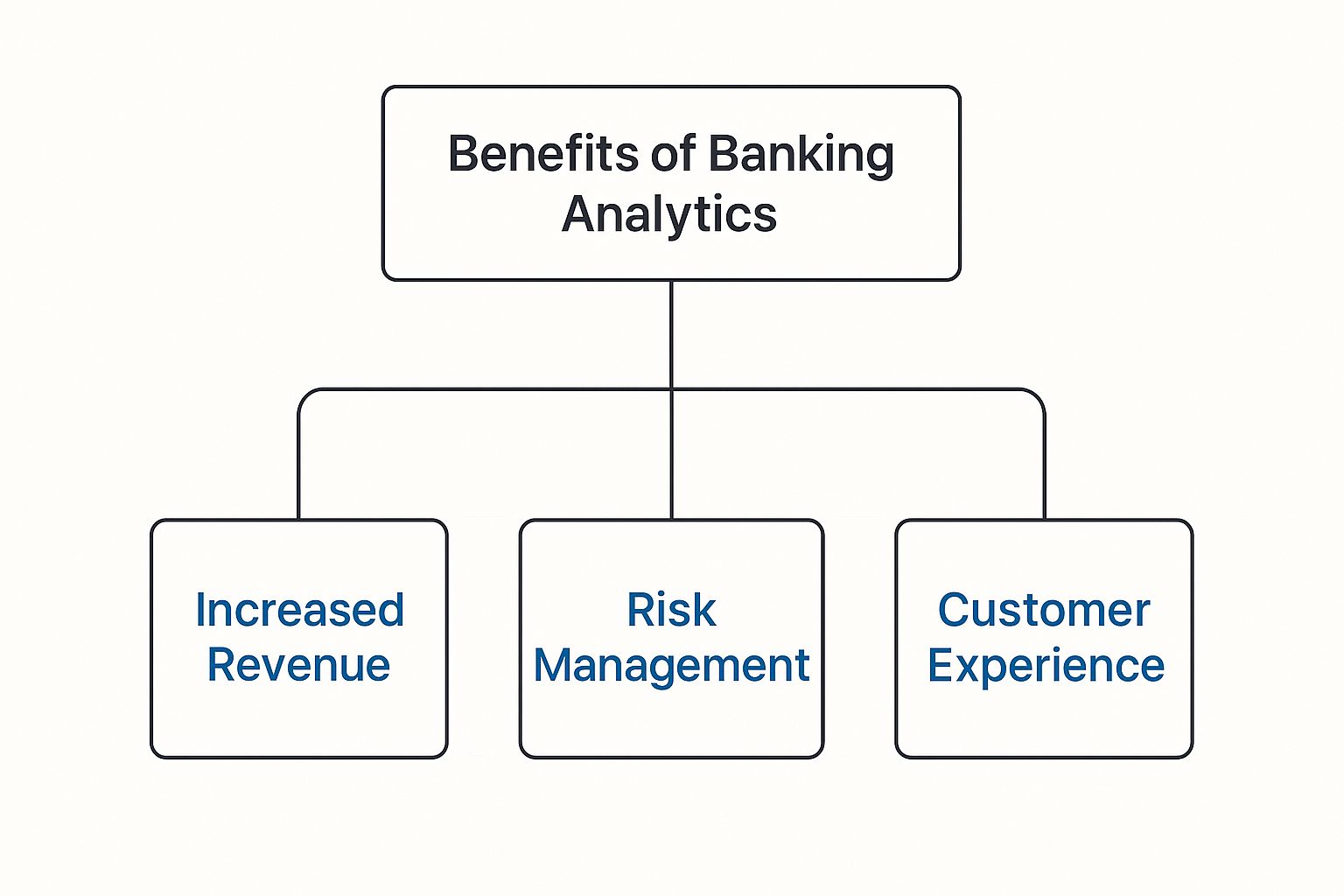
A mature analytics program delivers tangible results—enhancing revenue, tightening risk controls, and improving the customer experience.
Tier 1: Descriptive Analytics — What Happened?
This is the foundation. Descriptive analytics synthesizes historical data to provide a clear picture of past performance. It answers the fundamental question: "What happened?"
This is your bank's performance record—the standard reports, dashboards, and alerts tracking key metrics like loan origination volumes, deposit growth, and non-interest income. A report might show, for example, that mortgage applications declined by 10% last quarter. This is a critical data point, but it is only a starting point.
This first step often requires consolidating data from disparate sources. To analyze a customer's financial health from submitted documents, you might need to structure unstructured data. Learning to utilize PDF to CSV converters can be a critical tactical skill in making such data machine-readable.
Tier 2: Diagnostic Analytics — Why Did It Happen?
Knowing what happened naturally leads to the executive's next question: "Why?" Diagnostic analytics addresses this by digging deeper to identify the root causes behind observed trends.
It is the process of drilling down, connecting disparate data points, and identifying key drivers.
Diagnostic analytics bridges the gap between observing a data point and understanding its business implication. It transforms a statistic—like a 10% drop in applications—into actionable business intelligence.
To continue the example, a diagnostic analysis might reveal a strong correlation between the 10% application decline and a competitor's launch of an aggressive mortgage rate three weeks prior. Further analysis might show the drop was sharpest among first-time homebuyers with credit scores over 740—a segment you previously dominated. Now you have context, which is the precursor to strategy.
Tier 3: Predictive Analytics — What Will Happen Next?
Once you understand the past, you can begin to forecast the future. Predictive analytics employs statistical models and machine learning to project future outcomes. It answers the critical question: "What is likely to happen next?"
Here, data transitions from a rearview mirror into a forward-looking instrument. Your model might predict that, absent intervention, mortgage applications will decline by another 8-12% next quarter. This could translate to a potential $50 million shortfall in loan volume, a material impact requiring immediate attention.
Tier 4: Prescriptive Analytics — What Should We Do?
This is the highest level of data intelligence. Prescriptive analytics does not just forecast the future; it recommends the optimal response. It answers the ultimate strategic question: "What is our best course of action?"
Prescriptive models simulate various scenarios to identify the optimal strategy. In our mortgage example, it might recommend a targeted counter-offer—not a bank-wide rate cut, but a 0.25% rate reduction aimed specifically at the high-credit, first-time homebuyer segment you are losing. It could also calculate the optimal marketing spend to deploy this offer, maximizing ROI while protecting overall net interest margin.
This four-tiered framework is the core of modern banking analytics. By progressing through each level, you convert raw data into a strategic asset. Platforms like Visbanking’s BIAS accelerate this journey, providing the peer benchmarks and performance intelligence to ask—and answer—these critical questions. The first step is to see how your bank’s performance compares to the competition.
Using Predictive Analytics to Outmaneuver Risk
Predictive analytics marks the leap from describing what happened to forecasting what’s next. For a bank executive, this is not an academic exercise—it is about making decisions today to protect profitability tomorrow.
Moving beyond simple historical reporting allows you to anticipate market shifts, identify changing customer behaviors, and see portfolio risks developing before they impact the balance sheet. This foresight is the ultimate competitive advantage, enabling you to act while competitors are still analyzing last quarter's results.
The market recognizes this value. The predictive analytics in banking sector, valued at $3.63 billion, is projected to reach $19.61 billion by 2033. This 20.6% compound annual growth rate is driven by a single imperative: the need for smarter risk management.
Forecasting and Mitigating Credit Risk
The most immediate and powerful application of predictive modeling is in credit risk management. Traditional underwriting relies on a static, point-in-time snapshot. Predictive analytics provides a dynamic, forward-looking view of your loan portfolio.
Consider your small business loan book. A predictive model can analyze transaction data, payment histories, cash flow patterns, and macroeconomic trends in real-time. It can then flag specific loans showing early indicators of distress, assigning a quantified risk score well before they become 90 days past due.
A practical example: Your analytics platform identifies 15 small business loans, totaling $4.2 million in exposure, that now carry a default probability score over 85%. Instead of waiting for delinquency notices, your lending officers can engage these clients proactively today. They might offer a short-term, interest-only payment plan or a formal restructuring. With this action, you have potentially preserved the client relationship and protected $4.2 million from becoming a charge-off.
This fundamentally changes risk management from a defensive, reactive posture to a strategic, preventative one.
Identifying Customers at Risk of Churn
Predictive analytics is equally critical for protecting your most valuable asset: your customer base. It is well-established that acquiring a new customer is far more costly than retaining an existing one, yet most banks only become aware of attrition after an account is closed.
An effective churn prediction model identifies the subtle behavioral signals that a customer is preparing to leave.
- Decreased Activity: A commercial client whose transaction volume drops from 50 to 15 per month.
- Declining Balances: A high-net-worth individual whose average balance has fallen by 30% over the past 60 days.
- Behavioral Shifts: A long-time customer who has ceased using mobile deposit or bill pay services.
Predictive analytics provides a critical early warning. It allows you to address a problem while it is still solvable, transforming customer service into a profit-protection function.
By flagging these accounts, your relationship managers can intervene with a personal call or a targeted retention offer. For a deeper dive, review our guide on how to apply predictive analytics in banking.
Making Forecasting Accessible to Leadership
Historically, building such predictive models was a resource-intensive endeavor, requiring teams of data scientists and months of development. This kept powerful insights siloed away from the executives who needed them most.
That paradigm is changing. Modern platforms like Visbanking’s BIAS democratize this capability. By embedding predictive intelligence into intuitive dashboards, we make data-driven forecasting accessible to leaders without requiring a Ph.D. in statistics.
When you can clearly see a projection of next quarter’s deposit flows or identify which loan segments carry escalating risk, you can make more intelligent decisions about capital allocation and strategic planning. The purpose of banking analytics is not merely to generate a forecast; it is to provide the confidence to act on that forecast.
High-Impact Use Cases That Drive Your Bottom Line
Strategy remains theoretical until it impacts the balance sheet. These are the real-world applications of banking analytics that directly affect profitability, efficiency, and market position. These are not academic exercises but proven applications that sharpen your competitive edge.
The goal is to move beyond buzzwords and examine specific scenarios where superior data leads to profitable decisions. Applying analytics to core banking functions reveals opportunities that intuition-based competitors will miss.
Unlocking True Customer Profitability
A common error is equating large deposit balances with high customer value. Banking analytics dismantles this assumption by revealing true profitability at the customer level.
This requires a holistic analysis, factoring in non-interest income, the actual cost-to-serve, product utilization, and referral value.
Consider a $1.2 billion community bank that undertakes a deep-dive analysis of customer profitability. The findings are a strategic mandate:
- The top 12% of customers generate 75% of the bank’s total non-interest income. These are not always the largest depositors but are active users of wealth management, treasury services, and other fee-generating products.
- Conversely, the bottom 30% of customers are net unprofitable. High-frequency teller transactions and support call volume erode any potential margin.
This insight demands action. The solution is not to offboard unprofitable customers, but to re-segment and manage them intelligently. The bank can now confidently invest in a premium service model for its top 12%, justified by hard data. Concurrently, it can promote digital self-service channels to its lower-profitability segments, aligning the service model with economic reality.
Slashing Losses with Advanced Fraud Detection
Fraud is a persistent and costly operational risk. Legacy, rules-based fraud detection systems are inherently reactive and generate a high volume of false positives, which irritates valued customers and burdens operations teams. Advanced banking analytics models offer a more intelligent, proactive defense.
By analyzing thousands of data points in real-time—transaction size, location, time of day, and historical behavior—machine learning algorithms can identify anomalous activity with superior precision.
This is not just about stopping a single fraudulent transaction. It is about identifying sophisticated fraud networks and adapting to new attack vectors before they can inflict significant financial damage.
For example, a regional bank experiencing $3.5 million in annual wire fraud losses could cut that figure by over 50% in the first year by implementing an AI-powered detection system. The system identifies patterns a rules-based engine would miss, such as a series of rapid, small-value transfers to newly established international accounts, and successfully prevents a $1.8 million loss within nine months.
The projected growth of the big data analytics in banking market—from USD 8.06 billion to USD 21.83 billion by 2034—is largely driven by this demand for superior fraud and risk management tools. Banks that adopt these technologies are better positioned to protect their assets and their customers.
Strengthening Portfolios with Refined Credit Risk Analytics
Sound credit risk management is the bedrock of a stable institution. Banking analytics enhances this core function by moving beyond static credit scores to dynamic risk modeling. These models predict default probability with greater accuracy by incorporating a wider array of data, including industry-specific economic indicators and real-time cash flow analysis.
Imagine a bank with a $750 million commercial real estate (CRE) portfolio. By applying a predictive analytics model to its 1.5% default rate, it identifies a segment of loans—previously considered low-risk—exhibiting early warning signs correlated with rising vacancy rates in specific submarkets.
This provides the lending team with crucial lead time. They can now proactively engage these borrowers to restructure terms, request additional collateral, or take other risk-mitigating actions. This data-driven intervention successfully reduces the portfolio's overall default rate by 0.75%, preventing $5.6 million in potential losses and strengthening the entire book of business. You can learn more by reviewing our guide on banking data analytics best practices.
Building a Data-Driven Culture from the Top Down

The most advanced banking analytics platform is an expensive liability without a culture that values data. Meaningful change is not a grassroots movement; it must be driven with conviction from the C-suite and the boardroom. As a leader, your responsibility is to embed a data-first mindset into the operational fabric of your bank.
This involves shifting the organizational focus from "we've always done it this way" to "what does the data tell us?" The goal is to make data a non-negotiable component of every critical decision, from high-level strategy to branch-level performance. This cultural overhaul yields dividends in agility and profitability.
Get Clear on Strategy with Data
The first step is to define success in clear, measurable terms. Vague objectives like "grow the loan portfolio" are inadequate. A data-driven leader asks a better question: "Which specific loan segments offer the best risk-adjusted returns, and what is our precise growth target for them over the next two quarters?"
Your key performance indicators (KPIs) must be surgically linked to strategic goals. Instead of merely tracking total loan volume, you should monitor metrics like:
- Net Interest Margin by Product: Isolate which assets are creating the most value.
- Customer Acquisition Cost (CAC) vs. Lifetime Value (LTV): Ensure you are acquiring profitable relationships, not just transient accounts.
- Efficiency Ratio by Branch/Region: Identify top-performing units and codify their best practices for replication.
When you establish precise, data-backed targets, you provide your teams with a clear scorecard. You replace ambiguity with accountability and ensure universal alignment.
Tear Down the Information Silos
A data-driven culture is impossible when information is hoarded. For decades, departments like lending, marketing, and finance have operated in functional silos with their own data and their own version of the truth. This must end.
Effective banking analytics requires a single, unified view of the customer and the institution. When you integrate marketing data with lending performance, you might discover your most profitable customers originated from a single digital campaign—a clear signal for where to double down on investment. When finance and operations data are unified, you can finally calculate the true cost-to-serve for different customer segments.
Executing this requires both technology and an executive mandate. Investing in robust data governance in banking is non-negotiable. It establishes the rules for data quality, access, and security, creating a single source of truth that the entire organization can trust.
Give Your Teams the Right Tools and Talent
Finally, a data-first culture is about empowerment. This requires investment in two key areas: tools and talent. User-friendly platforms like Visbanking’s BIAS are engineered to catalyze this change, putting powerful, self-service insights directly into the hands of team leaders—no statistics degree required. When a branch manager can benchmark their performance against peers in just a few clicks, they are empowered to own their results.
This cultural shift also demands the right personnel. As technology becomes increasingly central to banking, your talent strategy must evolve. This may require new approaches to hiring top FinTech professionals who can bridge the gap between finance and technology.
When leadership champions data, dismantles silos, and equips its people, it creates a powerful flywheel effect. Decisions become faster, strategies become sharper, and the bank builds a sustainable competitive advantage. It begins by establishing an objective baseline of where you stand today.
Turning Insight into Your Next Strategic Action
Superior analytics are worthless without decisive action. The models and use cases discussed are merely theory until they are executed. For any bank leader, the primary challenge is not understanding the data, but acting upon it.
The most critical first step is to gain an objective, unvarnished assessment of your bank's performance against its competition. This is not about anecdotal evidence but hard numbers. Where do your loan yields, efficiency ratios, and deposit costs actually stand relative to your direct competitors?
From Ambiguity to Certainty
Answering these foundational questions with granular, peer-to-peer data is the bedrock of any winning strategy. It separates guesswork from certainty and provides a clear map of your strengths and vulnerabilities.
Consider a board meeting debate about expanding commercial loan growth.
- The Old Way: The decision hinges on anecdotes and a general sense that "the market is hot." The strategy is a vague directive to the lending team to "originate more loans."
- The Analytics-Driven Way: You reference a real-time dashboard. It shows your bank’s C&I loan yield is 4.85%, while a specific peer group of five local competitors is averaging 5.30%. You also see their non-performing loan ratio in the same category is 0.15% lower than yours.
This specific insight fundamentally changes the conversation. The question is no longer "should we grow?" It becomes "how do we close this 45-basis-point yield gap while tightening our underwriting to match our peers' risk profile?"
This is what it means to turn insight into action. You replace broad assumptions with precise, strategic questions that lead to profitable execution.
To achieve this, you need a partner that can deliver this essential competitive and performance intelligence. Visbanking’s BIAS is built to provide exactly this clarity, giving your leadership team the tools to convert data into a decisive competitive advantage. Stop guessing where you stand. Benchmark your performance and identify your next strategic opportunity. Explore your bank’s data now.
Your Questions, Answered
As a bank executive, it is prudent to ask critical questions before adopting a new methodology. Here are direct answers to common queries about banking analytics, focused on bottom-line impact.
What’s the Real ROI Here?
While institution-specific, the return on investment materializes quickly in three primary areas: improved efficiency, reduced credit losses, and higher-value customer relationships. The key is to target high-impact use cases first to demonstrate value and build momentum.
Consider the financial impact: what if you could use predictive insights to reduce your commercial loan default rate by 0.5%? For a bank with a billion-dollar portfolio, that translates to a $5 million reduction in charge-offs. Or imagine cutting fraudulent transaction losses by over 40% with more intelligent detection. The value of these actions compounds as analytics is integrated more deeply into core operations.
Do We Need to Hire a Bunch of Data Scientists?
No. This is a critical point. Modern business intelligence (BI) platforms are not designed for statisticians; they are designed for business leaders. The era of requiring a dedicated data science department to answer fundamental business questions is over.
The objective of modern banking analytics is not to create a technical bottleneck. It is to empower your leaders directly. The right platform performs the complex statistical work, translating raw data into clear business signals.
Platforms like Visbanking’s BIAS are designed to deliver powerful insights through dashboards and models that are intuitive to a banker, not just a programmer. Your head of lending, marketing director, and regional managers can instantly benchmark their performance against peers without writing code. This self-service model enables your best people to make smarter, data-validated decisions independently.
Will This Work with Our Existing Core System?
Yes. Any credible analytics platform is designed for interoperability. These systems are built to integrate securely with standard core banking systems, general ledgers, and other institutional data sources. The objective is to create a single, unified view of your bank's performance.
This is about adding a powerful intelligence layer on top of your existing infrastructure, not undertaking a disruptive "rip and replace" project. You unlock the value latent in your data without derailing daily operations. The right tools work with your existing technology to deliver the insights you need.
Your bank's data holds the answers to your most pressing strategic questions. At Visbanking, we provide the tools to uncover those answers, benchmark your performance against any peer group, and turn insight into decisive action. Explore your bank's performance data today.
Latest Articles
Brian's Banking Blog
Automated Alerts and Notifications for Banks
Brian's Banking Blog
Customer Feedback Loop for Banks: A Practical Playbook
Brian's Banking Blog
Commercial Lending Trends: What Bank Executives Must Know
Brian's Banking Blog
Bank Marketing Dataset Analysis Strategy

Brian's Banking Blog
ESG Peer Benchmarking for Bank Leaders
Brian's Banking Blog