
Driving Profitability with Advanced Credit Info Systems
Brian's Banking Blog
In today's dynamic lending market, relying on traditional credit scorecards is a strategic liability. A modern credit info system is not a compliance tool; it is the intelligence engine that underpins sustainable growth, turning vast datasets from a reporting burden into a decisive competitive asset. This is a fundamental pivot from reacting to historical performance to proactively shaping future outcomes.
Moving Beyond Scorecards to Strategic Intelligence
For decades, banking has operated with a limited view of credit risk. Traditional scorecards and bureau reports offer a rearview mirror—they document a borrower's past, not their trajectory. While historically necessary, this snapshot provides minimal forward-looking insight, leaving significant value unrealized and exposing portfolios to unforeseen risks.
The competitive landscape has shifted. Leading institutions are no longer merely managing credit; they are anticipating it. This requires moving beyond static data points to embrace a multi-dimensional, real-time view of both risk and opportunity.
The Strategic Shift from Reporting to Intelligence
Adopting a modern credit information strategy is a business evolution, not just a technology upgrade. It is the difference between knowing a borrower's FICO score and understanding their real-time cash flow, the specific economic pressures affecting their industry, and the behavioral patterns that signal future distress or growth potential.
Consider a commercial real estate loan application. A traditional review might show a flawless payment history. An advanced system, however, could overlay market data revealing a 15% increase in vacancy rates for comparable properties in that specific submarket. This uncovers a material risk entirely missed by standard reports. This is the function of a true intelligence system.
For bank leadership, the directive is clear: transform data from a passive archive into an active, strategic asset. This is how you drive portfolio growth, mitigate emerging threats, and expand into new markets with confidence.
This transition requires a system capable of three core functions:
- Aggregate Diverse Data: It must unify all relevant inputs—traditional credit data, alternative sources like transaction analytics, industry benchmarks, and macroeconomic indicators.
- Generate Predictive Insights: The objective is to apply analytical models that forecast credit events, not merely report on them after the fact.
- Enable Proactive Decisions: It must arm lending and risk teams with the intelligence to act decisively, whether that means adjusting loan covenants or identifying an underserved market segment.
Ultimately, a sophisticated credit info system reframes risk management from a defensive posture to an offensive strategy. To make this capability work for your institution, it's essential to understand modern banking data analytics. To lead, you must first know how your credit performance stacks up. A data intelligence platform like Visbanking allows you to benchmark your institution's capabilities today.
Anatomy of a Modern Credit Intelligence Engine
To gain a competitive edge, a modern credit information system must function as a dynamic intelligence engine, not a static data repository. It is built on four essential pillars, each designed to directly enhance profitability, manage risk, and drive strategic growth. For bank executives, understanding this anatomy is crucial for evaluating and justifying investment in data intelligence.
The infographic below illustrates the evolution from a traditional, static scorecard system to this modern engine.
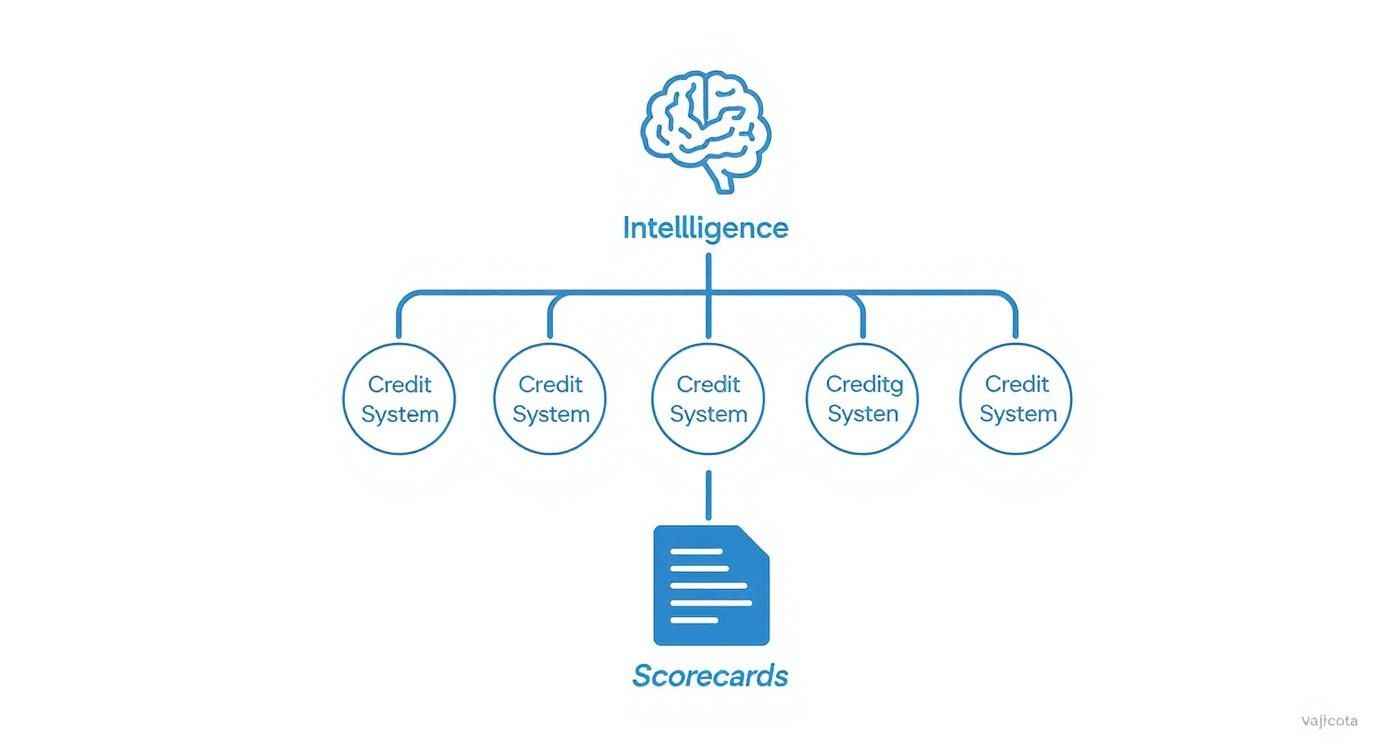
While raw data and conventional scorecards form the foundation, the strategic value—the competitive differentiator—is unlocked by the predictive intelligence at the apex.
A strategic credit information system is an interconnected capability. Each component builds on the last, converting raw data into decisive action.
Components of a Strategic Credit Information System
| Component | Function (What It Does) | Strategic Impact (Why It Matters) |
|---|---|---|
| Data Aggregation & Unification | Consolidates internal, bureau, and alternative data into a single, cohesive borrower profile. | Replaces guesswork based on isolated facts with a comprehensive view, revealing risks and opportunities otherwise missed. |
| Advanced Analytics & AI Modeling | Employs machine learning to analyze unified data, identify hidden patterns, and predict future outcomes. | Transforms historical data into a forward-looking tool, enabling anticipation of delinquencies and market shifts rather than reaction. |
| Automated Decisioning Engine | Translates insights from AI models into instant, consistent, and documented lending decisions. | Frees senior personnel from routine tasks, reduces operational costs, and delivers the fast, seamless experience modern borrowers demand. |
| Integrated Compliance & Governance | Embeds regulatory compliance and a complete audit trail directly into every automated process and decision. | Makes compliance a natural byproduct of sound strategy, satisfying regulators and protecting the institution. |
Understanding these components reveals how a well-architected system creates a powerful feedback loop: better data leads to smarter insights, which drive faster, compliant actions.
Pillar 1: Data Aggregation and Unification
The foundation of any high-performance credit info system is its ability to integrate and interpret disparate data streams. This goes far beyond pulling a standard credit report; it involves systematically gathering traditional and alternative data to build a complete, 360-degree profile of every borrower.
This requires unifying all sources:
- Internal Data: Core banking information, loan performance history, and real-time transaction data.
- Bureau Data: Standard credit files from major reporting agencies.
- Alternative Data: Cash flow analytics from business accounts, public records, and industry-specific economic trends.
By unifying these sources, a bank can move from analyzing isolated data points to understanding the complete narrative. For example, a business borrower may have a perfect payment history, but a 30% decline in their monthly cash flow signals impending trouble. A traditional report would miss this critical leading indicator.
Pillar 2: Advanced Analytics and AI Modeling
The second pillar is the system's analytical core, where raw, unified data is transformed into predictive insight. Machine learning and AI models identify patterns, forecast future behavior, and quantify risks invisible to the human eye. This is a significant leap from static, rules-based scorecards.
Instead of labeling a loan as "performing," an AI model can generate a dynamic probability of that loan becoming delinquent in the next 90 days—and update it in real time. For instance, a model could flag a cohort of auto loans in a specific metropolitan area where local economic data predicts a rise in unemployment, allowing the bank to proactively adjust its risk strategy weeks before late payments materialize.
Pillar 3: The Automated Decisioning Engine
Insight without action is a costly academic exercise. The third pillar, the decisioning engine, translates predictive analytics into immediate, consistent, and fully auditable actions. It automates straightforward underwriting decisions, escalates complex applications for human review, and issues portfolio-wide alerts based on predefined triggers.
A well-configured decisioning engine is the bridge between intelligence and operational execution. It ensures that insights generated by analytics are applied consistently across the institution, reducing human error and dramatically accelerating response times.
Consider a small business loan application. An automated engine can process it in minutes—verifying data, running the risk model, and generating a decision. This not only cuts operational costs by an estimated 20-25% but also creates a superior borrower experience, which is a significant competitive advantage. For a closer look at the mechanics, explore our guide on essential credit risk management tools.
Pillar 4: Integrated Compliance and Governance
The final pillar is a robust compliance framework embedded within the system's architecture. In a heavily regulated industry, governance cannot be an afterthought. A modern credit information system must provide complete transparency and a clear audit trail for every decision it facilitates.
This means maintaining a detailed log of the data used, the models applied, and the rationale behind every automated approval or denial. This built-in framework ensures that as your bank adopts more powerful analytical tools, it remains fully compliant with regulations like the Fair Credit Reporting Act. It provides regulators with a clear, defensible record of your risk practices, transforming compliance from a burden into a byproduct of sound strategy.
How Data Translates to Tangible Financial Wins
For bank leadership, the value of a modern credit info system must be measured in bottom-line impact: increased loan volume, reduced credit losses, and successful market expansion. The following scenarios illustrate how a sophisticated data framework delivers quantifiable financial results.
Precision Underwriting in Consumer Lending
A regional bank with $10 billion in assets uses a legacy credit scoring model for its auto lending, resulting in rigid "approve/deny" decisions. This approach rejects many near-prime applicants who are creditworthy but do not fit the outdated scorecard.
By implementing a credit intelligence system, the bank integrates alternative data, such as real-time cash flow from deposit accounts and employment stability metrics. This provides a clearer picture of an applicant's true capacity to repay. The system identifies a segment of applicants with FICO scores between 640 and 680 who, despite thin credit files, demonstrate stable income and strong debt-to-income ratios.
The outcome is a more nuanced, risk-adjusted underwriting policy. The bank can now confidently approve an additional 8% of its near-prime auto loan applications. This data-driven change adds $15 million in new loan originations annually without increasing its historical default rate. This is the financial impact of moving from a simple score to genuine insight.
Proactive Portfolio Monitoring for Commercial Real Estate
A mid-sized commercial bank holds a $500 million commercial real estate (CRE) portfolio, with a heavy concentration in multi-family housing. Its risk team relies on quarterly reviews, reacting to delinquencies only after they occur.
A new credit information system changes this dynamic. It continuously integrates loan performance data with hyper-local economic trends, property vacancy rates, and regional employment data. Its AI models are designed to detect early warning signs of sector-specific stress.
In Q2, the system identifies a 12% increase in delinquency risk within a specific segment of its CRE portfolio—properties located in cities experiencing a slowdown in tech sector job growth. This warning is generated a full 90 days before any payments are missed.
Armed with this predictive insight, the bank's leadership acts immediately. They proactively adjust risk-weighted asset calculations and increase the allowance for credit losses for that specific segment. This decisive action prevents an estimated $5 million in potential losses.
Targeted Market Expansion for Small Business
A community bank aims to grow its small business lending but struggles with inefficient, broad-based marketing efforts that yield low conversion rates.
The bank deploys a credit intelligence platform that analyzes UCC filings, public business records, and behavioral data to map the local market. The analysis uncovers an underserved niche: established service businesses (e.g., HVAC, plumbing) with revenues between $1 million and $5 million. These businesses exhibit strong, stable cash flow but have limited use of traditional term loans, indicating a potential need for flexible lines of credit.
This insight is actionable. The bank develops and launches a new line-of-credit product tailored to this segment. Marketing is no longer speculative but a precision campaign targeting pre-qualified, high-potential prospects. The result: the new product attracts $20 million in new, high-quality balances in its first year. This growth was unlocked by data that revealed a hidden market opportunity.
This focus on data-driven decisions reflects a broader industry trend. The credit scoring market, currently valued at $17.47 billion, is projected to reach $55.64 billion by 2032, growing at a CAGR of 15.58%. This expansion is fueled by the integration of AI models in advanced fintech systems. You can discover more about these market trends and their implications for lending.
These examples demonstrate a clear principle for banking executives: a modern credit info system is a direct engine for financial performance. To identify similar opportunities, you must first benchmark your institution against the market. A platform like Visbanking allows you to explore how your data intelligence capabilities stack up.
Quantifying the ROI of Advanced Credit Analytics
An investment in a modern credit info system is a significant capital decision. For bank leaders, the critical question is not about features, but about financial return. The business case rests on three pillars: loss prevention, operational efficiency, and profitable growth.
Stopping Losses Before They Start
The most immediate return from a superior credit information system is a measurable reduction in credit losses. Predictive models, fueled by a rich blend of traditional and alternative data, can identify loans trending toward distress far earlier than conventional methods. This enables proactive intervention before a loan becomes a charge-off.
Consider a community bank with a $1.5 billion commercial loan portfolio. By leveraging a system that monitors real-time industry trends and borrower cash flow, the bank identifies a cohort of loans exhibiting early warning signs, despite a perfect payment history. This allows the risk team to engage with those borrowers, restructure terms, or adjust reserves months ahead of schedule.
The result is a direct, positive impact on your allowance for credit losses. A conservative 25-basis-point reduction in the net charge-off rate on that portfolio translates to $3.75 million in annual savings. This is the tangible value of pre-emptive risk management.
Optimizing reserves is critical, and modern systems provide the granular data needed for greater precision. You can explore best practices for the allowance for credit losses to enhance your bank's financial resilience.
Making Your Operations Hum
The second component of ROI is derived from operational efficiency and cost reduction. Manual underwriting is slow, expensive, and prone to inconsistency. A smart credit info system automates routine processes, freeing seasoned lenders to focus on high-value, complex transactions.
A regional bank processing 1,000 small business loan applications per month can automate the initial screening for over half of them. This single change can reduce the average processing time from days to hours.
This velocity delivers on two fronts:
- Lower Costs: Reducing loan processing time by 25% can lower the origination cost per loan by 15-20%—a substantial saving when scaled across the entire lending operation.
- Enhanced Borrower Experience: Faster decisions provide a significant competitive advantage, increasing applicant conversion rates and strengthening the bank's market reputation.
Finding New Ways to Grow
Finally, superior data intelligence is an offensive tool. By analyzing market data in conjunction with your own portfolio, you can identify underserved segments where you can safely and profitably expand lending. This transforms a credit info system from a risk mitigation tool into a revenue generation engine.
Imagine a bank identifies a local niche of medical practices with strong, predictable cash flow but thin credit files, causing other banks to overlook them. Armed with this insight, the bank can design a specialized loan product for this segment. Capturing just $10 million in new, high-quality loans from this market in the first year provides a direct and immediate return on the data investment.
This proactive market analysis is becoming essential. The global credit risk assessment market, currently valued at $8.36 billion, is projected to reach $31.46 billion within ten years, growing at an annual rate of 14.17%. This growth is driven by banks using smarter analytics to improve risk prediction and accelerate execution. You can discover more insights about these market projections to understand the competitive landscape.
To win, you must see these opportunities first. The path forward requires benchmarking your performance against the market to identify your next competitive advantage.
Your Bank's Implementation and Future-Proofing Strategy
Implementing a modern credit information system is a strategic transformation, not a simple software installation. A successful deployment requires executive sponsorship, a clear governance framework, and a forward-looking perspective on financial technology. For bank leadership, the objective is to integrate the new system effectively today while building a platform resilient enough to capitalize on future disruptions.

Foundational Pillars for a Successful Launch
A successful implementation of a new credit info system depends on three critical factors. Failure in any one area risks turning a strategic asset into an expensive liability. These pillars ensure the system delivers tangible value from day one.
Rock-Solid Data Governance: A clear governance model is a prerequisite. This involves defining data ownership, establishing quality standards, and ensuring regulatory compliance. Strong governance prevents the "garbage in, garbage out" problem that undermines data initiatives and serves as the first line of defense against threats like the rising threat of infostealer malware and credit card data leaks that can compromise data integrity.
Seamless Core Integration: The credit intelligence engine cannot operate in a silo. It must integrate flawlessly with the core banking platform, loan origination system, and other key technologies. This enables the smooth data flow required for automation, reduced manual processing, and accelerated decision-making.
Proactive Change Management: New technology alters workflows and decision processes. A strategic change management plan is essential for team adoption. This includes training loan officers and risk managers not just on system mechanics, but on a new paradigm of credit risk—shifting from static report analysis to dynamic, data-driven insight.
Getting Ready for the Next Frontier in Credit Intelligence
The credit risk landscape is constantly evolving. A durable strategy must account for the emerging forces that will reshape how risk is measured and managed. Banks that anticipate these shifts will gain a significant competitive advantage.
The key is not merely adopting today's technology, but building an architecture that can readily incorporate tomorrow's innovations. This means selecting systems with flexible, API-first designs that can evolve with the market.
Key trends shaping the future of credit info systems include:
The Rise of Generative AI: Beyond predictive models, generative AI will serve as a risk co-pilot. An analyst will be able to ask, "What are the top three emerging risks in our commercial real estate portfolio?" and receive a concise, data-backed summary in seconds, revolutionizing strategic analysis.
The Impact of Open Banking: As open banking becomes more prevalent, the volume and velocity of available data will increase exponentially. Systems must be prepared to ingest and analyze real-time transaction data from multiple sources, providing a comprehensive view of a borrower's complete financial position.
Integration of ESG Factors: Environmental, Social, and Governance (ESG) criteria are becoming integral to risk assessment. Future systems must be able to quantify and incorporate ESG risks—such as climate impact on real assets or supply chain vulnerabilities—directly into standard underwriting models.
To ensure your institution is not just keeping pace but leading the market, you must continuously benchmark your capabilities against industry developments. A data intelligence platform like Visbanking can help you build a credit strategy that is both resilient and prepared for the future.
Turning Intelligence into a Competitive Advantage
A credit information system should not be viewed as a cost center. It is a core strategic asset that creates a sustainable competitive advantage. The purpose of such a system is to enable smarter, faster, and more profitable decisions throughout the entire credit lifecycle. This represents a fundamental shift from merely reporting on past performance to proactively shaping future outcomes—the key differentiator between market leaders and the rest of the pack.
However, the final step rests with executive leadership. Leading effectively requires looking beyond internal metrics. It is imperative to know how your credit risk and lending performance compare to the competition in real time.
A credit intelligence system's true power is unlocked when it moves from an internal reporting tool to a market-facing strategic weapon. It provides the essential context needed to identify specific opportunities for profitable growth that are invisible when looking only at your own portfolio.
If you are serious about leveraging this intelligence for market leadership, you must explore proven competitive advantage strategies. Gaining this critical market perspective is the final piece of the puzzle. It is time to see how your institution’s performance truly measures up.
A Few Common Questions We Hear
After seeing the strategic potential of a modern credit information system, bank executives usually have a few questions on their minds. Let's tackle some of the most common ones.
How Is a Modern Credit Info System Different From the Old Credit Bureau Reports?
Think of it this way: traditional bureau reports are like a black-and-white photograph of a borrower's past. A modern credit info system is more like a live, high-definition video feed of their financial life.
It's a dynamic intelligence engine that pulls in bureau data and mashes it up with everything else—internal transaction data, real-time cash flow, and even alternative data sources. Then, it uses AI to predict what's coming next. It stops just telling you what a borrower did and starts showing you what they're likely to do. That's the game-changer.
What's the Biggest Mistake Banks Make When Upgrading These Systems?
Hands down, the biggest blunder is treating it like just another IT project. This isn't about swapping out one piece of software for another.
A successful upgrade is a fundamental business transformation. You have to completely rethink your credit processes to take advantage of the new firepower you have. This means getting senior leaders on board, getting risk and lending and IT teams to actually work together, and having a laser focus on the business goals, whether that's slashing decision times or building a much healthier loan portfolio.
How Do We Actually Measure the ROI on This Kind of Investment?
The return on investment shows up in three key places. First, you'll see it in risk reduction—think lower charge-off rates and shrinking loan loss provisions. Second is a huge boost in operational efficiency, measured by the hard cost savings from automating underwriting and getting loans out the door faster.
Picture this: knocking just 30-basis-points off your net charge-off rate on a $2 billion portfolio. That puts a cool $6 million back into your pocket, every single year.
Finally, you'll see it in straight-up revenue growth. You'll be able to safely approve more applicants and roll out new credit products with confidence. When you benchmark these numbers against your peers, the financial impact becomes crystal clear.
To truly know where you stand, you must measure your performance against the market. Visbanking is the intelligence and action platform that helps you turn data into decisive, profitable moves. Explore how your data capabilities stack up today.
Related Articles

Visbanking Blog
Transforming Credit Unions: Visbanking's Data Revolution

Visbanking Blog
Banking Data Analytics: Turning Information Into Profit

Visbanking Blog
Make More Informed Decisions with BIAS, the Data-Driven Banking Solution

Visbanking Blog
Unveiling the US Banks Credit Quality Chart on VisBanking Report Portal

Visbanking Blog
Visbanking and Credit Unions

Visbanking Blog