
Top Credit Risk Management Tools for 2025
Brian's Banking Blog
Navigating the Credit Risk Landscape in 2025
Effectively managing credit risk is crucial for financial institutions. This listicle examines eight leading credit risk management tools to help you navigate the complexities of 2025. We'll cover Visbanking, SAS Credit Risk Management, Moody's Analytics CreditLens, Experian Ascend, FICO Enterprise Risk Suite, Oracle Financial Services Analytical Applications, Equifax Ignite, and Fiserv Risk Office. Learn the pros and cons of each platform and discover how these tools can help mitigate losses, improve decision-making, and enhance regulatory compliance. This concise guide provides the information you need to choose the right credit risk management tools for your organization.
1. Visbanking: A Data-Driven Approach to Credit Risk Management
Visbanking offers a powerful suite of tools designed to enhance credit risk management within financial institutions. Its core strength lies in the Bank Intelligence and Action System (BIAS), a comprehensive platform that aggregates over 30 years of multi-source data from more than 10,000 banks. This wealth of information, encompassing financial metrics, regulatory insights, real-time news, and key performance indicators, empowers banking professionals to move beyond reactive data consumption and adopt a proactive, strategic approach to risk management. In the current landscape of volatile interest rates and margin pressures, this future-ready approach is crucial for maintaining a competitive edge and mitigating potential financial risks. Visbanking is a particularly valuable credit risk management tool because it provides a holistic view of the financial ecosystem, facilitating informed decision-making and strategic planning. By leveraging this comprehensive data set, institutions can identify emerging risks, assess the creditworthiness of counterparties, and make data-driven decisions to optimize their credit portfolios.
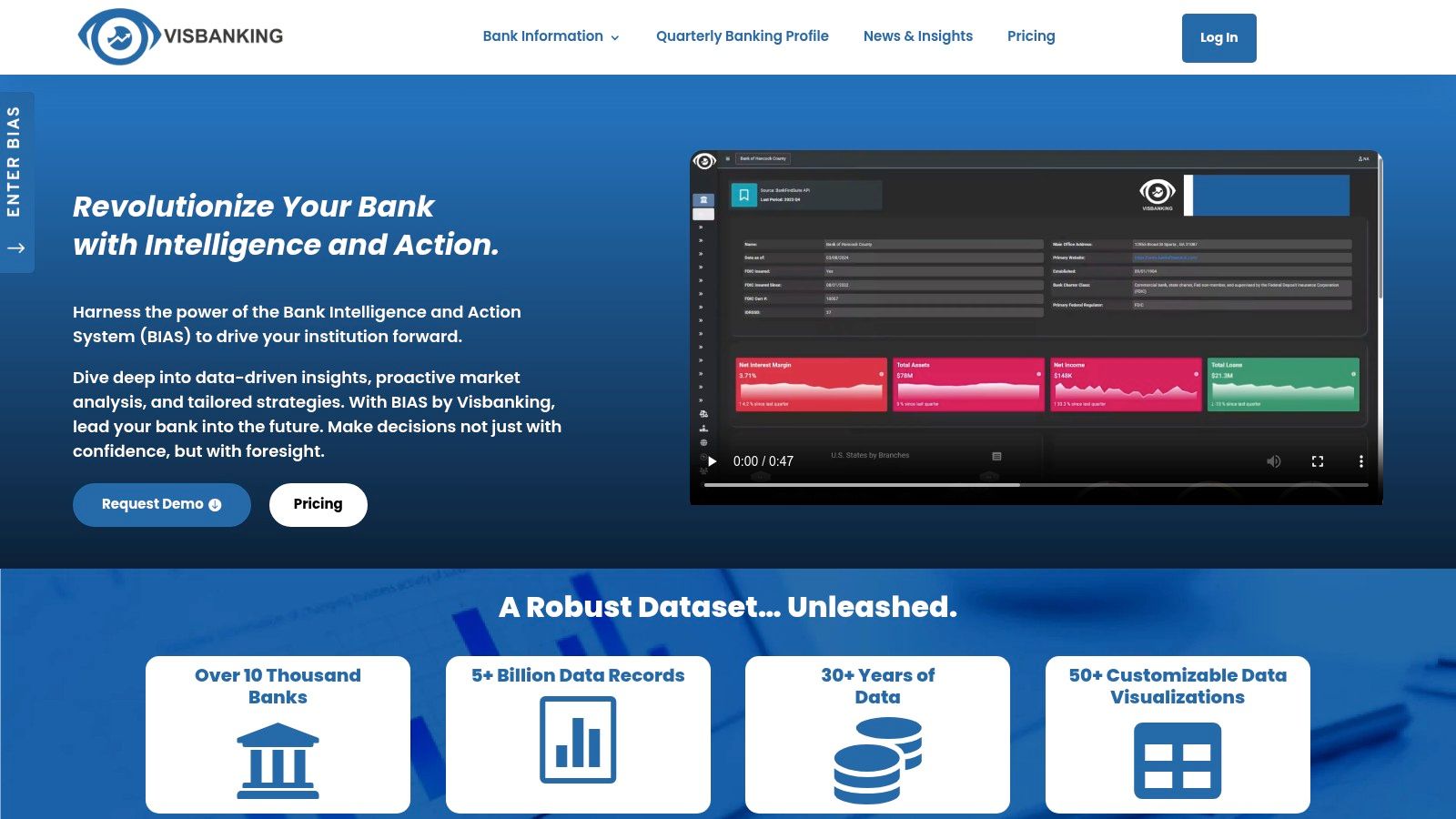
For credit risk professionals, Visbanking offers a unique advantage by providing a deep understanding of counterparty risk. Imagine needing to assess the creditworthiness of a potential borrower. Instead of relying on limited internal data, Visbanking allows you to access a vast repository of historical and real-time information on that institution, including financial performance, regulatory compliance history, and even news sentiment. This granular level of insight allows for more accurate risk assessments and informed lending decisions. Furthermore, the platform's customizable dashboards and reporting features can be tailored to specific needs, providing key metrics and trends at a glance. This empowers risk managers to proactively identify potential problem areas and implement mitigation strategies before losses occur.
Visbanking offers a variety of flexible content delivery options, including APIs, SQL connections, and interactive dashboards, ensuring seamless integration with existing workflows. The platform’s 50+ customizable visualizations further enhance data analysis and interpretation. This flexibility is key for institutions of all sizes, as it allows them to tailor the platform to their specific requirements and integrate it into their current technological infrastructure. For example, a bank could use the API to integrate Visbanking data directly into its internal credit scoring models, automating the risk assessment process and improving efficiency.
Pros:
- Unparalleled data depth: Integrates 30+ years of data from 10,000+ banks with over 5 billion records.
- Actionable insights: Combines diverse data types into one platform for holistic analysis.
- Customizable and flexible: Offers 50+ visualizations and multiple delivery formats (APIs, SQL, dashboards).
- Proactive risk management: Enables strategic decision-making and enhances crisis management.
- Wide applicability: Caters to various stakeholders, promoting transparency and innovation.
Cons:
- Pricing opacity: Requires contacting sales for quotes, hindering immediate budget assessment.
- Potential learning curve: The data-rich platform may require training for full utilization.
While pricing details are available upon request through their website (https://www.visbanking.com), the lack of transparent pricing might be a hurdle for some. However, the platform's depth of data and powerful analytical capabilities make it a worthwhile investment for institutions serious about enhancing their credit risk management strategies. Requesting a demo is highly recommended to fully grasp the platform's potential and determine its suitability for your organization.
2. SAS Credit Risk Management
SAS Credit Risk Management is a powerful, comprehensive solution designed to help financial institutions effectively assess and manage credit risk across their entire portfolio. This platform combines advanced analytics with robust data management capabilities, providing a holistic view of credit risk exposure. This makes it a crucial tool for navigating the complexities of today's financial landscape. It enables organizations to not only comply with stringent regulatory requirements such as IFRS 9, CECL, and Basel regulations but also optimize capital allocation and enhance decision-making processes. Its breadth of features makes it suitable for large institutions grappling with significant data volumes and intricate risk profiles.
For banking executives seeking to minimize financial losses and maintain a healthy balance sheet, SAS Credit Risk Management provides a valuable toolset. It offers advanced statistical models and machine learning algorithms for accurate risk assessment, going beyond traditional methods to leverage the power of predictive analytics. This allows institutions to proactively identify potential risks and make more informed lending decisions. Learn more about SAS Credit Risk Management and its applications in predictive analytics. Furthermore, its comprehensive stress testing and scenario analysis capabilities allow institutions to evaluate their resilience under various economic conditions, ensuring they are prepared for unexpected market downturns. The platform also automates credit scoring and rating processes, streamlining operations and reducing manual effort. Real-time monitoring and early warning indicators provide continuous oversight of the credit portfolio, enabling swift responses to emerging risks.
For risk and compliance professionals, the integrated regulatory compliance frameworks (IFRS 9, CECL, Basel) are invaluable. These frameworks are built into the platform, simplifying the process of adhering to complex regulatory requirements and reducing the risk of non-compliance penalties. Innovation and IT leaders will appreciate the platform's robust data management and integration capabilities, which allow for seamless integration with existing systems. This fosters a data-driven culture within the organization, promoting better decision-making across all levels.
While SAS Credit Risk Management boasts industry-leading analytics capabilities with both traditional and AI/ML models, and is highly customizable to fit specific institutional needs, it does have some drawbacks. The implementation can be complex, requiring specialized expertise and often involving significant upfront investment. The cost is generally higher compared to many alternative credit risk management tools, which can be a barrier for smaller institutions. Furthermore, there is a steep learning curve for new users, necessitating comprehensive training. For smaller financial institutions with less complex needs and fewer resources, the platform's extensive features may be excessive.
Pricing for SAS Credit Risk Management is typically based on the size and complexity of the institution, as well as the specific modules and features required. Technical requirements vary depending on the chosen deployment option (on-premise or cloud-based) and the integration with existing systems. Consulting with SAS directly is recommended to obtain precise pricing and technical specifications. Implementation tips include clearly defining objectives, securing executive buy-in, allocating adequate resources for training, and collaborating closely with SAS throughout the implementation process. This collaborative approach ensures the platform is tailored to the institution's specific requirements and that staff are adequately trained to leverage its full potential. By carefully considering these factors, financial institutions can harness the power of SAS Credit Risk Management to gain a competitive edge in today's dynamic and increasingly regulated financial environment.
3. Moody's Analytics CreditLens
Moody's Analytics CreditLens is a powerful cloud-based platform designed to enhance credit risk management throughout the entire credit lifecycle, from origination to monitoring. Its inclusion in this list of top credit risk management tools stems from its comprehensive features, integration of Moody's extensive data and analytics, and focus on streamlined automation. This makes it a particularly strong solution for financial institutions looking to improve the efficiency and accuracy of their credit decisions.
CreditLens addresses the challenges of modern credit risk management by providing a single, unified platform. This centralization simplifies workflows and offers a holistic view of credit exposures, crucial for effective risk assessment and mitigation. Banking executives can leverage the platform's portfolio management tools for a macro-level understanding of risk concentration and capital adequacy, while financial analysts benefit from the detailed financial spreading and analysis tools with automated data extraction.
Key Features and Benefits:
- Financial Spreading and Analysis: Automated data extraction and spreading significantly reduces manual effort and improves accuracy in financial statement analysis. This feature allows analysts to focus on interpreting the data rather than tedious data entry.
- Integrated Credit Scoring and Industry Data: Leveraging Moody's robust data and analytics, including industry benchmarks and credit scoring models, enhances the quality of credit assessments and enables informed decision-making. This is particularly valuable for risk and compliance professionals in adhering to regulatory requirements and internal policies.
- Customizable Workflows and Credit Policies: CreditLens adapts to your institution's unique processes and policies. Customizable approval workflows and credit policies ensure consistency and adherence to regulatory frameworks. This configurable nature allows for seamless adoption by organizations of varying sizes and complexity.
- Covenant Tracking and Compliance Monitoring: Comprehensive monitoring of loan covenants allows for proactive identification of potential breaches, minimizing losses and strengthening compliance efforts. This automation is crucial for risk managers in mitigating potential defaults and maintaining portfolio health.
- Portfolio Management and Risk Concentration Analysis: Gain a comprehensive view of your credit portfolio, identify risk concentrations, and perform stress testing. This macro-level view enables banking executives and regulators to make strategic decisions for optimizing capital allocation and mitigating systemic risks.
Pros:
- Cloud-based Architecture: The cloud-based nature provides flexibility, scalability, and accessibility, allowing users to access the platform from anywhere with an internet connection. This is particularly advantageous for organizations with geographically dispersed teams.
- Moody's Data Integration: Direct access to Moody's extensive credit research, ratings, and data significantly enhances the depth and accuracy of risk assessments.
- Highly Configurable: CreditLens can be tailored to fit specific credit processes and workflows, minimizing disruption during implementation.
- Strong Audit Trail: Robust document management and audit trail capabilities strengthen compliance efforts and facilitate internal and external audits.
Cons:
- Pricing: The premium pricing model may be prohibitive for smaller institutions with limited budgets.
- Customization Complexity: Some advanced customizations may require professional services support, adding to the overall cost.
- Legacy System Integration: Integration with existing legacy systems can pose challenges and require careful planning.
- Learning Curve: Utilizing all available features effectively requires a learning curve, necessitating adequate training for users.
Implementation Tips:
- Phased Rollout: Implementing CreditLens in phases can mitigate disruption and allow for gradual user adoption.
- Dedicated Project Team: A dedicated project team comprising IT, risk management, and business users can ensure smooth implementation.
- Training and Support: Adequate training and ongoing support from Moody's Analytics are crucial for maximizing the platform's benefits.
Comparison with Similar Tools:
While several credit risk management tools exist, CreditLens distinguishes itself through its integration with Moody's data and analytics, advanced customization capabilities, and focus on the entire credit lifecycle. Competitors may offer specific functionalities at potentially lower price points, but may lack the comprehensive suite of features offered by CreditLens.
Website: https://www.moodysanalytics.com/product-list/creditlens
In conclusion, Moody's Analytics CreditLens is a valuable credit risk management tool for financial institutions seeking to enhance their credit decision-making process through advanced analytics, automation, and a centralized platform. While the premium pricing and potential integration challenges should be considered, the platform's comprehensive features and integration with Moody's data offer significant advantages for organizations seeking a robust and scalable solution. For innovation and IT leaders, the cloud-based architecture and API-driven integration capabilities offer flexibility and future-proofing. CreditLens ultimately provides a valuable tool for navigating the complexities of modern credit risk management.
4. Experian Ascend: Advanced Analytics for Credit Risk Management
Experian Ascend is a powerful credit risk management tool designed for financial institutions seeking to leverage advanced analytics for improved decision-making. This platform distinguishes itself by combining Experian's vast data resources with sophisticated analytical tools, enabling organizations to build, test, and deploy robust credit risk models. Its inclusion in this list of top credit risk management tools is warranted by its comprehensive features, focus on data security, and potential for significant improvements in risk assessment accuracy.
Key Features and Benefits:
- Access to Extensive Data: Experian Ascend provides access to Experian's comprehensive consumer and business credit data, including alternative data sources. This wealth of information allows for a more holistic view of borrowers, leading to more accurate risk assessments and potentially uncovering previously hidden insights. This feature is crucial for developing more predictive models and making more informed lending decisions.
- Advanced Analytics and Modeling: The platform boasts built-in analytical tools and modeling capabilities, catering to both simple analyses and complex modeling scenarios. This empowers financial institutions to develop custom risk scoring models tailored to their specific needs and portfolio characteristics.
- Collaborative Workspace: Ascend fosters collaboration between data scientists and business users through a shared workspace. This facilitates streamlined communication and ensures that models are developed and implemented in alignment with business objectives.
- Real-Time Decisioning: The platform supports real-time credit decisioning and strategy implementation, enabling faster loan processing and improved operational efficiency. This is especially beneficial in today's fast-paced lending environment.
- Regulatory Compliance: Experian Ascend integrates regulatory compliance frameworks, assisting organizations in adhering to industry standards and minimizing compliance risks. This feature simplifies the process of maintaining compliance and reduces the potential for penalties.
Practical Applications and Use Cases:
- Developing custom credit scoring models: Ascend allows financial institutions to develop tailored models that incorporate both traditional and alternative data sources, leading to more refined risk segmentation.
- Stress testing portfolios: The platform facilitates stress testing under various economic scenarios, enabling proactive risk management and improved preparedness for economic downturns.
- Identifying early warning signals of borrower distress: By leveraging advanced analytics, Ascend can help identify patterns and trends indicative of potential borrower defaults, allowing for timely intervention and mitigation strategies.
- Optimizing pricing strategies: A deeper understanding of risk allows for more accurate pricing of loans, balancing profitability with risk appetite.
Pros and Cons:
Pros:
- Extensive data assets, including alternative data, enhance predictive power.
- Scalable architecture supports both simple and complex modeling needs.
- Reduces time from insight to implementation, accelerating the model development lifecycle.
- Robust data security and governance controls ensure data integrity and compliance.
Cons:
- Subscription costs can be substantial depending on data usage and required features.
- Fully leveraging the advanced features may require dedicated expert resources.
- Some customizations may necessitate professional services assistance, adding to the overall cost.
- The platform's full value is often best realized by larger organizations with established in-house analytics teams.
Pricing and Technical Requirements:
Pricing information for Experian Ascend is not publicly available and typically requires contacting Experian directly for a customized quote. Technical requirements will vary depending on the specific implementation and desired functionalities.
Implementation and Setup Tips:
- Begin with a clear understanding of your organization's specific credit risk challenges and objectives.
- Engage with Experian early in the process to discuss your requirements and determine the optimal configuration.
- Dedicate adequate resources for implementation, including both technical and analytical expertise.
- Develop a comprehensive training program to ensure that users can effectively utilize the platform's features.
Comparison with Similar Tools:
While other credit risk management tools exist, Experian Ascend differentiates itself through its combination of extensive data assets, advanced analytics capabilities, and integrated regulatory compliance framework. Competitors like FICO Blaze Advisor and SAS Credit Scoring offer similar functionalities but may not have the same breadth of data access or specific regulatory compliance integrations.
Website: https://www.experian.com/business/products/ascend-analytics-platform
By leveraging Experian Ascend, financial institutions can gain a more granular understanding of credit risk, improve the accuracy of their lending decisions, and ultimately enhance their overall risk management strategies. This sophisticated platform is a valuable tool for organizations looking to stay ahead in the increasingly complex landscape of credit risk management.
5. FICO Enterprise Risk Suite
The FICO Enterprise Risk Suite earns its place on this list of top credit risk management tools due to its comprehensive coverage of the entire credit lifecycle, robust decision optimization capabilities, and proven track record in major financial institutions globally. It offers a powerful suite of solutions designed to help financial institutions, from global banks to credit unions, manage credit risk more effectively and efficiently. This platform empowers organizations to implement standardized risk management practices while simultaneously enhancing customer experiences and optimizing operational workflows.

From application processing and account management to fraud detection and collections, the FICO Enterprise Risk Suite leverages FICO's deep expertise in predictive analytics and decision management to provide a holistic view of credit risk. This allows for more informed decisions across all stages of the customer relationship. For example, during the application process, the suite can automate credit scoring and decisioning based on customized models, streamlining approvals and reducing manual workload. In account management, it allows for ongoing monitoring of customer behavior and risk profiles, enabling proactive intervention to mitigate potential losses. Its robust fraud detection capabilities help identify and prevent fraudulent activities, further minimizing risk exposure. Finally, in collections, the suite optimizes recovery strategies by segmenting customers and tailoring collection efforts based on individual risk profiles.
Key features of the FICO Enterprise Risk Suite include industry-standard credit scoring models with customization options, allowing institutions to tailor models to their specific portfolios and risk appetites. Decision optimization is powered by advanced analytics and business rules, enabling automated, data-driven decision-making. The suite also facilitates customer-level strategy management across products, providing a unified view of customer risk. Automated workflows for credit applications and approvals significantly reduce processing time and improve efficiency. Comprehensive reporting and visualization capabilities offer valuable insights into portfolio performance and risk trends. You can learn more about FICO Enterprise Risk Suite and how it applies to bank risk assessments.
While the FICO Enterprise Risk Suite offers significant advantages, it's crucial to consider the potential drawbacks. Implementation can require a significant investment in terms of both cost and time, and its complex architecture often necessitates specialized skills for maintenance and support. Integrating the suite with existing systems can be challenging, particularly for organizations with complex IT infrastructures. Furthermore, some components may require separate licensing, adding to the overall cost.
Pros:
- Proven track record in major financial institutions globally
- Comprehensive solution covering the entire credit lifecycle
- Strong decision optimization capabilities
- Flexible deployment options (on-premises, cloud, or hybrid)
Cons:
- Significant investment in cost and implementation time
- Complex architecture may require specialized skills
- Integration with multiple external systems can be challenging
- Some components may require separate licensing
Specific pricing and technical requirements for the FICO Enterprise Risk Suite are not publicly available and typically require direct consultation with FICO. However, it is generally understood that the suite's pricing model is based on the size and complexity of the implementing institution and the specific modules selected. Technical requirements vary based on the chosen deployment option (on-premises, cloud, or hybrid).
For institutions seeking a comprehensive and robust credit risk management solution, the FICO Enterprise Risk Suite offers a compelling option. However, potential users should carefully evaluate the cost, implementation complexity, and technical requirements before making a decision. Comparing the suite with other tools like Experian PowerCurve or SAS Risk Management for Banking can provide a broader perspective and help identify the best fit for your organization's specific needs. Effective implementation requires meticulous planning, dedicated resources, and close collaboration with FICO's implementation team. This collaborative approach is crucial for ensuring a smooth transition, maximizing the suite's capabilities, and realizing a strong return on investment.
6. Oracle Financial Services Analytical Applications
Oracle Financial Services Analytical Applications (OFSAA) offers a comprehensive suite of credit risk management tools tailored for financial institutions. It empowers these organizations to effectively measure, monitor, and manage credit risk across their diverse portfolios, all while ensuring compliance with stringent regulatory requirements. OFSAA achieves this by integrating data from various sources, providing a consolidated view of credit exposure, and supporting advanced risk models and stress testing scenarios. This makes it a powerful tool for banking executives, financial analysts, risk and compliance professionals, IT leaders, and regulators alike.
OFSAA’s unified data model ensures consistent risk assessment across the entire organization. This is crucial for large institutions with complex operations where maintaining a consistent approach to risk evaluation can be challenging. Its advanced analytics capabilities facilitate credit scoring, risk rating, and the development of sophisticated risk models. Moreover, OFSAA provides comprehensive regulatory reporting, covering key frameworks such as Basel, IFRS 9, and CECL, simplifying compliance processes and reducing the risk of penalties. The platform's stress testing and scenario analysis functionalities allow institutions to assess their resilience to adverse economic conditions, supporting proactive risk mitigation strategies. A flexible calculation engine further enhances OFSAA's utility, enabling customization of risk metrics to align with specific institutional needs.
Features and Benefits:
- Unified Data Model: Provides a consistent view of risk across the organization, eliminating data silos and improving decision-making.
- Advanced Analytics: Enables sophisticated credit scoring, risk rating, and model development for more accurate risk assessments.
- Regulatory Reporting: Streamlines compliance with Basel, IFRS 9, CECL, and other regulations, reducing the burden on compliance teams.
- Stress Testing & Scenario Analysis: Allows institutions to proactively identify and mitigate vulnerabilities through robust simulations.
- Flexible Calculation Engine: Facilitates customized risk metric calculations tailored to specific institutional requirements.
Pros:
- Enterprise-Scale Architecture: Handles high transaction volumes and complex data structures effectively.
- Strong Oracle Integration: Seamless integration with existing Oracle databases and financial systems simplifies implementation and data management.
- Comprehensive Regulatory Compliance: Covers a wide range of regulatory frameworks, reducing compliance risks and costs.
- Robust Data Management Foundation: Ensures data quality and integrity for reliable risk analysis.
Cons:
- Complex Implementation: Requires significant IT resources and expertise, potentially leading to longer implementation timelines.
- Higher Total Cost of Ownership: Compared to some alternatives, OFSAA can be more expensive, particularly for smaller institutions.
- Potential Overengineering: The extensive feature set may be excessive for institutions with less complex credit risk management needs.
- User Interface: While functional, the user interface might be less intuitive compared to more modern solutions.
Pricing and Technical Requirements:
Pricing for OFSAA is typically based on the modules implemented and the size of the institution. Contact Oracle directly for detailed pricing information. Technical requirements vary depending on the specific configuration but generally include Oracle Database and other Oracle middleware components.
Comparison with Similar Tools:
OFSAA competes with other enterprise-grade credit risk management platforms such as SAS Risk Management and Moody's Analytics RiskAuthority. While these tools offer similar functionalities, OFSAA differentiates itself through its tight integration with the Oracle ecosystem, making it a particularly compelling choice for organizations already leveraging Oracle technologies.
Implementation/Setup Tips:
Successful OFSAA implementation requires careful planning and collaboration between IT and business stakeholders. Engaging experienced Oracle consultants can significantly streamline the implementation process and ensure optimal configuration. Prioritizing key modules and functionalities based on specific institutional needs can also help manage complexity and costs.
OFSAA’s inclusion in this list of top credit risk management tools is justified by its comprehensive functionalities, robust architecture, and strong regulatory compliance capabilities. While the complexity and cost might be a barrier for some, its powerful features make it a valuable asset for large financial institutions seeking a comprehensive and integrated credit risk management solution.
Oracle Financial Services Analytical Applications
7. Equifax Ignite: Advanced Credit Risk Management Platform
Equifax Ignite earns its place on this list of top credit risk management tools as a powerful data and analytics platform empowering financial institut
Latest Articles

Brian's Banking Blog
First Contact Resolution for Banks: A Practical Playbook
Brian's Banking Blog
Bank Cash Flow Analysis: A Practical Executive Playbook
Brian's Banking Blog
API Security Solutions for Regulated Banks
Brian's Banking Blog
Operational Risk Indicators for Banks
Brian's Banking Blog
Loss Given Default Calculation for Bank Executives
Brian's Banking Blog