
Rethinking Compliance Regulatory Training: A Strategic Imperative for Bank Leadership
Brian's Banking Blog
For too long, compliance training has been treated as a mandatory, check-the-box chore—a cost center to be minimized. This perspective is not just outdated; it is a significant, unmeasured risk. For a modern financial institution, a data-driven compliance regulatory training program is a critical tool for managing risk, protecting the bottom line from severe financial penalties, and preserving the bank’s reputation.
A forward-thinking, data-backed training strategy is no longer merely a defensive measure against increasingly complex regulations. It is a competitive advantage. The failure of many programs stems from a fundamental misunderstanding of their strategic purpose. They are executed as a perfunctory annual exercise instead of being managed as a core business function that underpins strong governance and enables sustainable growth. A passive approach leaves the institution vulnerable to unforeseen risks and heightened regulatory scrutiny.
The financial stakes are substantial. The global market for compliance training is valued at approximately USD 5.6 billion and is expanding, as detailed in reports on corporate compliance spending trends on Business Research Insights. This investment reflects a growing recognition among leading institutions: effective training is a non-negotiable component of robust risk management.
Moving from Cost Center to Strategic Asset
Effective leadership is shifting the conversation entirely. The question is no longer, "Did our team complete the training?" but rather, "Did the training demonstrably reduce our compliance exceptions?" This shift requires moving beyond simple completion rates to metrics that connect training directly to measurable business outcomes.
For a bank’s board, the true measure of a training program isn't a completion certificate. It’s a demonstrable reduction in compliance violations, fewer findings in regulatory exams, and a stronger, more resilient risk culture.
This data-first mindset is paramount. For example, if a bank experiences a 10% increase in fair lending complaints, the standard response of assigning more generic training is insufficient. A strategic approach involves analyzing the data to identify the specific departments, loan products, or decision points driving the increase.
Data intelligence platforms like Visbanking provide the necessary context, allowing executives to benchmark performance and risk profiles against peer institutions. This pinpoints precise vulnerabilities that require targeted intervention. Reviewing effective bank compliance training strategies demonstrates how this data-driven approach works in practice.
When training is directly linked to risk data, it ceases to be an expense and becomes a precision instrument for strengthening the entire organization.
Building a Defensible Training Program
A "defensible" training program is one that withstands rigorous regulatory examination. This is not achieved by deploying generic, off-the-shelf modules. It requires a program architected from the ground up, based on the bank’s unique, data-validated risk profile.
The process must begin with a rigorous, data-driven risk assessment that moves beyond theory to address day-to-day operational realities. High-priority training areas—whether the Bank Secrecy Act (BSA), fair lending, data privacy, or UDAAP—must be methodically identified. A one-size-fits-all approach is not only ineffective but also serves as a significant red flag to examiners.
For instance, a commercial loan officer's fair lending training must be substantially more detailed and scenario-rich than that provided to an IT administrator. The depth, frequency, and complexity of training must directly correlate with an employee's role in managing a specific risk. This demonstrates a thoughtful and strategic allocation of resources.
From Risk Assessment to Program Design
Consider a hypothetical $2.5 billion community bank with a heavy concentration in commercial real estate (CRE) lending. A standard risk assessment would correctly identify CRE regulations as a priority. However, a data-led approach provides a much sharper, more powerful focus.
This visual illustrates how effective training directly supports risk mitigation, which in turn enables sustainable organizational growth.
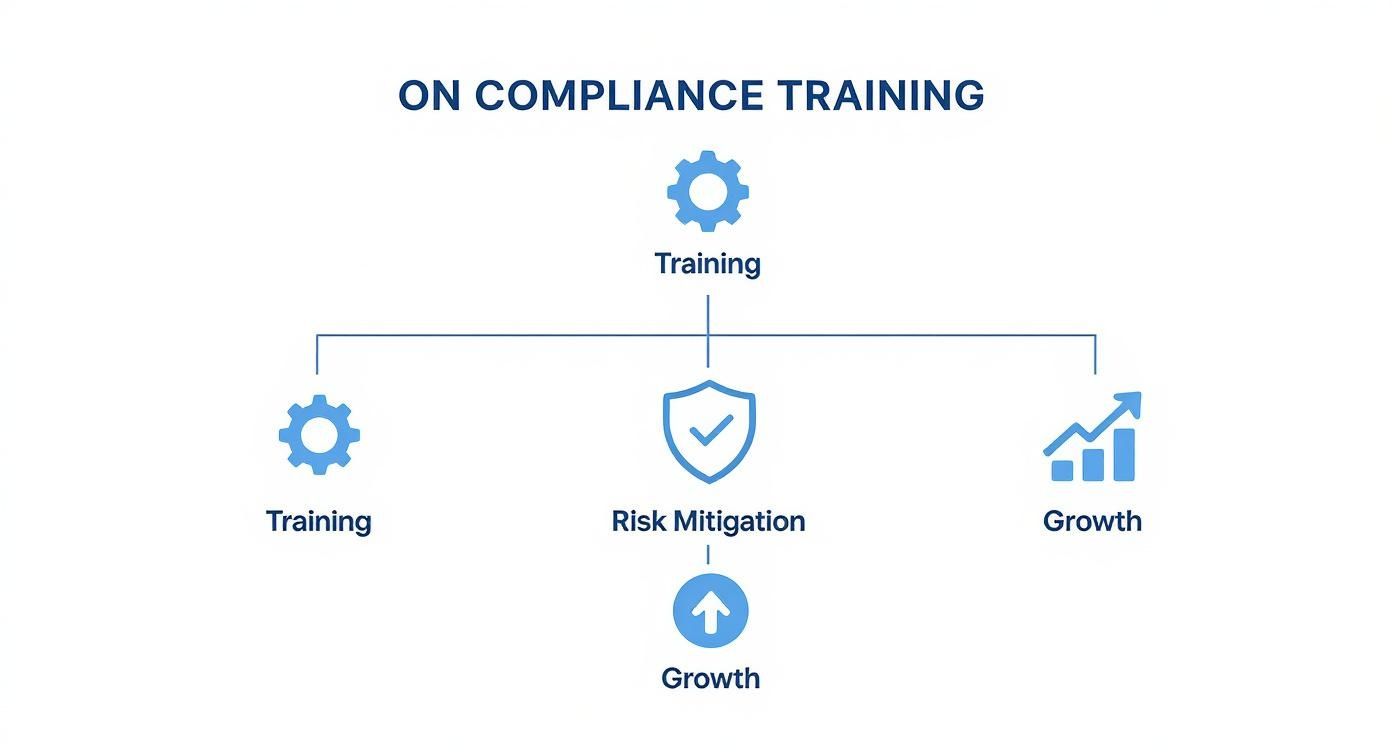
The key takeaway is that training is not merely a cost center; it is the engine that protects the bank and facilitates intelligent growth.
Using a data intelligence platform, this bank’s executives can analyze the activities of peer institutions with similar asset sizes and lending concentrations. They might discover that regulators are imposing enforcement actions on peers for issues related to appraisal compliance or environmental risk disclosures within their CRE portfolios. This is actionable intelligence.
A defensible program isn't built on what you think your risks are; it's built on what the data proves them to be. It replaces assumptions with evidence, creating an audit trail that clearly justifies every training decision.
Armed with this data, the bank can act preemptively. It can design its compliance regulatory training to address these specific, demonstrated risks. Instead of a generic CRE module, it can develop targeted sessions on appraisal independence rules for the lending team and specialized environmental due diligence training for underwriters.
This transforms the program from a reactive, check-the-box exercise into a proactive, strategic defense. It demonstrates to regulators that the board not only understands its own risk profile but also its position within the broader market. Benchmarking your compliance focus against real-world data builds a program that is truly defensible. You can explore how Visbanking's platform leverages peer data to sharpen these risk assessments.
Key Regulations Driving Training Mandates
A bank's compliance training program should be viewed not as a perfunctory requirement but as a direct response to high-stakes legal mandates. For directors, the priority is not memorizing acronyms but understanding the specific business risks each regulation is designed to mitigate. The intensity of training must be proportional to the regulatory focus, which is particularly acute in certain areas.
The regulatory environment is not static. While foundational rules remain constant, examiners continually shift their focus to new and emerging threats. An agile training program is the most effective defense, ensuring the institution is prepared for both current audits and future regulatory trends.
Foundational Pillars of Bank Compliance
Certain regulations form the bedrock of U.S. banking compliance. Failure to adhere to these is not an option and can lead directly to multi-million-dollar fines and crippling consent orders.
Bank Secrecy Act (BSA) and Anti-Money Laundering (AML): This is arguably the most scrutinized area of banking regulation. Training can no longer be limited to spotting large cash deposits; it must address sophisticated schemes like trade-based money laundering and terrorist financing. A failure in this area is a systemic failure. For a detailed breakdown, our AML compliance checklist outlines the essential controls every bank must implement.
Fair Lending Laws (ECOA & FHA): Regulators are intensely focused on ensuring equitable access to credit. Training must equip lending teams to avoid both overt discrimination and the more nuanced "disparate impact" in underwriting, pricing, and marketing.
Consumer Protection (TILA, RESPA, UDAAP): From mortgage disclosures to the broad prohibition of Unfair, Deceptive, or Abusive Acts or Practices, these rules are designed to protect customers. Training must be grounded in practical, real-world scenarios to prevent violations that can damage the bank's reputation and result in costly remediation.
The following table outlines how these core regulations translate into specific training requirements.
Core Regulatory Training Areas for U.S. Banks
| Regulation | Primary Focus | Key Training Requirement |
|---|---|---|
| BSA/AML | Preventing money laundering & terrorist financing | Identifying suspicious activity, customer due diligence, and reporting obligations. |
| ECOA/FHA | Ensuring fair and equal access to credit | Preventing discrimination in lending, underwriting, and advertising. |
| UDAAP | Protecting consumers from unfair or deceptive acts | Recognizing and avoiding practices that could mislead or harm consumers. |
| GLBA | Safeguarding nonpublic personal information | Data privacy, cybersecurity protocols, and incident response. |
Mastery of these fundamentals is non-negotiable and forms the backbone of any defensible compliance program.
Emerging Areas of Regulatory Scrutiny
Beyond these foundational pillars, regulators are continuously focusing on new risk areas. A forward-looking training plan must address these evolving threats with equal rigor. As a parallel, other regulated industries demonstrate this principle; for example, essential DOT compliance training illustrates how specific rules mandate educational programs across different sectors.
This is where data provides a decisive strategic advantage.
Imagine discovering through peer data that regulatory actions tied to cybersecurity disclosures under the Gramm-Leach-Bliley Act (GLBA) have increased by 20% among banks in your asset class. This is not merely a statistic; it is a clear directive to reinforce your own institution's training in that specific area.
Using a platform like Visbanking to monitor such regulatory trends allows you to act proactively. Training budgets and resources can be allocated to address potential weaknesses long before they appear in an examiner's findings report.
Measuring What Actually Matters
Completion rates are a measure of attendance, not effectiveness. For bank leadership, this distinction is critical.
The success of compliance training cannot be gauged by the percentage of employees who completed an online module. The definitive evidence lies in tangible behavioral changes and a measurable reduction in compliance exceptions.
To determine if training is delivering results, one must understand the distinction between tracking and truly measuring. The objective is to move beyond superficial metrics to Key Performance Indicators (KPIs) that link training directly to operational outcomes. This requires the discipline to connect training data with performance data from across the bank.

From Training Inputs to Business Outcomes
The only question executives should ask is: "Did the training work?" The answer is found not in an HR report, but within operational data.
Consider a targeted BSA/AML training program rolled out to frontline tellers. A 98% completion rate is noted, but it reveals nothing about its impact. A far more meaningful metric would be a 15% increase in the quality and accuracy of Suspicious Activity Reports (SARs) filed in the subsequent quarter. This represents a direct, quantifiable return on investment that will withstand regulatory scrutiny.
This data-driven feedback loop is essential. Findings from internal audits and formal regulatory examinations must be systematically used to refine and refocus the training curriculum. If an audit repeatedly identifies weaknesses in the documentation of commercial loan exceptions, it is a clear signal to intensify targeted training for lending officers.
Leveraging Peer Data for Proactive Strategy
The most sophisticated institutions extend this analysis beyond their own operations.
Benchmarking compliance metrics against a relevant peer group provides an invaluable layer of strategic context. This is where a robust business intelligence platform for banks transitions from a useful tool to a critical asset.
By analyzing peer data, you can spot systemic weaknesses or emerging regulatory trends before they become your own internal problems. This flips compliance training from a reactive, fire-fighting exercise into a proactive, strategic advantage.
For example, if data reveals that peer banks of a similar size are experiencing a spike in UDAAP violations related to new deposit products, you can preemptively enhance your team's training in that specific area before an issue arises internally.
This proactive posture is more critical than ever as the global focus on risk management intensifies. The pressure to demonstrate robust controls is immense. Ultimately, measuring what matters means treating training as an integral component of the risk management framework—one that is driven by data and validated by performance.
Adopting Modern Training Methodologies
The era of the mandatory, hour-long annual training video is over. This outdated model was an ineffective ritual that fostered disengagement—a check-the-box exercise that failed to alter behavior. For a modern bank, transitioning to a dynamic, continuous learning culture is not merely an upgrade; it is a strategic necessity for managing real-world risk.
Effective compliance regulatory training is not a singular event but an ongoing process. It must blend various formats to ensure teams move beyond rote memorization of rules to active application in their daily functions.
Shifting to an Active Learning Model
The most effective programs have abandoned the passive, one-size-fits-all approach in favor of methods that demand active participation and critical thinking. The goal is to ensure concepts are not just learned, but truly understood.
Modern approaches that deliver results include:
- Blended Learning: This model combines efficient, self-paced online modules for foundational knowledge with interactive, instructor-led sessions for high-stakes topics like fair lending or AML investigations. This respects employee time while ensuring critical nuances are thoroughly addressed.
- Microlearning: To combat training fatigue, microlearning delivers short, focused bursts of content—such as five-minute videos, brief quizzes, or concise case studies—that reinforce key concepts throughout the year. This keeps regulations top-of-mind without overwhelming staff.
- Scenario-Based Training: This is where theory is tested against reality. Employees are placed in realistic compliance dilemmas, forcing them to apply regulations in a controlled environment. For example, a loan team could run a simulation where they must price a commercial loan for a minority-owned business without triggering any fair lending violations. Their decisions provide invaluable, actionable data on their true level of comprehension.
This shift is validated by market trends. The blended training segment of the corporate compliance market alone is projected to reach USD 9.8 billion by 2030, a clear signal of its perceived effectiveness. Further insights on the business case for compliance training on GlobeNewswire underscore this direction.
Using Technology as a Strategic Enabler
Modern learning platforms do more than distribute content; they generate critical intelligence. They can track engagement, pinpoint specific knowledge gaps through assessments, and provide a clean, auditable record of all training activities.
By analyzing assessment data, you can identify systemic misunderstandings within a department or across the entire bank. If a high failure rate is observed on questions regarding SAR filing procedures, this is not a personnel issue—it is a data point indicating the need for more targeted training.
This data transforms training from a simple compliance checkbox into a powerful risk management tool.
By benchmarking assessment scores against operational data, you create a powerful feedback loop. You can draw a direct line from training initiatives to a reduction in compliance exceptions, demonstrating a clear return on investment to both regulators and your board.
Turning Training Data Into Board-Level Insight
The board of directors requires strategic insight, not another spreadsheet. In the context of compliance training, they need a clear narrative that connects training activities to the bank's overall risk posture. This is an opportunity to demonstrate that compliance is not a cost center but a strategic function that protects and enables the business.
A meaningful compliance dashboard does not simply list pass/fail rates; it connects the dots. Imagine presenting data showing that following targeted cybersecurity training, employee-reported phishing attempts increased by 30%. This is not a sign of failure but a clear indicator of success—proof of a more vigilant team and a stronger human firewall. This is the type of analysis that elevates the discussion from tactics to strategy.

From Metrics to Strategic Narrative
The Chief Compliance Officer’s report to the board must answer the question, "What does this data mean for our future risk exposure?" This requires moving beyond a data dump to present a clear, compelling narrative.
An effective board-level report includes:
- Correlated Performance Metrics: Do not merely report that fair lending training was completed. Show that it was followed by a 10% decrease in underwriting exceptions flagged by the internal audit team. This demonstrates cause and effect.
- Knowledge Gap Analysis: Pinpoint specific areas of weakness. If 40% of new tellers fail assessment questions related to cash structuring, you have identified a critical vulnerability in the onboarding program that requires immediate remediation.
- Behavioral Impact: Connect training to real-world actions. A 20% increase in high-quality Suspicious Activity Report (SAR) filings following a BSA workshop is a direct measure of your return on investment.
The most effective reporting frames training not as a checkbox exercise, but as a direct weapon against risk. It shows the board exactly how you're fortifying the bank's defenses against known threats.
Contextualizing Performance with Peer Intelligence
To capture the board’s full attention, demonstrate how your institution’s performance compares to its peers. This moves the function from reactive to predictive.
Using a platform like Visbanking, a CCO can benchmark the bank's compliance metrics against a curated peer group. Imagine presenting the following to the board: "Our investment in advanced UDAAP training for the marketing department is timely, as peer data reveals a 25% spike in regulatory actions for deceptive advertising among banks in our asset class."
This reframes the training expenditure as a strategic investment based on market intelligence, demonstrating foresight. It changes the entire conversation from "What did we do?" to "Are we prepared for what's coming?" The compliance report thus becomes an indispensable tool for strategic guidance, aligning leadership on the most significant threats and the most prudent investments.
Your bank's data holds the key to smarter, faster decisions. With Visbanking, you can benchmark your compliance performance, identify emerging risks from peer activity, and turn regulatory training into a measurable strategic advantage. Explore our data and see what your peers are doing.
Related Articles

Visbanking Blog
Bank Regulatory Compliance: Navigating the Complex Maze

Visbanking Blog
U.S. Regulators Issue New Guidance for Third-Party Risk Management

Visbanking Blog
The FFIEC: Regulating and Supervising Financial Institutions to Maintain a Safe and Sound Financial System

Visbanking Blog
CFPB Creates New Repeat Offender Unit

Visbanking Blog
What is a “Risk Continuum” and why on earth should you even care??

Visbanking Blog