
Business Banking Prospecting Software: How Data Intelligence Drives Growth
Brian's Banking Blog
Legacy prospecting methods—spreadsheets, static lead lists, and siloed CRMs—are no longer sufficient for competitive growth. Modern business banking prospecting software is not merely a tool; it is an intelligence engine that analyzes vast market data to deliver prioritized, actionable opportunities directly to your commercial bankers.
Why Outdated Prospecting Methods are a Drag on Revenue
In commercial banking, growth is a function of speed and precision. Relying on manual methods forces relationship managers into a reactive posture, chasing cold leads instead of engaging high-value prospects with immediate needs. This operational drag is a significant source of revenue leakage.
Traditional prospecting is akin to navigating a modern city with a paper map—functional, but devoid of the real-time context required for strategic decisions. Bankers waste valuable hours on manual research, guessing at financial needs, and hoping their timing is right. The process is inefficient, with a predictably low success rate.
The Shift to a Proactive Growth Model
This is where modern business banking prospecting software fundamentally changes the approach. It acts as a central intelligence hub, analyzing market data to identify businesses with specific, time-sensitive needs. This capability allows an institution to shift from a reactive stance to a proactive growth model.
A proactive strategy is predicated on identifying opportunities before the competition. It is the difference between learning a company is expanding after a deal is announced and being the first banker to call because your data platform flagged its growth indicators six months prior.
Consider this scenario: your intelligence platform identifies a local manufacturing firm whose $2.5 million commercial real estate loan is maturing in the next quarter. Simultaneously, it flags another local business that just submitted Uniform Commercial Code (UCC) filings for new equipment—a clear signal of a potential need for an expanded credit line or enhanced treasury management services.
Translating Market Data into Actionable Intelligence
This level of granular insight is unattainable with a spreadsheet. A powerful data platform translates raw information into clear, actionable directives for your team, ensuring their efforts are focused where the return is highest. This is the essence of effective business intelligence for banks—transforming market signals into profitable new relationships. The objective shifts from managing contacts to strategically pursuing qualified opportunities.
Moving beyond manual prospecting is a strategic necessity. Equipping your team with the right intelligence tools empowers them to act with confidence, approach prospects with relevant solutions, and drive measurable growth for the bank. It is imperative to evaluate your current processes and recognize the competitive advantage that data intelligence provides.
Intelligence Platforms vs. Standard CRMs: A Critical Distinction
A frequent question from bank executives is how a true business banking prospecting software differs from their existing CRM. Understanding this distinction is crucial, as conflating the two means retaining a system not engineered for proactive growth.
A CRM functions as a digital system of record. It excels at managing existing relationships and tracking ongoing sales processes. It is fundamentally reactive, organizing internal data like call logs and deal stages. It cannot, however, identify your next major opportunity.
A prospecting intelligence platform is a system of discovery. It proactively scans the market for growth signals that a standard CRM is blind to. While your CRM logs a phone call, an intelligence platform identifies which business to call next and precisely why it is a prime target now.
This is not merely about efficiency; it is about securing a competitive advantage. The market for these tools reflects this reality. The third-party banking software market, valued at USD 6.77 billion, is projected to more than double to USD 12.98 billion as institutions recognize the need for smarter customer acquisition. You can read the full analysis of the third-party banking software market for a detailed forecast.
From Managing Internal Data to Reading the Market
The core difference is the data's purpose. A CRM manages internal data—your history with known contacts. A prospecting intelligence platform ingests vast amounts of external data—public records, regulatory filings, financial performance—to create a dynamic map of your entire market.
A standard CRM tells you who you have contacted. An intelligence platform like Visbanking tells you who you should contact, often identifying needs before the prospects themselves are fully aware of them. This is the leap from record-keeping to proactive opportunity generation.
As a practical example, your CRM can remind you to follow up with a known prospect. An intelligence platform will alert you the moment a non-customer manufacturer files for new equipment, signaling an immediate need for an expanded line of credit. One manages a pipeline; the other actively creates it.
This graphic illustrates the transformation from static, manual methods to a dynamic, intelligence-driven approach.
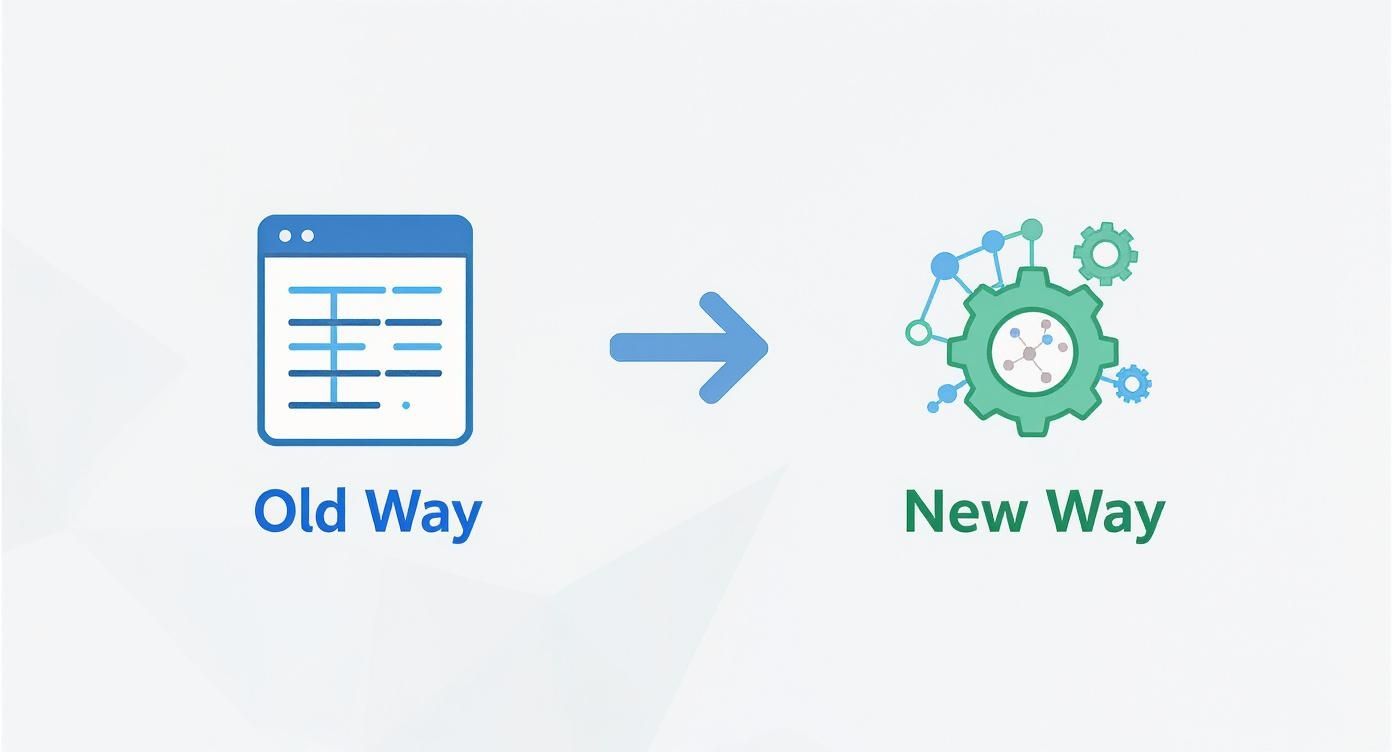
This signifies a move away from siloed spreadsheets and toward an interconnected system where real-time market signals drive strategic action.
To clarify the distinction, consider this comparison.
Feature Comparison: Standard CRM vs. Prospecting Intelligence Platform
| Capability | Standard CRM System | Business Prospecting Platform |
|---|---|---|
| Primary Function | Manages existing relationships | Discovers new opportunities |
| Data Source | Internal data (call logs, emails) | External data (public records, filings) |
| Core Value | Organizes current pipeline | Creates new pipeline |
| Approach | Reactive (tracks past interactions) | Proactive (identifies future needs) |
| Market View | View of known contacts only | Comprehensive map of the entire market |
| Key Feature | Contact and deal tracking | Trigger event monitoring and alerts |
These tools are designed for fundamentally different objectives. One is for management; the other is for growth.
Core Capabilities That Drive Revenue Growth
A true business banking prospecting platform is defined by core features designed to add new revenue, not just manage tasks.
Key differentiators include:
- Trigger Event Monitoring: The platform acts as your market surveillance system, monitoring for signals that a business requires banking services. Examples include a commercial real estate loan nearing maturity, a C-suite transition, or a recent capital raise. These events create openings for engagement that a standard CRM will miss entirely.
- Predictive Analytics: By analyzing industry trends, company growth trajectories, and financial data, these platforms forecast future needs. For example, the system might flag a logistics company that, based on hiring velocity and sector growth, has a high probability of requiring new fleet financing within six to nine months. This allows your team to engage far ahead of the competition.
- Advanced Market Mapping: An intelligence platform provides a visual, data-rich map of your entire territory. You can identify underserved industries, analyze competitor entrenchment, and locate clusters of high-potential prospects. It transforms territory management from guesswork into a data-driven strategy.
Ultimately, the choice is strategic. Do you need a better system to organize existing contacts, or do you need a powerful engine to find your next $10 million commercial relationship?
For any institution serious about growth, investing in true market intelligence is a necessity. You can explore how Visbanking’s data helps you benchmark your market position and uncover these critical opportunities.
How Data Intelligence Translates into New Deposits
For any bank executive, the ultimate test of a technology investment is its impact on the bottom line. Vague promises of "efficiency" are insufficient; what matters is tangible growth in loans and deposits.
The power of business banking prospecting software is best understood by contrasting the traditional approach with a data-first methodology.
Assume your bank's board has set a new directive: grow the commercial and industrial (C&I) loan portfolio by $50 million this fiscal year. This goal demands a surgical approach from your relationship managers.

The Traditional Method: A Shot in the Dark
The process typically begins with purchasing a lead list of, for example, 5,000 businesses, filtered by broad industry and revenue. This method is inherently flawed.
The data is often stale upon acquisition and lacks critical context. It provides no insight into a company’s current banking relationships, financial health, or immediate needs. Relationship managers are forced into a high-volume, low-yield game of cold calling.
The inefficiency of this approach is clear:
- Effort: Contacting 5,000 leads is a massive expenditure of time and resources.
- Yield: A successful campaign might achieve a 1% qualification rate from a cold list, resulting in just 50 lukewarm leads.
- Conversion: Of those 50, perhaps 10%—a total of five businesses—convert after months of effort.
This "spray-and-pray" method is costly, drains resources, and is demoralizing for top-performing bankers. It is a strategy of brute force, not intelligence.
The Data-Driven Approach: Precision and Timing
Now, consider the same scenario using a data intelligence platform like Visbanking. Instead of buying a generic list, the bank's leadership conducts a market analysis, identifying an underserved, high-growth niche: medical device manufacturers with revenues between $10 million and $25 million.
The platform instantly filters the market, reducing 5,000 generic names to a focused list of 45 high-potential targets matching the ideal profile.
The true strategic advantage lies in the next step.
The platform does not just deliver a list; it serves up timely, actionable intelligence. It analyzes public records, UCC filings, and other data for "trigger events"—clear signals that a business requires banking services now.
From the list of 45 targets, the system flags three as immediate, high-priority opportunities:
- Company A: Holds a $7.5 million C&I loan with a competitor that matures in four months.
- Company B: Recently filed UCCs for new equipment, indicating a probable need to expand its line of credit.
- Company C: Is demonstrating 20% year-over-year growth and is likely outgrowing its current treasury management services.
This intelligence transforms the engagement. Your relationship manager is no longer making a cold call but a strategic, informed inquiry based on precise data. For a deeper look at this methodology, our guide on modern lead generation for banks provides further detail.
The ROI of Intelligence
The results of this data-driven approach are dramatically different. The relationship manager focuses exclusively on three high-probability targets. The conversation shifts from a generic sales pitch to a consultative discussion addressing a specific, verified need.
The new financial logic is compelling:
- Qualification Rate: With prospects identified by immediate need, the qualification rate approaches 100%.
- Conversion Rate: Relevant, timely conversations are powerful. Assuming the bank wins two of the three deals, it secures $12 million in new C&I loans from a handful of targeted calls.
- Acquisition Cost: Customer acquisition cost plummets as wasted hours on unproductive outreach are eliminated.
By repeating this targeted process, the team can build a pipeline that not only meets the $50 million goal but surpasses it. The software transforms prospecting from an inefficient numbers game into a precise, high-return strategic instrument. This is how modern banks win—not by outworking the competition, but by outthinking them with superior data.
Integrating Prospecting Software into Your Core Strategy
Top-tier business banking prospecting software is not an isolated sales utility. For bank directors, viewing this technology solely through a sales lens is a strategic misstep. Its true value is realized when its market intelligence is integrated into the core operational fabric of the institution.
The objective is to unlock value across the entire organization, from informing product development to refining risk management.
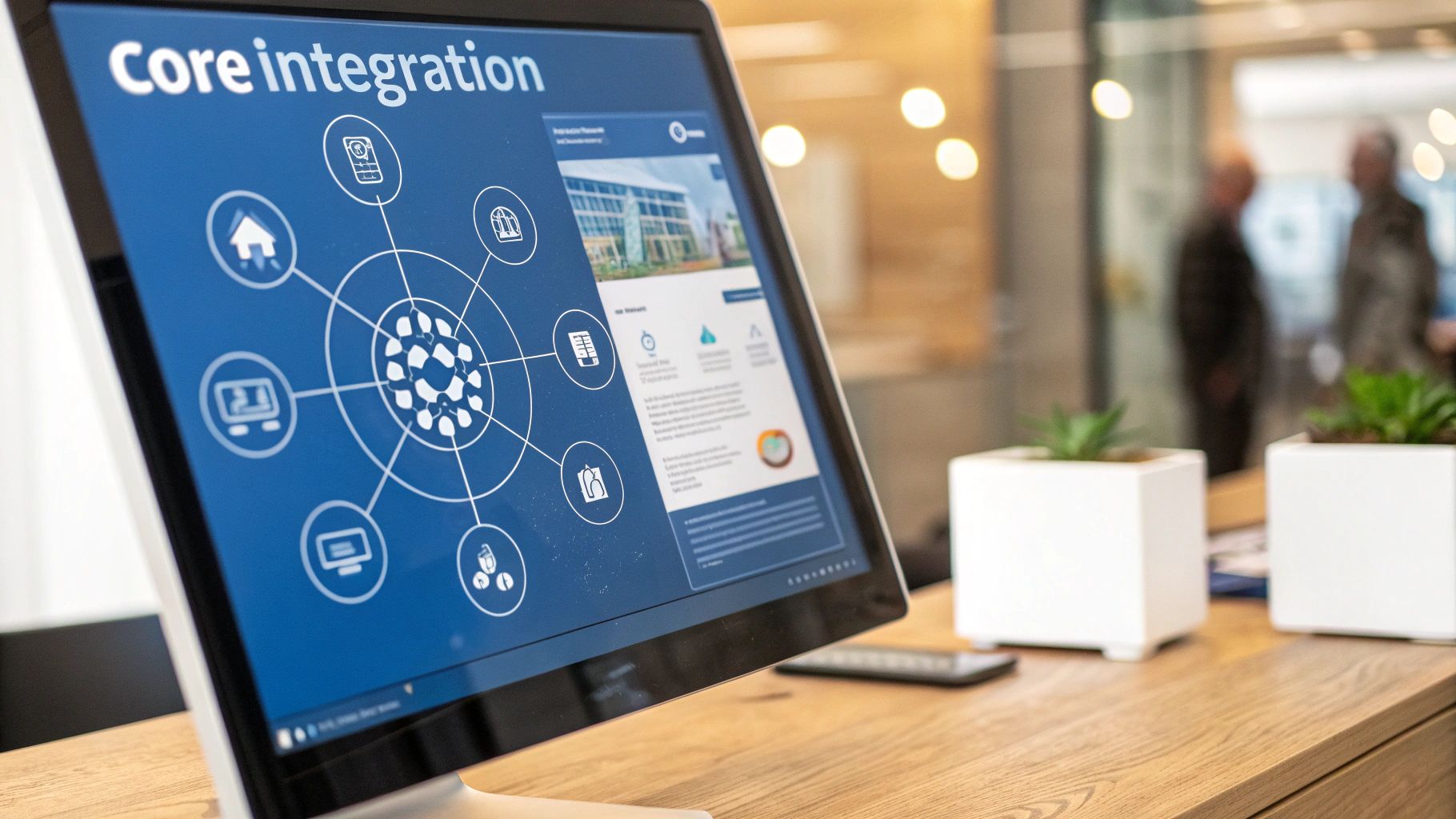
When fully integrated, the platform evolves from a simple lead generator into a central nervous system for market-aware decision-making. It connects front-line relationship managers with the executive suite, ensuring high-level strategy is grounded in real-time market dynamics, not outdated assumptions.
Beyond Sales: A Strategic Intelligence Hub
A modern prospecting platform's data should feed directly into your core banking system, creating a continuous information loop. This elevates its function from tactical lead generation to strategic intelligence.
Here is how this intelligence informs other key banking functions:
- Product Development: If the platform identifies a surge in demand for equipment financing among logistics companies in a specific county, this provides hard evidence for the product team to prioritize that loan product or develop a new offering tailored to that niche.
- Pricing Strategy: Access to competitor loan maturity data provides a significant advantage. If you identify a rival’s $15 million commercial real estate portfolio maturing in the next six months, you can strategically position your rates to capture that business.
- Risk Management: Risk officers can receive early warnings about industry-wide headwinds before they manifest in your loan portfolio. This foresight allows for proactive adjustments to underwriting standards or exposure limits.
Unifying Data for a Competitive Edge
This unified approach is becoming the industry standard. The global market for core banking software, increasingly built with these integrated capabilities, is projected to grow from USD 16.79 billion to USD 64.96 billion. This rapid expansion underscores the industry's commitment to integrated, data-first systems. You can review these projections for core banking software on Fortune Business Insights for further analysis.
A disconnected prospecting tool creates data silos, stranding valuable market intelligence within the sales team. An integrated system ensures that every department—from marketing to finance—operates from the same clear, data-informed view of the market.
For instance, when a relationship manager logs a new prospect, that data should flow into the core system. This enables the marketing team to tailor campaigns to that industry and the finance team to adjust deposit forecasts based on the new pipeline.
This level of integration is a prerequisite for sustained competitiveness. By treating your prospecting platform as a source of bank-wide intelligence, you maximize the return on your technology investment and build a more resilient, market-responsive institution. The goal is to move from isolated actions to a coordinated strategy, where every decision is supported by the best available market data.
Choosing the Right Technology Partner for Your Bank
Selecting a vendor for your business banking prospecting software is a long-term strategic decision. The right partner delivers more than a platform; they provide a continuous stream of actionable intelligence that becomes a core institutional asset. The wrong choice can result in poor data quality, low user adoption, and a technology stack that impedes growth.
The market for this technology is expanding rapidly. The global core banking software market, estimated at $12.37 billion, is expected to reach $13.32 billion with a 10.2% growth rate, as noted in industry analysis findings from Grandview Research. This growth attracts numerous vendors, necessitating a rigorous evaluation framework.
Data Accuracy and Sourcing: The Foundation of Trust
The platform's value is derived directly from its data quality. Inaccurate or outdated information will erode user trust, leading to low adoption and a wasted investment.
Demand transparency from potential partners on these key points:
- Data Sources: Are they utilizing reputable public sources like FDIC call reports, UCC filings, and SBA program data, or are they relying on less reliable online directories?
- Update Frequency: Market conditions change rapidly. Data that is months old is a liability, not an asset. What is their update cadence?
- Data Hygiene: What is their process for verifying, cleaning, and de-duplicating data? Request specific examples of their quality control measures.
A vendor that is evasive about data sourcing is a significant red flag. A credible partner will be transparent about their data operations.
Scalability and Integration: The Path to Growth
Your bank's technology partner must be capable of scaling with your institution. A platform suitable for a $500 million community bank may not perform adequately for a $5 billion regional institution. The software must handle increasing data volumes, user loads, and query complexity without performance degradation.
An effective prospecting platform shouldn't operate in a silo. It must seamlessly integrate with your existing core banking and CRM systems to create a unified intelligence ecosystem. This ensures that market insights directly inform your broader strategic and operational frameworks.
Consider an expansion into a new metropolitan statistical area (MSA). A scalable platform should allow you to instantly load and analyze that market's data, map the competitive landscape, and identify initial high-value targets. A system that cannot support this is not built for growth.
User Adoption: The Final Measure of Success
The most powerful software is worthless if your team will not use it. The user interface must be intuitive and designed for the workflow of a commercial relationship manager. A clunky or complex system will drive users back to their spreadsheets.
Insist on a live demonstration that simulates your team's daily tasks. Better yet, request a pilot program with a small group of your top performers. Their feedback is the most valuable diligence you can perform. A partner confident in their product will welcome this level of scrutiny.
Choosing the right technology partner is a decision with long-term consequences. By focusing on data integrity, scalability, and usability, you can secure a partner that will actively contribute to achieving your growth targets. We encourage you to benchmark your current capabilities and explore our data to see what true intelligence looks like.
The Future of Prospecting: Predictive Intelligence
Business banking prospecting is evolving from a reactive to a proactive, predictive discipline. For bank executives, this is not a distant trend but a present-day strategic imperative.
The ability to anticipate a client's needs before they—or your competitors—recognize them is becoming the new standard for winning and retaining high-value commercial relationships.
This capability is driven by artificial intelligence and machine learning embedded within modern prospecting software. These systems analyze vast datasets—market shifts, supply chain dynamics, hiring trends—to forecast future banking needs with increasing accuracy. It is the difference between navigating by the rearview mirror and having a clear map of the road ahead.
From Reactive to Predictive Action
The bottom-line impact of this shift is significant. Instead of waiting for an obvious trigger like a loan maturity, a predictive platform identifies opportunities as they begin to form. This allows relationship managers to engage prospects with a level of foresight that is otherwise impossible.
Consider a predictive model that flags a mid-sized logistics company. Based on its hiring velocity and local economic indicators, the model calculates a 90% probability of the company needing a major equipment loan in the next six to nine months. Your team can initiate a relationship now, long before the company issues an RFP. You are no longer just competing; you are setting the terms of the engagement. Learn more about how predictive analytics in banking are reshaping these strategies.
Predictive intelligence transforms your bankers from product salespeople into indispensable strategic advisors. They enter meetings not with a generic pitch, but with a data-backed solution to a problem the client is just beginning to confront.
Securing a Lasting Competitive Edge
The future of prospecting will be determined not by who possesses the most data, but by who derives the most predictive insights from it. As the technology advances, the gap will widen between banks operating on historical data and those leveraging predictive intelligence. The latter will capture the market share.
The time for adoption is now. Banks that embrace this shift will build a sustainable competitive advantage. It is time to critically assess your current prospecting efforts and explore how a data intelligence platform like Visbanking can position your institution to win.
Burning Questions
As a bank executive, any new technology investment requires rigorous scrutiny. Below are answers to the most common questions regarding modern business banking prospecting software.
Isn't This Just Another CRM?
No. A CRM is a system of record for managing existing relationships. It is your digital rolodex.
A prospecting intelligence platform is a system of discovery. It is your market scout. While your team logs calls in the CRM, a tool like Visbanking is scanning the market for trigger events, such as a competitor's $5 million commercial real estate loan nearing maturity or a prospect filing a UCC for new equipment.
It does not replace your CRM; it makes it exponentially more valuable by feeding it a continuous stream of high-quality, pre-qualified opportunities that would otherwise be missed.
How Long Until We're Actually Using This?
Implementation is streamlined. We are not describing a year-long IT overhaul. A realistic timeline from contract to your relationship managers actively sourcing deals is 30 to 60 days.
The implementation's heavy lifting is our responsibility. We handle the data integration with your core systems and provide comprehensive team training. The objective is a rapid return on investment, not a protracted project.
How Do We Prove This is Worth the Money in Year One?
ROI measurement should be straightforward and tied to your existing key performance indicators. The most effective method is a pilot program. Compare the results of a group of bankers using the software against a control group using traditional methods.
Key metrics to track include:
- Increased Qualified Leads: Measure the number of actionable opportunities uncovered by the pilot group versus the control group. The disparity will be significant.
- Improved Closing Ratios: Armed with data-backed insights, the pilot team should see conversion rates increase by 15-20% from initial conversation to closed deal.
- Lower Customer Acquisition Cost (CAC): The software virtually eliminates hours spent on manual research and unproductive cold calls, directly reducing your CAC.
By tracking these metrics, the financial impact becomes clear and quantifiable within the first six to twelve months.
Ready to stop looking at dashboards and start making decisive moves? Visbanking gives you the market intelligence to sharpen your targeting, boost performance, and see around corners with confidence.
Related Articles

Visbanking Blog
Prospect AI Tool: Transforming Your Bank's Growth Strategy with Smart Targeting

Visbanking Blog
Revolutionize Your Banking Operations with Data-Driven Insights from BIAS

Visbanking Blog
In the world of banking, digital transformation is no longer a 'nice-to-have'. It's a necessity

Visbanking Blog
Empowering Banks with Visbanking's Enterprise Solution: Performance, Prospects, and Talent Insights

Visbanking Blog
Banking Data Analytics: Turning Information Into Profit

Visbanking Blog