
Banking as a Platform: A Strategic Blueprint for Growth
Brian's Banking Blog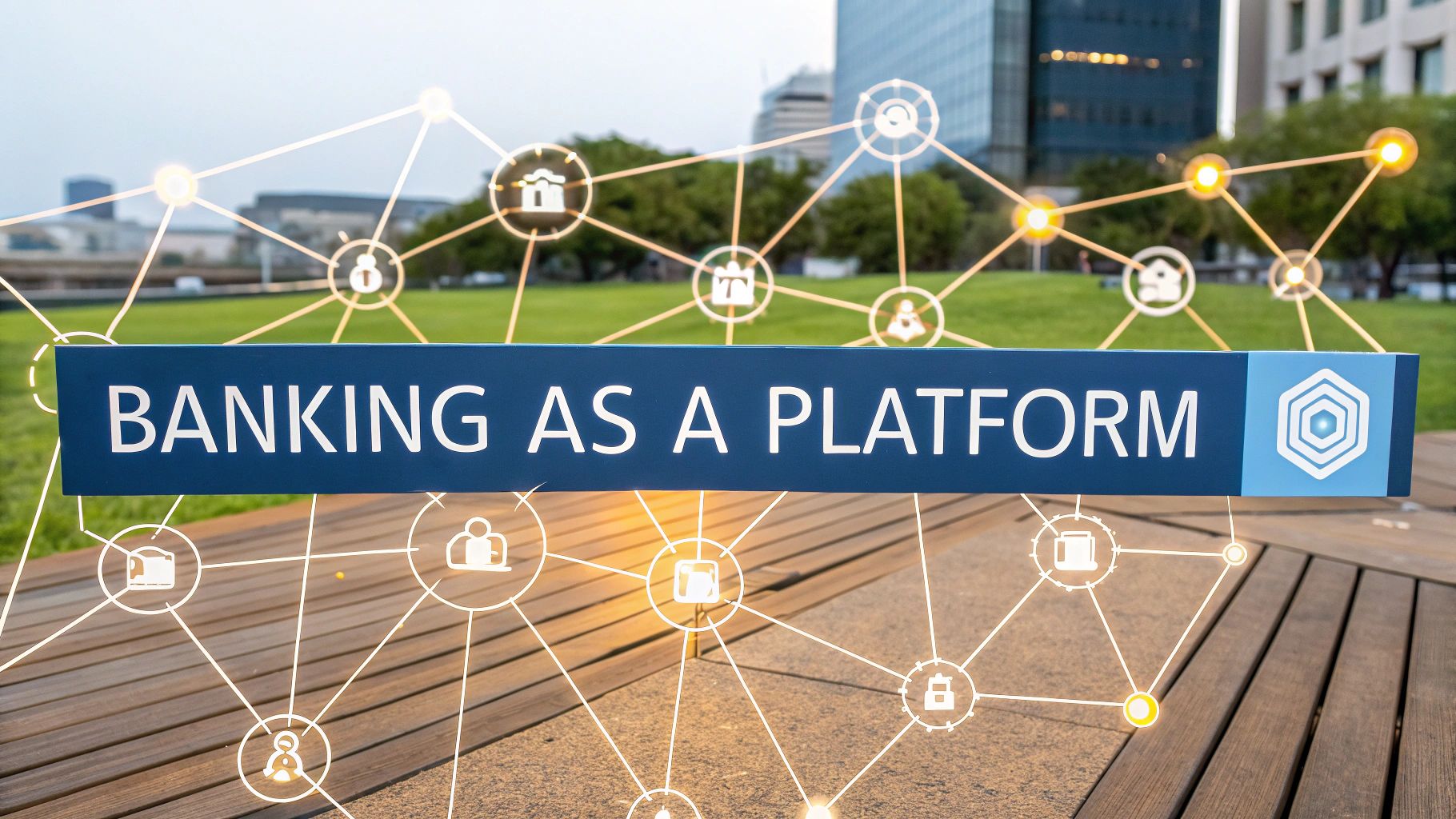
Faced with a swarm of nimble fintech competitors, bank executives must see Banking as a Platform (BaaP) for what it is: not another buzzword, but a fundamental strategic pivot. This is not a minor technology upgrade; it is about reinventing your institution from a walled-off provider of products into the central orchestrator of a financial ecosystem. Executed correctly, this model unlocks new revenue streams and future-proofs the institution.
The Strategic Shift to Banking as a Platform
The days of traditional banking operating as a closed system are numbered. The Banking as a Platform model involves opening core services—payments, account management, lending—through secure Application Programming Interfaces (APIs). This allows third-party partners, from fintech startups to established software companies, to build their own products on top of a regulated banking infrastructure.
Think of your bank as the foundational operating system, like iOS or Android. Your charter, compliance framework, and core systems provide the stability and security that non-banks cannot replicate. On top of this "OS," partners build the "apps" that reach new customer segments, all without the staggering overhead of becoming a bank themselves.
From Competitor to Collaborator
Suddenly, fintechs that once appeared as threats become powerful distribution channels. Instead of watching customers migrate to a slick new budgeting app, you can partner with that app, providing the underlying accounts and payment rails it needs to function. It becomes a symbiotic relationship with clear economic benefits for both parties.
Consider a practical example: A regional bank partners with a national accounting software firm. By embedding its business checking accounts directly into the software via an API, the bank could onboard 1,000 new commercial customers with minimal direct marketing spend. The software company adds immense value for its clients, and the bank acquires a significant volume of low-cost deposits and new commercial relationships.
Before proceeding, it is critical to crystallize the differences between the old and new models.
Traditional Banking vs. Banking as a Platform
This table offers a high-level comparison of how the platform model fundamentally re-engineers the business, shifting from a closed, product-focused approach to an open, ecosystem-driven one.
| Attribute | Traditional Banking Model | Banking as a Platform Model |
|---|---|---|
| Business Model | Sells proprietary financial products directly to customers. | Provides open infrastructure for third parties to build financial products. |
| Technology | Closed, monolithic core systems with limited external access. | Open architecture centered around APIs for easy integration. |
| Revenue Streams | Interest income, fees on own products. | API access fees, revenue sharing with partners, new customer acquisition. |
| Customer Reach | Limited by its own brand and marketing footprint. | Exponentially expanded through the reach of its partners' customer bases. |
| Innovation | Slow, internally driven product development cycles. | Rapid, externally driven innovation from a diverse partner ecosystem. |
| Competitive View | Views fintechs and other banks as direct competitors. | Views fintechs as potential collaborators and distribution channels. |
The contrast is stark. One model is about protecting a fortress; the other is about building a vibrant commercial center where others can conduct business.
Data as the Driving Force
Executing this strategy requires more than just technology; it demands a deep, data-driven understanding of the market. Deciding which partners to engage, how to price API access, and which industries offer the best return are critical decisions that cannot be based on intuition. This entire process is central to a modern financial digital transformation, shifting the bank's entire mindset from product-centric to platform-centric.
A winning platform strategy is built on a foundation of data. It’s about using market intelligence to identify underserved niches, properly vet potential partners, and set pricing for maximum profitability. It turns a strategic concept into a calculated business decision.
This is where intelligence tools like Visbanking provide essential clarity, allowing executives to benchmark opportunities and analyze potential partners before committing capital. You can assess a fintech's financial health and market traction, ensuring your platform is built on solid ground for sustainable growth. The first step is to benchmark your own institution’s performance against direct competitors to understand your baseline.
Understanding the BaaP Operating Model
To effectively lead this shift, executives need a clear mental model of how a Banking-as-a-Platform (BaaP) structure operates. This is not an abstract concept but a tangible framework with distinct, interconnected layers that create and distribute value in a new way.
Think of it as an electrical grid. Your bank provides the reliable, regulated power. Your partners then build innovative appliances that plug into your system, creating new value for customers and new revenue streams for your institution.
Let's break it down into its three core components.
The Three Core Layers of BaaP
The entire structure is built on three pillars, each with a critical function.
Foundational Infrastructure: This is your bank’s core—the charter, compliance frameworks, and systems of record. It’s the regulated, secure foundation that fintechs cannot replicate on their own. A significant component is navigating the complex web of fintech regulatory compliance.
API Layer: This layer is the secure, standardized bridge connecting your core infrastructure to the outside world. APIs act as universal outlets that expose specific banking functions—like payment processing or opening an account—for partners to use in a controlled, safe manner.
Partner Ecosystem: This is the dynamic, external layer, composed of the fintechs, retailers, and SaaS companies building on top of your foundation. These partners become your new distribution channels, bringing innovative products to market much faster by plugging into your core services.
This visual illustrates the simple but powerful relationship between a bank's core and its partner ecosystem, connected by the critical API layer.
The key takeaway is that the API isn't just a piece of technology; it's the commercial contract that defines the partnership and allows value to flow between parties.
Data-Driven Execution
The market is adopting this model rapidly. The global banking as a service market was recently valued at $18.6 billion, with the platform segment comprising approximately 69% of that total. Projections show a compound annual growth rate of 15.1% through 2034, signaling a clear urgency for banks to define their strategy.
A successful BaaP strategy hinges on data intelligence. It’s about more than technology; it’s about making calculated decisions on which partners to select, how to price API access, and where to focus efforts for the greatest return.
This is precisely where a platform like Visbanking provides value. It delivers the market data needed to properly vet potential partners, assess their financial health, and analyze how your offerings compare to the competition.
While the model appears straightforward, it is crucial to remember that banking as a service has major risks, especially concerning third-party oversight and compliance. A data-driven approach is the only way to manage these risks effectively while capitalizing on this significant opportunity.
From Theory to Profit: Unlocking New Revenue and Efficiency
Theoretical models are irrelevant if they do not impact the bottom line. For Banking-as-a-Platform (BaaP), the critical questions from the board are direct: How does this generate revenue, and how does it improve efficiency?
The BaaP model provides compelling answers to both.
First, this model opens income streams far beyond the traditional net interest margin. By treating core banking services as products that can be packaged and sold via APIs, you can build entirely new, recurring revenue channels.
This new playbook includes:
- API Access Fees: Charging partners a flat monthly or tiered fee to access specific banking functions.
- Per-Transaction Charges: Taking a small cut or a fixed fee for every payment processed or account opened through a partner's application.
- Revenue-Sharing Agreements: A true partnership model where you receive a percentage of the revenue generated by the partner's end product.
This is not a niche market. The global Banking-as-a-Service platform market reached USD 4.9 billion and is projected to grow at a 14.7% compound annual growth rate, reaching USD 19.3 billion by 2035. This growth is fueled by an insatiable demand for embedded finance.
Driving Down Costs While Scaling Up
Beyond generating new revenue, the BaaP model can fundamentally re-engineer the expense side of the ledger. By leveraging partners for customer acquisition, you can significantly reduce marketing and sales expenditures.
Imagine a community bank partners with a popular accounting software company. By embedding business accounts directly within the software, that bank could onboard 1,000 new commercial customers without a large-scale marketing campaign. This turns a partner's user base into a low-cost growth engine.
The platform model is intelligent outsourcing. You allow partners to handle the high costs of customer acquisition and niche product development—functions they are often built for. This frees you to focus on your core strengths: compliance, security, and robust infrastructure.
You also sidestep the massive capital investment and risk associated with building new, specialized products from scratch. A fintech partner might invest millions in developing a slick user application, while you provide the secure, regulated banking engine for a fraction of that cost.
Profitability Must Be Engineered, Not Assumed
Success is not guaranteed; it must be built with data. A data-driven approach is non-negotiable. When designing new services, you must know how to calculate the break-even price for your business to ensure profitability from the outset.
This is where an intelligence platform like Visbanking becomes a strategic asset. Our system provides the real-world market data needed to price API services competitively and identify the most lucrative partnership opportunities. Before entering negotiations, you can analyze what peers are charging and gauge market demand, ensuring every decision is backed by quantitative analysis.
From Strategy to Execution: Real-World Use Cases
Strategy is one thing; execution is another. For any executive evaluating a banking-as-a-platform model, the most convincing arguments are not theoretical. They are happening now, generating significant value in the real world.
These examples demonstrate how BaaP translates into market share, customer acquisition, and deeper commercial relationships.
The concept is simple: deliver financial services at the customer's point of need—within a software platform, during a retail checkout, or inside a company's daily workflow.
Embedded Lending at Point of Sale
Consider a large online marketplace for home improvement that connects contractors with homeowners. A primary friction point is project financing. Instead of directing customers to a bank, the marketplace partners with one.
By integrating a lending API directly into its checkout flow, the marketplace can offer instant financing for projects ranging from $5,000 to $50,000. The result? The marketplace sees a 30% increase in average project size. For the bank, it's a new, highly efficient channel for acquiring qualified, low-risk consumer loans at a fraction of the traditional cost.
Specialized Services for Niche Markets
Another powerful application is serving communities that large banks often overlook. Consider a startup focused on gig economy workers, a demographic with unique financial needs that traditional banking products do not address.
Instead of spending years and millions pursuing a bank charter, the startup partners with an established bank. Using the bank’s APIs, it builds a mobile application with features custom-built for freelancers—automated tax withholding, instant payouts, and income smoothing tools.
The bank handles the regulated checking and payments in the background, gaining thousands of loyal new depositors in a high-growth demographic. This is a classic win-win, powered by the platform model.
These are not just product integrations. They represent a fundamental shift from selling financial products to powering seamless financial experiences. The bank becomes a critical, yet invisible, engine inside another company's operations.
Of course, selecting the right niche is paramount. This decision requires robust data. An intelligence platform like Visbanking allows you to size different market segments, assess the financial health of potential fintech partners, and determine which use cases offer the highest potential return. Before you sign a partnership agreement, our data can show you where the most profitable opportunities lie.
Making Data-Driven Platform Decisions
A successful Banking as a Platform (BaaP) strategy is not about technology; it is about superior data intelligence. While APIs are the conduits connecting you to the ecosystem, data is the control room where strategic decisions are made.
Embarking on a platform model without a robust intelligence layer is akin to navigating a merger blindfolded. The risks are unacceptably high.
The shift to digital banking is the standard. Over 76% of American customers now use mobile banking apps and expect financial services to be seamlessly embedded into their daily lives. This is a primary driver behind the increase in global bank revenue to $8.5 trillion, a 6.3% increase from the previous year. To capture a share of this growth, every platform decision must be deliberate and informed. You can review these shifts in updated banking statistics and trends.
From Strategic Bet to Calculated Move
Before signing any partnership agreement, your executive team requires clear answers to critical questions. Is this fintech partner financially stable? Is their user growth genuine or fueled by unsustainable marketing spend? How do we price our API services to be competitive yet profitable?
Answering these questions requires a unified view of financial, regulatory, and market data. This is precisely the function of Visbanking’s Bank Intelligence and Action System (BIAS).
A platform strategy is only as strong as the data that underpins it. The difference between a profitable partnership and a costly liability often comes down to the quality of due diligence and market analysis conducted before a contract is signed.
Our system helps leadership convert a strategic bet into a calculated decision.
For instance, if you are considering a partnership with a point-of-sale lender, you can use BIAS to:
- Benchmark API Pricing: Analyze what other banks are charging for similar lending APIs to ensure your fee structure is optimized for the market.
- Conduct Rigorous Due diligence: Scrutinize a potential partner's financial health, examining their cash flow, funding sources, and key performance indicators from a single source.
- Identify Lucrative Segments: Use market data to find underserved niches where a new embedded finance offering could capture market share with minimal competition.
- Model Potential ROI: Project the revenue and customer growth from a partnership, based on the partner’s verified user numbers and transaction volumes.
This level of deep-dive analysis is no longer a "nice-to-have"; it is essential for success in the BaaP space. By using comprehensive analytics for banking, you can properly assess counterparty risk, validate opportunities, and build a platform strategy designed for profitability and long-term stability.
Key Questions from the Board
When considering a major strategic pivot, leaders require direct answers, not jargon. For those weighing a Banking as a Platform (BaaP) strategy, it is essential to cut through the noise and address what it means for the institution.
Here are the high-stakes questions we hear from executives, with the direct answers needed to inform your next move.
Is This Simply a New Name for Open Banking?
No. While often mentioned together, their objectives are fundamentally different.
Open Banking is a regulatory mandate. It is about compliance—compelling banks to share customer-permissioned data through secure APIs. It is a requirement, not a business model.
Banking as a Platform is a strategic choice to generate revenue. You are packaging your bank's core capabilities—payments, lending, account opening—and selling them as commercial products to other businesses through APIs.
Consider this analogy: Open Banking requires you to open a specific, regulated back door to your data. A BaaP strategy is your decision to build a new commercial storefront, inviting qualified business partners to purchase your services. A sophisticated platform model leverages Open Banking principles but extends far beyond them to build new, durable revenue streams.
What Are the Primary Risks of a Platform Model?
The primary risks fall into three categories: compliance, security, and reputation.
Once you open your APIs, your regulatory perimeter expands. You become responsible for ensuring every partner adheres to the same stringent standards you do, from BSA/AML to consumer protection.
Your cybersecurity posture becomes more complex. Every new partner connection is another potential vector for attack. Each one must be rigorously secured, monitored, and managed.
Finally, your brand reputation becomes intertwined with your partners' performance. If they experience a service outage or a data breach, your customers may perceive it as your failure. Mitigating these risks requires an ironclad governance plan and continuous monitoring. This is where data intelligence is indispensable. A system like Visbanking provides the tools to conduct deep due diligence, assessing a partner's financial health and operational risk before you integrate.
How Can a Smaller Regional Bank Compete in This Space?
You compete by not trying to out-muscle the money-center banks. You out-smart them. The winning strategy is to dominate a niche, not fight on every front.
Your competitive advantage is deep local knowledge and community trust—two assets the national players cannot easily replicate.
Instead of pursuing generic fintech deals, identify specific industries in your own backyard. If your institution is in an agricultural region, partner with an AgTech software company to embed equipment financing directly into their platform—a market you already understand intimately. If you are in a logistics hub, offer specialized treasury services for trucking companies through the fleet management software they already use daily.
The key is using data to identify these opportunities. The right market intelligence allows you to pinpoint where your regional expertise provides an unbeatable edge, turning your local focus into a defensible and profitable advantage.
Shifting to a Banking as a Platform model is a significant business decision, not a technology project. Success depends on making intelligent, data-backed moves at every stage—from partner selection to pricing strategy.
To understand where your institution stands and identify your most profitable path forward, you need a clear picture of the landscape. Benchmark your bank's performance and explore market opportunities with Visbanking today.
Related Articles

Visbanking Blog
Revolutionize Your Banking Operations with Data-Driven Insights from BIAS

Visbanking Blog
Banking Data Analytics: Turning Information Into Profit

Visbanking Blog
In the world of banking, digital transformation is no longer a 'nice-to-have'. It's a necessity

Visbanking Blog
M&A, expansion strategies, and consistent growth aren't just goals—they're vital lifelines.

Visbanking Blog
Navigating the Banking Landscape with BIAS as Your Compass

Visbanking Blog