
A Guide to Treasury Management in Banking for Executive Leadership
Brian's Banking Blog
A bank's treasury department is its financial command center. This is not a back-office bookkeeping function; it is the strategic nerve center responsible for institutional stability and competitive positioning, particularly in volatile markets.
What Is Bank Treasury Management? A Strategic Perspective
For bank executives and directors, a firm grasp of treasury management is fundamental to survival and growth. At its core, the treasury function is the guardian of the bank's balance sheet. It is the nexus where critical decisions regarding liquidity, risk, and capital converge.
Modern treasury has evolved beyond mere cash handling. It is a strategic, data-driven unit focused on proactive positioning rather than reactive measures. The primary objective is to ensure the bank can meet all financial obligations without incurring catastrophic losses, regardless of market conditions.
Why It's a Strategic Imperative
Effective treasury management is directly reflected in a bank's key performance indicators. It boils down to core responsibilities that have a material impact on financial results.
These functions can be broken down by the specific roles treasury undertakes and how they directly influence the bank's bottom line.
Core Treasury Functions and Their Strategic Impact
This table outlines the primary roles of a bank's treasury department, demonstrating how each function achieves key strategic goals and enhances performance.
| Treasury Function | Key Activities | Impact on Bank KPIs |
|---|---|---|
| Liquidity Optimization | Managing cash flow, funding loans, meeting withdrawals, and investing surplus cash. | Improves Net Interest Margin (NIM) and ensures operational stability. |
| Risk Mitigation | Hedging against interest rate swings, currency volatility, and credit risk in the investment portfolio. | Protects against capital erosion and reduces earnings volatility. |
| Capital & Funding Strategy | Sourcing funds at the lowest cost and allocating capital to support growth and meet regulatory rules (e.g., Basel III). | Lowers cost of funds, increases Return on Equity (ROE), and ensures regulatory compliance. |
Essentially, a proactive treasury team does not merely hold capital—it deploys that capital to work harder and more intelligently for the institution.
A sharp treasury function does more than just preserve capital; it enhances it. By turning raw financial data into predictive insights, treasury leaders can spot opportunities to widen the net interest margin and build a fortress against market shocks.
Consider a practical example. A treasury team leveraging peer data intelligence discovers its funding costs are 0.15% higher than banks of a similar asset size. For an institution with $2,500,000,000 in liabilities, this is not a rounding error. That single insight points to a potential annual savings of over $3,750,000 by optimizing the funding mix.
Part of this work involves navigating the complexities of capital markets, which can include asset classes like Commercial Mortgage-Backed Securities (CMBS). A savvy team must be able to analyze historical performance data, like understanding CMBS vintages from specific time periods, to inform its investment strategy.
Ultimately, mastering treasury management is about converting data into a decisive competitive advantage. Platforms like Visbanking provide the necessary intelligence, enabling executives to benchmark performance, execute what-if scenarios, and make strategic capital decisions with confidence.
💡 Data collection is a means, not an end. The objective is to make data actionable and transform banking operations. 💡
The Three Pillars of Treasury Management
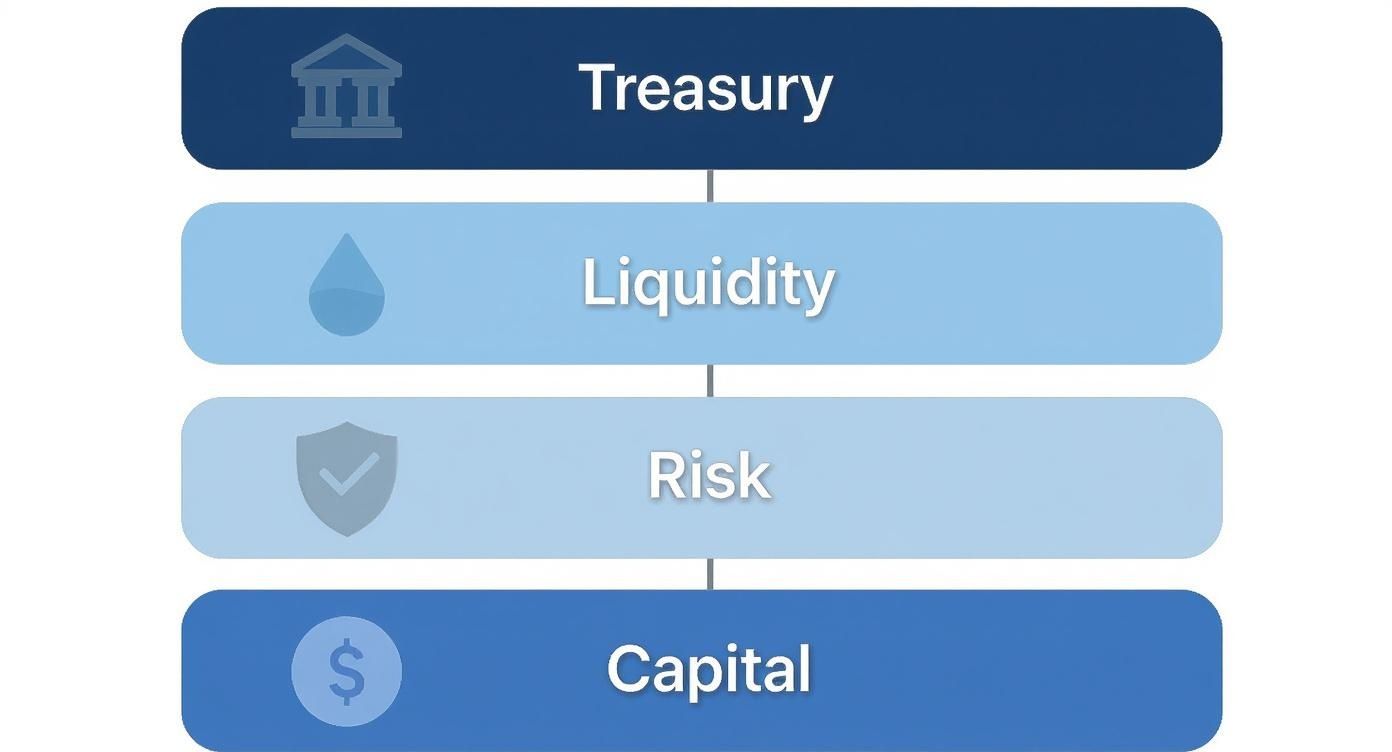
A bank's treasury management is a structure built on three core pillars. For any bank executive or director, understanding these pillars is not about operational minutiae—it is about comprehending the foundation of how the bank protects its balance sheet, generates profit, and ensures long-term viability.
These are not siloed functions. Liquidity, Risk, and Capital Management are the strategic levers used to build a resilient institution.
The diagram below illustrates this critical relationship. Treasury is the bedrock, and these three pillars rise from it, supporting the bank's strategic objectives.
While distinct, these pillars must operate in concert. A unified treasury strategy is the only effective means to safeguard and grow the bank's financial health.
Pillar 1: Liquidity Management
Liquidity management is the discipline of ensuring the bank can meet every payment obligation on time, without incurring a material loss. It is the most immediate and high-stakes test of a treasury team's competence, involving a daily flux of Fedwire payments, unpredictable depositor withdrawals, and loan funding commitments. Failure is not an option.
Consider a mid-sized bank with $4,000,000,000 in assets. On a given day, it might process $300,000,000 in outgoing wires and fund $50,000,000 in new commercial loans. An institutional client then unexpectedly withdraws $75,000,000. Without foresight, the bank's reserves are suddenly under significant strain.
The core of liquidity management is not merely having cash. It is having the right amount, in the right place, at the right time. A failure here is not a minor hiccup; it is an existential threat.
Guesswork is obsolete. A modern treasury utilizes data intelligence to run predictive cash flow models. By analyzing real-time deposit data and benchmarking withdrawal patterns against peers, treasury can maintain liquidity at an optimal level—sufficient to handle unforeseen events, but not so excessive that it becomes a drag on profitability.
Pillar 2: Risk Management
The second pillar focuses on identifying and neutralizing financial threats before they can inflict material damage. The primary adversary is market volatility, which most often manifests as interest rate risk.
To illustrate, imagine a bank's treasury holds a $500,000,000 bond portfolio with an average duration of five years. If interest rates rise by 100 basis points (1.00%), the market value of that portfolio would decline by approximately $25,000,000.
This is not a theoretical exercise; it is a market reality. Treasury's role is to actively hedge against these scenarios using instruments like interest rate swaps or options. The objective is to insulate the bank's earnings and capital from market fluctuations. This is a critical component of a broader strategy, which we detail in our guide on bank asset liability management. Executed correctly, risk management transforms treasury from a passive recipient of market forces into an active defender of the balance sheet.
Pillar 3: Capital and Funding Management
This third pillar represents the strategic management of the bank's capital base and funding sources. The mission is twofold: acquire funds at the lowest possible cost and deploy capital to drive intelligent growth, all while satisfying regulatory requirements.
On the funding side, treasury is in constant pursuit of the optimal mix of deposits, wholesale funding, and other sources. A single data-backed decision to shift $200,000,000 from expensive brokered deposits into stable, low-cost core deposits could save the bank over $1,000,000 annually in interest expense, flowing directly to the Net Interest Margin (NIM).
On the capital side, compliance is the baseline, not the goal. The objective is "capital efficiency"—deploying every dollar of capital into business lines that deliver the highest risk-adjusted return. Utilizing platforms that enable performance benchmarking and capital scenario modeling is how executives ensure their capital is deployed to maximize shareholder value.
How Data Intelligence Turns Treasury Workflows into Profit Centers
The era of treasury as a back-office function operating on spreadsheets is over. Today, it is a strategic nerve center fueled by data intelligence. The modern bank treasurer begins the day not with raw numbers, but with analytics that reveal the narrative behind the numbers.
This represents the most significant evolution in treasury management: the shift from reporting historical events to actively shaping future outcomes. Instead of viewing a static cash balance, a treasurer can now visualize liquidity trends, benchmark funding costs against peers, and forecast future cash flows. This strategic shift transforms the treasury function from a cost center into a profit center.
From Data Points to Strategic Decisions
Consider a treasurer at a $5,000,000,000 bank reviewing their morning dashboard. The traditional approach would yield a simple report showing a $50,000,000 excess overnight cash balance.
With a modern analytics platform, they receive a critical insight: this surplus has been idle for 12 of the last 15 business days. Furthermore, the platform indicates that peer banks are earning a 0.25% higher yield on similar funds.
Armed with this intelligence, the treasurer acts immediately, moving the $50,000,000 surplus into overnight repurchase agreements (repos) instead of allowing it to earn a negligible return in a correspondent account. That single, data-backed action generated over $3,400 in additional income. Overnight.
Data intelligence converts idle money into working capital. It is the difference between holding cash and actively deploying it for optimal return.
These incremental gains compound rapidly. Replicating this type of data-driven decision daily could yield over $850,000 in new pre-tax income annually. This is a material impact, driven entirely by superior information and the confidence to act upon it.
The Power of Forward-Looking and Comparative Analysis
The strategic value of data intelligence lies not only in reviewing past performance but in forecasting future trends and assessing the competitive landscape. The best platforms provide analytics that guide holistic strategy.
Predictive Cash Flow Modeling: By analyzing historical deposit trends and upcoming loan fundings, advanced models can forecast liquidity needs with high accuracy. This allows treasury to anticipate shortfalls or surpluses, enabling more profitable decisions.
Peer Benchmarking: How does your bank's funding mix, investment yield, or liquidity position compare to direct competitors? Data platforms like Visbanking provide clear visibility into your market standing, uncovering opportunities to reduce your cost of funds or identify underperforming assets. We explore this further in our overview of what business intelligence analytics can do.
Scenario Analysis: What is the impact of a 75 basis point rise in interest rates? What happens if a major depositor withdraws 20% of their funds? Data intelligence platforms allow you to conduct these stress tests in minutes, not days, ensuring preparedness for market eventualities.
Executing on this requires clean, accessible data. This is where effective data modernization strategies are critical. Outdated systems and siloed information are the primary obstacles preventing treasury teams from becoming true strategic partners.
Ultimately, integrating data intelligence into the treasury workflow allows you to shift from managing the balance sheet to actively optimizing it. It empowers your team to make faster, more intelligent, and more profitable decisions daily.
The Technology Backbone of Modern Treasury
High-performance treasury operations do not run on cumbersome spreadsheets and legacy software. The most effective treasury teams are powered by a sophisticated technology stack that functions as the bank's central nervous system for financial management. This is not an IT expense; it is a core business asset that directly fuels profitability and resilience.
The heart of this stack is the Treasury Management System (TMS). A modern TMS aggregates financial data from across the institution—deposits, loans, investments, payments—and consolidates it into a single source of truth. This unified view is the foundation for managing liquidity and risk exposure in real time.

Beyond the Core System to an Agile Ecosystem
A standalone TMS is no longer sufficient. The true competitive advantage lies in connectivity. Market leaders are building flexible ecosystems using Application Programming Interfaces (APIs) and managed services, creating a seamless, real-time data flow between the TMS and other critical platforms.
This interconnected architecture links treasury with the core banking system, asset-liability management (ALM) software, and external market data feeds. The result is an environment of instantaneous data movement. This empowers treasurers to move beyond rearview mirror analysis and build dynamic risk models and forecasts that reflect current market conditions. The strategic integration of financial data is the critical component of this modern framework.
The Strategic Value of the Right Tech Stack
For bank executives, investing in a modern technology stack is a strategic decision, not an operational one. A properly integrated system delivers tangible business value far beyond incremental efficiency gains. It becomes a competitive differentiator that impacts the bottom line.
A modern treasury tech ecosystem delivers significant benefits:
- Enhanced Security and Control: Centralized systems with stringent access controls drastically reduce the risk of fraud and operational errors.
- Simplified Audits and Compliance: An integrated stack creates a transparent, auditable trail, making regulatory reporting and internal audits less burdensome and more accurate.
- Scalability for Growth: As the bank expands, a modern infrastructure accommodates increased transaction volume and complexity without a linear increase in headcount, protecting margins.
The data supports this imperative. While 94% of larger companies now use a dedicated TMS, the leaders are those investing in modular, API-driven ecosystems. This provides the flexibility to scale and maintain resilience in volatile markets, a trend highlighted in the 2025 global treasury survey.
Investing in your treasury's technology is a direct investment in your bank's ability to compete. The right platform transforms your treasury from a transactional unit into a strategic intelligence hub, capable of navigating market volatility with precision.
Ultimately, the right technology enables treasury to transition from a reactive to a proactive posture. It provides the tools to not only manage risk but also to identify and seize market opportunities with conviction.
By leveraging a platform like Visbanking, executives can benchmark their current capabilities against peers and map out a clear path to building a high-performance treasury function. Explore our data to see how your institution measures up.
Managing Growth in a High-Velocity Market
The global financial system operates at a velocity that challenges traditional treasury models. This immense flow of capital creates significant challenges for bank treasuries, where legacy systems and manual processes introduce institutional risk.
In this high-stakes environment, growth is both an opportunity and a threat. Suppose your bank successfully grows its institutional deposits by 8% annually for five years. While a positive outcome, this growth creates a fundamentally different risk profile. The tools that supported the previous balance sheet are insufficient to manage the new liquidity and interest rate risks of a larger, more complex institution.
The New Scale of Financial Intermediation
This is not a hypothetical scenario; it is the current market reality. An unprecedented volume of capital has entered the global banking system, fundamentally altering the landscape for treasury and cash management.
Between 2019 and 2024, funds intermediated by the global banking system increased by an estimated $122 trillion. This represents a nearly 40% increase in just five years, driven by explosive growth in wealth held by households and institutions. This trend is detailed in the latest global banking annual review.
Attempting to manage this new reality with outdated methods is not only inefficient but dangerous.
The Rise of New Funding Profiles
The challenge extends beyond the sheer volume of capital. The composition of that capital is also changing, introducing new behaviors and risks that demand a more sophisticated understanding.
Notably, funds from private capital grew the fastest during that five-year period, increasing at an annual rate of 17.2%. This establishes private capital as a major force in global markets, creating a new challenge for treasury teams. These funds do not behave like traditional retail or commercial deposits; their volatility and duration present a different risk profile.
A treasury department that cannot accurately model the behavior of these different funding sources is operating blind. In a market moving this fast, a lack of visibility is not just a weakness—it is a catastrophic failure waiting to happen.
To effectively manage these new profiles, treasury teams require significant analytical firepower. This includes the ability to segment funding sources, analyze their historical behavior under various market conditions, and stress-test their stability. These capabilities are beyond the scope of manual spreadsheet analysis.
The Imperative for Data-Driven Decision Making
In this environment of high volume and complexity, data intelligence is no longer optional. It is a fundamental tool for survival and growth. Modern data platforms provide the clarity and analytical capability required to maintain control and capitalize on emerging opportunities.
This translates into tangible actions:
- Real-Time Liquidity Monitoring: Move beyond end-of-day reports to a live, up-to-the-minute view of liquidity, flagging potential shortfalls or excess cash that can be deployed.
- Predictive Funding Models: By analyzing historical data, treasury can predict the behavior of different depositor segments—such as private capital clients—and proactively adjust funding strategies to mitigate outflow risk.
- Peer Benchmarking: Compare your funding costs and mix against other institutions on a similar growth trajectory. This helps identify opportunities to optimize the liability structure and enhance net interest margin.
The transition from reactive reporting to a proactive, data-driven strategy is what distinguishes a modern, high-performing treasury. Platforms like Visbanking deliver this critical intelligence, empowering executives to benchmark performance and make decisive, data-backed decisions.
Curious where your institution stands? We invite you to explore our data and uncover your competitive edge.
Building a High-Performance Treasury Function
Too many banks relegate their treasury function to a defensive role—a cost center focused on risk mitigation. In today's market, this is a losing strategy. A bank's treasury department must be a strategic weapon and a profit center.
The transition from a defensive to an offensive posture hinges on a single asset: data intelligence.
A high-performance treasury team does more than manage daily cash and ensure compliance. They are actively seeking opportunities to lower funding costs, optimize the investment portfolio for superior risk-adjusted returns, and conduct rigorous stress tests against potential market disruptions.
This requires a foundation of clean, reliable data and the analytical tools to convert that data into action.
From Defense to Strategic Offense
What separates a top-quartile treasury from an average one? The ability to use data to anticipate market movements. Instead of merely reporting on the past quarter, a modern treasury uses predictive analytics and peer benchmarking to inform its next strategic move.
Consider this: a treasurer discovers their bank's cost of funds is 0.12% higher than its peer group. For a bank with $3,000,000,000 in liabilities, this is not a minor discrepancy—it is a $3,600,000 annual opportunity being forfeited. The right data intelligence platform makes this insight unavoidable, providing the evidence needed to adjust the funding mix and capture that margin.
A truly effective treasury function doesn’t just manage the balance sheet; it actively shapes it for competitive advantage. It uses data not just to see where the institution has been, but to chart a more profitable course for where it is going.
Actionable Intelligence for Decisive Leadership
Making strategic decisions requires confidence, and confidence is born from clarity. A bank intelligence platform is non-negotiable for this purpose. It cuts through the noise of raw data to deliver specific, decision-ready analytics.
The dashboard below demonstrates how Visbanking consolidates complex data into a clear, comparative view, enabling executives to benchmark performance instantly.
With a visualization like this, leadership can immediately compare key metrics like Net Interest Margin or loan growth against a curated peer group. Strategic gaps and opportunities become immediately apparent.
Ultimately, modernizing your treasury is about empowering your team to act with conviction. Arming them with the right intelligence transforms the treasury department from a back-office utility into a powerful engine for profitability and resilience.
Your bank’s data holds the key to its full potential. The first step is to see exactly where you stand. We invite you to explore our platform and benchmark your performance to uncover your next strategic move.
Straight Answers to Your Big Questions About Treasury
Here are direct answers to the questions bank executives are asking about treasury's strategic role. The focus here is on substance, linking treasury's daily operations directly to the key performance indicators that matter.
How Does Treasury Management Actually Move the Needle on Net Interest Margin?
Treasury impacts Net Interest Margin (NIM) through both offensive and defensive actions. Defensively, a sharp treasury team relentlessly pursues the lowest-cost funding sources, systematically replacing expensive brokered funds with stable, low-cost core deposits to directly reduce interest expenses.
Offensively, treasury puts all excess cash to work, deploying it into assets that generate the optimal interest income. For example, a treasury team identifies $100,000,000 in overnight funds that can be shifted to a higher-yielding, short-term security. Capturing an additional 25 basis points on that sum adds $250,000 to the bottom line annually. This continuous optimization—minimizing liability costs while maximizing asset yields—is what directly widens your NIM.
What’s the One Risk That Should Keep Treasury Up at Night?
While treasury manages a portfolio of risks, liquidity risk is paramount. It is the risk of being unable to meet obligations as they come due without suffering catastrophic losses. A sudden deposit run or a frozen funding market can destroy confidence in an institution almost instantly.
Ultimately, every other financial risk—interest rate, credit, operational—can manifest as a liquidity problem if mismanaged. A failure in liquidity management can jeopardize a bank's solvency in a matter of days, which is why its oversight is treasury's most critical responsibility.
Can a Community Bank Realistically Adopt Top-Tier Treasury Practices?
Absolutely. Community banks can leverage modern data intelligence platforms to compete effectively without a large internal team. By moving beyond manual spreadsheets, executives can gain instant access to automated peer benchmarking, cash flow forecasting, and investment analytics.
This levels the playing field, enabling a smaller institution to make the same sophisticated, data-backed decisions as a national bank. The ability to precisely identify performance gaps and strategic opportunities enhances competitiveness and profitability without significant overhead.
A world-class treasury function runs on superior data intelligence. At Visbanking, we provide the kind of decision-ready analytics that give bank executives the confidence to go from insight to action. See how your institution stacks up by taking a look at our platform at https://www.visbanking.com.
Related Articles

Visbanking Blog
Net Interest Margin Secrets: How Top Banks Maximize Profits

Visbanking Blog
Bank Capital Requirements: The Ultimate Survival Guide

Visbanking Blog
Capital Banking in the USA: An Overview of Investment Services, Financial Instruments, and Regulations

Visbanking Blog
Banking Data Analytics: Turning Information Into Profit

Visbanking Blog
Bank Interest Rate Predictions: What Experts See Coming

Visbanking Blog