
A Guide to Bank Asset Liability Management
Brian's Banking Blog
Bank asset liability management, or ALM, is the game plan banks use to handle the risks that pop up when their assets and liabilities don't quite line up. This isn't just about playing defense; it’s a constant, active effort to boost profitability and shield the bank's capital from market curveballs, like a sudden jump in interest rates.
Why ALM Is a Bank’s Financial Rudder
Think of yourself as the captain of a massive ship. Your assets—things like loans and investments—are the valuable cargo you're carrying. Your liabilities, like customer deposits and funds you've borrowed, are the ship's ballast, keeping everything stable. Bank asset liability management is the fine art of keeping this delicate balance. If the cargo shifts unexpectedly or the ballast is off, the whole ship is in trouble.
ALM is what allows a bank to steer through choppy economic waters. It’s all about looking ahead to guide the bank toward its most important financial goal: protecting and growing its Net Interest Margin (NIM). This margin, which is the simple difference between what a bank earns on assets and what it pays out on liabilities, is the lifeblood of its profits.
Balancing Profitability and Stability
A bank flying blind without a solid ALM framework is incredibly vulnerable. Let's say interest rates spike. A bank holding a lot of long-term, fixed-rate loans (its assets) could suddenly find itself paying much higher rates on its short-term deposits (its liabilities). That mismatch squeezes the NIM and hits profitability hard.
On the flip side, if rates tumble, the bank might earn less from its variable-rate loans while still being stuck paying higher rates on long-term CDs. Good ALM sees these scenarios coming, using smart models to predict the impact and inform better strategic moves. For a closer look at how these two sides of the balance sheet play off each other, you can get the full story in this comprehensive guide on bank assets and liabilities.
The whole process is way more than just reacting to the market. It’s about building a balance sheet that’s designed for stability from the ground up.
"A well-handled Treasury and ALM function contributes significantly to the bank’s financial stability, especially in times of market volatility and economic uncertainty."
The Strategic Importance of ALM
When you get right down to it, bank asset liability management is a core strategic function that goes far beyond just ticking a risk management box. It helps leaders answer the make-or-break questions about where the institution is headed.
- Pricing Decisions: How should we price our new loans and deposit products to stay competitive but also profitable in this rate environment?
- Funding Strategy: What’s the right mix of funding—from retail deposits to wholesale funding—to keep things stable and control our costs?
- Capital Protection: How do we set up our balance sheet to defend our capital from getting battered by market swings?
By delivering clear answers in these areas, ALM acts as the essential navigation system for any bank. It’s what lets a financial institution chase sustainable growth while staying resilient enough to handle economic storms and satisfy the regulators.
Understanding the Core Risks in ALM

Any solid bank asset liability management framework is designed to handle three critical financial pressures. These aren't just abstract ideas; they're real forces that can seriously ding a bank's health and bottom line if you're not paying attention.
At its heart, ALM gives you the strategic playbook to get ahead of and control liquidity risk, interest rate risk, and funding risk. Getting a handle on each one is crucial to understanding how banks stay on solid ground.
Navigating Liquidity Risk
Think about your own personal budget. You need enough cash in your checking account to cover daily stuff like groceries and bills. That's your personal liquidity. But what if your car's transmission blows and you suddenly need a few thousand bucks for a repair you didn't see coming?
For a bank, liquidity risk is that same problem, just on a much, much bigger scale.
It’s the danger that a bank won't be able to pay its bills—like depositor withdrawals or funding new loans—without taking a huge financial hit. Not having enough cash or assets you can sell quickly forces you into a corner.
You might have to sell off long-term assets, like quality bonds or good loans, at fire-sale prices. This doesn't just crush your profits; it can shatter your bank's reputation and spark a crisis of confidence.
Confronting Interest Rate Risk
Interest rate risk is probably the central challenge in bank asset liability management. It all comes down to the fact that a bank's assets and its liabilities don't always move in sync when market interest rates change.
Let’s use a simple example. Say your bank has a big portfolio of 30-year fixed-rate mortgages (your assets). At the same time, most of your funding comes from variable-rate savings accounts (your liabilities).
Now, what happens if the Fed hikes rates by 2%?
- The income you earn from those fixed-rate mortgages stays exactly the same.
- But the interest you have to pay out on those savings accounts will jump almost immediately to stay competitive.
That mismatch squeezes your Net Interest Margin (NIM) and takes a direct bite out of your profits. The reverse is also a problem. Falling rates can hurt a bank that has a lot of floating-rate loans funded by fixed-rate liabilities like long-term CDs. This is the kind of thing that keeps an Asset-Liability Committee (ALCO) up at night.
The fallout from the 2007-2008 financial crisis really changed the game here. We went through a long stretch of historically low interest rates that forced banks to deal with shrinking margins. Meanwhile, regulators were turning up the heat, especially on interest rate risk. This pushed everyone toward better ALM tools using gap analysis, duration modeling, and scenario planning to get a grip on these mismatches.
This is a complex balancing act, which is why we've put together a whole article on managing interest rate risk for anyone who wants to go deeper.
Securing Stable Funding Risk
Funding risk is a close cousin to liquidity risk, but it's really about the long game. It's the risk that a bank can't find and keep a stable, reliable source of money to support its growth and day-to-day operations over time.
Think of it this way: getting a one-time cash infusion from a buddy is different from landing a long-term, stable investor for your business. One is a temporary patch; the other is a foundation for real growth.
Banks have to manage their funding mix carefully to avoid leaning too heavily on twitchy, short-term sources like overnight interbank loans. A solid funding profile is built on:
- Core Deposits: Those sticky savings and checking accounts from your loyal retail and business customers.
- Long-Term Debt: Bonds and other tools that lock in funding for years at a time.
- Shareholders' Equity: The bank's own capital—the most stable source of all.
An unstable funding base is a huge weakness when the market gets shaky. If those short-term lenders get spooked and stop rolling over their loans, a bank could face an immediate funding crisis, even if its loans and investments are perfectly sound. A key goal of ALM is to build a diversified, dependable funding structure that can handle economic shocks and fuel sustainable growth.
Essential ALM Models and Methodologies
To really get a grip on the balance sheet, bank leaders need a solid toolkit of analytical models. These aren't just abstract theories; they're the practical, data-driven instruments that turn the complexities of bank asset liability management into clear, confident decisions. They give the Asset-Liability Committee (ALCO) the visibility it needs to sidestep risk and drive the bank toward its biggest goals.
Think of these models as different lenses for looking at the same financial landscape. Each one offers a unique angle on the bank's risk exposure. When you put them all together, you get a complete, 360-degree picture. The three most critical methodologies are Gap Analysis, Duration Analysis, and Net Interest Income (NII) Simulation.
The infographic below shows how modern dashboards help analysts see and manage rate risk—a central focus of all these models.
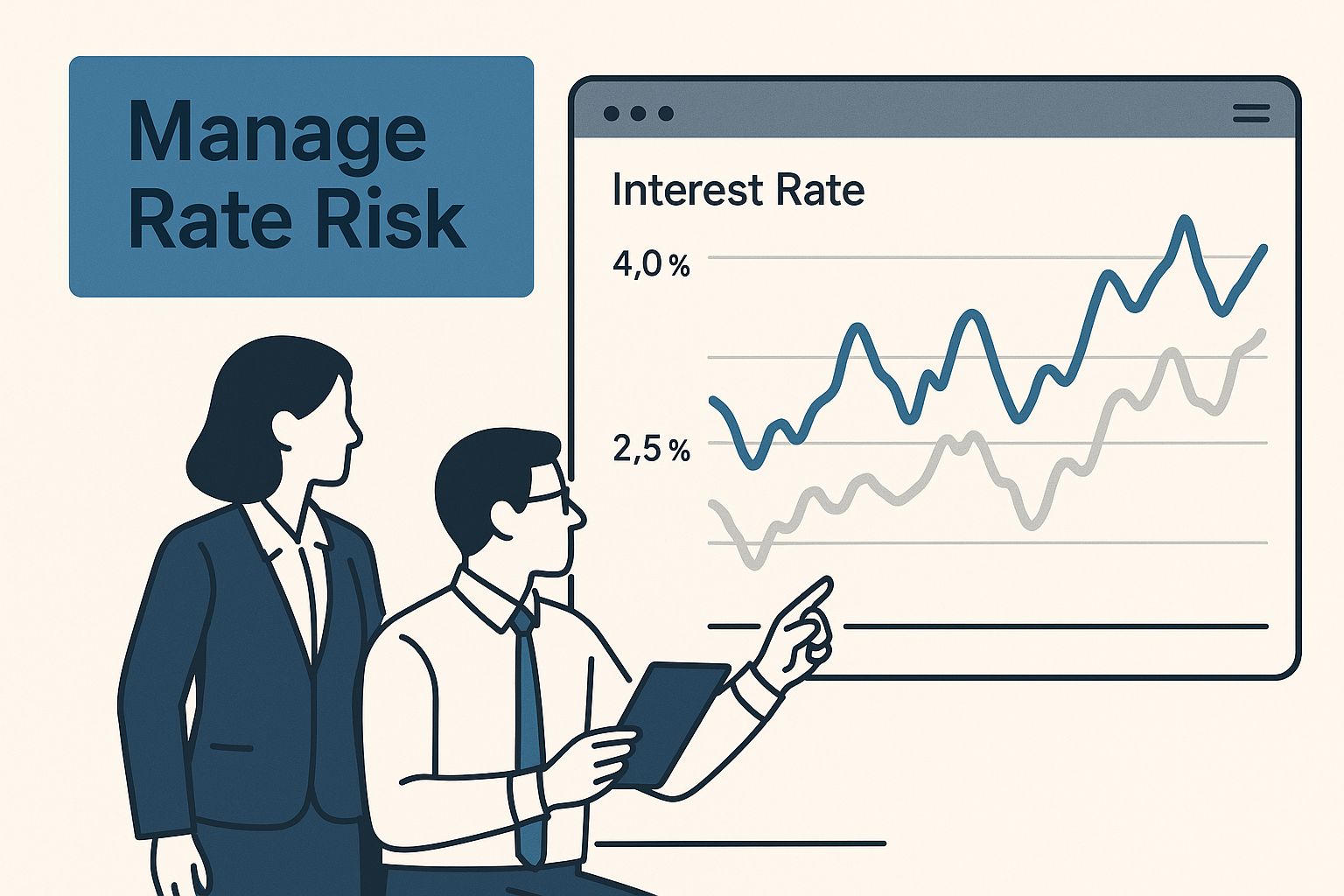
This kind of real-time visualization is a game-changer. It takes abstract numbers and transforms them into something the ALCO can immediately grasp and act on.
Gap Analysis: The Calendar Matchup
Gap Analysis is the foundation of ALM. At its heart, it’s a simple calendar-matching game. It measures the "gap" between the volume of assets and liabilities set to reprice within a specific timeframe.
Imagine you have a bucket for every month of the year. You toss all your adjustable-rate loans resetting in June into the June bucket. Then, you do the same for all your deposits whose rates might change that same month. The difference between what’s in the asset side versus the liability side of that bucket is your repricing gap.
- A positive gap means you have more rate-sensitive assets than liabilities. Here, the bank usually wins when interest rates climb.
- A negative gap means you have more rate-sensitive liabilities than assets. In this scenario, the bank is positioned to benefit when rates fall.
It's a straightforward sorting method that gives management a quick, high-level snapshot of its interest rate exposure, whether it's overnight or several years out.
Duration Analysis: Gauging Balance Sheet Sensitivity
While Gap Analysis tells you when things reprice, Duration Analysis tells you how much their value will shift when interest rates move. It's a more sophisticated tool that digs deeper into the balance sheet's true sensitivity.
Picture the bank's balance sheet as a seesaw. Assets sit on one side, liabilities on the other. Duration acts like the weight and position of each person on that seesaw. It calculates the weighted-average time until cash flows are paid out, telling you just how much the seesaw will tilt if interest rates—the external force—budge.
A higher duration means more sensitivity. A 30-year fixed-rate mortgage, for instance, has a much longer duration than a 3-month auto loan. If rates go up, the market value of that mortgage will drop far more dramatically than the short-term loan's value.
Duration gap analysis involves comparing the weighted average duration of assets to the weighted average duration of liabilities. A larger gap indicates that the bank's net worth is more exposed to fluctuations in interest rates, providing a crucial metric for managing capital volatility.
Net Interest Income Simulation: A Financial Forecast
If Gap and Duration are snapshots, think of Net Interest Income (NII) Simulation as the full-motion picture. This methodology is like a financial weather forecast, letting banks run "what-if" scenarios to project future earnings under all sorts of economic conditions.
ALCOs use NII simulations to get answers to make-or-break questions, like:
- What happens to our net interest income if rates suddenly spike by 2%?
- How will a long stretch of flat or inverted yield curves hit our earnings?
- What's the impact if customers start moving their money from checking accounts into higher-yield CDs en masse?
By modeling these potential futures, banks can get ahead of the curve. They can shorten asset durations, lock in hedges, or adjust product pricing before the storm hits, not after. This forward-looking mindset is essential for stable, predictable earnings.
To give you a better sense of how these models compare, here’s a quick breakdown:
Comparison of Key ALM Methodologies
This table clarifies how each methodology serves a different purpose, from providing a quick snapshot to running complex forecasts.
| Methodology | Primary Function | Key Metric | Best For |
|---|---|---|---|
| Gap Analysis | Measures repricing mismatches over time | Repricing Gap | Quick, high-level view of short-term rate exposure |
| Duration Analysis | Gauges the price sensitivity of the balance sheet | Duration Gap | Assessing the impact of rate changes on net worth |
| NII Simulation | Forecasts earnings under various scenarios | Net Interest Income (NII) | Strategic planning and stress testing |
Each model provides a vital piece of the puzzle, helping the ALCO steer the bank with confidence.
Over time, these techniques have become incredibly refined. As discussed in this overview of ALM practices, the evolution from simple gap analysis to sophisticated simulations allows banks to precisely manage earnings volatility and stay well ahead of regulatory capital requirements.
Ultimately, these models are more than just risk management tools. They empower leadership to turn financial complexity into strategic advantages, ensuring the bank stays profitable and resilient no matter what the market throws at it.
How Regulation Shapes Modern ALM
Smart bank asset liability management isn't just good business anymore—it's a regulatory must-have. After the global financial crisis sent shockwaves through the system, regulators completely rebuilt the rulebook. ALM went from being a back-office strategy function to a critical, front-and-center compliance mandate.
Global agreements like Basel III and national laws like Dodd-Frank in the U.S. have totally changed how banks manage their balance sheets. These rules aren't suggestions; they're a standardized playbook designed to force institutions to hold up against major financial shocks.
The whole point is to prevent one bank's failure from starting a domino effect across the financial world. Because of this, modern ALM is now just as much about keeping regulators happy as it is about boosting the bottom line.
The New Rules of Liquidity
Post-crisis reforms put a laser focus on one thing: a bank's ability to survive a sudden cash crunch. Two key metrics from Basel III now define the game.
Liquidity Coverage Ratio (LCR): Think of the LCR as your bank's 30-day survival kit. It demands that banks hold enough high-quality liquid assets (HQLA)—cash, central bank reserves, government bonds—to cover all net cash outflows during a nasty 30-day stress scenario. It’s a direct answer to the problem of banks looking solid on paper but folding the second liquidity dries up.
Net Stable Funding Ratio (NSFR): If the LCR is a survival kit, the NSFR is your one-year stability plan. It makes sure that long-term assets, like a portfolio of mortgages, are funded with equally stable, long-term sources, not with jumpy, short-term borrowing. This puts a stop to the risky habit of funding long-term bets with money that could vanish tomorrow.
Together, the LCR and NSFR act as powerful regulatory guardrails. They force banks to build their balance sheets for both immediate shocks and long-term stability, cementing liquidity planning as a core piece of modern ALM.
These rules have made liquidity risk management an essential part of ALM. After the 2008 crisis, reforms like Basel III introduced these liquidity coverage and net stable funding ratios to ensure banks could cover cash outflows for 30 days and stabilize funding over a year.
The Mandate of Regulatory Stress Testing
On top of these standing ratios, regulators also require banks to prove their toughness through rigorous stress testing. This is no simple "what-if" exercise. It's a mandatory financial fire drill where banks must show they can take a punch from a severe economic downturn.
Regulators hand down specific, grim scenarios—picture a deep recession, unemployment spiking, and the stock market tanking. Banks then have to plug these nightmare scenarios into their ALM models and calculate the potential damage to their earnings, capital, and liquidity.
The results aren't just for internal navel-gazing; they’re reported directly to regulators, who decide if the bank is holding enough capital to survive. For a deeper dive into this critical process, it's worth exploring the specifics of stress testing for banks and its central role in compliance.
These tests compel banks to look beyond what's happened in the past and actively prepare for future crises. It makes forward-looking risk assessment a core function of ALM, not an afterthought. By proving they can survive the worst, banks build trust with regulators and the market, securing their place as stable pillars of the economy.
The Future of Asset Liability Management
The world of bank asset liability management is shifting on its axis. The traditional models we all grew up with, built for calm, predictable economic cycles, are cracking under the pressure of recent volatility. Think high inflation and those sudden, sharp interest rate hikes. This isn't your grandfather's economy anymore.
This new reality calls for a much more dynamic, forward-looking way to manage the balance sheet. The future of ALM isn't just about tweaking old methods; it's being completely reimagined by technology.
Technology as an ALM Co-Pilot
Artificial intelligence (AI) and machine learning (ML) are finally moving from industry buzzwords to practical tools in the ALCO's kit. These technologies give us predictive modeling capabilities that make legacy systems look like relics. Instead of just reacting to last quarter's numbers, banks can now run incredibly sophisticated forecasts that actually anticipate market shifts. It’s about moving from a reactive to a proactive stance on risk.
Think of this tech not as a replacement for human expertise, but as a powerful co-pilot. AI and ML algorithms can chew through massive datasets in real-time, spotting subtle patterns in customer behavior or market trends that would be invisible to even the sharpest human eye. This gives ALCOs deeper, data-driven insights to navigate the complexity with real confidence.
The discipline of ALM has come a long way. Over the past 25 years, it has grown from a niche practice in insurance and pension funds into a cornerstone of global banking. This shift was kicked into high gear by stricter regulations after the financial crisis and the dramatic economic swings we’ve seen lately. As a result, ALM systems have had to get much smarter, with advanced modeling and real-time data analytics becoming the new standard. You can find more great insights about this evolution at Davies Group.
Integrated Platforms and Proactive Strategy
The next leap forward in bank asset liability management is all about integrated platforms. As banks map out the future of ALM, modernizing their existing tech is a must. To tap into advanced analytics and real-time insights, you have to think strategically about legacy system integration. Siloed data and clunky, disconnected systems just won't cut it.
Modern platforms, like Visbanking’s BIAS, are designed to pull all the critical data points—financials, regulatory requirements, market data, and performance indicators—into a single, cohesive view.
This screenshot from the Visbanking BIAS dashboard is a perfect example of how data from different sources can be presented in a way that’s immediately clear and actionable for bank leaders. It puts key performance indicators right at your fingertips, allowing for quick assessment and smarter strategic moves.
When you have this kind of unified perspective, ALCOs can stop playing defense. They can start actively identifying strategic opportunities, optimizing the balance sheet for both safety and profitability, and building a truly resilient institution that's ready for whatever comes next. The future is about making smarter, faster decisions backed by comprehensive intelligence.
Key Takeaway: The future of ALM is a fusion of human expertise and powerful technology. By embracing integrated platforms that deliver real-time, predictive insights, banks can transform ALM from a simple compliance exercise into a core driver of strategic growth and stability. In today’s uncertain financial landscape, this isn't just an advantage—it's essential.
Got Questions About Bank ALM? Let's Break It Down.
When you're talking about the core financial engine of a bank, asset liability management is where the action is. It's only natural that some common questions pop up. Let's clear the air and look at how ALM works in the real world to keep an institution safe and profitable.
What's the Deal with a Bank's ALCO?
Think of the Asset-Liability Committee (ALCO) as the bank's strategic command center for everything on the balance sheet. This isn't some low-level meeting; it's typically the senior executive team setting the game plan for interest rate risk, liquidity, and capital.
The committee digs into ALM model outputs and keeps a close eye on the economic horizon. From there, they make the big calls on things like:
- Pricing for loans and deposits—finding that sweet spot between being competitive and actually making money.
- The right mix of funding sources to keep things stable.
- Which investments to make and how to hedge against risk.
In short, the ALCO's job is to make sure the bank hits its financial goals without gambling with the house's money. It’s all about staying within the bank's stated risk appetite.
How Does Net Interest Margin Fit into ALM?
Net Interest Margin (NIM) is the pulse of the bank, and bank asset liability management is all about keeping that pulse strong and steady. It’s the simple-but-critical gap between the interest a bank makes from its assets (like loans) and the interest it pays out on its liabilities (like deposits).
A huge part of ALM is protecting and growing the NIM, no matter which way interest rates swing. Smart strategies, like carefully managing the timing of when assets and liabilities reprice, are what keep a bank’s core profitability stable.
Why Do Banks Bother with Stress Testing in ALM?
Stress testing is the bank’s financial fire drill. It’s how you find out what breaks before it actually breaks. You run simulations of some pretty grim—but totally possible—scenarios, like a sudden market crash or interest rates going through the roof, just to see how your balance sheet holds up.
This isn't about looking in the rearview mirror; it's about preparing for the storm that might be on the horizon. By seeing how much damage a crisis could do to earnings and capital, management and regulators can be sure the bank has enough of a cushion to survive. It’s a non-negotiable part of modern risk management.
Ready to stop reacting and start executing a proactive strategy? Visbanking gives your team the integrated data and clear intelligence you need to truly own your bank's asset liability management. Benchmark your performance, spot opportunities before the competition does, and build a strategy for the future with the BIAS platform. See how Visbanking can empower your bank today.
Latest Articles
Brian's Banking Blog
Understanding Statistical Significance in Banking
Brian's Banking Blog
Option Adjusted Spread: A Banker's Practical Framework
Brian's Banking Blog
How to Improve Margins: A Bank Leader's Playbook
Brian's Banking Blog
Automated Alerts and Notifications for Banks
Brian's Banking Blog
Customer Feedback Loop for Banks: A Practical Playbook
Brian's Banking Blog