
What Is Scenario Planning for Modern Banks?
Brian's Banking Blog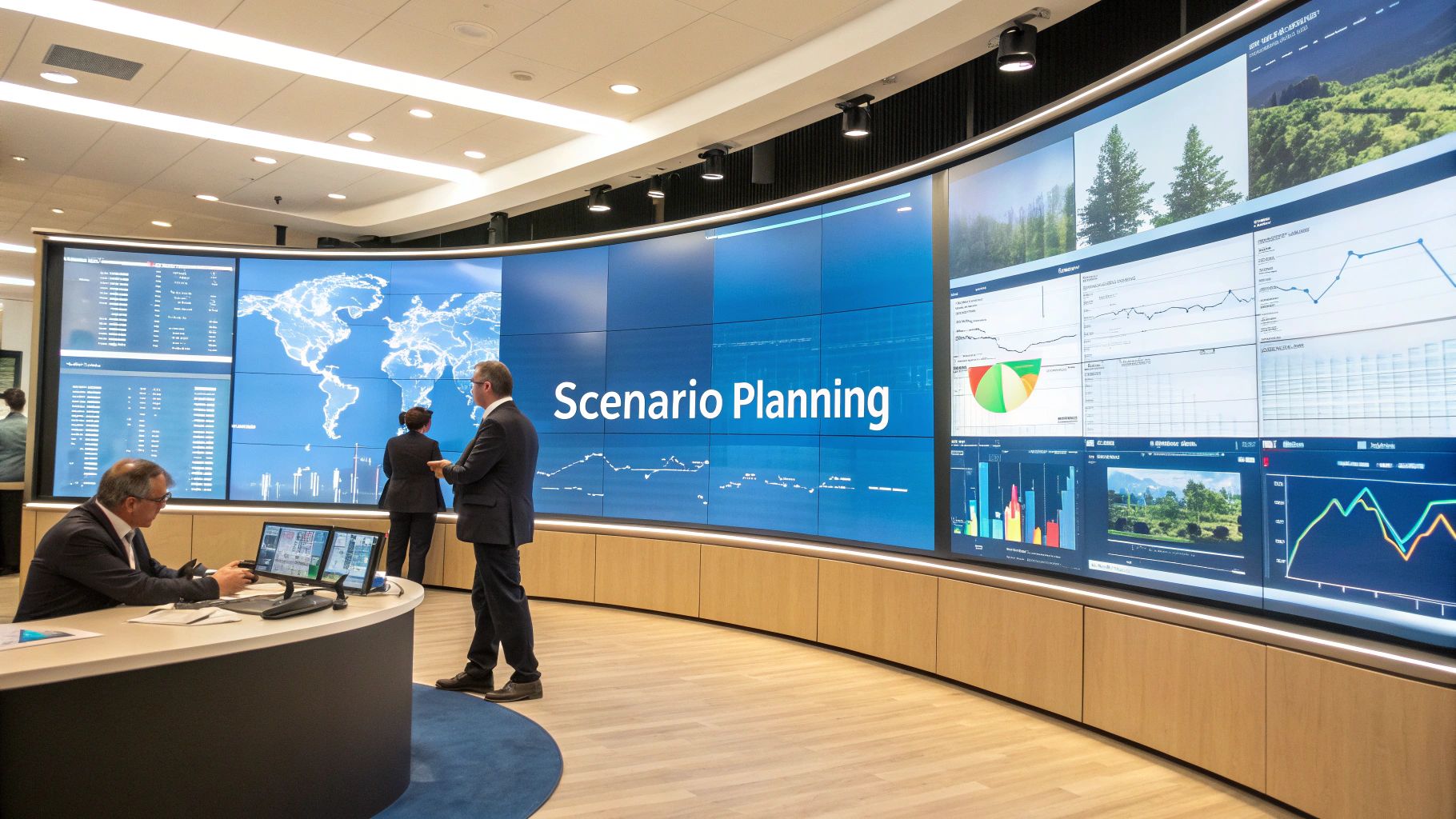
Traditional forecasting provides one version of the future. It is almost always wrong.
Scenario planning is the strategic alternative. It is a disciplined framework for evaluating several plausible futures to enable superior decision-making today. The objective is to prepare not for a single expected outcome, but for a range of possibilities that could fundamentally alter the banking landscape.
Seeing Beyond the Forecast
In banking, uncertainty is the only constant. Relying on a single forecast—for example, a 25-basis-point rate hike—exposes an institution to significant risk when reality delivers a 100-basis-point hike, an unexpected rate cut, or a period of stagflation. A reactive posture is a strategic liability.
Scenario planning reverses this dynamic. It shifts a leadership team from passively hoping for a favorable outcome to actively preparing for a spectrum of realistic futures.
This is not a predictive exercise. It is a rigorous mapping of the terrain of uncertainty. By outlining distinct, credible futures—each supported by robust data and a clear causal narrative—strategies can be tested before capital is committed.
From A Single Point to a Full Spectrum
The fundamental difference is one of perspective. Forecasting aims to predict a specific outcome. Scenario planning explores a range of them.
Consider these potential environments:
- A "High-Rate Environment" Scenario: How does a federal funds rate sustained above 5.0% impact net interest margin, deposit composition, and commercial real estate portfolio valuations?
- A "Regional Recession" Scenario: If a dominant local industry contracts sharply, what is the quantifiable impact on loan delinquencies and the allowance for credit losses?
- A "Digital Disruption" Scenario: If a national fintech aggressively enters the market with high-yield savings products, what percentage of the core deposit base is at risk?
When a balance sheet is tested against these possibilities, vague threats become manageable variables. This is how an institution builds the resilience not merely to survive volatility, but to capitalize on it.
To clarify, let's delineate the fundamental differences between these two methodologies.
Forecasting vs. Scenario Planning for Bank Executives
| Attribute | Traditional Forecasting | Strategic Scenario Planning |
|---|---|---|
| Objective | Predict a single, most likely outcome (e.g., net income). | Explore a range of plausible future environments. |
| Output | A single number or a narrow range of figures. | A set of distinct narratives and their financial implications. |
| Mindset | Reactive: "What do we think will happen?" | Proactive: "What could happen, and are we ready?" |
| Focus | Precision and accuracy for a single point in time. | Resilience and adaptability across multiple futures. |
| Strategic Value | Useful for short-term operational budgeting. | Essential for long-term strategic resilience and growth. |
The comparison makes it clear: while forecasting has its utility in operational planning, it is insufficient for shaping long-term strategy in a volatile world.
The Role of Data Intelligence
Effective scenario planning is driven by data, not intuition. Generic assumptions yield flawed, generic results.
True strategic insight is derived from granular, market-specific intelligence. Rather than planning for "increased competition," a data-driven approach models the precise financial impact of three local credit unions increasing their CD rates by 50 basis points. It projects potential deposit outflows from specific customer segments.
This is where a platform like Visbanking provides a decisive edge. It translates "what-if" scenarios into quantifiable financial impacts. Our internal guide on stress testing for banks delves deeper into these data-driven methods.
By moving beyond simple forecasts, a bank can develop actionable playbooks for multiple futures. This disciplined preparation is the hallmark of strategic leadership.
A Practical Four-Step Scenario Planning Framework
Theory is insufficient for executives accountable for a bank's performance. To transform scenario planning into a strategic tool, a disciplined, actionable framework is required. This is not an academic exercise; it is a structured methodology for building resilience and identifying market opportunities.
This four-step framework converts abstract uncertainty into concrete strategic actions, moving from a rigid forecast to a flexible, multi-dimensional decision-making map.
This flow illustrates how replacing a single forecast with multiple potential scenarios leads to clearer, more robust decisions.
Step 1: Identify Critical Driving Forces
First, isolate the few external forces with the potential to materially impact the bank. The objective is to eliminate noise and focus on the two or three variables that are both highly uncertain and highly impactful.
For a community bank, these might include:
- Interest Rate Trajectory: Will rates remain elevated, decline sharply, or stabilize?
- Local Economic Health: What is the impact if the area's largest employer downsizes, or a new one arrives?
- Regulatory Environment: Could new capital requirements or lending rules fundamentally alter the business model?
Data, not intuition, must guide this selection. Analyze regional economic data, benchmark peer performance in different rate environments, and assess regulatory proposals to ground scenarios in the realities affecting your balance sheet.
Step 2: Build Plausible Worlds
With driving forces identified, combine them to construct a few distinct, plausible future "worlds." These are not simplistic best-case/worst-case narratives. They are rich, data-backed stories of how events might unfold. Aim for three or four different, credible scenarios.
For a bank with significant commercial real estate exposure, these worlds might be:
- Scenario A: Sustained High Rates - Persistent inflation compels the Fed to maintain rates at 5.5%. CRE valuations decline 15% due to refinancing pressure and higher capitalization rates.
- Scenario B: The Soft Landing - The economy cools moderately. Rates fall to 3.5% by year-end, unemployment remains low, and local CRE transaction volume increases 10%.
- Scenario C: Digital Disruption - A national fintech enters the market with a high-yield deposit product, drawing $50 million in core commercial deposits within 12 months.
Each world requires a clear narrative supported by numbers that can be modeled. This transforms abstract risks into tangible futures. For context on how this integrates into broader strategy, review our breakdown of the strategic planning process steps.
Step 3: Analyze Strategic Impact
This is where data intelligence becomes indispensable. With scenarios defined, the next step is to model the financial impact of each. The conversation moves from the boardroom to the balance sheet.
Answer specific, quantitative questions:
- In the 'Sustained High Rates' world, what is the projected impact on our net interest margin over the next eight quarters?
- How would a 15% decline in CRE values affect the risk ratings of our top 20 commercial loans and our resulting loan loss provisions?
- In the 'Digital Disruption' scenario, what is the projected deposit outflow and its effect on our liquidity coverage ratio?
A platform like Visbanking is essential here. It enables these models to be run using real-time peer data and a granular view of your own portfolio. The exercise becomes a precise financial stress test yielding data-backed projections, not estimates.
Step 4: Develop Actionable Playbooks
The final step is to convert analysis into action plans. For each scenario, the leadership team must develop a playbook of strategic responses and, critically, the early-warning indicators—or signposts—that signal which future is materializing.
A playbook is a set of pre-approved actions, ready for deployment.
- Signposts: What specific data points are being monitored? A 10% increase in 90-day CRE delinquencies in your county, or two consecutive quarters of negative local job growth.
- Triggers: When does a signpost compel action? For example, if a key competitor’s CD rate exceeds yours by 75 basis points for 30 consecutive days, it could trigger a pre-planned response.
- Actions: What specific measures will be taken? This could range from tightening underwriting standards on a specific loan category to launching a marketing campaign to defend core deposits.
By developing these playbooks, you position your bank to act decisively and intelligently, rather than reacting from a defensive posture. This is the essence of modern strategic management.
Putting Scenarios into Practice at a Community Bank
Frameworks are valuable, but execution determines outcomes. To illustrate the practical application, let's analyze three distinct scenarios for a hypothetical $2 billion community bank. This bridges the gap between abstract concepts and the quantifiable results a board of directors requires.
We will move from "what if" to a rigorous analysis of "what is," assigning hard numbers to each potential future. This makes strategic decisions a function of data-backed preparation, not intuition. Each scenario will test a different component of the bank's resilience, from credit quality to liquidity.
This discipline is not new. Royal Dutch Shell famously used it in the early 1970s. By modeling futures that included geopolitical tension and oil supply shocks, Shell was prepared for the 1973 oil crisis and acted decisively while competitors faltered. More recently, analysis shows that robust scenario planning can improve risk mitigation by up to 30% during volatile periods. You can read more about how scenario planning builds corporate resilience on intuendi.com.
Modeling Three Plausible Futures
For our $2 billion community bank, we will map three plausible, yet divergent, futures. Precision in assumptions is key to ensuring the clarity of the financial modeling.
- Scenario A: The Soft Landing
- Scenario B: Stubborn Inflation
- Scenario C: Geopolitical Shock
Each path necessitates a unique playbook. The objective is not to predict the future, but to ensure the bank has a pre-vetted, data-driven plan for any eventuality.
Scenario A: The Soft Landing
We begin with an optimistic but realistic outcome where the Federal Reserve successfully guides the economy to a stable state.
Key assumptions:
- Federal Funds Rate: Stabilizes at 3.5% by year-end.
- GDP Growth: Modest but positive 1.5% annual growth.
- Unemployment: Remains low at approximately 4.0%.
In this environment, the strategic focus shifts from defense to offense. A data intelligence platform allows us to model the precise balance sheet implications.
The model indicates a 15 basis point expansion in net interest margin (NIM) as funding costs stabilize against strong loan yields. Furthermore, renewed business confidence is projected to drive $75 million in new commercial loan demand. The board now has a clear, data-supported rationale for increasing the marketing budget and expanding its team of lenders to capture this opportunity.
Scenario B: Stubborn Inflation
This scenario models a more challenging reality where persistent inflation forces more aggressive Federal Reserve action. This is a classic stress test of the loan portfolio and capital adequacy.
Key assumptions:
- Federal Funds Rate: The Fed hikes rates to 6.0%.
- Economic Impact: A mild recession ensues, with GDP contracting by -0.5%.
- Asset Values: Commercial property values in the primary market decline by 15% due to higher capitalization rates and refinancing challenges.
The strategic imperative shifts to capital preservation and risk mitigation. Vague concerns about a "downturn" are replaced by specific figures.
The model projects a $12 million increase in non-performing loans, concentrated in the commercial real estate portfolio. This directly translates to a required $4.5 million increase to the allowance for loan and lease losses (ALLL), impacting capital ratios. The board now has a specific number to inform capital planning, which may necessitate curtailing share buybacks or reducing dividends to maintain capital strength.
The image below demonstrates how a data intelligence platform visualizes such trends, allowing executives to track key metrics and benchmark them against peers—an essential capability for modeling scenarios like this one.
Visualizing data in this manner provides leadership with a clear view of how metrics like Net Interest Margin or Efficiency Ratio are performing against a chosen peer group, offering critical context for any scenario.
Scenario C: Geopolitical Shock
Our final scenario introduces an external event that triggers significant financial market disruption. This is a direct test of the bank’s liquidity and crisis management capabilities.
Key assumptions:
- Market Event: A major global conflict erupts, causing a flight to safety.
- Deposit Behavior: Commercial clients begin withdrawing funds, seeking the perceived security of systemically important financial institutions.
- Liquidity Test: The bank experiences a sudden, unexpected outflow of $150 million in non-insured deposits over two weeks.
The focus is now on institutional viability. The question is whether the bank can meet its obligations without resorting to a forced sale of assets or emergency borrowing at punitive rates.
Running this scenario through a liquidity model reveals the immediate impact. The $150 million outflow would push the bank’s on-hand liquidity below its board-approved policy limits, necessitating advances from the Federal Home Loan Bank (FHLB).
This exercise provides a stark, quantitative basis for strengthening the bank’s contingency funding plan. The board can now make an informed decision to either increase holdings of high-quality liquid assets or pre-position additional collateral at the FHLB. A theoretical risk is translated into a concrete balance sheet strategy.
By modeling these three futures, the bank’s leadership gains a deeper understanding of its vulnerabilities and opportunities, moving beyond reliance on a single forecast. This is the purpose of scenario planning: to build an institution resilient enough not just to survive, but to thrive in any plausible future. The next step is to leverage a dedicated platform to run these models with confidence. A logical starting point is to benchmark your bank's performance to establish a current baseline.
Gaining a Strategic Edge with Data-Driven Scenarios
The quality of a strategy is dictated by the quality of its underlying data. Generic assumptions produce flawed strategies, rendering critical planning sessions into theoretical exercises with no practical application.
Effective strategic planning is not about abstract discussions; it is about modeling quantifiable outcomes based on solid, real-world intelligence.
Data intelligence fundamentally alters the process. Instead of vaguely addressing "increased deposit competition," a data-driven approach models the precise impact of three local credit unions increasing CD rates by 50 basis points. It projects potential outflows from specific customer segments and calculates the immediate effect on net interest margin.
Data intelligence is the engine that powers meaningful scenario analysis, moving an institution from guesswork to a state of operational readiness based on trusted insights.
From Vague Assumptions to Precise Models
Without granular data, scenario planning is ineffective. Assumptions are too broad to be actionable. A discussion about a potential recession remains a high-level threat until it is grounded in specific, measurable variables from your portfolio and market.
This demands a shift from qualitative narratives to quantitative models:
From: "A downturn could hurt our CRE portfolio."
To: "A 1.5% increase in the local unemployment rate, based on historical correlations in our market, would likely increase delinquencies in our retail CRE book by $8.2 million."
From: "We need to watch our funding costs."
To: "If our top three peer banks increase their money market rates by 25 basis points, our model projects a $35 million outflow from our core deposits within 60 days unless we respond."
This level of precision is not academic; it is essential for robust risk management and strategic foresight.
The Power of Benchmarking Within Scenarios
Developing a scenario is only the first step. True context is derived from understanding how a planned response compares to that of peers. An action that appears sound in isolation may still result in a competitive disadvantage if peers are executing more effective strategies.
A true strategic advantage comes from benchmarking your performance within each potential future. Data intelligence platforms enable you to model how your balance sheet would perform against a curated peer group under the same adverse conditions, revealing competitive weaknesses before they become liabilities.
Consider a liquidity management plan for a "deposit run-off" scenario that appears adequate internally. Benchmarking might reveal that your reliance on wholesale funding is 15% higher than your peers, indicating a disproportionate vulnerability to market shocks. This is the type of insight that shifts an institution from a defensive posture to one of competitive resilience.
Platforms like Visbanking provide this essential layer of context. By integrating real-time peer data directly into your models, you can assess whether a strategy will merely ensure survival or drive outperformance. Our guide on business intelligence analytics details how to convert raw data into such strategic insights.
Ultimately, data-driven scenario planning gives leadership the confidence to make decisive moves. It provides the financial rigor to justify strategic pivots, allocate capital effectively, and build a playbook that withstands both scrutiny and reality. It is time to demand more from your strategic planning process.
Embedding Scenario Planning into Your Strategic Rhythm
A static strategy document is a liability. In today's volatile market, scenario planning cannot be a standalone project. It must be a core discipline integrated into the bank's ongoing strategic and capital planning cycles to build true institutional agility.
The goal is to transition from a static annual review to a dynamic, quarterly assessment. This rhythm transforms scenario planning from a theoretical exercise into a practical leadership tool for making informed adjustments as conditions evolve.
Moving from Project to Process
This requires establishing a structured, repeatable cadence for the executive team and board. Each quarter, leadership must move beyond reviewing past performance to actively re-evaluating primary scenarios against current market realities.
The central question for these meetings is: Which of our plausible futures is becoming more likely, and what actions must we take today? This proactive stance is the difference between calculated pivots and panicked reactions.
A Sample Quarterly Scenario Review Agenda
An effective review meeting is concise, focused, and data-driven. It bypasses generic discussion to focus on the pre-defined signposts and triggers, and it concludes with concrete decisions.
A typical agenda:
- Signpost Review (30 minutes): Analyze current data for our early-warning indicators. Is local unemployment rising? Have competitor deposit rates crossed a key threshold? This requires current, granular data.
- Scenario Re-weighting (15 minutes): Based on the data, has the probability of our scenarios shifted? Has the "Stubborn Inflation" scenario moved from a 20% probability to 40%?
- Playbook Activation Discussion (30 minutes): Have any pre-defined triggers been met? If so, formally debate and decide whether to execute the corresponding strategic actions—such as tightening CRE underwriting or launching a new digital product.
- Action Items and Ownership (15 minutes): Assign clear responsibility and deadlines for every decision. This step is critical for accountability and immediate execution.
This structured rhythm is the best defense against strategic drift. It creates a formal process for leadership to dynamically reallocate capital, pause initiatives, or approve new investments based on clear evidence, not intuition.
This disciplined approach ensures the bank is constantly adapting, not just reacting. It transforms the strategic plan into a living document and builds the resilience required to outperform peers, regardless of market conditions.
The first step is knowing where you stand. Begin by benchmarking your bank's performance against key peer groups to establish that critical, data-driven baseline.
Your Top Questions Answered
When discussing scenario planning with bank executives and directors, several practical questions consistently arise. The most common relate to its distinction from regulatory stress testing and the resources required for implementation.
How Is This Different From Regulatory Stress Testing?
This is a critical distinction. Regulatory stress tests like DFAST are a compliance exercise. Their objective is to demonstrate sufficient capital to survive a specific, regulator-defined crisis. It is a pass/fail test against a prescribed worst-case scenario.
Strategic scenario planning is a business-driven process focused on growth and opportunity, not just survival. It explores a range of plausible futures—positive, negative, and neutral. While a stress test asks, "Can we withstand a severe downturn?", scenario planning asks, "How do we optimize performance across a range of outcomes?" It is about preparing for a local economic boom as much as for a credit crisis.
What Resources Does This Realistically Require?
The initial setup requires commitment. A cross-functional team—comprising leaders from finance, risk, and lending—must dedicate time over several weeks to build the framework and define the core scenarios relevant to the bank.
However, once this foundation is established, the process becomes highly efficient. With a modern data intelligence platform, the labor-intensive task of data aggregation and modeling is automated. Ongoing effort shifts to focused, high-value quarterly reviews. The ROI is clear when measured against the cost of a single major strategic misstep.
The objective is not to create more bureaucracy, but to build a lean, data-driven capability that provides a decisive strategic edge with minimal ongoing friction.
Is Scenario Planning Viable For a Smaller Community Bank?
Yes. In fact, it may be more critical for community banks, as the principles scale directly. The focus shifts from global events to localized "what-ifs" that can determine success or failure.
What if the area's largest employer closes? What if an aggressive new competitor enters the market with premium deposit rates?
The process does not require overly complex financial models and can be tailored to available resources. For community banks, which often have less capacity to absorb major shocks, this disciplined foresight is not a luxury. It is essential for maintaining independence and long-term success.
At Visbanking, we provide the data intelligence and action platform that transforms scenario planning from a theoretical exercise into a measurable strategic process. It is time to move beyond dashboards and make decisive, forward-looking decisions that build a stronger institution.
Ready to see how you stack up and prepare for what comes next? Explore the possibilities at https://www.visbanking.com.
Related Articles

Visbanking Blog
Visbanking: Leading Financial Intelligence for Banks

Visbanking Blog
Banking Data Analytics: Turning Information Into Profit

Visbanking Blog
Prospect AI Tool: Transforming Your Bank's Growth Strategy with Smart Targeting

Visbanking Blog
The Future of Financial Analytics: Solutions by VISBANKING

Visbanking Blog
Revolutionize Your Banking Operations with Data-Driven Insights from BIAS

Visbanking Blog