
A Data-Driven Framework for the Strategic Planning Process Steps
Brian's Banking Blog
In banking, strategy can no longer be a static document reviewed annually. That approach is a relic from a slower, more predictable era. Today, effective strategy is a continuous, data-driven discipline—a rigorous cycle of analysis, execution, and adaptation that separates market leaders from the institutions they leave behind.
This is how your bank not only defends its position but actively captures market share. It’s how strategy moves from the boardroom binder to the bottom line.
Moving Strategy From the Boardroom to the Bottom Line

For bank executives and directors, the strategic planning process is the core discipline for driving measurable growth and navigating market volatility. A well-executed plan aligns every function of the institution—from the front line to the C-suite—with its most critical financial and operational objectives.
This guide outlines the essential steps for building a strategic framework that is both robust and agile. The non-negotiable foundation is a data-first mindset, where every significant decision is validated by empirical evidence, not executive intuition.
A rigorous, data-informed process isn't just a "nice-to-have." It’s your primary competitive advantage. It's what separates the banks that react to market shifts from those that proactively shape their own destiny.
The Evolution of Strategic Planning
The traditional, top-down model—where a plan is dictated by the board and passively received by management—is broken. It breeds resistance and fails to adapt to on-the-ground realities.
Modern strategic planning is a collaborative and iterative discipline. Engaging key staff and stakeholders from the outset delivers two critical advantages: deep organizational buy-in and a plan resilient enough to withstand market shocks. In fact, organizations that embrace this inclusive, feedback-driven approach have a 30-40% higher likelihood of hitting their long-term targets.
A Framework for Action
How do you implement a modern strategic plan that delivers tangible results? It requires a clear, repeatable process that directly connects intelligence to execution.
This is the framework for success:
- Environmental and Peer Analysis: It starts with an objective assessment. Use hard data to benchmark precisely where your institution stands against its peers and identify the external forces shaping your market.
- Goal Formulation: This is where raw data insights are translated into specific, measurable strategic goals. Vague aspirations are replaced with concrete targets.
- Implementation Design: Develop a detailed operational roadmap. Define ownership, establish KPIs, and create a system for tracking progress against clear timelines.
- Measurement and Adaptation: The plan is not complete upon publication. It requires a continuous feedback loop to measure results and make intelligent, data-driven adjustments.
This structured process ensures your strategy is not only brilliantly conceived but also agile enough to win in the real world.
For a deeper look at the whole process, exploring expert tips, tools, and techniques for organizational success can offer some powerful ideas. By grounding your plan in granular data intelligence, like that provided by Visbanking’s platform, you turn strategic vision into tangible financial results.
Diving Deep: Rigorous Environmental and Peer Analysis
Executive intuition has its place, but it is not the foundation of a sound strategic plan. That foundation must be an unflinching, data-centric assessment of your institution's performance and the competitive landscape. This is not a cursory review; it is a deep analysis of your bank's true position in a constantly shifting market.
Your board and leadership team require more than topline figures. A superficial review is a strategic liability. The analysis must be granular, examining the internal capabilities and external forces that define performance.
How Do You Really Stack Up Against Your Peers?
Effective competitive intelligence demands precise, apples-to-apples comparisons. It requires knowing your own metrics intimately and, more importantly, understanding how they measure up against a carefully selected peer group. Without this context, performance data is meaningless.
Consider this: your bank reports a net interest margin (NIM) of 2.5%. In isolation, this figure is inert.
But when a data intelligence platform reveals that your direct asset-size competitors are averaging a NIM of 3.1%, that single data point becomes a strategic imperative. It exposes a critical performance gap and forces urgent questions about your asset pricing, funding costs, and overall balance sheet efficiency.
The objective is to convert raw data into actionable intelligence. A proper peer analysis doesn’t just report your position; it illuminates specific threats and uncovers the material growth opportunities that will anchor your strategic plan.
This level of scrutiny must be applied across every key financial driver of the bank:
- Loan Growth: Are you keeping pace with peers in high-margin lending categories, or is your growth concentrated in commoditized, lower-margin products?
- Deposits & Funding Costs: How does your deposit composition—specifically the ratio of non-interest-bearing to interest-bearing accounts—compare to top performers? An adverse mix directly erodes profitability.
- Efficiency: Is your efficiency ratio 62% while your peers operate at 55%? That gap represents a significant operational drag that must be addressed.
Looking Beyond Your Competitors to the Bigger Picture
A comprehensive analysis extends beyond peer benchmarking to evaluate the macroeconomic and regulatory trends that create opportunities or pose risks. Your strategy must be resilient enough to withstand market turbulence.
This means systematically reviewing the external environment:
- Regulatory Storm Clouds: Are prospective changes in capital requirements, compliance standards, or consumer protection rules poised to impact your operating model?
- The Economic Crystal Ball: How will interest rate fluctuations, inflation, and local economic health affect loan demand and credit quality? For instance, a slowdown in regional construction necessitates a rapid pivot away from commercial real estate concentration.
- The Fintech Invasion: The proliferation of fintech competitors and evolving consumer expectations for digital banking are not abstract trends; they are active forces reshaping the industry landscape.
This cycle of gathering, interpreting, and acting on intelligence is the essence of modern strategy. By leveraging comprehensive banking data analytics, you move from conjecture to evidence-based decision-making.
With a clear, data-driven understanding of the competitive and economic landscape, you can confidently determine where to compete and how to win. The next step is to translate these powerful insights into focused, achievable goals.
Turning Data Into Action: Setting Your Strategic Goals

You have completed the analytical heavy lifting. The deep dive into your bank's performance and the competitive landscape is done. You now possess a wealth of intelligence, but data in isolation is inert. The critical step is converting these insights into a clear, actionable roadmap for your team.
Vague goals like "grow loans" or "increase profits" are insufficient. They may sound compelling in a boardroom, but they lack the specificity required for effective execution. Strategic goals must be forged from data, giving them the authority and clarity needed to drive action. They must be specific, measurable, and directly tied to the opportunities or threats uncovered in your analysis.
From Peer Gaps to Clear Priorities
Imagine your peer analysis reveals a significant underperformance in small business lending. You discover that peer institutions generate 15% of their loan income from this segment, while your bank lags at just 5%. Simultaneously, local economic data from a source like Visbanking indicates a surge in new business formation, signaling unmet demand.
This is no longer an intuition; it is a data-validated, market-based opportunity.
Therefore, the strategic goal is not merely to "increase small business lending." It is to set a precise, quantifiable target.
A goal with teeth: Capture 10% of the local small business lending market within 36 months, increasing segment revenue from $2M to $5M annually.
This is a powerful, defensible goal. It is derived from evidence, provides leadership with a compelling rationale to rally the organization, and establishes a clear benchmark for success. This is what it means to let data guide strategy. To excel at this, learning how to master bank peer group analysis for strategic advantage is non-negotiable.
The Power of Saying 'No'
One of the fastest ways to derail a strategic plan is by attempting to pursue too many objectives. A list of ten "top priorities" is, in effect, a list of zero priorities. It dilutes focus, drains resources, and guarantees mediocre results across the board.
Effective leadership requires making disciplined choices. Your data analysis should not only identify what to do but also provide the justification for what not to do.
This is why high-performing banks are defined by their focus. The data is clear: approximately 62% of top-quartile organizations commit to no more than five core strategic goals within a given planning cycle. This is not about limiting ambition; it is about concentrating it for maximum impact.
Your strategic goals should represent the critical few initiatives that will materially advance your bank's financial and market position. This is how you transition from a well-researched plan to a focused, powerful engine for growth.
Designing a Bulletproof Implementation Blueprint
A brilliant strategy is worthless if it remains a slide deck. The most common point of failure for strategic plans is the chasm between high-level goals and ground-level execution. A plan without a detailed implementation blueprint is merely an expensive statement of intent.
This is the phase where you architect accountability.
Turning Goals into Action
Here, you translate broad strategic goals into a tactical, operational plan. Every strategic initiative must be meticulously deconstructed into clear actions, with assigned ownership, defined Key Performance Indicators (KPIs), allocated resources, and firm timelines.
This is not micromanagement; it is the construction of a framework for success.
For instance, a strategic goal to increase non-interest income from 15% to 20% of total revenue is a solid objective. The implementation plan gives it life by specifying the required actions:
- Hire two new financial advisors by the end of Q2.
- Launch a targeted marketing campaign for wealth management services in Q3.
- Achieve a client acquisition target of 50 new high-net-worth accounts by Q4.
The objective is transformed from an aspiration into an executable project plan with clear accountability.
Assigning Ownership and Resources
Clarity is paramount. Execution begins with assigning a single owner for each key initiative. This individual is the champion, responsible for mobilizing resources, removing obstacles, and reporting progress. Ambiguity in ownership is a primary cause of implementation failure.
This visual illustrates the critical flow from high-level objectives to the specific resources required for execution.
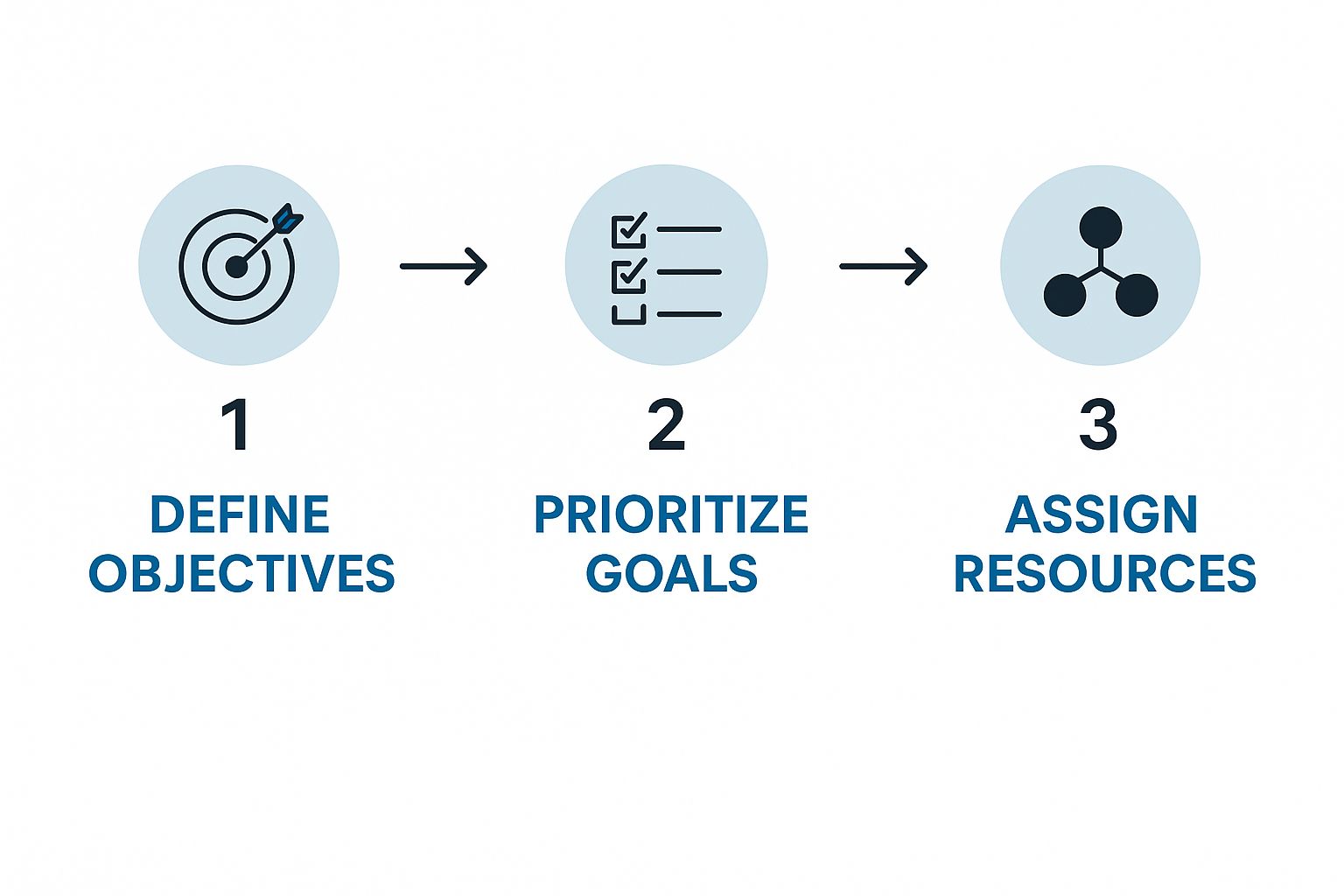
The image underscores a fundamental truth: defining and prioritizing goals is only half the battle. The most crucial step is committing the human and financial capital required to achieve them. Without this commitment, the preceding steps are academic exercises.
A detailed implementation plan, backed by continuous performance tracking, is what bridges the gap between ambition and results. It replaces hope with a system of accountability.
A simple table can be a powerful tool for mapping out who is responsible for what, and by when.
Strategic Goal Implementation Framework Example
| Strategic Goal | Key Initiative | Owner | Primary KPI | Timeline |
|---|---|---|---|---|
| Grow Small Business Lending Portfolio by 10% | Launch New SBA Loan Product | Head of Commercial Lending | $5M in New SBA Originations | Q1 Launch, End of Q4 Goal |
| Grow Small Business Lending Portfolio by 10% | Hire & Train 2 SMB Lenders | HR / Head of Lending | 2 Hires Completed & Trained | End of Q2 |
| Grow Small Business Lending Portfolio by 10% | Targeted Digital Marketing Campaign | Marketing Director | 200 Qualified Leads/Month | Q2-Q4 |
| Enhance Digital Customer Experience | Roll Out New Mobile Banking App | Chief Digital Officer | 75% Active User Adoption | End of Q3 |
This structure eliminates ambiguity. Every stakeholder understands their role and the definition of success.
The Central Role of Data in Execution
Your blueprint cannot be static; it requires a constant feed of performance data to remain relevant and on track. This is where modern data intelligence platforms are indispensable. As a leader, you need a near-real-time dashboard, not a static quarterly report, to monitor how initiatives are tracking against KPIs.
Imagine your small business lending initiative is three months underway, but new loan origination is only at 20% of its target. A platform like Visbanking allows for immediate, granular investigation. Is the shortfall due to marketing outreach? Are applications stalling in underwriting? Are loan officers inadequately trained on the new product?
This capability enables precise, surgical interventions rather than broad, reactive course corrections. It empowers your team to make informed adjustments, ensuring minor obstacles do not become strategic failures. This continuous feedback loop is one of the most vital strategic planning process steps you can implement.
Establishing a Cadence for Measurement and Adaptation

A strategic plan that is not actively monitored is a wasted investment. The final phase of the planning process is not an endpoint; it is the start of a continuous, disciplined feedback loop where strategy confronts market reality.
This is where leading banks create significant distance from their competitors. They institutionalize a rigorous cadence for measurement and adaptation—typically through quarterly strategic reviews where leadership candidly assesses performance against KPIs. The objective is not punitive; it is to learn and adjust with speed and precision.
From Diagnosis to Action
Consider a practical scenario. Your bank launches a major digital onboarding initiative with the goal of acquiring 1,000 new DDA accounts in six months. At the end of Q2, you have only achieved 450.
The traditional response—allocating more marketing funds and hoping for a different outcome—is a recipe for failure.
A data-driven leadership team uses this performance gap as a diagnostic opportunity. A robust analytics platform enables you to ask the right questions:
- Is this a marketing problem? Are our ads reaching the target audience but failing to convert clicks to applications?
- Is it a technology problem? What is our application abandonment rate? Is there a specific step in the workflow causing excessive friction?
- Is it a product-market fit problem? Are the account features misaligned with the needs of our target market?
Imagine your data reveals a 70% applicant drop-off at the identity verification stage. The problem is no longer a vague "we missed our goal." It becomes a specific, actionable directive: "We must immediately address the friction in our ID verification workflow."
The purpose of this phase is to build a culture where the strategic plan is continuously sharpened by real-world performance data. It is about making pivots based on fresh intelligence, not outdated assumptions.
Making the Plan a Living Document
Examine any framework for strategic planning process steps, and you will find it culminates in this critical phase of measurement and adjustment. The reason is clear: studies show that 70-80% of organizations that follow a structured review process report superior execution and alignment. In today's market, the ability to adapt is a prerequisite for survival.
This is where a tool like Visbanking becomes a strategic command center, providing the near-real-time data required to keep the plan on course and relevant.
The Power of an Agile Feedback Loop
By integrating performance data directly into your strategic reviews, you empower your executive team to make intelligent course corrections. Instead of discovering an initiative has failed at year-end, you can identify and rectify the problem within a single quarter.
This agility is a significant competitive advantage. It ensures that capital and human resources are dynamically allocated to the initiatives with the highest probability of success, accelerating your path to achieving long-term objectives.
Answering Your Strategic Planning Questions
Even the most robust strategic plans will face tough questions from the board and the leadership team. This scrutiny is not a sign of weakness; it is a hallmark of an engaged and accountable organization.
Here are common questions from bank executives, with answers that demonstrate how data transforms strategy from an exercise in forecasting to a data-driven discipline.
What Is the Ideal Frequency for Strategic Planning?
The five-year strategic plan is obsolete. Market velocity has rendered such long-term, static documents ineffective. Your strategic plan must be a living document.
The optimal cadence is a disciplined annual refresh complemented by quarterly performance reviews.
The annual refresh is a comprehensive deep dive. This is when you re-evaluate your environmental scan, re-benchmark against peers using the latest data, and rigorously challenge your core assumptions. It is the time to make major adjustments to your one- to three-year goals based on new intelligence.
Quarterly reviews are tactical sessions focused on execution. The purpose is to measure progress against KPIs and make agile course corrections. For example, if a new loan product is missing its Q1 origination target by 30%, you don't wait until year-end. You use the quarterly meeting to diagnose the issue—weak lead sources, underwriting friction, poor market response—and redeploy resources immediately.
The Board vs. Management: Who Does What?
Clarifying roles is essential for effective governance and accountability. The roles are distinct but symbiotic.
- The Board's Role (The 'What' and 'Why'): The board sets the strategic destination. As fiduciaries, they are the guardians of the bank's long-term vision. Their function is to approve the strategic direction, challenge management's assumptions, and ensure the plan aligns with shareholder interests and the institution's defined risk appetite.
- Management's Role (The 'How'): The executive team is responsible for building and executing the plan. They perform the detailed analysis, formulate the goals, create the implementation roadmap, and are directly accountable for achieving the KPIs.
How Do We Keep the Plan Relevant in a Volatile Market?
A strategic plan becomes irrelevant when it is based on static assumptions. Relevance is a function of agility, and agility is impossible without a continuous flow of high-quality data. You must institutionalize a feedback loop that is constantly fed with real-time intelligence.
Your plan's resilience isn't determined when you write it; it's proven by how quickly you can adapt it. This means institutionalizing a process where fresh data—on peer performance, market shifts, or internal execution—forces a re-evaluation of your strategy.
This is precisely why a dynamic intelligence tool like Visbanking is no longer a luxury but a necessity. It allows you to continuously stress-test your strategy against what is happening in the market now. For a more detailed examination of building this adaptability, our guide on banking strategic planning provides actionable frameworks.
Your ability to answer these critical questions with confidence comes down to the quality of your data. To benchmark your performance, identify your next growth opportunity, and execute your strategy with precision, see how Visbanking provides the clarity your leadership team requires. Explore our data intelligence platform today.
Latest Articles
Brian's Banking Blog
Predictive Risk Management for Banks
Brian's Banking Blog
Business Registration Data Banks Can Actually Use
Brian's Banking Blog
How to Secure REST API with JWT for Banking
Brian's Banking Blog
Commercial Loan Analysis: A Bank Executive's Guide
Brian's Banking Blog
Understanding Statistical Significance in Banking
Brian's Banking Blog