
What Is Embedded Finance: A Strategic Guide for Bank Executives
Brian's Banking Blog
Embedded finance is not another industry buzzword; it is a fundamental redistribution of how financial services are delivered. It involves integrating banking capabilities—payments, lending, insurance—directly into non-financial digital platforms, making them a seamless, native part of the customer experience.
For bank executives, this represents a strategic imperative. The operational model is shifting from being a destination customers visit to becoming the invisible, indispensable engine that powers their commercial and personal activities. Understanding this shift is critical for future revenue growth and market relevance.
Beyond the Buzzword: A Definition for the Boardroom

Embedded finance is the contextual delivery of financial services at the precise point of need. Instead of a customer navigating to a bank's website to apply for a loan, a financing offer is presented directly within an e-commerce checkout or an accounting software platform.
This model transforms banking from a distinct, separate action into a frictionless service that accelerates the customer's primary objective. Done correctly, it unlocks new, low-cost distribution channels and provides unparalleled insight into customer behavior—data that traditional banking interactions fail to capture.
The Core Strategic Shift
At its heart, embedded finance demands a re-evaluation of the bank's role: moving from a primary service destination to a foundational, behind-the-scenes partner.
This shift materializes in three key areas:
- Contextual Problem-Solving: The focus moves from selling standalone products to solving immediate customer problems. For example, offering invoice financing directly within a small business's accounting software at the exact moment a cash flow gap is identified.
- Data-Driven Decisioning: The integration provides real-time access to operational and transactional data, enabling faster, more accurate risk assessments and predictive financial offers.
- Platform-Based Distribution: Services are distributed through third-party digital ecosystems, the core principle of the banking-as-a-platform model.
This is not a new sales channel. It is a redefinition of the bank's value proposition. The objective is to make financial services so integrated that they become an invisible, essential component of a customer's existing workflow.
The market scale validates the urgency. Valued at over USD 112.67 billion, the embedded finance market is projected to reach USD 1,217.37 billion in the coming years. This represents a massive transfer of value toward integrated financial models. For bank leaders, the critical task is to identify which platforms and partnerships align with their strategic objectives. A data intelligence platform like Visbanking provides the market and peer analysis required to identify high-potential opportunities and execute a data-backed strategy.
The Strategic Imperative for Banks to Engage
Remaining on the sidelines of embedded finance is not a neutral position; it is a decision that invites strategic risk. Ignoring this shift exposes an institution to disintermediation, commoditization, and the gradual erosion of its customer relationships.
The primary threat is disintermediation. When a technology company embeds financial services into its platform, it seizes ownership of the customer relationship. The bank, if involved at all, is relegated to the background, providing its balance sheet and charter while the partner captures customer loyalty and high-value data.
This leads directly to commoditization. When a bank becomes the invisible "plumbing" for a partner's user experience, its products—loans, accounts, payments—become interchangeable commodities. Competition shifts solely to price, a battle that erodes margins and brand equity.
Shifting from Defense to Offense
While the risks of inaction are significant, the opportunities for proactive institutions are substantial. Embedded finance offers a powerful and capital-efficient growth strategy. By partnering with non-financial companies, banks can access large, established customer ecosystems at a fraction of traditional acquisition costs.
Consider the economics. A bank might spend $300 to $500 in marketing to acquire a single small business checking account. Through an embedded partnership with an accounting software platform, that same bank can onboard thousands of high-quality business customers at a dramatically lower cost per acquisition, with pre-validated operational data.
Engaging in embedded finance is about strategically placing your services at the point of need, transforming your institution from a destination into an essential, integrated utility. This shift is vital for capturing the next generation of revenue.
Market data confirms this is a U.S.-led transformation. North America commands a 38.75% revenue share of the global embedded finance market, driven by high digital adoption rates and a mature fintech ecosystem. You can review the complete market analysis to understand the drivers of this expansion.
Ultimately, the decision rests on strategy for distribution and data. The banks gaining an early advantage are generating new, high-margin fee income through Banking-as-a-Service (BaaS) models. More importantly, they are gaining unprecedented visibility into customer behaviors that occur far beyond their own digital walls. This is precisely where a tool like Visbanking becomes essential. It provides the capability to benchmark potential partners and analyze market data to identify the most profitable points of entry. Explore our platform to see how data intelligence can sharpen your embedded finance strategy.
Embedded Finance in Action with Tangible Examples
Theoretical benefits are irrelevant without measurable financial outcomes. For bank executives, the value of embedded finance is demonstrated through tangible results: new revenue, expanded market share, and profitable portfolio growth. The winning strategy is to stop thinking of banking as a place customers go to and start embedding it where they are.

Consider a retail scenario: a mid-sized e-commerce platform partners with a regional bank to offer a 'Buy Now, Pay Later' (BNPL) option at checkout. The impact is immediate. The retailer experiences a 20% increase in average order value and a 15% reduction in cart abandonment.
For the bank, this single partnership generates $500,000 in new, high-margin annual fee income. This business was acquired at a fraction of the cost of a traditional marketing campaign.
Moving Beyond Consumer Retail
The most significant opportunities, however, often lie in complex commercial verticals.
Imagine a B2B software platform providing project management tools to construction contractors. They partner with a bank to embed a project-based loan product directly into their software workflow. When a contractor initiates a new project valued at $250,000, the system automatically generates a pre-qualified financing offer to cover materials and labor.
This seamless integration achieves several key objectives:
- For the Contractor: The friction of a separate, time-consuming loan application process is eliminated. Projects can commence faster.
- For the Bank: This partnership creates a highly targeted channel for commercial lending, growing its construction loan portfolio by $15 million in the first year with significantly lower origination costs.
The core principle is solving a specific business problem at the precise moment it arises. The banking service becomes the solution, not a separate task. This contextual integration is what separates successful embedded finance plays from simple digital banking.
The Power of Data in Partnership
Both examples are powered by a critical asset: access to rich, real-time data that banks typically cannot see. The bank in the BNPL partnership gains a granular view of consumer spending habits. The bank working with contractors sees project cash flows and operational details, enabling smarter underwriting and proactive offers for adjacent products like equipment financing.
Some partners utilize white label payment gateway solutions to brand these financial services as their own, further solidifying customer loyalty. This is one of many fintech trends reshaping financial product distribution.
This is where data intelligence becomes non-negotiable. A platform like Visbanking gives executives the ability to analyze these market opportunities, vet potential partners, and model the financial impact before committing capital. It enables you to build a data-backed business case, moving beyond intuition to make decisions with clarity.
Navigating the Risks and Regulatory Landscape
While the opportunities in embedded finance are significant, the risks are equally substantial and demand board-level attention. Extending a bank's charter and balance sheet through a non-bank partner introduces a new class of third-party risk. This is not a standard vendor relationship; it is a deep, technical integration that exposes the bank to direct regulatory and reputational consequences.
The most acute risk is compliance. When a fintech partner handles customer onboarding, the bank remains 100% accountable for Know Your Customer (KYC) and Anti-Money Laundering (AML) obligations. A failure by the partner is a failure by the bank. Regulators offer no exemptions.
Fortifying Your Defenses
Standard due diligence is insufficient. A multi-layered defense system—rigorous, transparent, and continuously monitored—is required. Regulators are scrutinizing these partnerships with unprecedented intensity.
Key areas of focus must include:
- Robust API Security: APIs are the digital conduits between the bank and its partner. Any weakness presents a direct vector for data breaches and fraud. Stringent security protocols and real-time monitoring are non-negotiable.
- Clear Data Governance: A precise framework defining data ownership, control, and access must be established from the outset. Ambiguity in data governance is a primary source of compliance failures.
- Airtight Contracts: Agreements must explicitly detail all responsibilities, liabilities, data security protocols, and customer complaint resolution procedures. There can be no room for interpretation.
The central challenge is maintaining control and visibility when your banking services operate on a third-party platform. Your brand's reputation is inextricably linked to the actions and integrity of every partner.
The Banking-as-a-Service (BaaS) model has attracted significant regulatory scrutiny for these reasons. As you evaluate partnerships, it is critical to understand that BaaS has major risks. A proactive, data-informed risk management strategy is essential for navigating this landscape.
This is where superior data intelligence provides a decisive advantage. With a platform like Visbanking, you can benchmark a potential partner’s financial health and market performance against its peers before initiating discussions. Imagine verifying a fintech’s claimed $100 million in transaction volume by cross-referencing public data like UCC filings. This transforms due diligence from a procedural checklist into a data-driven investigation, ensuring you enter these complex partnerships with full clarity.
Leveraging Data Intelligence to Win
The sustainable competitive advantage in embedded finance is not derived from transaction fees alone, but from the proprietary data these partnerships generate. This integration provides banks with a real-time, ground-level view of customer spending, supply chain dynamics, and business cash flows—insights that are absent from standard financial statements. The test for leadership is the ability to convert this raw data into profitable action.
A modern data intelligence platform enables a bank to synthesize this new information with its existing core data. This unified view is where strategic opportunities are identified and risks are mitigated. It is the capability that separates market followers from market leaders.
From Reactive to Proactive Partnership
Consider a bank partnering with a leading payroll and HR software provider. The platform’s data reveals real-time wage flows, employee tenure, and corporate cash reserves—far more valuable than a static, quarterly financial statement.
By analyzing this data stream, the bank can transition from a reactive service provider to a proactive financial partner. It can identify specific, actionable opportunities based on verifiable financial health.
The objective is to leverage these embedded data streams to anticipate a customer's next financial need before they do. This foresight builds durable banking relationships and a formidable competitive moat.
For instance, by analyzing transaction data from a partner's platform, a bank can identify merchants with strong, consistent cash flow who are prime candidates for a pre-approved line of credit. A restaurant supplier processing $2.5 million annually through a partner’s system with stable monthly revenue becomes a top-tier, low-risk lending target—no cold call required.
Quantifying Opportunities with Integrated Data
The strategic value is fully realized when this new data is benchmarked against internal performance metrics and broader market trends. A platform like Visbanking is engineered for this purpose—to connect disparate datasets into a clear, decision-ready view. This allows executives not only to find opportunities but to quantify their financial impact.
Of course, capitalizing on these data opportunities requires mastery of the inherent risks. This visual outlines the core domains of concern.
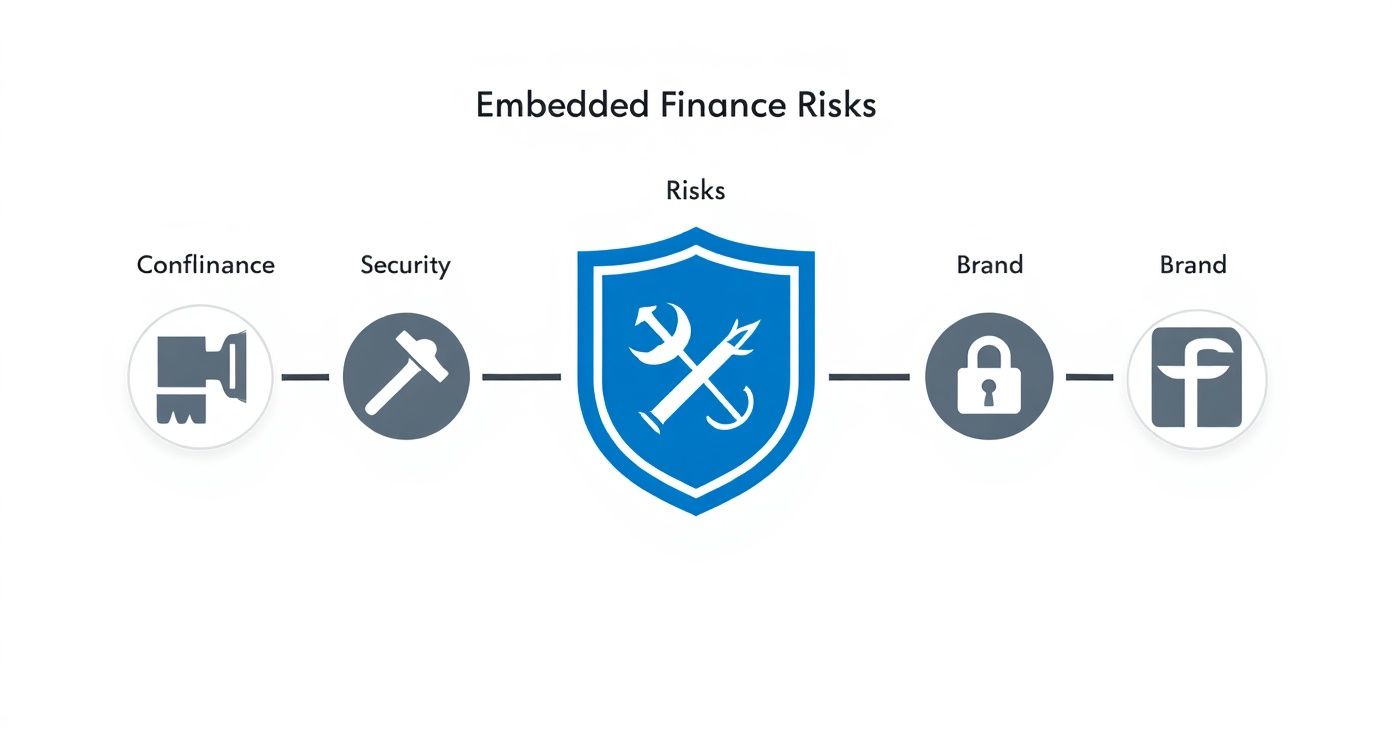
Managing compliance, security, and brand risk is fundamental. It ensures that data-driven partnerships are not only profitable but sustainable. By drawing a direct line from embedded insights to concrete banking actions, institutions can generate measurable financial results.
Connecting Embedded Data to Banking Actions
Translating data insights from embedded channels into specific, profitable banking actions.
| Data Insight (Source) | Resulting Banking Action | Potential Business Outcome |
|---|---|---|
| Consistent, high-volume B2B payments processed through a partner's invoicing software. | Proactive offer of a pre-approved $150,000 working capital line of credit. | Acquisition of a high-quality commercial loan with drastically reduced origination and marketing costs. |
| A trucking company's real-time fuel and maintenance spending spikes on their fleet cards. | Targeted offer for equipment financing or a specialized business loan for fleet upgrades. | Increased loan portfolio yield and a deeper, more tailored relationship with a commercial client. |
| A software company’s subscription revenue shows steady 15% month-over-month growth via an e-commerce partner. | Invitation to treasury management services to optimize cash flow and invest excess capital. | New non-interest income stream and solidified status as the company's primary financial institution. |
This data-first approach removes guesswork from business development. Instead of casting a wide net, your team can execute surgically targeted, pre-qualified offers that originate directly from your partner ecosystems. To win in embedded finance, you need more than partnerships; you need the intelligence to act decisively on the information they provide.
Explore how Visbanking's data intelligence system helps financial institutions benchmark performance and uncover these hidden growth opportunities.
Charting Your Embedded Finance Strategy
Executing an embedded finance strategy does not require a massive, multi-year technological overhaul. The most effective approach begins with a focused, intelligent pilot program. For bank executives, this means making deliberate, data-backed decisions that align with the institution's core competencies.
The starting point is a rigorous internal assessment. Where does your institution already excel? If your bank has deep expertise and a strong portfolio in small business lending, that is your initial vertical. If you lead in consumer payments, retail and e-commerce partnerships are the logical starting point. Strategy must be built upon existing strengths, not abstract market trends.
Building a Data-Backed Action Plan
Once promising verticals are identified, the critical next phase is vetting potential fintech and platform partners. This is where many strategies fail. A partner’s pitch deck is not a substitute for independent, hard data. You must analyze their financial health, market traction, and operational stability with the same rigor applied to your own loan portfolio.
For example, if a B2B SaaS platform targeting contractors claims $50 million in annual transaction volume, that claim must be verified through public records like UCC filings to construct an independent assessment of their financial position. To ensure success, effective system integrations are also critical for seamless data exchange and operational stability.
The most effective embedded finance strategies are not born from intuition. They are built on a foundation of verifiable data. Your first move should be to benchmark your capabilities and quantify market opportunities before committing serious capital.
This is precisely where a dedicated bank intelligence platform becomes indispensable. Instead of relying on generalized market reports, you can drill down into specific data to compare potential partners, analyze how peer banks are performing in similar ventures, and model the financial impact of a pilot program. It transforms strategic planning from a high-stakes bet into a calculated, data-driven decision.
A confident strategy requires clear insights. Visbanking provides the bank intelligence and action system that allows executives to benchmark opportunities, vet partners with precision, and move from concept to execution with a decisive, data-backed advantage. Explore how our platform can clarify your path forward at https://www.visbanking.com.
Related Articles

Visbanking Blog
Explore Banking Data: Financial Analysis with VISBANKING

Visbanking Blog
BIAS: The Power of Data and AI at Your Fingertips

Visbanking Blog
The Future of Financial Analytics: Solutions by VISBANKING

Visbanking Blog
Why Bank Financial Data Matters: Insights and Applications for Individuals and Businesses.

Visbanking Blog
Make More Informed Decisions with BIAS, the Data-Driven Banking Solution

Visbanking Blog