
A Guide to Mergers and Acquisitions in Banking
Brian's Banking Blog
In the banking sector, mergers and acquisitions are no longer a growth tactic—they are a core strategy for competitive positioning and survival. For any bank executive or director, a sophisticated M&A plan is essential to navigate an industry continuously reshaped by intense competition and evolving regulations.
The New Strategic Reality of Bank M&A
Standing still is not an option. As fintechs and non-bank lenders erode traditional revenue streams, M&A has become the definitive playbook for building scale, acquiring technology, and expanding market footprint. A proactive M&A strategy, grounded in robust data, is the most effective tool for protecting and enhancing shareholder value.
This guide moves beyond high-level theory to provide actionable insights for navigating this complex process. We will dissect the strategic drivers compelling banks to merge, the regulatory hurdles that must be cleared, and the data-driven due diligence that distinguishes a successful transaction from a cautionary tale.

Why M&A Is a Strategic Imperative
The rationale behind today's bank transactions is far more complex than simple asset aggregation. It is about constructing a stronger, more efficient, and more competitive institution.
The key drivers typically converge on several critical objectives:
- Achieving Critical Scale: A sufficient asset base is required to absorb escalating compliance costs and fund necessary technology investments. When a $2.5 billion bank acquires a $750 million institution, it can distribute its fixed costs over a significantly larger revenue base, driving material improvements to its efficiency ratio.
- Acquiring Technology and Talent: Buying is often more efficient than building. Acquiring a bank with a proven digital platform or a high-performing commercial lending team can accelerate a strategic roadmap by years.
- Market Expansion: A well-targeted acquisition provides immediate entry into a new high-growth market or solidifies a dominant position in an existing one.
Successful M&A is not just about getting bigger. It’s about getting better—more efficient, more competitive, and better positioned for the future. This demands a disciplined assessment of how a potential transaction aligns with long-term strategic goals.
The Role of Data Intelligence
Execution hinges on deep data intelligence. Intuition and historical assumptions are liabilities in M&A.
Before a deal is contemplated, critical questions must be answered with hard data. How does a target’s loan portfolio truly perform against its peers? How stable are its deposits in the current interest rate environment? These insights are not found in standard financial statements.
This is where platforms like Visbanking deliver a decisive advantage. By providing granular, benchmarked data, we enable executives to move from speculation to certainty. Analyzing trends across thousands of institutions allows you to identify targets that truly complement your strategy, model post-merger performance with precision, and present a data-backed case that is indisputable.
To inform your strategy, it is useful to study market activity. You can explore a comprehensive list of banks that merged to understand recent market dynamics.
Decoding What's Driving Modern Bank Mergers
A successful M&A transaction requires absolute clarity on the 'why.' A deal grounded in a clear, data-backed strategic purpose has a high probability of creating shareholder value. Transactions driven by reactive pressure or ill-defined objectives almost invariably fail.
Currently, several key drivers are consistently compelling banks and credit unions to pursue M&A. These are not abstract concepts; they are the tangible pressures and opportunities shaping the industry.
The Never-Ending Quest for Scale and Efficiency
In banking, size translates directly to enhanced profitability and balance sheet strength. Fixed costs—compliance, core processing, and general overhead—disproportionately burden smaller institutions.
A merger allows two banks to spread these fixed expenses across a larger asset and revenue base. This provides an immediate and direct improvement to the efficiency ratio, a primary metric of profitability.
Consider a community bank with $3.0 billion in assets operating at a 62% efficiency ratio. It acquires an $800 million bank in an adjacent market. By consolidating back-office operations, decommissioning a core system, and streamlining management, it is feasible to reduce the combined efficiency ratio to a more competitive 55%. This represents millions in annual cost savings.
This imperative for efficiency is a significant factor in the current M&A climate. Following a period of slower activity, confidence is returning. Nearly 130 deals closed globally with a total value of $16.3 billion, signaling that scale and efficiency are top priorities for bank executives. You can explore the resurgence in bank M&A trends and the outlook for 2025 for a deeper analysis.
Buying Your Way to Better Tech and Talent
Building a modern digital banking platform from scratch is a costly and time-consuming endeavor. The pace of technological change is unforgiving. For many banks, the most prudent strategy is to acquire, not build.
Acquiring a tech-forward bank or a fintech company is a strategic shortcut. It provides immediate access to a proven digital platform, a sophisticated mobile app, and—critically—the engineering and product talent required to maintain and enhance it. An acquisition can instantly upgrade a bank's technology stack, enabling it to capture a new generation of customers who demand a seamless digital experience.
Planting a Flag in New Markets
Organic expansion into a new geographic market, one branch at a time, is a slow and capital-intensive process. A strategic merger, by contrast, delivers an immediate and established footprint. It provides branches, a local customer base, and a team of lenders with deep market knowledge.
A successful geographic expansion is not merely about planting a flag. It is about acquiring market share, local expertise, and a loan portfolio that diversifies the institution's risk profile. The right data is essential to confirm that a target’s market position is as strong as it appears.
Imagine your bank intends to expand into a thriving metropolitan area. Acquiring a local institution with $1.5 billion in assets and a 15% deposit market share is exponentially more effective than starting de novo. This is where data intelligence platforms are non-negotiable. They allow you to analyze a target's deposit stability, the true composition of its loan book, and its competitive standing before an offer is even considered.
Dealing with Capital and Regulatory Headaches
In some cases, regulatory pressure is the primary catalyst for a merger. Ever-increasing capital requirements and the sheer complexity of compliance can constrain a smaller bank's ability to invest in growth.
Merging with a larger, well-capitalized institution resolves this challenge. The combined entity possesses the financial strength and the developed compliance infrastructure to manage regulatory demands effectively. It is simply better positioned to absorb regulatory costs, maintain capital ratios, and address examiner scrutiny.
These drivers are not mutually exclusive; the most compelling transactions often satisfy multiple strategic objectives. The key for any management team is to use hard data to translate these opportunities into financial projections. With a platform like Visbanking, you can benchmark potential targets against your specific goals, ensuring your M&A strategy is built on a foundation of fact, not ambition.
Navigating the Complex Regulatory Landscape
No aspect of bank M&A is more critical than regulatory approval. To view this process as a mere administrative step is a fundamental error. It is the strategic gatekeeper that determines a deal's viability.
A successful approach requires anticipation. You need a data-driven strategy that addresses regulatory concerns long before an application is filed.
The process is overseen by three agencies: the Federal Reserve, the FDIC, and the OCC. While each has its jurisdiction, their analysis is guided by three core tenets of the Bank Merger Act.
The Three Pillars of Regulatory Scrutiny
Regulators do not aim to block transactions arbitrarily. Their mandate is to ensure that consolidation does not introduce systemic risk or disadvantage communities. To that end, they evaluate every deal through three specific lenses:
- Financial Stability: Will the combined institution be sound? Regulators will scrutinize capital adequacy, asset quality, and management expertise to ensure the new entity is resilient.
- Market Competition: Will the transaction substantially lessen competition in the local market? This is a data-intensive analysis. Regulators use the Herfindahl-Hirschman Index (HHI) to measure market concentration. A deal causing a significant increase in the HHI will invite intense scrutiny.
- Community Needs: Does the merger serve the public interest? This is where the Community Reinvestment Act (CRA) is paramount. Regulators will examine your track record of lending throughout your community, particularly in low- and moderate-income (LMI) neighborhoods.
Regulators are zeroing in on the real-world benefits a merger brings to the public. A solid CRA rating isn't just a compliance task anymore; it’s a critical piece of your M&A story, and you better have the data to back it up.
A Real-World Look at Regulatory Analysis
Consider this scenario: a $10 billion bank plans to acquire a $2.5 billion competitor in an adjacent metro area. The strategic logic—scale, efficiency, market entry—is clear. But the deal’s success hinges on the data.
Using a platform like Visbanking, the acquiring bank can model the post-merger market concentration. The analysis reveals the combined bank's deposit market share would increase the HHI by 250 points in one key county, pushing the market into the "highly concentrated" category—a significant red flag.
Simultaneously, an analysis of the target bank's CRA data reveals underperformance in mortgage lending to LMI borrowers relative to its peers. The acquiring bank, which has a strong CRA rating, now faces a strategic choice.
Rather than ignoring these issues, the acquirer uses this data to build a more compelling application. It can proactively commit to increasing LMI lending in the new market by $100 million over three years. It can also pledge to maintain all branches in LMI areas.
By presenting a plan that directly mitigates competition concerns and demonstrates a clear public benefit, the bank fundamentally strengthens its application. This proactive, data-informed approach is far superior to reacting to regulatory inquiries after the fact. As agencies continually refine their standards, staying informed is critical. You can review our analysis of the latest FDIC draft guidance for bank merger scrutiny to understand evolving expectations.
Ultimately, navigating the regulatory process is a data-driven exercise. The banks that succeed are those that use intelligence to see themselves clearly, model a deal's true impact, and build an irrefutable case for why their merger strengthens both the financial system and the communities it serves.
Executing a Data-Driven Due Diligence Playbook
Due diligence is not a checklist; it is an intelligence operation. The distinction between a value-accretive merger and a balance-sheet-destroying mistake is determined here, in the forensic examination of a target institution.
Too often, transactions are derailed by what was not uncovered—the hidden credit risks in a loan book, the antiquated core systems that resist integration, or a fundamentally incompatible corporate culture.
A modern due diligence playbook must penetrate far beyond surface-level financials. It requires the use of granular data to stress-test every assumption and ensure the narrative aligns with the reality buried in the numbers. This battle is fought on three critical fronts.
Financial Health and Asset Quality Assessment
The core of any diligence process is dissecting the target's financial health, with a primary focus on its loan portfolio. This is where the greatest risks in bank M&A reside. A cursory review of the reported non-performing loan (NPL) ratio is insufficient.
Effective diligence demands slicing the portfolio by every relevant dimension—loan type, geography, and even by the originating loan officer.
For example, a target may report a healthy commercial real estate (CRE) delinquency rate of 0.75%. A data-driven analysis, however, might reveal that 90% of these non-performing loans are concentrated in downtown office properties in a single metropolitan statistical area, all originated by two lenders. This represents a significant risk concentration that a standard report would completely obscure.
Due diligence is about finding the story behind the numbers. A low delinquency rate means nothing if it’s masking a ticking time bomb in one corner of the portfolio.
Achieving this level of detail is non-negotiable. For a review of the fundamentals, our guide on how to analyze financial statements covers the foundational techniques that fuel this kind of M&A scrutiny. Using a platform like Visbanking provides the capability to benchmark these granular trends against peer institutions, transforming raw data into a clear risk profile.
Operational and Cultural Compatibility
While financial risks command attention, it is often operational and cultural friction that silently erodes a merger's value post-close. The diligence in these areas must be equally rigorous.
- Operational Compatibility: This involves a deep dive into the target's core systems, digital banking platforms, and compliance frameworks. A common error is drastically underestimating the cost and complexity of technology integration. You might discover the target operates on a legacy core processing system requiring an unforeseen $5 million investment and an 18-month integration project—destroying projected cost savings.
- Cultural Alignment: This is frequently dismissed as a "soft" issue, but its impact is concrete. A culture clash leads to the attrition of top talent and a decline in productivity. Data can be used to analyze employee turnover, compensation structures, and decision-making authority. A bank with a top-down, centralized approval process will struggle to integrate with one that empowers its regional leadership, resulting in organizational chaos and the loss of key producers.
Once you have successfully navigated the diligence minefield, you face the high-level approval process with federal regulators, as the visual below shows.
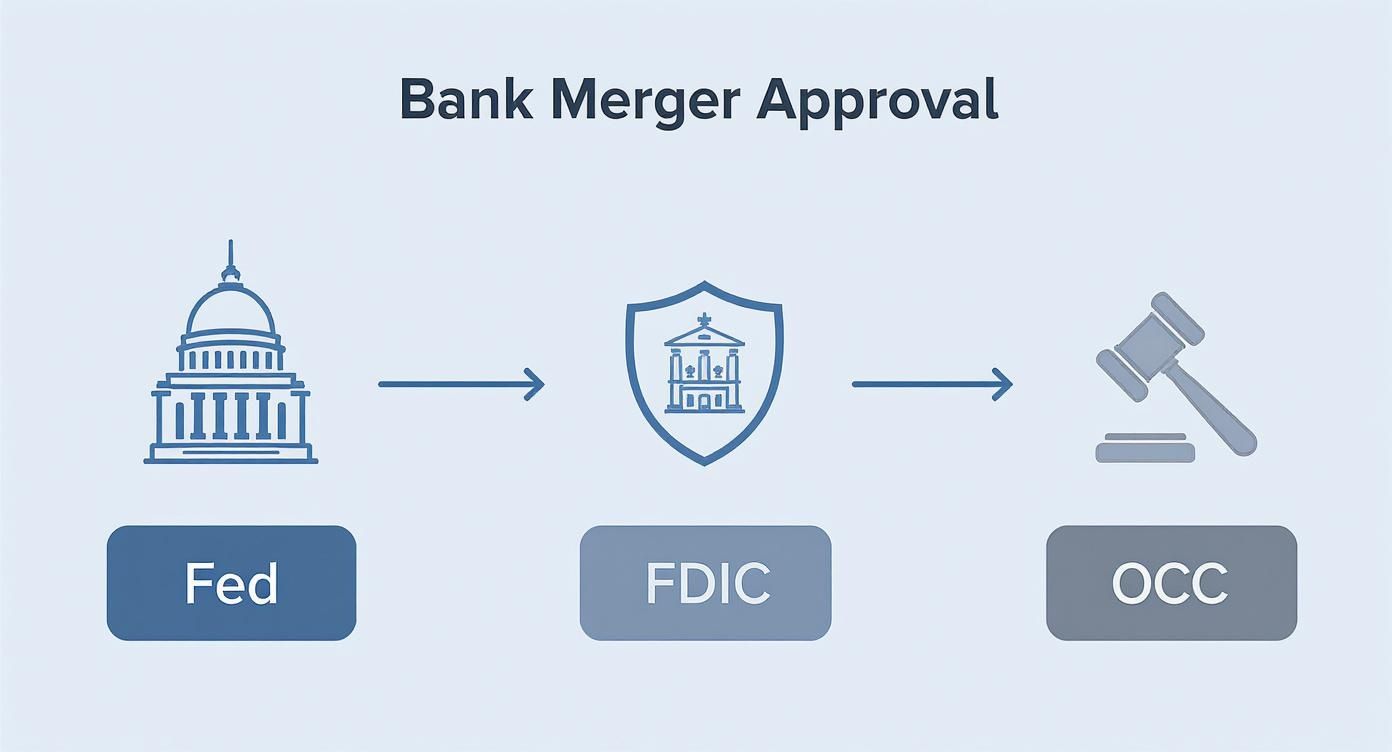
This gauntlet is precisely why a meticulous, data-backed diligence file is your ticket to getting the green light from regulators.
To frame this process, consider the specific metrics that require tracking. A robust data intelligence platform is your most valuable asset here, providing the context needed to interpret the target's performance.
Key Due Diligence Metrics for M&A Target Analysis
| Diligence Area | Key Metric | Why It Matters | Data Intelligence Application |
|---|---|---|---|
| Asset Quality | Non-Performing Loans (NPLs) by segment | Reveals where the true credit risk is hiding, not just the overall average. | Benchmark the target’s NPLs in CRE, C&I, and consumer loans against a custom peer group. |
| Loan Portfolio | Loan Concentrations (by industry/geography) | Exposes over-reliance on a single sector or region that could sour. | Map the target’s loan distribution against regional economic data to identify vulnerabilities. |
| Profitability | Net Interest Margin (NIM) | Indicates pricing power and the core earning potential of the franchise. | Compare the target’s NIM trends to peers with similar balance sheet structures. |
| Efficiency | Efficiency Ratio | Shows how well the bank controls its overhead relative to its revenue. | Analyze cost structure components (e.g., salary, occupancy) to pinpoint potential synergies. |
| Growth | Loan & Deposit Growth Rate | Measures market momentum and the ability to attract and retain customers. | Assess if growth is organic or driven by unsustainable pricing by comparing against the market. |
| Operational | Core System Provider | Determines the complexity, cost, and timeline for post-merger integration. | Identify other banks that have gone through a similar core conversion to model costs. |
| Human Capital | Employee Turnover Rate (esp. top producers) | A key indicator of cultural health and potential post-merger talent flight. | Benchmark compensation and turnover against similarly sized institutions in the same market. |
Ultimately, a data-driven due diligence playbook is your bank’s best defense against a catastrophic M&A mistake. It shifts the process from a reactive audit to a proactive, strategic assault. By using comprehensive data, you can validate the deal’s logic, price it right, and build an integration plan based on facts, not fantasy.
Mastering Post-Merger Integration and Execution
The transaction is signed and the press releases are issued. This may feel like the conclusion, but for the executive team responsible for delivering value, the work is just beginning.
The stark reality of banking M&A is that success is determined not by the dealmakers, but by the integrators. A flawed integration can destroy the very value the merger was intended to create.
The first 100 days are critical. This period sets the tone for the entire transition and requires a clear, decisive roadmap. Success depends on executing flawlessly across three interconnected pillars.

Pillar 1: Technology and Systems Integration
The integration of core banking platforms is the most formidable challenge in any bank merger. A poorly managed systems conversion is not merely an internal disruption; it can lead to catastrophic service failures, data loss, and rapid customer attrition. The objective is a seamless transition, but the path is fraught with operational risk.
This must be a data-first initiative. Before any technical work begins, detailed operational data must be used to map every critical process, from loan origination to transaction posting. A granular understanding of how both banks' systems operate is the only way to construct a migration plan that avoids disaster.
Pillar 2: Customer Communication and Retention
The moment a merger is announced, your customers become a primary target for competitors. Your only defense is a proactive, transparent, and persistent communication plan.
Silence is your greatest vulnerability. Customers need to hear from you early and often about what the merger means for them—changes to products, branch hours, or digital tools. A generic email blast is insufficient. A high-value commercial client requires a different message and a more personal approach than a retail checking customer. Data intelligence from a platform like Visbanking is a powerful tool here, enabling you to identify key customer segments and their product usage for targeted, effective outreach.
The most overlooked synergy in any merger is enhanced customer trust. Failing to communicate effectively doesn't just risk attrition; it forfeits the single greatest opportunity to strengthen relationships with your newly expanded customer base.
Pillar 3: Employee and Cultural Integration
Even with flawless technology integration and satisfied customers, the ultimate success of a merger depends on your people. Culture clashes are notorious for derailing mergers, often triggering an exodus of top talent at the most critical time. Integrating two distinct cultures requires deliberate, data-backed leadership.
Consider a real-world scenario: a $5 billion bank acquires a $1.5 billion competitor. Both have strong commercial lending teams, but their compensation structures are vastly different. Instead of imposing one system, the executive team uses performance data. They identify the top 20% of loan officers from both legacy banks based on portfolio quality and profitability—not just loan volume.
Using these insights, they construct a new, unified incentive plan based on the metrics that drive success for top performers. This data-driven approach accomplished two goals: it retained the best talent by rewarding proven results, and it established a merit-based culture from day one. As a result, the combined bank exceeded its projected cost synergy targets by 20% in the first year, largely because it avoided talent attrition and maintained loan production momentum.
As you manage post-merger integration, retaining key personnel is non-negotiable. It is wise to explore effective employee retention strategies to keep your team intact and maintain forward momentum.
Ultimately, a successful post-merger integration is about control, not chance. When you use deep data intelligence to guide decisions in technology, customer relations, and talent, you transform the chaotic art of integration into a disciplined science. To see how your bank’s performance metrics stack up before you dive into such a critical process, take a look at the benchmarking capabilities inside the Visbanking platform.
Measuring M&A Success with the Right KPIs
Closing the deal is the starting line, not the finish.
For any board of directors, the only question that matters is direct: Did this merger create value? Answering this requires a shift from a deal-making mindset to one of relentless accountability, measured by the right key performance indicators (KPIs).
Success is not defined by the size of the press release. It is defined by achieving the specific, data-backed objectives that justified the transaction. This requires tracking a balanced scorecard of financial and operational metrics from day one.
Essential Financial Scorecard
The performance of a post-merger bank is revealed in a handful of critical metrics. These are the KPIs that indicate whether promised synergies are materializing or if the integration is failing.
- Efficiency Ratio: This is the most direct measure of cost synergy realization. If the deal was predicated on operational consolidation, this ratio must decline. For instance, if your pro forma target was 55%, but six months post-close you are operating at 61%, it signals that cost controls are failing or synergies were overestimated.
- Return on Equity (ROE): Did the transaction enhance shareholder returns? A rising ROE indicates the combined entity is generating more profit from its equity base, validating the strategic rationale of the deal.
- Net Interest Margin (NIM): A stable or improving NIM demonstrates that the larger institution has maintained its core lending profitability and has not sacrificed credit quality for growth.
A successful M&A strategy isn't a single event; it's a continuous loop of analysis and action. The real discipline isn't in closing the deal, but in using data to prove you're delivering on the promises made to shareholders.
Beyond the Balance Sheet
Financial statements tell only part of the story. A bank's true value is also embedded in intangible assets like customer relationships and corporate culture. Ignoring these is a critical and costly error.
Two of the most important non-financial KPIs are customer attrition rates and employee engagement scores. A spike in customer departures—particularly high-value commercial accounts—will negate projected revenue synergies. Similarly, a decline in employee engagement and the loss of key personnel signal a culture clash that will undermine performance.
This is precisely where data intelligence provides a competitive edge. A platform like Visbanking allows you to benchmark your newly combined bank against a custom peer group in real-time. By continuously monitoring performance against these core KPIs, you can move beyond subjective assessments and objectively prove whether the merger is delivering on its promise.
Ready to see how your institution stacks up? Explore our data to benchmark performance and ensure your strategic moves are built on a foundation of fact.
A Few Common Bank M&A Questions
As a bank leader, you're always keeping an eye on the strategic horizon. Mergers and acquisitions can be a game-changer, but they're also loaded with risk. We get a lot of questions from executives trying to navigate this terrain—here are a few of the most common ones.
What's the Real Reason Most Bank Mergers Flop?
It is rarely the financial model. The single greatest cause of failure is poor post-merger integration.
A deal can appear perfect on paper, but if you cannot merge corporate cultures, retain top talent, and integrate disparate technology systems, the projected synergies will never materialize. The "soft" aspects of integration are invariably the most difficult to execute.
How Long Are We Stuck in Regulatory Limbo?
You should budget for six to twelve months for the regulatory approval process.
However, this is a baseline. A more complex transaction—such as a merger between two larger institutions or one that results in significant market concentration—will face deeper scrutiny from the Fed, FDIC, and OCC. This can easily extend the timeline beyond one year.
Can a Small Community Bank Actually Pull Off M&A?
Absolutely. For many community banks, M&A is not just an option—it is a strategic necessity.
Strategic acquisitions are one of the most effective ways to achieve the scale required to manage rising compliance burdens. It allows for rapid entry into new markets and can provide access to a modern digital banking platform far more quickly and cheaply than internal development. A well-executed acquisition can fundamentally transform the competitive position of a community bank.
A winning M&A strategy is not based on guesswork. It is a discipline built on superior data.
At Visbanking, we provide bank executives with the detailed, benchmarked intelligence needed to identify the right targets, execute rigorous due diligence, and measure success post-close. It is time to move from viewing dashboards to making decisive, data-driven moves.
Related Articles

Visbanking Blog
Bank Merger Mania: Winners, Losers, and Market Impact

Visbanking Blog
Banking Data Analytics: Turning Information Into Profit

Visbanking Blog
Revolutionize Your Banking Operations with Data-Driven Insights from BIAS

Visbanking Blog
BIAS: Your Competitive Edge in Banking Data Driven Strategy

Visbanking Blog
AI Banking Revolution: How Machine Learning Transforms Finance

Visbanking Blog