
A Banker's Strategic Guide to the Company DUNS Number Lookup
Brian's Banking Blog
Executing a company lookup by its DUNS number appears straightforward. The common method involves using the Dun & Bradstreet (D&B) online portal for a quick snapshot of basic company information.
For banking executives, however, this initial step is merely the entry point. A simple lookup is the key to unlocking a comprehensive, strategic view of commercial clients, transforming a routine data point into a decisive analytical advantage.
Why a DUNS Lookup is a Critical Tool for Banking Leadership
In modern banking, leveraging a DUNS number is more than an administrative task—it is a strategic imperative. It connects disparate information on commercial clients, creating a unified view that directly impacts risk assessment, client prospecting, and regulatory adherence.
Consider the DUNS number a universal identifier for a company's financial DNA. It links scattered data points, from UCC filings and payment histories to complex corporate family trees. For bank executives, mastering this process is about cutting through informational noise to mitigate risk and capitalize on opportunities with precision. This is the mechanism for converting fragmented data into actionable intelligence.
Turning a Data Point into a Go/No-Go Decision
Consider a practical application: a regional logistics firm applies for a $2.5 million commercial loan. The initial credit review appears immaculate.
However, a DUNS lookup, when integrated into a data intelligence platform like Visbanking, reveals a more complex reality. The firm is a subsidiary of a larger parent company—one with a documented history of delayed payments to its own key suppliers. This is a significant risk indicator. Armed with this insight, the underwriting team can restructure the loan with stricter covenants, insulating the bank from a potential loss.
The value is not merely in verification, but in context. The DUNS number serves as the central hub connecting critical information:
- Corporate Hierarchy: Who ultimately controls the entity? A DUNS lookup reveals parent companies, subsidiaries, and affiliates that could impact credit risk or present new cross-selling opportunities.
- Payment History: A review of their trade payment performance provides a clear indicator of operational discipline and financial health.
- Regulatory Standing: The system allows for cross-referencing against government watchlists and sanctions lists, strengthening AML/KYC protocols.
A single DUNS lookup can be the difference between averting a multi-million-dollar loss and uncovering a lucrative new relationship. It elevates the question from "Is this company legitimate?" to "What is the complete risk and opportunity profile of this entire corporate family?"
To gain a broader strategic advantage, understanding the key players in any target market is essential. For instance, an institution might be evaluating the top banking investors in the United Kingdom for potential partnerships. Platforms like Visbanking automate this data enrichment, connecting identifiers to deliver a complete institutional picture.
For a deeper understanding of the identifier itself, review our guide on what a DUNS number is and its critical role in banking.
Mastering DUNS Lookup Methods for Banking Operations
Not all DUNS lookup methods are created equal. A relationship manager's ad-hoc check on a prospect differs fundamentally from a data team's validation of an entire commercial loan portfolio. The key is to align the right tool with the strategic objective.
For a single verification, the Dun & Bradstreet web portal is a direct and effective solution. A loan officer can input a company's name and location to retrieve the nine-digit identifier, confirming the business's legitimacy. It is a fast, simple method for low-volume needs.
Scaling Intelligence with API Integration
When the requirement shifts to validating hundreds or thousands of entities, manual lookups become a significant operational bottleneck and a source of risk. This is the point at which API integration becomes indispensable.
By connecting core banking systems—such as a CRM or loan origination software (LOS)—directly to a DUNS database, the entire verification process can be automated.
Imagine a new $5,000,000 commercial loan application enters the LOS. An automated API call can instantly retrieve the applicant’s full company profile. This eliminates manual data entry and associated errors, equipping underwriters with clean, accurate data from the outset. The lookup evolves from a reactive task to a proactive, integrated workflow.
The critical question is not if a DUNS lookup should be performed, but how it is embedded into operations to drive efficiency and data integrity. A manual search solves a single problem; an integrated system builds institutional intelligence.
This is about converting raw data into a functional tool for making smarter banking decisions, and that process must be seamless.
As illustrated, a robust strategy to lookup company by DUNS number is what transforms a simple data point into a decisive business insight.
Choosing the Right Lookup Strategy
The appropriate method is dictated by the specific business scenario.
Common banking applications include:
- Quick Prospect Check: A relationship manager preparing for a client meeting can use the D&B website for an immediate identity verification.
- Portfolio Health Review: A credit risk team analyzing its $500,000,000 commercial portfolio should utilize a batch lookup—via file upload or API—to refresh and validate data for thousands of businesses simultaneously.
- Real-Time Loan Decisions: An LOS should have an API call integrated directly into its workflow. The moment an application is submitted, it is automatically enriched with DUNS data, eliminating delays.
This concept of integrated intelligence is the foundation of platforms like Visbanking. The objective is to evolve beyond static lookups toward a live feed of decision-ready analytics. For those assisting clients, understanding how to get a DUNS number is the first step.
The ultimate goal is to equip teams with the tools required to act with speed and confidence. An institution's proficiency to lookup company by DUNS number serves as a clear indicator of its data maturity.
Creating a 360-Degree Client View with Connected Data
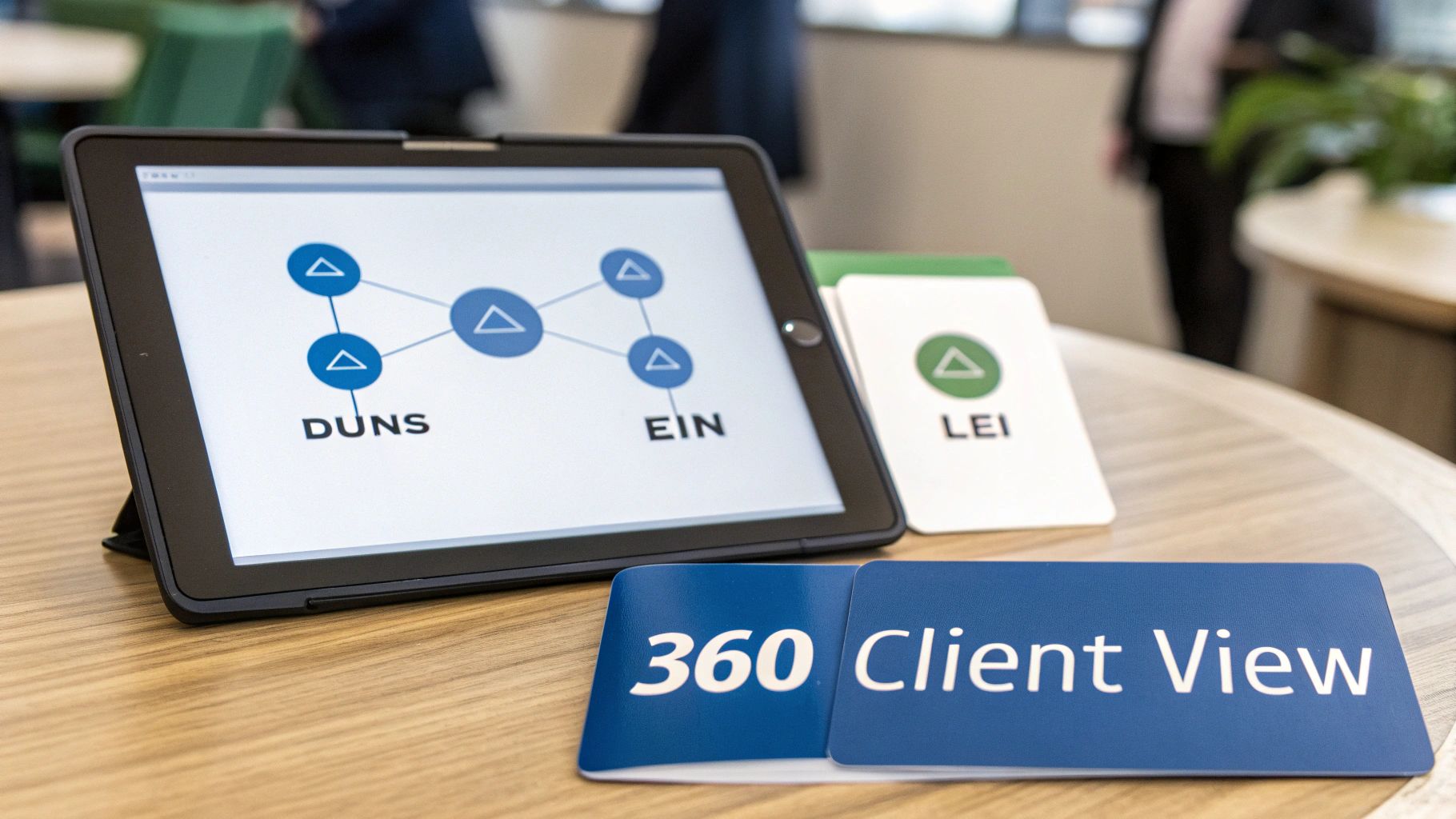
A DUNS number is a powerful identifier. However, its full value is realized only when connected to other critical business identifiers. This data triangulation forms the bedrock of modern risk management, robust KYC/AML programs, and intelligent client acquisition.
This is how an institution moves from a simple lookup to a complete, 360-degree view of any commercial entity. It is not about administrative compliance; it is about achieving a holistic understanding by linking a company’s DUNS to other key identifiers, each contributing to the complete narrative.
Key Identifiers for a Holistic View
For banking professionals, several identifiers are essential for constructing a comprehensive client profile:
Employer Identification Number (EIN): The IRS-issued identifier is fundamental. Mapping an EIN to a DUNS is the primary step in confirming the legal and tax-paying status of any U.S. business.
Legal Entity Identifier (LEI): For entities engaged in financial transactions, particularly securities or derivatives, the LEI is non-negotiable. Linking it to a DUNS provides a clean, auditable trail for regulators and clarifies identities within the global market.
FDIC/NCUA Numbers: Critical for correspondent banking or when assessing another financial institution. Tying their regulatory ID to a DUNS number delivers an instant snapshot of their charter, insurance status, and operational scale.
Cross-referencing these data points carries significant real-world implications.
From Data Points to Strategic Advantage
Consider this scenario: a mid-sized manufacturer with DUNS 01-234-5678 applies for a $10,000,000 line of credit. The initial DUNS lookup shows a solid payment history.
However, cross-referencing this DUNS through an integrated system reveals it is connected to multiple other entities sharing directors, all with recently issued LEIs but minimal operational history. Without connected data, this pattern is invisible. With it, the system has flagged a potential shell company structure designed to obscure risk.
The ability to triangulate these identifiers is what separates a standard credit check from true institutional due diligence. It exposes hidden risks, prevents fraud, and ensures a compliance framework built on verified, interconnected data.
Connecting these dots reveals the entire network—complex corporate family trees and relationships that would otherwise remain siloed in separate databases. By understanding the full context provided by Dun & Bradstreet data and its connections, your bank can make decisions with far greater certainty.
Key Business Identifier Cross-Reference for Banking
| Identifier | Primary Use in Banking | Issuing Authority | Relation to DUNS |
|---|---|---|---|
| EIN | Tax compliance, regulatory reporting, basic business verification (U.S.) | Internal Revenue Service (IRS) | Confirms the legal tax entity associated with the business. |
| LEI | Global financial transaction reporting, counterparty identification | Global Legal Entity Identifier Foundation (GLEIF) | Links the DUNS profile to its official role in global financial markets. |
| FDIC/NCUA | Assessing financial health and regulatory status of other institutions | FDIC / NCUA | Validates a bank's or credit union's charter and operational standing. |
This table illustrates why no single identifier is sufficient. True diligence requires a networked approach.
Platforms like Visbanking are designed to automate these connections, transforming a laborious manual research process into an instant, actionable insight. The objective is to move beyond isolated lookups and begin building a dynamic intelligence asset. The question must evolve from, "Who is this company?" to "What is this company's entire network, and what does it mean for my bank?"
Driving Revenue and Mitigating Risk with DUNS Data
Theory must translate to business impact. The ability to look up a company by its DUNS number is not an IT function—it is a core driver of profitability and a primary defense against unforeseen risk. This is where data transitions from a passive asset to an active strategy, impacting everything from loan portfolio health to sales pipeline efficiency. The key is to embed this intelligence directly into critical workflows.

Proactive Commercial Underwriting
In a practical example, a $2,500,000 commercial real estate (CRE) loan application from a regional construction firm appears solid. However, a DUNS lookup reveals a consistent pattern of late payments to three of their key material suppliers over the last 18 months.
This is not merely a data point; it is a clear indicator of potential cash flow distress. Armed with this insight, the underwriting team can adjust loan covenants or require additional collateral, converting a high-risk proposal into a defensible asset. This single lookup directly reduces the probability of default and protects the bank’s capital.
The objective is to anticipate risk, not react to it. DUNS-driven intelligence enables accurate risk pricing from the outset, rather than discovering a problem after the loan has been funded.
Accelerating High-Value Prospecting
In commercial banking, speed and accuracy are paramount. Relationship managers cannot afford to pursue unqualified leads. Using DUNS data for prospecting transforms the model from broad outreach to targeted engagement.
When a team identifies a promising mid-market manufacturer, a DUNS lookup provides a significant advantage before the first call:
- Identify Entry Points: It may reveal the prospect is a subsidiary of a larger national company with which the bank already has a relationship, providing an immediate warm introduction.
- Understand Their Business: Mapping their supplier network allows the team to craft a tailored pitch around supply chain financing or treasury management solutions.
- Target Decision-Makers: It verifies the C-suite and ownership structure, ensuring engagement is directed at individuals with authority.
This approach drives efficiency. Teams enter every conversation armed with relevant intelligence, shortening sales cycles and closing deals faster.
Fortifying Regulatory Compliance
Compliance is a critical risk-management function. Verifying corporate structures with a DUNS number is non-negotiable for meeting stringent beneficial ownership and AML/KYC regulations. A failure in this area can result in significant regulatory fines and reputational damage.
A DUNS lookup provides auditable, third-party verification of a business's identity and its network of connections. This is the mechanism for untangling complex ownership structures designed to obscure ultimate control, thereby strengthening the bank’s defenses against financial crime.
The D-U-N-S Number, established by Dun & Bradstreet in 1963, is the global standard. Today, lenders use these profiles to gauge financial stability, which can accelerate loan approvals by up to 30%. You can learn more about how Dun & Bradstreet has shaped modern business verification on their corporate blog.
Ultimately, mastering the lookup company by duns number workflow is about deploying intelligence where it has the greatest impact. The next step is to explore how platforms like Visbanking can help your institution turn these data points into decisive action.
From Data Points to Decisive Action
The ability to look up a company by its DUNS number is not a clerical task; it is the conversion of raw data into a decisive, profitable action. In a competitive market, the winning banks are those that can assess risk and seize opportunities with both speed and accuracy. This capability is the gateway to true market intelligence.
This directly impacts the bottom line. It is well-documented that 90% of Fortune 500 companies rely on this system for a clear view of their global supply chains and counterparty risks. For banks, this translates to 15-25% faster vendor onboarding and a lower incidence of defaults. As seen on how DUNS numbers speed up business operations on Ramp.com, when the full picture is available, loan processing operates more smoothly.
Beyond the Lookup: Gaining Strategic Foresight
The primary objective is to move beyond backward-looking reports. Institutions require integrated intelligence that delivers decision-ready analytics directly into team workflows. This is how a simple verification check becomes a tangible competitive advantage.
Consider a commercial loan committee reviewing a $15,000,000 credit facility. A standard lookup confirms the applicant's identity. However, a connected data platform reveals a deeper insight: the applicant’s primary supplier, identified by its own DUNS number, shows a declining payment score over the last two quarters.
The conversation immediately shifts from routine approval to a strategic discussion about supply chain vulnerability, risk-based pricing, and protecting the bank's position.
True data intelligence is not about more charts. It is about having the right information, at the moment of decision, to ask better questions and preempt risks before they materialize.
Putting Intelligence to Work Across the Bank
This capability should be leveraged across the entire institution, not confined to the credit department.
- For Business Development: Prospecting teams can pinpoint high-growth companies in specific NAICS codes that are expanding their corporate family—a clear signal of a need for new treasury services.
- For Compliance: AML officers can map beneficial ownership and uncover complex, hidden relationships that pose a regulatory risk.
- For Executive Strategy: Leadership gains a macro view, enabling analysis of market share by tracking the collective health of commercial clients in key industries. This informs strategic decisions on where to invest or pull back.
For leaders committed to building a data-driven strategy, the logical next step is to implement a platform that enables these outcomes. Visbanking is focused on transforming raw data into a clear competitive edge, providing teams the tools to benchmark performance and uncover new opportunities with confidence.
Core Questions for Banking Leadership
When discussing the integration of DUNS data with executives, a set of recurring, practical questions emerges. The focus is never on technology for its own sake, but on tangible results: Sharper decisions, increased efficiency, and institutional protection.
How Reliable Is the Data from a DUNS Number Lookup?
Dun & Bradstreet data is highly reliable, curated through a patented quality process that monitors firmographics and corporate family trees. It provides a solid foundation.
However, for a bank, optimal value is achieved by blending this data with other trusted sources, such as regulatory filings and payment performance data. Advanced data platforms excel here. They do not merely accept DUNS information at face value; they cross-validate it against multiple sources to provide a richer, contextualized view for critical functions like credit underwriting. A single data point is elevated to a verified, multi-dimensional insight.
Can We Integrate DUNS Lookups into Our Core Banking Software?
Yes, and it is essential for any bank focused on peak efficiency. Modern APIs are designed for this purpose, allowing for direct data integration into your CRM, loan origination system (LOS), or core platform. This is standard practice for institutions prioritizing speed and accuracy.
This automation enriches client profiles in real-time, reduces costly manual data entry errors, and embeds critical business intelligence directly into daily workflows. It makes the process to lookup a company by duns number a natural component of operations, not a cumbersome, separate task.
What is the Practical Difference Between a DUNS Number and an EIN?
This point of confusion is easily clarified by understanding their distinct purposes. An Employer Identification Number (EIN) is issued by the IRS for U.S. federal tax reporting. It is a compliance identifier.
A DUNS number is issued by Dun & Bradstreet for the marketplace. It is the global standard for commercial credit assessment, business identity verification, and supply chain risk analysis. One is for tax authorities; the other is for assessing commercial risk and opportunity.
For a bank, this distinction is critical. An EIN serves tax compliance. A DUNS number is the primary tool for understanding commercial creditworthiness, supply chain exposure, and global corporate linkages. An effective data strategy does not choose one over the other—it maps both identifiers to a single, unified view of a business entity.
At Visbanking, we transform these essential data points into a competitive edge. Our platform integrates fragmented information, enabling your bank to move from simple lookups to proactive, data-driven decisions. Explore our tools to see how you can benchmark performance, identify new opportunities, and act with greater confidence. Learn more at Visbanking.
Related Articles

Visbanking Blog
Why Bank Financial Data Matters: Insights and Applications for Individuals and Businesses.

Visbanking Blog
Revolutionizing Banking Analysis: Introducing the Bank Comparisons Tool on Visbanking Banking Report Portal

Visbanking Blog
Bank Comparison Tools: Find Your Perfect Financial Match

Visbanking Blog
Bank Branch Networks: Are Physical Locations Still Relevant?

Visbanking Blog
Banking Data Analytics: Turning Information Into Profit

Visbanking Blog