
List of Banks in Florida USA: An Executive's Guide to Market Intelligence
Brian's Banking Blog
For banking executives, a simple 'list of banks in Florida USA' is merely a starting point, not a destination. The real value lies in converting that raw data into strategic intelligence. Florida's dynamic market, characterized by significant wealth migration, a growing population, and diverse regional economies from Miami's international finance hub to Tampa's burgeoning tech scene, demands more than a surface-level competitor scan. It requires a granular understanding of market share, asset concentration, and performance benchmarks.
Knowing which banks are capturing deposit growth in high-net-worth enclaves like Palm Beach versus those expanding commercial lending in the Orlando corridor allows for precise strategic adjustments. For example, a bank that grew its deposits in Palm Beach County by $50 million last quarter is executing a different strategy from a competitor that expanded its commercial loan portfolio in Orange County by $75 million. This shift from data collection to active intelligence is a core component of modern financial strategy. For a deeper dive into how the financial sector as a whole is leveraging technology, explore the dynamics of digital transformation in financial services.
This analysis will not just list sources; it will deconstruct how to leverage them to identify threats, capitalize on opportunities, and drive data-backed decisions that enhance shareholder value. We will explore the critical data sources that, when analyzed correctly, provide the bedrock for effective strategy in the Sunshine State. Each source reviewed includes direct links and guidance to help you transform public data into a powerful competitive advantage.
1. FDIC BankFind Suite (Federal Deposit Insurance Corporation)
For any executive team seeking an authoritative, regulator-verified foundation for their market analysis, the FDIC BankFind Suite is the definitive starting point. Instead of relying on third-party aggregators, this free government portal provides direct access to the official database of all FDIC-insured institutions. It is the gold standard for creating a comprehensive list of banks in Florida, USA, because the data comes directly from the source.
The platform’s strength lies in its raw, unfiltered data. It is not a polished analytics tool but a powerful repository for foundational research. Executives can use its state-level filters to instantly generate a complete roster of every insured bank and credit union operating in Florida, from major national players to local community banks. This data serves as the baseline for any serious competitive analysis.
Core Capabilities and Strategic Use
While the interface is data-dense and functional rather than intuitive, its capabilities are essential for strategic planning:
- Institution Profiles: Retrieve detailed profiles on any Florida-based competitor, including their FDIC certificate number, official address, regulatory contacts, and complete merger and acquisition history.
- Market Share Data: Link directly to the Summary of Deposits (SOD) data to analyze deposit market share by county, metropolitan statistical area (MSA), or a custom-defined market. This is crucial for identifying expansion opportunities or defending your current footprint.
- Branch Network Analysis: Export complete lists of a competitor's branch locations in Florida to map their physical presence and identify service gaps.
Executive Insight: The FDIC BankFind Suite is your single source of truth for bank charter information. Before your team invests in advanced analytics or market research, ensure your foundational list of Florida competitors is validated against this official database.
The FDIC provides the raw data, but data intelligence tools are required to make it actionable. For instance, after using BankFind to identify all banks in the Miami-Dade MSA with assets between $500 million and $2 billion, a platform like Visbanking can benchmark their performance metrics—such as a 3.5% Net Interest Margin or a 12% loan growth rate—to identify true strategic threats or potential acquisition targets. Understanding the role of the FDIC is fundamental for banking leaders; you can learn more about U.S. banking regulatory agencies to deepen this knowledge.
Website: https://www.fdic.gov/resources/bankfindsuite/
2. FFIEC National Information Center – Search Institutions
Where the FDIC BankFind Suite focuses on insured depository institutions, the FFIEC National Information Center (NIC) provides a broader, structural view of the financial landscape. For executives needing to understand the corporate hierarchy and ownership structures behind a list of banks in Florida, USA, this is an indispensable, free-access federal resource. It aggregates data from the Federal Reserve, OCC, and FDIC to create a comprehensive picture of financial entities.
The NIC’s unique value lies in its ability to map the relationships between banks, their holding companies, and other affiliated entities. This is critical for competitive analysis, M&A due diligence, and compliance, as it reveals the ultimate controlling parties and the full scope of a competitor's operations. While its interface is technical and designed for regulatory users, the strategic insights it offers are unmatched for deep corporate discovery.
Core Capabilities and Strategic Use
While not a market analytics tool, the NIC is a powerful instrument for foundational research and structural verification. Its capabilities are essential for understanding the corporate architecture of the Florida banking market:
- Corporate Hierarchy Mapping: Easily trace a Florida community bank back to its parent bank holding company (BHC), including multi-tiered ownership structures. This helps identify the ultimate decision-makers and financial backers of a competitor.
- Comprehensive Entity Search: Use state filters to list not just banks but also active bank holding companies and U.S. branches of foreign banks operating in Florida. Each entity has a unique profile with identifiers like the RSSD ID and LEI.
- Historical and Structural Data: Access detailed histories of institutions, including formation dates, mergers, and status changes. This is vital for tracking market consolidation and understanding a competitor’s legacy.
Executive Insight: Use the FFIEC NIC to vet the corporate structure of potential acquisition targets or strategic partners in Florida. Understanding an institution’s full holding company structure can uncover hidden complexities or synergies that are not apparent from a simple bank-level analysis.
For example, your team could use the NIC to identify all BHCs headquartered in Florida with consolidated assets over $10 billion. After identifying the subsidiary banks under each BHC, a data intelligence platform allows a side-by-side performance comparison of those banks. This reveals how a BHC's capital allocation strategy impacts a subsidiary's ROAA—one might show a 1.2% ROAA focused on commercial lending while another has a 0.85% ROAA driven by mortgage banking. This uncovers the true strategic priorities of your competition.
Website: https://www.ffiec.gov/npw
3. Florida Office of Financial Regulation (OFR) – REAL Portal (Verify a License)
While federal databases like the FDIC’s provide a national overview, executive teams focused on the Florida market must also consult the state-level regulator. The Florida Office of Financial Regulation (OFR) and its REAL portal offer the definitive source for verifying the charter and regulatory standing of all state-chartered institutions. This free tool is essential for due diligence and creating a nuanced list of banks in Florida, USA, that distinguishes between federal and state supervision.
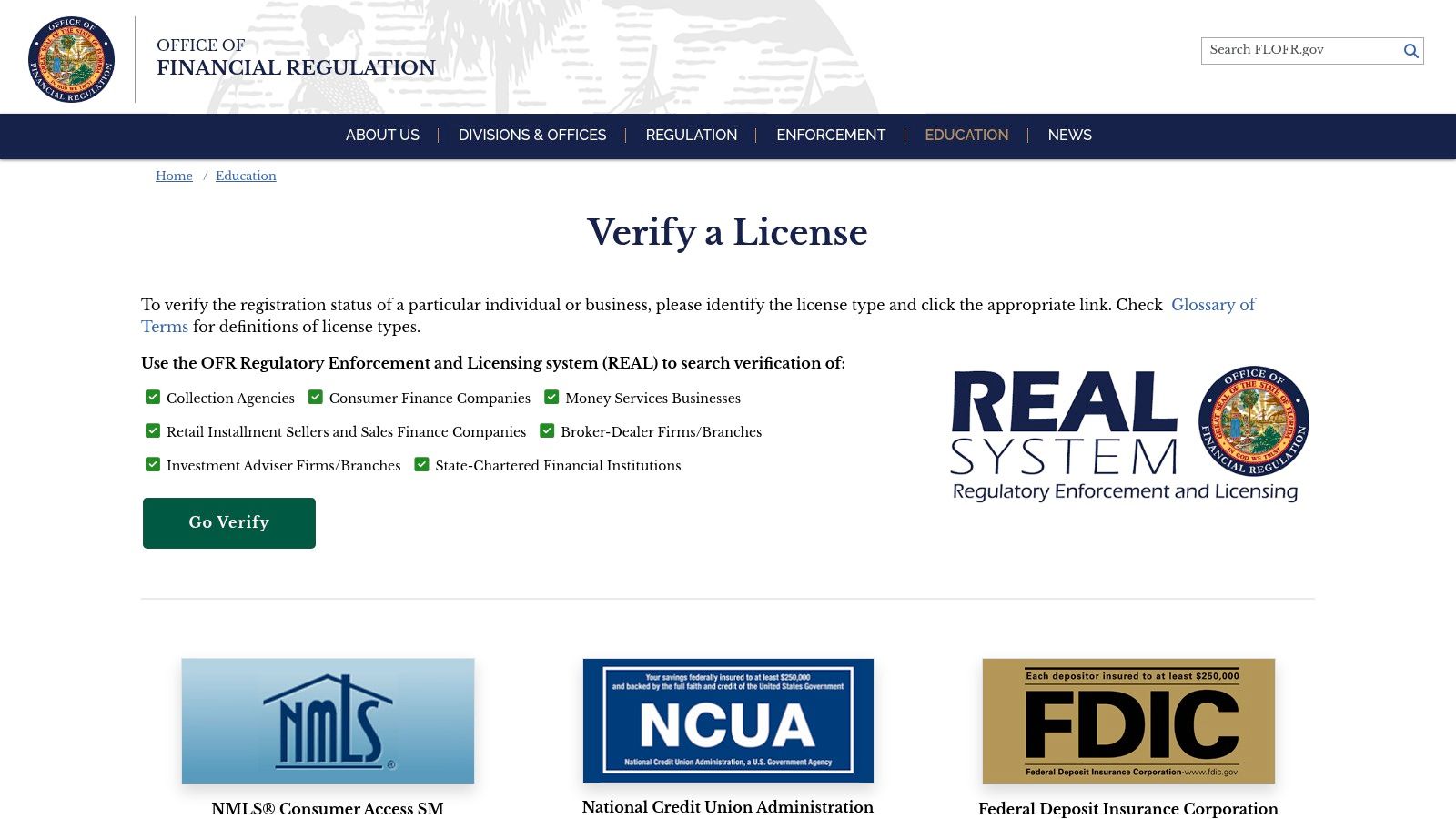
The OFR's portal complements federal tools by providing a lens specifically on entities operating under Florida state law. While its primary function is license verification rather than bulk data export, it is invaluable for confirming the status of a specific local competitor, potential partner, or acquisition target. Understanding an institution's charter type is a critical first step in competitive strategy, as it influences its regulatory obligations and operational scope.
Core Capabilities and Strategic Use
The portal’s interface is a straightforward lookup tool, designed for verification, not broad market analysis. However, its targeted data is crucial for specific strategic initiatives:
- Charter Verification: Instantly confirm whether a Florida bank is state-chartered, providing clarity on its primary regulator and the specific state-level rules it must follow.
- Regulatory Standing: Check the active status of any supervised entity’s license, ensuring you are dealing with a compliant and currently regulated institution.
- Florida-Specific Details: Access official addresses and contact information for state-chartered entities, directly from the supervising authority.
Executive Insight: Before engaging in a potential partnership or M&A discussion with a Florida-based community bank, use the OFR portal to verify its state charter and good standing. This simple check is a fundamental step in risk assessment and due diligence.
The OFR portal provides foundational charter data, but it doesn't offer performance metrics. After using the portal to confirm that a regional competitor in the Orlando MSA is state-chartered, the next strategic step is to analyze its financial health. A data intelligence tool like Visbanking is necessary to benchmark that bank’s loan portfolio composition (e.g., 60% CRE, 20% C&I) and profitability (e.g., 55% efficiency ratio) against other state and federally chartered peers in the same market, revealing its competitive vulnerabilities.
4. OCC Financial Institution Lists and Search (Office of the Comptroller of the Currency)
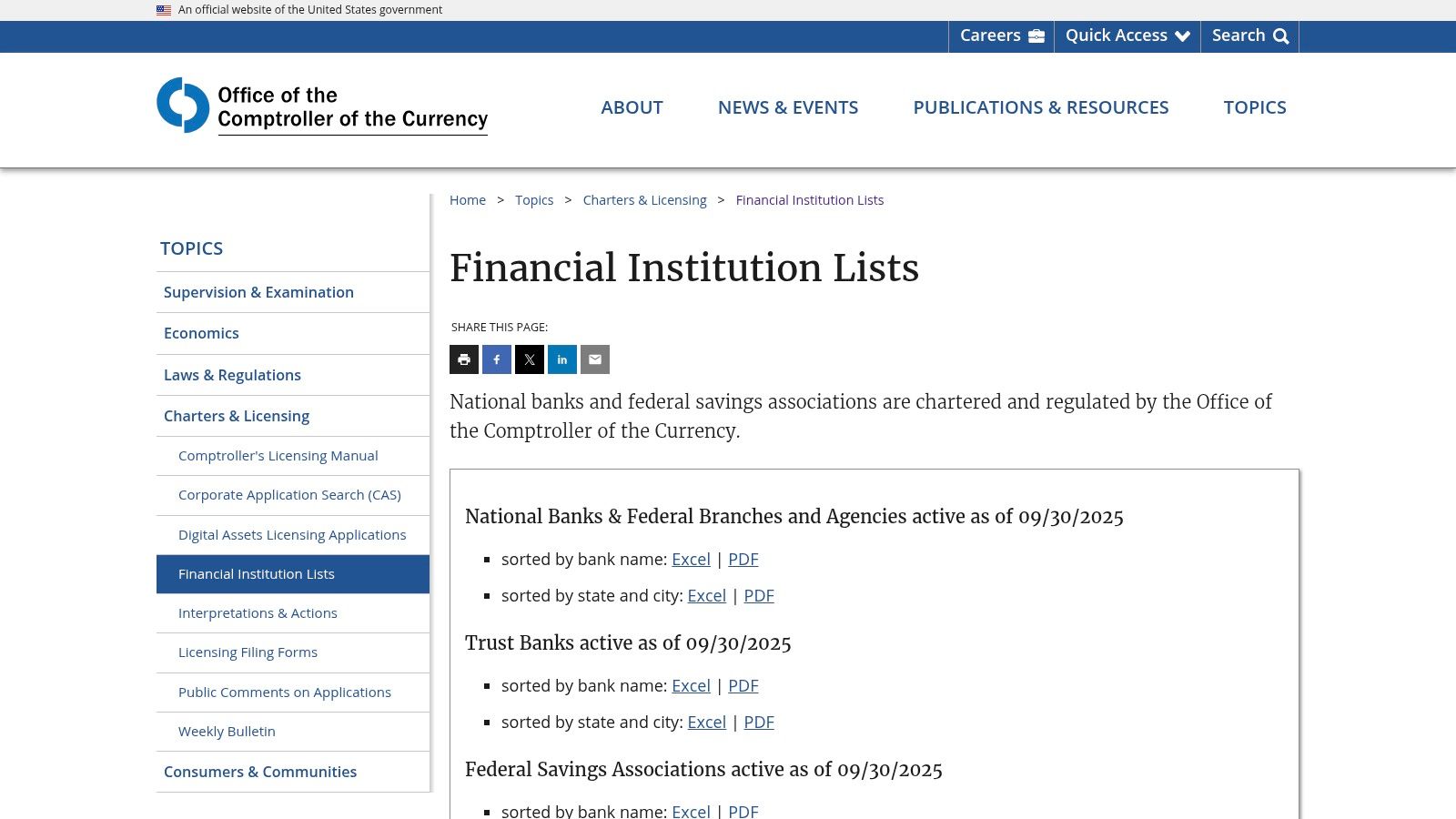
For executive teams needing to specifically segment and analyze federally regulated competitors, the Office of the Comptroller of the Currency (OCC) provides an indispensable resource. While the FDIC database is comprehensive, the OCC's Financial Institution Lists portal offers a focused, downloadable roster of national banks and federal savings associations. This allows for a targeted analysis when creating a list of banks in Florida, USA, focusing solely on institutions under federal charter.
The platform’s value lies in its directness and specificity. Instead of a complex search interface, it provides raw, downloadable Excel and PDF files that can be quickly filtered to isolate all OCC-regulated institutions operating in Florida. This is particularly useful for compliance, risk, and M&A teams who need to understand the competitive landscape as defined by regulatory oversight.
Core Capabilities and Strategic Use
The OCC's portal is a streamlined data source, not a discovery tool. Its primary function is to provide clean lists for offline analysis, enabling targeted strategic activities:
- Federally Chartered Rosters: Download the "Active Institutions" list and instantly filter by "State" and "City" columns to produce a definitive list of all national banks and federal thrifts with operations in Florida.
- Corporate Actions Tracking: Use related searches to monitor recent corporate actions, such as charter applications, mergers, or conversions, involving federally chartered Florida competitors. This provides early indicators of strategic shifts in the market.
- Regulatory Scope Definition: The site offers clear guidance on which institutions fall under OCC jurisdiction versus state regulators or the FDIC. This is critical for ensuring accurate regulatory and compliance mapping.
Executive Insight: Use the OCC’s lists to build a precise peer group of federally chartered Florida competitors. This segmentation is crucial for nuanced competitive benchmarking, especially when assessing institutions that operate under a different regulatory framework than your own.
Obtaining the raw list from the OCC is the foundational first step. The strategic advantage comes from enriching this data. After isolating all national banks in the Tampa-St. Petersburg MSA from the OCC's Excel file, a strategic team must perform a deep-dive analysis. A platform like Visbanking enables benchmarking their loan portfolios, assessing deposit composition (e.g., comparing a 45% non-interest-bearing deposit mix to a peer's 30%), and evaluating their capital adequacy to identify strategic vulnerabilities within that federally regulated peer group.
5. Florida Bankers Association (FBA) – Member Directory
For strategic teams looking beyond raw regulatory data, the Florida Bankers Association (FBA) Member Directory offers a qualitative layer of market intelligence. While the FDIC provides a comprehensive list, the FBA directory reveals which institutions are actively engaged in the state's banking community. This curated resource is invaluable for understanding the competitive landscape from a local industry perspective, complementing the foundational list of banks in Florida, USA.
The directory’s value lies in its context. It is not just a list; it is a roster of banks committed to the Florida market, indicated by their association membership. For executives gauging regional influence or seeking partnership opportunities, knowing which banks are active FBA members can be a key indicator of their local commitment and networking presence. The platform is a free and accessible tool for initial reconnaissance.
Core Capabilities and Strategic Use
While simpler than regulatory databases, the FBA directory provides unique strategic angles for market analysis and business development:
- Targeted Networking: Identify key contacts and headquarters locations for banks actively involved in Florida’s banking advocacy and professional development circles. This is essential for building regional alliances.
- Competitive Landscaping: Quickly generate a list of peer institutions that prioritize local industry engagement. This can help segment competitors based on their community involvement, not just their asset size.
- Geographic Search: The directory allows sorting by city, making it easy to identify key players in specific local markets like Tampa, Orlando, or Jacksonville for targeted outreach or competitive analysis.
Executive Insight: Use the FBA Member Directory to add a qualitative dimension to your quantitative analysis. A bank’s membership signals its investment in the local market, making this directory a powerful tool for identifying deeply-rooted competitors or potential partners who are “on the ground” in Florida.
The FBA directory helps you identify the players, but it does not provide the performance data needed for a full strategic assessment. For example, after identifying a list of community banks in Central Florida from the FBA site, an executive would use a platform like Visbanking to benchmark their financial health. Comparing key metrics—such as a 4.5% year-over-year loan growth rate versus a peer's 8.2%—turns a simple member list into a strategically prioritized roster of institutions to watch, partner with, or compete against.
Website: https://web.floridabankers.com/Bank-Member
6. BankBranchLocator – Florida Banks
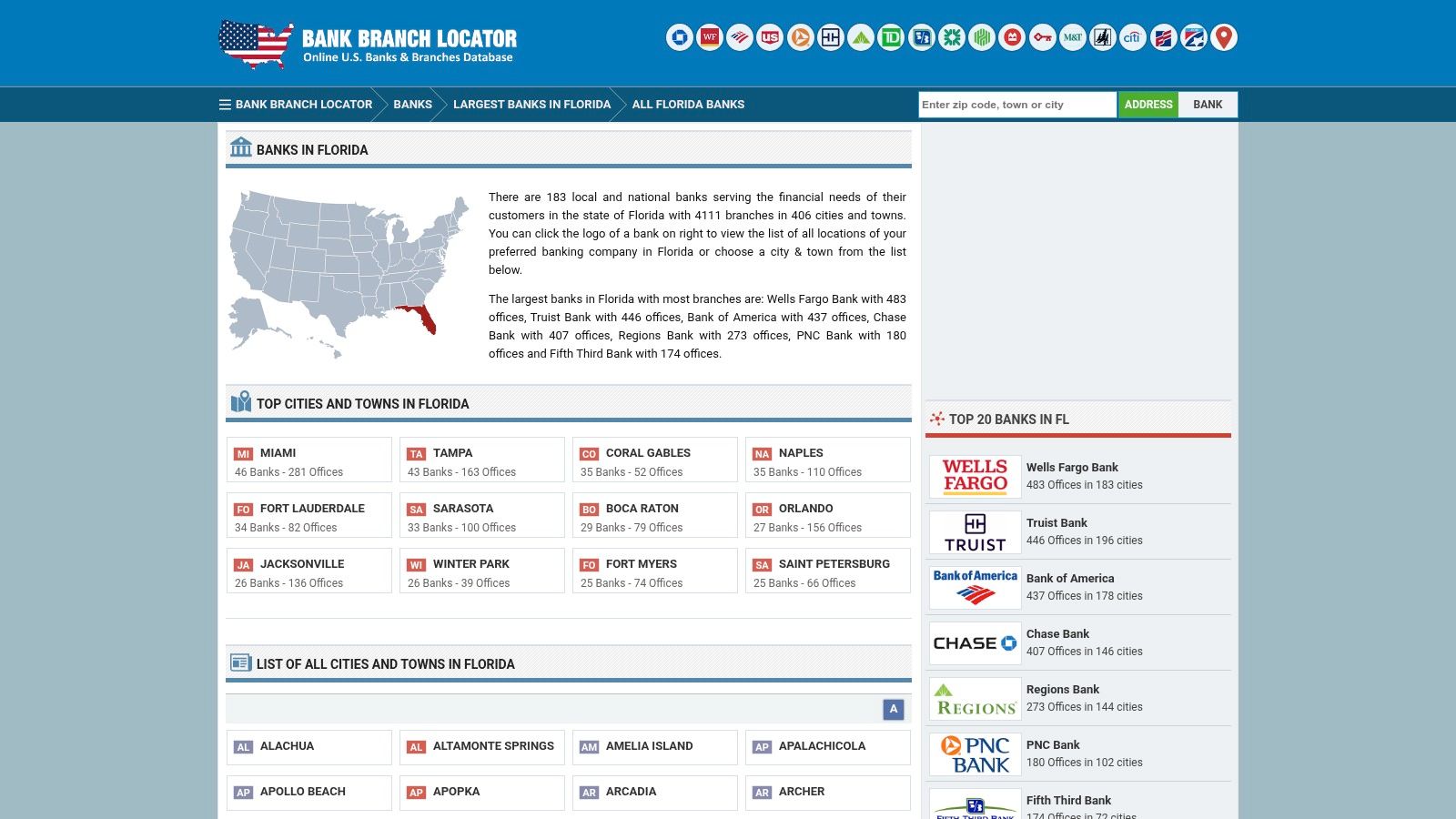
For strategic teams focused on retail footprint and physical network intelligence, BankBranchLocator offers a high-level, accessible directory. While not a regulatory source, this third-party aggregator provides a quick and easy way to visualize the branch distribution of competitors across the state. It is a useful tool for initial reconnaissance when evaluating market saturation or identifying potential service areas for a new branch.
The platform’s value lies in its simplicity and focus on physical locations. It aggregates branch counts and addresses, offering a snapshot of which institutions have the largest physical presence in Florida. For a quick overview of a competitor’s retail network without delving into deep financial data, this directory serves as an efficient starting point to build a foundational list of banks in Florida, USA, based purely on branch count.
Core Capabilities and Strategic Use
While the data is aggregated and may have occasional lags, its ease of use makes it valuable for specific tactical planning:
- State-Level Network Overview: Instantly see a ranked list of banks by their total number of offices in Florida, providing a clear picture of the most dominant retail players.
- City and Bank Drill-Downs: Filter by city to identify all bank branches in a specific local market, complete with addresses and operating hours. This is ideal for pre-screening locations for de novo branching or assessing hyper-local competition.
- Quick Competitor Mapping: Use the platform to quickly compile a list of a rival bank's branch addresses for a specific county or MSA, which can then be used for more detailed geospatial analysis.
Executive Insight: Use BankBranchLocator for rapid assessments of physical network density. If your strategy involves expanding your retail footprint in a specific Florida market like Orlando or Tampa, this tool can help you create a first-pass list of competitor locations in minutes.
This directory is best used as a directional tool. After identifying the top three banks by branch count in Broward County using BankBranchLocator, your team must then pivot to a data intelligence platform. Analyzing the deposit totals—for instance, one branch holding $250 million versus another with $45 million—and the loan-to-deposit ratios of those specific branches determines their actual market impact. Understanding the broader trends is key; you can gain deeper insights by navigating the U.S. bank branch network with a comprehensive analysis to inform your strategy.
Website: https://www.bankbranchlocator.com/florida-banks.html
7. US Bank Locations – Florida Banks
For executives needing a high-level, readable overview of competitor branch networks, US Bank Locations offers a valuable directory. While not a regulatory source, this free platform serves as an excellent cross-reference tool for quickly assessing the physical footprint of institutions across the state. It provides a simple, at-a-glance supplement to more granular data, making it useful for initial market scans and validating branch counts.
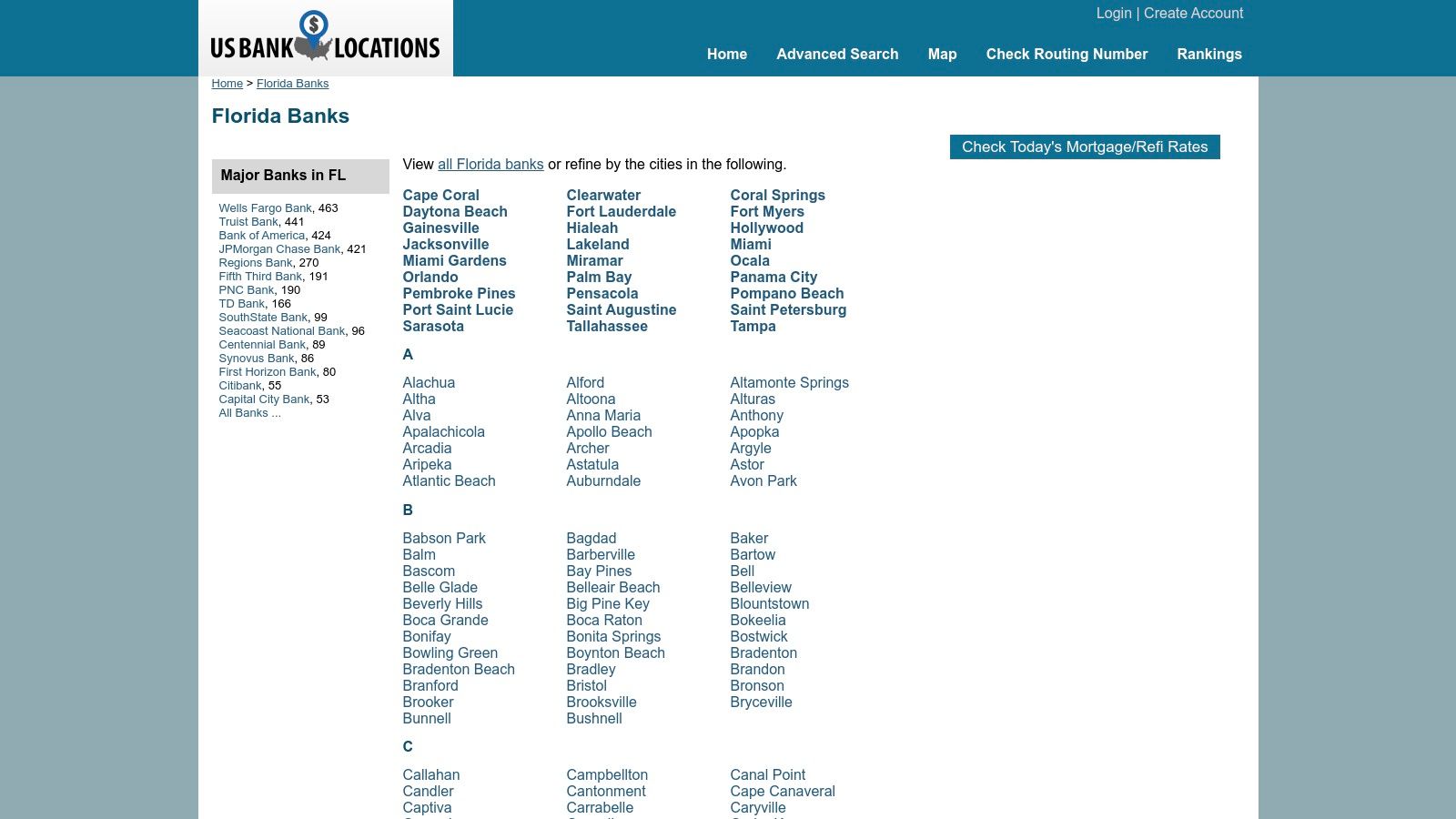
The site’s primary strength is its user-friendly presentation of branch data. Instead of navigating complex databases, a leadership team can instantly see a list of major banks in Florida ranked by their number of branches. This provides a quick answer to foundational questions about market saturation and competitor scale, which can then inform deeper strategic inquiries.
Core Capabilities and Strategic Use
While its financial data is summarized, the platform's branch intelligence is practical for initial competitive landscaping:
- Branch Network Summaries: Instantly view the total number of branches for major banks operating in Florida, offering a quick gauge of their physical presence.
- Detailed Branch Listings: Drill down into any specific bank to get a complete list of their Florida branch addresses, which is useful for mapping competitor territories.
- State-Level Search: Perform basic searches for banks and branches within Florida to quickly locate specific institutions or confirm the presence of a competitor in a target market.
Executive Insight: Use this directory as a rapid verification tool. If your initial analysis suggests a competitor has 75 branches in Florida, this site provides a straightforward, third-party source to quickly confirm that figure before dedicating resources to more in-depth, location-based analysis.
This platform is a starting point, not a final destination for analysis. After identifying a regional bank with a strong presence in the Tampa Bay area using US Bank Locations, the next step is to understand why that network is successful. An executive would then need to find key decision-makers at that institution to understand their strategy. Locating and connecting with these individuals requires a specialized approach, as outlined in this comprehensive guide to US bank contacts.
Website: https://www.usbanklocations.com/florida-banks.htm
7-Way Comparison of Florida Bank Listing Sources
| Source | 🔄 Implementation complexity | ⚡ Resource requirements | 📊 Expected outcomes | 💡 Ideal use cases | ⭐ Key advantages |
|---|---|---|---|---|---|
| FDIC BankFind Suite (FDIC) | Moderate — data‑dense UI; API available | Low — free web access & API | Authoritative institution profiles, deposit & branch data | Verify FDIC‑insured banks, historical/merger research | Most authoritative regulator data; rich historical records |
| FFIEC National Information Center | Moderate — technical interface, hierarchy views | Low — free access; limited exports | Ownership/hierarchy, multi‑regulator institution profiles | Check holding companies, ownership and structure | Broad federal coverage across regulators |
| Florida OFR REAL Portal | Low — license lookup workflow | Low — free state portal; manual lookups for bulk | State‑charter license/status and Florida supervision details | Confirm Florida charters and state regulatory status | Direct state regulator source for Florida institutions |
| OCC Financial Institution Lists | Moderate — download & local filtering required | Low — downloadable Excel/PDF; requires spreadsheet work | Official roster of national banks & federal thrifts | Identify OCC‑regulated national banks in Florida | Official, dated lists suitable for local filtering |
| Florida Bankers Association (FBA) Directory | Low — simple searchable directory | Low — web access; curated membership list | Curated member snapshots and contact info | Market research, industry contacts, Florida‑specific discovery | State‑focused, curated membership context |
| BankBranchLocator (third‑party) | Low — user‑friendly site | Low — free aggregator; may need cross‑check | Branch counts, addresses, hours; network snapshots | Quick branch network discovery by city | Fast, readable branch overviews and top‑network lists |
| US Bank Locations (third‑party) | Low — simple directory pages | Low — free; non‑authoritative | Per‑bank branch lists and summary stats | Cross‑check branch coverage and quick summaries | Readable summaries; good secondary verification |
From Data to Decision: Activating Your Competitive Intelligence
Compiling a comprehensive list of banks in Florida, USA, is a foundational step, but its strategic power is only unlocked through rigorous analysis and decisive action. The tools and resources detailed in this article, from the FDIC's BankFind Suite to the Florida OFR's REAL Portal, provide the essential raw materials. However, for banking executives and directors, the critical challenge is not merely accessing this data but synthesizing it into actionable competitive intelligence.
Isolated data points offer limited perspective. True strategic insight emerges when these sources are cross-referenced to form a coherent narrative of the market. For instance, combining FDIC deposit data with OCC charter information could reveal a national competitor is rapidly gaining market share in a high-net-worth area like Naples, not through new branches, but through a targeted digital campaign for specialized wealth management products. A traditional, branch-centric analysis would completely miss this emerging threat.
Transforming Raw Data into Strategic Advantage
The ultimate goal is to move beyond static lists and create a dynamic, decision-ready view of the competitive landscape. This requires a systematic approach to integrating disparate information.
- Anticipate Competitor Moves: By analyzing FFIEC holding company data alongside local market reports, you might discover a regional bank recently acquired a fintech specializing in commercial real estate (CRE) loans. This signals a strategic pivot that could directly impact your own CRE portfolio in a key market like Jacksonville or Orlando, allowing you to proactively adjust your own strategy.
- Identify Growth Opportunities: A simple list shows you who your competitors are. An integrated analysis reveals where they are vulnerable. Cross-referencing branch location data with demographic and business growth statistics might highlight underserved commercial corridors in the I-4 corridor where your institution’s specific expertise in small business lending would be a significant competitive advantage.
- Benchmark with Precision: Effective benchmarking goes beyond comparing asset sizes. It involves layering financial performance metrics (like ROA and efficiency ratios from regulatory filings) over market-specific data (like deposit growth and loan concentrations) to see exactly how your institution stacks up against its true peer group in specific Florida markets.
The Path Forward: From Information to Action
The transition from data collection to strategic execution is where leadership creates value. A well-curated list of banks in Florida, USA, is your starting point, not your destination. The crucial next step is to implement a system that transforms this fragmented information into a unified, actionable intelligence platform. This enables your team to stop spending valuable time collating spreadsheets and start focusing on making the informed, confident decisions that drive sustainable growth and profitability.
Ready to move beyond static lists and activate your competitive intelligence? Visbanking transforms scattered regulatory and market data into a powerful, interactive dashboard, allowing you to benchmark performance, identify market opportunities, and anticipate competitor moves in the Florida banking landscape. Explore our data-driven benchmarking tools to see how your institution truly stacks up against the competition.
Related Articles

Visbanking Blog
Top Banks in Florida | Updated Quarterly

Visbanking Blog
Top Banks in Arizona | Updated Quarterly

Visbanking Blog
Top Banks in Louisiana | Updated Quarterly

Visbanking Blog
Top Banks in California | Updated Quarterly

Visbanking Blog
Top Banks in Massachusetts | Updated Quarterly

Visbanking Blog