
Largest Banks in Texas: A Data-Driven Analysis for Executive Leadership
Brian's Banking Blog
In the dynamic Texas economy, market dominance is a fluid concept, continuously reshaped by deposit flows, M&A activity, and shifting client demands. For bank executives and directors, understanding the strategies of the largest players is not merely an academic exercise. It is a critical input for strategic planning, competitive benchmarking, and identifying market opportunities. This analysis moves beyond simple asset rankings to dissect the operational DNA of the seven largest banks in Texas.
We will examine the data-backed trends defining their market presence, from deposit concentration in key MSAs to loan portfolio composition. For instance, analyzing FDIC Summary of Deposits data reveals that while a national bank may lead in statewide assets, a regional player like Frost Bank often commands superior deposit market share in specific, high-growth corridors like Austin or San Antonio. This insight, derived from granular data, should prompt a leadership team to question its own branch strategy: are we positioned for demographic and economic growth, or are we defending legacy positions?
This data-driven perspective is essential for making informed decisions. Throughout this analysis, you will find direct insights into each institution’s footprint. Using a robust intelligence platform like Visbanking, executives can model these competitive dynamics, turning raw market data into actionable strategic foresight.
1. JPMorgan Chase
As the largest bank in Texas by deposit market share, JPMorgan Chase sets the benchmark for market saturation and integrated digital-physical service delivery. For bank executives, analyzing Chase's strategy in the state offers a masterclass in leveraging scale. Their extensive physical footprint, with hundreds of branches, acts as a powerful client acquisition and retention tool that smaller institutions must counter with superior service or targeted product offerings.
Strategic Product and Fee Structure
Chase's product suite is engineered for mass appeal while maintaining clear profitability levers. The popular Chase Total Checking® account serves as a primary example.
- Monthly Service Fee: $15.00
- Waiver Conditions:
- Electronic deposits totaling $500.00 or more.
- A beginning day balance of $1,500.00 or more.
- An average beginning day balance of $5,000.00 or more across linked qualifying Chase accounts.
This tiered waiver structure effectively segments clients. The $500.00 electronic deposit threshold captures the mass market, while the higher balance requirements incentivize deeper relationships. The Overdraft Assist℠ feature, which waives the $34.00 overdraft fee if the account is overdrawn by $50.00 or less, is a direct response to regulatory pressure, reducing friction for a significant client segment. Data intelligence allows a competitor to model the potential revenue impact of adopting a similar policy versus the potential gain in client acquisition and retention.
Digital and Physical Integration
Chase excels at creating a seamless user experience between its robust mobile app and its physical branches. New account bonuses, often ranging from $100.00 to $300.00, are aggressively marketed and serve as a potent driver of new household acquisition. Executives can benchmark their own client acquisition costs against these public offers. For example, if Chase offers $200.00 for a new checking account and your bank’s cost-per-acquisition is $350.00 through traditional channels, it is time to re-evaluate your marketing mix and digital onboarding efficiency.
While its massive scale is a key advantage, understanding its operational efficiency is crucial. For a comprehensive view of how JPMorgan Chase's financial standing compares nationally, you can review its position in the list of banks by asset size to contextualize their Texas dominance within their broader national strategy.
Official Website: https://www.chase.com
2. Bank of America
Bank of America maintains its position as a dominant force among the largest banks in Texas by skillfully blending a vast physical network with a sophisticated digital banking platform. For banking executives, its strategy showcases how to cater to a diverse client base through segmented product offerings and a powerful rewards program that fosters multi-product relationships. Its approach serves as a critical benchmark for customer retention and share-of-wallet growth.
Strategic Product and Fee Structure
Bank of America’s core consumer offering is its Advantage Banking suite. The most common of these is the Advantage Plus Banking® account.
- Monthly Maintenance Fee: $12.00
- Waiver Conditions:
- Have at least one qualifying direct deposit of $250.00 or more.
- Maintain a minimum daily balance of $1,500.00.
- Be an enrolled member of the Preferred Rewards® program.
This structure is highly effective at guiding client behavior. The direct deposit waiver secures the bank's position as the primary financial institution, while the rewards program incentivizes higher deposits. Notably, their SafeBalance Banking® account, which is Bank On–certified, eliminates overdraft fees by design, addressing a key consumer pain point and regulatory concern head-on. This is a strategic choice to attract specific demographics, a tactic that can be identified and countered by analyzing deposit data trends at the county or MSA level.
Digital and Physical Integration
Bank of America excels in creating a seamless user journey between its advanced mobile app and its extensive branch network. The true differentiator, however, is the Preferred Rewards program. This tiered loyalty program provides tangible benefits like fee waivers and interest rate boosters, effectively locking in high-value clients. For a competing bank, this poses a direct threat. Data analysis can help identify the "sweet spot" of clients who fall just below the Preferred Rewards qualification thresholds—for example, those with combined balances between $15,000.00 and $19,000.00—who could be targeted with a more straightforward, high-value proposition.
This model demonstrates how to structure loyalty programs that demonstrably increase client lifetime value. It also presents an opportunity for competitors to target underserved segments with simpler value propositions.
Official Website: https://www.bankofamerica.com
3. Wells Fargo
Wells Fargo maintains a formidable presence in Texas, leveraging its extensive branch and ATM network to secure a top-tier position among the largest banks in Texas. For banking executives, Wells Fargo’s strategy offers a case study in servicing a diverse customer base through a hybrid model that emphasizes both widespread physical access and accessible digital tools. Their approach to fee structures demonstrates an effort to balance mass-market appeal with profitability goals.
Strategic Product and Fee Structure
Wells Fargo’s core checking products are designed to cater to distinct consumer segments, with transparent fee structures. Their primary consumer offering is the Everyday Checking account.
- Monthly Service Fee: $10.00 (Scheduled to increase to $15.00 for fee periods beginning on or after Nov 29, 2025)
- Waiver Conditions:
- Direct deposits totaling $500.00 or more per fee period.
- A minimum daily balance of $500.00.
- The primary account owner is 17 through 24 years of age.
- A linked Wells Fargo Campus ATM or Campus Debit Card.
For customers seeking a more basic account, the Clear Access Banking option provides a low-cost alternative with a $5.00 monthly fee, waived for primary account owners aged 13 through 24. This dual-product strategy allows Wells Fargo to capture both traditional banking customers and younger demographics. The advance communication regarding the 2025 fee increase is a notable practice in client relations management, providing a long runway for adaptation and minimizing attrition risk.
Digital and Physical Integration
Wells Fargo’s competitive advantage lies in its deeply entrenched physical footprint, which it complements with a functional digital banking platform. This combination effectively serves clients who prioritize in-person interactions while meeting the expectations of digitally native users. The bank’s ability to maintain such a significant physical network while managing operational costs is a key performance indicator for competitors to monitor through call report analysis. For example, tracking Wells Fargo's efficiency ratio and non-interest expense per branch can provide a benchmark for your own institution's physical operations.
Understanding its national standing is crucial for a complete competitive analysis. You can see how Wells Fargo ranks among U.S. banks by asset size to better frame its statewide operations within its broader corporate strategy.
Official Website: https://www.wellsfargo.com
4. Frost Bank
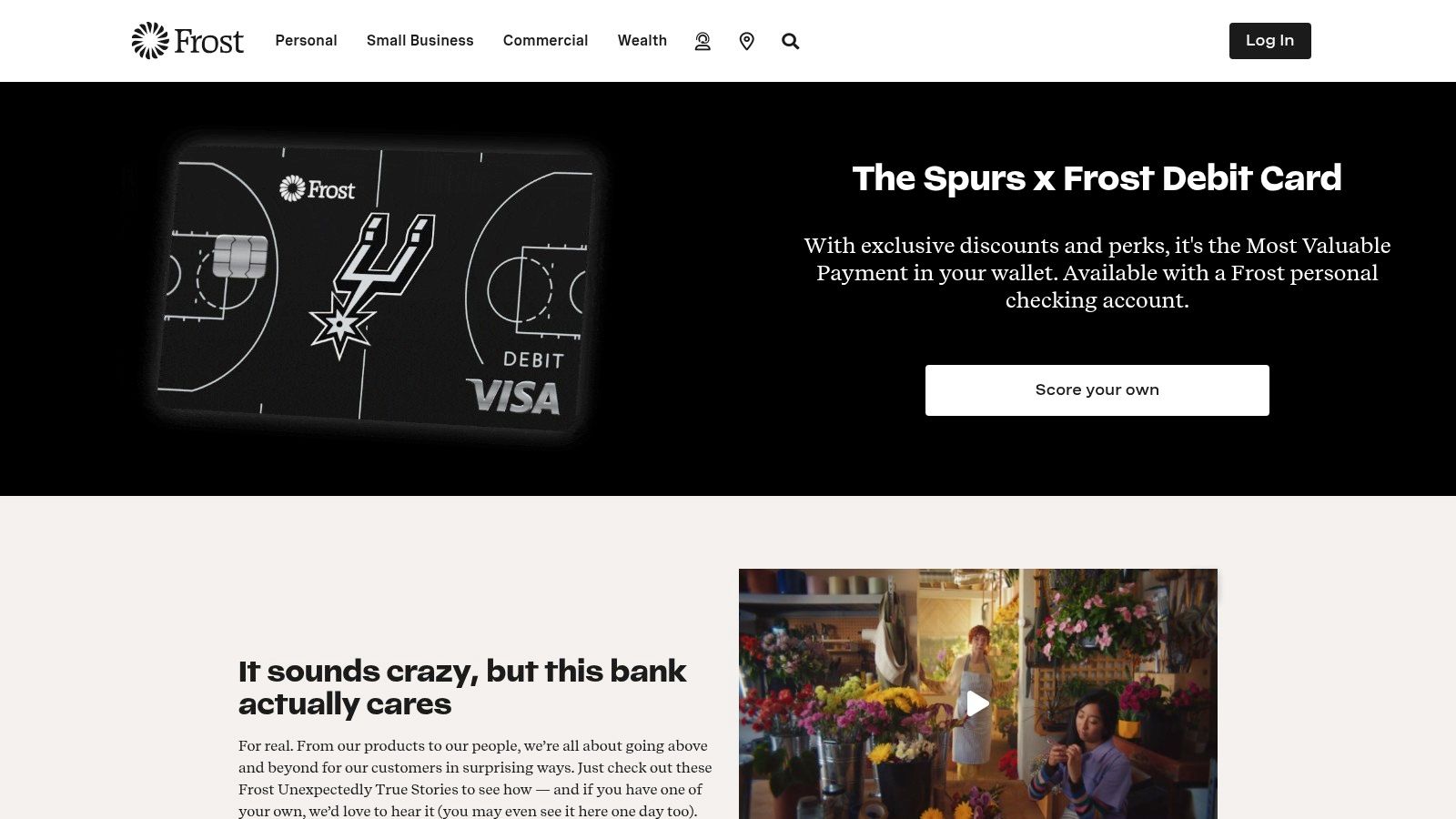
As a quintessential Texas institution, Frost Bank has built its formidable market position on a foundation of deep local roots and a client-centric service model. For banking executives analyzing the competitive landscape, Frost's strategy offers a powerful case study in how a regional player can successfully compete against national giants by cultivating trust. Its success demonstrates that a targeted, high-touch approach can create a durable competitive moat.
Strategic Product and Fee Structure
Frost's product strategy is centered on simplicity and transparency, a deliberate contrast to the complex fee schedules of larger competitors. The Frost Personal Account is designed to be accessible and straightforward.
- Monthly Service Fee: $8.00
- Waiver Conditions:
- Direct deposits totaling $100.00 or more per monthly cycle.
- Maintaining a $1,000.00 minimum daily balance.
- Account holders under 25 years of age.
These attainable waiver conditions are designed to attract a broad client base. The bank's most notable features are its consumer-friendly overdraft policies. The overdraft grace feature, which waives the fee if an account is overdrawn by $100.00 or less, and the complete elimination of NSF fees for consumer accounts are significant differentiators. These policies turn a potential point of negative engagement into a loyalty-building feature. A competing bank could use data tools to estimate the revenue impact of such a policy change and weigh it against the projected increase in market share and client retention.
Digital and Physical Integration
Frost Bank effectively combines a strong physical presence, with over 1,700 fee-free ATMs, and a highly-rated digital experience. This hybrid model caters to clients who value both in-person service and modern mobile banking. The bank’s commitment to 24/7 human support reinforces its service-oriented brand promise. This high-touch service model is a key driver of its strong local reputation and impressive client retention rates, which can be inferred by analyzing its stable, low-cost deposit base over time.
For a detailed comparison of its financial health and market share relative to other key players, you can explore a complete list of banks in Texas to understand its strategic position.
Official Website: https://www.frostbank.com
5. Prosperity Bank
Prosperity Bank, a significant Texas-based institution, demonstrates how a regional bank can compete effectively by offering straightforward, value-driven products. For executives at community and regional banks, Prosperity’s model provides a clear playbook for capturing local market share by emphasizing transparency and accessible account structures, a strategy that resonates strongly with both consumer and small business segments.
Strategic Product and Fee Structure
Prosperity Bank’s strength lies in its simple product lineup. Its core consumer offering, the Simply Free Checking account, is a powerful client acquisition tool.
- Monthly Service Fee: $0.00 (no conditions required)
- Overdraft Fees: Standard fees apply, though options like Overdraft Privilege and sweep services are available.
Unlike the complex waiver systems of larger competitors, Prosperity’s zero-fee, no-strings-attached approach creates a low-friction entry point. For business clients, its Small Business Checking offers 200 free items per month with a low $10.00 monthly fee, easily waived with a qualifying balance. This clarity provides a distinct value proposition for local enterprises that prioritize predictable costs. The strategic decision here is to sacrifice fee income on entry-level accounts to build a pipeline for more profitable commercial loans and treasury management services.
Digital and Physical Integration
Prosperity has successfully integrated a user-friendly online account opening process with its established physical branch network across Texas and Oklahoma. This hybrid approach ensures they cater to digitally-savvy clients while still providing the in-person support that many small business owners value. Their model proves that a regional player can win by excelling at the fundamentals rather than trying to out-feature national competitors. Analyzing their deposit growth and operational costs relative to their streamlined product set can offer valuable insights for strategic planning, especially for banks looking to simplify their own offerings without eroding profitability.
Official Website: https://www.prosperitybankusa.com
6. Charles Schwab Bank, SSB
Charles Schwab Bank, SSB, a Texas-chartered savings bank, presents a unique competitive model. Its direct banking and investment-centric approach captures a highly valuable, affluent client base, offering a case study in building deep relationships by integrating banking and wealth management. For traditional bank executives, Schwab’s model highlights the threat posed by non-traditional players that lead with a differentiated value proposition.

Strategic Product and Fee Structure
Schwab’s strategy hinges on its flagship Schwab Bank Investor Checking® account, which is inextricably linked to a Schwab One® brokerage account. This structure is a core client acquisition mechanism for the entire Schwab ecosystem.
- Monthly Service Fee: $0.00
- Key Features:
- No account minimums or monthly service fees.
- Unlimited ATM fee rebates worldwide.
- No foreign transaction fees on debit card purchases.
- Seamless cash transfers between the bank and brokerage accounts.
This fee-light structure is designed to eliminate friction points for high-value clients. By removing fees that traditional banks often rely on for revenue, Schwab forces competitors to justify their own fee structures. The mandatory brokerage link ensures every banking client is a potential investment client, creating a powerful flywheel for asset gathering. This strategy significantly increases the lifetime value of each relationship, a metric every executive should be tracking and benchmarking.
Digital and Physical Integration
Schwab’s model is predominantly digital, supported by the physical branch network of its parent brokerage company, Charles Schwab & Co., Inc. This hybrid approach provides the efficiency of a direct bank with the trust-building capabilities of a physical presence for complex wealth management conversations. The primary competitive challenge Schwab poses is its ability to subsidize a superior banking experience with revenue from its wealth management operations. A competing bank must use data to analyze its own non-interest income streams and client relationship profitability to determine how to compete with a model where core checking is a low-cost acquisition channel, not a primary profit center.
Official Website: https://www.schwab.com
7. IBC Bank (International Bank of Commerce)
As one of the largest banks in Texas headquartered within the state, IBC Bank provides a compelling model for community-focused banking at scale, particularly in South and Central Texas. For executives, IBC's strategy demonstrates how to compete against national giants by anchoring the brand in accessible, low-cost core products that resonate with local consumer and small business segments.
Strategic Product and Fee Structure
IBC’s primary competitive differentiator is its Free Checking account, a genuinely no-strings-attached product that stands in stark contrast to the complex waiver systems of larger competitors.
- Monthly Service Fee: $0.00
- Minimum Balance Requirement: None
- Opening Deposit: $10.00
This straightforward structure is a strategic choice designed to capture a broad segment of the market that prioritizes cost certainty. By eliminating monthly fees, IBC lowers the barrier to entry and builds goodwill, which it can later leverage for cross-selling more profitable business, mortgage, and wealth management services. This is a volume-based strategy; its success hinges on efficient operations and a robust ability to graduate these clients into deeper relationships.
Digital and Physical Integration
While IBC maintains a strong branch network, its product strategy is clearly designed to defend its market share against both national banks and digital-only neobanks. The Free Checking account is a direct answer to the fee-free models popularized by fintechs, but it is delivered with the trust and physical presence of an established institution. This hybrid approach allows IBC to cater to customers who value in-person service while still meeting the basic expectations of the modern, cost-conscious consumer. Analyzing the deposit composition and cross-sell ratios of institutions like IBC, using tools like Visbanking, is essential for any competitor looking to implement a similar "free" product strategy without eroding margins.
Official Website: https://www.ibc.com
Top 7 Texas Banks Comparison
| Bank | Account setup & complexity 🔄 | Access & resources ⚡ | Expected outcomes 📊⭐ | Ideal use cases 💡 | Key advantages ⭐ |
|---|---|---|---|---|---|
| JPMorgan Chase | Standard setup; moderate fee-waiver rules | Nationwide branches & ATMs; strong digital tools | Full-service coverage; possible monthly/overdraft fees if waivers not met | Clients wanting in-person access, broad products, or signup bonuses | Large network, robust app, clear waiver paths |
| Bank of America | Standard setup; multiple account tiers and Preferred Rewards enrollment | Extensive branches; strong mobile/web banking | Good fee-reduction potential via Preferred Rewards; strong digital UX | Users who value digital tools and rewards programs | Preferred Rewards benefits, Bank On–certified option |
| Wells Fargo | Standard setup; several account choices — monitor upcoming fee changes | Extensive TX branch/ATM footprint | In-person convenience; scheduled fee increases may raise costs | Clients needing local branch services and in-person support | Large branch access; transparent fee-change communications |
| Frost Bank | Simple opening; straightforward waivers; youth exemptions | Strong Texas branch network; 1,700+ fee-free ATMs; highly rated app | Lower incidental fees (no NSF), generous overdraft grace; regional reach | Texas residents seeking transparent, client-friendly banking | No NSF fees, generous overdraft grace, strong local support |
| Prosperity Bank | Easy online opening; clear fee/waiver tables | Regional Texas presence; standard digital services | Multiple $0.00 or easily waived accounts; clear business options | Clients and small businesses wanting simple, low-cost accounts | Transparent pricing, $0.00 checking options, clear comparisons |
| Charles Schwab Bank, SSB | Direct-bank setup; requires linked Schwab One brokerage | No branches; unlimited worldwide ATM fee rebates; travel-friendly | Fee-light checking with excellent global ATM reimbursement | Travelers and investors who use Schwab brokerage | No monthly fees, unlimited ATM rebates, no foreign transaction fees |
| IBC Bank (International Bank of Commerce) | Very simple opening (typically $10.00); instant-issue debit in-branch | Strong Texas/Oklahoma branch network; local service focus | Truly free checking with low barriers; local convenience | Local clients wanting no-fee checking and instant cards | Genuine no-strings free checking, instant-issue debit card |
From Insight to Action: Activating Competitive Intelligence
The competitive landscape of the Texas banking sector, dominated by behemoths like JPMorgan Chase alongside formidable regional players like Frost Bank, is a testament to strategic execution. Our analysis of the largest banks in Texas reveals a consistent theme: market leadership is the direct result of leveraging granular data to inform every critical decision, from branch placement and product pricing to commercial lending and talent acquisition.
The strategies employed by these leading institutions are not trade secrets; they are observable through public data, provided you have the right tools to interpret it. The path to outperformance is paved with actionable intelligence.
Translating Data into Decisive Strategy
For bank executives and directors, the central challenge is converting raw information into a competitive advantage. Static quarterly reports are insufficient. Winning in today's market requires dynamic analysis that connects disparate data points to reveal underlying opportunities and threats.
Consider a practical scenario: A regional bank aims to expand its commercial and industrial (C&I) loan portfolio in the Dallas-Fort Worth MSA. A surface-level analysis shows intense competition. However, a deeper dive using UCC filing data could reveal a competitor’s recent C&I lending is heavily concentrated in logistics and transportation, leaving mid-market professional services firms under-served. This is a precise, data-validated opening for a targeted business development campaign.
Similarly, analyzing Home Mortgage Disclosure Act (HMDA) data might show that while a major competitor has a high volume of mortgage applications in a specific county, its denial rate for loans between $300,000.00 and $500,000.00 is unusually high. This signals a potential gap in their underwriting model, creating a prime opportunity for your institution to capture well-qualified borrowers.
Key Factors for Activating Intelligence
To move from analysis to action, your institution must prioritize several key factors:
- Integrated Data Synthesis: Your team needs a unified view combining FDIC call report data, deposit trends, and local economic indicators. Siloed data leads to fragmented conclusions.
- Benchmarking Clarity: The ability to benchmark your bank’s performance against specific peers like Frost Bank or IBC Bank on key metrics such as efficiency ratios or loan growth is non-negotiable. This highlights where you lead, lag, and have the greatest potential for improvement.
- Forward-Looking Analysis: Effective intelligence moves beyond historical reporting. It involves modeling the potential impact of strategic decisions, such as opening a new branch, based on real-world market data.
The ultimate objective is to embed this analytical rigor into your bank's operational DNA. Competitive intelligence should not be a reactive exercise but a continuous, proactive engine for growth. By equipping your leadership team with a dedicated bank intelligence platform, you empower them to act with the data-driven confidence that defines the largest banks in Texas.
Transform these insights into your institution's competitive edge. With Visbanking, you can benchmark your performance against any bank in Texas, uncover hidden market opportunities, and arm your team with the granular data needed to make decisive, profitable moves. Explore the Visbanking platform to see how superior intelligence can sharpen your strategy today.
Related Articles

Visbanking Blog
Top Banks in Texas | Updated Quarterly

Visbanking Blog
Fastest Growing Banks: Who's Winning the Asset Race?

Visbanking Blog
Why Bank Financial Data Matters: Insights and Applications for Individuals and Businesses.

Visbanking Blog
Major Banks in US by Asset Size

Visbanking Blog
Revolutionize Your Banking Operations with Data-Driven Insights from BIAS

Visbanking Blog