
Find Company DUNS Number: A Guide to Smarter Due Diligence
Brian's Banking Blog
To find a company's D-U-N-S number, the most reliable methods are using the official Dun & Bradstreet lookup tool, checking government registries like SAM.gov, or requiring it directly from the business during onboarding. This nine-digit identifier is the master key to a company's verified commercial history and is non-negotiable for robust due diligence.
Why the D-U-N-S Number Is a Critical Asset in Modern Banking
In today's banking environment, a D-U-N-S Number is not just another data point; it is the key to unlocking a company's complete financial DNA. For any bank executive, the ability to find and act on this information is a core strategic discipline. It elevates due diligence from a procedural requirement to a competitive advantage.

This single number provides access to actionable intelligence, accelerating and sharpening decisions on commercial loans, risk management, and client prospecting. It offers a standardized lens through which to view a business, cutting through self-reported narratives and fragmented public records. If the concept is new to your team, you can learn more about what a D-U-N-S number is in our foundational guide.
From Identifier to Insight
Consider a relationship manager evaluating a $2,500,000 credit line for a mid-sized manufacturing company. Without the D-U-N-S number, the process is fragmented and slow, requiring manual data verification that can take days and introduce unnecessary risk.
With the D-U-N-S number, that same manager gains immediate access to a unified record of the firm's payment history, credit background, and public filings. Hours of research are compressed into minutes of focused analysis, de-risking the decision from the outset.
The D-U-N-S system’s power lies in its ability to present a clear, consistent picture of a business. It connects operational behavior to overall financial health, revealing risks and opportunities that would otherwise remain hidden.
The Foundation of Data-Driven Decisions
For banks committed to precision, the D-U-N-S number is the cornerstone of three critical activities:
- Risk Assessment: Quickly identify linkages between parent companies and subsidiaries. This is essential for uncovering concentrated credit exposure that might be obscured across seemingly unrelated entities.
- Client Acquisition: Analyze the D-U-N-S profiles of top-tier clients to build a data-backed model for identifying high-potential prospects in the market.
- Operational Efficiency: Standardize the commercial onboarding process. Every new client is vetted against the same high-quality, reliable data source, ensuring consistency.
Ultimately, incorporating D-U-N-S lookups is not about adding a step; it is about engineering a smarter, faster, and more profitable institution. With platforms like Visbanking, this data integrates directly into existing workflows, transforming raw numbers into decisive action.
Methods for Finding a Company's DUNS Number
For banking professionals, finding a company’s DUNS number is the first step in rigorous risk management and intelligent client acquisition. Your team must be proficient in several methods to ensure comprehensive coverage, from initial prospecting to final due diligence.
The Official Dun & Bradstreet Portal
The most direct method is Dun & Bradstreet’s own lookup tool. This provides a straightforward way to search using a company's name and location.

While a free search offers basic confirmation, the true value for financial institutions lies in a subscription. This unlocks the in-depth data required for serious credit analysis, understanding corporate family trees, and constructing a complete risk profile. The investment in a commercial plan is offset by preventing a single costly delay or poor decision in the credit approval pipeline.
Government Registries for Additional Vetting
For clients operating in the public sector, government databases are invaluable. The primary resource is the federal government's System for Award Management (SAM.gov). Any business seeking to contract with the U.S. government must register, creating a public record that includes its unique entity ID.
When a relationship manager vets a potential government contractor, SAM.gov serves a dual purpose. It not only provides the DUNS number but also instantly verifies the company's registration status and active contracts—a powerful diligence shortcut confirming legitimacy and revenue streams.
Direct Request from the Business
The simplest method is often overlooked: request the DUNS number directly from the business. This should be a standard, non-negotiable component of your commercial client onboarding process.
Frame the request appropriately. Explain that it is a required data point for building their commercial profile, which enables faster credit decisions and access to more suitable financial products.
Making the D-U-N-S number a mandatory field in your CRM and loan origination software standardizes due diligence. It ensures every relationship manager, underwriter, and analyst begins their assessment with the same high-quality, verified starting point.
This simple policy also signals that your bank operates with precision and relies on objective data. With over 520 million companies in the D&B system globally, the DUNS number is a critical credential, necessary for everything from supplying major retailers to publishing on the Apple Store. A client's DUNS status is a strong indicator of their operational maturity and readiness to scale.
DUNS Number Lookup Methods Comparison for Banking Professionals
The optimal lookup method depends on the context. This table outlines the primary options to guide your team, whether they are in business development, underwriting, or compliance.
| Method | Typical Speed | Associated Cost | Best Use Case for Banks |
|---|---|---|---|
| D&B Direct Lookup | Instant | Free (basic), Subscription (full data) | Deep-dive credit analysis, corporate linkage verification, and portfolio risk management. |
| Government Registries | Near-Instant | Free | Verifying government contractors and cross-referencing public sector activity. |
| Third-Party API/Service | Instant (API) | Subscription or Pay-per-lookup | High-volume lookups, integrating data directly into LOS/CRM systems for automation. |
| Direct Client Request | Variable | Free | Standard client onboarding and initial relationship setup. |
Each method has its place. Integrating these tools into a clear, repeatable process is what transforms raw data into a competitive advantage. Mastering these lookups equips your team for any scenario. For a deeper dive, our guide on how to lookup a company by DUNS number offers additional tactics. At Visbanking, we focus on empowering banks to integrate these critical data points seamlessly into their workflows.
Turning DUNS Data into a Strategic Advantage
Obtaining a company's DUNS number is merely the entry point. The strategic value is realized when a bank leverages the underlying data to build a significant competitive advantage. This nine-digit identifier is the master key that connects disparate data points—credit reports, payment histories, and complex corporate family trees—into a single, coherent narrative.
This is how top-performing institutions differentiate themselves. They understand the DUNS system is not for isolated checks but for mapping the entire ecosystem in which a company operates.
Uncovering Hidden Portfolio Risks
Consider a common scenario: a portfolio manager oversees relationships with three distinct commercial clients. Each operates under a unique name and in a slightly different industry; on the surface, they represent diversified risk.
However, upon pulling their DUNS numbers and mapping their corporate structures, it is discovered they are all subsidiaries of a single, highly leveraged parent company. A hidden, concentrated risk of $15,000,000 materializes. This insight allows the bank to proactively adjust exposure and mitigate a potential loss.
The DUNS number acts as a universal translator for business relationships. It cuts through the ambiguity of trade names and legal structures, providing a data-backed view of interconnected risk across a portfolio.
This level of clarity is foundational to sound risk management. The Dun & Bradstreet system, established in 1963, now encompasses over 600 million business records worldwide, with over 90% of Fortune 500 companies relying on it. For banks using intelligence platforms like Visbanking, it is the standard for obtaining verified business information. Explore the global impact of this identification system to understand its scope.
Driving Targeted Business Development
This strategic edge extends beyond risk mitigation to revenue growth. Business development teams can move from broad market segmentation to predictive, data-driven targeting.
By analyzing the DUNS profiles of your top 5% of commercial clients, you can identify common characteristics—specific industries, revenue tiers, or payment behaviors that signal a profitable, long-term relationship. This data-backed profile becomes a new targeting model, enabling your team to focus outreach on prospects that mirror your best customers. Robust company ID data allows you to qualify sales leads with precision before committing significant resources.
Platforms like Visbanking are designed to convert this raw data into actionable intelligence, enabling banks to shift from a reactive posture to a proactive strategy for building a more profitable institution.
Integrating DUNS Lookups into Your Bank's Workflows
True operational efficiency is achieved not through ad-hoc lookups but by embedding a disciplined, repeatable process into the bank’s core functions. To leverage the full power of the Dun & Bradstreet system, these lookups must be integrated directly into operations—from client onboarding to annual portfolio reviews. This transforms the D-U-N-S number from a simple data field into a foundational component of your operational intelligence.
This can be accomplished through manual discipline or automated intelligence. While both have merit, automation delivers scalability and significant returns.
Manual vs. Automated Integration
A manual approach establishes a baseline for data hygiene. It begins with procedural updates, such as modifying client intake forms, CRM fields, and loan origination software to make the D-U-N-S number a required data point for every commercial entity. This policy alone enforces consistency and provides underwriters with a verified identifier from day one.
However, leading banks are creating a sustainable competitive edge through automation.
API-based solutions transform a cumbersome, multi-step task into a seamless background process. The strategic value is immense, turning static data entry into a dynamic intelligence trigger. For example, when a new commercial client is entered into a system powered by a platform like Visbanking, it can automatically find and enrich that record with the correct D-U-N-S number. This single action can then trigger an immediate data pull from Dun & Bradstreet, populating the client's profile with critical credit and risk information without manual intervention.
This strategic process involves finding the identifier, connecting the data, and analyzing the resulting insights.
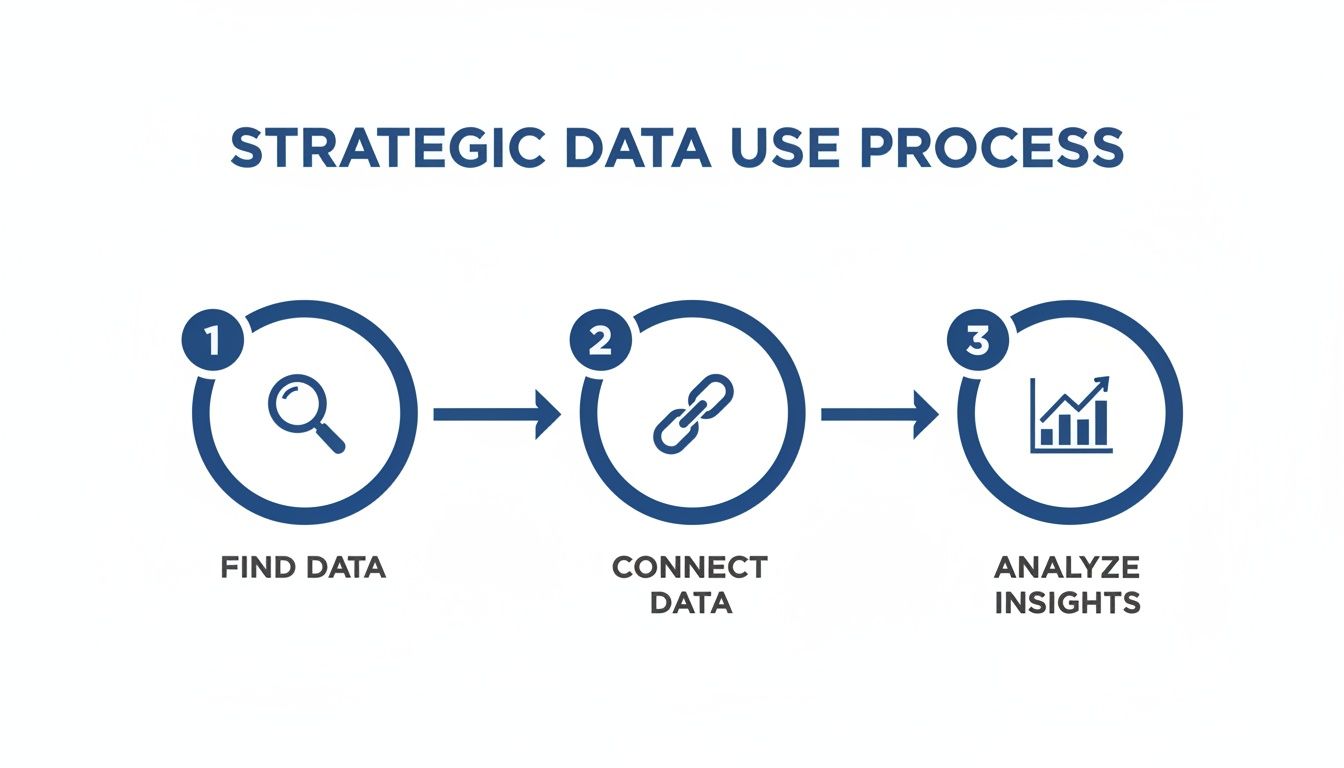
The most effective banks build systems that execute this process automatically, guaranteeing speed and consistency.
Calculating the Return on Investment
The ROI is tangible. Consider a mid-sized commercial banking division with 50 relationship managers. If automating the D-U-N-S lookup and initial data pull saves each manager just 30 minutes per week, the bank reclaims 1,300 hours of productive time annually. This is time reallocated from administrative tasks to high-value activities like strategic advising and business development.
By integrating D-U-N-S lookups directly into your core systems, you are not merely cleaning data. You are systematically freeing your most valuable asset—your team’s time—to focus on activities that generate revenue.
This shift from manual verification to automated enrichment is what distinguishes a modern, data-driven bank. To understand how these concepts fit within the broader context of risk management, review our analysis on modernizing your bank's credit information systems.
Integrating D-U-N-S lookups is a strategic investment in operational excellence. It ensures data consistency, accelerates decision-making, and delivers a clear, measurable return by empowering your team. It is a foundational step for any bank aiming to benchmark its performance against the competition.
Moving Beyond One-Off Lookups to Portfolio-Level Strategy
Once individual lookups are mastered, the next step is to scale the strategy. For institutions focused on growth and sophisticated risk management, DUNS data management must evolve from single checks to portfolio-level analysis.
This leap requires more advanced methods capable of processing data at scale, namely bulk lookups and direct API integrations. The appropriate tool depends on the strategic objective.
Bulk Lookups vs. API Integrations: What’s the Difference?
A bulk lookup service is the ideal tool for periodic, portfolio-wide health assessments. For a quarterly review of a commercial loan book containing 10,000 clients, you can submit the entire list for DUNS enrichment. This enables your analytics team to identify macro-level risk shifts, uncover previously unknown corporate linkages, and improve overall data integrity. It is a powerful, scheduled deep-dive.
An API-based approach, in contrast, is engineered for real-time action. When a new prospect is entered into your CRM, an API call can instantly fetch their DUNS number, pull a high-level credit file, and score the lead—all before a relationship manager makes the initial contact. It transforms a reactive process into an instantaneous, data-informed action.
The key distinction: Bulk processing provides a powerful snapshot for strategic analysis and portfolio reviews. API integration provides the engine for continuous, real-time intelligence that drives faster, smarter daily decisions.
How to Pick the Right Data Partner
Selecting a provider for these services must extend beyond cost-per-lookup. The evaluation should focus on total cost of ownership and, critically, data quality.
When vetting partners, investigate the following:
- Data Accuracy: What is their match rate? How do they resolve ambiguous company names? An incorrect match introduces more risk than no match at all.
- Refresh Rate: How frequently is their data updated? Time-sensitive decisions like credit approvals demand near real-time information.
- Integration Support: Do they provide clear documentation and expert support to facilitate integration with your core banking or CRM systems? A seamless integration is non-negotiable.
Building Your Single Source of Truth
Ultimately, these strategies converge on a single goal: achieving robust data governance. By establishing the DUNS number as the universal identifier for every commercial client, you create a single source of truth.
This dismantles information silos. Your business development, underwriting, and compliance teams all operate from the same verified data set. This is not merely an IT initiative; it is a strategic investment in operational efficiency and risk modeling accuracy. Platforms like Visbanking are designed to manage these data pipelines, allowing your team to focus on analysis rather than data collection.
The ability to find and leverage company DUNS number information at scale is a core competency for any modern bank. It is time to benchmark your institution's capabilities and turn portfolio-level intelligence into a decisive competitive edge.
A Few Final Questions on Managing D-U-N-S Numbers
As institutions integrate D-U-N-S data, several key questions consistently arise. For banking executives, clarity on how identifiers differ, the associated costs, and data maintenance protocols is essential for building a robust risk management framework.
D-U-N-S Number vs. Tax ID Number (EIN)
A common point of confusion is the distinction between a D-U-N-S Number and an Employer Identification Number (EIN). For a financial institution, these identifiers serve fundamentally different purposes.
An EIN is issued by the IRS for tax administration. It confirms a business is a legitimate taxable entity but provides no insight into its commercial activity or financial stability.
The D-U-N-S Number, by contrast, is a global identifier from Dun & Bradstreet created specifically to track a company's credit and financial health. It is the superior tool for due diligence, unlocking data on payment histories, corporate structures, and overall creditworthiness—intelligence an EIN cannot provide.
What’s the Real Cost of Finding a D-U-N-S Number?
While a business can obtain its own D-U-N-S Number at no cost, banks looking up third-party companies will incur expenses. This should be viewed not as a cost but as an investment in risk mitigation.
Dun & Bradstreet offers subscription packages and pay-per-search options tailored to financial institutions. While some numbers can be found freely on public databases like SAM.gov, comprehensive and timely access requires a commercial plan. The ROI calculation is straightforward: weigh the modest cost of verified data against the potential loss from a single poorly vetted commercial loan.
Data integrity is paramount. The only method to guarantee accuracy and timeliness is to source DUNS information directly from Dun & Bradstreet or a certified partner utilizing their live API.
How Can We Be Sure Our D-U-N-S Data is Accurate?
For data to be actionable, it must be correct. Banks can implement straightforward practices to ensure the integrity of their D-U-N-S data.
The gold standard is pulling data directly from Dun & Bradstreet or through a platform that maintains a live API connection. This is non-negotiable, as it connects your systems to D&B's own rigorous quality control processes. A system like Visbanking is architected to manage these complex data feeds, ensuring your team always operates with the most current, validated information.
Additionally, a prudent internal policy is to periodically re-verify D-U-N-S numbers during annual reviews or credit line renewals. This proactive measure maintains a clean and reliable portfolio database, which in turn enhances the accuracy of every risk model and growth strategy built upon it.
At Visbanking, we provide financial institutions with the intelligence and tools to transform complex data into decisive action. To explore how our platform can enhance your due diligence and portfolio analysis, visit us at https://www.visbanking.com.
Related Articles

Visbanking Blog
Did you know that your bank may not be giving you the full picture?

Visbanking Blog
Banking Data Analytics: Turning Information Into Profit

Visbanking Blog
Why Bank Financial Data Matters: Insights and Applications for Individuals and Businesses.

Visbanking Blog
Revolutionize Your Banking Operations with Data-Driven Insights from BIAS

Visbanking Blog
How Bank Efficiency Ratios Reveal Hidden Operational Costs

Visbanking Blog