
A Strategic Executive's Guide to De Novo Banks
Brian's Banking Blog
A de novo bank is a state or federally chartered institution operating for five years or less. For banking executives, the resurgence of these entities is not an academic curiosity—it is a critical strategic development. This comeback is driven by two primary forces: fintech firms seeking the stability of full banking charters and a market demand for specialized financial services in communities underserved by larger institutions.
The Strategic Imperative of De Novo Banks Today

For over a decade, banking has been a story of consolidation. Mergers and acquisitions dramatically outpaced new bank formation. To quantify this, the U.S. averaged just five new bank approvals annually between 2010 and 2023. This represents a stark decline from the 144 annual approvals common between 2000 and 2007.
This environment created a predictable, if stagnant, competitive landscape. That equilibrium is now shifting.
A confluence of regulatory adjustments and market demands is fueling a new wave of de novo applications. This presents both a direct threat and a significant opportunity for established banks. Ignoring this trend is a strategic error for any leadership team focused on market leadership.
Drivers of the De Novo Resurgence
The current de novo wave is not a simple return to pre-2008 conditions. It is powered by distinct forces that every incumbent bank's leadership must analyze.
- Fintech’s Pursuit of Charters: Technology firms are moving beyond less stable Banking-as-a-Service (BaaS) partnerships. They are now systematically pursuing full banking charters to gain direct payment system access, hold FDIC-insured deposits, and secure the regulatory legitimacy required for scalable growth.
- Serving Niche Markets: Many new de novo banks are built with a laser focus on specific, often underserved, customer segments. Consider a bank dedicated exclusively to financing renewable energy projects or one providing wealth management tailored to independent contractors—markets that large, generalized institutions may not efficiently serve.
- Regulatory Thaw: Regulators now appear to recognize that barriers to entry may have become excessively high. Recent FDIC commentary suggests a more receptive posture toward new bank formation to foster competition and innovation.
The key takeaway for executives: these new entrants are not merely traditional community banks. They are frequently tech-first, agile competitors engineered to exploit specific market gaps with precision.
To clarify these dynamics, the following table breaks down the critical trends shaping the modern de novo banking environment.
Key De Novo Banking Trends at a Glance
This summary highlights the core shifts in the de novo banking landscape, providing executives with a concise reference for strategic planning and competitive response.
| Trend Category | Historical Norm (Pre-2010) | Current Landscape | Strategic Implication for Incumbents |
|---|---|---|---|
| Primary Drivers | Community-focused, local economic growth | Fintech charters, niche market specialization | Defend against hyper-focused competitors. |
| Business Model | Traditional brick-and-mortar, broad services | Digital-first, specialized product offerings | Re-evaluate digital channel efficacy and product portfolio gaps. |
| Regulatory Mood | Encouraging, high volume of approvals | Cautious but thawing, focus on strong capital | Opportunity to engage regulators on competitive fairness. |
| Competitive Threat | Local, geographically constrained | National, tech-driven, not bound by location | Geographic moats are obsolete; competition is ubiquitous. |
The data is clear: this is not about more banks, but a different kind of bank. Incumbent strategies must adapt accordingly.
Data-Driven Competitive Analysis Is Crucial
Understanding the drivers of this trend is step one. Formulating an effective response requires robust data intelligence.
Consider a de novo applicant emerging in your primary market with a focus on small business lending. A surface-level review identifies a new competitor. A deeper, data-driven analysis reveals the true nature of the threat.
Using a platform like Visbanking, your team can benchmark its small business loan approval rates, average processing times, and fee structures against the applicant's projections. If their business plan projects an average loan decision time of 48 hours while your bank's average is 10 business days, you have identified a critical competitive vulnerability requiring an immediate strategic response.
The return of de novo banks is redrawing the competitive map. To see how market intelligence can help you benchmark performance and identify emerging threats, explore the data available on Visbanking.
The Great Banking Freeze-Out: Understanding the New De Novo Wave
To fully grasp the current de novo phenomenon, one must analyze the near-total freeze on new bank charters that followed the 2008 financial crisis. For nearly fifteen years, the banking industry became more concentrated not only through M&A, but because new entrants were systematically barred.
This created a predictable, almost insular, competitive environment. That era is definitively over.
The historical data is stark. Before the crisis, new bank formation was routine. From 1995 to 2007, the slowest year for charters still saw 93 new institutions. In 1984, 412 new banks were chartered in a single year.
Contrast that with the post-crisis period. Since 2010, a total of only 86 new banks have been chartered. That is not an annual figure—it is the cumulative total, averaging less than six new banks per year. This was a historic shutdown of industry entry.
This was not merely a market downturn; it was a structural impediment driven by a transformed regulatory and economic reality.
What Slammed the Brakes on New Banks?
Understanding the cause of this freeze is essential to appreciating the challenges today's de novo banks are engineered to overcome.
- Sky-High Capital Demands: Post-crisis regulations fundamentally increased the cost of entry. What was previously a $10 million to $15 million capital hurdle became a $25 million to $50 million requirement. This dramatically altered the profile of potential bank organizers.
- The Regulatory Gauntlet: The charter application process became an exhaustive marathon. Burned by the crisis, regulators subjected every business plan to intense scrutiny. Approval timelines extended from months to over a year, consuming significant pre-revenue capital.
- Rock-Bottom Interest Rates: For much of the last decade, the macroeconomic environment made it exceptionally difficult for a new bank to achieve profitability. With net interest margins compressed, the fundamental banking business model was unattractive for new ventures.
The post-crisis environment effectively constructed a regulatory moat around the existing banking industry. While intended to foster stability, it also suppressed the innovation and competition that new entrants provide.
Turning History into Strategy
For an executive at an established bank, this history provides critical competitive intelligence. The decade-long drought in new charters conferred a substantial structural advantage to incumbents.
You possess a mature, low-cost deposit base, a trusted brand, and optimized operational processes. A de novo bank, by contrast, faces three to five years of significant capital burn simply to reach operational parity.
This is where data becomes a strategic weapon. A platform like Visbanking allows you to quantify these advantages. You can benchmark your efficiency ratio or cost of funds against the optimistic pro forma projections of a new de novo targeting your market.
With this data, the competitive threat is no longer an abstract concept. It becomes a measurable performance gap that your institution can strategically exploit.
By understanding the formidable barriers that excluded new banks for so long, you can better appreciate the strategic focus of those emerging today. To see how your bank truly measures up, utilize the benchmarking tools on Visbanking.
Navigating the Modern Bank Chartering Process
Organizing a new bank is a marathon, not a sprint. Securing a new charter is a formidable undertaking that demands precise management of expectations and capital.
The process typically spans 18 to 24 months and involves intense scrutiny from a combination of state authorities, the Office of the Comptroller of the Currency (OCC), and the Federal Deposit Insurance Corporation (FDIC). A comprehensive understanding of the key regulatory agencies for banks is a baseline requirement for any founding team.
The post-2008 financial crisis fundamentally altered the chartering landscape.
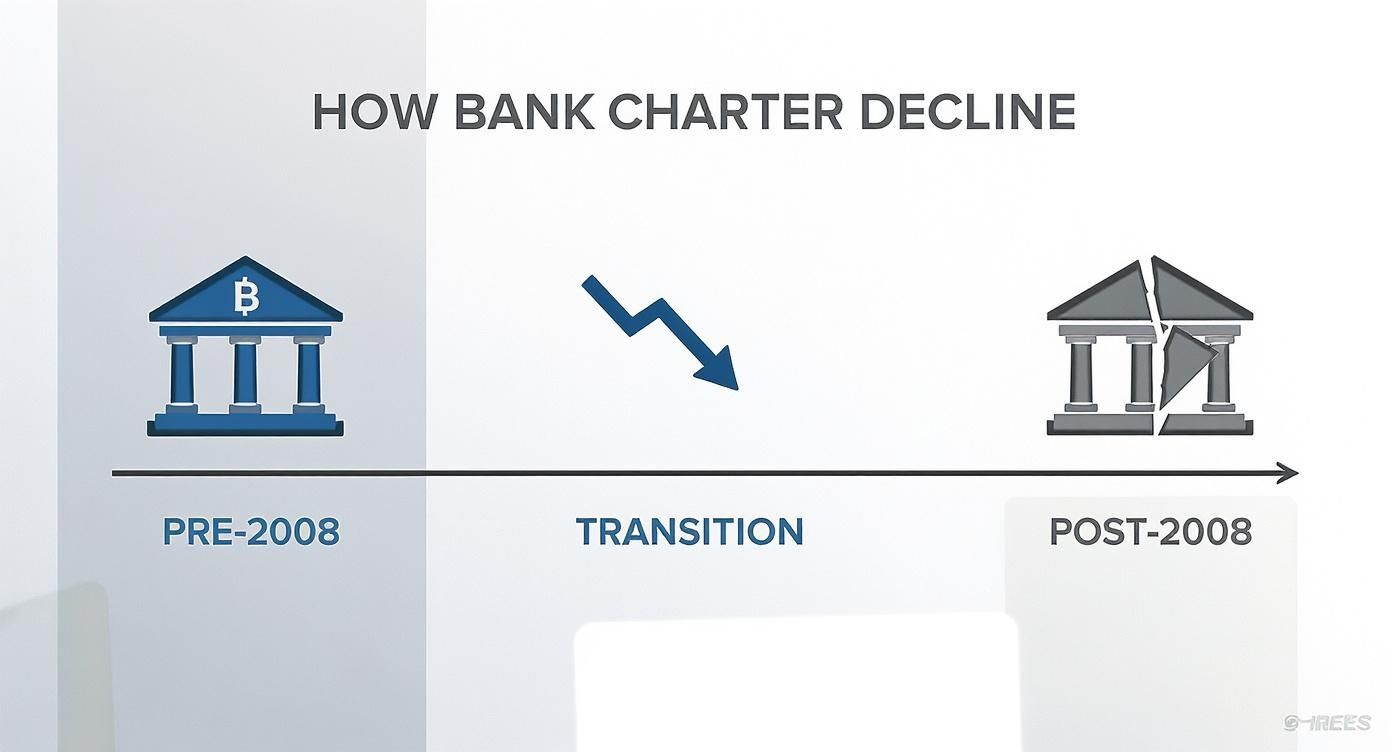
This chart illustrates a critical point: the once-steady flow of new banks slowed to a trickle because the approval process became substantially more rigorous.
The Three Phases of Chartering
The path to opening a de novo bank can be segmented into three distinct phases, each with its own challenges and capital requirements.
- Pre-Filing (6-9 Months): This initial phase involves assembling the organizing group, defining the business concept, and raising initial seed capital. A credible board with deep financial and operational expertise is non-negotiable. The primary deliverable is a comprehensive business plan—often several hundred pages—and the formal application submission.
- Application Review (9-15 Months): Upon submission, intense regulatory scrutiny begins. Regulators will dissect every assumption in the business plan, from financial projections and risk management frameworks to the qualifications of the proposed management team. During this phase, the main capital raise—typically between $25 million and $50 million—must be secured to demonstrate financial viability.
- Pre-Opening (3-6 Months): Following conditional approval, the operational build-out commences. This involves hiring core staff, implementing the technology stack, finalizing policies and procedures, and preparing for the final pre-opening regulatory examination. This exam verifies that the bank is prepared to operate safely and soundly.
Data as a Strategic Asset in the Application
Modern regulators are not persuaded by ambitious narratives alone. They demand empirical evidence that a business plan is viable and has a credible path to profitability. Data intelligence platforms like Visbanking can transform this compliance requirement into a strategic advantage.
Consider a hypothetical 'Fintech Community Bank' targeting small businesses in a specific metropolitan statistical area (MSA). Instead of relying on broad economic statements, the application can be fortified with precise data.
A business plan substantiated by verifiable market data is infinitely more credible to regulators. It demonstrates rigorous due diligence and a quantitative understanding of the market.
For example, the Fintech Community Bank application could demonstrate:
- Market Opportunity Analysis: By analyzing UCC filing and SBA loan data, the organizers could identify a $500 million addressable market of underserved businesses within a 20-mile radius that are not being adequately serviced by incumbent banks.
- Competitive Benchmarking: Pro forma financials can be benchmarked against the actual performance of peer banks in similar markets. Projecting a year-three efficiency ratio of 65% is far more credible when supported by data showing that high-performing peers achieve this metric.
This data-driven approach demonstrates to regulators that the strategy is based on quantitative analysis, not intuition. It proves the strategic rigor necessary for success.
How Fintech Is Reshaping the De Novo Landscape
The current wave of de novo banks is fundamentally a fintech phenomenon. Technology-first firms are aggressively pursuing full banking charters, representing a strategic pivot away from the Banking-as-a-Service (BaaS) model. For executives at established banks, understanding this shift is critical to assessing the nature of emerging competition.

This trend is accelerating. As of late 2023, approximately 20 filings for de novo charters, bank acquisitions, or conversions were in the pipeline—a multi-year high. This activity is overwhelmingly driven by fintech companies seeking the stability and strategic advantages of a full charter. It marks a significant departure from the previous decade, which saw an average of less than six new bank formations per year.
The Strategic Drivers Behind the Charter Pursuit
Why are sophisticated technology companies willing to endure the 18-to-24-month chartering process and commit $25 million to $50 million in initial capital? The decision is rooted in three core advantages that a BaaS partnership cannot provide.
- Direct Payment Rail Access: A full charter grants direct access to the Federal Reserve's payment systems. This disintermediates the BaaS partner, reducing transaction fees and counterparty risk, resulting in faster, more reliable, and lower-cost payments.
- A Stable, Low-Cost Funding Source: The ability to hold FDIC-insured deposits is a strategic game-changer. It provides a stable, low-cost source of funding compared to venture capital or wholesale funding. This cost advantage translates directly to more competitive loan pricing and superior net interest margins.
- Regulatory Legitimacy and Control: Owning the charter means owning the compliance framework and the direct relationship with regulators. This eliminates the existential risk of a BaaS partner facing regulatory action, providing long-term stability and strategic autonomy.
The pursuit of a bank charter is not a product launch; it is an enterprise-building strategy. Fintechs are graduating from renting balance sheets to building their own.
The Competitive Edge of Tech-Enabled De Novos
For executives at traditional banks, the implication is clear: these technology-powered de novos represent a new class of competitor. Their advantages are not theoretical; they are operationally embedded from day one.
As fintech continues to reshape banking, these new institutions will also leverage specialized platforms to gain an operational edge, such as fintech solutions for chargeback management.
Their technology-first operating model yields superior unit economics. For example, a digital-native de novo might achieve a customer acquisition cost (CAC) of $200, whereas a community bank with a physical branch network might face a CAC closer to $900. This 78% cost advantage allows the new entrant to offer more competitive pricing or reinvest savings into superior product development. For further analysis, review the latest trends in the fintech industry.
Furthermore, these new banks use data intelligence to surgically target profitable niches that larger, more diversified banks may overlook. A new entrant could analyze SBA and UCC filings to identify a $300 million market of independent creative agencies in a specific city, then develop a bespoke suite of lending and cash management products tailored to their unique needs.
This precision, combined with a leaner cost structure, creates a formidable competitive threat. To respond effectively, incumbent banks must employ data with equal sophistication to benchmark their own performance and identify these emerging players before they capture market share.
Assessing De Novo Risks and Failure Rates
While the opportunities for de novo banks are significant, the risks are substantial. For an executive at an established bank, understanding these risks is not about discouraging new entrants. It is about sharpening your own competitive strategy. Identifying a new bank's vulnerabilities allows you to leverage your institution's inherent strengths.
The data is unequivocal: new banks operate in a higher-risk environment. Research from the Federal Reserve indicates that de novo banks fail at more than double the rate of established institutions. This statistic reflects the immense operational, market, and capital pressures these startups face during their formative years.
This elevated risk profile manifests in specific, measurable ways that every new management team must confront.
The Profitability Gauntlet
The primary challenge for any de novo bank is the arduous path to profitability. From inception, they operate at a significant disadvantage, forced to build an entire asset base from zero while absorbing high upfront operating expenses.
A de novo bank must run a multi-year marathon with the financial reserves of a sprinter. High initial costs for technology, talent, and compliance mean they are expected to be unprofitable for their first three to five years, a period of intense regulatory scrutiny and capital consumption.
This "profitability gauntlet" creates predictable vulnerabilities. For instance, a new competitor might price loans aggressively to rapidly build its portfolio. With the right data intelligence, an established bank can model how long the de novo can sustain such a strategy before its net interest margin erodes, forcing it to raise additional capital or retreat. This analysis provides a clear window for a strategic countermove.
Key Pressure Points for De Novo Institutions
Beyond the overarching challenge of profitability, several specific pressures define the early life of a de novo. Each represents a potential point of failure.
- High Initial Operating Costs: A new bank incurs significant expenses for core systems, cybersecurity, and infrastructure before generating meaningful revenue. An established bank with a mature, amortized technology stack holds a significant efficiency ratio advantage.
- Building a Stable Deposit Base: Attracting low-cost, stable core deposits without established brand equity is difficult. De novo banks often must offer higher rates or rely on more volatile non-core funding, which negatively impacts their cost of funds and long-term stability.
- Navigating Heightened Supervision: For its first three years, a de novo operates under heightened regulatory supervision. The FDIC enforces a formal agreement requiring more frequent examinations and strict adherence to the initial business plan. Any deviation can trigger corrective actions, severely limiting operational flexibility.
A robust competitive analysis requires a deep dive into these factors, mirroring the rigorous process outlined in our guide for a bank risk assessment template. By benchmarking a new competitor’s projections against these known challenges, you can anticipate their actions and identify their weaknesses.
For example, by monitoring a de novo’s deposit growth and composition, you can determine if they are successfully building a stable funding base or resorting to expensive brokered deposits out of necessity. This transforms competitive monitoring from a passive exercise into a powerful, actionable strategic tool.
Building Your Strategic Response to New Competition
When a de novo bank enters your market, inaction is not a viable strategy. It is a clear signal of a shifting competitive landscape that demands a decisive, data-informed response.
For established banks, the question is not if you will react, but how. Passivity cedes the initiative, allowing a nimble competitor to define the terms of engagement—an unacceptable outcome.
The formulation of an effective response begins with a rigorous and honest assessment of your own institution's strengths, weaknesses, and risk appetite. This is a moment for hard data, not boardroom intuition.
The Three Strategic Pathways
Three primary strategic pathways exist for addressing a new de novo entrant: compete directly, collaborate through partnership, or acquire the new entity.
Compete: This is the logical response for institutions with a strong balance sheet and a commitment to investment. The strategy involves leveraging existing scale, customer relationships, and brand equity to outperform the newcomer on service, price, or product innovation. This requires a candid internal assessment to identify and address the specific market gaps the de novo aims to exploit.
Collaborate: If the de novo possesses superior technology or has captured a niche market that is inefficient for you to serve directly, a partnership may be the most prudent course. You provide the balance sheet, regulatory infrastructure, and distribution, while they provide the innovation. This is a capital-efficient method for acquiring new capabilities without the risk and expense of internal development.
Acquire: For well-capitalized banks, acquiring a promising de novo is a decisive move. This action instantly neutralizes a threat while absorbing its technology, talent, and customer base. It is the fastest path to turning a competitive threat into a strategic asset, but it carries significant integration risk and requires a sophisticated M&A execution capability.
The decision to compete, collaborate, or acquire cannot be made in a strategic vacuum. It must be the direct output of a data-driven analysis that benchmarks your performance against the market and quantifies the de novo's potential impact.
Let's use a practical example.
Imagine a new de novo projects a 4.50% net interest margin by targeting a high-yield commercial niche you currently dominate. This is a direct threat to your profitability that requires a competitive response. Using a platform like Visbanking, you can model the precise impact of matching their rates on your own P&L, enabling you to craft a calculated and sustainable counter-offer.
Alternatively, if a new fintech-chartered de novo is acquiring customers for $150 each due to a superior digital platform, attempting to replicate that technology internally could be prohibitively expensive. In this scenario, a collaboration or acquisition may be the only financially sound strategic options.
Strategic Response Matrix for Incumbent Banks
The decision-making process must be structured. This framework is designed to guide an executive team through a systematic evaluation of the options, ensuring alignment based on the bank's unique strategic position.
| Strategic Option | Key Objective | Required Capabilities | Potential Risks | Success Metric (KPI) |
|---|---|---|---|---|
| Compete | Defend market share and leverage existing scale to outperform the newcomer. | Strong balance sheet, agile product development, marketing budget, operational efficiency. | High capital expenditure, potential price wars, slow execution. | Customer retention rates, market share stability, Net Interest Margin (NIM). |
| Collaborate | Access new technology or market segments without building from scratch. | Partnership management, API integration, strong compliance oversight, clear legal frameworks. | Partner dependency, brand dilution, culture clash, revenue sharing conflicts. | New revenue from partnership, customer acquisition cost (CAC) reduction. |
| Acquire | Instantly neutralize a competitor and absorb their technology, talent, and customers. | Strong M&A execution team, capital for acquisition, post-merger integration expertise. | High upfront cost, massive integration challenges, regulatory hurdles, talent flight. | ROI on acquisition, successful tech/product integration, customer base growth. |
Ultimately, the goal is not to choose a box, but to conduct a clear-eyed assessment that leads to a deliberate, data-backed strategic decision.
The rise of de novo banks is not simply a threat; it is a catalyst for strategic action. With the right market intelligence, this competitive pressure can be converted into a significant strategic advantage.
Burning Questions About De Novo Banks
For any banking executive, the return of the de novo bank raises critical questions about the evolving competitive landscape. Here are direct, data-driven answers to the most pressing inquiries.
How Much Cash Does It Take to Start a De Novo Bank?
The capital required today is substantial: $25 million to $50 million in initial capital is the current standard.
This figure is significantly higher than pre-2008 levels due to a more demanding regulatory environment. Regulators require sufficient capital to absorb projected operating losses for the first three to five years—the period during which new banks are almost certain to be unprofitable.
Organizers cannot simply propose a number; they must substantiate it. This is where data intelligence platforms become invaluable, allowing them to demonstrate to regulators that their capital plan is a sound projection based on the performance and cost structures of relevant peer banks.
How Long Is the Wait to Open the Doors?
The timeline from conception to launch is an 18 to 24-month marathon.
The process can be broken into three phases:
- Organizational Phase (6-9 months): Assembling the management team and board, developing a comprehensive business plan, and raising initial seed capital.
- Regulatory Review (9-15 months): The period of intense regulatory scrutiny where every assumption in the application is rigorously vetted.
- Pre-Opening Execution (3-6 months): Following conditional approval, this is a sprint to implement technology, hire staff, and prepare for the final pre-opening examination.
This lengthy and expensive process consumes significant capital in legal and consulting fees long before the bank generates its first dollar of revenue.
Do De Novos Make Money Right Away?
No. Profitability is the single greatest challenge, and all stakeholders—especially regulators—expect a de novo bank to operate at a loss for its first three to five years.
These initial years are defined by high cash burn for technology, salaries, and compliance, while the asset base is slowly built. Regulators will monitor performance closely against the business plan's milestones, such as progress toward a target 1.0% Return on Assets (ROA).
For an established bank, this predictable period of vulnerability is a strategic asset. You can model a competitor's burn rate to anticipate when they will face capital pressure, creating a strategic window to act.
A de novo’s path to profitability is a predictable gauntlet. Understanding their financial pressure points—from their cost of funds to their efficiency ratio projections—is critical for any incumbent crafting a competitive response.
What's the Real Difference Between a De Novo and a Fintech with a BaaS Partner?
The fundamental distinction is ownership of the bank charter. It is the difference between owning the underlying asset and leasing access to it.
- A de novo bank holds its own charter, granting it direct access to FDIC insurance and the Federal Reserve's payment systems. This provides institutional stability, strategic control, and a lower cost of funds. It is directly accountable to regulators.
- A fintech with a BaaS partner is leasing access to another institution's charter. This creates significant counterparty risk. If the partner bank faces regulatory enforcement action, the fintech's operations can be disrupted or shut down with little warning.
This inherent risk is precisely why a growing number of fintechs are pursuing their own charters. They are strategically choosing long-term stability and control over short-term speed to market.
The de novo trend is reshaping the competitive landscape. Your institution can either observe these changes or leverage them to its advantage. Effective action requires sharp, actionable intelligence. Visbanking provides the data to benchmark your performance against new entrants, identify their vulnerabilities, and formulate a winning strategy. See how data can protect your market share at https://www.visbanking.com.
Related Articles

Visbanking Blog
Fastest Growing Banks: Who's Winning the Asset Race?

Visbanking Blog
Revolutionize Your Banking Operations with Data-Driven Insights from BIAS

Visbanking Blog
Bank Branch Networks: Are Physical Locations Still Relevant?

Visbanking Blog
Empowering Banks with Visbanking's Enterprise Solution: Performance, Prospects, and Talent Insights

Visbanking Blog
BIAS: Your Competitive Edge in Banking Data Driven Strategy

Visbanking Blog