
A Banking Executive's Guide to Checking a Business Credit Rating
Brian's Banking Blog
When an executive team needs to check a business credit rating, a cursory look at a single score is insufficient. A superficial review exposes the institution to unnecessary risk, while a comprehensive assessment reveals both hidden threats and strategic opportunities.
True due diligence requires triangulating data from the three primary commercial bureaus—Dun & Bradstreet, Experian, and Equifax—and layering in supplemental intelligence, such as UCC filings. This methodology builds a robust risk profile that drives sound, data-backed lending decisions and protects the bank’s balance sheet.
The Strategic Imperative of Comprehensive Credit Analysis
For any banking institution, accurately checking a business credit rating is the foundation of prudent risk management and sustainable portfolio growth. This process is not a procedural formality; it is an intelligence-gathering function that directly informs lending decisions, shapes client relationships, and safeguards the financial health of the bank.
Each major credit bureau utilizes proprietary scoring models and unique data sets. A business may present a strong profile in one report and a concerning one in another. Relying on a single source provides an incomplete, and therefore dangerously flawed, assessment of risk.
The Three Pillars of Commercial Credit Intelligence
The commercial credit landscape is dominated by three key bureaus. Understanding the specific insights each provides is critical to constructing a holistic risk profile.
- Dun & Bradstreet (D&B): Renowned for its global database and the D-U-N-S® Number, D&B’s PAYDEX® score offers a clear, historical view of a company's payment performance with its suppliers.
- Experian: This bureau excels at integrating trade payment data with public records, including liens, judgments, and bankruptcies. This provides a broader perspective on a company's legal and financial encumbrances.
- Equifax: Equifax provides critical insights into a company’s management of financial accounts, such as term loans and lines of credit, alongside its trade payment history. This is invaluable for assessing how a business manages existing credit facilities.
The following table provides a strategic summary.
Key Commercial Credit Bureaus for Banking Diligence
| Bureau | Primary Score Model | Key Data Points | Strategic Application |
|---|---|---|---|
| Dun & Bradstreet | PAYDEX® Score (1-100) | Trade payment history, D-U-N-S® Number, company size/history | Assessing supplier payment reliability and operational consistency. |
| Experian | Intelliscore Plus℠ (0-100) | Trade payments, public records (liens, judgments), UCC filings, collections | Gaining a blended view of payment behavior alongside legal and financial obligations. |
| Equifax | Business Credit Risk Score™ | Financial account data (loans, leases), trade payment history, public records | Evaluating how a business manages existing credit facilities with financial institutions. |
Synthesizing intelligence from each bureau allows a credit committee to identify patterns that a single-source review would miss.

Empirical data validates this approach. Institutions that implement proactive, multi-source credit monitoring have historically reduced default rates by as much as 30% during periods of economic contraction. S&P Global's analysis of resilient global credit conditions underscores the value of such vigilance.
A fragmented view of credit risk inevitably leads to flawed decisions. Integrating disparate data sources into a single intelligence platform, such as Visbanking, creates a holistic, actionable profile of every commercial client and prospect.
This strategic approach transforms the credit check from a reactive, administrative task into a proactive tool for risk mitigation and opportunity identification. It is how data-driven institutions sharpen your bank's competitive edge.
Decoding the Three Pillars of Commercial Credit Data
A single-bureau credit assessment is an incomplete and hazardous foundation for any lending decision. For banking leaders, relationship managers, and credit officers, true insight is derived from synthesizing data across the three major bureaus: Dun & Bradstreet, Experian, and Equifax.
Mastery of their distinct methodologies and proprietary scores is fundamental to making defensible credit decisions.
Significant variances between bureau scores are not errors; they are critical signals demanding deeper investigation. Each report offers a unique analytical lens, and the discrepancies between them often tell the most important part of the story.
Interpreting Core Commercial Scores
The primary scores from each bureau are designed to predict different outcomes, from payment delinquency to business failure. Understanding the inputs of each model is essential to interpreting its outputs.
Dun & Bradstreet’s PAYDEX® Score (1-100): This score is a direct, dollar-weighted measure of payment history, reflecting how a business pays its suppliers based on trade experiences. A score of 80 indicates prompt payment; 100 signifies early payment. It is a straightforward indicator of operational discipline. For a deeper analysis, review our overview of Dun & Bradstreet data and its applications in banking.
Experian’s Intelliscore Plus℠ (0-100): This model provides a broader risk assessment by incorporating trade payment data with public records—including liens, judgments, and bankruptcies—and UCC filings. A strong PAYDEX® score can be misleading if a low Intelliscore reveals significant, underlying legal or financial liabilities.
Equifax’s Business Credit Risk Score™ (101-992): Equifax places significant weight on how a company manages its financial obligations, such as loans and leases. This score is a powerful predictor of future loan performance, as it is based on historical management of credit facilities.
Triangulating these data points is not optional; it is a core tenet of sound risk management. A business may appear creditworthy through one bureau's lens while exhibiting severe warning signs in another. True credit intelligence emerges from the synthesis of this information.
A Practical Scenario in Triangulation
Consider a loan application from a mid-sized manufacturing firm with $25,000,000 in annual revenue. The initial credit analysis reveals contradictory scores:
- D&B PAYDEX® Score: 78 (Consistently paying suppliers within terms.)
- Experian Intelliscore Plus℠: 45 (A high-risk indicator.)
- Equifax Business Credit Risk Score™: 650 (Moderate risk.)
Dismissing the low Experian score as an anomaly would be a critical error.
A thorough analysis reveals the cause: the company is maintaining its supplier payments, hence the solid PAYDEX® score. However, Experian's data has captured two recent UCC filings from alternative lenders and a pending tax lien. Equifax's data reflects this added risk, resulting in its more cautious score.
This triangulation reveals the true narrative: the company is likely facing a working capital crisis. It is prioritizing trade credit to maintain operations while securing high-cost financing to cover more significant obligations. This is precisely the nuanced insight a unified platform like Visbanking is designed to surface, transforming conflicting data points into a clear, actionable risk narrative and enabling a confident, data-backed decision.
Operationalizing Commercial Credit Report Acquisition
Acquiring the data to check a business credit rating is a critical operational function. Banking leaders must evaluate the options—direct bureau access, third-party resellers, or API integrations—based on workflow efficiency, cost, and data integrity.
The traditional approach involves relationship managers or credit analysts logging into separate portals for Dun & Bradstreet, Experian, and Equifax. This method is inefficient, time-consuming, and prone to manual entry errors. It allocates highly skilled personnel to administrative tasks rather than strategic client engagement or analysis.
The Strategic Value of Integrated Data Systems
A superior approach is to integrate commercial credit data directly into the bank’s core intelligence platform via APIs. This is not merely a matter of convenience; it fundamentally improves operational effectiveness by embedding critical credit information into existing workflows, eliminating redundant data entry, and establishing a single source of truth.
For example, an API integration can reduce a relationship manager's manual data entry tasks by over 90%, freeing up dozens of hours per month for portfolio management and business development. This unified view, where external bureau data is seamlessly combined with internal bank data, is the hallmark of modern credit information systems.
Integrating commercial credit data is a strategic necessity. Embedding real-time credit signals directly into your bank's daily workflows transforms risk management from a reactive, historical review into a proactive, forward-looking discipline.
Identifiers and Compliance
Regardless of the acquisition method, data accuracy and regulatory compliance are paramount. The process begins with using the correct business identifiers.
- Employer Identification Number (EIN): The primary identifier for U.S. federal tax purposes.
- D-U-N-S® Number: Dun & Bradstreet's proprietary global identifier, essential for leveraging its extensive database.
Furthermore, all processes must adhere to legal and regulatory standards. While the Fair Credit Reporting Act (FCRA) primarily governs consumer credit, its principles of accuracy and permissible purpose are best practices in the commercial lending sphere. Ensuring an efficient and compliant process is non-negotiable.
Ultimately, the objective is to create a seamless flow of intelligence. By integrating external credit data into a platform like Visbanking, an institution can move beyond simple report pulling. It can benchmark a prospect’s financial health against industry peers, establish automated risk alerts for its portfolio, and equip its team with the complete, actionable intelligence needed to make smarter, faster decisions.
Reading Between the Lines of a Credit Report
A business credit score is the headline; the substantive analysis lies within the detailed report. The ability to look beyond the summary score and interpret the underlying data is what separates basic due diligence from true risk foresight. This skill transforms a static document into a dynamic narrative of financial behavior.
The key is to identify patterns and subtle signals hidden within the data. A strong payment score can mask significant underlying weaknesses. The objective is to find leading indicators of financial stress that predict future behavior, not just report on past actions.
Identifying Critical Red Flags
When you check a business credit rating, several data points warrant immediate and thorough scrutiny. These are not just numbers; they are direct indicators of financial stability and management quality.
- UCC Filings: A recent increase in Uniform Commercial Code (UCC) filings, particularly from non-traditional or high-interest lenders, is a significant warning sign. It often indicates that the business has exhausted conventional credit sources and is resorting to more expensive, and often riskier, forms of financing.
- Collection Actions and Judgments: Any new collection activity or legal judgment is an unambiguous signal of financial distress. These public records represent a failure to meet obligations and are powerful predictors of future default.
- Deteriorating Payment Trends: A business may maintain a "prompt" payment classification to protect its score, but a trend analysis might reveal that payment cycles are extending from 15 days to 28 days. This gradual slowdown is an early indicator of tightening liquidity.
Modern bank intelligence platforms are designed to address this challenge. Instead of requiring manual deep-dives, systems like Visbanking can automatically surface these predictive risk signals, flagging accounts that require immediate attention from the credit or relationship management team.
A Real-World Look at Predictive Risk
Consider a prospective borrower in the logistics sector with a respectable PAYDEX® score of 75. On the surface, the company appears to be a low-risk client.
However, a deeper analysis reveals three new UCC liens filed in the last quarter by merchant cash advance companies. Concurrently, their average days-to-pay with key suppliers has deteriorated from 20 to 45 days. This narrative, entirely invisible in the top-line score, points to a business struggling with working capital and relying on high-cost, short-term financing to maintain operations.
A credit report is a historical document. Effective risk management requires translating that history into a forward-looking assessment. By connecting disparate data points like UCC filings and payment trends, you can identify a potential default months before it impacts the headline score.
The current global economic climate makes this level of analysis more critical than ever. Poor credit profiles directly impact cash flow. A recent Allianz Trade analysis found that USD 1.1 trillion in international trade receivables are in high-risk countries, magnifying collection challenges and potential losses for lenders. It is well-documented that financial institutions monitoring credit ratings on a quarterly basis can reduce non-performing loans by an average of 25%.
Executing this requires reliable data and the correct identifiers, such as the D-U-N-S® Number. Learn more about what a D-U-N-S® Number is and why it matters in our guide.
When a credit check is elevated from a simple lookup to a deep analysis, your institution gains a significant competitive advantage. It is time to benchmark your current process against what modern data intelligence makes possible.
Integrating Credit Intelligence into the Banking Workflow
Acquiring a credit report is merely the first step. The strategic value is realized when that data is converted into action. A bank's ability to effectively check a business credit rating is measured not by its ability to pull a score, but by its capacity to embed that intelligence into daily operations to manage risk and identify growth opportunities.
For business development teams, this means replacing outdated call lists with data-driven prospecting. Arming them with credit intelligence from the outset allows them to pre-qualify prospects, identify financially sound targets, and enter initial meetings with a clear understanding of the business's financial health and potential needs.
From Static Reports to Dynamic Risk Monitoring
For relationship managers responsible for the existing portfolio, a one-time credit check at origination is dangerously inadequate. The standard of care has shifted to continuous monitoring. An effective system must automatically generate an alert the moment a client's credit standing deteriorates.
This capability transforms relationship managers from reactive problem-solvers into proactive risk managers. Instead of learning of a problem after a payment is missed, an automated alert about a new UCC filing or a degrading payment trend allows them to engage the client preemptively.
The objective is to minimize the latency between a negative credit event and the bank's response. Automating risk signals enables proactive intervention, which protects the bank's assets and preserves valuable client relationships.
A Playbook for Proactive Risk Management
Consider a common scenario: a key commercial client, a mid-sized distributor with a $2,000,000 line of credit. A modern bank intelligence platform like Visbanking flags a new UCC lien filed by a high-interest, non-bank lender.
The response protocol is as follows:
- Immediate Notification: The relationship manager receives an instant email or CRM notification detailing the lien and flagging the associated risk.
- Collaborative Review: The RM convenes with a credit officer. Using a unified platform, they review the client's complete profile—payment history, existing credit facilities, and this new filing.
- Strategic Engagement: Armed with comprehensive data, the RM contacts the client. The conversation is not accusatory but consultative: "We observed a recent filing and wanted to understand if there have been any changes in your working capital needs."
A potential default is thus converted into an opportunity to strengthen the relationship. The bank may be able to restructure the credit facility to better meet the client's needs, securing its own position while reinforcing its role as a strategic partner.
Market analysis supports this proactive stance. Fitch Ratings recently noted that 82% of corporate sector outlooks are currently 'neutral'. While this suggests stability at a macro level, it masks significant performance volatility among individual companies. Historically, businesses with stronger credit profiles can access capital at rates up to 40% lower in constrained markets. Banks with real-time data pipelines can reduce credit decisioning time by 50% and act with greater certainty. You can explore the corporate finance trends in the full analysis here.
This flowchart outlines a disciplined process for identifying and acting on early warning signs.
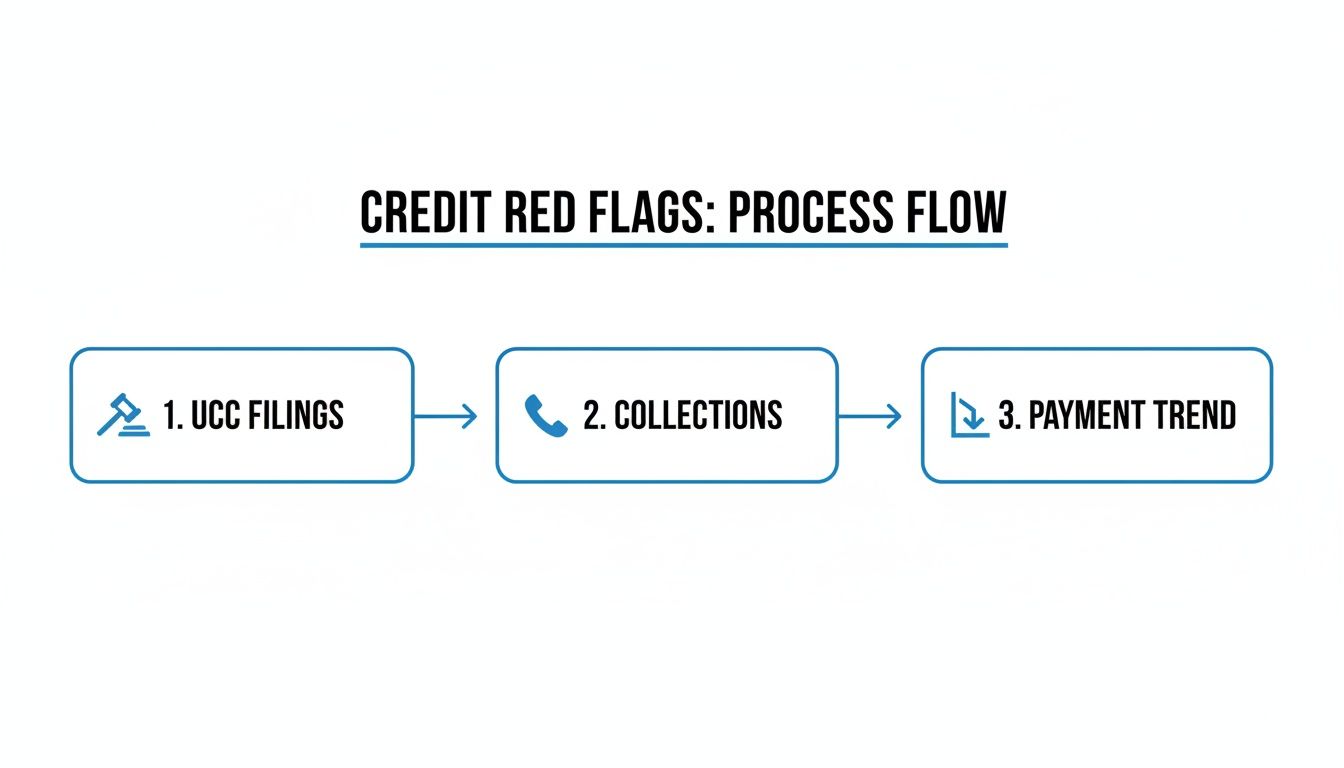
As illustrated, events like UCC filings and payment slowdowns are leading indicators of financial distress, often appearing long before a material decline in the headline credit score.
By implementing these intelligent workflows, your institution moves beyond simply checking credit. You are building a system that anticipates risk, identifies opportunities, and fosters stronger, more profitable client relationships.
Critical Questions for Bank Leadership
Deriving actionable intelligence from a business credit report requires asking the right questions. The following are common inquiries from banking teams focused on making faster, more informed credit decisions.
How Often Should a Business's Credit Be Formally Reviewed?
The traditional standard of an annual review is now merely the baseline. For high-risk sectors or significant exposures—for instance, credit lines exceeding $1,000,000—a quarterly review is the minimum for responsible risk management. For any new prospect, a full credit assessment is a day-one requirement.
However, modern bank intelligence platforms render this calendar-based approach obsolete. The new standard is automated, continuous monitoring. This technology provides real-time alerts for material changes—a new lien, a judgment, or deteriorating payment patterns. This shifts the risk management posture from reactive and cyclical to proactive and continuous.
What is the Substantive Difference Between a Business and a Personal Credit Score?
A personal credit score (typically a 300-850 range) measures an individual's management of personal debt. A business credit score assesses a company's management of its commercial obligations to suppliers, vendors, and lenders. The underlying models are entirely different. D&B's PAYDEX® score, for example, is a 1-100 scale focused exclusively on payment velocity.
The input data also differs fundamentally. Business reports are constructed from trade payment histories, public records (lawsuits, bankruptcies), UCC filings, and industry-specific risk factors. While a small business owner's personal credit is almost always reviewed for a guaranteed loan, the business's own credit rating is the primary indicator of its capacity to service its commercial debt.
When scores from different bureaus diverge, it is not an error—it is an analytical signal. A business may strategically maintain a high PAYDEX® score by prioritizing key suppliers, while a tax lien reported only to Experian severely depresses its Intelliscore. Relying on a single source is a formula for being blindsided.
Why Can a Business Score Differ So Significantly Between Bureaus?
Significant variance is not only possible but expected. These differences often contain the most critical insights. Each bureau uses a proprietary data collection network and a unique scoring algorithm.
Consider this common scenario: a construction contractor maintains impeccable payment terms with its material suppliers, earning it an excellent Dun & Bradstreet PAYDEX® score. Simultaneously, an outstanding lawsuit or tax lien, captured only in its Experian report, results in a dangerously low Intelliscore. A credit decision based solely on the D&B report would be based on an incomplete and misleading risk profile. Triangulating data from all three major bureaus is the only method to uncover the complete financial narrative.
True foresight in banking isn’t about having more data; it's about seeing the complete picture in one place. Visbanking provides the intelligence platform to benchmark prospects, monitor portfolio risk in real-time, and give your teams the unified view they need. See how we turn disconnected data into decisive action at https://www.visbanking.com.
Related Articles

Visbanking Blog
Unveiling the US Banks Credit Quality Chart on VisBanking Report Portal

Visbanking Blog
How does a bank decide whether or not your business qualifies for a loan?

Visbanking Blog
Capital Banking in the USA: An Overview of Investment Services, Financial Instruments, and Regulations

Visbanking Blog
Make Better Decisions with Confidence with BIAS, the Tailored Strategies Solution

Visbanking Blog
Revolutionize Your Banking Operations with Data-Driven Insights from BIAS

Visbanking Blog