
Driving Commercial Deposits with Data-Driven Prospecting
Brian's Banking Blog
In today's hyper-competitive banking landscape, sustainable growth in commercial deposits is no longer a product of relationships alone. It is the direct result of superior data intelligence and a proactive, surgical strategy. Modern cash management prospecting software is the engine that transforms the art of sales into a predictive science, equipping your relationship managers to win high-value accounts.
The Mandate For Data-Driven Deposit Growth
Relying on traditional prospecting methods—cold calls, anecdotal leads, and intuition—is inefficient and insufficient for meeting growth targets. The market is saturated, and commercial clients expect sophisticated financial partners who arrive with data-backed insights, not generic sales pitches. This environment demands a fundamental shift in how banks pursue deposit growth.
For bank executives, the central question is tactical: how do you arm your relationship managers with the intelligence required to identify and capture untapped commercial deposits? Without a systematic, data-driven framework, your institution is ceding market share to competitors who have already weaponized market intelligence.

From Relationship Banking To Intelligence-Led Growth
The strategic mandate is to move beyond identifying large companies and pinpointing specific businesses with suboptimal treasury structures or significant, untapped operating cash. This level of analysis is impossible with conventional methods.
Consider a hypothetical $50 million manufacturing firm. Traditional prospecting flags it based on revenue. An intelligence-led approach, powered by platforms like Visbanking, provides a far more granular and actionable picture. Data analysis might reveal:
- The company holds an average of $4.5 million in a non-interest-bearing account at a competitor bank—a significant opportunity cost.
- Payment data indicates a heavy reliance on manual checks, signaling a clear need for ACH or lockbox services.
- Recent UCC filings for new equipment suggest changes in capital expenditure and future cash flow requirements.
This intelligence transforms a cold outreach into a strategic consultation. Your team is no longer asking for business; they are presenting a data-backed solution to a balance sheet problem the prospect may not have fully quantified. Leveraging AI business solutions for unlocking growth is critical here; it automates the analysis of vast datasets to surface these precise opportunities.
The objective is no longer to find prospects. It is to find the right prospects at the right time with the right solution. This precision is achievable only through robust data intelligence.
By applying sophisticated analytics, banks can target companies with surgical accuracy and tailor treasury solutions to specific, identified needs. This provides a decisive competitive advantage. The first step is recognizing that market data is your most valuable, underutilized asset for strategic growth.
How Modern Prospecting Software Actually Works
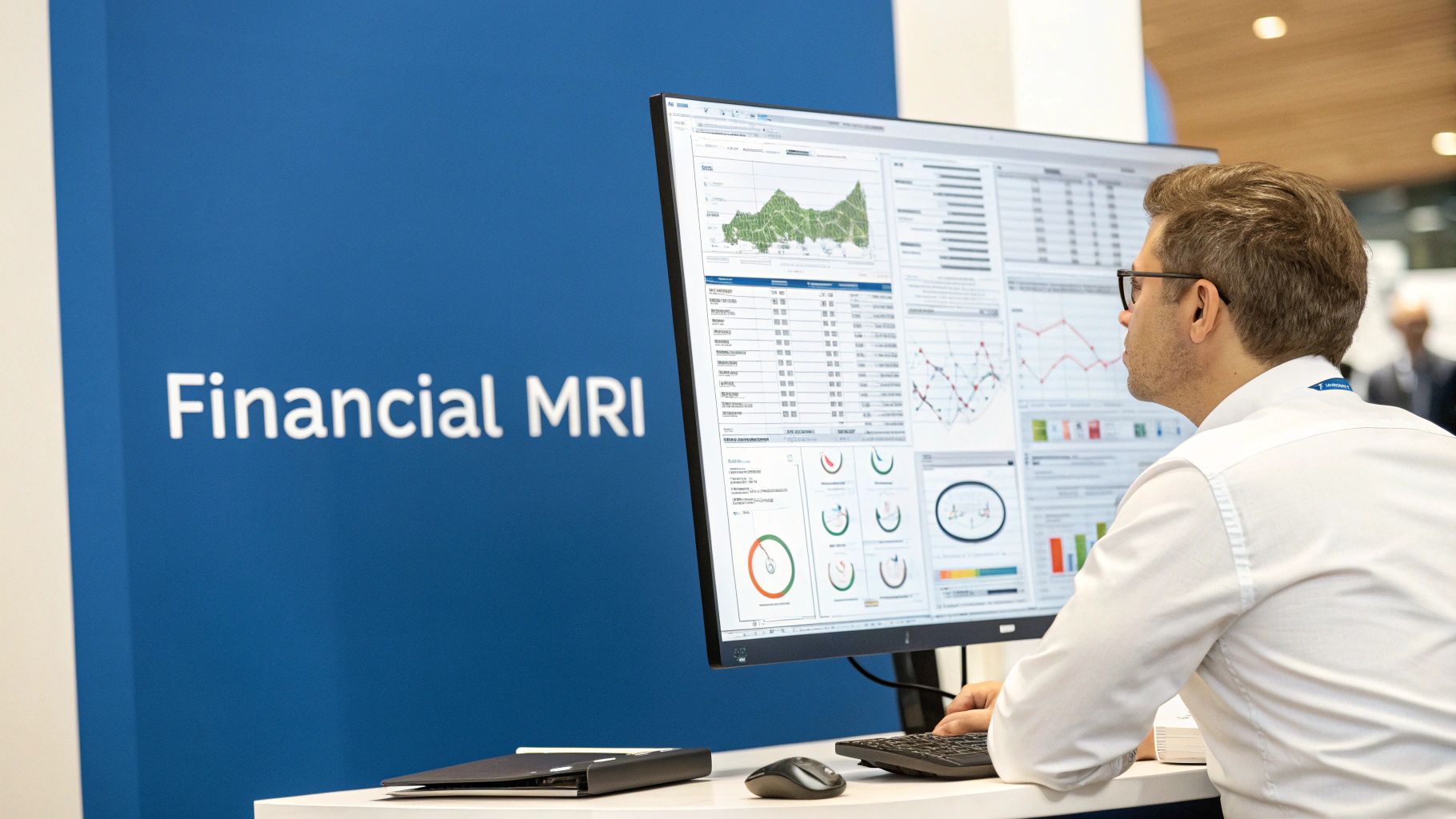
Cash management prospecting software is not another CRM. It is a dedicated intelligence engine designed to uncover high-value commercial deposits by providing financial X-ray vision into your market. While a CRM manages existing relationships, this software identifies the new relationships you should be initiating.
It synthesizes disparate data sources—public financial records, UCC filings, import/export data, and industry benchmarks—to construct a comprehensive financial profile of potential clients. Its primary function is to identify companies with inefficient cash management structures, converting a sea of market data into a curated list of high-probability leads.
From Raw Data to Actionable Intelligence
The core of this technology lies in sophisticated AI-powered data extraction engines. These systems do not merely aggregate information; they analyze it to detect trigger events and financial behaviors that signal an immediate need for treasury services.
For example, the software might identify a mid-sized distributor holding $3,500,000 in excess cash within a low-yield account at a competitor. It deduces this by analyzing the company’s financials and benchmarking its working capital against industry peers (by NAICS code). The platform immediately flags this as a qualified opportunity.
This arms your relationship managers with specific, data-backed insights, enabling them to lead with value. They transition from product sellers to strategic advisors, prepared to discuss and solve a quantifiable financial problem.
It’s a fundamental shift from asking "who could we bank?" to knowing "who should we bank, and why right now?" The software provides data-driven answers to these critical questions.
Identifying Triggers for Treasury Needs
Timing is a critical variable in treasury sales. A company’s need for enhanced cash management services is often triggered by specific business events. The most effective prospecting software is engineered to detect these signals in real time.
Consider these actionable triggers a platform like Visbanking can surface:
- Rapid Growth: A private logistics company’s revenue increases by 40% year-over-year. This growth is a strong indicator that its existing cash management infrastructure is under strain and requires upgrading.
- Supply Chain Expansion: Import/export data reveals a local manufacturer is now sourcing materials from Southeast Asia. This is a direct signal of an impending need for international ACH or foreign exchange services.
- Acquisition Activity: Public records show a local technology firm has acquired a smaller competitor. This event creates an immediate need for consolidated banking relationships and sophisticated cash concentration services.
Platforms like Visbanking excel at translating market noise into these clear, actionable signals. Our guide to a top treasury sales prospecting tool provides a deeper breakdown. By identifying these trigger events, your team can engage prospects with relevant solutions at the precise moment of need, dramatically increasing the probability of winning their business.
Key Features That Drive Commercial Deposits
A lengthy feature list is irrelevant if it does not translate directly to balance sheet growth. For bank executives evaluating cash management prospecting software, the ultimate measure is its ability to drive low-cost commercial deposits and fee income. The right tools deliver actionable intelligence that systematically fills the sales pipeline with high-value opportunities.
The best platforms move beyond basic firmographics. They segment the market based on specific treasury needs, providing relationship managers with the precise intelligence required to secure meetings and win mandates.
Predictive Analytics and Lead Scoring
At the core of a modern prospecting platform is predictive analytics. This is not about targeting the largest companies; it is about identifying those most likely to require new treasury solutions before they actively seek them. The software analyzes thousands of data points—UCC filings, revenue trends, and industry-specific cash cycles—to generate a probability score for each prospect.
For example, the system might flag a local manufacturer with a 75% probability of needing a new lockbox service in the next six months. This score is not arbitrary; it is based on data indicating increased supply chain complexity, rising accounts receivable, and payment patterns suggesting operational friction. This allows your team to initiate a timely, consultative conversation centered on a relevant solution.
Automated Market and Needs-Based Segmentation
Generic market segmentation is obsolete. Leading software automatically groups prospects based on demonstrated needs, such as international payments, investment sweeps, or fraud protection. This enables the development of highly targeted campaigns that address specific business challenges.
Consider a practical application: identifying businesses expanding their import/export activities.
- The Trigger: The system detects a surge in international trade data associated with a specific local company.
- The Need: This is a clear indicator of a probable need for foreign exchange (FX) services, international ACH, or letters of credit.
- The Action: Your team can approach this company with a tailored, high-value proposal that solves an immediate problem, rather than a generic pitch for deposit accounts.
This level of focus ensures your team's efforts are concentrated on the most promising opportunities, driving higher conversion rates and operational efficiency.
Competitive Intelligence Modules
Knowing a prospect's current banking relationships—and potential service gaps—provides a powerful competitive advantage. A critical feature of advanced cash management prospecting software is the ability to identify competitor vulnerabilities. The system analyzes public data to infer where a prospect’s primary operating accounts are held and then flags potential service deficiencies.
By uncovering a rival's weakness, such as an outdated international payment system, you provide your relationship managers with the ideal entry point to demonstrate your bank’s superior capabilities.
This intelligence transforms the sales approach from a broad appeal to a surgical strike targeting a known pain point. Demand for these capabilities is accelerating as financial institutions recognize their strategic value. The cash management market is projected to reach USD 54 billion by 2033, fueled by the adoption of AI-driven intelligence, according to Research and Markets.
Forward-thinking executives can gain a first-mover advantage by implementing a robust commercial deposit prospecting tool now. At Visbanking, we see firsthand how this data empowers banks to accelerate market share acquisition.
Quantifying The ROI Of A Data-Driven Approach
In banking, strategic decisions are validated by financial outcomes, not ambiguous promises. When evaluating cash management prospecting software, the decisive question is its impact on the balance sheet. Does the investment generate a quantifiable increase in low-cost deposits and fee income?
The logic is straightforward: using precise data to identify and win high-value commercial clients should yield a return that significantly exceeds the software's cost. This is not an IT expense; it is a strategic investment in the bank's core funding and profitability.
Let's model a realistic scenario to illustrate the financial impact.
A Practical Case Study For A $10 Billion Bank
Consider a $10 billion community bank committed to growing its commercial deposit base. The leadership team evaluates a cash management prospecting platform with a $150,000 annual subscription fee. The objective is to determine if the investment can generate a positive, substantial return within the first year.
Using the new data intelligence, the bank’s relationship managers are tasked with acquiring ten new mid-market commercial clients previously unidentified through traditional methods. The software enables them to pinpoint companies with significant, untapped operating cash.
A conservative breakdown of the financial impact is as follows:
- New Clients Acquired: 10 mid-market commercial businesses.
- Average Operating Deposits Per Client: $2,500,000 in non-interest-bearing demand deposit accounts (DDA).
- Total New Low-Cost Deposits: 10 clients x $2,500,000 = $25,000,000.
This $25,000,000 in stable, low-cost funding directly enhances the bank’s net interest margin (NIM) by providing new capital for lending activities.
The entire value proposition is about turning market data into real, low-cost deposits. It's a straight line from intelligence to P&L impact, allowing a bank to systematically build a stronger funding base.
Calculating The Financial Return
Now, let's quantify that return. Assuming a conservative net interest spread of 3.50% on these new deposits, the annual contribution to net interest income is significant.
The calculation is clear:
- Net Interest Income (NII) Contribution: $25,000,000 x 3.50% = $875,000.
This represents $875,000 in new NII generated from opportunities uncovered by the software. This figure excludes ancillary treasury fee income from services like ACH, remote deposit capture, and lockbox solutions, which could add another $5,000 to $15,000 in non-interest income per client annually.
When measured against the initial investment, the business case is compelling.
- Gross Annual Return (NII only): $875,000
- Software Investment: ($150,000)
- Net First-Year ROI: $725,000
This conservative model demonstrates a return of nearly 5x the initial investment in the first year from net interest income alone.
To further illustrate, a hypothetical ROI model for a bank of this size is presented below.
Hypothetical ROI Model For A $10B Bank
The table outlines the potential 12-month financial impact of acquiring new commercial clients with and without cash management prospecting software, based on conservative assumptions.
| Metric | Without Prospecting Software | With Prospecting Software | Financial Impact |
|---|---|---|---|
| New Mid-Market Clients | 2 | 10 | +8 Clients |
| Average DDA Balance per Client | $2,500,000 | $2,500,000 | N/A |
| Total New Deposits | $5,000,000 | $25,000,000 | +$20,000,000 |
| Net Interest Spread | 3.50% | 3.50% | N/A |
| Annual NII Contribution | $175,000 | $875,000 | +$700,000 |
| Annual Fee Income (Est.) | $10,000 | $50,000 | +$40,000 |
| Software Cost | $0 | ($150,000) | ($150,000) |
| Net Financial Gain | $185,000 | $775,000 | +$590,000 |
The data-driven approach dramatically accelerates deposit growth, transforming a typical year into an exceptional one.
The infographic below highlights the key features that enable this targeted prospecting.
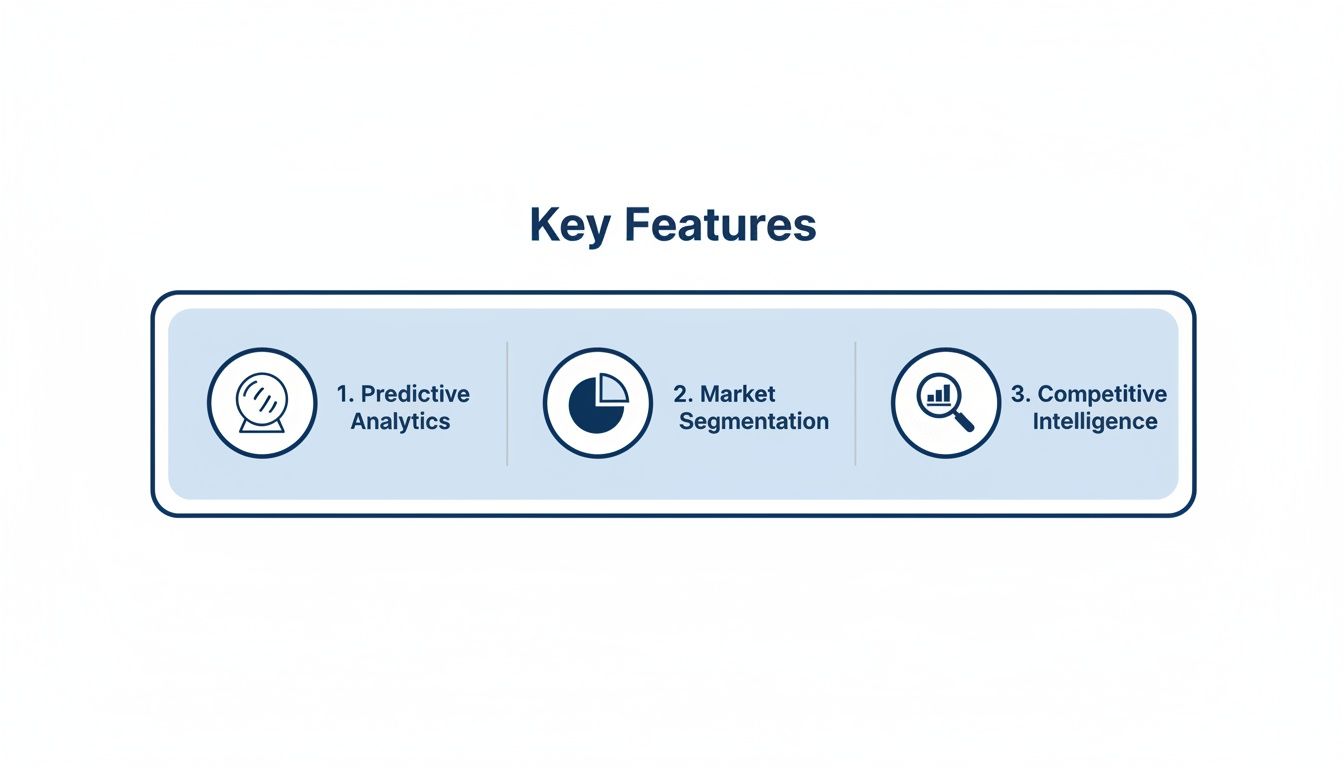
Predictive analytics, intelligent segmentation, and competitive intelligence converge to deliver the actionable leads that drive this ROI. When data is used to pinpoint specific needs, your bankers can engage prospects with precision and a clear strategic plan. This framework provides a tangible model for evaluating the potential returns for your institution. The first step is to gain a clear understanding of your market—an analysis we provide at Visbanking to reveal where these opportunities reside.
How To Pick The Right Technology Partner
Selecting the right software platform is as critical as the decision to invest. For bank executives, this evaluation must transcend feature comparisons. The true test of any cash management prospecting software is its ability to deliver accurate, actionable intelligence that integrates seamlessly into existing workflows and produces measurable results.
A vendor's technology is only as valuable as its underlying data and its understanding of the banking industry. Generic business intelligence tools lack the nuance required for commercial banking, leading to flawed insights and wasted resources. An effective partner must demonstrate a deep, institutional knowledge of banking operations, regulatory data, and the specific indicators of treasury service needs.
Look Past The Shiny Demo: Data And Integration Matter
During vendor vetting, the conversation must move beyond user interfaces to the integrity of their data. Data accuracy is paramount; even a small error rate can render a prospect list useless and undermine your team's efforts.
It is essential to ask probing questions about data sourcing, cleansing, and refresh cycles. A premier partner can verify the reliability of their information and demonstrate how they synthesize diverse sources—such as FDIC call reports, UCC filings, and market data—to create a complete financial profile of a prospect.
Furthermore, seamless integration is non-negotiable. The platform must be compatible with your existing core systems and CRM. A standalone tool that creates data silos and manual processes will fail to deliver its promised value.
The objective is to arm your team with intelligence, not burden them with another login. A platform that does not easily plug into your established workflow will never deliver the ROI it promised.
De-Risk The Deal With A Phased Rollout
A bank-wide implementation from day one carries unnecessary risk. A more prudent strategy is a phased rollout, beginning with a pilot program in a single, well-understood market. This approach allows you to validate the concept, measure results against a clear baseline, and secure buy-in from the relationship managers who will use the tool daily.
For instance, a bank could launch a 90-day pilot targeting mid-market manufacturing firms in a specific metropolitan area.
- Goal: Acquire five new commercial clients with average DDA balances of $1,000,000.
- Playbook: Utilize the software to identify 50 high-potential prospects based on estimated cash-on-hand and competitive positioning.
- Scorecard: Track key metrics such as the call-to-meeting ratio, proposal win rate, and total new deposits, comparing them to a control group using traditional methods.
This creates a contained experiment with clear success criteria, providing the hard data needed to justify a broader, bank-wide investment.
Use Their Own Medicine: Vet Vendors With Data Intelligence
Before engaging in vendor demonstrations, obtain a clear, data-driven assessment of your own market potential. A preliminary market analysis is your most effective negotiating tool. By first using a data intelligence platform, you can independently identify which geographic or industry segments offer the greatest opportunity for your bank.
This initial analysis serves as your objective benchmark. When a potential partner presents their view of your market opportunities, you can validate it against your own intelligence. This positions you to challenge their assumptions and ensure the selected software aligns perfectly with your strategic growth objectives.
At Visbanking, we believe this initial market assessment is crucial. By helping you benchmark your market from the outset, we place you in a position of strength. You are not just purchasing software; you are making a calculated investment to capture identifiable market share.
The Future Of Commercial Prospecting Is Predictive
For any financial institution serious about growth, predictive analytics is no longer a future concept; it is a core competency. The shift from relationship-based outreach to surgically precise, data-driven targeting is fundamentally reshaping the commercial sales process and directly strengthening the balance sheet.
This evolution is central to the broader digital transformation occurring across the banking sector. Banks that master the use of data to anticipate client needs will create an insurmountable competitive advantage over those that do not.
Shifting From Reactive To Proactive Growth
Traditional prospecting is inherently reactive, dependent on referrals, chance encounters, or inbound inquiries. Predictive prospecting, powered by cash management prospecting software, reverses this model. It proactively analyzes market-wide data to identify companies statistically primed for new treasury services, often before they recognize the need themselves.
For example, a predictive model might flag a $40 million logistics company because its cash conversion cycle has extended by 15 days over the past six months. This is not a random data point; it is a clear signal of a potential liquidity squeeze, making the company an ideal candidate for a line of credit or improved receivables management.
This is the essence of data-driven banking: converting market intelligence into a timely, relevant, and value-added conversation. For a deeper analysis of how these models function, review our examination of predictive analytics in banking.
Demand for these capabilities is accelerating. The cash management systems market is projected to grow from USD 20.35 billion in 2025 to USD 28.67 billion by 2030, driven by a corporate mandate for AI-powered forecasting and real-time cash optimization. The data is clear: a predictive approach is the future of commercial banking. For more details, see the latest market analysis from Mordor Intelligence.
The most strategic first step is not a software demo, but a data-driven assessment of your own market. Understand your potential before you invest in the tool to unlock it.
Before committing to a platform, bank leadership must first quantify the opportunity. Using an intelligence platform like Visbanking provides the necessary context to benchmark your institution's position against the market. This data-first approach identifies which industries or regions hold the most untapped potential, ensuring your technology investment is underpinned by a robust, measurable business case from day one.
A Few Common Questions
When evaluating new technology, asking direct questions is sound business practice. Here are answers to common inquiries from bank executives regarding the implementation and impact of cash management prospecting software.
Isn't This Just Another CRM?
No, it is a distinct tool designed for a different purpose.
Your Customer Relationship Management (CRM) system is a system of record for relationships you already have. It organizes contacts, tracks interactions, and manages your sales pipeline. It is fundamentally a tool for organization.
This software is a system of discovery. It is engineered to analyze the entire market to identify high-potential businesses that are not yet your clients. It tells your team who to target and, more importantly, why they are a qualified prospect at this specific moment.
Think of it this way: Your CRM is the playbook for your current team. Prospecting software is the scouting report that identifies the star players you need to recruit to win. One system feeds the other; intelligence from the prospecting tool populates your CRM with truly qualified leads.
What Does Getting Started Actually Look Like?
Implementation is a structured process, not a multi-year IT project. A typical rollout, from pilot to full deployment, takes approximately 90 to 120 days.
The process generally unfolds as follows:
- The Pilot (Weeks 1-4): We begin with a limited-scope pilot focused on a single market or industry vertical. For example, we might target 50 manufacturing companies with revenues between $20 million and $100 million to demonstrate immediate ROI.
- Integration and Training (Weeks 5-8): The platform is integrated with your CRM, and relationship managers receive comprehensive training to ensure proficiency and adoption.
- The Full Rollout (Weeks 9-12): Leveraging the success and best practices from the pilot, access is expanded across the entire institution.
Is This Only For The Big National Banks?
Not at all. This technology is arguably more critical for community and regional banks.
Large money-center banks can deploy massive marketing budgets to play a numbers game. Community and regional banks must compete on intelligence and efficiency. This software is the tool that levels the playing field.
For a $2 billion community bank, acquiring just five new commercial clients—each with $1,500,000 in operating deposits—is a significant achievement. This software uncovers local opportunities that larger competitors overlook, enabling you to gain profitable market share and punch above your weight.
At Visbanking, we believe data should drive every strategic decision. The first step is not a sales pitch; it is a clear-eyed assessment of the untapped potential within your market. Explore our platform to see precisely where your next wave of commercial deposit growth is waiting. Learn more at https://www.visbanking.com.
Related Articles

Visbanking Blog
Make More Informed Decisions with BIAS, the Data-Driven Banking Solution

Visbanking Blog
Prospect AI Tool: Transforming Your Bank's Growth Strategy with Smart Targeting

Visbanking Blog
Revolutionize Your Banking Operations with Data-Driven Insights from BIAS

Visbanking Blog
Banking Data Analytics: Turning Information Into Profit

Visbanking Blog
In the world of banking, digital transformation is no longer a 'nice-to-have'. It's a necessity

Visbanking Blog