
Mastering Metro 2 Reporting: A Strategic Guide for Bank Executives
Brian's Banking Blog
For many bank executives, "Metro 2" is synonymous with "compliance headache"—a regulatory hurdle to be cleared. But viewing it solely through that lens is akin to owning a race car and only driving it to the grocery store. You are missing its real power. Accurate credit reporting is not merely about avoiding fines; it is the bedrock of your bank's risk management, loan quality, and ultimately, its bottom line.
This guide reframes Metro 2, moving it from the compliance cost center to its rightful place as a strategic value-driver. Once this data standard is mastered, your institution can stop playing defense and start leveraging high-integrity data to make superior lending decisions. The objective is to transform a mandatory report into a source of decisive competitive intelligence.
Metro 2 as a Strategic Asset

The data transmitted in the Metro 2 format is a direct reflection of your bank's operational health and portfolio quality. In a market where data integrity dictates competitive advantage, precision is non-negotiable.
The Foundation of Modern Credit Reporting
The Metro 2® format, developed by the Consumer Data Industry Association (CDIA), is the standardized language for furnishing consumer credit data to the major credit bureaus. Its market significance is clear: the global demand for Metro 2 compliance solutions reached USD 1.32 billion in 2024, underscoring its critical role. Widespread adoption has proven effective, contributing to a documented reduction in reporting errors of up to 30%.
This is not a peripheral IT function. A single error—an incorrect Account Status Code or a misreported Date of First Delinquency—can create financial and regulatory ripples that impact everything from individual loan pricing to the bank's aggregate Allowance for Credit Losses (ACL).
The integrity of your Metro 2 submission is a direct proxy for the health of your portfolio. Inaccurate data leads to flawed risk models, mispriced loans, and ultimately, eroded margins.
From Compliance Burden to Business Intelligence
Viewing Metro 2 reporting purely as a compliance task leaves significant value on the table. Each submitted file contains a wealth of intelligence regarding customer financial behavior and portfolio performance.
Managed correctly, this data becomes a powerful tool for:
- Proactive Risk Management: Identify early-warning indicators by analyzing payment patterns across loan segments. For example, a bank might notice a 15% uptick in 30-day delinquencies for a specific auto loan vintage, signaling a need to review underwriting standards for that cohort before losses materialize.
- Informed Strategic Planning: Analyze portfolio concentrations and benchmark performance against peers to identify market opportunities and risks.
- Operational Excellence: Pinpoint and rectify systemic data-entry or processing flaws at their source, improving efficiency and reducing downstream costs.
The prerequisite for leveraging this intelligence is a robust framework. Strong data governance in banking ensures the accuracy and consistency required to trust the insights derived from your credit data. As technologies evolve, the potential for this data grows, a trend explored in discussions about AI in the Canadian Banking Era. The path from raw data to actionable intelligence begins with flawless reporting.
Decoding the Metro 2 Format for Executive Oversight

While your technical teams manage the intricacies of the 426-character Metro 2 file, executive oversight demands a strategic perspective. This file is the official record of your consumer credit portfolio, shaping your bank's risk profile and lending decisions. It is not a routine compliance task; it is a declaration of portfolio health.
Think of each Metro 2 file as a detailed manifest for your most valuable asset: customer credit data. Each character is precisely defined to ensure the credit bureaus interpret the information exactly as intended. The format is built for precision, not approximation.
The Anatomy of a Metro 2 File
The file is structured into three primary record types, each vital to constructing an accurate portfolio narrative. Understanding their function connects data points to risk management outcomes.
The Header Record: This is the manifest's cover sheet. It identifies your bank, the reporting period, and contact information. An error here—akin to a shipping label with an incorrect address—undermines the credibility of the entire submission from the outset.
The Base Segment: This is the core of the report, containing the granular details for each consumer account: Account Status Codes, Payment History Profiles, and Current Balance. The financial story of every borrower is written here, character by character.
The Trailer Record: This serves as the final quality control check. It contains control totals, such as the total number of accounts and the sum of all balances. These must reconcile perfectly with the Base Segment, confirming the data's integrity and completeness upon transmission.
This rigid, logical structure is the foundation of reliable metro 2 reporting, designed to ensure data is both comprehensive and verifiable.
From Data Fields to Strategic Decisions
This level of detail is critical because these fields directly influence the credit profiles that drive lending decisions. A minor inconsistency can create significant downstream consequences. For instance, reporting a loan with a Date Closed while the Current Balance remains above $0.00 creates a logical contradiction that distorts credit scores and invites consumer disputes.
A single systemic error, such as miscalculating the Date of First Delinquency across an entire loan category, can materially distort your portfolio risk, attract unwanted regulatory scrutiny, and directly impact the bank's Allowance for Credit Losses (ACL).
Consider a portfolio of 10,000 auto loans. A recurring system glitch fails to correctly update the "Payment History Profile" after a payment is reversed. This seemingly minor flaw could make thousands of accounts appear more or less delinquent than they are, corrupting risk models. The bank might consequently tighten credit policies unnecessarily or misprice new loans, directly impacting profitability.
This table illustrates how specific data segments within the Metro 2 file directly influence the bank's strategic operations.
Key Metro 2 Data Segments and Their Strategic Impact
| Data Segment | Content Example | Impact on Banking Decisions |
|---|---|---|
| Account Status Code | 11 (Current), 93 (Charge-off) |
Directly impacts credit scoring models and determines eligibility for new credit. |
| Payment History Profile | 111111N111... (history of payments) |
Informs predictive analytics for loan defaults and helps set interest rates for new loans. |
| Date of First Delinquency | MMDDYYYY |
A critical input for collections strategies and compliance with statutes of limitations. |
| High Credit/Original Loan Amount | $25,000.00 |
Used to assess a consumer's total credit exposure and informs your bank's risk appetite. |
Precision in these fields is not merely about compliance; it is about ensuring your risk models, pricing strategies, and lending decisions are built on a foundation of fact.
Flawless metro 2 reporting transforms a regulatory chore into a powerful business intelligence tool. Data intelligence platforms like Visbanking rely on this high-quality data, enabling you to confidently benchmark your portfolio against peers. Understanding the structure of your credit reporting ensures the data reflects reality—the essential first step to making smarter decisions.
Managing the High Stakes of Reporting Compliance
Metro 2 reporting operates within a stringent regulatory framework defined by the Fair Credit Reporting Act (FCRA). Its mandate for "maximum possible accuracy" is not a suggestion; it is a legal directive enforced by regulators like the Consumer Financial Protection Bureau (CFPB). Consequently, reporting accuracy must be treated as a cornerstone of the bank's risk management framework, not a delegated IT task.
The stakes are substantial. A single, seemingly minor system error can cascade into a significant liability. Consider a regional bank where a software bug mistakenly reports a month of on-time mortgage payments as 30 days late. If this impacts 5,000 customers, the bank is exposed to a class-action lawsuit. The financial fallout from such an error—including legal fees, settlements, and remediation—could easily exceed $1,500,000.00, not to mention the irreparable damage to brand reputation and customer trust.
The Regulatory Landscape and Financial Risks
Regulatory scrutiny continues to intensify. Federal agencies now expect a clear, documented audit trail for every data field in your Metro 2 file, tracing it from its source system. Failure to produce this evidence can lead to steep penalties, consent orders, and costly mandatory audits.
The financial consequences extend beyond direct fines:
- Increased Dispute Volume: Inaccurate data leads to a higher volume of consumer disputes, consuming operational resources and increasing compliance costs.
- Distorted Portfolio Risk: Flawed data compromises the integrity of risk models, leading to mispriced loans and an inaccurate Allowance for Credit Losses (ACL).
- Reputational Damage: Public enforcement actions and negative press can erode confidence among customers and investors, impacting the institution's valuation.
The most effective defense is a robust, proactive compliance program. This approach transforms Metro 2 reporting from a reactive, defensive posture into a proactive strategy to safeguard the bottom line. Building a strong framework for regulatory compliance for banks is non-negotiable in this environment.
Accuracy Isn't Just a Rule—It's a Strategy
The level of precision required for Metro 2 reporting is comparable to the diligence needed to navigate the challenges of high-risk banking environments, where strict compliance is a prerequisite for survival.
In the U.S. alone, over 1,000 financial institutions furnish data via the Metro 2® format, submitting millions of credit records monthly. This standardized system has yielded tangible benefits, contributing to an estimated 25% improvement in the speed of credit decisions and a 15% reduction in consumer disputes. Further details on these guidelines are available from the CDIA website.
An investment in reporting accuracy is an investment in institutional integrity. Every error avoided is a potential lawsuit sidestepped, a regulatory fine prevented, and a customer relationship preserved.
Ultimately, managing these high stakes is about protecting the integrity of the data that underpins your core lending operations. Clean, reliable data facilitates smarter risk modeling, fairer pricing, and more effective strategic planning. It is the foundation for sound banking. When compliance is treated as a strategic priority, you build a data foundation that can be trusted—enabling you to use intelligence platforms like Visbanking to benchmark performance and turn a regulatory burden into a competitive advantage.
Building a Framework for Flawless Data Reporting
Transitioning from data ambiguity to reporting clarity requires a deliberate, executive-led framework. Delegating metro 2 reporting to an operational team without strategic oversight is a recipe for risk. A robust reporting structure should be viewed not as an IT project, but as a core business function that protects the bank from regulatory action and sharpens its decision-making.
Effective leadership in this area is built on four critical pillars. Together, they create a comprehensive system of controls that ensures data integrity from origination to submission. When executed correctly, this framework transforms a compliance burden into a source of institutional strength.
Pillar 1: Rigorous Data Mapping
The first principle is absolute clarity on data lineage. You must maintain meticulous, audit-ready documentation that maps every field from its source system to its precise position in the 426-character Metro 2 layout.
Without this map, you are operating blindly. For example, if your core system stores a customer's full name in a single field ("John A. Doe"), while Metro 2 requires separate fields for Surname, First Name, and Middle Name, you must have a documented, automated process to parse this data correctly. A manual workaround is neither scalable nor defensible under regulatory scrutiny.
Pillar 2: Strategic Technology Adoption
Manual processes are the primary source of reporting errors. Relying on spreadsheets or manual data entry for any component of the Metro 2 workflow introduces unacceptable risk. Strategic technology adoption is about automating the creation, validation, and submission of credit reporting files.
Modern platforms can execute thousands of validation checks before a file is transmitted to the credit bureaus. They can flag logical impossibilities, such as an account with a Date Closed that still carries a Current Balance greater than $0.00. This proactive error detection is essential. A thoughtful evaluation of available Metro 2 software is a critical step toward building a resilient reporting framework that minimizes human error and solidifies compliance.
Pillar 3: Proactive Internal Controls
Waiting for a regulatory exam to identify reporting weaknesses is a failed strategy. Proactive internal controls, including regular, independent audits of Metro 2 files, are non-negotiable. These reviews must be designed to identify the exact types of issues that regulators target.
For instance, consider a scenario where a payment reversal for insufficient funds fails to trigger a recalculation of the "Last Good Payment" date. This subtle logic flaw could misrepresent delinquency statuses for hundreds of accounts. A proactive internal audit would simulate this scenario, detect the logic gap, and mandate a fix before it escalates into widespread inaccurate reporting.
The infographic below illustrates the costly domino effect of a single, uncorrected reporting error.
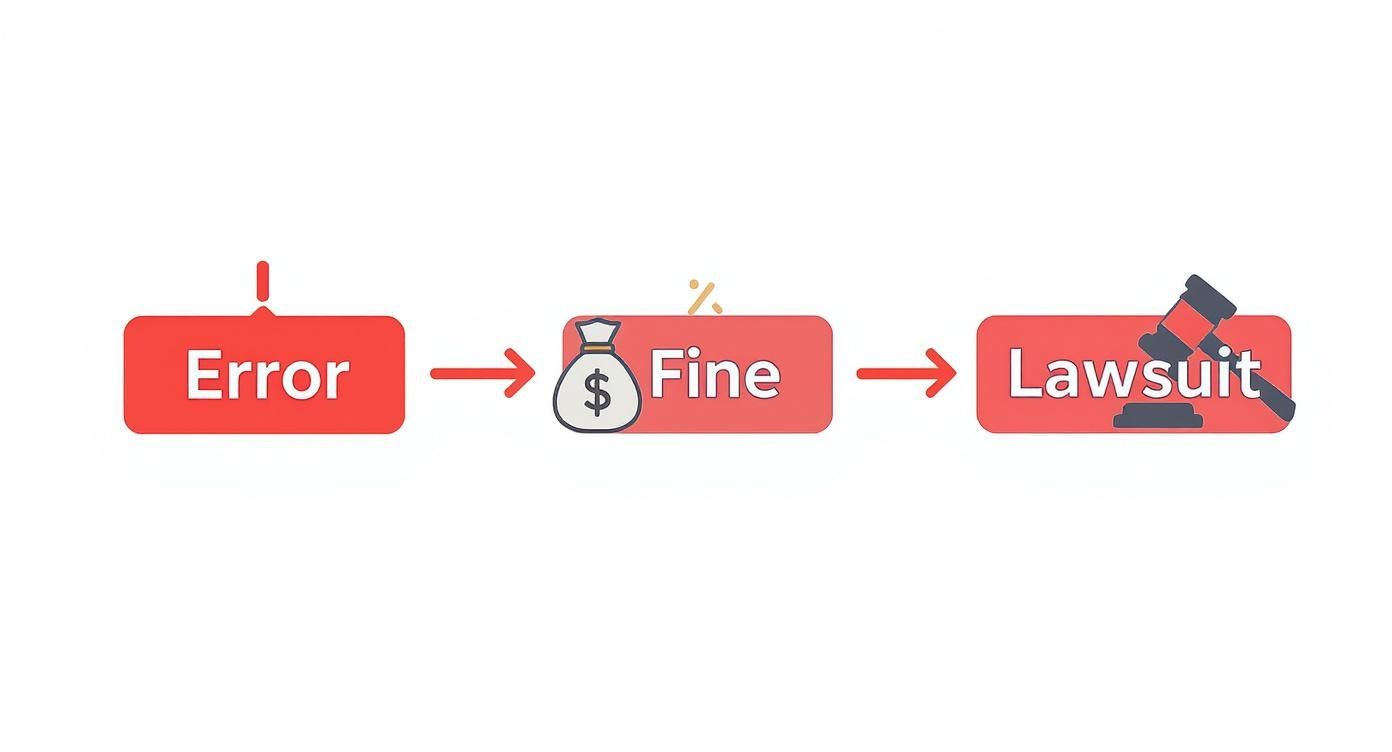
This visual underscores how a minor technical flaw can quickly escalate into significant financial and legal consequences, reinforcing the need for a preventative framework.
Pillar 4: Comprehensive Team Training
Technology and controls are only as effective as the people who manage them. A culture of accountability begins with robust training. Every employee who touches data destined for the Metro 2 report—from loan officers to collections staff—must understand their role in maintaining its accuracy.
Training must extend beyond process ("how") to include purpose ("why"). When your team understands that applying an incorrect special comment code could prevent a customer from securing a mortgage, they transition from data entry clerks to guardians of data quality.
Flawless data reporting is not an accident. It is the direct result of an intentional, executive-sponsored framework that values precision, demands accountability, and leverages technology to mitigate risk.
By implementing these four pillars, your institution can build a reporting process that is both defensible and highly accurate. This foundation of data integrity is the prerequisite for advanced analytics. With clean, reliable data, you can confidently use a platform like Visbanking to benchmark your portfolio's performance against peers, converting raw compliance data into a tangible competitive advantage.
The Bottom-Line Impact of Reporting Accuracy
Mastering Metro 2 reporting is not a compliance formality; it is a direct driver of financial performance. For executives, the connection between a single data field and the P&L statement must be unambiguous. Deficient reporting introduces systemic risks that silently erode profitability.
Let's quantify the impact. Consider a community bank with $2 billion in assets. A minor, systemic error—such as misclassifying 30-day delinquencies as current by a single payment cycle—can trigger a cascade of negative consequences. This single flaw could understate the Allowance for Credit Losses (ACL), inviting immediate regulatory intervention.
The damage doesn't end there. A distorted view of portfolio health leads to mispriced risk. If the bank cannot accurately assess its true delinquency rates, it might underprice an entire loan segment. This could easily result in a charge-off rate 5% higher than modeled for that cohort, directly impacting net income and capital adequacy.
From Data Points to Dollar Signs
The bank’s high-level financial metrics are only as reliable as the granular data they are built upon. A compromised data foundation leads to a compromised institution. Conversely, when Metro 2 data is pristine, it enables superior financial management.
Accurate reporting is the bedrock of strong performance:
- Precision Risk-Based Pricing: With trustworthy payment history and delinquency data, you can price loans with confidence that the yield adequately compensates for the risk undertaken.
- A Defensible ACL: An accurate depiction of your portfolio’s credit quality allows for a defensible and precise ACL, satisfying both regulators and auditors.
- Enhanced Investor Confidence: Clean, transparent reporting signals strong operational control and sophisticated risk management—key attributes sought by investors and rating agencies.
This direct line from data field to financial outcome is why executive oversight of Metro 2 reporting is a fundamental fiscal responsibility, not just a compliance task.
The Strategic Edge of Accurate Benchmarking
Once reporting accuracy is achieved, the strategic application begins. Clean data allows you to look beyond your own institution and assess your true market position. This is where data intelligence platforms become indispensable.
Inaccurate data tells a false story, leading to flawed strategy. Accurate data, when benchmarked against peers, reveals the truth about your performance and uncovers hidden opportunities for growth and risk mitigation.
Returning to our $2 billion bank: using a peer analysis tool, it discovers its reported 60-day auto loan delinquency rate is 15% lower than the regional average for peer institutions. This finding prompts two critical, mutually exclusive questions:
- Is there a reporting flaw? Are our systems failing to capture and report these delinquencies correctly, creating a hidden pocket of risk?
- Do we have a competitive advantage? Are our underwriting or collections strategies genuinely outperforming the market, representing an edge to be exploited and expanded?
Without unimpeachable reporting accuracy, you cannot distinguish between a problem and an opportunity. Flawless data transforms benchmarking from an exercise in speculation into a powerful diagnostic tool. It empowers executives to ask the right questions and build strategy based on reality. This is how a bank shifts from playing defense (compliance) to playing offense (strategy). To see how your institution measures up, explore how Visbanking’s peer data can help you benchmark performance and convert reporting accuracy into a tangible competitive edge.
Turning Compliance Data Into a Competitive Advantage
For too long, leadership teams have viewed Metro 2 reporting as a non-negotiable cost of doing business. But mastering this process yields a powerful strategic asset: a clean, high-integrity dataset that reflects your portfolio’s health and your team’s operational discipline. This data is the raw fuel for making smarter, faster strategic decisions.
Activating Your Data Asset
An unimpeachable record of customer payment behavior enables the development of more sophisticated predictive models for credit risk. This is not an academic exercise; it translates directly to sharper pricing, more accurate capital allocation, and a stronger bottom line.
A pristine dataset also illuminates clear opportunities for growth. Analyzing accurate, long-term payment trends can reveal unmet market needs, guiding the development of new loan products or the refinement of existing ones. For example, if your data reveals a growing segment of customers consistently paying off small-dollar loans ahead of schedule, it could signal a market opportunity for a new, targeted lending product.
Banks that excel at Metro 2 reporting are simply better equipped to make these data-driven moves, outmaneuvering competitors who are still bogged down by compliance challenges.
For executives serious about leading with data, the logical next step is to benchmark your loan portfolio against peers, transforming your investment in reporting accuracy into a true strategic advantage.
Once reporting is perfected, the objective shifts from compliance to intelligence. The operative question is no longer "Is our data correct?" but rather "What is our correct data telling us about the market and our performance within it?"
This is where the investment in data integrity delivers its full return. By using a platform like Visbanking to analyze how your portfolio stacks up against your peers, you can finally convert compliance efforts into a measurable competitive edge.
Answering Your Top Metro 2 Questions
In discussions with banking executives, several key questions about Metro 2 reporting consistently arise. Here are direct answers to the most pressing concerns regarding compliance, risk, and strategy.
What's the Single Biggest Risk We Face?
The greatest risk is not a one-time fine; it is the cascading effect of a single, undetected systemic error.
Imagine a minor coding flaw in how your core system calculates the Date of First Delinquency following a partial payment. This single error can propagate across thousands of accounts over several reporting cycles. Suddenly, you are facing an understated Allowance for Credit Losses (ACL), attracting scrutiny from the CFPB, and defending against a class-action lawsuit. One hidden, systemic issue can inflict far greater financial and reputational damage than a thousand isolated manual errors.
How Often Should We Be Auditing This?
An annual audit is the bare minimum—it is merely table stakes. High-performing institutions conduct comprehensive validation checks at least quarterly.
A proper audit goes beyond validating the final output file. It stress-tests the logic of the source systems. For instance, auditors must confirm that when a loan is charged-off (Account Status Code 93), the Current Balance is correctly zeroed out and the Date Closed field is populated. These proactive, frequent checks are what separate market leaders from the rest. They enable you to identify and correct logic gaps before they multiply.
For bank leadership, Metro 2 reporting should be viewed as a core operational function, not a compliance afterthought. The integrity of this data is a direct reflection of the institution's risk management discipline and operational control.
Can't We Just Outsource This Whole Thing?
You can, and often should, outsource the technical process of file generation. However, you can never outsource the accountability.
Regulators are unequivocal: as the data furnisher, your institution is 100% responsible for the accuracy of the data reported. If your vendor makes a mistake, the regulatory penalties and reputational damage are entirely yours to bear. This necessitates rigorous vendor oversight, including independent validation of their output and a thorough review of their internal controls to ensure they meet the FCRA’s "maximum possible accuracy" standard. It is non-negotiable.
At Visbanking, we see accurate reporting as the launchpad for smart, strategic action. Once your data is clean, you can finally start turning it into a real competitive edge.
Ready to see how your portfolio stacks up against your peers? Discover how Visbanking can turn your data into decisions.
Related Articles

Visbanking Blog
The Future of Financial Analytics: Solutions by VISBANKING

Visbanking Blog
Visbanking Unveils Interactive Quarterly Banking Profile, Available One Month Ahead of FDIC Release

Visbanking Blog
BIAS: Your Competitive Edge in Banking Data Driven Strategy

Visbanking Blog
BIAS: Pioneering the Future of Banking Analysis

Visbanking Blog
Make More Informed Decisions with BIAS, the Data-Driven Banking Solution

Visbanking Blog