
A Data-Driven Executive Guide to Governance Risk and Compliance Solutions
Brian's Banking Blog
In banking, Governance, Risk, and Compliance (GRC) has migrated from the back office to the boardroom. It is no longer a cost center; it is a bank's most critical strategic asset. For executives and directors, a data-driven framework for decision-making is essential. Modern governance risk and compliance solutions provide that framework, transforming raw data into a clear strategic advantage.
Why GRC Is a Bank's Most Critical Strategic Asset
In an environment of complex regulations, persistent cyber threats, and volatile markets, a reactive approach to governance is a recipe for failure. Effective GRC is not merely about avoiding regulatory penalties. It is about building a sustainable competitive edge by making smarter, risk-adjusted decisions. It translates a deluge of data from across the institution into a single, coherent strategic picture.
This represents a fundamental shift in mindset—from defense to offense. Consider a bank evaluating a new fintech partnership. The legacy approach involved siloed reviews of market opportunity, third-party risk, data security, and consumer protection. A robust GRC framework enables leadership to assess and weigh all these factors simultaneously, providing a holistic view of the opportunity.
The Financial Imperative for GRC
The strategic necessity for GRC is underscored by major regulatory frameworks like global banking regulations like Basel III, which mandate sophisticated systems for capital and risk management. While non-compliance is prohibitively expensive, strategic investment in a unified GRC platform delivers measurable returns.
The market recognizes this imperative. Projections show significant growth, driven by the need to manage escalating threats and stricter regulations. Institutions utilizing integrated GRC platforms consistently report significant reductions in compliance costs and accelerated audit cycles.
A proactive GRC strategy enables a bank to move faster and with greater confidence than its competitors. It transforms compliance from a procedural roadblock into a strategic advantage, ensuring growth is both aggressive and sustainable.
Data as the Foundation of Modern GRC
Any GRC solution is only as effective as the data that fuels it. Without accurate, timely, and relevant information, governance is reduced to guesswork. This is where a powerful data intelligence platform like Visbanking provides a decisive advantage.
By integrating financial, regulatory, and market data, banks can benchmark their risk and compliance performance against peers with precision. This allows leadership to answer critical strategic questions:
- Are our capital reserves properly calibrated relative to peers facing similar market conditions? A bank might hold a 9.5% Tier 1 Capital Ratio, but if its peer group average is 10.2%, that 70-basis-point gap is a critical insight.
- How does our loan denial rate for a specific demographic in the Chicago MSA compare to the market benchmark?
- Is our operational risk profile improving at a faster rate than our top-performing competitors?
This level of insight transforms GRC from a historical reporting exercise into a forward-looking strategic tool. For a deeper analysis, our guide on regulatory compliance for banks illustrates how benchmarking with Visbanking's data sharpens your competitive edge.
Deconstructing Modern GRC Solutions for the Boardroom
The term "GRC solution" often evokes images of dense, monolithic software. This is a misconception. The most effective GRC platforms are not single programs but integrated suites of modules engineered to communicate seamlessly. For bank leadership, this architecture is the key to abandoning disconnected spreadsheets and establishing a single source of truth for strategic oversight.
The objective is to dismantle the dangerous departmental silos that obscure an institution's true risk profile until it is too late.
A truly effective GRC platform is built upon three pillars: Governance, Risk, and Compliance. When these functions are integrated, they transform GRC from a cost center into a strategic asset.
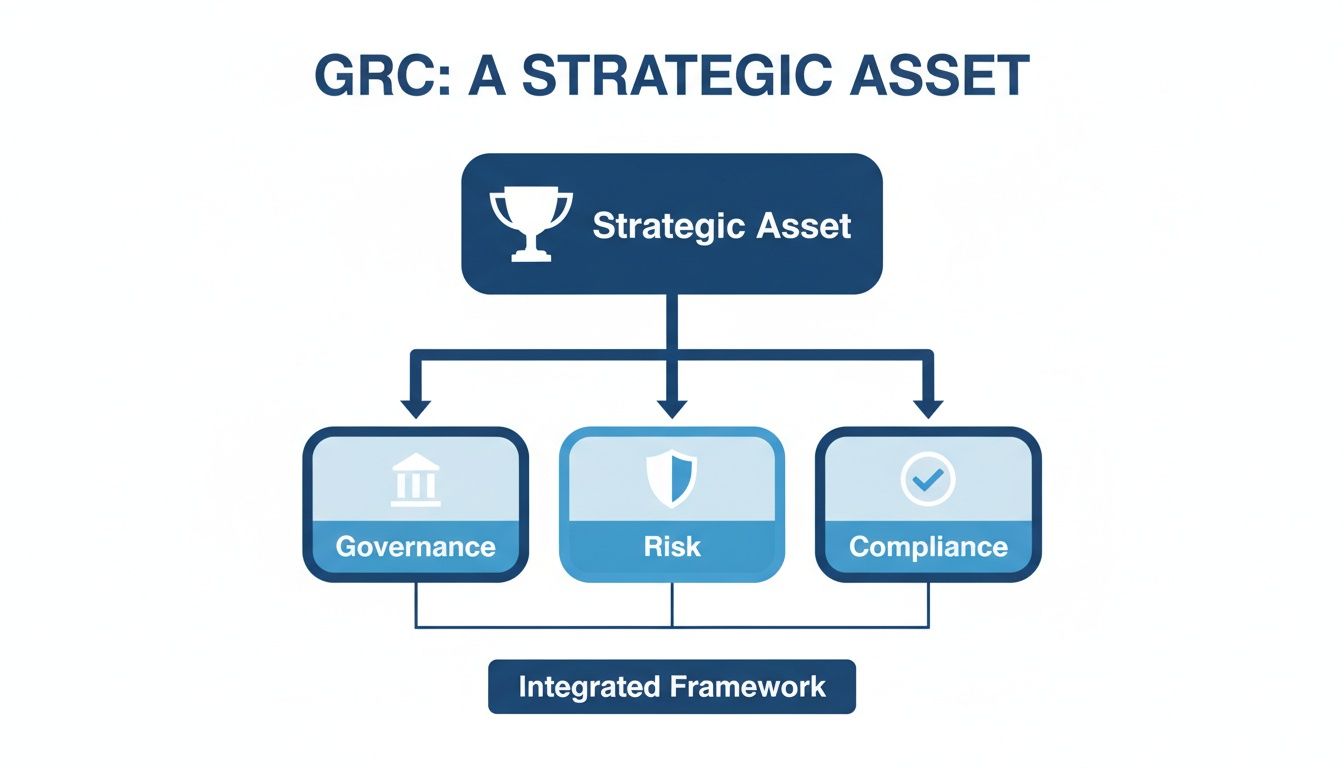
When these three functions operate in concert, GRC is elevated from a compliance checklist to a core component of institutional resilience and competitive strength.
The Powerhouse Modules
Each pillar is supported by specialized modules designed for the unique pressures of the banking industry. While nomenclature may vary between vendors, any high-performance governance risk and compliance solution will contain these core components.
A modern GRC platform is a strategic framework, not merely a collection of features. The following table outlines the essential modules and their direct implications for executive decision-making.
Core GRC Solution Modules for Financial Institutions
| GRC Module | Primary Function | Key Benefit for Bank Executives |
|---|---|---|
| Risk Management | Identifies, assesses, and models credit, market, and operational risks. | Moves from reactive risk tracking to proactive "what-if" analysis (e.g., simulating a 25-basis-point rate hike's impact on the loan portfolio). |
| Compliance Management | Maps external regulations (BSA/AML, Dodd-Frank) to internal policies and controls. | Creates a clear, auditable trail that proves systematic compliance to examiners, making audits smoother and less adversarial. |
| Audit Management | Manages the entire audit lifecycle, from workpapers to remediation tracking. | Slashes time spent preparing for audits and can reduce external audit fees by 15-20% annually by providing clean, organized evidence. |
| Policy Management | Centralizes the creation, review, approval, and distribution of all internal policies. | Ensures consistency and provides a single source of truth, eliminating outdated or conflicting policy documents on shared drives. |
| Vendor Risk Management | Onboards, monitors, and assesses the risk posed by third-party vendors and partners. | Protects the bank from reputational and operational damage caused by a vendor's security breach or compliance failure. |
These modules are not standalone tools; they are interconnected components of a system designed to provide a holistic view of the institution's health.
The Strategic Value of Integration
The true power of a GRC platform is unlocked through deep integration and seamless data sharing.
Consider a $5,000,000,000 community bank preparing to launch a new digital lending product. In a siloed environment, the business team moves forward, the compliance team reacts to potential Fair Lending issues, and the risk team assesses credit risk impact after the fact. The process is inefficient and introduces unnecessary risk.
An integrated GRC platform fundamentally changes this dynamic.
From a single dashboard, the Chief Risk Officer can see how the new product simultaneously affects the bank's capital adequacy (risk), its consumer compliance obligations (compliance), and the necessary updates to internal controls (governance). This holistic view is impossible with disconnected systems.
This integration is the bedrock of sound decision-making. The ability to directly link a policy to a specific risk, and that risk to a control, creates a resilient operational fabric that withstands regulatory scrutiny and market shocks.
Establishing this unified data layer is also a critical step for any institution serious about advancing its data governance in banking maturity. It is about building a foundation of trusted intelligence.
Putting GRC into Practice: Strategic Use Cases for Banking
A GRC framework on paper is theory. Its value is measured by its real-world application. For bank leadership, the bottom line is clear: how does this tool translate into stronger performance, reduced risk, and a more robust defense against regulatory actions? The most sophisticated institutions are no longer reacting to compliance checklists; they are using governance risk and compliance solutions to gain a competitive advantage.
A unified GRC platform provides a clear line of sight from boardroom policy to daily operations. This visibility eliminates the siloed, fragmented decision-making that exposes a bank to unforeseen risks.
Let's examine three high-stakes scenarios where a modern GRC framework, fueled by precise data, delivers a measurable impact.

Streamlining BSA and AML Compliance
Bank Secrecy Act (BSA) and Anti-Money Laundering (AML) compliance represents a significant operational burden for any bank. Legacy approaches—cobbling together disparate systems and relying on manual reviews—are inefficient and ineffective. They generate a high volume of false positives, consuming analyst resources and driving up operational costs.
A modern GRC solution automates the entire workflow, linking transaction monitoring directly to case management and the filing of Suspicious Activity Reports (SARs). This creates a seamless, efficient, and auditable process.
Consider this: A regional bank with $12,000,000,000 in assets implements an integrated GRC platform for its BSA/AML program.
- Before: Its legacy system flagged 5,000 potential issues monthly, 95% of which were false positives. Each alert required approximately 90 minutes of manual investigation by an analyst.
- After: The new GRC solution uses advanced analytics to refine monitoring rules. False positives decrease by 40%. With all data centralized, investigation time is cut in half, saving the team over 1,500 analyst-hours per month.
Crucially, the platform maintains a perfect, auditable trail of every decision, streamlining regulatory examinations and demonstrating a robust control environment.
Proactively Managing Fair Lending Risk
Fair Lending is a top regulatory priority and a significant reputational risk. The primary danger lies in discovering a problem only after an examiner identifies it. By then, the institution is already on the defensive.
A modern GRC platform enables a proactive stance. By integrating loan origination data, demographic information, and decisioning logic, executives can continuously monitor for potential disparities in applications, underwriting, or pricing across protected classes.
This approach shifts the paradigm from reactive defense to proactive assurance. The objective is not merely to have answers for regulators; it is to identify and remediate potential issues before they are questioned.
If analytics detect a statistical anomaly—for instance, a significant difference in denial rates for a specific demographic in a certain geography—the GRC system can automatically trigger an internal review. This allows the bank to investigate, document its reasoning, and implement corrective action before it becomes a regulatory finding.
Bolstering Operational and Third-Party Resilience
A bank's resilience is no longer defined solely by its internal controls. It is inextricably linked to the security and performance of its key third-party vendors. A failure at a critical technology provider can trigger a catastrophic operational event.
A GRC solution serves as the command center for managing this complex ecosystem. It allows you to:
- Map critical business processes to the specific vendors that support them.
- Model the operational impact of a key vendor outage.
- Automate vendor risk assessments and due diligence.
This capability is essential for building a business continuity plan that is both effective and credible to regulators. By understanding precisely which services would be affected by a vendor failure, you can develop targeted, effective contingency plans that meet regulatory expectations for operational resilience.
Centralizing vendor data also yields significant efficiency gains. Enterprise GRC (eGRC) platforms can reduce the costs of managing multiple disconnected vendor tools by up to 40%. Given that non-compliance penalties resulted in over $3,000,000,000 in SEC fines for U.S. firms in 2022 alone, GRC is a critical anchor. You can explore more about this on grandviewresearch.com.
In each of these use cases, the GRC platform is the engine, but external data provides the strategic map. Integrating peer benchmarks from a data intelligence source like Visbanking allows you to evaluate your performance in a market context. This provides a much clearer picture of whether your risk posture is truly optimized.
A Director's Playbook for Selecting Your GRC Solution
Choosing a governance, risk, and compliance (GRC) solution is a foundational strategic decision, not an IT procurement exercise. It will define your bank's resilience and competitive positioning for the next decade. The right platform becomes the central nervous system for the institution, providing the board with a clear, unified view of risk. The wrong choice becomes an expensive, cumbersome liability.
It is easy to become mired in feature-by-feature comparisons. However, a sophisticated user interface is meaningless if the core architecture cannot support the bank's strategic objectives. The evaluation must be grounded in several non-negotiable business realities.
Beyond the Demo: Scalability and Future-Proofing
The primary test is scalability. A GRC platform adequate for a $2,000,000,000 institution may fail under the complexity of a $10,000,000,000 bank. The board must ask a direct question: "Does this platform have a proven track record of growing with its clients?"
If your bank's strategic plan includes M&A activity, the selected GRC platform must be capable of absorbing the data, policies, and risk frameworks of an acquired institution without requiring a multi-year, multi-million-dollar reimplementation. This demands a flexible, modular architecture designed for growth—not a rigid system that only meets today's requirements.
Integration: The Linchpin of a Unified View
A GRC platform's strategic value is realized only when it can communicate with a bank's other core systems. A standalone GRC solution that requires manual data uploads is not a solution; it is another silo.
Effective integration enables the automatic, real-time flow of data, which turns raw information into actionable intelligence.
- Core Banking System: Automatically pulling transaction data to feed BSA/AML monitoring models.
- Loan Origination Software: Tying lending decisions directly to Fair Lending analytics to identify potential disparities proactively.
- External Data Intelligence: Connecting to platforms like Visbanking to benchmark your risk metrics against peer performance, providing crucial context for your risk appetite.
Without deep integration, a GRC platform operates with significant blind spots, undermining its core purpose.
Vendor Viability and Total Cost of Ownership
Finally, it is imperative to look beyond the software and rigorously vet the vendor and the true total cost of ownership (TCO). A GRC platform is a long-term partnership, not a one-time purchase.
The board's inquiries should focus less on the initial license fee and more on the vendor's financial stability, its commitment to the banking sector, and its product roadmap. A vendor without deep financial services expertise will not understand the nuances of regulatory expectations.
The TCO analysis must be equally thorough, accounting for all associated costs:
- Implementation and Configuration Fees: What is the realistic cost to deploy and tailor the system to your specific risk and control frameworks?
- Internal Resource Commitment: How many full-time employees must be dedicated to managing and maintaining this platform?
- Training and Adoption Costs: What is required to ensure front-line staff and managers can utilize the tool effectively?
- Ongoing Maintenance and Support: What are the annual fees, and what level of support is contractually guaranteed?
To facilitate this critical board-level discussion, we have developed a scorecard. Use it as a strategic checklist to cut through sales pitches and evaluate potential GRC partners based on the criteria that determine long-term success.
GRC Solution Evaluation Scorecard
| Evaluation Criterion | Key Question for the Board | Look For (Green Flag) | Avoid (Red Flag) |
|---|---|---|---|
| Strategic Scalability | Will this platform support our 5-year growth plan (organic & M&A)? | Modular architecture; proven success with banks larger than yours. | Rigid, monolithic systems; a client list of only small institutions. |
| Integration Capability | How easily does it connect to our core, LOS, and external data sources? | Pre-built API connectors; a dedicated integration support team. | Reliance on manual data uploads or expensive custom-built integrations. |
| Vendor Financial Health | Is this vendor a stable, long-term partner or a potential liability? | Profitable; strong balance sheet; backed by reputable investors. | High cash burn rate; recent leadership turnover; frequent pivots in strategy. |
| Banking Industry Focus | Do they live and breathe banking, or are we just another vertical for them? | Former bankers on staff; active participation in industry groups. | Generic, one-size-fits-all marketing and product design. |
| Total Cost of Ownership | What is the all-in cost over the next 5-7 years, not just the initial fee? | Transparent pricing for all modules, support, and implementation. | Hidden fees for data storage, API calls, or standard support tickets. |
| Implementation Roadmap | Do they have a clear, realistic plan to get us from purchase to "go-live"? | Phased, milestone-based approach; dedicated project manager. | Vague timelines; over-reliance on your internal IT team for heavy lifting. |
Selecting a GRC partner is one of the most significant technology decisions a board will oversee. By focusing on scalability, seamless integration, and long-term viability, you ensure the investment strengthens the bank's strategic foundation.
To see how your institution's current risk posture compares to the market, explore how Visbanking's peer data provides the critical benchmarks for a more informed GRC strategy.
Measuring the Return on Your GRC Investment
Investing in a modern governance, risk, and compliance (GRC) solution is not merely about "improving processes." The board and executive team require a clear answer to a single question: how does this strengthen the bank’s financial position? It is imperative to move beyond qualitative benefits like "enhanced oversight" and quantify the hard, measurable ROI.
The value proposition is threefold: reducing direct costs, mitigating critical risks, and enabling strategic growth. Each area has concrete key performance indicators (KPIs) that directly link the GRC platform's capabilities to the bottom line.

Quantifying Cost Reduction and Efficiency Gains
The most immediate financial impact is realized by streamlining manual, labor-intensive tasks. Automating compliance routines, audit preparation, and policy management translates directly into operational savings.
Consider a compliance team of ten analysts. If a GRC platform automates routine monitoring and reporting, achieving a conservative 15% reduction in manual work is equivalent to adding 1.5 full-time employees. If the average fully-loaded cost per employee is $100,000, this unlocks $150,000 in annual productivity. This is talent that can be redeployed to high-value strategic risk analysis instead of manual data compilation.
The objective is not just to perform existing tasks faster. It is to fundamentally alter the cost structure of control functions. GRC automation transforms fixed compliance labor costs into a more flexible and efficient operating model.
Furthermore, providing external auditors with a clean, centralized data repository can reduce their preparation and review time by 20% or more. This is a direct, tangible cost reduction.
Valuing Proactive Risk Mitigation
Quantifying the financial impact of a disaster that was avoided is challenging but essential. The cost of a single major compliance failure—a significant BSA/AML fine or a major data breach—can easily reach millions of dollars, encompassing regulatory penalties, remediation costs, legal fees, and long-term reputational damage.
For example, the impact of a data breach extends beyond the initial fine to include customer attrition, heightened regulatory scrutiny, and a potential increase in the cost of capital. The value of a GRC platform is its ability to prevent such events by ensuring controls are operating effectively.
The escalating cybersecurity threat makes this calculation non-negotiable. It is no surprise that cybersecurity is a primary driver for the GRC market, which was valued at $48,700,000,000 in 2023 and is projected to reach $179,500,000,000 by 2032. Documented benefits such as a 25% reduction in overall risk and a 35% gain in audit efficiency make the ROI clear. As you can learn from market research on zionmarketresearch.com, this investment is a direct response to real and growing threats.
Measuring Strategic Enablement and Growth
The most powerful, yet often overlooked, component of the GRC value proposition is its function as a business accelerator. When risk and compliance are integrated into strategic planning from inception, a bank can execute with greater speed and confidence than its competitors.
Consider the launch of a new lending product. With a robust GRC platform, compliance checks, risk assessments, and policy updates occur in parallel with product development, not sequentially. This can shorten the go-to-market timeline by 25% or more, allowing the bank to capture market share while less agile competitors are mired in internal reviews.
This strategic velocity is fueled by data. By integrating external intelligence from a platform like Visbanking, executives can benchmark the new product's risk profile against industry norms in real-time. This leads to faster, data-backed decisions on pricing and underwriting, ensuring growth is both aggressive and responsible.
Ultimately, the ROI of a GRC solution is a composite of these three pillars: reducing the cost of compliance, avoiding catastrophic financial events, and empowering the institution to capitalize on strategic opportunities with confidence.
To build a data-backed case for your GRC strategy, explore how Visbanking’s peer benchmarks can help you quantify your current risk and performance posture.
The Future of Banking GRC with AI and Predictive Intelligence
Current governance risk and compliance solutions have successfully transitioned banks from reactive checklists to proactive management. The next evolution, driven by artificial intelligence and predictive analytics, is already underway.
For bank executives, this is not a distant concept; it is rapidly becoming the new standard for competitive and resilient banking. The focus is shifting from managing known risks to accurately predicting emergent ones.
This transformation elevates a GRC platform from a system of record to an engine of foresight. The implications are significant, turning traditional cost centers into strategic assets that directly impact the bottom line.
From Reactive Reporting to Predictive Action
Instead of merely flagging a suspicious transaction after the fact, an AI-powered GRC system can identify subtle patterns across thousands of accounts in real-time to predict a potential fraud ring before significant damage occurs. This is the power of AI in action.
In Fair Lending, rather than auditing a small sample of loans, AI tools can analyze 100% of the portfolio continuously, flagging potential disparities before they escalate into regulatory issues.
Further practical applications include:
- Predictive Risk Modeling: Machine learning algorithms can analyze macroeconomic trends, local market data, and borrower behavior to forecast potential loan defaults with far greater accuracy than traditional models. This allows for proactive adjustments to underwriting criteria or loan loss provisions.
- Automated Regulatory Change Management: AI can scan new legislation and regulatory updates upon publication, instantly identifying which internal policies and controls require review. This converts a tedious manual process into an immediate, automated alert system for the compliance team.
The future of risk management is not just having a clear view of today, but a statistically sound forecast of tomorrow. A GRC engine's power is amplified exponentially when fed comprehensive, benchmarked industry data.
The Crucial Role of Data and Governance
An AI model is only as intelligent as the data it consumes. This is where external data intelligence, such as that provided by Visbanking, creates a significant competitive advantage.
Feeding a GRC platform with anonymized, aggregated peer data provides predictive models with the real-world context necessary for effectiveness. It enables the benchmarking of your own risk exposure against the industry, making strategic decisions both informed and defensible. Of course, as GRC evolves with AI, a robust framework for ethical and compliant use is non-negotiable, requiring the implementation of strong AI governance best practices.
The integration of compliance and artificial intelligence represents a fundamental shift in banking operations. It provides the board with a new level of assurance by moving from retrospective review to forward-looking analysis.
Bank leadership must view GRC strategy as a dynamic capability. To maintain a competitive edge, it is essential to explore how advanced data platforms can fuel this next generation of predictive GRC.
See how your institution’s performance provides the perfect baseline for a smarter GRC strategy. Benchmark your bank against its peers with Visbanking's data intelligence today.
A Few Common Questions from the Boardroom
When directors and executives evaluate GRC solutions, several key questions consistently arise. Here are direct answers to guide your decision-making.
What’s a Realistic Implementation Timeline?
A GRC implementation is not an overnight project. For a mid-sized bank implementing core risk and compliance modules, a phased approach spanning three to six months is a realistic timeline.
The initial phase typically focuses on high-impact areas like operational risk and regulatory compliance. Successful execution depends on strong executive sponsorship and the allocation of dedicated internal resources to collaborate with the vendor's implementation team.
How Do These GRC Solutions Talk to Our Core Banking System?
Modern GRC platforms are designed for connectivity, not isolation. They integrate with existing core banking systems, loan origination software, and other key applications using APIs (Application Programming Interfaces) and pre-built connectors.
The objective is to achieve a seamless, automated flow of data, eliminating manual entry and dismantling data silos. For example, transaction data should flow from your core directly into your AML monitoring module without manual intervention. When selecting a vendor, it is non-negotiable that they have proven integration experience with U.S. financial institutions and their core systems.
The goal of integration is to create a single source of truth. When your risk platform can pull real-time lending data from your LOS, you shift from retrospective analysis to proactive risk management. This enables faster, more intelligent decisions.
Can a GRC Solution Actually Help with ESG Reporting?
Yes. A well-designed GRC framework is inherently flexible. Leading platforms allow for the configuration of modules specifically to track Environmental, Social, and Governance (ESG) metrics.
This enables the management of ESG-related risks, such as the climate impact on your loan portfolio or reputational risk from governance lapses. More importantly, it provides the capability to generate accurate, auditable reports for stakeholders, investors, and, increasingly, regulators. The platform centralizes ESG data and integrates these efforts into your overall risk and governance strategy.
Your GRC framework is only as powerful as the data that fuels it. Visbanking provides the external intelligence and peer benchmarks needed to transform your GRC platform from a compliance tool into a strategic asset. Benchmark your bank's performance and discover actionable insights today.
Related Articles

Visbanking Blog
BIAS: The All-in-One Solution for Banking Intelligence and Action

Visbanking Blog
BIAS: The Smart Choice for Banking Intelligence and Action

Visbanking Blog
BIAS: The Smart Choice for Banking Intelligence and Action

Visbanking Blog
The Future of Financial Analytics: Solutions by VISBANKING

Visbanking Blog
Bank Regulatory Compliance: Navigating the Complex Maze

Visbanking Blog