Financial Institution Risk Management: Your Complete Guide
Brian's Banking Blog
Understanding Today's Complex Risk Environment
Effective financial institution risk management has moved far beyond a simple checklist. Imagine captaining a modern cargo ship. The old-school compass and paper charts won't cut it in today's crowded, unpredictable seas, where a small issue in one port can trigger delays and dangers worldwide. The financial world is just as connected, with risks acting less like isolated storms and more like a complex, interlocking weather system.
This new reality demands a complete rethinking of old risk models. Strategies that worked just five years ago now feel dangerously insufficient. The institutions that succeed aren't just reacting to problems; they are building advanced early warning systems. It’s the difference between seeing a storm on the radar from miles away versus realizing you're in a hurricane when waves are already crashing over the deck.
The Perfect Storm of Interconnected Threats
Today's financial institutions are navigating a storm where different challenges feed into each other, creating a highly volatile environment. These aren't just separate risks but a tangled web where one issue can set off a chain reaction. Key drivers making things so complex include:
- Geopolitical Instability: A political conflict or trade dispute in one corner of the globe can instantly affect currency values, supply chains, and investor confidence everywhere else.
- Rapid Technological Change: While technology brings incredible opportunity, it also opens the door to major cybersecurity threats and operational risks if not managed with extreme care.
- Economic Volatility: Shifting interest rates, inflation, and market moods create a tricky environment for lending, investing, and long-term planning.
This interconnectedness means a bank’s risk exposure isn't just about its own balance sheet anymore. A political event overseas could disrupt a critical technology partner, creating a cybersecurity vulnerability and an operational breakdown at the same time. This is the cascading effect that makes modern risk management so challenging.
This screenshot from the International Monetary Fund's Global Financial Stability Report page shows just how many factors are influencing global financial health right now.
The reports shown here prove that topics like private credit, interest rate moves, and global financial conditions are central to stability. These are the very interconnected factors that risk managers must constantly track.
Adapting to the New Normal
A crucial first step is learning how to conduct a risk assessment that truly captures these new, dynamic relationships. It’s no longer enough to just list potential threats; leading banks are mapping how these risks connect and influence one another. This forward-looking view is a pillar of strong financial institution risk management.
Recent analysis confirms this. As of 2025, financial institutions worldwide are dealing with a more complex risk landscape, fueled by tighter global financial conditions and high geopolitical tensions. The International Monetary Fund's Global Financial Stability Report from April 2025 points out that these changes have seriously increased financial stability risks. Banks must adjust their playbooks to account for this heightened state of alert. You can read the full report from the IMF to dig into their detailed analysis. This isn't about theory; it's about real-world survival tactics from institutions that have learned to read the warning signs.
Breaking Down Risk Types That Actually Matter
To manage risk well, you first need a clear map of the terrain. Just listing generic categories won't cut it. Real financial institution risk management means understanding how different threats behave and connect in the real world. Think of it like a game of chess. A grandmaster doesn’t just see individual pieces; they see the entire board, anticipating how one move affects everything else. The best banks use this same strategic vision, sorting threats by their potential impact, not just their textbook definition.
This infographic simplifies the main hierarchy, showing how major risks branch out from the core financial landscape.
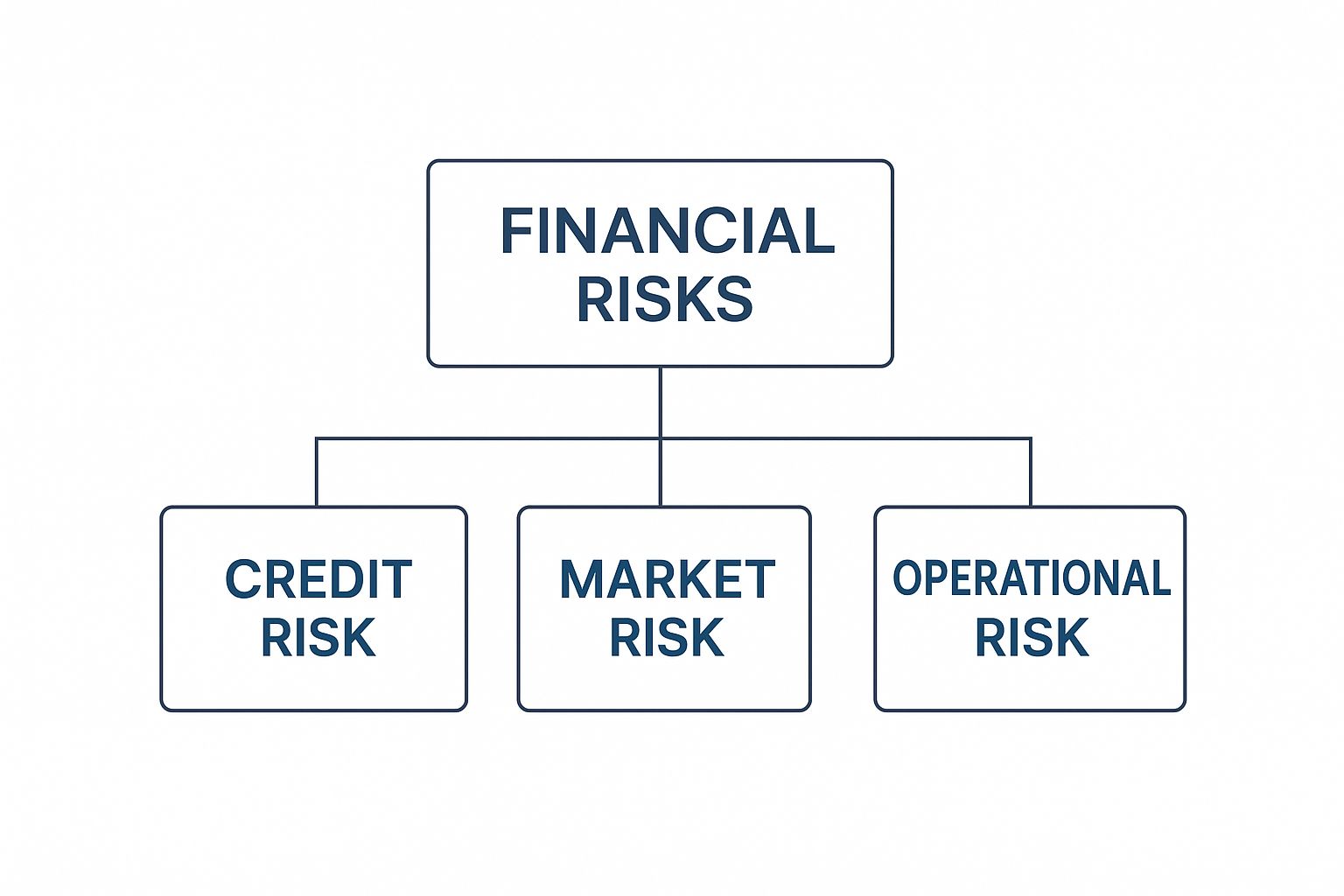
As the visual shows, credit, market, and operational risks are the foundational pillars of a bank's risk profile. Each of these core categories holds its own world of interconnected challenges that demand specific strategies and constant watchfulness.
To make sense of these complex categories, it's helpful to organize them by what drives them and how they can be managed. The table below breaks down the most important risk types with practical monitoring approaches and their potential real-world impact.
| Risk Type | Primary Drivers | Monitoring Approach | Impact Level | Mitigation Strategy |
|---|---|---|---|---|
| Credit Risk | Borrower defaults, economic downturns, collateral devaluation, industry concentration | Loan portfolio analysis, regular credit scoring, stress testing for economic scenarios | High | Diversify loan book, implement strict underwriting standards, maintain adequate loan loss provisions |
| Market Risk | Interest rate fluctuations, currency exchange rate shifts, equity price volatility | Value-at-Risk (VaR) models, sensitivity analysis, monitoring market indices and economic indicators | High | Hedging with derivatives, diversifying investment portfolios, setting strict trading limits |
| Operational Risk | Internal process failures, employee error or fraud, IT system outages, cyberattacks | Internal audits, key risk indicators (KRIs), business continuity planning, cybersecurity drills | Medium-High | Automate manual processes, strengthen internal controls, invest in robust IT infrastructure and staff training |
| Liquidity Risk | Sudden deposit withdrawals, inability to meet short-term obligations, market disruptions | Cash flow forecasting, liquidity coverage ratio (LCR) monitoring, scenario analysis | Critical | Maintain a diverse funding base, hold high-quality liquid assets (HQLA), establish contingency funding plans |
| Compliance Risk | Changes in laws and regulations, failure to adhere to AML/KYC standards, regulatory penalties | Regular compliance audits, employee training on new regulations, automated monitoring systems | Medium-High | Appoint a dedicated compliance officer, use regulatory technology (RegTech), foster a culture of compliance |
This breakdown shows that no single risk exists in a vacuum. A market downturn (market risk) can lead to more loan defaults (credit risk), while a system failure (operational risk) could prevent the bank from accessing funds (liquidity risk). Effective management requires seeing these connections.
The Big Three: Credit, Market, and Operational Risk
These three categories represent the classic foundation of banking risk, but their character is always changing.
Credit Risk: This is the original banking risk—the chance a borrower won't repay a loan. While it's the oldest and most familiar threat, it is still a main cause of bank failures. Today, credit risk goes beyond simple defaults to include concentration risk (too many loans in one industry or area) and the declining value of collateral during economic shifts.
Market Risk: If credit risk is about individual borrowers, market risk is about the entire financial sea. It’s the potential for loss from factors affecting the whole market, like changes in interest rates, foreign exchange rates, or stock prices. A sudden interest rate increase, for example, can devalue a bank's bond portfolio almost instantly, showing the swift and broad impact of market forces.
Operational Risk: This covers losses from failed internal processes, people, and systems—or from outside events. It's a wide-ranging category that includes everything from employee fraud and transaction mistakes to system crashes and natural disasters. As banks grow more dependent on technology, the operational risk tied to cybersecurity and IT systems has ballooned, making it a chief concern for regulators. To explore this topic further, you might be interested in our guide on key financial risk management strategies.
The New Kingmakers: Interconnected and Emerging Risks
While the "big three" are fundamental, the sharpest risk managers know that threats rarely stay in neat boxes. A major new concern is the growing web between traditional banks and less-regulated non-bank financial institutions (NBFIs), such as private equity and credit funds. According to a recent analysis from the European Central Bank, these links create complex, layered exposures. A bank might lend to a private fund, its investors, and the companies the fund owns, creating a tangled web of risk that is hard to see and measure.
This screenshot from the Bank for International Settlements (BIS) shows the wide range of publications addressing these complex topics.
The reports featured here highlight the global focus on everything from Basel III monitoring to managing climate-related financial risks. This proves that the definition of "risk" is constantly expanding and demands a dynamic, forward-looking approach.
Conquering Cybersecurity Risk In The Digital Age
In banking risk management, cybersecurity has moved from a back-office IT task to a frontline, board-level concern. Imagine a bank isn't just a vault of cash, but a digital fortress. A decade ago, this fortress had high walls and few gates. Today, it has countless digital windows, doors, and passages created by mobile banking, third-party apps, and cloud services. Each one is a potential weak point for attackers.
This isn't only about stopping thieves from stealing money; it's about protecting the very foundation of any financial institution: trust. A single breach can destroy customer confidence overnight, causing deposit runs and long-term reputational harm that far exceeds the initial financial loss. The costs also pile up from regulatory fines, legal battles, and the expensive process of notifying customers and fixing systems.
Building a Resilient Digital Fortress
Good cybersecurity risk management isn’t about building walls so high that no one can ever get in. It’s about creating a resilient defense system that can adapt. It works on the assumption that a breach is a matter of when, not if, and focuses on the ability to detect, respond, and recover quickly with minimal damage. This requires a layered approach that brings together technology, processes, and people.
The core parts of a strong cyber defense include:
- Continuous Threat Monitoring: Using advanced tools to constantly scan for weak spots and suspicious activity across all networks.
- Proactive Penetration Testing: Hiring "ethical hackers" to actively test your defenses, find weaknesses before criminals do, and patch them up.
- Incident Response Planning: Creating and regularly practicing a detailed plan for what to do the moment a breach happens, ensuring everyone reacts swiftly and in a coordinated way.
- Employee Training: Realizing that your staff is the first line of defense. Consistent, engaging training on phishing, social engineering, and secure data handling can prevent 95% of cybersecurity breaches.
As part of a solid cybersecurity framework, data protection is crucial. This includes putting secure file sharing practices in place to protect sensitive information as it moves inside and outside the bank. This ensures that even if other defenses are bypassed, the data itself stays locked down.
The Human Element: Your Strongest and Weakest Link
Ultimately, technology alone can't solve the cybersecurity puzzle. The best firewall is worthless if an employee clicks a malicious link in an email. This is why institutions are investing heavily in creating a security-first culture, a shift that has become a top priority for leadership.
This screenshot from WTW shows the main concerns for financial leaders, with cyber risk front and center.
The analysis clearly shows that digital risks, especially cyber threats, are the dominant worry. This focus is driving big changes in how institutions handle security.
In fact, cybersecurity risk is now a primary concern for financial institutions around the globe. Recent risk management benchmarks from central banks show cyber risk is the top immediate worry. This has led many organizations to expand their risk teams and invest in staff training to fight these threats. You can explore more findings on top risks for financial institutions to see how this trend is affecting the industry. True resilience happens when every employee, from the teller to the CEO, understands their part in protecting the bank's digital fortress.
Creating Risk Governance That Actually Works
Strong financial institution risk management isn’t built on dense binders gathering dust on a shelf. Think of it like the command structure of an aircraft carrier. Everyone, from the flight deck crew to the captain, knows their exact role and communicates through clear, established channels. When a threat appears, the response is immediate and coordinated, not tangled in bureaucracy. Too often, governance frameworks look great on paper but create more paperwork than accountability, slowing down decisions when speed is critical.
Effective governance is about building a system that makes the bank stronger and more responsive, not just compliant. It’s about creating a structure where oversight and agility can coexist. This is a careful balance; too much oversight can paralyze action, while too much agility invites chaos. The real goal is to design committees, define roles, and establish reporting lines that are so clear people want to participate because it makes their jobs easier and the institution safer.
The Three Lines of Defense Model
A proven framework for organizing this command system is the Three Lines of Defense. This model clearly outlines who is responsible for what, ensuring there are no gaps in oversight. It’s a simple but powerful idea:
- First Line: This is the business itself—the loan officers, traders, and relationship managers. They are on the front lines, so they own the risks tied to their daily activities and are responsible for managing them within set limits.
- Second Line: These are the risk management and compliance functions. They provide the frameworks, tools, and independent oversight to help the first line manage risk well. They set the rules of engagement and monitor how everyone is performing against them.
- Third Line: This is the internal audit function. They provide independent assurance directly to the board that the first two lines are operating as intended. They are the ultimate check on the system.
When these three lines work in concert, they create a robust system of checks and balances that embeds risk awareness into every single decision. This approach transforms governance from a top-down policing function into a shared responsibility across the entire organization.
To make this practical, it's crucial to define who does what at each level. The following table breaks down how these responsibilities cascade through the organization to create real accountability.
Risk Governance Roles That Drive Real Results
Clear breakdown of governance responsibilities that create accountability and drive effective risk management across all organizational levels
| Organizational Level | Primary Responsibilities | Key Decisions | Reporting Requirements | Accountability Measures |
|---|---|---|---|---|
| Board of Directors | Sets the overall risk appetite and strategy for the entire institution. Provides ultimate oversight. | Approving the Risk Appetite Statement. Appointing the Chief Risk Officer (CRO). | Receives high-level risk reports from the CRO and Chief Audit Executive. | Fiduciary duty to shareholders; regulatory compliance. Performance is tied to the long-term health and stability of the institution. |
| Executive Management | Translates the board's risk strategy into actionable policies and procedures. Ensures business units have necessary resources. | Setting risk limits for specific business lines. Allocating capital based on risk assessments. | Reports comprehensive risk profiles to the board's risk committee. | Performance metrics tied to risk-adjusted profitability. Adherence to board-approved risk appetite. |
| Business Units (First Line) | Owns and manages risks generated from daily activities. Operates within established risk limits. | Making individual loan or investment decisions. Pricing products to reflect their inherent risk. | Reports on risk exposures and incidents to the Second Line (Risk Management). | Performance reviews that include risk management metrics. Adherence to internal policies and procedures. |
| Risk & Compliance (Second Line) | Develops risk frameworks, monitors exposures, and provides independent challenge to the First Line. | Validating risk models. Setting operational risk guidelines. Escalating breaches of risk limits. | Provides independent risk analysis and monitoring reports to Executive Management and the board. | Effectiveness of risk frameworks. Timeliness of identifying and reporting emerging risks. |
| Internal Audit (Third Line) | Provides independent assurance that the overall risk management framework is effective and followed. | Determining the scope and frequency of audits. Assessing the effectiveness of the First and Second Lines. | Reports directly to the board's audit committee to ensure independence. | Audit findings and the successful implementation of remediation plans. Regulatory exam results. |
This structured approach ensures that from the boardroom to the front line, everyone understands their role in protecting the bank. It connects high-level strategy to day-to-day actions, which is the hallmark of a governance structure that truly works.
The Role of Regulatory Oversight
Of course, a bank's internal governance doesn't exist in a bubble. It is heavily shaped by external regulatory bodies that establish the minimum standards for safety and soundness. For U.S. financial institutions, this means operating under the watchful eye of several agencies.
The Federal Reserve, for instance, is a key player in supervising financial institutions to ensure they operate safely and to monitor their effect on the wider financial system.
This image highlights the wide scope of regulatory attention, which covers everything from enforcement actions and community reinvestment to financial stability. These external rules aren't just obstacles to overcome; they provide a solid foundation for building an internal governance structure that is effective, pushing banks to maintain high standards of integrity and transparency. The best governance aligns these external mandates with internal business goals, creating a system that protects both the institution and its customers.
Building Your Risk Mitigation Fortress
Spotting risks is just the start; building a solid fortress to defend against them is what separates resilient banks from the ones that crumble. Think of financial institution risk management like constructing a skyscraper in an earthquake-prone city. You don't just hope the ground stays steady. You engineer a structure with layers of defense—flexible foundations, reinforced supports, and emergency systems—so if one component is stressed, others kick in to prevent a total collapse. The objective isn't to dodge every tremor but to make sure the building is still standing when the shaking stops.

As reports from the World Economic Forum show, global risks are interconnected and demand strategic, layered responses, not one-off fixes. Modern banks build their defenses with this reality in mind, creating strategies that protect them from many potential disruptions at once.
Core Mitigation Strategies That Work
Once you've identified and measured a risk, the next move is to mitigate it. This means putting specific controls and plans in place to either reduce the chance of the risk happening or soften its impact. The best institutions diversify their defenses without getting bogged down by excessive caution. Three core strategies are the foundation of any strong mitigation plan:
- Risk Avoidance: This is the most straightforward approach: simply choosing not to take on an activity with an unacceptable level of risk. A bank might, for instance, decide against expanding into a highly volatile new market or refuse to offer complex financial products that are too difficult to oversee.
- Risk Reduction: This involves actively taking steps to lower the severity or likelihood of a loss. A great example is investing in top-tier cybersecurity to minimize the chance of a data breach. Building a strong defense includes practical steps, like the banking scam prevention methods that protect both the bank and its customers.
- Risk Transfer: This strategy moves the financial hit from a risk onto someone else. The most common way to do this is by buying insurance policies, like liability or property coverage, which passes the potential cost of a disaster to an insurer.
The Institutional Insurance Policy: Business Continuity Planning
Beyond these individual tactics lies the ultimate safety net: a Business Continuity Plan (BCP). A BCP isn't a dusty binder on a shelf; it's a living, detailed playbook that guides a bank through a crisis. It answers the most important question: "If our main operations go down, how do we keep serving customers and protecting our assets?" A solid BCP covers more than just IT disaster recovery; it lays out clear procedures for every critical function of the bank. To see how these pieces fit into the bigger picture, check out our guide on the complete banking risk management framework.
Looking ahead, the strategic response to risk in 2025 will increasingly depend on geographic diversification and robust continuity planning. Banks and insurers are spreading their investments and operations across different regions to buffer against local economic or political shocks. This forward-thinking approach ensures a crisis in one area doesn't bring down the whole institution. You can discover more about these global risk responses and what they mean for the industry. By creating clear contingency plans that teams can actually follow, banks turn theory into a powerful insurance policy for survival.
Leveraging Technology For Smarter Risk Management
Modern financial institution risk management is shifting from a reactive guessing game to a more predictive science. Think of technology not as a simple tool, but as a set of x-ray goggles. Advanced analytics and artificial intelligence (AI) give banks a new kind of vision, letting them see subtle risk patterns buried in mountains of data—patterns a human team could never hope to find on their own. The smartest institutions are using this power to turn raw information into real risk intelligence.
The focus is on tools that create genuine value. Top banks are automating routine risk monitoring, which liberates their expert teams from repetitive work. This change allows them to concentrate on what matters most: strategic planning, solving complex problems, and strengthening client relationships. The aim is to make technology a partner that sharpens human judgment, not just a machine that replaces it.
From Manual Processes To Automated Intelligence
Moving from old-school, manual risk management to a technology-first approach offers powerful benefits. Instead of waiting for periodic, backward-looking reports, banks can now keep an eye on risks as they happen.
Key applications of technology include:
- Predictive Analytics: AI models can sift through historical data to predict potential loan defaults, market changes, or even operational hiccups before they cause trouble. For instance, by analyzing transaction patterns and economic data, a model might flag a commercial loan portfolio showing early signs of distress, long before any payments are missed.
- Automated Compliance: Technology can automatically scan transactions for red flags related to money laundering or other illegal activities. This dramatically improves the speed and accuracy of complying with rules like the Bank Secrecy Act (BSA).
- Advanced Scenario Analysis: Modern platforms enable more sophisticated stress testing. A bank can simulate the impact of several interconnected events—like a sudden interest rate hike paired with a regional economic downturn. Exploring these "what-if" scenarios is essential for being prepared, and you can learn more by navigating insights into the Federal Reserve’s 2025 stress test scenarios.
Harnessing Data For A Competitive Edge
Using technology effectively is no longer just about playing defense; it’s about creating a competitive advantage. Platforms that pull together different data sources—from financial reports to regulatory alerts—give decision-makers a complete picture of the risk landscape.
The dashboard below from Visbanking’s BIAS solution is a great example of how different data points can be combined into a single, clear interface.

This kind of unified view allows executives to benchmark performance, spot new opportunities, and track industry trends with confidence. By making data easy to access and understand, these tools transform risk management from a simple compliance chore into a strategic engine for growth and stability.
Your Risk Management Action Plan
Knowing the theory is one thing, but putting it into practice is what truly matters. It's time to turn all that knowledge into a concrete plan for your financial institution's risk management. Think of it like setting a destination in your car's GPS. You need to know your starting point (your current situation), where you want to go (your ideal state), and the turn-by-turn directions to get there. Without that route, you’re just driving aimlessly.
The key to success is breaking down the journey into small, manageable steps. Successful risk leaders will tell you that building momentum through small, consistent victories is far more effective than trying to do everything at once.
Step 1: Establish Your Baseline and Set Priorities
Before you can chart a course forward, you need a brutally honest look at where you are right now. This isn't about shaming or finding fault; it's about taking a complete inventory of your current risk management tools and processes.
- Conduct a Gap Analysis: How do your current procedures, technology, and governance stack up against industry best practices and what regulators expect? Where are the most obvious weak spots?
- Interview Key Stakeholders: Get out and talk to the people on all three lines of defense. What are their daily frustrations? What risks keep them up at night? Their on-the-ground perspective is gold.
- Prioritize Initiatives: You can't fix everything overnight. Use a simple impact/effort matrix to map out your priorities. Go after the high-impact, low-effort items first. These early wins build confidence and get everyone on board for the bigger projects down the road.
Step 2: Develop a Phased Implementation Roadmap
With your priorities straight, it's time to build the roadmap. A phased approach keeps teams from feeling overwhelmed and gives you the flexibility to make adjustments. Here’s what a typical journey might look like: