
A Board-Level Guide to the Cybersecurity Risk Assessment Template
Brian's Banking Blog
Relying on a patchwork of disconnected spreadsheets for cybersecurity is a strategic gamble. It is a bet that modern financial institutions cannot afford to make.
A formal cybersecurity risk assessment template is not just another document; it is the structured, data-driven framework required for sound governance and credible defense. This guide moves beyond informal check-ins to detail how a proactive, measurable security posture is built. This is not an IT task—it is a core component of strategic business management.
Why Ad-Hoc Risk Assessments Expose Modern Banks

Scattered spreadsheets and casual departmental reviews for managing cybersecurity are relics. For bank leadership, this reactive approach creates significant blind spots that both regulators and adversaries are poised to exploit.
The fundamental failure of this method is its fragmented nature. When risk management is decentralized, data becomes inconsistent. This makes a single source of truth impossible, leaving the board to make critical decisions based on conflicting or incomplete information.
The High Cost of Inconsistent Data
Consider this common scenario: your wealth management and commercial lending divisions both use the same third-party data analytics provider. Wealth management, using a simple checklist, greenlights the vendor as "Low Risk." Concurrently, the commercial lending IT team, using a more technical spreadsheet, flags several control gaps and marks the same vendor as "High Risk."
Which assessment is correct?
Without a standardized framework, the executive team is presented with two contradictory risk profiles for the same operational dependency. This forces a decision based on flawed intelligence:
- Over-invest: Treat the vendor as high-risk across the board. This could result in spending an unnecessary $50,000 on redundant monitoring and contingency planning.
- Under-invest: Accept the "Low Risk" assessment. You have now accepted a critical vulnerability that could lead to a breach with losses that dwarf that $50,000 figure.
This is a recipe for misallocated resources, failed audits, and an inability to make sound security investments.
A fragmented risk process paralyzes strategic action. The board cannot confidently allocate capital to mitigate the biggest threats if the definition of "biggest" changes from one department to the next.
From Compliance Burden to Strategic Tool
The regulatory push toward structured frameworks is a direct response to this operational chaos. Cyber risk is now a permanent fixture in the boardroom, and regulators demand a cohesive, evidence-based approach.
Adopting a unified cybersecurity risk assessment template is essential, driven by global standards like NIST SP 800-30 and other mandates. These frameworks compel banks to build structured, repeatable processes. A standardized template creates a common risk language across IT, legal, and finance, which accelerates the assessment process and allows analysts to focus on analysis, not administration. You can learn more about how leading standards are shaping risk management requirements on threat-modeling.com.
This is about more than satisfying an audit. It is about transforming risk assessment from a compliance exercise into a source of strategic intelligence. When every asset and vendor is measured against the same yardstick, the resulting data is clean, comparable, and—most importantly—actionable.
This unified view provides leadership with a clear picture of the entire risk landscape. Instead of debating which departmental report is correct, the conversation shifts to prioritizing threats based on their quantifiable business impact.
This is where data intelligence platforms like Visbanking become indispensable. They enable you to benchmark your security posture not just internally, but against your peers. By replacing ad-hoc methods, you empower your bank to answer the most critical questions: Where are we truly vulnerable? Are our security investments aligned with our greatest risks? And how does our performance compare to the competition?
Designing Your Bank’s Core Assessment Framework
A generic, off-the-shelf risk assessment template is insufficient for a financial institution. Your bank’s cybersecurity risk assessment template must be a tailored instrument, calibrated to the realities of your operations and the intense regulatory scrutiny you face. The objective is not merely to produce a document that satisfies a compliance requirement; it is to build a strategic engine that provides the board with actionable intelligence.
An effective framework begins by identifying and prioritizing the specific assets that are critical to your bank's operations and value. This is not about servers and software—it is about the business functions they power.
Identifying and Prioritizing Critical Assets
The board requires a clear, tiered inventory of assets. This is not a technical exercise; it is about framing the conversation around direct business impact and financial stability.
Certain assets will immediately be classified as Tier 1. These are the non-negotiables:
- Core Banking Systems: The central nervous system of the bank, processing all daily transactions.
- SWIFT and Payment Gateways: The arteries for multi-million-dollar fund transfers.
- Customer Data Repositories: The location of PII and sensitive financial records; a primary target for attackers.
- Loan Origination Systems: The engine driving your primary revenue streams.
Once critical assets are identified, they must be mapped to credible, specific threat scenarios. Generic threats like "malware" are insufficient. A bank-centric approach demands specificity, such as a ransomware attack encrypting the loan origination system during the busiest quarter, or a sophisticated phishing campaign targeting treasury staff to execute fraudulent wire transfers. This level of detail is essential for an accurate assessment.
Moving to a Hybrid Risk Scoring Model
Most assessment templates fail because they rely entirely on qualitative scoring. Labeling a risk "High" or "Medium" is ambiguous and does not provide directors with the concrete information needed to allocate capital or make strategic decisions. Financial decisions cannot be based on subjective labels.
The solution is a hybrid assessment model. This approach integrates the descriptive clarity of a qualitative review with the hard data of quantitative financial modeling.
A hybrid model forces a crucial shift in thinking. A phishing attack is no longer just a ‘High’ risk; it becomes a risk with a calculated potential loss of $1.5 million and a 15% annualized probability, based on historical incident data and peer benchmarks from a platform like Visbanking. This is data the board can act on.
This is how technical threats are translated into business impact, the language of the boardroom. Data consistently shows that templates blending both methods provide a much fuller picture. A qualitative scale offers a quick overview, while a quantitative approach assigns real numbers—potential financial losses, exploit probabilities—that allow leadership to calculate the precise monetary stakes.
The image below shows the initial step where analysts use threat intelligence. This is the foundation for defining the specific risk scenarios previously discussed.
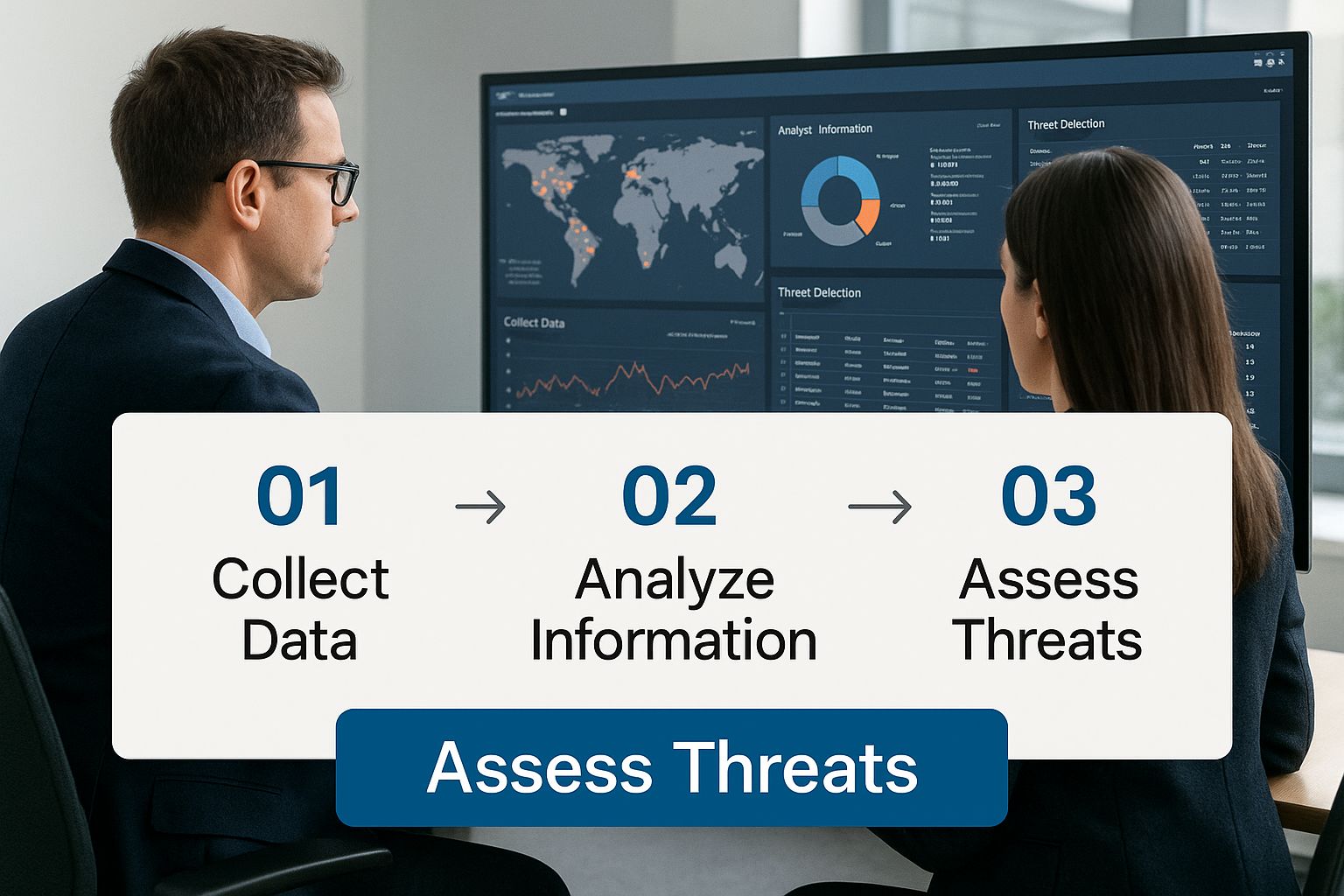
This reinforces a critical point: the entire assessment process must begin with a deep analysis of external threats. Only then can they be contextualized and quantified for your specific institution.
Building a Data-Driven Assessment Engine
A well-designed framework captures the specific data points needed to fuel this hybrid model. The template itself should be structured to guide your team through this process, ensuring consistent results. For a detailed blueprint on assembling these components, our comprehensive bank risk assessment template provides a detailed guide.
This table illustrates how a hybrid model translates threats into a language executives can act on.
Hybrid Risk Scoring Matrix Example
| Threat Scenario | Qualitative Impact (Operational) | Quantitative Impact (Potential Financial Loss) | Likelihood (Annualized) | Overall Risk Score |
|---|---|---|---|---|
| Ransomware on Loan Origination System | Critical (Revenue generation halted) | $2.5M (SLE) | 5% (Low) | High |
| Business Email Compromise (Wire Fraud) | High (Reputational & Financial) | $500K (SLE) | 20% (Medium) | High |
| Insider Data Theft (Customer PII) | Critical (Regulatory & Trust) | $4M (SLE, including fines) | 2% (Very Low) | Medium |
| DDoS Attack on Online Banking Portal | Major (Service Disruption) | $150K (SLE) | 30% (High) | Medium |
This matrix moves the conversation from abstract concerns to concrete business risks with clear financial implications. By designing your framework around these principles, the cybersecurity risk assessment template becomes an active intelligence tool that draws a direct line from security controls to financial outcomes. This empowers your board to govern with clarity and confidence.
Weaving Critical Threat Vectors into Your Template
A standardized template is the foundation. Its real value is realized when it is tailored to address the specific threats facing your institution. A risk assessment cannot be a static checklist; it must be a dynamic tool that enables proactive defense.
For any bank leader, this means focusing on three critical areas: ransomware, third-party vendors, and the cloud. Generic risk scores are inadequate. The assessment must pose specific questions that tie directly to operational resilience and the bottom line.
How Ready Are You Really for Ransomware?
The ransomware conversation must be more sophisticated than, "Do we have backups?" That is table stakes. An effective template module forces the team to produce business metrics that the board can act upon.
Your template must compel answers to questions that connect directly to financial outcomes:
- Recovery Time Objective (RTO): What is the board-approved RTO for our core banking platform? Four hours? One day?
- Downtime Cost: What is the financial loss for every hour our core platform is down? For a smaller bank, this could be $100,000 per hour in lost revenue and operational costs. For a larger institution, that figure multiplies.
- Recovery Testing: When was the last full-scale recovery test, and did we meet our RTO? What were the failure points?
These questions transform the exercise from a technical review into a critical business continuity discussion. The answers provide leadership with the data to weigh the cost of stronger defenses against a tangible, calculated financial risk.
Answering "yes" to having backups is meaningless without a tested, verified recovery time that aligns with the bank's tolerance for financial loss. The template must enforce this level of rigor.
Putting Third-Party and Supply Chain Risk Under the Microscope
A bank's security perimeter is no longer defined by its own walls. Every FinTech partnership and outsourced service alters your risk profile. A recent study found that 61% of U.S. companies have suffered a data breach caused by a third-party vendor.
A simple pass/fail vendor questionnaire is insufficient. Your risk assessment template requires a tiered framework that evaluates partners based on their level of access to your data and systems.
Consider this scenario: You are onboarding a new FinTech partner offering an AI-powered loan analysis tool.
- Tiering: The partner requires real-time API access to your loan origination system and sensitive customer financial data. This immediately classifies them as a Tier 1 vendor, subject to the highest level of scrutiny.
- Assessment: Instead of relying on self-attestation, your template should trigger a deep-dive assessment, requiring evidence such as penetration test results and SOC 2 Type II reports.
- Risk Quantification: You must then quantify the risk. If the vendor has weak API security, your template should help model the potential impact. A breach could lead to a $3M loss from fraudulent loans and a significant decline in customer trust.
This structured, data-first approach transforms vendor management from a relationship exercise into a disciplined risk function.
Sizing Up Your Cloud Security Posture
As more core banking operations migrate to the cloud, assessment templates must evolve. Assessing cloud security is different from evaluating on-premises servers; it requires a new set of questions focused on configuration, access controls, and the shared responsibility model.
The approach should be similar to financial modeling for stress testing for banks. We apply pressure to identify weak points. This is the mindset required for cloud security assessments, and the template must guide this analysis.
By building these specific, rigorous modules into your assessment template, it transitions from a static document to a powerful governance tool. It provides the board with clear, quantifiable data on your most significant threats, allowing you to focus resources where they will have the greatest impact.
Getting Your Findings from the Server Room to the Boardroom
Completing your cybersecurity risk assessment template is the starting point. The real value is generated when technical data is translated into a compelling business narrative for the board.
Raw vulnerability data must be framed as a strategic roadmap that compels executive action. The objective is not just to identify problems, but to frame cyber risks in terms of what matters to the C-suite: loan growth, customer retention, and quarterly earnings.
Talk Business, Not Tech
The board does not require a briefing on exploit kits. They need to understand consequences. Do not report, "We have unpatched servers in the loan origination environment." That is IT-speak.
Instead, frame it like this: "Our loan origination platform has a vulnerability. If exploited, we could be forced to halt all new loan processing for 72 hours. During our busiest quarter, that represents a direct revenue impact of approximately $2.1 million."
This reframing shifts the conversation from a technical issue to a business risk with a clear financial dimension. The most effective method is a simple dashboard showing only the top five cyber risks and their quantifiable business impact.
- The Tech Finding: The mobile banking app has a weak API.
- The Boardroom Translation: A flaw in our mobile app could expose customer transaction data. The potential impact, including regulatory fines and customer attrition, could be $4.5 million.
This is the clarity that drives sound decisions and appropriate funding.
The Power of Knowing Where You Stand
Internal data reveals what is happening within your own institution. External benchmarks provide perspective. Knowing your risk score is one thing; knowing how it compares to your direct competitors provides an entirely different level of insight.
This is where data intelligence tools are critical. A platform like Visbanking supplies the objective, data-driven peer benchmarks that add weight to your findings.
A finding like, "Our risk score for mobile banking security is 7.8," is interesting. This is far more powerful: "Our risk score for mobile banking is 7.8, while peer banks our size average a 6.2." This is an immediate call to action, flagging a competitive weakness that requires attention.
This comparison answers the question every board member will ask: "How are we performing compared to our peers?" It removes guesswork from the discussion and grounds it in market reality. Are your security investments making you a leader, or are you merely keeping pace?
When you connect your assessment data to business objectives and layer in peer performance metrics, you build a case that is impossible to ignore. Your cybersecurity risk assessment template transforms from a static report into a dynamic tool for strategic decision-making. You are not just providing data; you are delivering the intelligence to act with confidence.
Want to see how your institution’s risk profile measures up against the competition? Find out how Visbanking’s powerful analytics can deliver the benchmarks you need to get ahead.
Benchmarking Performance and Driving Improvement
Completing a cybersecurity risk assessment is not the finish line; it is the start of a continuous improvement cycle. A static assessment becomes obsolete the moment it is finalized. For bank leadership, the real power of a cybersecurity risk assessment template lies in using it as a dynamic tool to track progress and enforce accountability.
A disciplined rhythm is essential. A full, bank-wide review must occur at least annually. However, your crown jewel assets—the core banking system, payment gateways, and critical third-party vendors—require more frequent review, likely quarterly.
From Static Report to Performance Metric
The objective is to track risk reduction with objective data. This reframes security from an opaque cost center into a measurable business function. The boardroom conversation must shift from, "Did we complete the assessment?" to "Did our actions and investments measurably reduce our risk since last quarter?"
For example, assume the board approves a $250,000 investment to enhance data encryption after an assessment identified a high risk of data theft. The subsequent review cannot simply note that new software was installed. You must demonstrate its effectiveness.
The follow-up assessment needs to show a real, quantifiable drop in the risk score for data exfiltration. If the score started at an 8.5 (High), a successful project should bring it down to a 5.0 (Medium). That's how you show a direct ROI on that $250,000 investment.
This provides the clear evidence of due diligence that regulators and shareholders demand. It moves your bank from being merely compliant to being actively defended, where every security dollar is tied to risk reduction.
The Critical Role of External Benchmarking
Evaluating internal progress is only half the picture. The critical question for any director is not just, "Are we improving?" but "How are we performing relative to our peers?" Answering this requires external intelligence.
Relying solely on internal historical data is insufficient. You must benchmark your risk posture and security investments against other banks of a similar size and business model. With the right banking analytics, you can put your performance into context.
A report showing you reduced third-party vendor risk by 15% is good. But a report showing you reduced it by 15% while your peers only achieved a 5% reduction demonstrates market leadership and justifies strategic security spending.
This table illustrates an annual cycle that turns data into action and measures it against the industry.
Risk Mitigation and Benchmarking Cycle
| Quarter | Action | Key Metric (Internal) | Benchmark Metric (Visbanking Peer Data) |
|---|---|---|---|
| Q1 | Conduct enterprise-wide risk assessment. Identify top 3 risks. | Initial risk scores established for all critical assets (e.g., Phishing susceptibility at 7.8/10). | Average peer phishing susceptibility score is 6.5/10. |
| Q2 | Implement phishing simulation & training program. | Target: Reduce phishing click-rate by 50% from Q1 baseline. | Peer group average click-rate reduction after training is 35%. |
| Q3 | Re-assess phishing risk post-training. Review project ROI. | New phishing susceptibility score is 4.1/10 (a 47% reduction). | Peer average susceptibility score is 5.9/10. We are now outperforming. |
| Q4 | Board review of security program performance. Allocate budget for next year based on data. | Present evidence of risk reduction and benchmark outperformance. | Demonstrate security program effectiveness is in the top quartile of peers. |
This process moves security from a one-off task to a strategic, data-driven program. A well-managed cybersecurity risk assessment template is the foundation of a mature security program. By establishing a reassessment rhythm, tracking progress with hard numbers, and benchmarking against the competition, you create a powerful cycle of accountability that turns security into a strategic asset.
Straight Answers for Bank Directors
As a director, your role is not technical minutiae; it is ensuring the bank's cybersecurity strategy is sound, intelligent, and supportive of the business. Here are direct answers to the key questions regarding a formal cybersecurity risk assessment.
How Often Do We Really Need to Do This?
A full, comprehensive risk assessment should be conducted at least annually. This provides the board with a solid baseline and a complete picture of the institution's risk posture.
However, an annual review is insufficient for your most critical systems. The core banking platform, SWIFT gateways, and key vendors with deep data access are high-stakes assets. They demand more frequent evaluation.
These crown jewels should be reassessed quarterly, or immediately following a significant event, such as a major system upgrade or the onboarding of a new FinTech partner. This ensures your view of the most acute risks is never more than 90 days out of date.
What's the Board's Real Job in This Process?
The board's role is governance and oversight, not technical management. Your primary responsibility is to ensure a robust framework is in place and then to challenge the intelligence it produces.
In practice, this means:
- Insist on a Real Framework: Mandate a standardized risk assessment template that translates technical jargon into financial and business impact.
- Challenge Everything: If management presents a risk as "Medium," your question should be, "Show me the data. What is the potential financial loss that defines it as 'Medium'?"
- Spend Money Smarter: Use the assessment's findings to guide budgetary decisions. Approve security investments that address the largest financial and operational risks.
- Demand Proof: Hold management accountable for results. They must demonstrate, with data, that risk is decreasing over time as a direct result of board-approved actions.
Your duty is to ensure this process generates intelligence that leads to decisive action.
The board’s most critical job is to change the conversation from, "Are we secure?" to "Can you prove our security investments are reducing our specific, quantified risks better than our peers?" That requires objective data.
How Do We Prove Cybersecurity Spending Is Actually Worth It?
The ROI of cybersecurity is proven by demonstrating a measurable reduction in risk. A quantitative scoring system within your template is the essential tool for this.
Consider this scenario: your assessment identifies a business email compromise threat with a potential $5 million loss, scoring it an 8 out of 10. The board approves a $200,000 investment for enhanced email security and training.
The subsequent quarterly assessment provides the proof. If that same risk now scores a 4 out of 10, you have tangible evidence of ROI. You have demonstrated how a $200,000 expenditure effectively mitigated a multi-million-dollar threat.
This is powerful on its own, but becomes more compelling with benchmarking. Platforms like Visbanking provide the external peer data to contextualize your performance. Proving your risk reduction outpaces that of peer banks is not just about closing gaps—it is about building a sustainable competitive advantage.
Effective bank directors do not govern by intuition; they use data to lead with confidence. At Visbanking, we deliver the peer benchmarks and intelligence you need to validate your strategy and turn your security program into a source of strength. See how you compare by exploring our platform.
Latest Articles
Brian's Banking Blog
Automated Alerts and Notifications for Banks
Brian's Banking Blog
Customer Feedback Loop for Banks: A Practical Playbook
Brian's Banking Blog
Commercial Lending Trends: What Bank Executives Must Know
Brian's Banking Blog
Bank Marketing Dataset Analysis Strategy

Brian's Banking Blog
ESG Peer Benchmarking for Bank Leaders
Brian's Banking Blog