
A Data-Driven Playbook for Executive Decisions on Bank Growth
Brian's Banking Blog
For bank executives and directors, the traditional playbook for growth—accumulating assets for the sake of a larger balance sheet—is obsolete. The modern imperative is not simply to grow, but to grow profitably and sustainably.
True bank growth is a function of strategic execution. It requires expanding high-quality assets, securing stable, low-cost deposits, and driving superior profitability, all while navigating a volatile economic landscape. Growth-at-any-cost is no longer a viable strategy; it is a liability.
Redefining Bank Growth in the Modern Economy

In boardrooms, the conversation has shifted from size to substance. The focus is now on the quality and sustainability of growth, a strategic pivot dictated by economic realities and intense competition.
Leading institutions no longer measure success by total assets alone. The critical metrics are the returns those assets generate. Return on Equity (ROE) and Net Interest Margin (NIM) have become the definitive indicators of a bank’s health and strategic effectiveness. A bank that grows assets by 10% while its NIM compresses by 25 basis points has not grown; it has acquired lower-quality business and diluted shareholder value.
From Brute Force to Precision Strategy
This new reality demands a transition from instinct-based decisions to data-driven strategy. Sustainable bank growth is the result of precise, data-backed execution.
Consider two peer banks:
- Bank A pursues market share by aggressively cutting commercial loan rates. Its asset base expands, but its ROE stagnates as margins erode.
- Bank B utilizes a data intelligence platform to identify an underserved niche in specialized equipment financing. It grows its loan portfolio by a more modest 6% but achieves a higher risk-adjusted return, expanding its overall NIM.
Bank B is the clear victor. Its growth is profitable, targeted, and built on a defensible strategy. This illustrates a critical point: significant opportunities are often buried in granular data that competitors overlook.
In today's market, the greatest risk is not calculated expansion. It is making strategic decisions with incomplete information while competitors act on precise, real-time intelligence.
Competitive intelligence platforms are no longer a luxury for large institutions; they are essential tools for identifying market gaps, benchmarking against direct peers, and capitalizing on opportunities.
Without this level of insight, you are operating blind. To drive meaningful bank growth, you must have a comprehensive view of the competitive landscape. The first step is to benchmark your institution not against a generic national average, but against the specific competitors you face every day. Explore how Visbanking’s data platform provides the clarity required to build a winning growth strategy.
The Three Pillars of Sustainable Bank Growth
Sustainable bank growth is not the pursuit of a single metric but the management of a finely tuned engine with three critical, interlocking components: Asset Growth, Deposit Growth, and Profitability.
For any bank executive, mastering the interplay between these pillars separates fleeting expansion from the strategic growth that builds enduring institutional value. It requires moving beyond textbook definitions to address the strategic trade-offs inherent in daily decision-making.
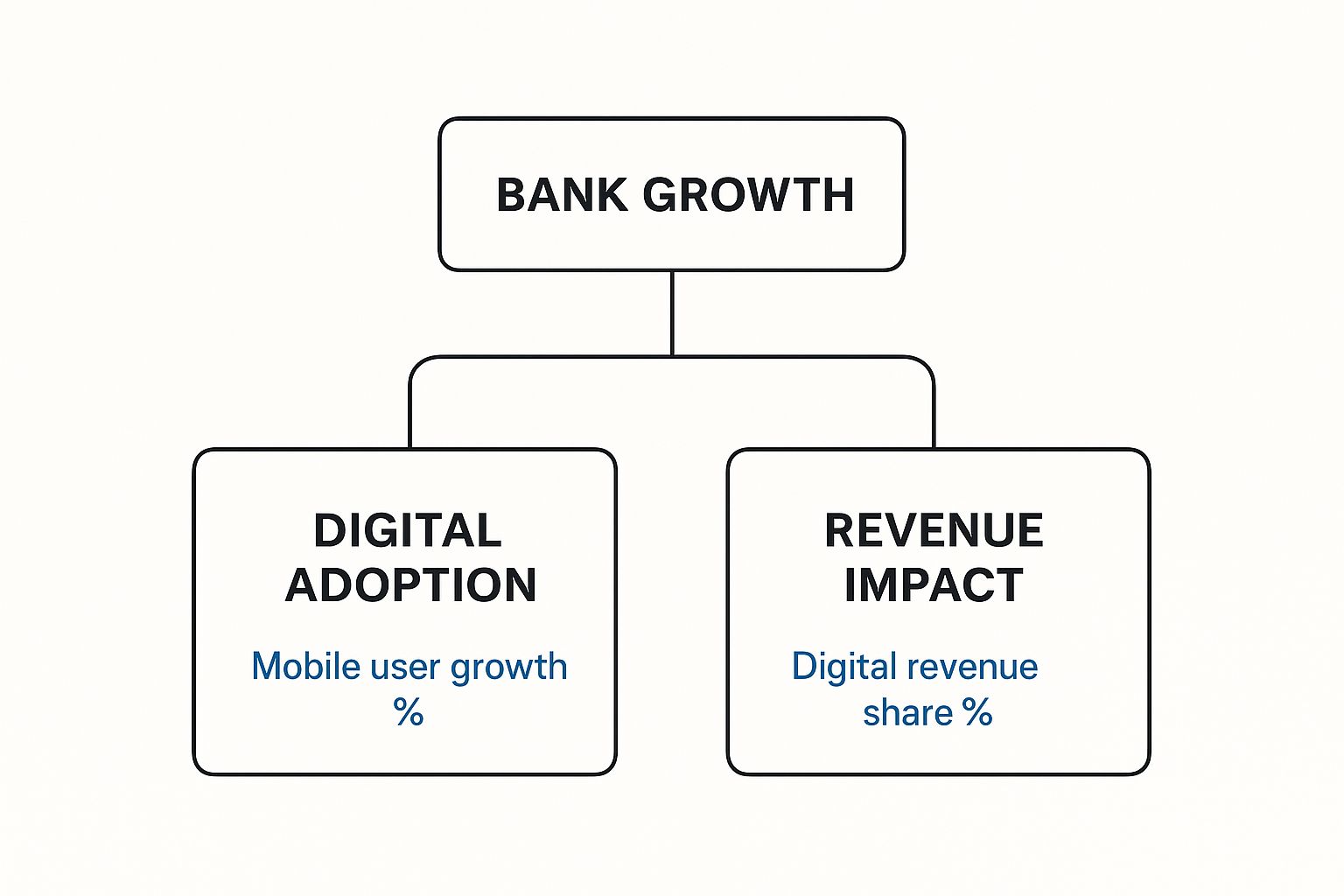
This chart illustrates a core truth of modern banking: digital user base expansion is directly correlated with revenue growth. It is a straight line from digital adoption to profitable bank growth.
Pillar 1: Asset Growth – Quality Over Quantity
Asset growth is the most visible metric, yet it is also the most frequently misunderstood. Any institution can expand its balance sheet; the art lies in growing assets profitably and strategically.
The critical question for the board is not if to expand the balance sheet, but how. This decision invariably involves a calculated trade-off between loan portfolio growth and investment securities.
Imagine a $2 billion community bank targeting asset growth. The conventional approach might be a broad marketing campaign for residential mortgages. However, data intelligence may reveal a more profitable alternative. An analysis using a tool like Visbanking’s BIAS could uncover an overlooked niche, such as C&I loans for local manufacturing firms that larger competitors are de-emphasizing.
By reallocating just 5% of its asset growth from low-margin mortgages to these higher-yield commercial loans, the bank could add over $1.5 million in annual interest income. This is not a speculative guess; it is a strategic pivot based on hard market intelligence, transforming a volume play into a targeted strike for profitability.
Pillar 2: Deposit Growth – The Hunt for Stability and Cost
On the liabilities side of the balance sheet, deposit growth presents a distinct set of challenges. The objective is to attract and retain low-cost core deposits, which provide a stable funding base that insulates the bank from interest rate volatility. The alternative is chasing expensive, non-core wholesale funds or promotional CDs that erode margins.
A bank's long-term viability is directly linked to its ability to win the battle for core deposits. This battle is won not on rate alone, but on a superior understanding and servicing of customer needs.
Data is the decisive weapon in this competition, enabling you to attract deposits without engaging in a destructive rate war. By analyzing competitor rate structures and deposit compositions within your specific market, you can make surgical decisions.
For example, data analysis might reveal that small businesses in your market prioritize sophisticated treasury management services and fraud protection over the last 10 basis points on their operating accounts. Armed with this insight, you can create product bundles that attract valuable core deposits based on tangible value, not price. This is how you protect your Net Interest Margin (NIM) and build a funding base resilient to economic cycles.
Pillar 3: Profitability – The Ultimate Arbiter
Ultimately, asset and deposit growth are inputs. The definitive report card on your bank's growth strategy is profitability. Metrics like Return on Equity (ROE) and NIM are not just figures for a quarterly report; they are the final verdict on your strategic effectiveness.
To connect the first two pillars to the bottom line, you require tools that move beyond high-level summaries. You must be able to model precisely how a shift in your loan mix will impact NIM, or how a change in deposit composition will affect ROE.
The table below outlines these drivers and the strategic questions leadership must answer with data.
Key Drivers of Bank Growth and Their Strategic Importance
| Growth Driver | Core Definition | Strategic Question for the Board |
|---|---|---|
| Asset Growth | The increase in a bank's total assets, primarily loans and securities. | Where can we deploy capital for the highest risk-adjusted return? Which loan segments are our competitors overlooking? |
| Deposit Growth | The increase in customer deposits, which fund the bank's lending activities. | How can we attract low-cost core deposits without initiating a rate war? What non-rate value propositions resonate with our target clients? |
| Profitability | The ability to generate earnings, measured by KPIs like ROE and NIM. | What is the direct impact of our asset and liability decisions on our bottom line? Are we growing, or just getting bigger? |
Each driver necessitates a critical conversation that requires more than intuition. The global banking industry is positioned for a significant shift, with loan growth projected to reach 6% in 2025—a substantial increase from 2% in 2024—as falling interest rates are expected to stimulate borrowing.
Forward-thinking banks are already using data to lock in higher-yield assets while simultaneously capitalizing on the 9.5% annual growth in the payments sector. This is not luck; it is preparation.
Data intelligence allows you to model these scenarios, translating raw numbers into an executable plan. This is the foundation for creating actionable bank growth strategies that deliver predictable returns. When your board can see the projected impact of a strategic initiative on ROE, hesitation is replaced by conviction. This is how data transforms strategic planning from an annual exercise into a continuous engine for performance.
Navigating Economic Headwinds to Protect Growth

The pursuit of bank growth is an exercise in navigating powerful external forces, including economic volatility, regulatory shifts, and competitive pressures. The true measure of leadership is not simply achieving growth in favorable conditions, but protecting and advancing your position when headwinds intensify.
Winning in this environment requires a shift from reactive measures to proactive anticipation. A powerful data platform becomes your command center, enabling you to foresee challenges and convert them into strategic opportunities.
Mastering Economic Volatility
Economic uncertainty is the most persistent headwind. Interest rate volatility, in particular, can compress Net Interest Margin (NIM) with alarming speed. Relying on quarterly call reports to assess the damage is an outdated and ineffective approach.
Real-time benchmarking provides a decisive advantage. If your cost of funds begins to rise, is this an institution-specific issue or an industry-wide trend? A platform like Visbanking allows you to instantly compare your deposit pricing and NIM against a curated peer group.
If peer margins are stable while yours are declining, it signals specific competitive pressure in your market. This insight enables precise adjustments to your deposit strategy before the problem compounds. It is the difference between addressing a minor issue and managing a crisis.
Monitoring broader market sentiment, such as the Fear Greed Index Stock Market, adds another layer of context, helping you identify macroeconomic shifts that could impact your institution.
Turning Regulatory Pressure into Strategic Advantage
New regulatory frameworks, such as the Basel III Endgame, are often viewed as costly compliance burdens. Many institutions adopt a purely defensive posture. Strategically astute banks, however, see an opportunity.
The new era of regulation demands more than compliance; it demands the ability to model the future. Banks that can accurately stress test their capital under various scenarios will not only satisfy regulators—they will uncover strategic advantages.
Instead of reactive calculations, a modern data platform enables forward-looking "what-if" scenarios. How would a new commercial loan product impact capital adequacy under proposed rules? What is the effect of shifting the investment portfolio?
This transforms compliance from a defensive necessity into a strategic tool for optimizing the balance sheet for both resilience and growth. A thorough understanding of modern stress testing for banks is critical for driving capital planning.
Despite these pressures, the industry outlook remains solid. U.S. banks are projected to maintain strong profitability through 2025, with an estimated return on common equity between 10.5% and 11.5%. This stability underscores a critical imperative: precise cost control and strategic technology investments will separate the leaders from the laggards.
Outmaneuvering the Competition with Precision
Finally, competition from traditional banks, credit unions, and fintechs is relentless. Competing on price is a race to the bottom that erodes the very profitability you seek to grow. The superior strategy is to identify and dominate a defensible niche.
This requires granular, street-level intelligence. Consider a $3 billion bank planning to expand its commercial real estate lending. A brute-force approach of undercutting rates is a flawed strategy.
The data-driven alternative involves analyzing competitor loan portfolios in the target geography. This analysis might reveal that while competitors are fighting over large office and retail CRE loans, there is a significant, underserved market for financing smaller, multi-family residential projects.
Armed with this insight, you can launch a targeted offering with competitive, yet profitable, terms. This allows you to gain valuable market share and achieve real bank growth without initiating a price war.
Using Consolidation as a Strategic Growth Catalyst
In a crowded banking landscape, organic growth has its limits. For executives seeking significant scale, market dominance, and enhanced shareholder value, consolidation through mergers and acquisitions (M&A) is a powerful strategic lever.
However, a successful M&A strategy is not a simple land grab. A well-executed acquisition is a surgical instrument used to reshape the balance sheet, enter new markets, acquire specialized talent, or integrate critical technology. The objective is not merely to add assets, but to add the right assets that create a stronger, more profitable institution.
The Data-Driven M&A Playbook
The history of U.S. banking validates this approach. Today’s industry giants were built through decades of targeted acquisitions. Over the past 25 years, the combined market capitalization of J.P. Morgan, Bank of America, Wells Fargo, and Citigroup grew to $1.52 trillion, a 3.3-fold increase since 2000. This M&A-driven growth demonstrates how consolidation can create empires. A visualization of this trend highlights the evolving competitive dynamics of the banking industry.
The lesson for today’s bank leaders is that the right deals build dynasties. But the game has changed. Modern M&A requires deep reliance on data intelligence. Intuition and guesswork are recipes for costly failures.
A successful merger is decided long before the signing. It is born from relentless, data-driven due diligence that validates the strategic fit and financial projections. This process converts a high-stakes gamble into a calculated investment.
A business intelligence tool like Visbanking’s BIAS serves as a critical strategic asset, enabling forensic analysis that goes far beyond surface-level financials.
From Target Identification to Post-Merger Success
A data-powered M&A process shifts your posture from reactive to proactive, allowing you to systematically hunt for the ideal strategic fit.
Data intelligence transforms the M&A lifecycle:
- Finding Hidden Gems: Systematically screen the market for banks meeting your specific criteria. Filter for institutions with low-cost core deposits in high-growth markets, or identify a target whose strong C&I loan book perfectly offsets your concentration in commercial real estate.
- Surgical Due Diligence: Go beyond the target's presented financials. Benchmark their asset quality, loan yields, and deposit costs against a curated peer group. If a target reports a Net Interest Margin of 3.50% while peers achieve 3.75%, it signals untapped pricing power you can unlock post-merger.
- Pinpointing Real Synergies: The promise of "synergy" is often where deals fail. Data makes it tangible. Analyze branch overlap, staffing ratios, and non-interest expenses to build a realistic, data-backed model for cost savings, providing the board with the hard numbers needed to approve the transaction with confidence.
Committing millions in capital to an acquisition demands undeniable proof. By modeling the financial impact of a potential merger with granular data, you provide your board with the conviction to make bold, strategic moves. This is how you leverage consolidation not just to increase size, but to build a more dominant and resilient institution.
Before your next strategic planning session, benchmark your bank—and your potential targets. You may uncover an opportunity your competition has completely overlooked.
The Data Intelligence Advantage in Strategic Planning

A strategic plan devoid of precise, granular data is not a strategy; it is a hypothesis. In today's market, operating on instinct or outdated assumptions is a direct path to eroding shareholder value.
Every concept discussed—from asset quality to deposit strategy—is underpinned by the power of business intelligence to drive conviction in the boardroom. The most successful banks have integrated data into the fabric of their strategic planning, transforming it from an annual exercise into a continuous engine for growth.
From Hypothesis to Actionable Intelligence
A data-driven framework moves beyond vague goals. It uses intelligence to answer critical strategic questions with confidence, enabling precise, measurable actions backed by evidence.
This framework has three core components:
- Benchmarking Performance: Stop using national averages. Set ambitious, achievable targets by measuring performance against a hand-picked peer group of your direct competitors.
- Analyzing Market Dynamics: Use granular, county-level data to guide high-stakes decisions like branch network optimization or new market entry.
- Monitoring Competitors: Exploit their strategic weaknesses by continuously tracking product pricing, market share shifts, and balance sheet compositions.
Consider a $5 billion bank looking to expand into an adjacent county. The traditional approach—relying on broad demographic data—offers no competitive edge and carries high risk. The data intelligence approach is fundamentally different, focusing on answering specific, high-stakes questions before committing capital.
A modern intelligence platform like Visbanking’s BIAS transforms market entry from a shot in the dark into a calculated strategic move. It provides the specific, actionable data needed to build a business case grounded in reality, not theory.
Instead of generic population statistics, you can pinpoint the target market's loan-to-deposit ratio, the average yield on commercial real estate loans, and competitor money market rates. This level of detail fundamentally alters the risk equation.
A Practical Example of Data-Driven Decision Making
Imagine your team is evaluating a new market where the top three competitors hold 80% of the deposit share. A traditional analysis might conclude the market is saturated.
However, a deeper data-driven analysis reveals a critical vulnerability: all three competitors are heavily concentrated in large-scale CRE loans, and their CD rates are 25 basis points below the regional average. This insight changes the strategic calculus.
You can now devise a precise entry strategy: launch with aggressively priced CDs to capture initial deposits while focusing lending on the underserved small-to-medium enterprise (SME) market. This is how data turns a perceived threat into a clear path for bank growth. The use of predictive analytics in banking can further sharpen these strategies, helping you forecast customer behavior and market shifts with greater accuracy.
The table below contrasts these two approaches.
Data-Driven vs. Traditional Strategic Decisions
| Strategic Decision | Traditional Approach (Guesswork) | Data-Driven Approach (Intelligence) |
|---|---|---|
| New Market Entry | Relies on broad demographics and assumes market needs. | Analyzes competitor loan yields, deposit mix, and pricing to find specific, underserved niches. |
| Product Pricing | Sets rates based on what "feels right" or by following the market leader. | Benchmarks rates against a curated peer group to optimize for both volume and margin. |
| Capital Allocation | Spreads investment across business lines based on historical performance. | Models the ROE impact of shifting capital to high-growth segments identified through market analysis. |
Data intelligence is not just a tool for analysts; it is a strategic partner for the executive team. It provides the evidence needed to challenge outdated assumptions, validate bold initiatives, and lead with the confidence that your decisions are built on a foundation of fact.
To secure your bank's future, you must see the market with absolute clarity. Start by benchmarking your bank against your true competitors to understand your current position.
Frequently Asked Questions About Bank Growth Strategy
As a bank leader, you are tasked with balancing ambitious growth objectives with the realities of risk and market dynamics. Here are direct answers to the most common questions from executives focused on intelligent, sustainable growth.
How Can My Bank Grow Deposits Without Starting a Rate War?
Avoid a rate war; it is a margin-destroying race to the bottom. Victory lies in exploiting competitor weaknesses, which requires sharp data analysis.
Begin by dissecting the deposit mix of peer banks in your market. A data intelligence platform can reveal if a competitor is over-reliant on high-cost CDs or is neglecting business operating accounts. That is your opening.
For example, if data uncovers a gap in treasury management services for local SMEs, you can develop a product suite that delivers superior value, making the interest rate a secondary consideration. By focusing on service, technology, and a deep understanding of a target client segment, you attract the stable, low-cost core deposits that are the foundation of a healthy bank. The strategic objective is to shift the conversation from price to value.
What Is the Single Most Important Metric for Sustainable Growth?
While numerous metrics are important, Return on Equity (ROE) is the ultimate arbiter of performance. It answers the board's most critical question: How effectively are we deploying shareholder capital to generate profit? A strong, consistent ROE is the clearest indicator of a well-managed institution creating durable value.
However, ROE is an outcome metric. It is sustainable only when supported by a solid Net Interest Margin (NIM), disciplined expense control, and strong asset quality.
A high ROE built on excessive leverage or a high-risk loan portfolio is a house of cards. True sustainability is derived from understanding how all these components interact—a level of clarity only deep data analysis can provide.
My Board Is Risk-Averse. How Do I Make the Case for Data-Driven Expansion?
Reframe the conversation. Present the initiative not as a "growth plan," but as a "risk mitigation plan." In today's market, the greatest risk is inaction—making critical decisions based on intuition while competitors act on evidence. Standing still is the fastest way to be left behind.
Position a data-driven approach as the method to de-risk your strategy. Instead of a vague proposal, use a tool like the Visbanking’s BIAS platform to build an undeniable, evidence-based case.
Present the financial models. Show the precise impact of entering a new market by detailing peer benchmarks on loan yields, deposit costs, and projected ROE. When you do this, you are no longer discussing abstract risk; you are having a productive conversation about a well-defined, manageable opportunity.
How Can We Use Data to Find the Right Merger and Acquisition Target?
Identifying the right M&A target requires looking far beyond the call report. A strategic acquisition is not about getting bigger; it is about finding a partner that remedies your weaknesses and amplifies your strengths. This demands a data-first approach.
Use a business intelligence platform to screen potential targets based on true strategic fit, not just asset size.
- Balance Sheet Optimization: If you are concentrated in commercial real estate, find a target with a strong C&I or agricultural lending portfolio to diversify risk.
- Low-Cost Funding Acquisition: Identify banks with a high concentration of low-cost core deposits. This stable funding becomes a competitive advantage post-merger.
- Geographic Expansion: Pinpoint a bank in a high-growth market where you have no presence to establish an immediate foothold.
This rigorous, data-led process ensures you are acquiring tangible strategic value, not just empty scale, and is the most reliable way to ensure an M&A transaction delivers shareholder value.
The banks that win are those that replace guessing with knowing. To build a growth strategy that withstands any economic condition, you must see your market, your competition, and your own institution with total clarity. With Visbanking, you can benchmark your bank against any peer group, uncover hidden opportunities, and build the data-backed case needed to lead with conviction.
Explore the Visbanking BIAS platform to see what your data is telling you.
Latest Articles
Brian's Banking Blog
Automated Alerts and Notifications for Banks
Brian's Banking Blog
Customer Feedback Loop for Banks: A Practical Playbook
Brian's Banking Blog
Commercial Lending Trends: What Bank Executives Must Know
Brian's Banking Blog
Bank Marketing Dataset Analysis Strategy

Brian's Banking Blog
ESG Peer Benchmarking for Bank Leaders
Brian's Banking Blog