
What is Competitive Benchmarking? A Guide for Bank Executives
Brian's Banking Blog
Relying solely on historical performance is a strategic liability. It creates a critical blind spot, leaving your institution vulnerable to market shifts and competitor advancements you cannot see.
This is the strategic imperative for competitive benchmarking: the disciplined practice of comparing your bank's key performance indicators (KPIs) against a meticulously selected peer group. It is not a historical review; it is a forward-looking intelligence tool that provides the essential context for sound executive decisions.
What Competitive Benchmarking Looks Like for Today's Banks

In an environment of compressed margins and relentless competition, inward-looking analysis is insufficient. Competitive benchmarking moves leadership beyond anecdotal evidence and internal assumptions, providing an objective, data-driven assessment of your bank’s performance across all core functions.
Effective benchmarking transcends superficial comparisons of interest rates. It requires a forensic examination of the bank's operational and financial structure to answer fundamental questions about profitability, efficiency, and market standing.
By measuring against a relevant peer group, a bank can distinguish between systemic market pressures and institution-specific inefficiencies, turning raw data into a clear mandate for action.
The Core Components of Benchmarking
A rigorous benchmarking analysis synthesizes disparate data points into a cohesive, holistic view of performance. It demands focus on the following areas:
- Financial Performance: How profitable is your institution? This requires analysis of metrics like ROA, ROE, and Net Interest Margin (NIM). For example, if your NIM is 3.10% while your peer group averages 3.50%, this 40-basis-point gap demands an immediate investigation into asset yields and funding costs.
- Operational Efficiency: Is your cost structure an asset or a liability? The Efficiency Ratio is the definitive metric. An efficiency ratio of 65% when your peers operate at 58% indicates a structural cost disadvantage that erodes profitability.
- Market Position and Growth: Are you gaining or ceding market share? Tracking deposit and loan growth rates against direct competitors provides an objective measure of whether your go-to-market strategies are delivering results.
Structuring this analysis requires a disciplined approach. For a deeper tactical view, a B2B competitive analysis framework can provide a robust model. The market has recognized its strategic value; the global competitive benchmarking sector is projected to expand from USD 55.56 billion to over USD 92 billion by 2030.
The following KPIs form the foundation of any credible bank benchmarking analysis.
Core KPIs for Banking Competitive Benchmarking
This table outlines the essential metrics banks must track to effectively benchmark against peers, moving from high-level financial health to operational effectiveness.
| Metric Category | Key Performance Indicator (KPI) | Strategic Question Answered |
|---|---|---|
| Profitability | Return on Assets (ROA) | How efficiently are we using our assets to generate profit? |
| Profitability | Return on Equity (ROE) | How much profit are we generating for each dollar of shareholder equity? |
| Profitability | Net Interest Margin (NIM) | Is our spread on earning assets competitive relative to our funding costs? |
| Efficiency | Efficiency Ratio | How much does it cost to generate one dollar of revenue? |
| Growth | Loan Growth Rate | Is our loan portfolio expanding faster or slower than our peers? |
| Growth | Deposit Growth Rate | Are we successfully attracting new deposits and growing our funding base? |
| Asset Quality | Non-Performing Loans (NPL) Ratio | What percentage of our loan book is at risk of default? |
Tracking these KPIs is not a reporting exercise. It is about asking the precise strategic questions that drive executive action. Platforms like Visbanking automate the aggregation and analysis of this data, transforming it into actionable intelligence for your board and leadership team.
Why Benchmarking Is No Longer Optional for Bank Leadership

For bank directors and C-suite executives, competitive benchmarking has evolved from a periodic review to a non-negotiable component of strategic management. It is the primary defense against institutional complacency, grounding decisions in market reality rather than internal narratives.
Without external benchmarks, you are only competing against last year's results. Your competitors, however, are competing in the current market. This disconnect creates a strategic blind spot where minor performance deviations can escalate into significant competitive threats before they are identified.
From Vague Hunches to Concrete Actions
Consider a community bank that observes a steady 30-basis-point decline in its net interest margin over two quarters. Without peer data, leadership might attribute this to general market conditions—a conclusion that invites inaction.
However, a peer group analysis conducted with a tool like Visbanking might reveal a different truth: the bank's cost structure is bloated, driving its efficiency ratio 7% higher than the peer average. The strategic conversation immediately pivots from "What's happening in the market?" to "Where, specifically, must we rationalize operational spending?"
Benchmarking moves the conversation from “What is happening to us?” to “Why are we underperforming our peers?” This shift in perspective is fundamental to maintaining a competitive position.
This data-driven clarity is essential for identifying and addressing systemic disadvantages. For example, detailed comparative analysis is the only way to uncover structural issues. As one study revealed, closing the technology gap is crucial for Black-owned banks to achieve competitive parity. Such insights are impossible to derive from internal data alone.
Ultimately, choosing not to benchmark is a strategic decision to operate with incomplete information, leaving your institution at a distinct disadvantage.
The Four Pillars of Effective Bank Benchmarking
Superficial metric-grabbing is not benchmarking; it is guesswork. A sound strategy must be built on four interdependent pillars. Analyzing them in concert provides a 360-degree view, revealing the critical trade-offs that drive sustainable value creation.
This diagram outlines the fundamental process of competitive benchmarking, from peer selection to data analysis.
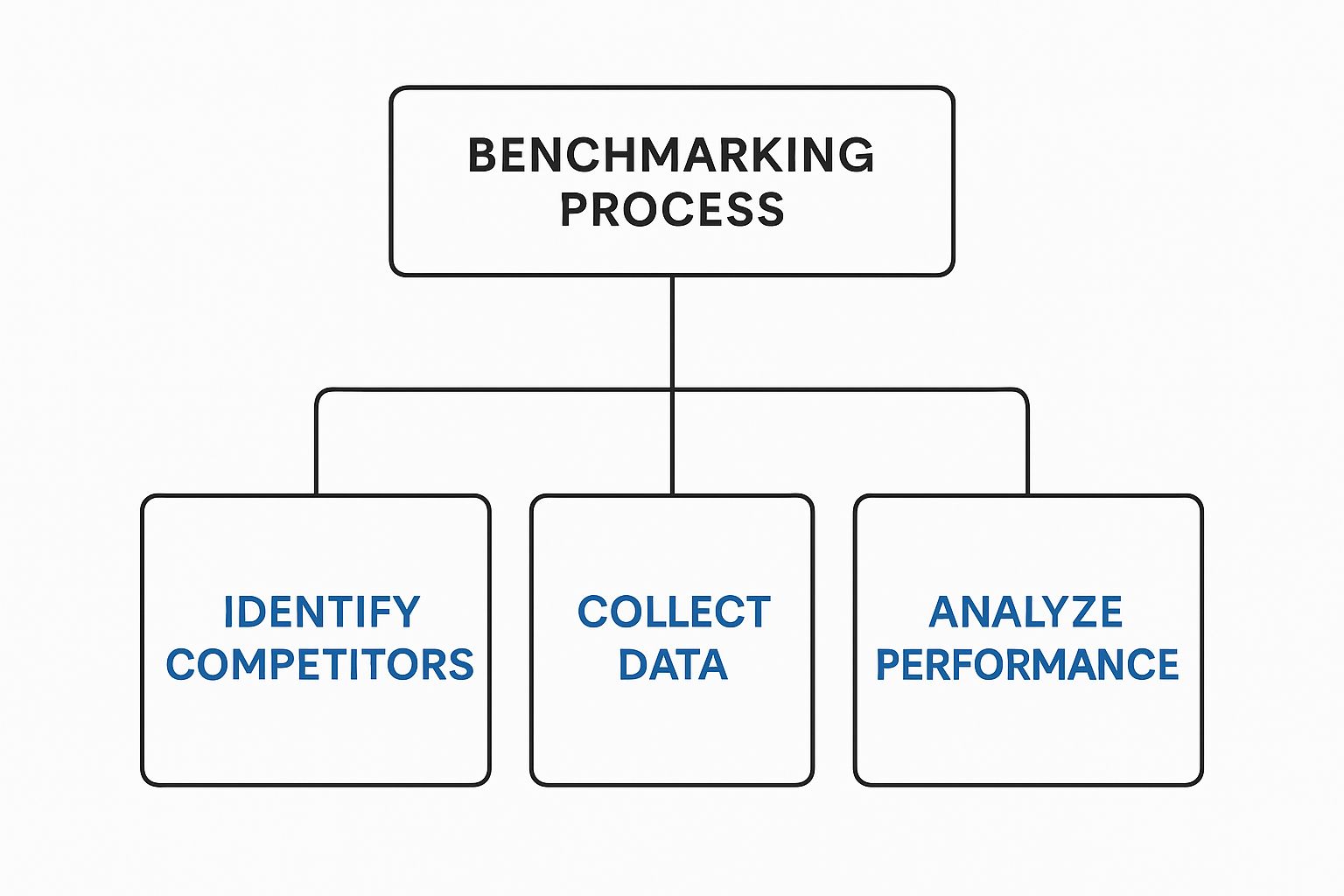
This process is the core of any data-driven analysis, ensuring insights are derived from a structured, repeatable methodology. Modern platforms like Visbanking automate these steps, enabling executives to focus on strategic implications rather than manual data reconciliation.
Pillar 1: Financial Performance
This is the bedrock of analysis, answering the fundamental question: are we profitable? Key metrics like Return on Assets (ROA) and Return on Equity (ROE) are non-negotiable. If your ROA is 0.85% while your selected peer group averages 1.10%, that 25-basis-point gap signals an urgent problem in asset utilization that demands board-level attention.
Pillar 2: Operational Efficiency
A bank can appear profitable while masking a bloated cost structure. The Efficiency Ratio is the ultimate measure of cost discipline. Celebrating revenue growth is premature if your efficiency ratio has deteriorated to 62% while peers maintain a leaner 55%. You are effectively losing ground on profitability with each transaction.
Pillar 3: Market Position
Are you gaining or ceding territory? Metrics like deposit growth and loan growth provide a clear verdict. If competitors are expanding their commercial loan books by 8% annually while your portfolio remains flat, it is a direct indictment of your product, pricing, or sales execution.
Pillar 4: Risk Management
Aggressive growth is unsustainable if built on a weak risk foundation. The Non-Performing Loan (NPL) Ratio is the critical indicator. A bank may boast superior loan growth, but a benchmark analysis revealing its NPL ratio at 1.2%—double the peer average of 0.6%—exposes that growth as a liability, not an asset.
A holistic view across these four pillars is essential. Superior performance in one area often comes at a cost to another—a trade-off that only becomes visible through comprehensive benchmarking.
This integrated perspective prevents strategic blind spots. With a platform like Visbanking, all four pillars are visible on a single dashboard, converting complex data into a clear narrative of your competitive standing.
Turning Data Overload into Decisive Action

For most bank leaders, raw data is more of a liability than an asset. You are inundated with information but starved for the actionable intelligence that drives decisions. This is the gap where strategy fails—a gap that legacy benchmarking methods cannot bridge.
Attempting to guide an institution with static call reports or cumbersome spreadsheets guarantees you will lag the market. By the time the data is compiled, the strategic window has closed. The global business intelligence market's projected growth to USD 78.42 billion by 2032 is fueled by this need for real-time analysis that quarterly reports can no longer provide.
From Historical Reports to Forward-Looking Intelligence
Modern data intelligence transforms benchmarking from a historical exercise into a predictive, competitive weapon. Instead of merely reviewing last quarter's results, you can diagnose why they occurred and model future scenarios.
This means you can dynamically construct peer groups to benchmark against your true competitors, not a generic industry average. It means visualizing multi-year trends in seconds to identify emerging threats and opportunities. Most importantly, it means drilling down into root-cause performance drivers—like loan yields or operational costs—to pinpoint the source of a performance gap.
The objective is not to produce a more detailed report of the past. It is to equip leaders with the clarity to make faster, more intelligent, and more profitable decisions about the future.
A tool like Visbanking provides a decisive advantage by automating the labor-intensive work of data aggregation and visualization, closing the gap between insight and action. With effective financial reporting automation, your leadership team is liberated from spreadsheet management to focus on high-level strategy. This transforms the data deluge into a clear mandate for action.
A Real-World Benchmarking Example: The $750M Community Bank
Theory is instructive, but application is definitive. Consider the leadership of a $750M community bank. The board mandates growth in commercial lending, but the current strategy lacks precision.
Using a platform like Visbanking, the team constructs a custom peer group of 15 institutions with similar asset sizes and regional footprints. The data immediately reveals a critical narrative.
Pinpointing the Problem
At first glance, performance appears adequate. The bank's 4% overall loan growth aligns with internal targets. However, segment-level analysis exposes a significant weakness. The Commercial & Industrial (C&I) loan portfolio is growing at a mere 2%, while the peer group is averaging a robust 7% growth rate.
This single data point reframes the entire strategic discussion.
Deeper analysis delivers another stark finding: the bank's yield on C&I loans is a full 50 basis points below the peer median. The institution is not only failing to capture market share, but the share it does acquire is underpriced and less profitable. The numbers provide an unequivocal verdict: the current C&I strategy is flawed.
This principle is universal. Top-tier retail chains obsessively benchmark sales and foot traffic against local competitors to optimize store performance. As detailed in these competitive benchmarking examples, this discipline is a hallmark of industry leaders.
Benchmarking transforms a vague objective like "improve commercial lending" into a specific directive: "Our C&I loan yield is 50 basis points below peer median, and our growth trails by 5 percentage points. We must immediately address our pricing and sales incentive structure."
Armed with this clarity, the board can authorize decisive action, including a full review of C&I underwriting standards, pricing models, and sales compensation plans. This is the function of practical benchmarking: to convert ambiguous data into an irrefutable mandate for change.
Elevate Your Strategy with Intelligent Benchmarking
In the demanding banking sector, strategy built on intuition is insufficient. Executive decisions require the backing of objective, external data. Competitive benchmarking provides this foundation.
It is a proactive framework for identifying market opportunities and driving your institution toward top-quartile performance. It marks the transition from conjecture to leading with intelligence. Modern data platforms provide the necessary speed and confidence to conduct this high-level analysis, transforming a static annual report into a dynamic strategic tool. This allows you to preempt market shifts, rectify performance gaps, and validate major investments with empirical evidence.
The most effective leaders are not asking, "How did we do last year?" They are asking, "How do we compare to our most relevant competitors right now, and what precise actions will secure our advantage tomorrow?"
Moving from Insight to Action
To achieve a sustainable competitive edge, you must move beyond manual, retrospective performance comparisons. The first step is to leverage the full capability of modern banking data analytics. This is not about building better spreadsheets; it is about cultivating a culture where every major decision is informed by a clear, unbiased view of the competitive landscape.
This proactive, data-driven mindset is what separates market leaders from the rest of the pack. The right tools are no longer a luxury—they are a fundamental component of modern bank leadership.
Ready to stop guessing and start making decisive, data-backed moves? See how Visbanking can deliver the clarity and competitive intelligence your leadership team needs to win. Explore our platform today.
Latest Articles

Brian's Banking Blog
Cross Selling Strategies in Banking: An Executive Blueprint

Brian's Banking Blog
Banking Data Solutions for Executives: 2026 Guide

Brian's Banking Blog
Credit Union Strategic Planning: A Data-Driven Playbook

Brian's Banking Blog
Intermodal Tank Transport USA: Lender Insights 2026

Brian's Banking Blog
A Bank Executive's Guide to the Yondr Data Center

Brian's Banking Blog