
Top 10 Strategic Imperatives: Trends Shaping the Banking Industry
Brian's Banking Blog
In an environment of compressed margins and heightened competition, strategic clarity is paramount. The banking landscape is not merely evolving; it is being fundamentally reshaped by powerful technological and societal shifts. For bank executives and board members, simply observing these changes is insufficient. The imperative is to dissect, quantify, and act upon the definitive trends in the banking industry to secure a competitive advantage. This requires moving beyond high-level observations and into a data-driven framework for decisive action.
This analysis provides a granular exploration of the strategic imperatives shaping the future of finance. We will dissect ten critical developments, from the integration of Artificial Intelligence and the rise of Embedded Finance to the non-negotiable adoption of ESG frameworks and real-time payment systems. Each trend is presented not as an abstract concept, but as a measurable force with direct implications for your institution's balance sheet, market share, and regulatory standing.
The focus here is on practical, actionable intelligence. We will demonstrate how a robust data intelligence platform transforms trend analysis from a passive exercise into a proactive strategy. By leveraging comprehensive peer data and analytics, you can benchmark your institution’s performance against these key trends, identify specific operational gaps, and execute with precision. This is your guide to converting industry currents into strategic capital and tangible results. We will cover the tactical implementation details necessary to navigate this new terrain, ensuring your institution is not just a participant but a leader in the next chapter of banking.
1. Digital-First Banking and Neobanks
The rise of digital-first banking and neobanks marks a fundamental trend in the banking industry, altering customer expectations and the competitive landscape. This model pivots from physical branches to a mobile-centric ecosystem where financial services are delivered through intuitive, app-based platforms. Neobanks operate entirely online, leveraging technology to offer streamlined, low-cost services without the overhead of a traditional branch network.
This shift forces established institutions to re-evaluate their service delivery models. The core appeal of neobanks lies in their unparalleled convenience, user-centric design, and niche-focused product offerings. For instance, Revolut has attracted over 20 million global users with its multi-currency support and seamless international transfers, while Chime has captured a significant U.S. market share by eliminating common banking fees. Similarly, Nubank has become Latin America's largest digital bank by focusing on financial inclusion and transparent credit products for a previously underserved population.
Implementing a Digital-First Strategy
Adopting a digital-first approach requires more than launching a mobile app; it demands a cultural and operational transformation centered on data and user experience.
- Prioritize User Experience (UX): The interface must be seamless and intuitive. A customer should be able to open an account, apply for a loan, or resolve an issue with minimal friction, directly from their mobile device. This is the baseline expectation set by neobank leaders.
- Leverage Data Analytics: A robust data intelligence platform, such as Visbanking, is critical. By analyzing transaction data and user behavior, banks can create highly personalized offers. For example, analyzing a customer's monthly cash flow data to identify a recurring surplus of over $1,000 could trigger an automated, pre-qualified offer for a wealth management consultation, improving cross-sell ratios by a measurable margin.
- Ensure Robust Security and Compliance: With an expanded digital footprint comes increased security risk. Implementing multi-factor authentication, end-to-end encryption, and proactive threat monitoring is non-negotiable. Regulatory technology (RegTech) solutions can automate compliance checks, ensuring adherence from day one without compromising the speed of digital onboarding.
Key Takeaway: Digital-first banking is a strategic achievement rooted in data. By analyzing specific customer pain points—like high fees or slow onboarding—banks can emulate the targeted, agile approach of neobanks. An institution can use its own deposit and transaction data to identify the 15% of customers most likely to attrit due to service friction and proactively address their needs.
This infographic summarizes the key advantages that define the neobank value proposition.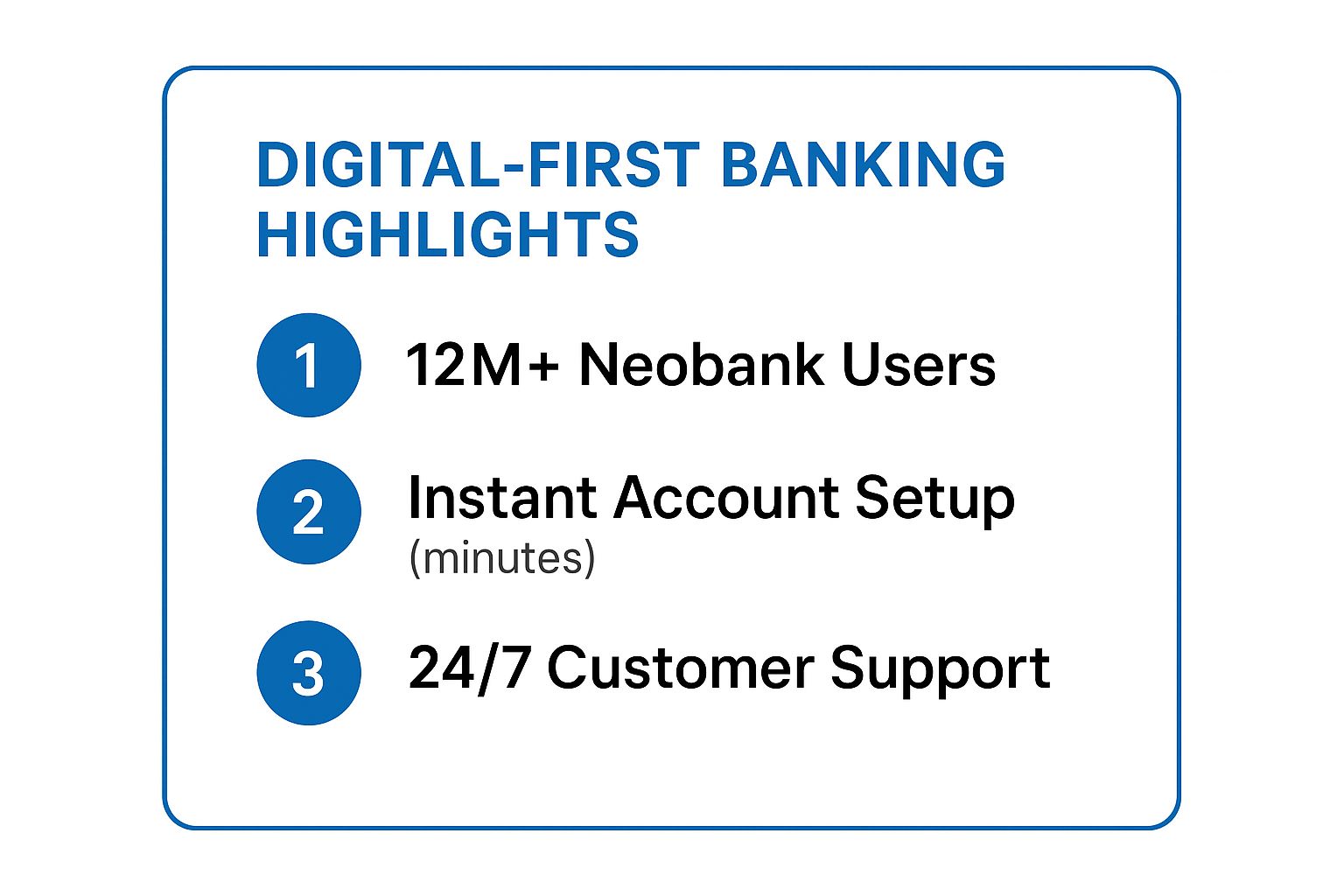
The data highlights the core pillars of the neobank model: rapid customer acquisition, instant service delivery, and continuous accessibility, which legacy institutions must now compete with.
2. Artificial Intelligence and Machine Learning Integration
The integration of Artificial Intelligence (AI) and Machine Learning (ML) is one of the most transformative trends in the banking industry, evolving from a niche technology to a core pillar of modern financial operations. These technologies empower banks to automate complex processes, derive predictive insights from vast datasets, and deliver hyper-personalized customer experiences. AI is no longer a futuristic concept but a practical tool for driving efficiency, managing risk, and creating new revenue streams.

Leading institutions are demonstrating the power of applied AI. JPMorgan Chase's COIN platform uses machine learning to analyze legal documents, saving an estimated 360,000 hours of manual work annually. Bank of America's virtual assistant, Erica, now handles millions of user interactions, offering proactive insights and simplifying routine banking tasks. Similarly, HSBC has successfully deployed AI to enhance its fraud detection systems, reducing false positives by over 50% and improving accuracy in identifying illicit activities.
Implementing an AI and ML Strategy
Successfully deploying AI requires a strategic, use-case-driven approach focused on solving specific business problems with measurable outcomes.
- Start with Specific Use Cases: Begin with high-impact areas like fraud detection, credit scoring, or customer service automation. A targeted pilot project allows for controlled implementation, clear ROI measurement, and scalable learning before a full-scale rollout. For a deeper dive into practical applications, consider looking into available AI analytics services.
- Invest in Data Quality and Governance: AI models are only as good as the data they are trained on. Establishing a robust data governance framework is essential to ensure data is clean, accurate, and accessible. This foundational step prevents flawed outputs and biased decision-making.
- Ensure Transparency and Human Oversight: "Black box" AI models create significant regulatory and reputational risk. Banks must prioritize explainable AI (XAI) to understand and justify automated decisions. Maintaining a human-in-the-loop system for critical decisions, like large loan approvals, is crucial for both compliance and customer trust. As regulators increase their focus, understanding the monitoring of AI use in the financial sector becomes a competitive necessity.
Key Takeaway: The strategic advantage of AI in banking is not just automation but augmentation. By leveraging AI to analyze market data, customer behavior, and operational metrics, executives can make faster, more informed decisions. Using a platform like Visbanking to benchmark the performance of an AI-driven credit scoring model against peer institutions can validate its effectiveness and guide further investment, turning data from a passive asset into a dynamic driver of performance.
3. Open Banking and API Integration
Open Banking represents a paradigm shift, transforming banking from a closed system into an interconnected ecosystem. This trend, driven by both regulation and market demand, compels banks to share customer financial data with authorized third-party providers (TPPs) through secure Application Programming Interfaces (APIs). This fosters innovation, allowing fintechs to build new services on top of traditional banking infrastructure.
This collaborative model is now a global standard. Europe’s PSD2 regulation was a catalyst, compelling banks to open their data. In the U.S., platforms like Plaid have become the de facto standard, connecting over 12,000 financial institutions and enabling countless fintech applications. Similarly, Australia’s Consumer Data Right (CDR) gives citizens control over their financial data, creating a vibrant market for personalized financial tools. This movement is fundamentally altering how customers manage their money.
Implementing an Open Banking Strategy
Successfully navigating Open Banking requires more than just API compliance; it demands a strategic vision for partnership and data monetization.
- Implement Robust Authentication and Authorization: Security is paramount. Use multi-layered security protocols, including OAuth 2.0 and OpenID Connect, to ensure that only properly authenticated and authorized TPPs can access customer data, and only with explicit user consent.
- Ensure API Reliability and Performance: The API is a product. It must be reliable, well-documented, and performant to attract high-quality fintech partners. A slow or unstable API will damage the bank's reputation in the developer community. A comprehensive developer portal is non-negotiable.
- Develop Clear Data Sharing Policies: Establish transparent policies that govern what data is shared, how it can be used, and for how long. Educate customers clearly about the benefits and risks, empowering them to make informed decisions and building trust.
Key Takeaway: Open Banking is a strategic opportunity, not a compliance threat. By leveraging their vast data assets through secure APIs, banks can create new revenue streams and become central players in a broader financial ecosystem. Data intelligence tools can help quantify this opportunity, for instance, by modeling the potential fee income from offering premium API access to the top 10% of data-consuming fintech partners.
4. Blockchain and Cryptocurrency Integration
The integration of blockchain and cryptocurrencies represents a pivotal, albeit cautious, shift among the major trends in the banking industry. Once viewed as a fringe threat, distributed ledger technology (DLT) and digital assets are now being explored by traditional institutions to enhance efficiency, security, and competitiveness. The focus is moving from speculation to practical applications like digital wallets, crypto-backed financial products, and blockchain-based payment systems.

Pioneering efforts from major financial players underscore this evolution. JPMorgan Chase, for instance, developed its JPM Coin to facilitate instantaneous payments for institutional clients, settling billions of dollars in daily transactions. Goldman Sachs re-established its crypto trading desk to serve growing institutional demand, while the Bank of America has filed over 50 patents related to blockchain technology. On a global scale, initiatives like SWIFT’s cross-border CBDC trials and China's expansive Digital Yuan pilot, with over 260 million wallets, signal that digital currencies are becoming a strategic imperative.
Implementing a Blockchain and Crypto Strategy
Navigating this new terrain requires a measured, strategic approach focused on risk management, regulatory adherence, and tangible value creation.
- Start with Pilot Programs: Begin with controlled, limited-scope use cases, such as internal cross-border settlements or tokenized real-world assets. This allows the institution to build expertise and assess risks without exposing the entire organization to volatility.
- Prioritize Regulatory Compliance and Security: The regulatory landscape for digital assets is still evolving. Invest heavily in RegTech solutions for real-time transaction monitoring and in advanced cybersecurity to protect against novel threats unique to the crypto space. Compliance must be a foundational element.
- Partner with Established Technology Providers: Rather than building everything from scratch, collaborate with reputable blockchain and crypto infrastructure companies. This accelerates development, reduces initial investment, and provides access to specialized expertise.
- Educate Stakeholders: Proactively educate both internal staff and customers on the opportunities and inherent risks of digital assets. Clear communication and transparent disclosures are essential for building trust.
Key Takeaway: The true value of blockchain for banks lies in its potential to overhaul core infrastructure. By leveraging a data intelligence platform like Visbanking to analyze payment flows and operational bottlenecks, executives can pinpoint the most impactful use cases for DLT. For example, data might show that 20% of cross-border trade finance transactions are delayed by a week due to paperwork, presenting a clear business case for a DLT-based solution that could unlock millions in efficiency gains.
5. Embedded Finance and Banking-as-a-Service (BaaS)
The integration of financial services into non-financial platforms represents one of the most transformative trends in the banking industry. Embedded finance places banking functionalities, like payments and lending, directly within a user's existing journey. Banking-as-a-Service (BaaS) is the engine that powers this, enabling fintechs and brands to offer regulated financial products by leveraging a licensed bank's charter and infrastructure.
This model shifts financial services from a destination to a native capability. For example, Shopify Balance provides merchants with an embedded bank account and debit card, seamlessly integrating business finances into their e-commerce dashboard. Similarly, BaaS providers like Cross River Bank and Green Dot act as crucial partners, powering the lending and card issuance for numerous well-known fintechs and neobanks. This allows non-banks to enhance their value proposition without the immense regulatory burden of becoming a bank.
Implementing a BaaS and Embedded Finance Strategy
Successfully entering the BaaS market requires a strategic focus on technology, compliance, and user experience to capture new revenue streams.
- Choose Compliant and Reliable BaaS Partners: For non-banks, selecting a BaaS provider with a proven track record in regulatory adherence is paramount. For banks, becoming a provider means investing heavily in compliance infrastructure to manage third-party risk.
- Ensure Seamless User Experience Integration: The financial component must feel like a natural extension of the host platform, not a disjointed handoff. The goal is to make the banking function invisible, reducing friction and enhancing the core service.
- Implement Robust Risk Management Procedures: Banks must use sophisticated data analytics to monitor their fintech partners' activities. A platform like Visbanking can help benchmark a partner's loan portfolio performance—for instance, a default rate of 4.5%—against an industry peer average of 3.2%, providing critical oversight and identifying risks before they escalate.
- Plan for Scalability from the Beginning: Both the technology stack and the partnership agreement must be designed to handle significant growth in transaction volume and user numbers.
Key Takeaway: Embedded finance is a fundamental shift in how financial products are consumed. For traditional banks, the opportunity lies in becoming the regulated backbone for this new ecosystem. By providing BaaS, banks can unlock massive, scalable revenue streams by monetizing their charter and compliance expertise. Data can reveal which non-financial sectors have the highest potential for embedded lending, guiding partnership strategy.
6. Enhanced Cybersecurity and Zero Trust Architecture
As digital transformation accelerates, the sophistication of cyber threats targeting financial institutions has grown in parallel. This reality makes enhanced cybersecurity one of the most critical trends in the banking industry. The traditional perimeter-based security model is no longer sufficient, leading institutions to adopt a Zero Trust Architecture (ZTA), a framework built on the principle of "never trust, always verify."
Leading institutions are already demonstrating the power of this approach. For example, Bank of America secures over 37 million mobile users with advanced biometric authentication, while HSBC has enrolled over 12 million customers in its voice biometrics system. Citi has undertaken a comprehensive security overhaul centered on zero trust principles, and Wells Fargo employs AI-powered fraud detection systems that achieve a greater than 99% accuracy rate, proactively protecting customer accounts.
Implementing a Zero Trust Security Model
Adopting a zero trust mindset requires a fundamental shift from protecting the network perimeter to protecting individual resources through continuous verification.
- Implement a Layered Security Approach: A robust strategy combines multiple layers of defense, including multi-factor authentication (MFA), advanced encryption for data at rest and in transit, and network micro-segmentation to contain potential breaches.
- Leverage AI for Threat Detection: Deploy AI and machine learning algorithms to analyze network traffic and user behavior in real time. These systems can identify anomalous patterns indicative of a threat—such as a login from an unusual geography attempting a $50,000 wire transfer—and trigger an immediate response.
- Prioritize Employee Training and Awareness: The human element remains a primary vulnerability. Regular, mandatory training on phishing, social engineering, and secure data handling practices turns employees into a proactive line of defense.
Key Takeaway: Zero Trust is a strategic security philosophy, not a single product. Its successful implementation depends on a deep, data-driven understanding of user access patterns and risk profiles. Banks must leverage intelligence platforms to map these interactions, identify vulnerabilities, and apply verification policies that are both stringent and seamless, ensuring security without disrupting the customer experience.
7. Personalized Financial Services and Hyper-Personalization
Hyper-personalization has become one of the most critical trends in the banking industry, marking a strategic evolution from generic demographic segmentation to highly individualized customer engagement. This approach leverages big data and AI to deliver financial products and advice precisely tailored to a customer's unique behaviors, financial health, and life events. It moves beyond simply using a customer's name to anticipating their needs and proactively offering solutions.
This shift is a direct response to rising customer expectations set by tech giants. For example, American Express uses AI to offer personalized rewards based on an individual's spending history. Capital One's Eno assistant provides proactive insights, alerting customers to potential duplicate charges. In Asia, DBS Bank has embedded AI-powered personalization into its digibank platform to guide customers toward their financial goals with customized nudges and recommendations.
Implementing a Hyper-Personalization Strategy
Successfully implementing hyper-personalization requires a robust data infrastructure and a clear focus on delivering tangible value to the customer.
- Establish Strong Data Governance: Before personalization can begin, data must be clean, accessible, and governed by clear policies. Ensure customer data is handled ethically, with transparent consent mechanisms in place. This builds essential trust.
- Leverage Advanced Analytics: Utilize a powerful data intelligence platform to move from reactive service to proactive engagement. For instance, analyzing cash flow patterns could identify a small business owner whose monthly deposits have grown 30% year-over-year, automatically flagging them as a candidate for a pre-approved line of credit.
- Balance Automation with Human Touch: While AI drives the personalization engine, the human element remains crucial for high-value interactions. Use technology to automate routine advice and identify opportunities, but empower relationship managers with these insights to have more meaningful, personalized conversations with clients.
Key Takeaway: Hyper-personalization is a core business strategy for deepening customer relationships and driving profitability. By using data to understand and anticipate individual needs, banks can transform from transactional providers into indispensable financial partners. The goal is to make each customer feel like the bank's only customer, demonstrably increasing loyalty and lifetime value.
8. Sustainable and ESG (Environmental, Social, Governance) Banking
The integration of Environmental, Social, and Governance (ESG) criteria is one of the most transformative trends in the banking industry, moving from a niche concern to a core strategic priority. This shift reflects growing pressure from investors, regulators, and customers for financial institutions to address their impact on climate change, social equity, and corporate ethics.
This trend is driven by both risk management and new market opportunities. Leading institutions are making substantial commitments. JPMorgan Chase, for example, has pledged $2.5 trillion for sustainable development, while Bank of America has targeted $1.5 trillion for environmental business initiatives by 2030. Likewise, institutions like BNP Paribas are actively divesting from certain fossil fuel projects, showcasing a tangible pivot in capital allocation based on ESG principles.
Implementing an ESG-Focused Strategy
Adopting an effective ESG strategy requires more than public declarations; it demands systemic integration of sustainability principles into core business functions, underpinned by robust data.
- Develop Clear Policies and Metrics: Establish a concrete ESG framework with measurable Key Performance Indicators (KPIs). This includes defining what constitutes a "green" loan, setting diversity and inclusion targets, and establishing governance standards for lending. Clear metrics are essential for tracking progress.
- Integrate ESG into Risk Management: Use advanced data analytics to model climate-related financial risks. A platform like Visbanking can help analyze portfolio concentrations, revealing, for example, that 15% of a commercial real estate portfolio is located in a high-risk flood zone. This data enables proactive risk mitigation and strategic adjustments.
- Ensure Authentic and Transparent Reporting: Avoid "greenwashing" by providing detailed, regular reports on ESG performance backed by verifiable data. Authenticity is crucial for maintaining trust with stakeholders. Learn more about how your institution's capital can support a greener economy.
Key Takeaway: ESG is no longer just a reputational matter; it is a critical driver of financial performance and risk management. Banks that successfully integrate ESG principles into their core strategy can unlock new revenue streams and attract investment. The key is to move from pledges to data-driven action, using analytics to identify both risks and opportunities in the transition to a sustainable economy.
9. Real-Time Payments and Instant Settlement
The global shift toward real-time payments represents one of the most transformative trends in the banking industry. This evolution moves beyond traditional batch processing systems to a 24/7/365 model where transactions are settled in seconds. This immediacy fundamentally reshapes liquidity management and provides consumers with instant access to funds.
This trend is rapidly becoming the new standard globally. The Federal Reserve's FedNow Service in the US enables instant credit transfers nationwide, while Zelle already facilitates real-time P2P payments for over 1,700 institutions. In the UK, the Faster Payments system processes over three billion transactions annually. Even more impressively, India's UPI handles more than eight billion transactions monthly, and Brazil's PIX network completed over 29 billion transactions in 2022, demonstrating the massive scale and customer appetite for instant financial services.
Implementing a Real-Time Payment System
Integrating an instant payment network requires a strategic approach that balances speed with security and operational stability.
- Ensure Robust Fraud Detection Systems: Real-time payments mean there is no window to reverse fraudulent transactions. Banks must implement advanced, AI-driven fraud detection models that can analyze transaction patterns and flag suspicious activity in milliseconds.
- Plan for High Availability and Redundancy: An instant payment system must operate flawlessly around the clock. This demands building a highly resilient infrastructure with built-in redundancy and failover mechanisms to guarantee uptime and maintain customer trust.
- Monitor Liquidity Management Closely: Instant settlement creates new liquidity demands outside of traditional business hours. Financial institutions must use sophisticated forecasting tools to monitor and manage their liquidity positions in real time, ensuring they can meet their settlement obligations 24/7.
Key Takeaway: The move to real-time payments is not optional; it is a baseline customer expectation. Success requires banks to use data to manage the associated risks. A data intelligence platform like Visbanking allows executives to model liquidity needs, analyze transaction volume forecasts, and benchmark fraud rates against peers, turning a potential operational challenge into a competitive advantage. For example, if peer banks on FedNow report fraud rates of 0.05%, you have a clear performance target for your own system.
10. Voice Banking and Conversational AI
The adoption of voice banking and conversational AI represents a major leap forward in customer interaction, making it one of the most convenience-driven trends in the banking industry. This trend leverages natural language processing (NLP) to allow customers to manage their finances through spoken commands on smart speakers, mobile apps, and phone systems.
This hands-free approach meets modern consumer demands for immediacy and ease of use. Leading institutions are already demonstrating its power. For instance, Bank of America's Erica has successfully handled over one billion client interactions, providing proactive guidance and transaction support. Similarly, Capital One enables customers to check balances and pay credit card bills via Amazon Alexa, while U.S. Bank offers robust banking services through both Alexa and Google Assistant, setting a high bar for accessible, voice-activated finance.
Implementing a Voice Banking Strategy
Deploying an effective voice strategy requires a meticulous focus on security, user experience, and the underlying AI technology.
- Prioritize Voice Biometrics and Security: Security is paramount. Implement robust voice authentication protocols to verify user identity accurately and prevent fraud. This creates a secure, yet frictionless, login experience.
- Design for Natural Conversation: The AI must understand context and intent, not just keywords. Design conversation flows that feel natural and intuitive. The system should handle queries like, "How much did I spend on groceries last month?" and provide clear, concise answers.
- Ensure Regulatory and Data Privacy Compliance: Voice interactions generate sensitive data that falls under strict regulations. Banks must ensure their AI platforms are fully compliant with voice data storage, processing, and privacy rules.
- Train AI on Diverse Data Sets: To ensure inclusivity and accuracy, train the AI models on a wide range of accents, dialects, and speech patterns. A system that only works for a narrow demographic will fail to deliver on the promise of universal access.
Key Takeaway: Voice banking's true potential is unlocked when it moves beyond simple commands to offer proactive, data-driven advice. By analyzing a customer's voice-based transaction history—for example, noting three consecutive months of increased spending on a specific retail category—a bank's AI can proactively offer a tailored budget alert or a specialized savings goal, turning a simple convenience into a powerful advisory tool.
Top 10 Banking Industry Trends Comparison
| Item | Implementation Complexity 🔄 | Resource Requirements 🔄 | Expected Outcomes 📊 | Ideal Use Cases 💡 | Key Advantages ⭐⚡ |
|---|---|---|---|---|---|
| Digital-First Banking and Neobanks | Moderate: Mobile and app development, digital UX | Medium: IT infrastructure, data analytics, cybersecurity | High: Faster account setup, accessibility, lower fees | Banking for digital natives, underbanked Latest Articles Brian's Banking Blog Predictive Risk Management for Banks Brian's Banking Blog Business Registration Data Banks Can Actually Use Brian's Banking Blog How to Secure REST API with JWT for Banking Brian's Banking Blog Commercial Loan Analysis: A Bank Executive's Guide Brian's Banking Blog Understanding Statistical Significance in Banking Brian's Banking Blog Option Adjusted Spread: A Banker's Practical Framework |