
7 Data Sources for Benchmarking Top Energy Companies in the USA for Strategic Banking Decisions
Brian's Banking Blog
Identifying the top energy companies in USA is more than an academic exercise; for bank executives, it's a foundational component of strategic lending, risk management, and portfolio growth. Standard revenue-based lists offer a limited view, failing to provide the granular operational, financial, and credit risk data necessary for sound capital allocation. For example, a company reporting $150 billion in revenue with deteriorating cash flow and concentrated geographic risk presents a vastly different credit profile than a $50 billion operator with strong reserve replacement and disciplined capital expenditure.
This analysis moves beyond superficial rankings. We will dissect seven primary sources used to evaluate the U.S. energy sector, providing a framework for how banking leaders can leverage these tools to build a comprehensive, data-driven view of clients and prospects. For each resource, we provide direct links and, more importantly, actionable takeaways on how to integrate disparate data points—from SEC filings and asset-level EIA reports to specialized market intelligence—translating them directly into smarter credit decisions and more effective prospecting.
Effectively assessing these companies also requires an understanding of evolving reporting frameworks. To that end, bankers must integrate analyses of global sustainability standards such as the ISSB IFRS S1 and S2 Global Standards, which are becoming integral to a comprehensive risk profile. The objective is not just to know who the top players are, but to understand why they lead and what underlying signals your institution must monitor for both risk and opportunity.
1. Fortune – Sector Leaders: Energy
Fortune's annual ranking is an essential starting point for any banking team seeking a high-level overview of the sector's dominant players. Based on its globally recognized Fortune 500 methodology, this list provides a clear, revenue-based snapshot of market leaders. For relationship managers and commercial lenders, it’s a fast, credible resource for initial market sizing and identifying the largest potential clients or counterparties in the energy space.
The platform’s value lies in its simplicity and authority; the names on this list drive headlines and major capital flows. It offers a foundational profile—annual revenue, profit figures, employee count, and headquarters location—useful for initial due diligence or meeting preparation.
What It Is & Why It Matters for Banking
Fortune’s list is a macro-level guide. While it lacks the granular data required for underwriting, it serves a critical strategic purpose: identifying and tiering the market.
For banking teams, this translates to practical applications:
- Initial Prospecting: Quickly build a target list of the largest enterprises headquartered within your bank's geographic footprint.
- Market Share Context: Understand which companies dominate the revenue landscape, providing a benchmark when evaluating mid-market competitors.
- Executive Briefings: Use the list as a credible, third-party source in presentations to leadership when discussing market-entry or expansion strategies.
Strengths & Limitations
| Feature | Strengths | Limitations |
|---|---|---|
| Ranking Methodology | Credible & Widely Cited: Based purely on annual revenue, providing a clear, objective hierarchy of the largest players. | Revenue-Only Focus: Ignores critical performance indicators like reserves, production volumes, profit margins, or leverage. |
| Data Accessibility | Free & Public: No subscription required. The interface is clean and easy to navigate. | Limited Data & Functionality: Lacks advanced screening tools, historical data comparison, or export capabilities. |
| Use Case | High-Level Overview: Excellent for a quick snapshot of the top U.S. energy names. | Lacks Underwriting Depth: Insufficient for detailed credit analysis or monitoring ongoing financial health. |
How Banking Teams Should Use It
A relationship manager at a regional bank might use the Fortune list to identify the top three energy companies headquartered in Texas. Seeing Exxon Mobil, Phillips 66, and Valero Energy at the top provides basic stats. However, revenue alone is a deceptive metric. A company can have massive revenues but dangerously thin margins—a $200 billion refiner with 2.5% net margins is a different risk than a $40 billion producer with 35% margins.
Actionable Insight: Use the Fortune list to build your initial high-level prospect list. Then, pivot to a data intelligence platform like Visbanking to layer in the essential credit and operational metrics Fortune omits. This allows your team to move from "who is biggest" to "who is the most creditworthy and viable banking client."
By combining Fortune's macro view with granular data, you can efficiently qualify prospects, understand their true financial standing, and tailor your approach with market intelligence that goes beyond a simple revenue ranking.
Website: https://fortune.com/ranking/fortune500/sector/energy/
2. S&P Global Energy (formerly S&P Global Commodity Insights / Platts)
For banking teams requiring institutional-grade market intelligence, S&P Global Energy moves beyond high-level revenue rankings. Its Top 250 Global Energy Company Rankings offer a more sophisticated view, evaluating companies on asset worth, revenues, profits, and return on invested capital (ROIC). This multi-factor approach gives a more balanced perspective on the financial health and operational efficiency of the top energy companies in USA and globally.
This platform is an integrated intelligence ecosystem, connecting performance data with real-time Platts commodity price assessments, sector-specific news, and in-depth research. For commercial lenders and capital markets teams, this means analyzing a company’s performance in the direct context of market forces impacting its profitability, from oil price volatility to shifts in power demand.
What It Is & Why It Matters for Banking
S&P Global Energy is a foundational tool for deep sector analysis and risk management. While a basic version of the Top 250 is often public, the platform's true value is its premium, subscription-based datasets—critical for making informed credit and investment decisions.
For banking teams, the value is clear:
- Deeper Due Diligence: Go beyond revenue to assess a company's asset base and profitability, providing a stronger foundation for initial credit evaluation.
- Market-Relative Performance: Benchmark a potential client’s ROIC not just against peers but against the underlying commodity markets it operates in.
- Strategic Risk Monitoring: Use its news and research to stay ahead of regulatory changes, geopolitical risks, and trends in the energy transition. The evolving landscape of how major financial firms approach the energy sector makes this forward-looking intelligence essential.
Strengths & Limitations
| Feature | Strengths | Limitations |
|---|---|---|
| Ranking Methodology | Holistic & Respected: Multi-metric analysis (assets, revenue, profit, ROIC) provides a more robust view of company health. | Global Focus: The primary list is global, requiring users to filter for U.S.-specific companies. |
| Data Accessibility | Integrated Intelligence: Links rankings to deep market data, pricing benchmarks (Platts), and expert analysis. | Requires Enterprise License: The most valuable data and tools are locked behind a significant, non-transparent paywall. |
| Use Case | In-Depth Sector Analysis: Ideal for teams needing to understand market dynamics and conduct thorough due diligence. | Cost-Prohibitive for Some: The enterprise-level cost can be inaccessible for smaller regional banks or individual teams. |
How Banking Teams Should Use It
A credit analyst at a large bank could use S&P Global to evaluate a midstream company. Instead of just seeing its revenue, they can analyze its ROIC against peers and map its financial performance against movements in key NGL prices reported by Platts. For example, seeing a 15% ROIC when peers average 11% during a period of volatile NGL prices signals superior operational efficiency—a key positive credit factor.
Actionable Insight: Use S&P Global’s rankings and research to identify fundamentally strong companies. Then, use a tool like Visbanking to pull detailed, bank-specific credit metrics (like debt-to-EBITDA) and monitor financial covenants and UCC filings to get a complete, real-time risk profile before engagement.
S&P provides the "why" behind market movements; operational data platforms provide the granular "what" of a company's current financial standing. Combining them creates a powerful, proactive approach to client selection and risk management.
Website: https://www.spglobal.com/commodityinsights/top250
3. Energy Intelligence – Top 100: Global NOC & IOC Rankings
While financial lists provide a snapshot of commercial scale, Energy Intelligence's Top 100 offers a fundamentally different and critical perspective for banking teams: an operational one. This annual ranking evaluates the top energy companies in USA and globally based on core metrics like oil and gas reserves, production volumes, and refining capacity. It provides a ground-truth view of a company's physical asset base and throughput—the true drivers of long-term revenue and creditworthiness.
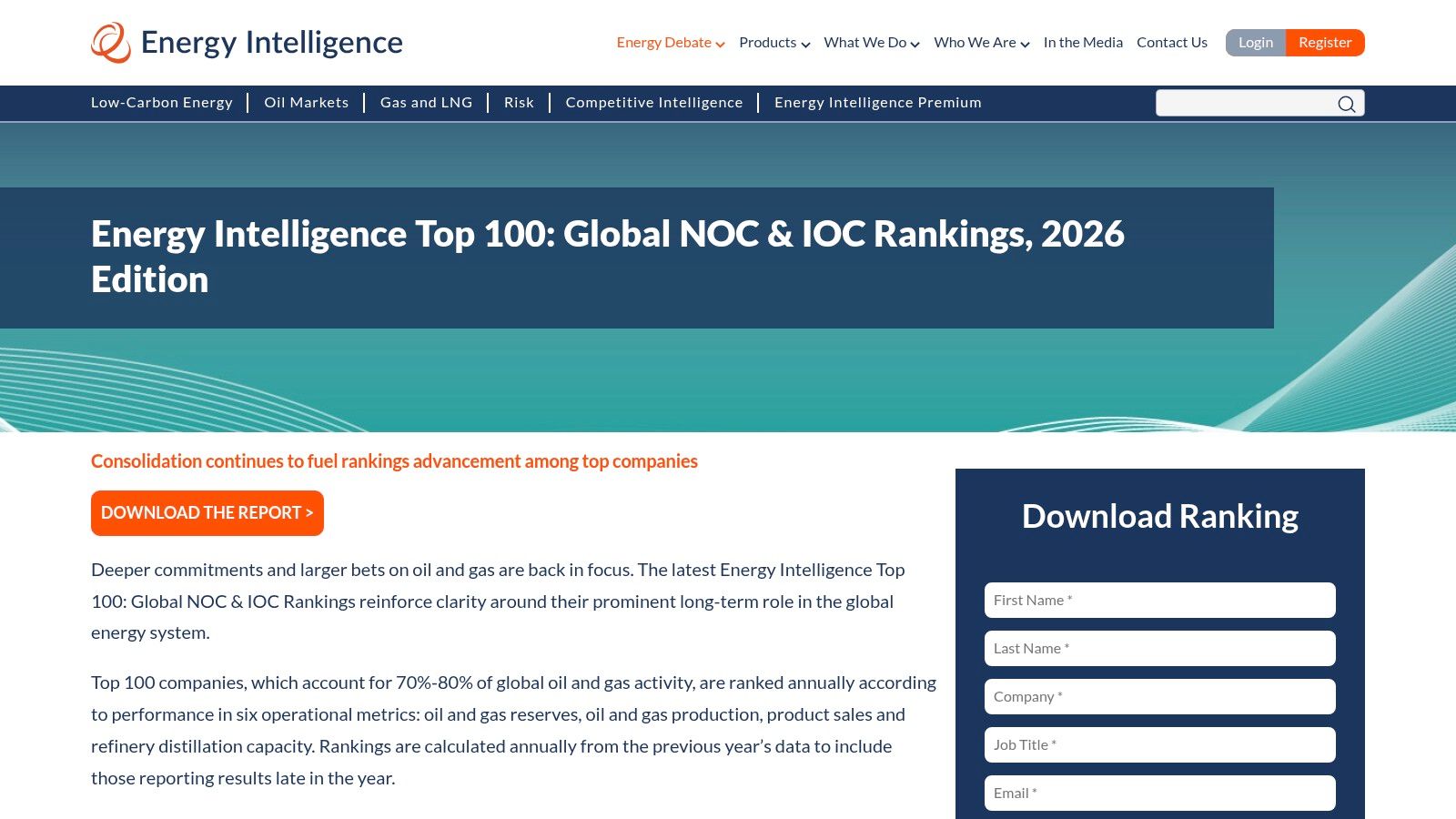
This operational focus is invaluable for understanding strategic positioning. For banking teams underwriting asset-based loans or analyzing M&A activity, knowing a company controls 2.5 billion barrels of proven reserves is more predictive of future performance than a trailing twelve-month revenue figure. The platform’s analysis also contextualizes these rankings, offering insights into consolidation trends affecting U.S. shale operators.
What It Is & Why It Matters for Banking
Energy Intelligence delivers an asset-level benchmark that complements financial rankings. For banking professionals, this operational lens is essential for assessing the tangible foundation of a company's balance sheet and its capacity to generate future cash flows.
This perspective supports key banking functions:
- Strategic Risk Assessment: Evaluate a company's long-term viability based on the quality and scale of its reserves and infrastructure.
- M&A and Trend Analysis: Use the accompanying editorial to understand the strategic rationale behind major acquisitions and divestitures.
- Peer Benchmarking: Compare a client’s daily production against its direct competitors to gauge market position and efficiency.
Strengths & Limitations
| Feature | Strengths | Limitations |
|---|---|---|
| Ranking Methodology | Operational Focus: Ranks companies based on physical assets (reserves, production), a strong indicator of long-term value. | Global Scope: Requires users to manually identify U.S.-based companies within the global list. |
| Data Accessibility | Strong Editorial Context: Offers deep analysis on strategy and M&A that explains the "why" behind the numbers. | Paywalled Data: Full access to detailed rankings and underlying data is restricted to subscribers. |
| Use Case | Strategic & Competitive Intelligence: Excellent for understanding a company’s physical market position and long-term direction. | Not a Financial Tool: Lacks the detailed financial statements and credit ratios needed for underwriting. |
How Banking Teams Should Use It
A commercial banking team leader might use Energy Intelligence to assess the strategic impact of a major merger, like ExxonMobil's acquisition of Pioneer Natural Resources. The platform’s data would quantify how the deal elevates the combined entity's production and reserve rankings, solidifying its dominance in the Permian Basin with, for instance, a 40% increase in proven reserves. This provides a strategic narrative that financial statements alone cannot convey.
Actionable Insight: Use Energy Intelligence to understand a company's strategic asset base. Then, use a platform like Visbanking to analyze the corresponding financial implications. You can monitor how a top-tier operational ranking translates into actual profitability (e.g., a 1.8x return on assets) and debt service capacity, connecting strategic strength to bankable financial health.
This two-step process validates that a company with a world-class asset portfolio also maintains the financial discipline required to be a prime banking client.
4. U.S. Energy Information Administration (EIA)
For banking teams that need to build their own granular, asset-based view of the market, the U.S. Energy Information Administration (EIA) is the foundational data source. As the statistical agency of the U.S. Department of Energy, the EIA provides free, authoritative datasets that allow analysts to construct custom lists of the top energy companies in USA based on tangible metrics like power generation capacity, plant ownership, or petroleum import volumes.
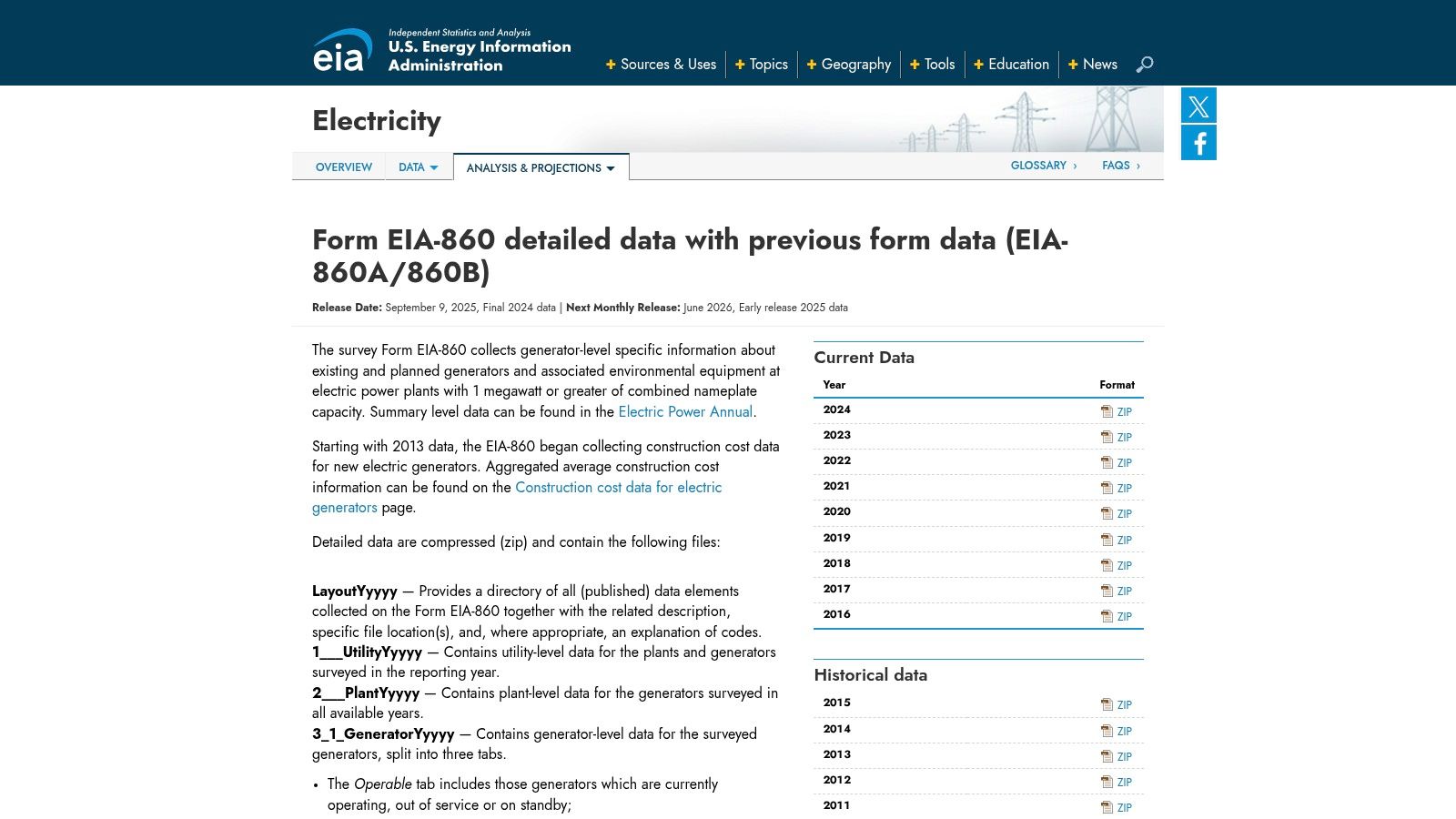
Unlike pre-packaged lists, the EIA offers raw, downloadable data files (like the EIA-860 survey) that require analysis to yield insights. Its value lies in its granularity and objectivity. For a credit analyst, this data is the raw material needed to calculate market share, assess asset concentration risk, and truly understand a company's physical footprint.
What It Is & Why It Matters for Banking
The EIA provides the data infrastructure for deep operational due diligence. While it doesn't offer financial metrics, its asset-level information is critical for understanding a company's core business.
For banking teams, this translates to practical applications:
- Custom Market Share Analysis: Aggregate plant ownership data from the EIA-860 survey to rank power producers by generation capacity in a specific region (e.g., ERCOT or PJM).
- Asset-Level Due Diligence: Identify the specific power plants, fuel sources, and operational status for a potential utility client.
- Supply Chain Risk Assessment: Use company-level import data to understand a refiner's reliance on specific foreign crude oil sources, a key factor in geopolitical risk analysis.
Strengths & Limitations
| Feature | Strengths | Limitations |
|---|---|---|
| Data Authority | Official & Unbiased: As a U.S. government source, the data is methodologically transparent and highly credible. | Raw Data Format: Requires significant effort to clean, model, and aggregate; not a ready-made league table. |
| Data Accessibility | Completely Free: All datasets are public and available for download in CSV/XLS formats. | Complex & Disparate: Data is spread across various surveys; linking datasets to create a unified company view is challenging. |
| Use Case | Granular Operational Analysis: Unmatched for building bottom-up views of company assets and physical operations. | No Financial Data: Lacks revenue, profitability, or balance sheet information, making it unsuitable for standalone credit risk assessment. |
How Banking Teams Should Use It
A commercial banking team evaluating a loan to a mid-sized independent power producer could download the EIA-860 dataset. By filtering for the company, they can precisely map its portfolio: ten natural gas plants totaling 3,500 MW in PJM territory and two solar farms totaling 450 MW in the Southeast. This allows them to assess asset diversification and regional concentration far more accurately than a simple revenue figure would allow.
Actionable Insight: Treat the EIA as your source for ground-truth operational data. Use it to validate a company's physical asset claims, but rely on a platform like Visbanking to integrate this operational data with the critical financial and credit metrics needed for a comprehensive risk assessment. This combines the "what they own" from the EIA with the "how they are performing" needed for a sound lending decision.
By leveraging the EIA’s detailed asset data within a broader financial framework, banking teams can build a far more robust and defensible view of risk.
Website: https://www.eia.gov/electricity/data/eia860/
5. SEC EDGAR
While other sources provide curated lists, the U.S. Securities and Exchange Commission's EDGAR system is the primary source of truth for all public U.S. companies. For banking teams conducting serious due diligence on the top energy companies in USA, this is the non-negotiable repository for official financial statements (10-K, 10-Q), material event disclosures (8-K), and detailed operational data, including proved reserve reports. It is the raw material from which all other financial analysis is derived.
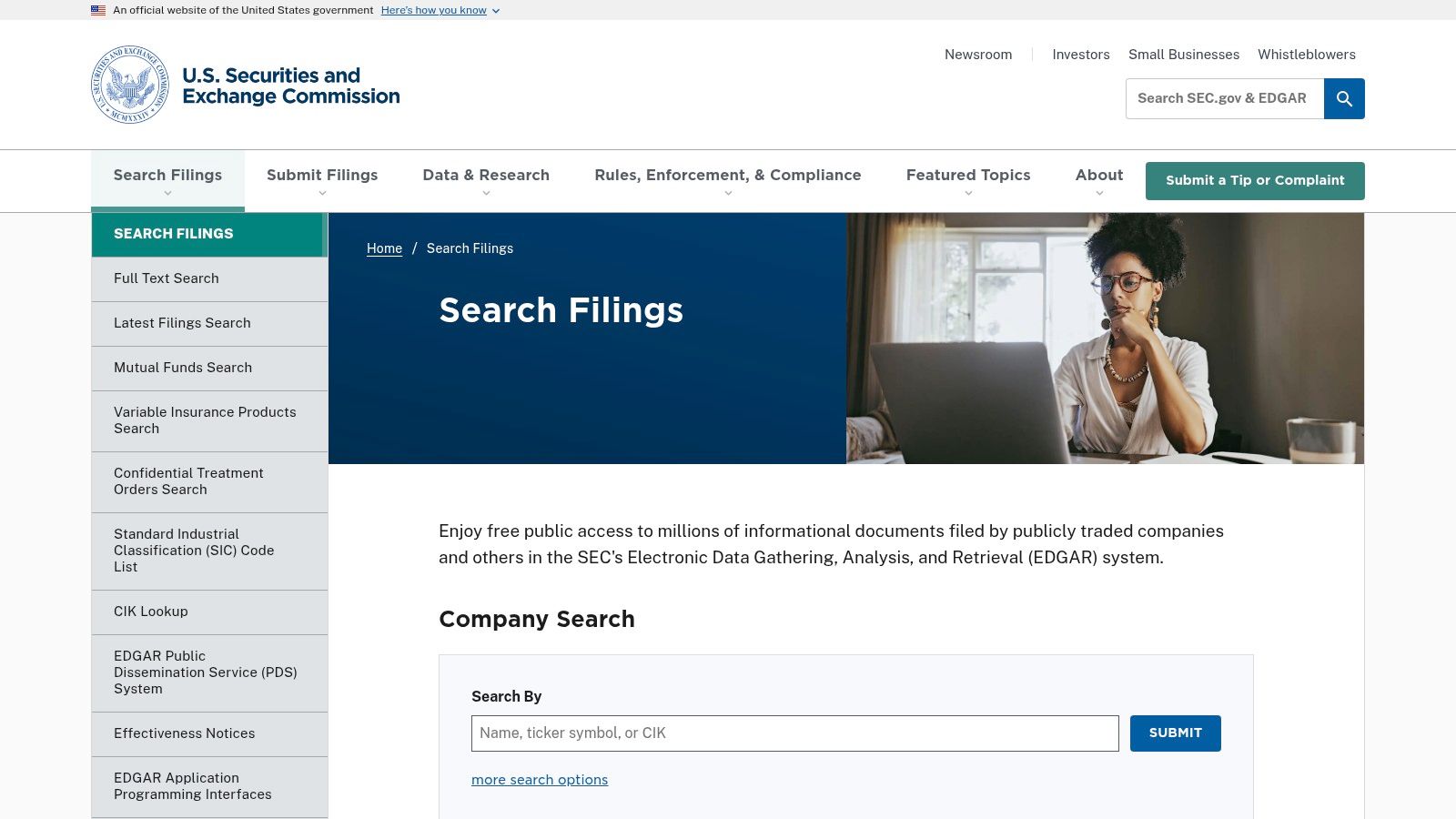
EDGAR is a validation and deep-dive resource, not a discovery tool. Its value lies in its unfiltered, direct-from-the-source nature. A credit analyst can pull a 10-K to verify revenue figures, scrutinize the Management’s Discussion & Analysis (MD&A) for risk factors, and examine footnotes for details on debt covenants or hedging strategies. This is where the numbers behind the rankings are born.
What It Is & Why It Matters for Banking
EDGAR is the definitive archive for corporate disclosures. For banking, it’s the bedrock of credit analysis and compliance, providing the unvarnished data needed to validate financial health and understand strategic direction.
Key banking applications include:
- Credit Underwriting: Directly access audited financials, debt schedules, and capital expenditure plans necessary for building a credit model.
- Risk Monitoring: Review 8-K filings for material events like major acquisitions or executive changes that could impact a borrower's risk profile.
- Strategic & Sector Analysis: Analyze the MD&A section across multiple E&P companies to identify common industry challenges, such as evolving ESG pressures, a trend reshaping capital allocation as detailed in recent analysis of green financing earnings.
Strengths & Limitations
| Feature | Strengths | Limitations |
|---|---|---|
| Data Integrity | Authoritative & Comprehensive: As the official repository, the data is the primary source for all public company financial information. | Raw & Unstructured: Does not provide rankings or comparative lists. Users must manually extract data from dense legal filings. |
| Data Accessibility | Free & Publicly Available: Complete access without subscription fees. APIs support automated retrieval for advanced workflows. | Steep Learning Curve: Navigating different form types and industry-specific disclosures requires expertise and time. |
| Use Case | Deep-Dive Due Diligence: Unmatched for detailed credit analysis, verifying financial metrics, and understanding company-specific risks. | Inefficient for Prospecting: Not designed for high-level market screening or quickly comparing multiple companies. |
How Banking Teams Should Use It
An underwriter evaluating a loan for a mid-sized E&P company would use EDGAR to move beyond high-level numbers. They would pull the latest 10-K to find the "Proved Oil and Gas Reserves" section to verify, for example, 500 million barrels of oil equivalent (MMBoe) and a reserve replacement ratio of 120%, critical indicators of collateral value. This granular work is required for sound lending, but it is incredibly time-consuming.
Actionable Insight: Use EDGAR as your ultimate verification tool, not your primary discovery platform. After identifying a prospect, turn to EDGAR for specific filings. For proactive monitoring, platforms like Visbanking ingest and structure this same EDGAR data, allowing you to set alerts for key financial changes or risk disclosures across your entire portfolio, saving hundreds of manual hours.
By treating EDGAR as the foundational data layer and using an analytical platform to interpret it, banking teams achieve both depth and efficiency.
Website: https://www.sec.gov/search-filings
6. S&P Global Market Intelligence (S&P Capital IQ Pro)
For banking professionals requiring institutional-grade data, S&P Global Market Intelligence is the full-stack platform for deep analysis of the top energy companies in USA. This is where banking teams move beyond rankings to perform rigorous screening, detailed financial analysis, and peer benchmarking. It provides the granular data needed to underwrite deals, monitor portfolio health, and assess market opportunities across the entire energy value chain.
The platform offers a comprehensive suite of tools for screening companies by market cap, ownership, reserves, production volumes, and specific asset locations. For relationship managers and credit analysts, it serves as a central hub for accessing decision-grade financial data, M&A activity, and proprietary S&P credit risk metrics, making it a standard for professional workflows in commercial and investment banking.
What It Is & Why It Matters for Banking
S&P Global is an underwriting and market intelligence engine. It provides the deep, multi-layered data required for making significant capital allocation and risk management decisions. Its strength lies in its vast, integrated datasets covering everything from individual power plants to complex corporate debt structures.
Key advantages for banking teams include:
- Granular Prospecting: Screen for E&P companies with production over 100,000 boe/d in the Permian Basin or identify renewable developers with projects in the financing stage.
- Peer Benchmarking: Create detailed comparable company analyses ("comps") using standardized financials, credit ratings, and operating metrics to evaluate a client’s standing against its direct competitors.
- In-Depth Due Diligence: Access detailed financial statements, earnings call transcripts, debt maturity profiles, and analyst estimates to build a comprehensive risk profile.
Strengths & Limitations
| Feature | Strengths | Limitations |
|---|---|---|
| Data Depth & Scope | Bank-Grade Data Universe: Offers broad coverage across oil, gas, utilities, and renewables with detailed financial and asset-level information. | Complexity & Training: The platform's extensive features present a steep learning curve and require dedicated training. |
| Functionality | Professional Workflow Tools: Advanced screening, data export, and modeling capabilities are designed for professional financial analysis. | Access & Cost: Requires an enterprise license. Pricing is opaque and provided via a sales process only. |
| Use Case | Underwriting & Strategic Analysis: Essential for detailed credit analysis, M&A research, and building sophisticated market intelligence reports. | Not for Quick Overviews: Can be overkill for teams needing only a high-level market snapshot. |
How Banking Teams Should Use It
A commercial banking team evaluating a loan for an upstream operator would use S&P Global to pull production data by basin, analyze its reserve life, and benchmark its leverage of 2.2x Debt/EBITDA against a custom peer group averaging 1.9x. This immediately flags a key discussion point for underwriting. The platform’s power is also its challenge; it’s a vast ocean of data requiring time and expertise to navigate effectively.
Actionable Insight: Use S&P Global for deep, deal-specific due diligence. For continuous, automated monitoring of your entire portfolio or a broad prospect list, a platform like Visbanking is more efficient. It can distill complex S&P-level data into prioritized risk signals and lending opportunities, alerting you to changes without manual queries.
By leveraging S&P Global for deep dives and a platform like Visbanking for proactive monitoring, banking teams can achieve both the depth and efficiency required to lead in energy finance.
7. Bloomberg (Energy sector pages, Bloomberg Terminal, BI and BNEF)
Bloomberg is the institutional standard for real-time market data and deep-dive analytics, making it indispensable for banking teams covering the top energy companies in USA. Its ecosystem combines a high-level public website with powerful, subscription-based tools like the Bloomberg Terminal, Bloomberg Intelligence (BI), and BloombergNEF. For banking professionals, it’s the definitive source for moving from static rankings to dynamic market intelligence.
The platform offers a comprehensive view, from top-line commodity price movements to granular financial models and proprietary research within the Terminal. This integration allows relationship managers to track a client’s stock performance, read breaking news impacting their creditworthiness, and access in-depth sector analysis in one place. It is the go-to resource for understanding a company's historical performance, current market perception, and future outlook.
What It Is & Why It Matters for Banking
Bloomberg provides a multi-layered intelligence platform essential for sophisticated client management and risk assessment. Its primary value is connecting real-time market data to fundamental company analysis—a critical linkage for the volatile energy sector.
For banking teams, the applications are extensive:
- Real-Time Monitoring: Track live stock prices, credit default swap (CDS) spreads, and bond yields for key clients and prospects.
- Deep-Dive Research: Leverage Bloomberg Intelligence (BI) for expert industry analysis and BloombergNEF for specialized research on the energy transition.
- Peer Analysis: Use the Terminal’s screening tools to create custom peer groups and benchmark a target company against competitors on dozens of metrics.
Strengths & Limitations
| Feature | Strengths | Limitations |
|---|---|---|
| Data Integration | Holistic View: Seamlessly integrates real-time market data, company financials, news, and proprietary research in one ecosystem. | High Cost: Access to the Terminal, BI, and BNEF requires a significant institutional subscription. |
| Research & Analytics | Institutional-Grade Quality: BI and BNEF provide expert analysis and unique datasets on topics like energy transition and ESG. | Steep Learning Curve: The Bloomberg Terminal is famously complex and requires training to use its advanced features effectively. |
| Use Case | Dynamic Analysis & Monitoring: Unmatched for real-time portfolio monitoring, in-depth company valuation, and sophisticated market research. | Overkill for Basic Prospecting: The platform's depth and cost are excessive for simple, high-level market sizing. |
How Banking Teams Should Use It
A commercial banker could use the Bloomberg Terminal to screen for U.S. E&P companies with over $500 million in debt maturing in the next 18 months. They could then overlay this screen with BI’s oil price forecasts to identify firms that may face refinancing challenges—a prime opportunity for a lending discussion. This level of analysis goes far beyond a simple revenue list, enabling a proactive, data-driven approach to client acquisition.
Actionable Insight: Use Bloomberg to monitor real-time market signals for your existing energy portfolio and identify tactical opportunities. Then, use a platform like Visbanking to automate the monitoring of key credit health indicators across your entire client and prospect list, turning Bloomberg’s high-level insights into scalable, actionable credit risk alerts.
By pairing Bloomberg’s market-facing depth with a dedicated credit monitoring tool, banking teams can build a comprehensive view of both market opportunity and underlying risk.
Website: https://www.bloomberg.com/markets/sectors/energy
Top U.S. Energy Companies — 7-Source Comparison
| Item | 🔄 Implementation complexity | ⚡ Resources & efficiency | 📊 Expected outcomes | 💡 Ideal use cases | ⭐ Key advantages |
|---|---|---|---|---|---|
| Fortune – Sector Leaders: Energy | Low — annual, prebuilt list | Free, public, instant access | Revenue-based leader snapshot, press-ready facts | Quick references, media citations, executive briefs | ⭐⭐⭐ Credible, easy-to-scan list |
| S&P Global Energy | Medium–High — enterprise integration | Paid enterprise licenses, quote-based access | Top-250 rankings + pricing benchmarks and market intel | Corporate strategy, commodity pricing, institutional research | ⭐⭐⭐⭐ Integrates rankings with pricing & market data |
| Energy Intelligence – Top 100 | Medium — annual report + gated content | Paid access for full datasets | Operational rankings (reserves, production, refining) with editorial analysis | M&A insight, peer benchmarking, strategy analysis | ⭐⭐⭐⭐ Asset/throughput focus with strong editorial context |
| U.S. Energy Information Administration (EIA) | Medium — requires data cleaning and modeling | Free, downloadable CSV/XLS; high granularity | Raw asset-level datasets enabling custom rankings and market-share calculations | Building custom leaderboards, academic/policy analysis, data modeling | ⭐⭐⭐ Authoritative, granular, transparent data |
| SEC EDGAR | Medium — filings require interpretation | Free, real-time filings, APIs for automation | Primary financial/disclosure data to validate revenues, reserves, CapEx | Due diligence, reserve validation, financial modeling | ⭐⭐⭐⭐ Comprehensive primary disclosures; programmatic access |
| S&P Global Market Intelligence (Capital IQ Pro) | High — platform depth and training needed | Enterprise license; extensive screening/export tools | Decision-grade comparables, deep financials, asset and credit metrics | Investment banking, credit analysis, client advisory, detailed modeling | ⭐⭐⭐⭐⭐ Bank-grade screening and benchmarking; broad coverage |
| Bloomberg (Terminal / BI / BNEF) | High — Terminal and subscriptions, steep learning curve | Premium institutional pricing; real-time integrated feeds | Real-time market data, research, transition datasets and peer analytics | Institutional investors, trading desks, comprehensive sector research | ⭐⭐⭐⭐⭐ Integrated real-time news, markets and analytics |
From Data to Decision: Activating Energy Sector Intelligence
The U.S. energy landscape is a complex, high-stakes arena where market dynamics shift with a single financial filing or regulatory update. As explored, a wealth of high-quality data is available from sources like the EIA, S&P Global, and SEC EDGAR. These tools provide the raw material for analysis, but they do not, in isolation, deliver a competitive advantage. The differentiator is not access to information, but the speed and precision with which an institution synthesizes it into actionable commercial strategy.
Navigating this ecosystem requires a disciplined, multi-source approach. Relying solely on a company's SEC filings might reveal its capital structure but overlooks the operational realities in EIA production data. Conversely, focusing only on broad market trends from S&P Global can obscure counterparty risks hidden within debt covenants detailed in a 10-K. The most successful banking teams weave these disparate threads into a coherent intelligence fabric.
Beyond Manual Analysis: A Strategic Imperative
The core challenge for banking leaders is operationalizing this multi-source approach at scale. Manually cross-referencing data is not only inefficient but also introduces significant risk. An analyst might spend hours collating data to identify a lending opportunity with an emerging midstream operator, only to find the window has closed by the time the analysis is complete.
The paradigm must shift from manual data collection to automated intelligence activation. Instead of tasking teams with building complex spreadsheets, leading institutions adopt platforms that unify this data and surface pre-qualified opportunities and risks. This frees relationship managers to focus on building relationships and structuring deals.
A proactive strategy is built on integrated intelligence, not isolated data points. Your team's ability to connect a shift in EIA-reported drilling permits to a specific company's UCC filings for new equipment financing is what separates market leaders from the competition.
Implementing an Intelligence-Driven Framework
Adopting a more sophisticated approach to energy sector analysis involves several key steps:
- Establish Key Performance Indicators (KPIs): Define what signals matter most. This could include a change in a company's debt-to-EBITDA ratio from 2.1x to 2.8x in a quarter, a sudden increase in drilling permits, or new UCC filings indicating significant capital expenditure.
- Automate Signal Monitoring: Deploy a system that automatically tracks these KPIs across your portfolio and prospect lists. An alert can be triggered when a privately-held portfolio company is named as a key counterparty in a public competitor's 10-K, revealing a previously hidden risk.
- Integrate Workflow: Intelligence must flow directly into your team's existing workflow. An alert about a prospect's M&A activity should automatically create a task in your CRM for the responsible relationship manager to engage with the company's leadership.
This framework transforms your bank from a reactive observer to a proactive participant. You are no longer just monitoring the top energy companies in USA; you are anticipating their needs, understanding their risks, and positioning your institution as their indispensable financial partner. By leveraging technology to connect the dots, your teams can move with the confidence and speed required to win in this dynamic sector.
Ready to transform your approach to the energy sector? See how Visbanking's Bank Intelligence and Action System (BIAS) integrates disparate data sources to deliver pre-qualified opportunities and risk signals directly to your team. Schedule a demo to discover how you can benchmark your portfolio and prospect with unparalleled precision.
Related Articles

Visbanking Blog
Fastest Growing Banks: Who's Winning the Asset Race?

Visbanking Blog
Six Major Banks to Participate in Fed’s Climate Scenario Analysis Exercise

Visbanking Blog
Unveiling the Top US Bank Rankings: Navigating Financial Excellence

Visbanking Blog
Exploring US Banks: A Deep Dive into the Visbanking Banking Report Portal

Visbanking Blog
The U.S. Banking System: Strength, Stability, and Credit Ratings

Visbanking Blog