
A Data-Driven Guide to Risk Management in the Banking Sector
Brian's Banking Blog
Effective risk management is no longer a matter of compliance; it is the core strategic driver separating banks that thrive from those that merely survive. For bank directors and executives, viewing risk management as a defensive, box-ticking exercise is a critical error. A proactive, data-fueled approach to risk management in the banking sector is the most decisive strategic advantage an institution can possess.
Why Risk Management Is Your New Competitive Edge

The discipline of risk management has fundamentally evolved from a defensive cost center to a powerful engine that protects the balance sheet while driving sustainable growth. In an environment of intense regulatory scrutiny and market volatility, the ability to precisely identify, measure, and manage risk is not just about loss avoidance—it is about value creation.
This transformation is driven by one element: the strategic application of data. Without robust data intelligence, leadership is confined to rearview-mirror analysis, making decisions based on historical performance and intuition. With it, you can move from a defensive posture to an offensive strategy.
From Cost Center to Growth Driver
Consider a practical example. A bank executive may see an acquisition target and focus primarily on top-line revenue growth. A Chief Risk Officer, armed with granular data, can model the impact of integrating the target’s loan portfolio. This analysis might reveal hidden credit quality issues poised to erode post-acquisition profitability by 10-15%.
This insight fundamentally changes the executive conversation from, "How much can we grow?" to, "How can we grow profitably and sustainably?" Data intelligence platforms provide a decisive advantage here. By benchmarking a target’s portfolio against best-in-class peers before a deal is signed, you can ascertain the true, risk-adjusted return on your investment.
The greatest unmanaged risk for any financial institution is the absence of timely, accurate peer and market data. Decisions made in a vacuum are gambles, not strategies.
The Power of Looking Outside Your Walls
A modern approach to risk management in the banking sector requires looking beyond your institution’s four walls. It necessitates a systematic process for continuously comparing your risk profile against competitors and the broader market.
This external intelligence enables decisive action:
- Proactive Portfolio Adjustments: If peer benchmarks reveal early signs of stress in a specific loan category—for instance, a rise in delinquencies in auto loans among peer banks—you can tighten underwriting standards long before losses materialize on your own books.
- Identify Underserved Markets: By cross-referencing regional economic data with competitor activity, you might uncover an underserved market for a high-margin product. A perceived risk becomes a calculated growth opportunity.
- Optimize Capital Allocation: Accurately modeling the impact of a 50-basis-point rate change on your Net Interest Margin (NIM) allows for far more efficient capital allocation to protect the bank’s earnings.
This guide reframes risk management as a primary executive tool. It is time to move beyond a compliance mindset and leverage data to build a more resilient and competitive institution. The first step is to establish a clear baseline by exploring how your bank's metrics compare to your peers with the powerful data tools from Visbanking.
Understanding the Core Pillars of Bank Risk
For bank directors and executives, risk management must move beyond abstract definitions. Effective risk management in the banking sector is not about sidestepping every conceivable threat. It is about understanding those threats with such clarity that you can price them, mitigate their impact, and transform them into a competitive advantage.
This understanding is built on three core pillars: Credit, Market, and Operational risk. While often discussed in isolation, these risks are deeply interconnected. A data-driven approach is the only way to illuminate these connections and enable decisive action.
This diagram outlines the fundamental structure of banking risks, branching into the three primary categories every executive must master.
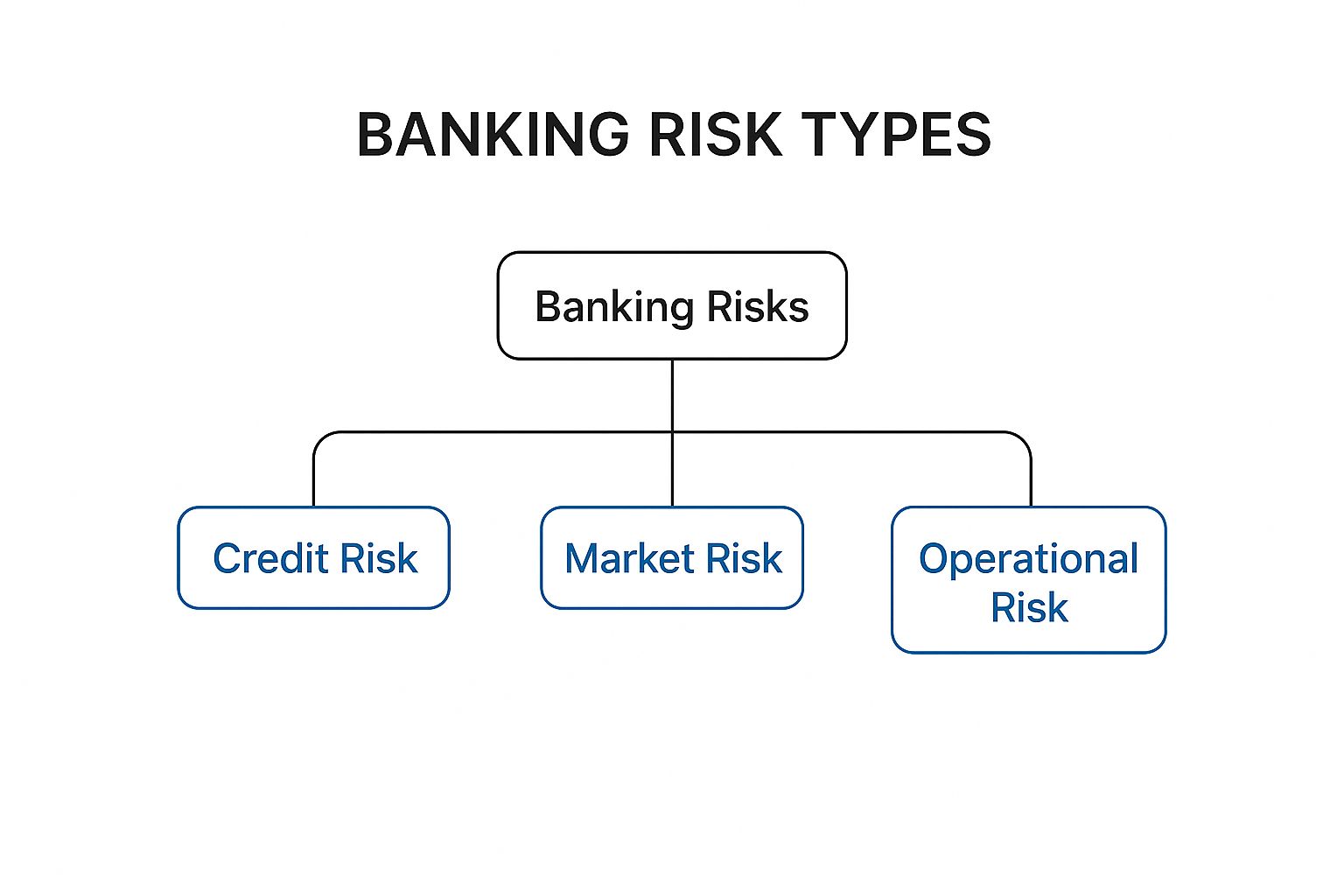
This structure serves as the foundational model for your bank's risk management framework.
Credit Risk: The Core Banking Challenge
Credit risk—the potential for loss from a borrower's failure to repay a loan—is the most traditional risk in banking. For executives, the critical question is not if defaults will occur, but where and when they are likely to concentrate.
Consider a community bank with a significant commercial real estate (CRE) portfolio. A reactive approach involves waiting for delinquency rates to rise before taking action. A proactive, data-intelligent strategy is fundamentally different. It involves using a platform like Visbanking to benchmark your CRE portfolio’s performance against peer banks in your specific market.
If peer data reveals growing stress in office-space loans while your own portfolio appears stable, this is not a reason for complacency; it is an early-warning indicator. You can then stress-test that specific segment. For instance, what if a 10% drop in local office occupancy rates would push 15% of your CRE loans into a higher risk grade? This is actionable intelligence, allowing you to tighten underwriting or increase loan loss provisions for that segment before the losses impact your P&L.
Market Risk: Navigating External Forces
Market risk arises from fluctuations in market prices, including interest rates, foreign exchange rates, and equity prices. While seemingly abstract, its impact on a bank’s Net Interest Margin (NIM) and investment portfolio value is direct and concrete.
The leadership challenge is to translate broad economic forecasts into quantifiable balance sheet impacts. A headline announcing a potential 50-basis-point interest rate hike must be answered with a precise figure.
Answering this question precisely is what separates good risk management from great risk management. Instead of relying on gut feel, data modeling can show you the exact impact on your NIM. You might discover it translates to a compression of 8 basis points, or $5 million in lost net interest income over the next year.
This data transforms a distant market threat into a tangible number that drives hedging strategies, asset-liability management (ALM), and capital decisions. The ability to model these scenarios is central to a strong banking risk assessment.
Operational Risk: The Hidden Threat
Operational risk is the danger of loss resulting from inadequate or failed internal processes, people, and systems, or from external events. It is the most diverse and frequently underestimated risk category, encompassing everything from employee fraud and system failures to a major cybersecurity breach.
The impact extends beyond direct financial loss. Imagine a core system migration glitch that locks customers out of their accounts for 48 hours. The immediate operational cost may be manageable, but the reputational damage and subsequent customer attrition could be severe, potentially eroding 5% of your retail deposit base.
These are not hypothetical concerns. The FDIC's 2025 Risk Review highlights that while banks’ capital positions have improved, underlying risks have not disappeared. Industry-wide equity capital grew by $118.9 billion (5.2%), and the Tier 1 risk-based capital ratio climbed to 14.27%. Yet, the number of banks on the problem list also grew, proving that a strong capital buffer alone does not eliminate persistent credit and operational threats.
The Four Pillars of Bank Risk Management
These risks can be framed as four pillars supporting a sound strategy. Each pillar poses a critical question for the executive team—a question that can only be answered with objective data intelligence.
| Risk Pillar | Executive-Level Question | Required Data Intelligence (Visbanking) |
|---|---|---|
| Credit Risk | Where are our hidden loan concentrations and how do they compare to our peers? | Peer group loan portfolio analysis, concentration reports, and local market economic indicators. |
| Market Risk | How will a specific interest rate change or market shock impact our net interest margin (NIM) and earnings? | Balance sheet stress testing, interest rate sensitivity modeling, and asset-liability (ALM) analytics. |
| Operational Risk | Are our internal systems, processes, and staffing levels creating vulnerabilities or inefficiencies? | Peer analysis of non-interest expenses, efficiency ratios, and staffing levels by asset size. |
| Liquidity Risk | Do we have sufficient, diversified funding to withstand a sudden outflow of deposits? | On- and off-balance sheet liquidity analysis, funding source diversification metrics, and peer dependency on non-core funding. |
Mastering these pillars requires moving from a siloed view to an integrated, data-powered one. It is time to replace conjecture with quantification. Begin today by benchmarking your bank’s performance against peers to identify where your greatest risks and opportunities reside.
Building a Modern Risk Management Framework
An effective framework for risk management in the banking sector is not a static policy document reserved for auditors. It is a dynamic, living system that forms the strategic DNA of the bank. For executives and directors, constructing this framework is a primary responsibility, as it provides the architecture for sound, data-driven decision-making.
A modern framework moves beyond vague principles to quantifiable action. It is built on clear governance, a precise risk appetite, and agile processes that respond to market shifts in real time. Anything less exposes the institution to both unmanaged threats and missed opportunities.

Defining Risk Appetite With Precision
The framework begins with the risk appetite statement. This critical document translates the bank's strategic objectives into explicit, measurable risk tolerances. Vague declarations like "a moderate appetite for credit risk" are ineffective. A strong statement provides management with clear guardrails.
For example, if your bank aims to expand its small business loan portfolio, a weak statement offers little guidance. A powerful one might specify a tolerance for a 0.5% increase in the non-performing loan (NPL) ratio for that specific segment over the next fiscal year.
This figure is not arbitrary. It is derived from rigorous analysis, such as benchmarking against top-performing peers in the same lending vertical.
Think about it: using a data intelligence platform like Visbanking, you can see the NPL ratios of high-growth peers with a similar size and footprint. This instantly transforms your risk appetite from an internal guess into a strategic, market-informed target.
This data-backed approach empowers lending teams to pursue growth confidently within well-defined limits, ensuring strategic initiatives do not inadvertently jeopardize the balance sheet.
Establishing Robust Governance and Controls
With a clear risk appetite defined, the next step is to build the governance structure. This involves clarifying ownership and ensuring accountability from the board and Chief Risk Officer (CRO) down to individual loan officers.
The key components include:
- Board Oversight: The board must approve the risk appetite statement and hold management accountable for operating within its parameters.
- CRO Empowerment: The CRO must have the authority and resources to challenge business-line decisions that deviate from the established framework.
- Three Lines of Defense: The roles of front-line business units (first line), risk and compliance functions (second line), and internal audit (third line) must be clearly delineated. This classic model remains effective for a reason.
A critical element of robust controls is audit readiness. Utilizing a comprehensive audit readiness checklist can guide this process and help validate the effectiveness of your internal controls.
From Static Reports to Agile Processes
Finally, a modern framework replaces static, backward-looking reports with agile, forward-looking processes. This is a shift from periodic reviews to continuous monitoring powered by real-time data.
For example, instead of assessing portfolio interest rate sensitivity only after a Federal Reserve rate change, an agile process involves continuous scenario analysis. Your team should consistently model the impact of various rate shifts—+25 bps, +50 bps, -25 bps—on net interest income.
This proactive stance ensures that when the market moves, your bank is prepared to act decisively. The goal is to create a system that constantly learns and adapts. You can dive deeper into designing these systems by exploring a detailed guide to a bank risk management framework.
Ultimately, building this framework means drawing a straight line from strategic goals to quantifiable risk tolerances to daily operational decisions. The ideal starting point is a clear-eyed assessment of your current position. Benchmark your bank against its peers to identify where your framework requires reinforcement.
Navigating Modern Cybersecurity and Geopolitical Threats
The traditional risks of credit and market volatility, while still critical, are no longer the sole drivers of institutional vulnerability. Today's most complex threats are intertwined issues like state-sponsored cyberattacks and unpredictable geopolitical events. For a bank director, vague warnings about "cyber threats" are insufficient. What is required is a quantitative assessment of how a specific, high-stakes scenario would impact the bottom line.
Abstract concern does not protect your bank. Effective risk management in the banking sector is about assigning a dollar value to these external threats.
Consider a ransomware attack on a mid-sized bank. The immediate cost is not merely the ransom payment. The true damage encompasses regulatory fines for the data breach, the cost of system remediation, and—most significantly—the long-term erosion of customer trust and deposits.
A well-executed attack could easily result in $10 million in direct expenses. However, the secondary effects, such as a 5% decline in retail deposits over the following year, can inflict a much deeper and more permanent wound on the balance sheet.
Connecting Global Events to Your Balance Sheet
The same quantitative rigor must be applied to geopolitical risk. A director's responsibility is to ask how an event on the other side of the globe connects to the bank's loan book. How might rising trade tensions in one region amplify credit risk in your commercial portfolio? A traditional, siloed risk assessment would fail to see the connection.
This is where an integrated data intelligence platform becomes indispensable. It allows you to overlay geopolitical risk indicators onto your own loan data, revealing concentrated risks that were previously invisible. You might discover that 15% of your manufacturing loans are heavily dependent on a single supplier in a high-risk zone. Instantly, a nebulous headline risk becomes a specific, quantifiable exposure demanding an immediate strategic response.
The Inadequacy of Siloed Assessments
This is precisely why legacy risk assessment models are failing. They treat cybersecurity, operational resilience, and credit risk as separate domains. This mindset is dangerously obsolete. A cyberattack is not just an IT problem; it is a potential liquidity crisis, a reputational catastrophe, and a credit event rolled into one.
Siloed risk management creates blind spots. The most significant vulnerabilities in today's banking environment exist at the intersection of different risk categories—where a geopolitical shock triggers a market event, which in turn exposes a cyber vulnerability.
This is why integrated data platforms like Visbanking are no longer a "nice-to-have" for good governance; they are essential. They provide the only means to model these complex, multi-layered risks and build strategies resilient enough to withstand them. This involves stress-testing your portfolio against real-world scenarios: what is the impact if a major cloud provider experiences an outage, or if a foreign government nationalizes key industries where your clients operate?
The modern financial world is profoundly interconnected. Therefore, risk management in the banking sector today is about understanding how financial institutions can mitigate these threats through advanced scenario analysis and crisis planning.
The ability to see these connections is what separates a resilient bank from a vulnerable one. It allows leadership to stop reacting to yesterday's news and start proactively defending against threats that their siloed competitors cannot even see. To understand your position, start by benchmarking your risk metrics against your peers, then begin modeling the scenarios that truly matter.
Gaining the Data Intelligence Advantage

In today's banking environment, effective risk management is not merely a defensive necessity. Executed correctly, it becomes your most potent competitive weapon.
The key is data intelligence. Executives armed with superior data are not just mitigating threats more effectively—they are identifying strategic opportunities invisible to their competitors.
This is the difference between reacting to past events and anticipating future trends. The following scenarios illustrate this distinction.
Proactive Credit Risk Management
Imagine your bank holds a substantial agricultural lending portfolio. The conventional method is to wait for quarterly delinquency reports to assess performance. By the time these reports flag a problem, the damage is done. The window for proactive intervention has closed.
Now, consider an alternative approach. Using a data intelligence platform like Visbanking, your team benchmarks its agricultural loans against a curated peer group in real time. The system flags a small but consistent increase in late payments among dairy farm loans at peer institutions.
This is your early-warning signal.
Although your own portfolio appears stable, you act on this forward-looking indicator. You immediately tighten underwriting standards for new dairy loans and increase monitoring of your existing book. You are now ahead of a problem that will impact your less-informed competitors in the coming quarter. This is the power of converting peer data into a strategic advantage.
Superior data intelligence transforms risk management from a historical review into a forward-looking strategic function. It enables executives to act on emerging threats before they materialize into balance sheet damage.
Strategic Opportunity Identification
Data intelligence is equally powerful for identifying smart growth opportunities.
Assume your strategic plan calls for expansion, but traditional market analysis offers only generic guidance. A platform like Visbanking enables a much deeper analysis. Instead of just reviewing economic data, your team can analyze the specific product gaps and performance metrics of direct competitors.
This analysis uncovers an underserved market. You find that while your region has a growing light manufacturing sector, most competing banks have reduced their exposure, creating a lending vacuum. Furthermore, peer data shows that the few banks with well-structured manufacturing loan products are achieving returns 150 basis points higher than standard commercial loans, with lower default rates.
Suddenly, a perceived risk—lending where others have retreated—is reframed as a data-validated opportunity. You can launch a targeted lending program with confidence, knowing you are entering a market with proven demand and superior risk-adjusted returns.
Responding to a Shifting Global Risk Landscape
The need for sharp, data-driven insight is intensifying. Today’s Chief Risk Officers (CROs) are navigating a complex web of global threats that demand more than intuition.
A recent global survey underscores this point, identifying cybersecurity as the top concern for CROs worldwide. Geopolitical risks have also surged in importance, reshaping the risk hierarchy for banks. In some regions, approximately 65% of CROs planned to overhaul their interest rate risk strategies in response to this new landscape. You can read more in the 14th annual EY/IIF global bank risk management survey.
The message is unequivocal. Whether navigating credit cycles, pursuing market share, or responding to global shocks, the bank with the clearest, most actionable data prevails. The advantage belongs to the leadership team that can benchmark every strategic move against the market and translate that insight into decisive action.
To assess your position, the first step is to explore your data and benchmark your performance against your true peers.
From Insight to Impact: Making Your Data Work
We have discussed the theory; now let us focus on execution. For executive leadership, the takeaway is clear: risk management in the banking sector has evolved from loss avoidance to opportunity creation and competitive differentiation. Static, siloed reports are obsolete. Modern banking is driven by integrated data intelligence.
The single greatest risk an institution faces is not on its balance sheet—it is the risk of making critical decisions with incomplete or outdated information. That is not strategy; it is a gamble. The imperative is to change not only the tools you use but also the way you think about risk.
Turning Data Into Dollars
Let's make this concrete. Your leadership team reviews the loan portfolio, and the overall non-performing asset (NPA) ratio is stable at a respectable 0.75%. On the surface, performance appears solid.
However, when you benchmark this metric against a curated peer group using a data intelligence platform, a different story emerges. You discover that top-performing banks in your peer group are running an average NPA of just 0.50% in commercial real estate—a sector where your bank has significant exposure.
This single insight changes the entire conversation.
A 0.25% performance gap might not sound like much, but on a $1 billion portfolio, that's $2.5 million in excess risk. That's a direct hit to your earnings that your internal-only reports would never have caught.
With this data, you can take decisive action. You can scrutinize underwriting standards, review concentration risk, and assess the team managing that specific CRE segment. You have moved from guessing to actively closing a performance gap and enhancing the bottom line. This is what it means to turn data into dollars.
The Leadership Mandate
Ultimately, accountability rests with the board and executive team. It is your mandate to lead the institution away from legacy thinking. Reacting to risk after the fact is a losing proposition. It is time to equip your teams with tools that enable them to anticipate what is next, quantify potential impacts, and stress-test strategies against real-world market dynamics.
Using a platform like Visbanking allows you to hold your bank's complete risk profile against your true peers and see exactly where you stand. Stop guessing. It's time to turn intelligence into decisive, profitable action. Explore your bank's performance data and see how you compare.
Frequently Asked Questions for Bank Directors
As a bank director, you are tasked with navigating your institution through an increasingly complex financial landscape. Strong risk management in the banking sector is not merely a regulatory requirement; it is the foundation of strategic leadership.
Here are direct answers to the questions most frequently raised in the boardroom.
What Is the Board's Primary Role in Modern Risk Management?
The board's role has evolved beyond simple oversight to active strategic direction. Your primary responsibility is to set the bank’s risk appetite using clear, quantifiable metrics.
This requires moving past vague statements like "a moderate risk tolerance." The board should demand and approve specific, data-backed limits. For example, you might establish a policy capping exposure to any single commercial real estate developer at 5% of Tier 1 capital. Your role is to challenge assumptions, demand forward-looking analysis instead of just historical reports, and provide the executive team with clear guardrails and the right tools for safe and profitable operation.
How Can We Measure the ROI of Investing in Advanced Risk Management Technology?
The return on investment in data intelligence is tangible and can be measured through both cost savings and revenue generation. It is a direct contributor to the bottom line, not just an expense.
The ROI is realized when you reduce loan loss provisions because you identified a negative trend in a peer group’s portfolio before it impacted your own. It is found in optimizing capital allocation through more precise risk models. It is also found in identifying new, high-margin market opportunities that competitors overlook.
Benchmarking your bank against its peers is the ultimate performance scorecard. When you can identify a performance gap—such as a higher efficiency ratio or a lower net interest margin compared to top performers—and then take action to close it, you are generating measurable financial returns.
How Do We Integrate a New Data Platform Without Disrupting Operations?
Successful integration focuses on augmenting, not replacing, existing workflows. The optimal approach is to begin with a single, high-impact project that delivers a quick and visible win.
For instance, start by benchmarking your commercial loan portfolio against a select group of key peers. This exercise can immediately reveal hidden concentration risks or performance gaps.
Modern data platforms are designed for business leaders, not just data scientists. This allows for a phased rollout, proving value at each step and building internal support for broader implementation. You can learn more about this approach in our guide on financial institution risk management.
At Visbanking, we operate on the principle that superior data drives superior decisions. It is time to stop making critical strategic moves based on stale, incomplete information. See exactly how your bank stacks up against the competition and turn that insight into decisive, profitable action. Benchmark your performance against your peers today.
Latest Articles
Brian's Banking Blog
Automated Alerts and Notifications for Banks
Brian's Banking Blog
Customer Feedback Loop for Banks: A Practical Playbook
Brian's Banking Blog
Commercial Lending Trends: What Bank Executives Must Know
Brian's Banking Blog
Bank Marketing Dataset Analysis Strategy

Brian's Banking Blog
ESG Peer Benchmarking for Bank Leaders
Brian's Banking Blog