
10 Critical Risk Management Best Practices for Banks in 2025
Brian's Banking Blog
In an era of compressed margins and unprecedented market velocity, the traditional, reactive approach to risk management is no longer sufficient for institutional survival, let alone success. Today's banking leaders must operate with a level of foresight and precision that can only be achieved through a strategic synthesis of data, technology, and robust governance. A passive stance on risk is a direct threat to shareholder value and institutional stability.
This article moves beyond theoretical frameworks to present ten actionable risk management best practices, tailored for the executive suite. Each practice is a critical component of building a resilient institution, demonstrating how leveraging advanced data intelligence, like Visbanking’s BIAS platform, transforms risk from a defensive necessity into a strategic advantage. You will learn not just what to do, but how to implement these strategies effectively.
We will explore how to quantify emerging threats before they materialize, benchmark your institution’s risk profile against the performance of your closest peers, and embed a culture of proactive risk ownership that drives superior financial outcomes. For example, we will detail how a peer bank used real-time data to adjust its commercial real estate loan concentration, mitigating a potential 5% capital loss identified three quarters ahead of market downturns. The goal is to equip your leadership team with the specific, data-backed insights needed to secure your bank’s future in a complex operating environment.
1. Establish a Comprehensive Risk Management Framework
The foundation of any sound banking operation is a comprehensive risk management framework. This isn't merely a document; it's the organization's codified philosophy on risk, defining objectives, processes, and a clear governance structure. Pioneered by standards like COSO and ISO 31000, a robust framework ensures that risk management practices are applied consistently across all business units, from the front line to the boardroom. It transforms risk management from a reactive, compliance-driven exercise into a strategic, value-creating function.

A framework’s effectiveness hinges on its connection to reality. This is where data intelligence becomes indispensable. Setting a risk appetite statement in a vacuum is a recipe for either uninspired performance or excessive risk-taking. The Visbanking BIAS platform grounds your framework in empirical data by providing precise peer benchmarks for key risk indicators (KRIs). This allows you to set a risk appetite that is both ambitious and, more importantly, defensible to regulators and shareholders.
Practical Implementation Example
Consider a $5 billion community bank that, upon review, found its Commercial Real Estate (CRE) concentration was 350% of Tier 1 Capital. Using the BIAS platform, the risk committee benchmarked this figure against a custom peer group of similarly sized institutions in its region. The data revealed a peer average of 250%.
This data-driven insight provided the board with a clear, objective measure of its outlier status. The framework’s CRE concentration limit was subsequently revised, and the bank implemented a strategic plan to rebalance its portfolio over the next 18 months, proactively mitigating regulatory risk and diversifying its asset base.
Actionable Steps for Implementation
To build a framework that drives performance, focus on these key steps:
- Align with Strategy: Your risk framework must directly support your bank's strategic objectives. If your strategy is to grow your commercial lending portfolio, your framework must define the acceptable risk parameters for that growth.
- Secure Leadership Sponsorship: Commitment from the board and senior leadership is non-negotiable. They must own the framework, champion its adoption, and enforce its principles.
- Start Simple, Evolve Continuously: Don't aim for a perfect, 300-page document on day one. Begin with a solid foundation covering key risks and governance, then iterate and expand its sophistication as your bank's complexity grows. Learn more about how to establish a comprehensive risk management framework on visbanking.com.
2. Implement Regular Risk Identification and Assessment
A risk management framework is only as effective as the risks it identifies. Static risk registers quickly become obsolete in today's dynamic financial landscape. Therefore, one of the most critical risk management best practices is implementing a continuous, systematic process for identifying and assessing potential risks. This proactive approach ensures that both existing and emerging threats to the bank’s objectives are discovered, analyzed for their potential impact, and managed before they can escalate into significant losses or regulatory issues.
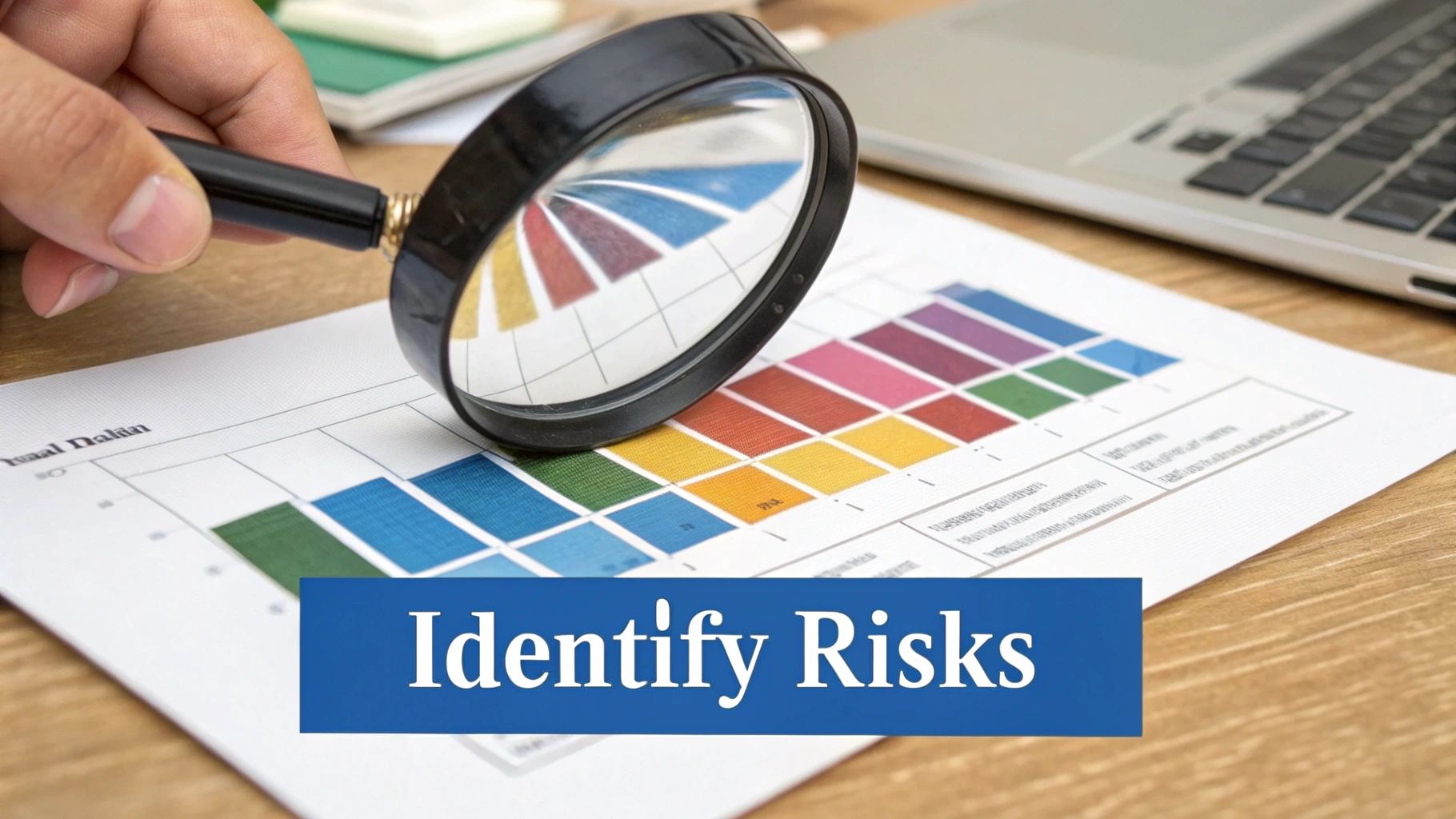
This process must move beyond annual reviews and become an embedded, data-driven discipline. By leveraging data intelligence, banks can shift from a reactive posture to a predictive one. The Visbanking BIAS platform transforms risk assessment by providing the granular data needed to spot anomalies and trends before they are widely recognized. It enables you to compare your institution's risk profile against a curated peer group, turning abstract threats like interest rate sensitivity or credit concentration into quantifiable, benchmarked metrics that demand strategic attention.
Practical Implementation Example
A regional bank with $8 billion in assets was concerned about its exposure to fluctuations in commercial property values. Its internal models suggested a manageable risk level. However, by using the BIAS platform to analyze non-owner-occupied CRE loan-to-value (LTV) ratios, they uncovered a concerning trend. Their portfolio average LTV was 78%, while the peer average for banks in their high-growth metro area was a more conservative 68%.
This data-backed insight revealed a hidden vulnerability. The bank’s risk profile was significantly more aggressive than its peers, exposing it to greater potential losses in a market downturn. The risk committee immediately tightened underwriting standards for new non-owner-occupied CRE loans and developed a plan to reduce its portfolio's overall LTV, directly mitigating a previously underestimated risk.
Actionable Steps for Implementation
To embed regular risk assessment into your operations, focus on these steps:
- Combine Top-Down and Bottom-Up Approaches: Involve both senior leadership in setting strategic risk priorities and frontline staff who have firsthand knowledge of operational risks. This dual perspective ensures comprehensive coverage.
- Leverage Data Analytics: Use data to move beyond qualitative "what if" scenarios. Analyze historical data, market trends, and peer benchmarks to quantify the likelihood and potential impact of identified risks.
- Use Diverse Perspectives: Incorporate insights from across the bank, including lending, operations, compliance, and IT. A risk that seems minor to one department may have significant implications for another. Learn more about how to enhance risk assessment with data on visbanking.com.
3. Develop and Maintain Risk Registers
A risk register is more than a simple spreadsheet; it is the central nervous system for operational risk management. This living document serves as a centralized repository for cataloging identified risks, their potential impact, likelihood, existing controls, and planned mitigation strategies. As popularized by institutions like the Project Management Institute (PMI), a well-maintained risk register transforms abstract threats into manageable, trackable items, ensuring that accountability is clear and nothing falls through the cracks. It provides a single source of truth for all stakeholders, from department heads to auditors.

The primary weakness of most risk registers is that they become static, based on subjective assessments rather than dynamic data. This is where external intelligence provides a critical advantage. The Visbanking BIAS platform can populate and validate a risk register with hard numbers. For instance, when assessing operational risk, you can benchmark your institution’s efficiency ratio or non-interest expense growth against peers to quantify whether your operational spending patterns represent an outlier risk that needs to be formally tracked and managed.
Practical Implementation Example
A mid-sized bank identified "talent retention" as a high-level strategic risk in its register. Initially, this was based on anecdotal evidence from exit interviews. To add analytical rigor, the risk team used the BIAS platform to compare its salary and benefits expenses as a percentage of total non-interest expense against a peer group of high-growth banks. The data showed their compensation expenses were in the 35th percentile, while top-performing peers were consistently above the 60th percentile.
This data transformed a vague risk into a quantifiable one. The bank now had a clear metric to track and a data-supported case for the board to approve a revised compensation strategy. The risk register entry was updated with a specific KRI: "Maintain compensation expense in the top quartile of the peer group."
Actionable Steps for Implementation
To ensure your risk register is a dynamic tool and not a static document, follow these steps:
- Assign Clear Ownership: Every identified risk must have a designated owner who is responsible for monitoring the risk and executing mitigation plans. Accountability is essential.
- Integrate with Reporting: The risk register should feed directly into committee and board reporting. Key risks, changes in risk scores, and the status of mitigation plans should be standard agenda items.
- Keep it Dynamic: Implement a formal process for regular reviews and updates, such as quarterly. Risks are not static, and your register must reflect the current environment. Learn more about how to enhance your risk management process on visbanking.com.
4. Create Robust Business Continuity and Disaster Recovery Plans
Operational resilience is a cornerstone of modern risk management best practices, moving far beyond a simple IT backup plan. A robust Business Continuity Plan (BCP) and Disaster Recovery (DR) strategy is a comprehensive, organization-wide approach designed to maintain critical functions during any disruption, from a cyber-attack to a natural disaster. Pioneered by standards from the Business Continuity Institute (BCI) and post-9/11 resilience initiatives, these plans ensure a bank can protect its people, preserve customer trust, and maintain market stability through adversity.

While BCP/DR is often seen as a qualitative exercise, its effectiveness is quantifiable and can be sharpened with data intelligence. For instance, understanding your operational dependencies requires deep insight into your cost structure and resource allocation. The Visbanking BIAS platform allows you to analyze non-interest expenses with granular detail, benchmarking against peers to identify potential single points of failure or over-reliance on specific vendors. This data helps prioritize which processes are truly "critical" and informs the resource allocation needed for effective recovery. To further support the development of resilient operational cores, consider exploring leading business continuity planning software.
Practical Implementation Example
A regional bank was developing its pandemic response plan and needed to assess the financial impact of shifting 80% of its non-branch workforce to remote operations. The plan seemed sound, but the CFO was concerned about unforeseen costs. Using the BIAS platform, the bank analyzed peer data on technology and telecommunications spending as a percentage of total non-interest expense.
They discovered their direct peers who had already invested more heavily in remote infrastructure had a 15% higher technology spend but a 5% lower overall facility cost. This data provided a clear financial case for investing in redundant communication channels and secure remote access, transforming the BCP from a theoretical document into a data-backed strategic investment.
Actionable Steps for Implementation
To ensure your plans are effective when you need them most, follow these steps:
- Identify Critical Dependencies: Use data to map out all critical processes, systems, and third-party vendors. Understand the recovery time objectives (RTOs) for each.
- Conduct Regular Drills: A plan that isn't tested is just a theory. Run regular, realistic simulations, from tabletop exercises to full-scale DR tests, to identify weaknesses and train your teams.
- Keep Plans Simple and Actionable: Complex, hundred-page documents are useless in a crisis. Create clear, concise, role-based playbooks that can be executed under pressure. Ensure redundant communication channels are established and tested.
5. Establish Strong Governance and Oversight
An effective risk framework is only as good as the governance structure that supports it. Strong governance ensures that risk management activities are not just documented but actively overseen, with clear lines of accountability flowing from business units to senior management and the board. Following the financial crisis and subsequent reforms championed by bodies like the Basel Committee on Banking Supervision, robust oversight has become a non-negotiable component of modern risk management best practices. It establishes who owns risk, who makes decisions, and who is held accountable for outcomes.
Governance, however, can quickly become a bureaucratic exercise without objective measures of performance and risk. This is where data intelligence provides critical clarity. A board's risk committee cannot effectively challenge management's assumptions without an independent, data-backed view of the bank's position. The Visbanking BIAS platform delivers this external perspective, enabling directors to compare their institution's risk profile, capital adequacy, and performance metrics against a relevant peer group. This transforms oversight from a subjective conversation into a data-driven dialogue.
Practical Implementation Example
Imagine a regional bank’s risk committee is reviewing its new loan origination strategy. Management presents a plan to increase its exposure to hospitality loans. While internal models show acceptable risk, a director uses the BIAS platform to analyze the hospitality loan performance and charge-off rates of peer banks in similar economic regions over the last five years. The data reveals that peers with similar concentrations experienced significantly higher-than-average losses during the last economic downturn.
This external, data-driven insight empowers the board to ask more pointed questions about the bank's underwriting standards and stress-testing assumptions. The governance structure worked, not just as a rubber stamp, but as an effective challenge function, leading to refined concentration limits and enhanced monitoring for the new portfolio.
Actionable Steps for Implementation
To build a governance structure that actively mitigates risk, focus on these key steps:
- Ensure Board-Level Expertise: The board or its risk committee must possess genuine risk management expertise. This may involve targeted director recruitment or providing specialized training to existing members.
- Establish Clear Reporting Lines: Define unambiguous reporting channels for risk issues. The Chief Risk Officer (CRO) should have a direct, unimpeded line of communication to the risk committee and the board.
- Balance Oversight with Efficiency: Governance should not stifle the business. Streamline reporting and decision-making processes to ensure that oversight is both rigorous and agile, enabling the bank to respond to market opportunities and threats effectively. Learn more about how to enhance risk governance with data intelligence on visbanking.com.
6. Implement Comprehensive Risk Monitoring and Reporting
A risk management framework is only as effective as the information it generates. Comprehensive risk monitoring and reporting transform static policies into a dynamic, living system. This involves establishing systematic processes for tracking risk indicators, monitoring the effectiveness of controls, and delivering timely, relevant reports to decision-makers. It moves beyond historical, lagging indicators to provide forward-looking insights that enable proactive management.
This best practice is about creating a real-time feedback loop for your institution’s risk profile. Without it, a bank is essentially flying blind, reacting to events after they have already impacted the balance sheet. Effective monitoring and reporting provide the visibility needed to navigate market volatility, regulatory changes, and competitive pressures, making it a cornerstone of modern risk management best practices.
Practical Implementation Example
A regional bank with $8 billion in assets aimed to improve its oversight of interest rate risk (IRR) in a volatile rate environment. The ALCO committee felt its quarterly reports were insufficient for timely decisions. They implemented a new process using the Visbanking BIAS platform to generate monthly, on-demand IRR sensitivity reports, benchmarked against a custom peer group of banks with similar asset-liability structures.
The first benchmarked report revealed that their Net Interest Income (NII) sensitivity to a +200 bps shock was 25% higher than the peer median. This data-driven alert triggered an immediate strategy review, leading to the execution of an interest rate swap that brought their exposure in line with their stated risk appetite and peer norms, protecting millions in future earnings.
Actionable Steps for Implementation
To build a robust monitoring and reporting system, focus on these key steps:
- Focus on Leading Indicators: While lagging indicators (like historical charge-offs) are important, prioritize leading indicators (like changes in FICO score distribution in new loan originations) that can signal future problems.
- Customize Reports for the Audience: The board of directors needs a high-level dashboard summarizing key risk indicators (KRIs) against appetite. In contrast, a department head needs detailed operational metrics specific to their business unit.
- Automate Data Collection: Manual data aggregation is slow, expensive, and prone to error. Leverage technology to automate the collection and consolidation of risk data to ensure reports are timely and accurate.
- Regularly Review and Update Indicators: The risk landscape is not static. Review your KRIs at least annually to ensure they remain relevant to your bank’s strategic objectives and the current economic environment. Find out how to enhance your reporting with peer data at visbanking.com.
7. Foster a Strong Risk Culture
A strong risk culture is the critical human element that animates any framework or policy. It is the shared set of attitudes, values, and behaviors that determines how an organization identifies, discusses, and manages risk. This culture transforms risk management from a siloed function into a collective responsibility, where every employee, from the teller line to the executive suite, feels empowered and accountable for proactive risk identification. It's the difference between a risk policy that sits on a shelf and one that genuinely influences daily decision-making.
The strength of a risk culture can be difficult to quantify, but its absence is glaringly obvious in hindsight, often after a significant loss or regulatory censure. Data intelligence provides a tangible way to ground cultural discussions in objective reality. By benchmarking performance and risk metrics, banks can identify areas where behavior deviates from stated policies. The Visbanking BIAS platform allows leadership to see, for example, if a specific lending team consistently originates loans outside of established credit policy exceptions, providing a data-driven starting point for a cultural conversation.
Practical Implementation Example
A regional bank was promoting a "challenge culture" where employees were encouraged to voice concerns. However, loan growth in its agricultural portfolio was far outpacing its peer group, raising concerns about underwriting standards. The risk team used the BIAS platform to compare the bank's charge-off rates and delinquency trends in that specific portfolio against a custom peer group of agricultural lenders.
The data revealed that while growth was high, early-stage delinquencies were also trending 15% above the peer average. This objective insight depersonalized the issue, allowing leadership to open a constructive dialogue with the lending team not about their effort, but about the risk indicators in their results. It shifted the conversation from blame to a collaborative review of underwriting practices, strengthening the desired risk culture.
Actionable Steps for Implementation
To foster a culture where risk is managed proactively, focus on these steps:
- Lead by Example: The board and senior management must consistently demonstrate that sound risk management is valued above short-term gains. Their actions, questions, and decisions set the ultimate tone.
- Integrate Risk into Daily Routines: Make risk a standing agenda item in team meetings. Integrate risk management competencies into job descriptions, performance reviews, and compensation structures.
- Communicate and Educate: Regularly communicate the bank's risk appetite and policies. Use real-world examples, both internal and external, to educate staff on the consequences of both poor and excellent risk decisions. You can learn more by exploring how to benchmark your performance and foster accountability on visbanking.com.
8. Integrate Risk Management with Strategic Planning
Truly effective risk management is not a separate function operating in a silo; it is woven into the very fabric of strategic planning. This integration ensures that risk considerations are not an afterthought but a core component of every major decision, from market expansion to product development. When risk and strategy are aligned, an organization can confidently pursue growth opportunities, knowing it has a clear-eyed view of the potential downsides. It moves risk management from a defensive posture to a strategic enabler that supports sustainable value creation.
This practice is one of the most vital risk management best practices because it directly connects risk appetite to business objectives. A strategy conceived without rigorous risk analysis is merely a hopeful ambition. Conversely, a risk function that doesn't understand the bank's strategic goals becomes a department of "no," stifling innovation and growth. Integrating the two ensures that the board and management are asking the right question: "Is the potential return from this strategy worth the risk we are taking on?"
Practical Implementation Example
Imagine a $10 billion regional bank is developing its five-year strategic plan, which includes aggressive growth in fintech partnerships and digital lending platforms. The risk management team is brought into the planning sessions from day one. Using the BIAS platform, they analyze the operational and compliance risk profiles of peer banks that have already embarked on similar digital transformations.
The data reveals a 40% higher incidence of reported cybersecurity events and a 25% increase in compliance costs for the first 24 months among their more digitally advanced peers. Armed with this intelligence, the strategy is not abandoned but adjusted. The bank allocates a larger upfront budget for cybersecurity infrastructure and compliance expertise, building these risk mitigation costs directly into the financial model for the strategic initiatives. This proactive, data-informed approach prevents costly surprises down the line.
Actionable Steps for Implementation
To embed risk management into your strategic DNA, follow these steps:
- Include Risk Leaders in Strategy Formation: Ensure the Chief Risk Officer (CRO) or equivalent has a seat at the table during all strategic planning and review sessions. Their perspective is crucial for identifying and evaluating risks inherent in proposed initiatives.
- Use Scenario Analysis for Major Decisions: For any significant strategic move, such as an acquisition or entering a new market, conduct thorough scenario analysis. Model potential outcomes under various economic and competitive conditions to understand the full spectrum of risk and reward.
- Link Risk Appetite to Performance Goals: Your bank’s risk appetite statement should directly inform strategic goals and incentive compensation. If you have a low appetite for credit risk, performance metrics should not solely reward loan volume without regard to quality. Explore how your risk profile compares to your peers by benchmarking your bank's data on visbanking.com.
9. Maintain Effective Third-Party Risk Management
In today's interconnected financial ecosystem, a bank's risk profile extends far beyond its own walls. Effective third-party risk management (TPRM) is no longer a peripheral compliance activity but a core component of operational resilience. This practice involves a systematic approach to identifying, assessing, and managing risks arising from relationships with vendors, fintech partners, and other external suppliers. As banks increasingly rely on third parties for critical functions, a failure in their supply chain can directly translate into reputational damage, operational disruption, and regulatory penalties.
A robust TPRM program moves beyond simple due diligence checklists to ongoing, data-informed monitoring. The challenge lies in objectively assessing the financial health and risk posture of your key vendors. The Visbanking BIAS platform addresses this directly by allowing you to analyze a third-party bank or credit union partner’s performance data. This provides an empirical basis for your risk assessments, moving from subjective reviews to data-backed conclusions about a partner's stability and operational soundness.
Practical Implementation Example
Imagine a mid-sized bank that relies on a specific fintech partner for its mobile banking application. This partner is critical to the bank’s digital strategy. The bank's risk team used qualitative questionnaires for its annual review. To elevate their process, they began using BIAS to monitor the partner's public financial filings (if available) and benchmarked the fintech's key financial health indicators against its industry peers.
This quantitative analysis revealed a declining liquidity ratio and rising operational expenses at the partner firm, metrics that were not apparent from the standard questionnaire. This insight prompted the bank to engage the vendor about its financial stability and begin developing a contingency plan with an alternative provider, proactively mitigating a potentially significant operational risk.
Actionable Steps for Implementation
To integrate TPRM as one of your core risk management best practices, focus on these steps:
- Tier Vendors by Criticality: Not all vendors pose the same level of risk. Classify third parties based on their importance to your operations and the sensitivity of the data they access. This allows you to focus intensive due diligence and monitoring efforts where they matter most.
- Embed Risk in Contracts: Your legal agreements with third parties must include specific clauses related to risk management, security standards, audit rights, and clear expectations for business continuity and disaster recovery.
- Monitor Continuously: Risk is not static. Implement a process for ongoing monitoring that includes financial health checks, performance reviews, and assessments of the vendor’s own risk and compliance environment. Learn more about how to structure these efforts with a third-party risk management framework on visbanking.com.
10. Leverage Technology and Data Analytics
In today's data-rich environment, relying on manual processes for risk management is equivalent to navigating with an outdated map. The tenth of our risk management best practices involves leveraging technology, particularly advanced data analytics, AI, and machine learning, to supercharge risk identification, monitoring, and response. This shifts risk management from a historical, backward-looking exercise to a proactive, forward-looking strategic advantage, allowing banks to anticipate threats before they fully materialize.
Modern analytics platforms transform raw data into predictive intelligence. By analyzing vast datasets of transactions, market movements, and operational metrics, these systems can identify subtle patterns and anomalies that would be invisible to human analysts. This capability is critical for everything from detecting sophisticated fraud schemes to modeling credit risk with unprecedented accuracy. To fully leverage technology for risk mitigation, integrating actionable DevOps security best practices throughout the software development lifecycle is essential.
Practic
Latest Articles

Brian's Banking Blog
Commercial Lending Trends: What Bank Executives Must Know
Brian's Banking Blog
Bank Marketing Dataset Analysis Strategy

Brian's Banking Blog
ESG Peer Benchmarking for Bank Leaders
Brian's Banking Blog
What Is Repricing Risk: A Bank Executive's Guide
Brian's Banking Blog
How to Manage Vendor Relationships in Banking
Brian's Banking Blog