
7 Risk Appetite Statement Examples for Bank Executives
Brian's Banking Blog
Defining a bank's risk appetite is not an academic exercise; it is a critical strategic function that separates market leaders from the laggards. A well-crafted risk appetite statement is the instrument by which a board translates strategy into actionable, measurable guidance for the entire organization. It establishes clear boundaries for decision-making, ensuring every business unit—from commercial lending to wealth management—pursues growth in lockstep with the board's strategic vision. Without this clarity, an institution drifts, exposing itself to unintended threats or, conversely, foregoing calculated opportunities that drive franchise value.
This article moves beyond theory to provide concrete risk appetite statement examples that bank leadership can adapt and implement. We will dissect quantitative, qualitative, and hybrid statements, offering a blueprint for articulating the specific levels and types of risk your institution is willing to assume in pursuit of its objectives. The goal is to provide a practical toolkit that empowers executive teams to make smarter, data-informed decisions. To fully appreciate how these statements integrate into your broader strategy, consider exploring strategic guides on risk management frameworks. The following examples are designed to be precise and actionable, demonstrating how to link high-level policy directly to operational execution.
1. Quantitative Risk Appetite Statement
A quantitative risk appetite statement defines acceptable risk using hard numbers. It replaces ambiguity with precision by setting specific, measurable boundaries—financial thresholds, percentages, and statistical limits—that guide decision-making across the institution. This method provides the clearest possible signal to business units about where the lines are drawn, making it a cornerstone for data-driven governance.

This approach is non-negotiable in the banking sector, where capital adequacy and solvency are paramount. For bank executives and directors, quantitative statements are not merely about compliance; they are about capital preservation and strategic allocation. By translating strategy into metrics, leadership ensures that risk-taking activities directly support long-term objectives without exposing the bank to unacceptable losses.
Strategic Analysis: Precision in Practice
Quantitative statements anchor risk management in objective reality. A bank setting its credit risk appetite with the metric, “Maintain consolidated net charge-offs below 0.50% of average loans,” establishes not a vague guideline, but a direct mandate that informs underwriting standards, loan pricing, and collection strategies.
Key Insight: Quantitative metrics transform risk appetite from a philosophical concept into an operational control. They provide an early warning system. A rising charge-off ratio is a clear, data-backed trigger for management intervention long before it becomes a crisis. For instance, a rise from 0.35% to 0.45% in one quarter signals a need to re-evaluate underwriting in specific loan segments.
Leading institutions use Value-at-Risk (VaR) limits to cap potential daily trading losses to a specific dollar amount, such as $50 million. This is a powerful, clear risk appetite statement example that leaves no room for interpretation and directly controls market risk exposure.
Actionable Takeaways for Bank Executives
To implement this effectively, executives must connect high-level strategy to on-the-ground metrics.
- Align Metrics with Strategy: If the bank’s strategy is to grow its C&I portfolio by 15% annually, the risk appetite must include specific metrics for that segment, such as a concentration limit capping C&I loans at 40% of the total portfolio and a non-performing loan target below 1.5% for new originations.
- Leverage Data Intelligence: Use platforms like Visbanking to benchmark proposed thresholds against peer institutions. Seeing that your targeted Tier 1 Capital Ratio of 9% is in line with top-quartile performers provides a data-validated foundation for your risk appetite.
- Stress Test Your Thresholds: Do not set limits in a vacuum. Use robust bank stress testing models to see how your metrics would perform under adverse economic conditions, such as a 300-basis-point rise in interest rates or a 5% increase in regional unemployment. This ensures your thresholds are resilient.
2. Qualitative Risk Appetite Statement
A qualitative risk appetite statement uses descriptive language and principles to define acceptable risk, focusing on culture, values, and reputation. It addresses the "how" and "why" behind risk-taking, guiding behaviors and decisions where numbers alone fall short. This approach establishes a strong ethical and cultural foundation, ensuring that risk decisions align with the institution's core identity.

While quantitative metrics are essential, qualitative statements are indispensable for managing non-financial risks like reputational, ethical, and strategic threats. For bank executives, these statements are crucial for embedding a consistent risk culture across the organization. They translate the bank's mission into behavioral guardrails, empowering employees to act with integrity even in ambiguous situations.
Strategic Analysis: Principles in Practice
Qualitative statements bring abstract values to life. A bank declaring, “We will not engage in product design or sales practices that could erode long-term customer trust for short-term profit,” directly governs product development, sales incentive plans, and marketing communications. This principle prevents the kind of missteps that lead to costly regulatory fines and irreparable brand damage.
Key Insight: Qualitative statements serve as a strategic compass. They guide decision-making in complex areas like adopting new AI technologies or entering emerging markets, where numerical data may be limited but the potential for reputational harm is high.
A prime example is a bank’s stance on compliance risk: “The bank has zero tolerance for willful or repeated non-compliance with anti-money laundering (AML) regulations.” This is one of the most powerful risk appetite statement examples because it sets an unambiguous operational boundary for the entire organization, from the frontline to the back office. It defines the bank’s character and commitment to legal and ethical standards.
Actionable Takeaways for Bank Executives
To effectively implement qualitative statements, executives must ensure they are understood and enforced.
- Be Explicit, Not Vague: Avoid generic phrases like “we take risk seriously.” Instead, use clear, direct language. For example: “We have zero tolerance for actions that compromise the security of customer data, and any breach will be treated as a critical incident” is far more effective.
- Integrate into Training and Performance: Embed these qualitative principles into all employee onboarding, ongoing training, and performance management systems. Use real-world case studies to illustrate acceptable and unacceptable behaviors, ensuring the principles are not just words on a page.
- Combine with Quantitative Measures: Qualitative statements are strongest when they complement quantitative ones. A statement like, “We prioritize a stable and conservative growth path,” should be supported by a metric such as a peer-benchmarked target for annual asset growth not to exceed 10%.
3. Hybrid Risk Appetite Statement
A hybrid risk appetite statement blends the precision of quantitative metrics with the contextual richness of qualitative principles. This comprehensive approach creates a balanced framework, offering the hard-line clarity of numbers alongside the adaptive wisdom of descriptive guidance. It acknowledges that not all significant risks, such as reputational damage or strategic missteps, can be neatly captured by a single metric.
This balanced model provides a holistic view of risk that resonates with the complexity of modern banking. For executives and board members, a hybrid statement ensures that while financial guardrails are firm, the institution retains the flexibility to navigate nuanced threats and opportunities. It bridges the gap between the black-and-white world of capital ratios and the gray areas of brand integrity and corporate culture.
Strategic Analysis: The Best of Both Worlds
Hybrid statements prevent a purely numbers-driven culture from overlooking critical, unquantifiable risks. Consider a bank that pairs a quantitative limit on operational losses, "Keep annual operational losses from a single event below $5 million," with a qualitative statement: "We have zero tolerance for unethical conduct that compromises client trust or our brand reputation, regardless of the immediate financial impact."
Key Insight: The hybrid model forces a conversation between different types of risk. The qualitative principle gives management the authority to act decisively on an ethical breach even if the immediate financial loss is well within the quantitative threshold. This prevents a minor financial issue from escalating into a major reputational crisis.
This model is a hallmark of sophisticated risk management. This type of risk appetite statement example ensures that data-driven decisions are always tempered by strategic and ethical judgment, providing a more resilient governance structure. A bank might set a quantitative limit on CRE concentration while qualitatively stating it will avoid financing speculative construction projects with no pre-leasing agreements.
Actionable Takeaways for Bank Executives
To build an effective hybrid statement, executives must ensure both sides of the equation are connected and mutually reinforcing.
- Link Qualitative to Quantitative: Ensure your qualitative principles have clear implications for your quantitative metrics. A qualitative commitment to "conservative asset-liability management" should be directly linked to quantitative limits on interest rate sensitivity (e.g., NII variance under +/- 200 bps shocks) and liquidity coverage ratios.
- Prioritize Holistically: Use the qualitative statements to inform which quantitative metrics matter most. If "best-in-class digital customer experience" is a stated strategic priority, your risk appetite must include specific metrics around system uptime (e.g., 99.95%) and cybersecurity incidents, not just traditional financial risk.
- Establish Clear Escalation Paths: Define what happens when a qualitative boundary is crossed. While a metric breach has a clear trigger, a reputational issue requires a pre-defined escalation protocol involving senior leadership, communications, and legal teams to ensure a swift, coordinated response.
4. Scenario-Based Risk Appetite Statement
A scenario-based risk appetite statement defines acceptable risk levels across different business scenarios and market conditions. Instead of a single static limit, this dynamic approach provides context-specific guidance, enabling an institution to adjust its risk-taking posture based on whether it is operating in a “business-as-usual” environment or a “stressed” market. This provides nuance and flexibility, allowing for more aggressive strategies in favorable conditions and rapid de-risking when threats emerge.

This method is crucial for institutions with significant exposure to market volatility. For bank executives, a single set of risk tolerances is insufficient. A scenario-based framework empowers them to pre-authorize different operational playbooks, ensuring that the organization can react with speed and decisiveness without waiting for emergency board meetings.
Strategic Analysis: Resilience by Design
Scenario-based statements link risk appetite directly to strategic planning and stress testing. For example, a bank might define two scenarios: a "Normal Market" and a "Severe Downturn." The risk appetite for market risk under the normal scenario might allow a Value-at-Risk (VaR) of $15 million, but under the severe downturn scenario—defined by specific triggers like a VIX above 40—this is automatically reduced to $5 million, triggering an immediate portfolio rebalancing.
Key Insight: A scenario-based approach embeds resilience into the governance structure. It forces leadership to define not just what is acceptable today, but what becomes unacceptable under duress, transforming risk management from a reactive function to a proactive, strategic one.
This forward-looking approach is a powerful risk appetite statement example that prepares an organization for change. A community bank could use scenarios to define its tolerance for CRE concentration, allowing higher limits during periods of stable property values but automatically tightening them if regional vacancy rates rise by more than 200 basis points.
Actionable Takeaways for Bank Executives
To implement a scenario-based approach, executives must build a bridge between theoretical models and practical business triggers.
- Define Clear, Plausible Scenarios: Start with a few well-defined scenarios relevant to your business. For a community bank, this could be "Baseline," "Local Recession" (e.g., unemployment rises 3%), and "Rapid Interest Rate Hike" (e.g., Fed Funds rate increases 250 bps in 12 months).
- Link Scenarios to Key Risk Indicators (KRIs): For each scenario, define corresponding thresholds for key metrics. Your Tier 1 Capital Ratio target might be 10% in the baseline but have a hard floor of 8.5% in the recession scenario, triggering mandatory capital preservation actions.
- Validate with Data Intelligence: The effectiveness of scenarios depends on the quality of the underlying assumptions. This is where robust bank stress testing models are indispensable. Data intelligence platforms like Visbanking allow you to validate how your balance sheet and capital would respond under each defined scenario compared to peers.
5. Risk Category-Specific Appetite Statement
A risk category-specific appetite statement disaggregates the firm's overall risk tolerance into distinct, tailored statements for each major risk category, such as credit, market, operational, and strategic risk. This structured approach moves beyond a single, monolithic statement, allowing for nuanced and context-aware risk management. It empowers individual business lines with clear, relevant boundaries while ensuring the board maintains cohesive oversight.
This method is a strategic necessity for any complex financial institution where different risk types have vastly different impacts and require specialized control frameworks. For executives at diversified banks, it ensures that the growth-oriented appetite for market risk in a trading division does not inadvertently create an unacceptable level of operational risk in back-office processes.
Strategic Analysis: Tailored Controls for Diverse Risks
Category-specific statements connect high-level strategy to the unique risk dynamics of each business function. A bank's board may approve a moderate overall risk appetite, but this translates differently across categories. The credit risk appetite might be conservative ("Maintain a problem loan ratio below 2% and a Texas ratio below 15%"), while the strategic risk appetite for technology investment could be more aggressive ("Allocate up to 10% of non-interest expense to experimental fintech partnerships and AI projects").
Key Insight: Segmenting risk appetite allows an organization to be both risk-averse and innovative simultaneously. It prevents a single, conservative metric from stifling necessary risk-taking in areas critical for future growth, like digital transformation or market expansion.
This granular approach provides one of the most effective risk appetite statement examples because it aligns governance directly with operational reality. The following diagram illustrates how a bank might structure its primary risk categories.
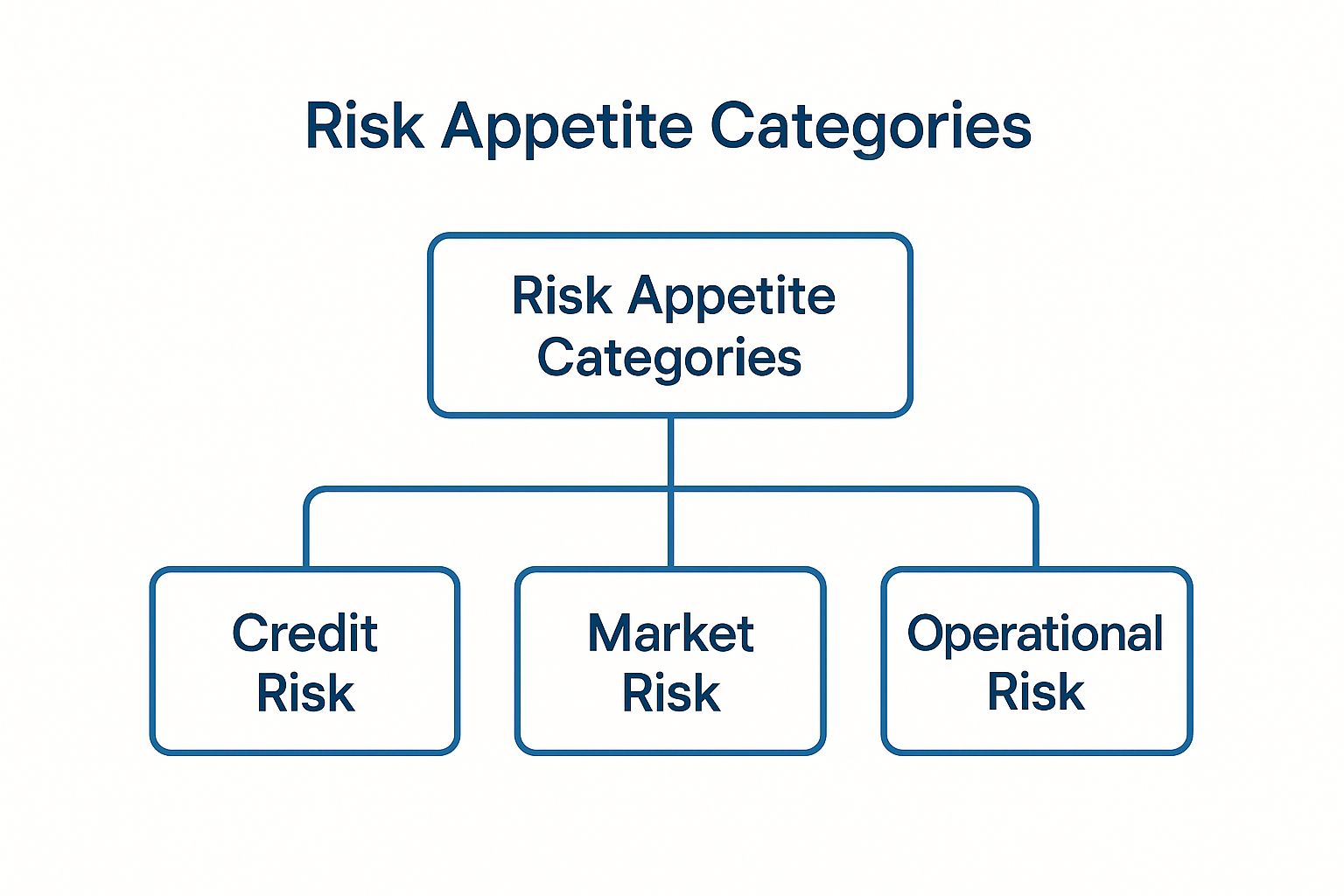
This hierarchical structure ensures that every major exposure is managed under a purpose-built framework, preventing gaps and promoting clear accountability across the institution.
Actionable Takeaways for Bank Executives
To deploy this approach, leadership must champion a comprehensive yet clear risk taxonomy.
- Define Clear Categories: Start by mapping your institution's unique risk landscape. At a minimum, this should include credit, market, liquidity, operational, compliance, and strategic risk. Ensure definitions are clear to avoid overlap.
- Establish Coordination Mechanisms: While appetites are separate, risks are interconnected. A new product launch (strategic risk) impacts credit and operational risk. Your risk committee's governance process must assess these interdependencies, ensuring the complete risk profile is understood.
- Integrate into Performance Reviews: Tie the performance of business line leaders to their adherence to the risk appetite statements for their specific categories. A commercial lending head should be evaluated on the portfolio's performance against credit risk appetite metrics.
- Review Category Relevance: Markets and business models evolve. Annually review whether your defined risk categories still accurately reflect your primary exposures. A growing fintech partnership, for instance, might elevate third-party risk to its own distinct category.
6. Board-Level Risk Appetite Statement
A board-level risk appetite statement is the ultimate expression of an institution's risk philosophy, set from the very top. It is a high-level, strategic document approved by the board of directors that defines enterprise-wide risk tolerance. Rather than detailing granular metrics, it focuses on aligning the firm’s overall risk-taking activities with its corporate strategy, capital strength, and stakeholder expectations.
This approach ensures that risk governance is not a siloed function but an integral part of strategic leadership. For bank directors, this statement is the primary tool for establishing the "tone at the top," cascading a clear and consistent risk culture throughout the organization. It provides the foundational principles upon which all other departmental risk limits and controls are built.
Strategic Analysis: The Board's North Star
Board-level statements connect strategy directly to risk boundaries. A statement like, "The bank will accept a moderate level of risk to achieve its strategic objectives, while maintaining capital levels and liquidity sufficient to withstand a severe economic stress scenario without threatening our viability or reputation," is a clear mandate. It is a declaration to shareholders, regulators, and employees about the kind of institution the board intends to run.
These are powerful risk appetite statement examples because they demonstrate the board's direct ownership of enterprise-wide risk outcomes. The goal is to move beyond passive oversight to active governance, setting the strategic direction for risk.
Key Insight: A board-level statement transforms risk management from a compliance exercise into a strategic enabler. It empowers management to pursue opportunities confidently, knowing they are operating within the board's defined and understood boundaries.
Actionable Takeaways for Bank Executives
To make a board-level statement effective, it must be embedded into the governance fabric of the institution.
- Link to Strategy and Capital: The statement must explicitly reference the bank’s strategic plan and capital adequacy. For instance: “We will accept a moderate level of credit risk to achieve our growth targets, provided our Tier 1 Capital Ratio remains above 10% under stressed scenarios.” This creates a clear link you can explore when developing your strategic planning for banks.
- Ensure Board Fluency: Do not assume all board members are risk experts. Conduct dedicated training sessions to ensure they understand the concepts of risk appetite, tolerance, and capacity. This empowers them to challenge and approve the statement meaningfully.
- Tie to Executive Compensation: Link executive compensation and performance reviews to adherence to the risk appetite statement. This creates powerful incentives for senior leaders to manage their business units within the board's mandated risk boundaries.
7. Dynamic Risk Appetite Statement
A dynamic risk appetite statement creates an adaptive framework that automatically adjusts risk tolerance based on real-time market conditions, internal performance, or predefined triggers. Instead of static, once-a-year limits, this approach allows risk boundaries to expand or contract, enabling responsive and intelligent risk management in volatile environments. It embeds agility directly into the governance structure.
This forward-thinking method is essential for institutions operating in fast-moving markets or those with significant digital operations. For executives, a dynamic statement is not just about managing downside risk; it is about strategically seizing upside opportunities. It allows the institution to cautiously increase its risk exposure when conditions are favorable and automatically pull back when warning signs appear, optimizing performance without manual intervention for every shift.
Strategic Analysis: Agility in Action
Dynamic statements link risk appetite directly to key performance indicators (KPIs) or external market signals. Consider a bank’s auto lending division. The appetite statement might read: “If the 60-day delinquency rate on new indirect auto loans remains below 1.5% for two consecutive quarters, and the Manheim Used Vehicle Value Index is stable or rising, the maximum approved loan-to-value (LTV) ratio for prime borrowers will automatically increase from 120% to 125%.”
Key Insight: A dynamic risk appetite transforms risk management from a reactive function into a proactive, automated system. It builds a self-correcting mechanism into your strategy, allowing the institution to capitalize on momentum or de-risk based on live data, providing a significant competitive advantage.
Leading financial players leverage this model extensively. Algorithmic trading platforms dynamically adjust risk limits based on market volatility indices. These are powerful risk appetite statement examples that demonstrate how to embed intelligent, automated responses into core business operations, driven by real-time data.
Actionable Takeaways for Bank Executives
To implement a dynamic framework, executives must build a system of triggers and responses grounded in data.
- Start with Simple, Reliable Triggers: Begin with well-understood and easily monitored metrics. Link commercial real estate concentration limits to a reliable external index of regional property values or vacancy rates. Connect consumer loan underwriting standards to local unemployment data.
- Ensure Robust Back-Testing: Back-test your dynamic rules against historical data to ensure they would have performed as expected during past market cycles. Use data intelligence to stress test the logic to prevent unintended consequences, like over-tightening during a temporary market dip.
- Maintain Human Oversight: An automated system should not be a "black box." Implement clear protocols for manual override and ensure a risk committee regularly reviews the model's performance, the relevance of its triggers, and the appropriateness of its automated decisions.
Risk Appetite Statement Types Comparison
| Risk Appetite Type | Implementation Complexity 🔄 | Resource Requirements ⚡ | Expected Outcomes 📊 | Ideal Use Cases 💡 | Key Advantages ⭐ |
|---|---|---|---|---|---|
| Quantitative Risk Appetite Statement | Medium to High — Requires precise metrics and thresholds | High — Needs sophisticated risk measurement and monitoring tools | Clear, measurable risk boundaries; precise monitoring and reporting | Financial institutions, trading, insurance with stable environments | Clear guidance; supports automation; consistent decision-making |
| Qualitative Risk Appetite Statement | Low to Medium — Uses descriptive principles, less structure | Low — Relies on cultural and behavioral inputs | Flexible risk communication; promotes risk-aware culture | ESG risks, reputational, strategic risks, changing environments | Adaptable; captures soft risk factors; easy stakeholder communication |
| Hybrid Risk Appetite Statement | High — Combines quantitative and qualitative elements | High — Demands integration of multiple frameworks | Balanced precision and flexibility; comprehensive coverage | Large multinationals; complex risk portfolios | Comprehensive; balances adaptability and precision; broad appeal |
| Scenario-Based Risk Appetite Statement | High — Complex scenario definitions and triggers | High — Advanced modeling, stress-testing required | Context-specific, dynamic risk guidance; proactive management | Volatile markets; crisis management; scenario planning | Adapts to market shifts; supports stress testing; forward-looking |
| Risk Category-Specific Appetite Statement | Medium to High — Multiple category frameworks to manage | Medium to High — Specialized monitoring and governance | Targeted risk management; focused monitoring by category | Organizations with diverse risk profiles; specialized risk units | Specialized expertise; improves risk assessment; focused resource use |
| Board-Level Risk Appetite Statement | Medium — Strategic, high-level framework | Low to Medium — Governance and reporting focused | Enterprise-wide risk tolerance aligned with strategy | Corporate governance; stakeholder assurance; regulatory compliance | Top-level commitment; strategic oversight; regulatory alignment |
| Dynamic Risk Appetite Statement | Very High — Automated, real-time adjustments | Very High — Requires advanced tech and analytics | Rapid adaptation to market changes; optimized risk-return | Fintech, algorithmic trading, volatile market environments | Highly responsive; reduces manual input; supports agility |
Final Thoughts
We have explored a comprehensive spectrum of risk appetite statement examples, from the precision of quantitative metrics to the nuanced guidance of qualitative declarations. Moving beyond mere templates, the analysis of these diverse statements reveals a critical truth for modern banking leadership: a risk appetite statement is not a static document for compliance; it is a dynamic strategic instrument that guides decision-making at every level of the institution.
The most effective examples share core characteristics. They are specific, measurable, and directly linked to the bank's strategic objectives. They avoid vague platitudes, instead offering clear guardrails that empower, rather than restrict, business units. Whether defining a precise 5% limit on subprime auto loan concentration or articulating a "cautious but open" stance toward fintech partnerships, a powerful statement translates board-level strategy into operational reality.
From Theory to Action: Key Takeaways for Bank Leadership
As you move to refine or develop your own institution's framework, consider these pivotal takeaways drawn from the detailed examples:
- Integration is Non-Negotiable: The strongest risk appetite statements are woven into the fabric of strategic planning, capital allocation, and performance management. They are not an isolated compliance exercise but a central component of your bank’s operating system. A statement that isn't referenced in loan committee meetings or new product discussions is failing its primary purpose.
- Data is the Bedrock of Confidence: A qualitative goal like "maintaining a strong credit culture" is admirable, but it becomes powerful when supported by quantitative KRI targets, such as keeping non-performing loans below 1.25% of the total portfolio. This fusion of qualitative intent with data-driven thresholds provides the clarity and defensibility required to navigate both regulatory scrutiny and market volatility.
- Dynamic Frameworks Win: The banking landscape is not static, and neither should your risk appetite be. The dynamic and scenario-based statement examples highlight the necessity of a framework that can adapt. Regularly stress-testing your assumptions against market shifts, such as sudden interest rate hikes or regional economic downturns, ensures your risk posture remains relevant and resilient.
Ultimately, mastering the art of the risk appetite statement is about achieving strategic alignment. It ensures that the board, executive management, and frontline staff are all moving in the same direction, with a shared understanding of which risks are acceptable in the pursuit of sustainable growth and which are not. This clarity is the ultimate competitive advantage, fostering a culture of informed risk-taking that protects the institution while enabling it to seize opportunities with confidence. The difference between a well-run bank and a vulnerable one often lies in the quality, communication, and application of these foundational principles.
Your risk appetite statement is only as strong as the data you use to monitor it. To see how your institution's key risk indicators stack up against peers and build a truly data-informed framework, explore the competitive intelligence and market benchmarks available throug
Latest Articles
Brian's Banking Blog
Automated Alerts and Notifications for Banks
Brian's Banking Blog
Customer Feedback Loop for Banks: A Practical Playbook
Brian's Banking Blog
Commercial Lending Trends: What Bank Executives Must Know
Brian's Banking Blog
Bank Marketing Dataset Analysis Strategy

Brian's Banking Blog
ESG Peer Benchmarking for Bank Leaders
Brian's Banking Blog