
A Bank Executive's Guide to Pre-Provision Net Revenue (PPNR)
Brian's Banking Blog
Pre-Provision Net Revenue (PPNR) is the purest measure of a bank's core operational profitability. It represents the earnings generated from lending, deposits, and fee-based services before accounting for the provision for credit losses.
For bank executives and directors, PPNR is a critical diagnostic tool. It isolates operational performance from credit risk, providing a clear view of how effectively the institution is managing its balance sheet and controlling expenses. A strong, consistent PPNR demonstrates the bank's capacity to absorb credit cycle shocks using its fundamental earning power, making it the first line of defense against economic downturns.
Defining Pre-Provision Net Revenue

At its core, PPNR strips away the variable and often volatile impact of credit loss provisions to reveal the fundamental earning power of the institution.
This metric answers a critical question for any leadership team: How profitable are our day-to-day operations? By separating operational performance from credit risk management, PPNR delivers an unvarnished assessment of the bank's health.
The Federal Reserve defines PPNR as a key financial metric reflecting a bank's earnings from core activities, calculated as net interest income plus noninterest income, minus noninterest expense. The official methodology is detailed in its stress test framework overview.
PPNR as a Strategic Indicator
For decision-makers, tracking PPNR is not an accounting exercise; it is a strategic imperative. It serves as a leading indicator of the institution's underlying financial health.
Is PPNR rising? This suggests effective net interest margin management, successful fee income strategies, or disciplined expense control. Conversely, a declining PPNR—even if net income appears stable due to low credit costs—is a significant red flag. It may signal eroding margins or operational inefficiencies that demand immediate board-level attention.
A bank’s PPNR is its first line of defense in a downturn. It is the earnings buffer that absorbs credit losses before capital is impaired.
Mastering this metric is fundamental to strategic planning. It quantifies the bank's ability to generate sustainable profits independent of the credit environment.
The Core Components of PPNR
To effectively manage PPNR, leadership must understand its three core components. The table below outlines the primary levers for driving core profitability.
| Component | Description | Example Sources |
|---|---|---|
| Net Interest Income | The spread between revenue from interest-earning assets and the expense of interest-bearing liabilities. | Loan and investment securities interest; deposit interest expense. |
| Noninterest Income | Revenue from fee-based services and activities outside of core lending, crucial for revenue diversification. | Service charges, card fees, wealth management fees, mortgage banking income. |
| Noninterest Expense | The costs of operating the bank, including all overhead from compensation to technology infrastructure. | Salaries and benefits, occupancy costs, technology expenses, marketing spend. |
Each of these components provides critical data points on institutional performance. A rigorous analysis is a strategic necessity, not merely an accounting function.
Why This Metric Demands Executive Focus
Without a sharp focus on PPNR, leadership risks a false sense of security. Strong net income can easily mask deteriorating operational performance during periods of low credit costs.
By zeroing in on PPNR, you can:
- Assess Core Efficiency: Obtain an objective measure of how well assets, liabilities, and operating costs are being managed.
- Identify Performance Drivers: Pinpoint what is truly driving profits: a strong net interest margin, growing fee income, or disciplined expense management.
- Strengthen Strategic Planning: Make data-driven decisions on capital allocation, product pricing, and operational priorities.
A deep command of PPNR is foundational to sound governance. Platforms like Visbanking provide the data intelligence to not just track these components but to benchmark them against peer institutions. This transforms raw data into actionable insights, revealing opportunities to gain a competitive advantage.
How to Calculate PPNR Step-by-Step
Understanding the pre-provision net revenue definition is necessary, but calculating it consistently is what empowers strategic decision-making. The calculation itself is direct, consolidating the three primary operational levers of the bank.
This process provides a clear, quantitative picture of what drives core profitability—and what impedes it. Such clarity is essential for making targeted strategic adjustments.
This infographic outlines the straightforward but powerful process for determining your bank's true operational earning power.
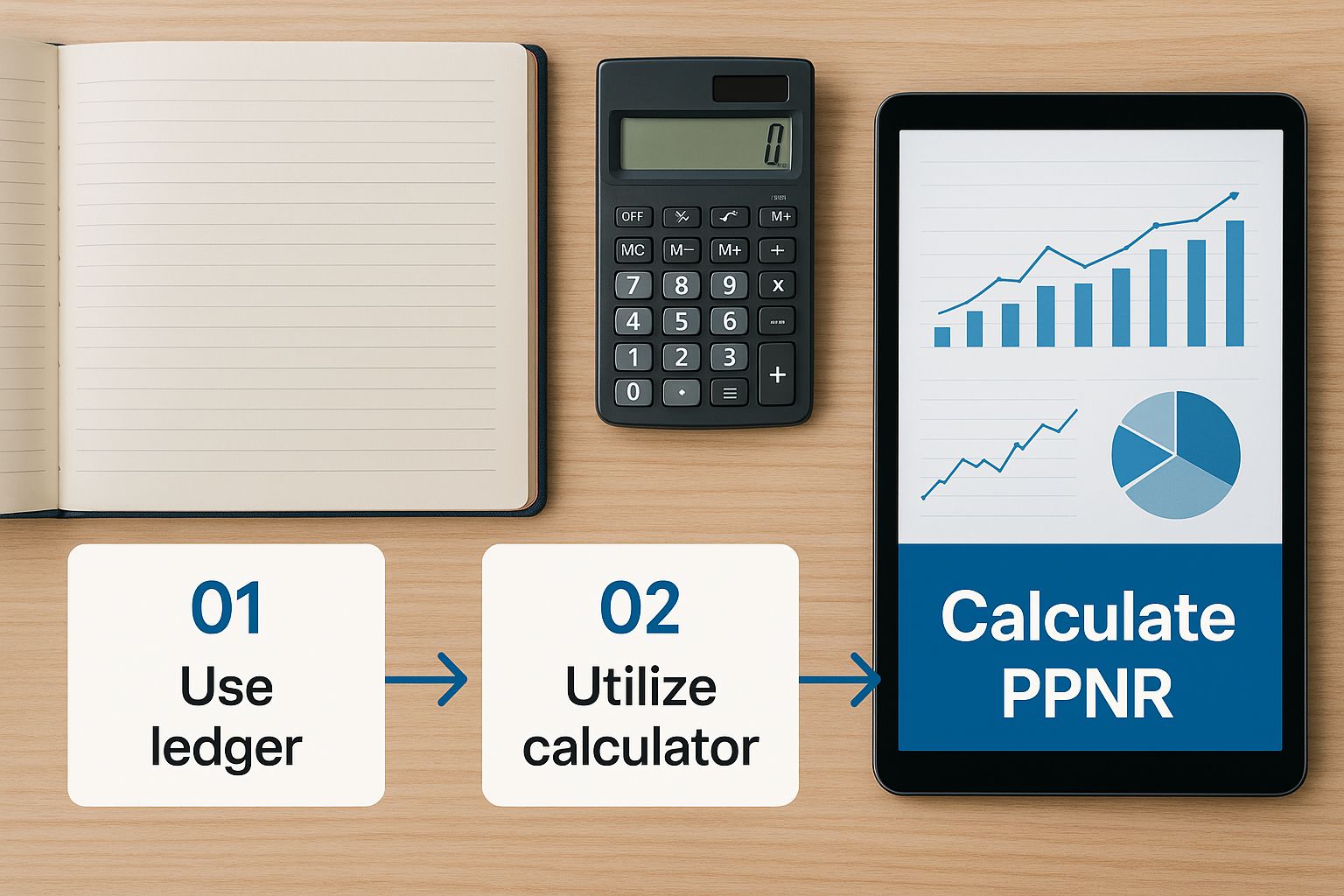
The calculation aggregates all operational income streams and subtracts all operating costs, leaving the pure, unvarnished performance of the business.
The PPNR Formula in Action
Let’s apply the formula to a hypothetical $2 billion community bank.
Calculate Net Interest Income (NII): Assume the bank earns $80 million in interest from its loan and investment portfolio and pays $20 million in interest on deposits and other borrowings.
- NII = $60 Million
Add Noninterest Income: The bank generates $15 million from fee-based revenue sources, including service charges, wealth management, and mortgage banking activities.
- Total Revenue = $75 Million ($60M NII + $15M Noninterest Income)
Subtract Noninterest Expense: Total operating costs—including salaries, benefits, technology, and occupancy—amount to $40 million.
- Final PPNR = $35 Million ($75M Total Revenue - $40M Noninterest Expense)
This $35 million PPNR represents the bank’s core earnings available to absorb potential loan losses and generate net income. This is the financial engine that powers the institution.
Regulatory and Reporting Context
PPNR is not merely an internal metric; it is a vital component of regulatory reporting and scrutiny. Regulators view it as the primary measure of a bank’s ability to generate revenue before accounting for credit risk.
The FR Y-14Q reporting schedule, for instance, requires large banks to report detailed PPNR components quarterly. Key financial resources, such as Nasdaq's financial glossary, also recognize its importance.
Once this calculation is mastered, leadership can shift from simply reporting a number to diagnosing performance. It unlocks critical questions about margin compression, fee income strategy, and operational efficiency.
Understanding the calculation is the first step. The second is benchmarking each component against peers to identify true competitive advantages and vulnerabilities.
Why PPNR Is a Critical Leadership Metric

Stripping away accounting variables reveals the core operational health of the institution. This is the strategic value of Pre-Provision Net Revenue. For any bank executive or board member, PPNR answers the fundamental question: How well is our business operating?
A rising PPNR indicates that core strategies are effective—whether in asset-liability management, fee generation, or expense control. It confirms the operational engine is performing efficiently.
Conversely, a declining PPNR is an early warning signal that demands investigation. Net income might be temporarily buoyed by a benign credit environment, but falling PPNR signals an erosion in underlying profitability. An expert-level grasp of the pre provision net revenue definition is therefore non-negotiable for effective oversight.
Your First Line of Defense
PPNR is the bank's primary financial shock absorber. It is the earnings cushion generated from operations that absorbs credit losses before they erode the capital base.
Consider two $3 billion asset banks, each facing a $20 million provision for loan losses.
- Bank A has a robust PPNR of $45 million. After absorbing the $20 million provision, it reports a healthy $25 million in pre-tax profit. Its business model is resilient.
- Bank B operates on thinner margins, with a PPNR of only $25 million. The same $20 million provision leaves it with a marginal $5 million in pre-tax profit, exposing its vulnerability to further credit deterioration.
PPNR is not an abstract figure; it is a direct measure of institutional resilience. A strong PPNR proves the viability of a business model capable of withstanding economic cycles without derailing strategic objectives.
This comparison highlights why PPNR is a vital forward-looking indicator. Data intelligence platforms like Visbanking enable you to benchmark PPNR against relevant peers, transforming this metric into a tool for proactive strategic management.
PPNR's Starring Role in Regulatory Stress Tests
Following the 2008 financial crisis, PPNR evolved from an important internal metric to a cornerstone of regulatory supervision.
During stress tests like the Dodd-Frank Act Stress Test (DFAST), regulators are primarily assessing a bank's capacity to absorb severe economic shocks. PPNR is their starting point. It represents the bank's innate power to absorb losses through operations.
An institution with a healthy, predictable PPNR is fundamentally more resilient. It possesses the operational capacity to cover rising loan loss provisions directly from earnings, thereby protecting its capital base. This makes PPNR a critical input for capital planning and regulatory assessments.
The Foundation of Bank Health Assessments
PPNR is now the baseline for determining how a bank would perform under adverse economic scenarios.
Research from the New York Federal Reserve underscores PPNR as a foundational component in assessing bank health under duress. The complete research on how regulators model PPNR for stress tests details this methodology. This intense focus means a bank’s projected PPNR performance directly influences regulatory approval of its capital plans.
Regulators view PPNR as the first line of defense. A strong PPNR projection signals that the institution can withstand severe credit losses with its core earning power, preserving capital and ensuring stability.
For bank executives, the ability to accurately model and project PPNR is a core competency. Developing robust bank stress testing models is the only way to meet these heightened expectations.
The Direct Line to Your Capital Plans
The strength of a bank's PPNR projections has direct consequences. Regulators scrutinize these figures to determine if projected earnings can cover losses while maintaining required capital levels.
A weak PPNR forecast can lead to the rejection of a capital plan, forcing a bank to curtail dividends or share buybacks. Conversely, demonstrating a resilient PPNR stream provides regulators with the confidence that the institution is prepared for adverse conditions.
This is where precise data intelligence becomes a strategic asset. Using platforms like Visbanking, you can benchmark every component of your PPNR—from net interest margin to efficiency ratio—against a custom peer group. This builds defensible projections and identifies opportunities to strengthen core profitability long before regulatory review.
Use Benchmarking to Turn PPNR Into a Competitive Weapon
Calculating your bank's PPNR is the baseline. The strategic value is unlocked by benchmarking that number against your true competitors. The critical question is not just, "What is our PPNR?" but, "How does our core profitability compare to our direct peers?"
Without this context, you are operating with incomplete information. Is your net interest margin truly competitive, or are noninterest expenses eroding your profitability relative to the market? Internal data alone cannot answer these questions.
From Raw Numbers to a Diagnostic Tool
Data intelligence transforms PPNR from a static number into a dynamic diagnostic tool. With a platform like Visbanking, you can benchmark PPNR and its components against a hand-picked peer group, turning an academic metric into a powerful indicator of institutional health.
Consider a scenario where your bank’s PPNR as a percentage of assets is in the 75th percentile—a strong result. However, a deeper analysis reveals your noninterest expense ratio is significantly higher than the peer median.
That is the moment raw data becomes actionable intelligence. You have pinpointed a specific operational lever—expense control—that requires focus, preventing wasted resources on areas where you already lead.
This level of detail enables leadership to move from assumption-based decisions to data-driven action. It is the difference between knowing there is a problem and knowing its precise cause.
Turning Insight Into Strategy
By integrating benchmarking into your strategic planning cycle, you can identify performance gaps before they become critical issues.
For instance, you might discover a peer institution of similar size and business mix generates 20% more noninterest income as a percentage of assets. This is a clear directive to evaluate your own fee structures, product offerings, and customer strategies.
A firm grasp of the most relevant key performance indicators for banks provides the foundation for this analysis. Benchmarking PPNR provides the clarity needed to optimize the balance sheet, refine pricing strategies, and drive operational efficiency.
Data intelligence platforms reveal where your next strategic advantage is hidden.
Turning PPNR Data into Decisive Action
Understanding pre-provision net revenue is table stakes. Translating that understanding into decisive action is how market leaders win.
Consistent PPNR tracking and analysis enable a shift from a defensive, reactive posture to an offensive, forward-looking strategy. Leadership can proactively manage balance sheet composition, pricing, and operational costs before they become problematic.
This metric is more than a regulatory requirement; it is an internal compass for long-term, sustainable profitability. Is performance lagging due to margin compression, insufficient fee income, or expense bloat? PPNR analysis provides the answer, directing management focus and capital to where they will have the greatest impact.
The final step is execution. Utilizing powerful banking data analytics allows you to see how every component of your PPNR compares against relevant peers. A single metric becomes a strategic roadmap, pinpointing opportunities to build a more resilient and profitable institution.
Executive Q&A: Key PPNR Distinctions
For executives applying PPNR in strategic discussions, clarity on its nuances is essential.
How Is PPNR Different From Pre-Tax Income?
PPNR measures raw operational earning power before the provision for credit losses. It reflects the profitability of the bank's core business activities.
Pre-tax income is calculated after the provision for credit losses has been deducted. It represents profitability after accounting for the expected risk in the loan portfolio. PPNR shows how well you run the bank; pre-tax income shows the result after accounting for lending risk.
Can a Bank Have Strong PPNR But Weak Net Income?
Absolutely. This scenario is precisely why PPNR is a critical executive metric.
A bank can demonstrate excellent operational efficiency, generating strong PPNR. However, if its loan portfolio is poorly underwritten, the required provision for loan losses can be substantial, severely depressing or even eliminating net income.
This divergence is a key diagnostic signal. PPNR isolates operational performance from credit risk management, telling leadership exactly which engine—operations or credit—is underperforming.
Why Do Regulators Emphasize PPNR in Stress Tests?
Regulators view PPNR as a bank's primary buffer against a crisis. In an economic downturn, credit losses are expected to rise.
A bank with a consistently strong PPNR has a built-in shock absorber. It can use its recurring operational earnings to cover increasing credit losses without impairing its capital base. This capacity is the definition of institutional resilience and is central to the regulatory assessment of safety and soundness.
Knowing your PPNR is necessary. Contextualizing it against your peers is decisive. At Visbanking, we transform raw banking data into competitive intelligence, enabling you to benchmark every component of your PPNR against your true peer group. See how your bank stacks up by exploring our platform today.
Latest Articles

Brian's Banking Blog
Automated Alerts and Notifications for Banks

Brian's Banking Blog
Customer Feedback Loop for Banks: A Practical Playbook

Brian's Banking Blog
Commercial Lending Trends: What Bank Executives Must Know

Brian's Banking Blog
Bank Marketing Dataset Analysis Strategy

Brian's Banking Blog
ESG Peer Benchmarking for Bank Leaders
Brian's Banking Blog