
Mastering Operations Management in Banks for Executive Decision-Making
Brian's Banking Blog
Operations management is the engine of your institution. It is the core system that determines efficiency, customer satisfaction, and ultimately, shareholder value. While front-office strategies capture headlines, it is the operational framework that dictates whether your bank can deliver on its promises—profitably and at scale.
The Unseen Engine Driving Your Bank's Profitability

Strategic acquisitions and market positioning are critical, but sustainable profitability is forged in the essential world of daily operations. Every action—from processing a commercial loan and executing compliance checks to managing treasury functions and securing IT infrastructure—either builds or erodes your bottom line.
In today's competitive landscape, superior operations management is no longer a back-office function. It is a decisive competitive advantage.
The banking industry recently posted a global total shareholder return (TSR) of an impressive 30% between June 2023 and June 2024, significantly outpacing the broader market’s 19%. However, much of this performance was driven by favorable macroeconomic conditions, not fundamental gains in operational efficiency.
As those conditions normalize, leadership must turn its focus inward to protect and grow shareholder value. You can explore the full analysis of banking performance to understand the underlying drivers.
Beyond the Balance Sheet
Relying solely on high-level financial metrics can obscure the deep-seated inefficiencies that erode shareholder value. An optimized operational framework, in contrast, directly impacts the key performance indicators that define your institution’s health and resilience.
A bank can have a brilliant growth strategy, but if its loan origination process takes twice as long as its peers, that strategy will fail. Operations are where strategy meets reality—and where profitability is either realized or lost.
Superior operations translate directly into quantifiable financial outcomes:
- Reduced Non-Interest Expense: Streamlined workflows and targeted automation reduce labor costs and minimize expensive errors. A mere 5% reduction in operational overhead, for instance, can translate into millions of dollars flowing directly to net income for a mid-sized institution.
- Enhanced Customer Retention: In a saturated market, a frictionless experience for opening an account or securing a loan builds loyalty. High-value clients notice—and reward—efficiency.
- Strengthened Regulatory Adherence: Robust operational controls are the primary defense against costly compliance failures and significant regulatory penalties.
Mastering these functions transforms operations from a necessary cost center into a strategic asset that drives growth. To act effectively, leaders require a clear view of the core pillars that support a high-performing bank.
Core Pillars of Modern Banking Operations
This framework outlines the critical functions within a bank's operational structure, linking each directly to strategic success.
| Operational Pillar | Core Function | Strategic Impact on the Bank |
|---|---|---|
| Process Management | Designing, executing, and refining workflows for all banking products and services (e.g., loans, deposits, payments). | Directly influences efficiency, cost control, and the speed of service delivery. |
| Technology & IT | Managing core banking systems, digital platforms, cybersecurity, and data infrastructure. | Enables digital transformation, enhances security, and provides the foundation for data-driven decisions. |
| Risk & Compliance | Implementing controls and procedures to meet regulatory requirements and mitigate operational, financial, and legal risks. | Protects the bank's reputation, prevents financial losses, and ensures legal and regulatory standing. |
| Customer Service | Handling all non-sales customer interactions, including support, issue resolution, and account maintenance. | Shapes customer perception, drives loyalty, and is a key factor in retention and brand reputation. |
| Resource Management | Optimizing the allocation of human capital, physical assets, and financial resources across the organization. | Maximizes productivity, minimizes waste, and ensures the bank has the resources to execute its strategy. |
Each pillar is interconnected; a weakness in one undermines the others. True operational excellence demands a holistic, data-informed perspective.
The critical shift is from making decisions based on intuition to making interventions based on data. Platforms like Visbanking provide the hard intelligence leaders need, enabling you to benchmark performance against peers, pinpoint specific weaknesses, and act with conviction. It is time to explore how your operational metrics compare.
Getting Under the Hood: A Look at Critical Banking Processes
To optimize a complex system, one must first understand its constituent parts. Effective operations management is not about abstract strategy meetings; it is about mastering the granular, day-to-day processes that determine performance. These core processes are the gears of your institution. If one grinds, the entire engine is affected.
This infographic illustrates how analysts deconstruct a convoluted workflow into a clear path for improvement.
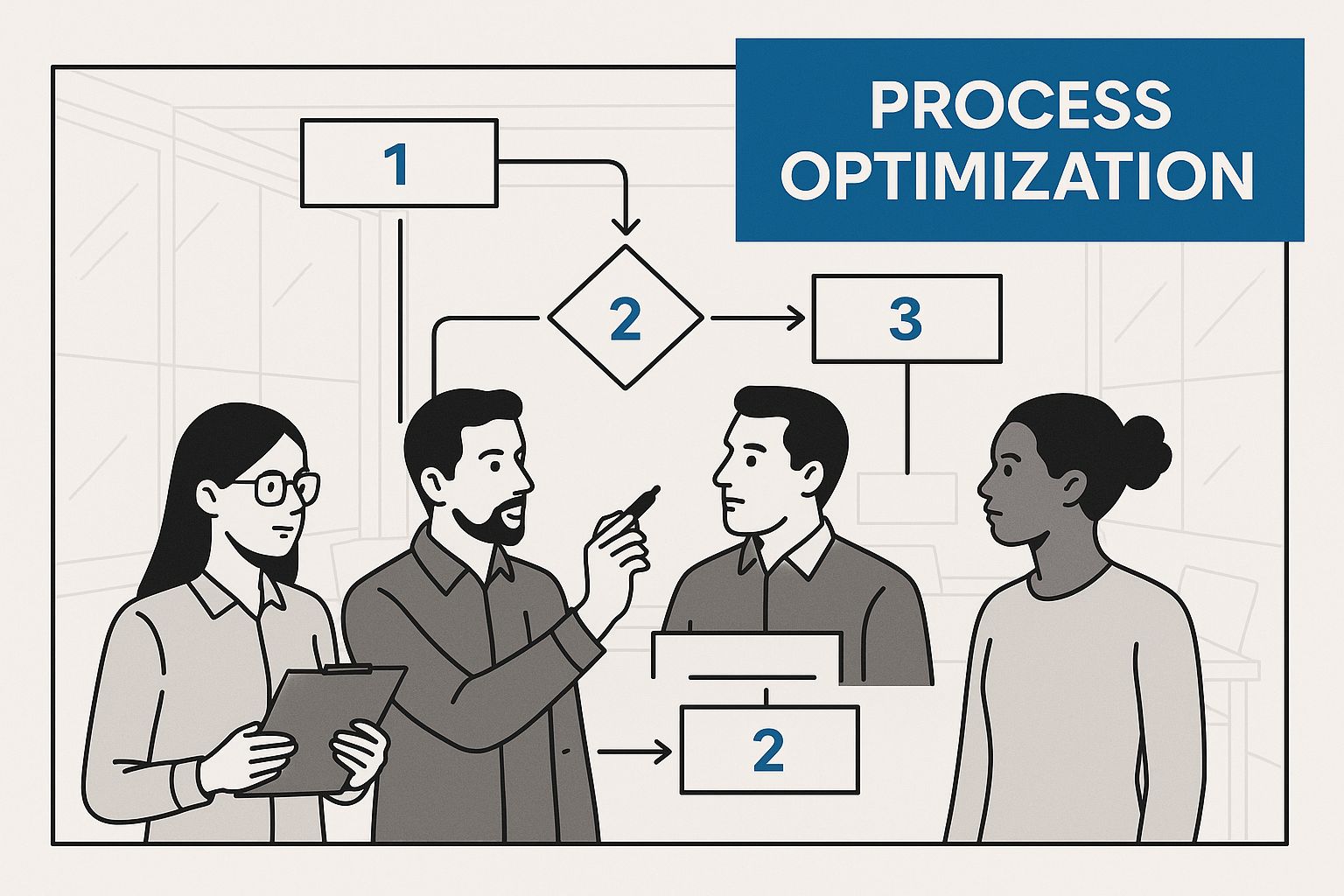
The objective is to map every step to identify and eliminate bottlenecks. This is the foundational work of any meaningful process improvement initiative. Let us examine several critical areas where inefficiencies commonly arise and where a data-driven approach yields substantial returns.
The Loan Origination Lifecycle
From application to funding, loan origination is a primary revenue driver and a significant source of operational friction. A cumbersome, slow process not only frustrates clients but also actively damages the bottom line. Understanding the principles of business process optimization is essential for gaining a competitive edge.
Consider a commercial loan application delayed for 48 hours in underwriting due to manual data verification. For a $500 million portfolio with an average loan size of $250,000, that single delay impacts 2,000 loans. This accumulated lag postpones interest income and creates an opening for more agile competitors.
The key metric is not just "time to close" but the velocity at which an application moves between stages. Data intelligence from tools like Visbanking allows you to compare your velocity against peer institutions, revealing in hard numbers whether your underwriting process is a competitive asset or a liability.
Account Opening and Onboarding
The initial client interaction sets the tone for the entire relationship. A modern onboarding experience must balance speed with stringent compliance. The legacy approach—requiring extensive paperwork and multiple branch visits—creates friction and increases abandonment risk.
If your onboarding process requires more than one physical visit or exceeds 24 hours for completion, you are already behind. This signals to high-value clients that your institution operates on an outdated timeline.
The metrics that matter are application abandonment rates and time to first transaction. A high abandonment rate is a clear indicator of a broken process. By analyzing the data, you can pinpoint the exact stage where clients disengage—such as a cumbersome identity verification step—and implement a targeted fix.
Payment Processing and Treasury Management
This is the circulatory system of the bank, handling every ACH, wire, and internal transfer. Here, efficiency is measured in milliseconds and basis points. Any error or delay can result in immediate financial loss, reputational damage, and regulatory scrutiny.
- Straight-Through Processing (STP) Rate: What percentage of payments are processed without manual intervention? An STP rate below 95% indicates a reliance on manual overrides, which are both costly and prone to error.
- Transaction Settlement Time: How long does it take for funds to settle and become available? In an economy moving toward real-time payments, any delay is a competitive disadvantage.
Optimizing these core processes is no longer an exercise in guesswork. It requires precise, comparative data that reveals exactly where you stand. By analyzing these critical workflows, you can identify the most significant opportunities for improvement and transform your operations from a cost center into a growth engine.
Pinpointing and Quantifying Operational Drag

Operational drag is the silent antagonist of profitability. It is the cumulative cost of process friction, legacy systems, and the increasing burden of compliance. While it does not appear as a line item on the balance sheet, its effects are felt in inflated expenses, missed revenue opportunities, and diminished shareholder returns.
This drag accumulates in predictable areas: fragmented data silos that impede informed decision-making and manual compliance checks that drive up labor costs while increasing the risk of human error. To combat it, you must first measure it.
From Vague Problems to Quantifiable Costs
Vague statements like "our branch network seems inefficient" are operationally useless. They represent a sentiment, not a diagnosis. A data-driven approach provides clarity and a defined path for action.
Consider a bank with an overstaffed branch network where foot traffic has steadily declined. This is not a minor issue; it is a direct drain on profitability. Data analysis might reveal that this excess capacity is inflating non-interest expense by 5-8%, severely damaging the bank's efficiency ratio compared to its peers.
The "sentiment" is now a quantifiable, multi-million-dollar problem that demands a strategic response. This is the essence of modern operations management.
A significant component of this drag is operational risk—the potential for losses resulting from inadequate or failed internal processes, people, and systems. As banks accelerate their digital transformation, this risk profile evolves. Technology failures and cyber threats now pose as significant a threat as traditional fraud. The annual banking operational risk loss data report from ORX provides valuable insights into current trends.
Where to Focus Your Search for Drag
Identifying operational drag requires granular analysis and comparative benchmarking. This is where data intelligence platforms like Visbanking become indispensable, providing the means to move from high-level assumptions to a precise diagnosis by benchmarking your key functions against peer institutions.
The objective is to isolate the specific processes that cost more and deliver less than those of your competitors. An efficiency ratio is a result; the underlying process metrics are the cause.
Begin your search in these critical areas:
- Excessive Manual Interventions: Quantify the number of processes, such as loan approvals or compliance reviews, that require manual intervention. A high rate is a definitive indicator of broken workflows and inflated labor costs.
- Technology Gaps: Analyze the allocation of your IT budget. If "run-the-business" maintenance costs for legacy systems consume more than 70% of your budget, you are systematically starving innovation.
- Siloed Decision-Making: Measure the time required to compile data for a critical executive report. If the answer is "days," it indicates the absence of a single source of truth, leading to wasted time and suboptimal decisions.
By tying these issues to hard numbers, you build an undeniable case for strategic change. You can further explore strategies for enhancing your bank's performance and achieving greater operational efficiency in banking. This is the first step in transforming your operations from a liability into a true competitive advantage.
The Technology Mandate in Modern Banking
Strategic technology investment is no longer optional for financial institutions; it is a mandate for survival. The systems underpinning daily operations are being fundamentally rewired, forcing a strategic shift from merely "running the business" to actively "changing the business."
This requires a rigorous examination of capital allocation. It is about moving beyond maintenance of legacy systems to making deliberate, high-ROI investments in automation, AI, and core modernization.
This spending shift is paramount. Banks are projected to spend US$176 billion on IT in 2025. However, a significant portion of this expenditure remains allocated to supporting aging, inefficient legacy systems. Analysis reveals that only 39% of this budget is dedicated to 'change-the-business' initiatives that improve services and drive efficiency. You can review the full global banking outlook for a complete breakdown. This represents a major vulnerability for any institution not aggressively pursuing core modernization.
From Cost Center to Competitive Weapon
The transformative power of technology is most profound not in customer-facing applications, but in the back office. The most significant gains—those that directly impact the bottom line—are realized by optimizing internal processes. Investing in a sleek mobile interface while the core transaction processing engine remains antiquated is a strategic error.
Consider these practical applications:
- Loan Underwriting: An AI-driven analytics engine can reduce underwriting time from days to hours by automating data verification and risk modeling. This not only accelerates the process but also accelerates revenue recognition.
- Compliance Monitoring: Routine transaction monitoring is a manual, labor-intensive task. Robotic Process Automation (RPA) can automate up to 90% of these reviews, reducing costs and freeing highly skilled analysts to focus on complex, high-risk investigations. Our analysis on regulatory compliance for banks details these applications.
Leading institutions are integrating technology directly into their regulatory frameworks, using tools like compliance process automation to build a more resilient and efficient operational foundation.
Focusing technology investments on the back office is not about cutting costs—it's about building capacity. Every automated process frees up human capital to focus on strategic growth, complex problem-solving, and high-value client relationships.
Legacy Processes vs Modernized Operations
The distinction between legacy and modernized operations is not incremental; it is transformative. Investing in modern, integrated systems creates a cascading effect of efficiency across the entire organization.
The following table illustrates the measurable impact of this transformation:
| Operational Process | Legacy Approach (Manual/Siloed) | Modernized Approach (Automated/Integrated) | Measurable Performance Gain |
|---|---|---|---|
| Loan Origination | Manual data entry, paper-based document review, siloed department approvals. | Automated data verification, digital document management, integrated workflow approvals. | 50-70% reduction in processing time. |
| Compliance Monitoring | Manual review of transaction logs by analysts, high rate of false positives. | AI-powered monitoring flags suspicious activity in real-time with high accuracy. | 90% reduction in manual review effort. |
| Customer Onboarding | Multiple forms, in-person verification, slow account activation. | Digital identity verification, single-application process, instant account opening. | 85% faster customer onboarding. |
| Reporting & Analytics | Data pulled from separate systems, compiled manually in spreadsheets. | Centralized data platform with automated dashboards and predictive insights. | 95% reduction in time to generate reports. |
This is not merely about executing the same tasks faster. It is about fundamentally elevating the capabilities of your operations team, enhancing the client experience, and improving financial performance.
Data as the Compass for Investment
Determining where to allocate capital—a new core system, an AI platform, or automation tools—cannot be based on intuition. These decisions require a data-driven framework that benchmarks your operational performance against relevant peers.
Technology provides the tools for operational excellence, but data intelligence platforms provide the compass to direct those tools effectively.
Using a system like Visbanking, you can benchmark critical metrics—such as cost-per-transaction or loan processing velocity—against the competition. This provides an objective, external perspective, allowing you to direct your technology budget precisely where it will deliver the maximum return on investment.
Using Data Intelligence for Decisive Action
Instinct and experience are valuable, but in today's market, they must be validated by data. This is non-negotiable for leading a high-performance banking operation. The insights gained from analyzing processes and technology are only valuable if they lead to decisive, profitable action. This is where advanced analytics transitions from a theoretical concept to a strategic tool that transforms operations from a reactive cost center into a proactive driver of value.
Raw data is noise. The objective is to convert that noise into clear signals that direct executive attention to areas of maximum impact. This empowers leadership to act with precision, armed with objective, comparative intelligence.
From Observation to Actionable Insight
Effective decision-making requires context. Knowing your average loan processing time is 15 days is an observation. Discovering it is five days slower than your direct peer group average is a call to action. This comparative context is what separates passive monitoring from strategic intervention.
Consider this scenario: an executive suspects a specific branch is underperforming. Historically, this would initiate a protracted, manual review. With a modern data intelligence platform, the analysis is immediate.
Example: You observe a branch’s operational cost-per-transaction is $4.75. Benchmarking this against the statewide average for branches of a similar size and deposit base reveals a peer average of $3.50. That 36% negative variance quantifies the problem, translating to an annual operational overspend of $250,000 for that single location. The conversation shifts instantly from, "Is there a problem?" to "How do we execute a solution?"
This level of granularity enables surgical interventions—such as targeted staff training or a specific process redesign—rather than deploying broad, inefficient changes.
Uncovering Systemic Friction Points
Data intelligence excels at identifying systemic issues that are invisible from within departmental silos. When information is fragmented, it is easy to miss the cross-functional bottlenecks that degrade institutional performance. A comprehensive platform connects disparate data points to reveal the true sources of friction.
For example, an analysis of the commercial loan pipeline reveals a persistent delay. By examining data at each stage, executives can pinpoint the precise cause of the logjam.
- Initial Diagnosis: The commercial loan portfolio's average "time-to-close" has increased by 10% over the last two quarters.
- Data-Driven Investigation: A deeper analysis shows that 70% of applications are stalled for more than five days at the "final credit review" stage.
- Actionable Conclusion: The issue is not the entire process but a specific capacity constraint or workflow inefficiency within the credit review team. This points toward a focused solution, such as reallocating resources or automating specific compliance checks.
This approach prevents wasted capital and ensures that resources are directed where they will deliver the highest return. You can gain further insights into these strategies by exploring the essentials of banking data analytics.
Clean, contextualized data empowers executives to act with confidence. It replaces ambiguity with certainty and enables the implementation of precise, ROI-driven solutions that strengthen the bank's operational core.
Ready to Build Your Bank's High-Performance Roadmap?
Achieving operational excellence is not about a new initiative or checklist. It requires a disciplined, data-first strategy to build a framework for sustainable high performance. This is a roadmap to measurable, bottom-line results.
The process is methodical and phased, with a relentless focus on quantifiable outcomes. It begins with an objective assessment of your current state.
Phase 1: Establish Your Baseline
You cannot improve what you do not measure. The first step is to obtain a clear, unbiased picture of your operational performance. This means moving beyond internal assumptions and benchmarking key metrics against your direct competitors.
A data intelligence platform like Visbanking is essential for this phase. It provides the external context needed to understand your true competitive position. For example, while you may perceive your overhead as high, Visbanking can reveal that your non-interest expense per employee is 15% higher than the peer average for banks of your specific asset size and business model. A vague concern is instantly transformed into a quantifiable, actionable target.
Phase 2: Isolate High-Impact Opportunities
With a clear baseline established, identify the top two or three areas that offer the greatest return on investment. The common temptation is to address all issues simultaneously; this is a mistake. Focus is critical. Allow the data to guide you to the functions where operational drag is most severe and the potential ROI is highest.
Common high-impact areas include:
- Loan Processing Velocity: A 20% reduction in the "underwriting to approval" stage alone can translate into millions in accelerated interest income.
- Branch Network Efficiency: Analyze cost-per-transaction and employee productivity at each location. Identifying the bottom quartile of performers reveals precisely where profitability is being eroded.
- Compliance Process Costs: Quantify the man-hours and system expenses associated with routine regulatory tasks. An outsized figure in this area often signals a prime opportunity for automation.
Phase 3: Define Goals and Pilot Solutions
With targets identified, set specific, measurable goals. "Improve loan processing speed" is an aspiration, not a goal. "Reduce average commercial loan processing time from 22 days to 18 days within six months" is a goal that creates accountability.
With a clear objective, implement focused pilot projects. Test proposed solutions on a small scale to validate their effectiveness before committing to a full-scale rollout. This mitigates risk and provides real-world data on performance. For example, deploying a new workflow automation tool in a single department allows you to measure its impact before a bank-wide implementation.
Operational excellence is not a project; it is a continuous discipline. This roadmap provides the structure to convert raw data into decisive action, building a more efficient, resilient, and profitable institution.
True operational command begins with clarity. Visbanking delivers the peer-based intelligence and granular data bank executives need to identify opportunities, act with confidence, and build a definitive high-performance roadmap. Explore the data and start building yours today.
Latest Articles
Brian's Banking Blog
Understanding Statistical Significance in Banking
Brian's Banking Blog
Option Adjusted Spread: A Banker's Practical Framework
Brian's Banking Blog
How to Improve Margins: A Bank Leader's Playbook

Brian's Banking Blog
Automated Alerts and Notifications for Banks
Brian's Banking Blog
Customer Feedback Loop for Banks: A Practical Playbook

Brian's Banking Blog