
10 Data-Driven Marketing Strategies for Banks in 2025
Brian's Banking Blog
In the current economic climate, marked by compressed net interest margins and heightened competition, the traditional drivers of bank profitability are under unprecedented pressure. Bank executives and directors can no longer rely solely on operational efficiency or favorable rate environments to secure growth. The new mandate is clear: deploy sophisticated, data-driven marketing strategies for banks that not only attract but also retain high-value customers. This isn't about more marketing; it's about smarter, more precise marketing.
The core challenge is transforming raw institutional and market data into a decisive competitive advantage. For instance, a community bank might see its deposit growth stagnate at 1.5% while a peer across town achieves 4% growth. The difference is rarely luck; it's a superior strategy informed by granular data on product appeal, customer demographics, and competitor performance. Simply launching a generic digital campaign is insufficient. Winning requires a deep understanding of which channels deliver the best return on ad spend (ROAS) for specific products, like high-yield savings accounts or small business loans.
The following strategies represent a definitive roadmap for institutions ready to move beyond reactive measures and proactively capture market share. Each is grounded in the principle that superior performance is a direct result of superior intelligence.
We will explore ten proven approaches, from hyper-local community engagement to advanced data personalization. Crucially, we will demonstrate how robust bank intelligence platforms like Visbanking provide the necessary performance data and peer benchmarks to turn these strategic plans into measurable, profitable outcomes. This guide provides the tactical framework to not just compete, but to lead.
1. Digital-First Customer Experience
A digital-first customer experience is no longer an alternative channel; it is the primary battleground for customer acquisition and retention. This strategy involves architecting the entire customer journey around seamless, intuitive digital interactions, relegating physical branches to a supporting role for specialized, high-value consultations. It's about more than just a functional app; it's a fundamental shift in operations, culture, and one of the most critical marketing strategies for banks today.
Leading institutions like JPMorgan Chase, with its 50 million+ active mobile users, and Bank of America, whose AI assistant Erica handles millions of queries, prove the model's success. These banks treat their digital platforms as core products, investing heavily in user experience (UX) research, agile development, and robust cybersecurity to create frictionless environments that meet nearly all day-to-day banking needs. The goal is to make digital interaction so efficient and satisfying that a branch visit becomes the exception, not the rule.
How to Implement a Digital-First Strategy
Successfully pivoting to a digital-first model requires a clear, data-driven plan. Focus on these key actions:
- Invest in a Scalable Tech Stack: Your core infrastructure must support seamless integration between mobile, online, and ATM channels. Prioritize robust APIs and a cloud-native architecture.
- Conduct Rigorous UX Testing: Regularly gather user feedback through A/B testing, heatmaps, and direct surveys. Use this data to eliminate friction points in common user journeys like fund transfers or new account openings.
- Prioritize Security from Day One: A data breach can instantly erase customer trust. Embed multi-factor authentication, biometric logins, and real-time fraud monitoring deep within your platform's architecture.
- Maintain Human Support: Digital excellence doesn't mean eliminating human contact. Ensure customers can easily connect with a knowledgeable support agent for complex issues that self-service channels cannot resolve.
This infographic summarizes the primary business benefits realized from a successful digital-first transformation.
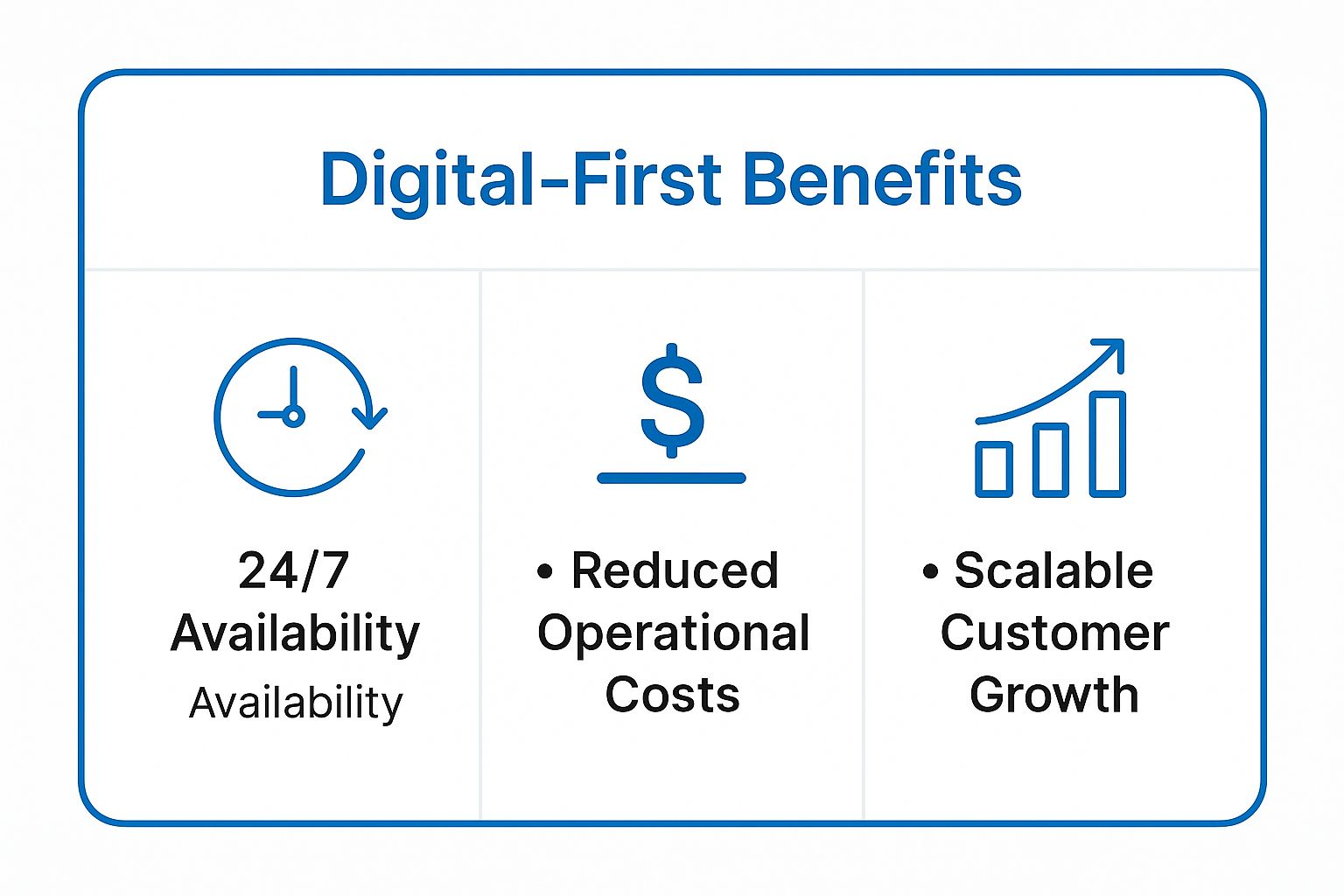
These core benefits create a powerful competitive advantage, enabling banks to serve more customers with greater efficiency and precision. A well-executed approach is essential for any institution looking to thrive. For a deeper analysis of this approach, explore this guide on a bank's digital strategy on visbanking.com.
2. Community-Based Marketing
Community-based marketing is a grassroots strategy that moves beyond transactional relationships to embed a bank within the very fabric of the localities it serves. This approach focuses on building deep-rooted trust and loyalty through active participation, meaningful sponsorships, and genuine partnerships. It positions the bank not merely as a financial institution but as a committed partner in the community's economic and social prosperity, making it one of the most durable marketing strategies for banks.

Institutions like Umpqua Bank, with its community-centric store concepts, and First National Bank of Omaha, known for its extensive local sports sponsorships, exemplify this strategy. They understand that today's consumers, particularly in an environment of digital impersonality, crave authenticity and local connection. This strategy generates powerful word-of-mouth marketing and creates a "hometown bank" perception that national giants struggle to replicate, fostering a resilient customer base that values shared community success over marginal rate differences.
How to Implement a Community-Based Strategy
Executing an effective community-based strategy requires authenticity and a long-term commitment, not just a marketing budget. Focus on these core actions:
- Identify and Empower Community Ambassadors: Train branch managers and staff to be active participants in local life. Encourage them to join civic groups, volunteer for local causes, and serve as the face of the bank in their neighborhoods.
- Align Sponsorships with Bank Values: Instead of generic sponsorships, choose partnerships that reflect your institution's core mission. This could mean sponsoring financial literacy workshops in schools or funding a local entrepreneurship incubator.
- Build Authentic Relationships: Move beyond just writing checks. Identify key community leaders, small business owners, and non-profit directors, and build genuine, long-term relationships with them. To delve deeper into the foundational aspects of creating a community-centric approach, even from an organizational perspective, see this guide on Building an Agency Around a Community.
- Measure Impact Beyond ROI: Track success through community feedback, local media sentiment, and employee engagement metrics. Use this qualitative data to refine your approach and demonstrate your bank's positive local impact.
A genuine community focus strengthens brand loyalty and provides a competitive moat that is difficult for larger, less-connected competitors to cross. Understanding the role of community banking is critical to this approach. For a deeper look at this dynamic, you can explore the pivotal role of community banking in local economies on visbanking.com.
3. Data-Driven Personalization
Data-driven personalization has evolved beyond targeted emails into a sophisticated marketing strategy for banks. It leverages customer data analytics, artificial intelligence, and machine learning to deliver banking experiences tailored to the individual. This approach dissects transactional data, behavioral patterns, and life stage indicators to proactively offer relevant products, advice, and communications, transforming the bank from a passive service provider into an indispensable financial partner.
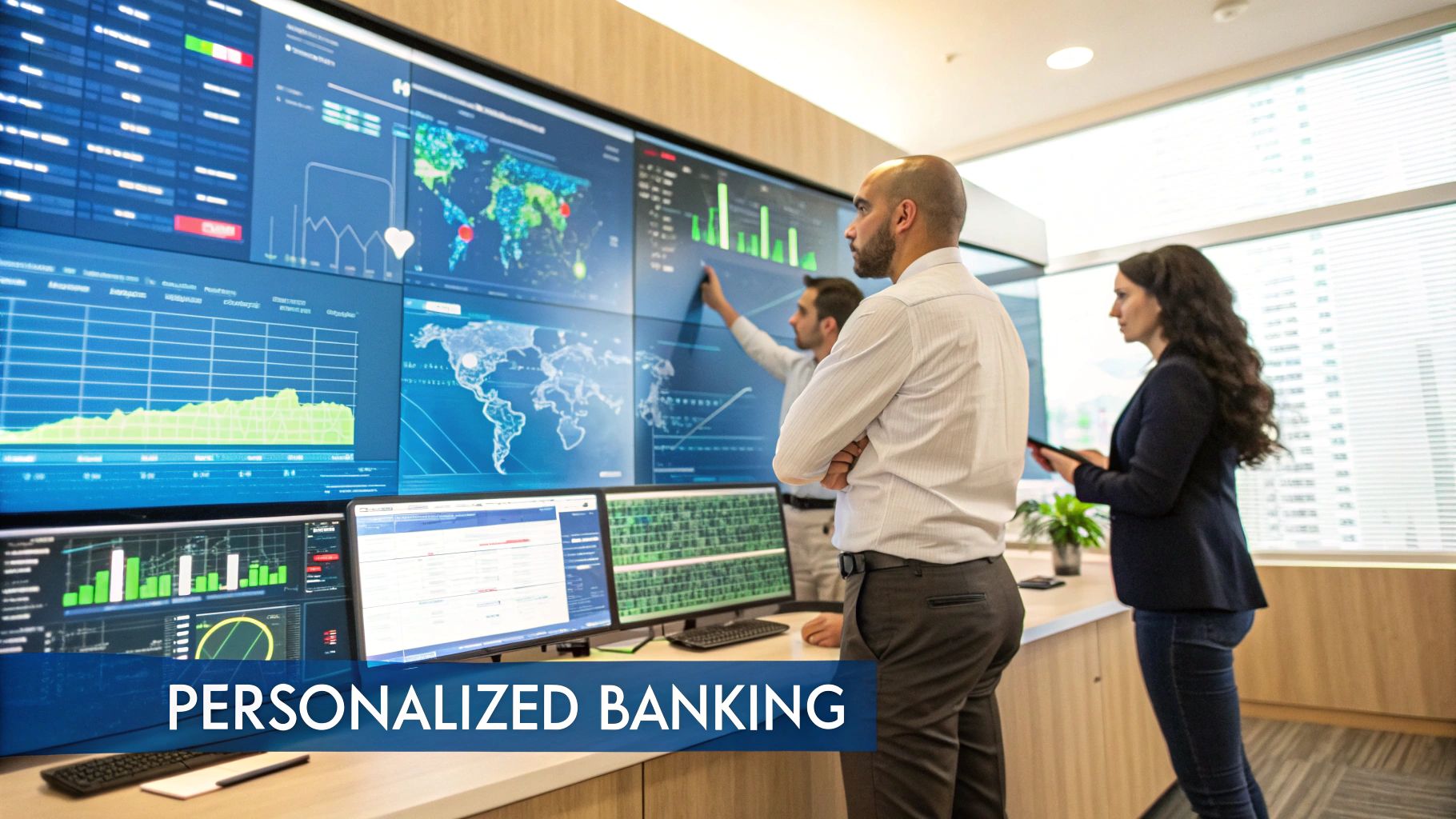
Pioneers like American Express and Capital One set the standard, using analytics to create highly targeted rewards and credit offers. Today, institutions like Wells Fargo apply predictive models to identify customers likely to need a mortgage, while HSBC uses AI to customize its app interface for millions of users. The goal is to anticipate customer needs, such as offering a small business loan to a customer whose transactions show startup-like activity, before the customer even begins their search. This level of foresight is a powerful competitive differentiator.
How to Implement Data-Driven Personalization
Effective personalization requires a robust framework built on data integrity and strategic execution. A disciplined approach is critical for success.
- Establish Strong Data Governance: Before launching any initiative, implement clear data governance and privacy policies. Ensure full compliance with regulations like GDPR and CCPA to build and maintain customer trust, which is the foundation of personalization.
- Invest in Data Quality and Integration: Your personalization engine is only as good as the data it ingests. Prioritize processes for data cleansing, standardization, and integration across silos like deposits, loans, and wealth management to create a single, accurate customer view.
- Train Staff on Data Interpretation: Equip your client-facing teams with the tools and training to understand and act on data-driven insights. An algorithm may flag a customer for a wealth management conversation, but it's the trained advisor who must execute it effectively.
- Audit Algorithms for Bias and Accuracy: Regularly review your machine learning models to ensure they are performing as expected and are free from unintentional biases. This protects both your customers and your institution's reputation.
By turning raw data into actionable intelligence, banks can forge deeper, more profitable customer relationships. To better understand the mechanics, explore this overview of predictive analytics in banking on visbanking.com.
4. Financial Education and Content Marketing
Shifting from a transactional relationship to an advisory one is a powerful move in today's crowded market. Financial education as a content marketing strategy positions your bank as a trusted authority, not just a service provider. This approach involves creating and distributing valuable, non-promotional content that addresses the real financial questions and pain points of your target audience, from managing debt to planning for retirement. It is one of the most effective long-term marketing strategies for banks looking to build deep, lasting customer loyalty.
Industry leaders demonstrate the power of this model. Bank of America’s Better Money Habits platform, in partnership with Khan Academy, provides accessible videos and tools on complex financial topics. Similarly, Chase's Financial Education Center offers comprehensive guides on everything from homeownership to investing. These institutions understand that an educated customer is a more confident, engaged, and ultimately more valuable customer. By providing guidance, they build trust and top-of-mind awareness for when a customer is ready to make a financial decision.
How to Implement a Financial Education Strategy
A successful content program requires a commitment to genuine value creation, not just thinly veiled product pitches. Focus on these core actions:
- Address Real Customer Pain Points: Use search data, customer service logs, and surveys to identify the most pressing financial questions your customers have. Create content that directly answers them, such as a comprehensive guide to Certificate of Deposit basics for those seeking secure savings options.
- Use Diverse Content Formats: Cater to different learning styles by producing articles, videos, webinars, interactive calculators, and podcasts. This multi-format approach broadens your reach and reinforces key messages across various channels.
- Optimize Content for Search Engines (SEO): Ensure your valuable resources are discoverable. Research and integrate relevant keywords like "how to build credit" or "first-time home buyer tips" to attract organic traffic from individuals actively seeking financial guidance.
- Track Engagement and Measure ROI: Monitor metrics like time on page, download rates, and lead generation from content. Use this data to refine your content strategy, doubling down on topics and formats that resonate most with your audience and drive measurable business outcomes.
5. Partnership and Co-Marketing Strategies
In an increasingly interconnected ecosystem, banks no longer operate in isolation. A powerful marketing strategy involves forging strategic partnerships with non-competing businesses, fintech innovators, or service providers to create mutually beneficial outcomes. This collaborative approach allows banks to embed their services into other customer journeys, acquire new customers at a lower cost, and offer value-added products that would be too costly or slow to develop in-house.
The success of this model is clearly demonstrated by high-profile collaborations like Goldman Sachs' partnership with Apple to launch the Apple Card or JPMorgan Chase's work with Amazon to streamline business lending. These alliances are not just marketing campaigns; they are deep, product-level integrations that leverage the partner's brand equity and vast user base. By tapping into these established networks, banks can dramatically expand their reach and present their offerings to customers at the exact moment of need, a core tenet of modern marketing strategies for banks.
How to Implement Partnership and Co-Marketing Strategies
Executing a successful partnership requires more than a handshake; it demands strategic alignment, technical readiness, and clear governance.
- Identify Synergistic Partners: Use market analysis to find companies whose customer base aligns with your target demographic but who are not direct competitors. A community bank might partner with local real estate agencies, while a larger institution could partner with a national retail chain.
- Define Clear Objectives and KPIs: Establish what success looks like from the outset. Key metrics could include the number of new accounts opened, loan volume generated, or customer acquisition cost (CAC) reduction. These goals must be shared and tracked transparently.
- Ensure Technical and Compliance Readiness: Before committing, rigorously assess the technical feasibility of integrating systems. Your core banking platform and APIs must be able to communicate securely and efficiently with the partner's technology. Equally important is ensuring the partnership structure complies with all banking regulations.
- Structure a Detailed Agreement: The partnership agreement should explicitly define roles, responsibilities, revenue-sharing models, data-sharing protocols, and a clear exit strategy. This legal framework prevents future disputes and protects both parties' interests.
6. Social media and Influencer Marketing
Social media and influencer marketing represent a strategic shift from broad, impersonal advertising to targeted, community-centric engagement. This approach leverages social platforms and trusted personalities to build brand affinity, educate consumers, and drive consideration for banking services. It moves beyond simple promotion, focusing on authentic dialogue and value delivery to forge genuine connections with key audience segments.
Institutions like Ally Bank have demonstrated mastery in this domain, using witty and responsive Twitter engagement to personify their brand and build a loyal following. Similarly, Charles Schwab utilizes LinkedIn for sophisticated educational content that positions them as thought leaders in wealth management. This strategy is effective because it meets customers where they are, using a conversational tone to demystify complex financial topics and build trust organically, making it one of the most resonant marketing strategies for banks in the digital age.
How to Implement a Social Media and Influencer Strategy
A successful social media presence requires more than just creating accounts; it demands a clear strategy rooted in compliance, value, and authenticity.
- Establish Clear Compliance Guardrails: Before launching any campaign, work closely with legal and compliance teams to create a robust social media policy. This should cover everything from employee advocacy and response protocols to FINRA and FFIEC guidelines for advertising and record-keeping.
- Prioritize Education Over Sales: Frame your content around solving customer problems and providing financial literacy. This builds credibility and trust, making customers more receptive when you do introduce a product or service. The goal is to be a resource, not just a vendor.
- Engage Authentically and Promptly: Social media is a two-way conversation. Use social listening tools to monitor brand mentions and industry trends. Respond to comments and questions swiftly and transparently, turning your channels into a valuable customer service and engagement hub.
- Leverage Micro-Influencers for Niche Audiences: Partnering with niche financial influencers (5,000-50,000 followers) often yields higher engagement and a better ROI than celebrity endorsements. Their followers see them as relatable peers, making their recommendations more trustworthy and effective for specific products like high-yield savings accounts or small business loans.
7. Mobile-First Marketing and App-Based Engagement
A mobile-first strategy goes beyond having a functional app; it positions the mobile device as the central hub for all customer interaction, marketing, and service delivery. This approach acknowledges that the smartphone is the primary tool customers use to manage their financial lives. Effective mobile-first marketing for banks involves creating a seamless, personalized, and highly engaging app ecosystem that drives loyalty and unlocks new revenue streams.
Institutions like Bank of America, with its nearly 40 million active mobile users, demonstrate the power of this model. Their app integrates personalized spending insights, AI-driven assistance, and seamless transaction capabilities. Similarly, Chase Bank uses its mobile platform to deliver tailored offers and spending summaries, turning a simple banking app into a powerful financial wellness tool. These leaders treat their app not as a support channel, but as a core product, which is a critical distinction in modern banking.
How to Implement a Mobile-First Marketing Strategy
Executing a successful mobile-first strategy requires a deep understanding of user behavior and a commitment to continuous optimization. Focus on these core actions:
- Segment Users by Mobile Behavior: Utilize app analytics to understand how different customer segments interact with your platform. Group users by feature usage, session frequency, and transaction types to deliver hyper-relevant push notifications and in-app offers.
- Time Push Notifications for Peak Engagement: Avoid notification fatigue by sending messages at optimal times based on user data. A message about a low balance is more impactful in the morning, while a promotional offer for a credit card might perform better in the evening.
- Prioritize Performance and Simplicity: Your app must be fast, intuitive, and reliable across all major devices and operating systems. Rigorously test performance to eliminate crashes and latency, ensuring a frictionless user experience that builds trust.
- Make Engagement Actionable: Every mobile interaction should have a clear purpose. Design messages to be concise and drive a specific action, whether it's setting a savings goal, reviewing a transaction, or applying for a pre-approved loan with a single tap.
8. Customer Referral and Loyalty Programs
A referral and loyalty program is a dual-engine strategy designed to leverage your most valuable asset: your existing satisfied customers. This approach systematically encourages word-of-mouth marketing by incentivizing current clients to become brand ambassadors, while simultaneously rewarding their long-term loyalty. It’s one of the most cost-effective marketing strategies for banks, transforming customer retention into a powerful acquisition channel and directly increasing customer lifetime value (LTV).
Leading institutions have perfected this model. For instance, Capital One and Chase Bank have built robust referral programs for their credit card products, offering statement credits or bonus points to both the referrer and the new customer. Ally Bank provides a direct cash bonus for successful referrals, making the value proposition clear and immediate. These programs succeed because they create a tangible win-win scenario, turning passive satisfaction into active advocacy and driving high-quality, low-cost customer acquisition.
How to Implement a Referral and Loyalty Program
An effective program must be frictionless for the customer and measurable for the bank. A data-centric approach is essential for tracking performance and optimizing incentives.
- Make Referrals Effortless: The referral process must be simple and integrated directly into your digital banking platforms. A customer should be able to generate and share a unique referral link in just a few taps within the mobile app.
- Offer Compelling, Mutual Incentives: The reward must be valuable enough to motivate action. Critically, rewarding both the referrer and the referee significantly increases conversion rates. Test different incentives, such as cash bonuses, reward points, or premium service fee waivers.
- Track Referral Quality, Not Just Quantity: Monitor the behavior and profitability of referred customers. Are they high-value clients or low-balance accounts? Use this data to refine targeting and incentives, ensuring the program delivers a strong return on investment.
- Promote the Program Across All Channels: Market your referral program actively through email, in-app notifications, ATM screens, and even in-branch signage. Your customers can't participate in a program they don't know exists.
These initiatives weaponize customer loyalty, turning it into a predictable growth driver. By analyzing the acquisition costs and LTV of referred customers versus those acquired through other channels, executives can precisely quantify the program's ROI and make informed decisions on budget allocation.
9. Targeted Direct Mail and Multichannel Campaigns
In a digitally saturated world, a well-executed physical mailer can cut through the noise and capture high-value attention. This strategy moves beyond generic mailings by integrating sophisticated data analytics to combine personalized direct mail with coordinated digital touchpoints. It leverages customer data to deliver highly relevant offers, creating a cohesive, multichannel campaign that respects customer preferences and significantly boosts response rates.
This approach remains a cornerstone for customer acquisition in specific segments. For example, Discover has famously mastered data-driven direct mail to acquire credit card customers, using precise targeting to offer pre-approved lines of credit. Similarly, Wells Fargo has used this method for mortgage refinancing campaigns, reaching existing homeowners with compelling, timely offers based on property and loan data. This blend of physical and digital is one of the most resilient marketing strategies for banks targeting specific, high-value demographics.
How to Implement a Targeted Multichannel Campaign
A successful campaign requires precise coordination between data, creative, and channel execution. Focus on these key actions:
- Use Variable Data Printing (VDP): Go beyond just using a recipient's name. Personalize the offer, interest rates, or credit lines based on detailed customer data segments. VDP allows each mail piece to be unique to its recipient.
- Integrate Digital and Physical Timing: Launch digital ads on social media and search platforms simultaneously with the mail drop. Use QR codes on the mailer to drive traffic to a personalized landing page, seamlessly bridging the physical-to-digital gap.
- Test and Optimize Relentlessly: A/B test every variable: the envelope, the offer, the call-to-action (CTA), and the creative format. A small lift in response rate, from 1.5% to 2.0%, can translate into millions in new business when scaled.
- Provide Multiple Response Channels: Ensure your CTA is clear and offers multiple paths for response. Include a unique phone number, a QR code, and a personalized URL (PURL) to track which channel is most effective for different customer segments.
10. Thought Leadership and Expert Positioning
In a crowded financial marketplace, thought leadership is not just a content play; it is a fundamental strategy for building institutional trust and authority. This approach positions bank executives and specialists as credible industry experts by leveraging their deep knowledge through research publications, media commentary, and high-profile speaking engagements. It moves marketing beyond product promotion to shaping industry narratives, establishing the bank as an indispensable source of insight.
This strategy is powerfully exemplified by the annual shareholder letters from JPMorgan Chase CEO Jamie Dimon, which are treated as essential reading across global finance. Similarly, Goldman Sachs' highly respected research reports and market analyses directly influence investment decisions and cement its reputation for intellectual rigor. These efforts differentiate the bank not by its services, but by the caliber of its expertise, attracting high-value clients and talent who seek to align with market leaders. This is one of the most sophisticated marketing strategies for banks looking to command influence.
How to Implement a Thought Leadership Strategy
Executing an effective thought leadership program requires a commitment to generating substantive, data-backed insights, not just opinions. Focus on these core actions:
- Identify Unique Areas of Expertise: Pinpoint specific domains where your bank has a distinct analytical edge, whether in niche commercial lending, wealth management for a particular demographic, or regional economic forecasting.
- Develop a Consistent Messaging Platform: Define a clear, defensible point of view on key market trends. Ensure all published content, from white papers to executive interviews, reinforces this core perspective.
- Build Relationships with Key Media: Proactively engage with financial journalists and industry publications. Offer your experts for commentary and provide them with exclusive data to build a reputation as a reliable, go-to source.
- Train and Equip Your Experts: Invest in media and public speaking training for your designated thought leaders. Equip them with the data and talking points needed to communicate complex topics with clarity and confidence.
Using data intelligence platforms like Visbanking can help identify market white space and substantiate your unique perspective with hard numbers, making your thought leadership far more compelling.
Marketing Strategies for Banks: 10-Point Comparison
| Strategy | Implementation Complexity 🔄 | Resource Requirements ⚡ | Expected Outcomes 📊 | Ideal Use Cases 💡 | Key Advantages ⭐ |
|---|---|---|---|---|---|
| Digital-First Customer Experience | High 🔄🔄 | High (tech investment, maintenance) ⚡ | Scalable growth, 24/7 availability 📊 | Banks aiming for digital transformation | Reduced costs, fast transactions, scalability ⭐⭐ |
| Community-Based Marketing | Medium 🔄 | Medium (staff time, community involvement) ⚡ | Strong brand trust, long-term loyalty 📊 | Local banks, rural/region-focused institutions | Emotional connections, authentic stories ⭐ |
| Data-Driven Personalization | High 🔄🔄 | High (advanced analytics, AI/ML tools) ⚡ | Higher conversion, improved satisfaction 📊 | Banks targeting personalized marketing | Superior experience, efficient spend ⭐⭐ |
| Financial Education & Content Marketing | Medium 🔄 | Medium (content creation, expertise) ⚡ | Trusted advisor status, improved literacy 📊 | Banks focusing on customer education | Authority building, SEO benefits ⭐ |
| Partnership & Co-Marketing | Medium-High 🔄🔄 | Medium-High (partner management, legal) ⚡ | Expanded reach, faster innovation 📊 | Banks seeking strategic alliances | Cost sharing, enhanced offerings ⭐ |
| Social Media & Influencer Marketing | Medium 🔄 | Medium (content, compliance, engagement) ⚡ | Brand awareness, customer engagement 📊 | Banks targeting younger/digital audiences | Authentic engagement, viral potential ⭐ |
| Mobile-First Marketing & App Engagement | Medium 🔄 | Medium (app development, push infrastructure) ⚡ | Direct, real-time customer access 📊 | Banks focusing on mobile-centric customers | High open rates, location targeting ⭐ |
| Customer Referral & Loyalty Programs | Low-Medium 🔄 | Medium (program management, rewards) ⚡ | Increased retention, quality leads 📊 | Banks leveraging existing customers | Lower acquisition cost, measurable ROI ⭐ |
| Targeted Direct Mail & Multichannel Campaigns | Medium 🔄 | Medium-High (printing, data integration) ⚡ | Better response rates, multichannel reach 📊 | Banks targeting diverse demographics | Tangible presence, precise targeting ⭐ |
| Thought Leadership & Expert Positioning | Medium-High 🔄🔄 | Medium-High (executive time, content creation) ⚡ | Credibility, high-value connections 📊 | Banks aiming for institutional trust | Credibility, media coverage, networking ⭐ |
From Strategy to Action: The Imperative of Bank Intelligence
The ten marketing strategies for
Latest Articles
Brian's Banking Blog
Understanding Statistical Significance in Banking
Brian's Banking Blog
Option Adjusted Spread: A Banker's Practical Framework
Brian's Banking Blog
How to Improve Margins: A Bank Leader's Playbook
Brian's Banking Blog
Automated Alerts and Notifications for Banks
Brian's Banking Blog
Customer Feedback Loop for Banks: A Practical Playbook
Brian's Banking Blog